
I’ve just returned from BrightonSEO.
I had a fantastic time. I caught up with old friends, made some new ones, spoke to agency staff and owners, and spent plenty of time discussing where our industry is heading.
And something became increasingly obvious.
People are tired of arguing about GEO.
For the last two years, we’ve had an almost ridiculous debate about whether generative engine optimisation is simply SEO with a new name.
We’ve had influencers telling everyone that GEO doesn’t exist. We’ve had endless LinkedIn arguments, plenty of grandstanding, and an awful lot of people confidently explaining why nothing has really changed.
Meanwhile, AI has been changing how people find information, evaluate options and make decisions.
The industry has spent so much time arguing about whether GEO is real that we’ve largely ignored how big the opportunity actually is.
And I think we’re making a monumental mistake.
Because I believe the generative economy will be significantly bigger than the SEO industry ever was.
Not because websites are disappearing.
Not because Google is dying.
And certainly not because SEO has stopped working.
But because we’re entering an economy in which AI increasingly influences human behaviour, and virtually every organisation on the planet has a reason to care about that.
Let me explain.
I just wanted to watch a film on Netflix
On Sunday afternoon, I conducted a rather simple experiment.
I wanted to watch a film on Netflix.
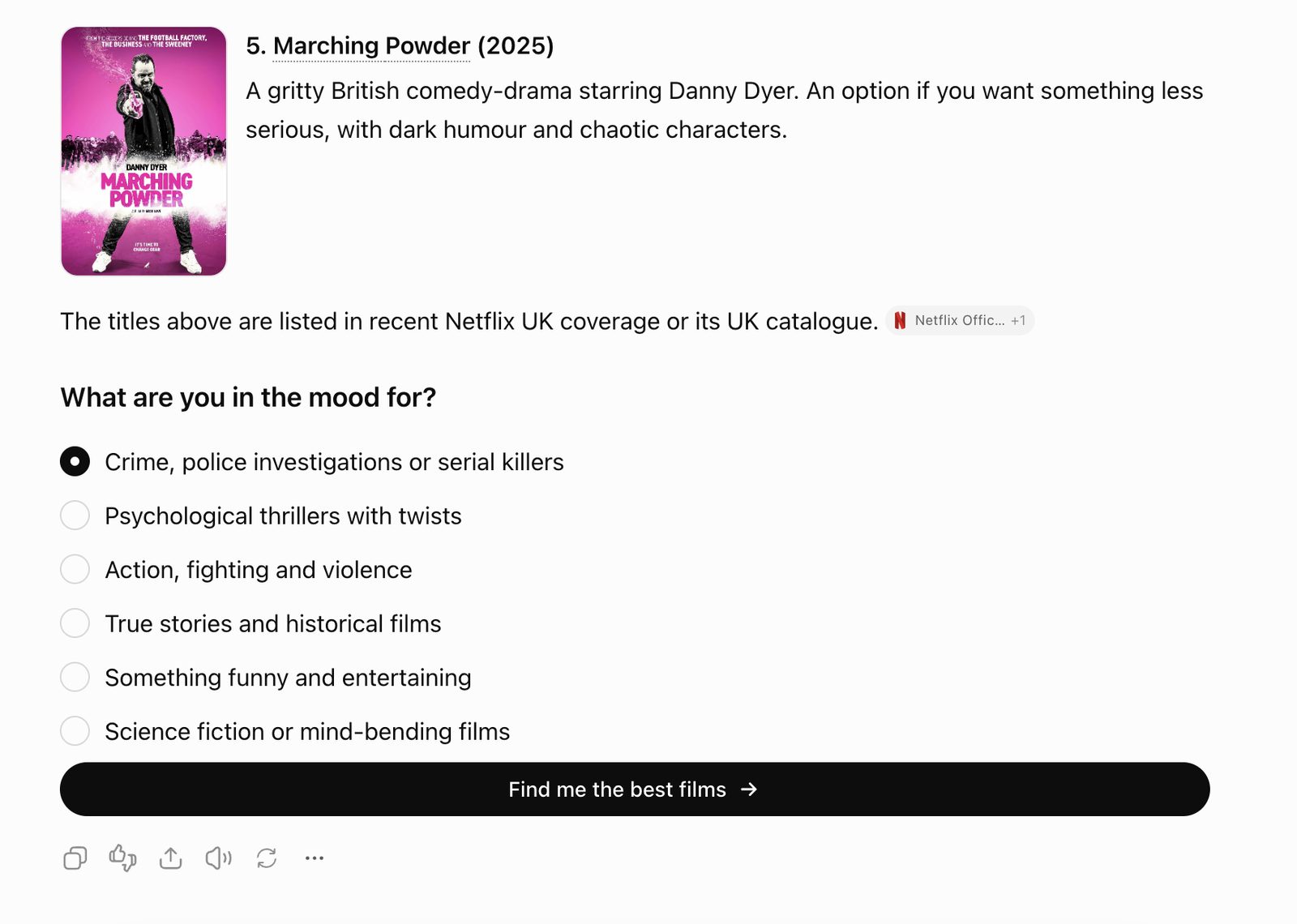
Nothing particularly complicated. I like action films, fighting and a decent amount of violence, so I asked both ChatGPT and Google’s AI Mode to recommend something worth watching.
Both gave me suggestions.
Interestingly, they even recommended some of the same films.
But there was a noticeable difference in how the information was presented.
ChatGPT’s interface was considerably better, thanks to its new ChatGPT 6 UI improvements out this week.
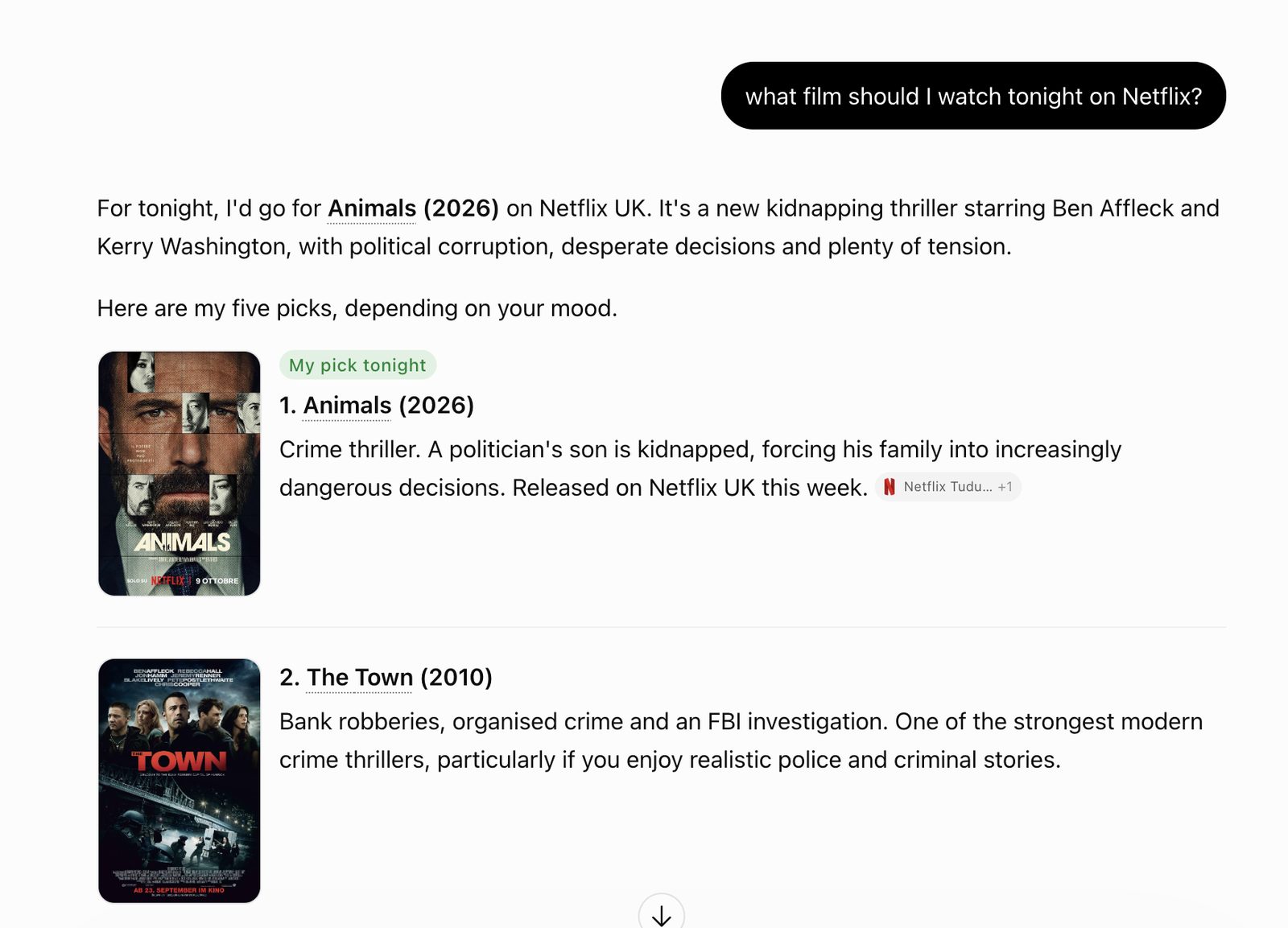
Rather than simply presenting a collection of recommendations, it gave me a more interactive experience. There were options to refine what I wanted, ways to explore other films and a visually engaging set of results.
It felt less like searching for information and more like having someone help me make a decision
Now, this isn’t a scientific study.
It’s one person, two AI products and a question about what to watch on television.
Google’s AI Mode is perfectly capable of sophisticated conversations, and another prompt could produce a different experience.
But the point wasn’t really which system won.
It was what the experience demonstrated.
AI is becoming an increasingly effective interface between humans and decisions.
And that changes the value of being recommended.
Think about Netflix for a moment.
A film studio spends millions producing a blockbuster. Millions more go into promotion, publicity, trailers, interviews, media coverage and getting people excited about the release.
Now imagine thousands of people asking AI what film they should watch tonight.
Which film gets suggested?
Why does one appear while another doesn’t?
What happens when somebody asks for something more specific? And what happens when an AI recommendation is persuasive enough that the person simply goes and watches it?
Suddenly, the information that AI systems encounter about a film becomes commercially important.
That’s GEO.
And we’ve barely scratched the surface.
Now imagine you’re deciding where to raise your family
I took the experiment a little further.
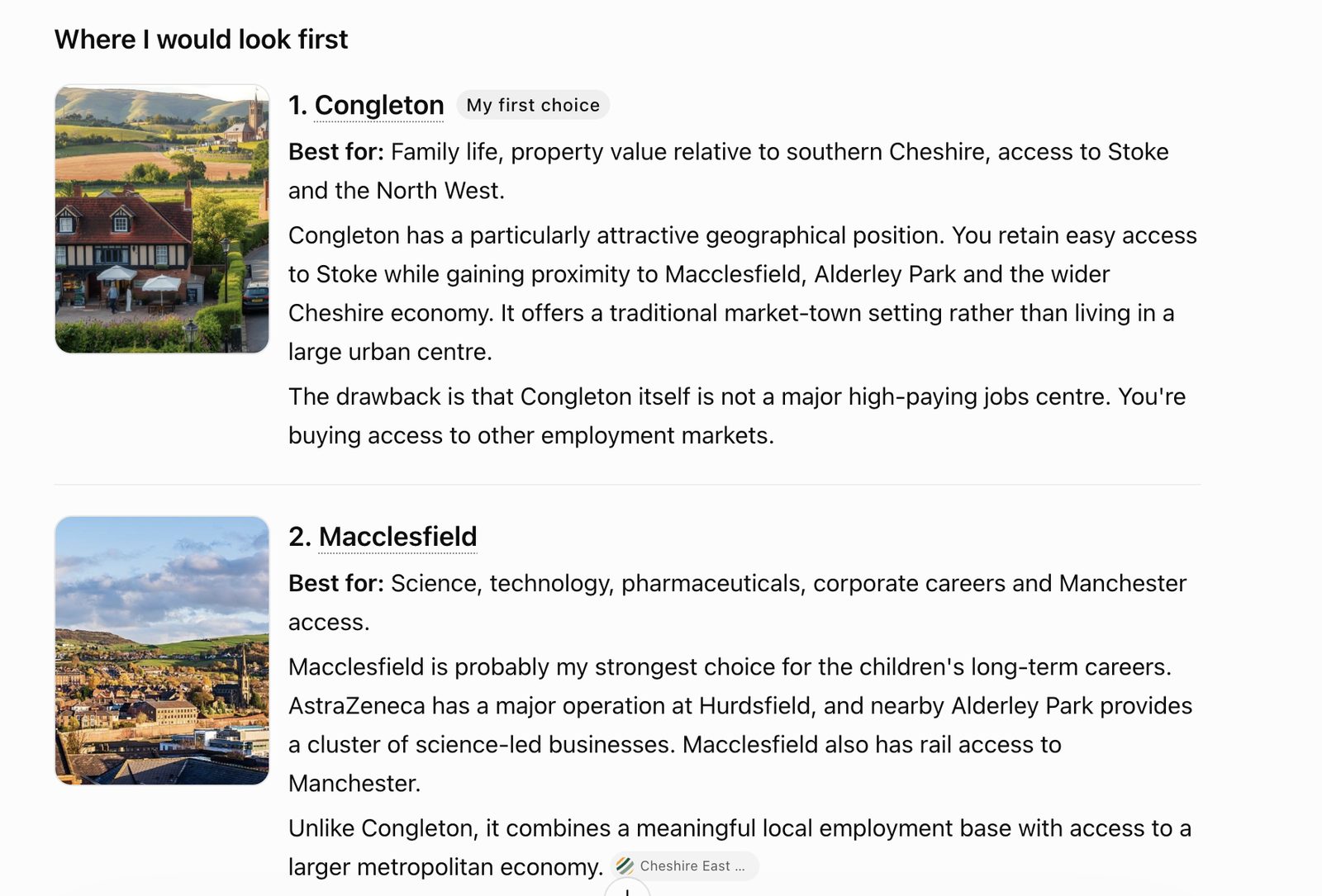
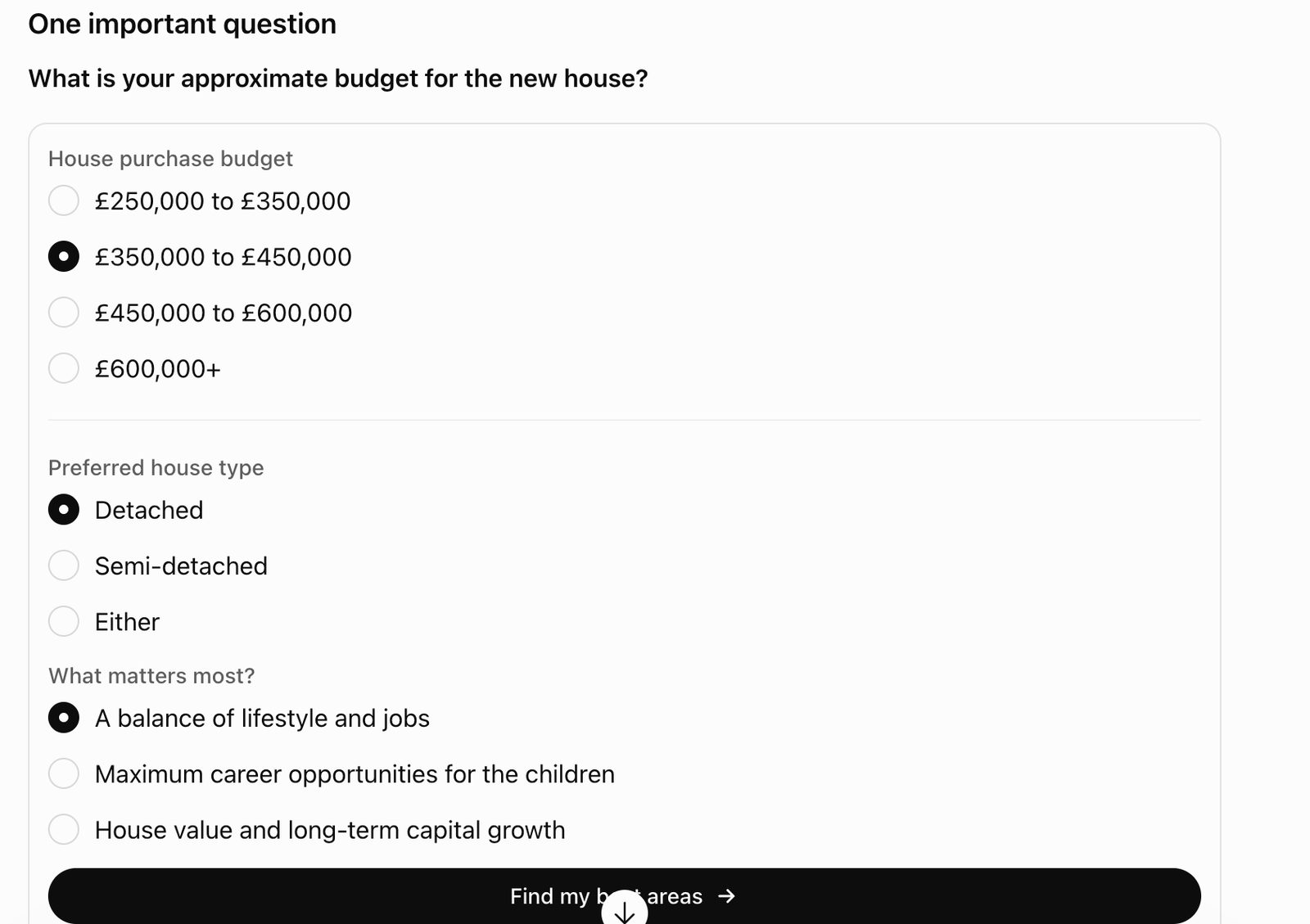
Instead of asking what film to watch, I asked ChatGPT and Google AI Mode about moving house.
I explained that I wanted better opportunities for my family. I wanted to live somewhere with good employment prospects, opportunities for my children, access to thriving local economies and a better long-term future.
This is obviously a much bigger decision than watching a film.
And again, both systems provided useful answers.
But ChatGPT offered what I felt was a richer experience. There was more room to explore the reasoning, evaluate different locations and consider the implications of moving to particular areas.
Now consider what this means for a local council.
For decades, councils have invested in campaigns to attract residents, businesses, skilled workers and tourists.
They produce destination websites, economic development reports, promotional videos, brochures and advertising campaigns.
But what happens when families increasingly ask AI where they should move?
A council might want its area to be recommended to people seeking affordable housing, good schools, career opportunities and somewhere pleasant to raise children.
So where does the AI get its information?
What does it understand about local employment?
Does it know about investment in the town centre, new transport connections, schools, infrastructure or improvements in public services?
Does the information available accurately reflect the area?
And crucially, how does the area compare with competing locations?
Suddenly, that council has a reason to invest in GEO.
Not because it wants more website traffic.
But because it wants more people to consider moving there.
I remember being asked, years ago, to pitch for a project designed to encourage teachers to relocate to a particular area because there was a shortage of teaching staff.
That was fundamentally a behavioural change challenge.
The organisation needed to persuade a specific group of people that relocating would improve their lives.
Imagine undertaking that project today without considering AI recommendations.
It would be a serious omission.
The generative economy is about behaviour, not clicks
This is where I think the opportunity becomes enormous.
We need to stop thinking about GEO purely in terms of brands appearing in ChatGPT.
Of course businesses want to be recommended.
A hotel wants bookings. A retailer wants sales. A solicitor wants enquiries.
But what about everyone else?
A museum wants more visitors during the summer.
A tourism board wants people to visit its destination.
A university wants prospective students to consider its courses.
A local authority wants businesses to invest in its area.
A fire service wants people to understand how to prevent house fires.
An NHS organisation wants people to find accurate, evidence-based information about health and available services.
These are all situations where AI could help inform behaviour.
Some are commercial. Others have public benefits.
And the difference matters.
In healthcare, for example, the objective should not be to make an AI recommend whatever an organisation happens to prefer. It should be to ensure that people can access accurate, trustworthy information that supports informed decisions.
But the wider principle remains.
Organisations have goals. AI increasingly informs decisions. GEO is concerned with how organisations are represented within that decision-making environment.
That’s a much bigger discipline than ranking a webpage.
It reaches into communications, public relations, reputation management, content strategy, community development, research and marketing.
It even extends into fields we don’t traditionally think of as marketing.
If an organisation wants people to change their behaviour, there’s a growing chance AI will become part of the information environment shaping that behaviour.
And somebody will need to understand how that works.
The recommended will become more recommended
There’s another reason why I believe organisations need to take GEO seriously.
Network science.
I’ve written previously about preferential attachment, a concept associated with network scientists Albert-László Barabási and Réka Albert.
The principle is relatively straightforward.
In many growing networks, nodes that already have lots of connections have an advantage when it comes to attracting new connections.
The rich get richer.
The popular become more popular.
The linked become more linked.
You can see why this is important when thinking about brands.
Established brands already enjoy advantages in awareness, distribution, media coverage, reputation and public discussion.
They are talked about more because more people know them.
Their existing popularity can create opportunities for further popularity.
Now introduce AI recommendations.
Imagine that one hotel is repeatedly recommended to people visiting a particular destination.
Those recommendations could produce more guests. Those guests could produce more reviews, social posts, discussions and independent mentions.
That additional information could strengthen the hotel’s reputation and, potentially, its future visibility within AI systems.
The recommended could become more recommended.
It’s a powerful possibility.
To be clear, preferential attachment is an established network mechanism, not proof that every AI system will automatically recommend an already popular business more frequently.
AI recommendations depend on many things, including the question, available evidence, system design, relevance and user preferences.
But the possibility of reinforcing advantage should concern every organisation competing for attention. Because the danger isn’t simply being absent from one recommendation today.
It’s allowing competitors to build reputational and informational advantages that become progressively harder to challenge.
That’s why I believe the wider information network matters so much.
SEO has traditionally concentrated heavily on optimising websites for search interfaces.
GEO requires us to think more broadly about the information, relationships, evidence and reputation signals distributed across the internet.
Or, as I’ve argued before:
SEO optimises for the interface. GEO optimises for the network.
There’s overlap, of course. Search engines also use networks, and strong technical SEO remains valuable.
But this distinction helps explain why GEO cannot be reduced to adding a few schema tags or changing headings on a page.
Every organisation will need to understand its AI recommendation position
I believe one of the biggest immediate growth opportunities in GEO isn’t optimisation itself.
It’s intelligence.
Specifically, AI marketing intelligence.
Before an organisation can seriously influence its position, it needs to understand the environment in which AI is making recommendations.
That sounds obvious.
But how many businesses can confidently answer the following questions?
Which AI platforms recommend us?
What kinds of questions cause us to be recommended?
Which competitors appear instead?
What attributes are associated with our brand?
What information might be missing, outdated or inaccurate?
Where are our competitors building stronger reputations than us?
And what would actually need to change for our position to improve?
Most businesses couldn’t answer those questions comprehensively.
Yet they spend considerable sums on paid media, SEO, content and PR without understanding how their brand is represented in this emerging channel.
That strikes me as an enormous gap.
It’s why I think AI category intelligence reports could become one of the most accessible entry points into GEO.
You don’t necessarily need to begin with an expensive programme.
You need to begin with a diagnosis.
I’d start with five things.
First, identify the decisions that matter.
Don’t just build a list of keywords and turn them into prompts.
Understand the possible questions people may ask when deciding whether to buy, visit, relocate, book or seek a service.
The goal is to understand customer behaviour, not simply produce a bigger spreadsheet.
Second, investigate the recommendation landscape.
Test those questions across relevant AI systems.
Look at who appears, when they appear, what attributes are mentioned and how recommendations change with different contexts.
A single prompt isn’t sufficient. Results can vary, so patterns matter more than isolated screenshots.
Third, investigate the evidence network.
Look beyond your website.
Examine publications, expert commentary, reviews, communities, industry reports, partnerships, independent research and other sources that help establish credibility.
Visible citations are useful clues, but they are not a complete explanation of how an AI generated a recommendation.
Fourth, develop a strategy to improve the evidence environment.
Perhaps your product has a competitive advantage that isn’t explained anywhere.
Perhaps a council has invested millions in regeneration, but independent information about those improvements remains limited.
Perhaps a hotel has exceptional facilities, but its competitors communicate them more effectively.
These are information and communications problems that GEO can help address.
Finally, measure what changes.
Track recommendations, descriptions, competitive presence and, where possible, real outcomes.
The objective isn’t to boast about appearing in a hundred AI answers.
It’s to understand whether better representation contributes to better decisions and meaningful organisational results.
That’s a practical GEO starting point.
And it’s work that many organisations should be commissioning now.
The biggest opportunity in marketing needs more people, not fewer
Which brings me back to BrightonSEO.
One of the recurring frustrations I heard was that SEO professionals are already extremely busy.
They have websites to optimise, technical problems to solve, content to improve, rankings to maintain and revenue to generate.
SEO hasn’t suddenly become irrelevant.
It’s still an enormously important source of business.
I know that because we generate enquiries through traditional organic search, just as we increasingly see opportunities emerging from AI.
So why are we expecting already busy SEOs to absorb an entirely new discipline without extra resources?
Why are businesses advertising for SEO and GEO specialists as if the two are interchangeable?
The opportunity I’ve described extends well beyond traditional search optimisation.
We need writers.
We need PR professionals.
We need researchers, journalists, social media specialists, community builders and marketing strategists.
We need people who understand how reputations are established and how information spreads across networks.
Above all, we need people whose responsibility is to understand GEO.
Not somebody squeezing it between a technical audit and a ranking report.
A dedicated GEO specialist should be able to connect the work of SEO, PR, content, social and communications teams.
Their role should begin with understanding the market and the organisation’s objectives, then developing a strategy for improving the information environment around the brand.
This doesn’t necessarily mean every small business needs a full-time GEO employee.
But larger organisations should seriously consider whether this emerging discipline deserves dedicated ownership, budgets and expertise.
Because the opportunity is potentially far too big to be treated as an afterthought.
The cost of waiting
I understand why some organisations are hesitant.
AI search is changing rapidly.
Nobody has all the answers, including me.
The tools are imperfect. The measurement systems are developing. We still have plenty to learn about what influences recommendations across different platforms.
But uncertainty doesn’t justify doing nothing.
We already know people are using AI to research options and make decisions.
We know organisations are being represented and compared inside those systems.
And we know the information available about an organisation can affect how accurately and favourably it is described.
That’s enough to justify investigation.
If you’re a CFO, marketing director or business owner, you don’t need to approve an enormous GEO budget tomorrow.
But you should understand your organisation’s position.
Who is being recommended in your market?
Why might they be recommended?
What information advantages do they possess?
And what happens if your competitors begin investing in this area while you continue waiting?
The generative economy isn’t simply about another way to drive traffic to a website.
It’s about the growing role of AI in how people understand the world and decide what to do next.
From the film someone watches tonight to the town where they raise their children.
From the hotel they book to the university they attend.
From the business they trust to the information they use when making important life decisions.
That’s the scale of what we’re talking about.
And we’ve spent two years arguing about whether GEO is just SEO.
Enough.
The generative economy is already here.
The real question isn’t whether your organisation will need to understand it.
It’s how much ground you’re prepared to surrender before you start.
Andrew Holland
Originally published on LinkedIn on 11 October 2026.