
Over the past couple of years, I’ve spent a considerable amount of time working with prompts, examining responses and changing how I investigate brands through AI.
The more I learn, the more useful I find the intelligence. And the more uncomfortable I become with some of the certainty attached to the dashboards.
Because much of what we call “AI visibility” comes from an environment we have constructed ourselves.
We write questions. Send them to models. Collect responses. Count appearances.
Then we attach a percentage to the results.
That percentage can be useful. But before we start presenting it as market visibility, we need to understand what it actually represents.
In this article, I explain what AI visibility actually means, share some of my past efforts, and outline the approaches.
Hopefully, by the end you’ll have a better idea of the power of measuring prompts and possibly a new way to look at it.
We created the test
If you put 100 prompts into a tool, you have created a set of 100 questions.
You haven’t established that customers ask those questions. You haven’t established how frequently they ask them. And you haven’t necessarily recreated the circumstances in which they ask them.
Running those prompts every morning doesn’t solve this.
It gives you more observations of your chosen test.
The responses are real. You have sent 100 questions to AI systems, and the responses are real AI responses. The leap from those responses to customer exposure is where the trouble begins.
Consider how differently people use AI.
I use conversational prompting, often through voice. I supply vast context, explain what I’m trying to achieve and continue the conversation.
My wife uses it far less frequently. Someone else might type six words. Another person might supply a detailed brief. Another might encounter an AI answer after entering a conventional Google search.
They could be using different platforms, models, locations and account settings. They could be midway through a conversation that has already established their preferences.
We know that ChatGPT can use relevant memory when rewriting a question for search. Your clean API prompt may therefore test different conditions than a customer’s personalised conversation.
An API test is valuable. But access to a model doesn’t automatically reproduce the full consumer product experience. It can’t do. You just don’t have the user data that the AI system does.
That is why I’m cautious about treating prompt tracking as keyword tracking with a new logo.
Even keyword data was imperfect. But we had evidence of search behaviour and demand estimates.
With constructed prompts, you can’t simply assume demand.
A prompt you can monitor is not automatically a question with a market behind it.
So what’s the solution, or the best way to move forward?
I’ll cover this now.
Decide what success means first
Before choosing prompts, you must decide what you want the business to achieve.
That sounds painfully obvious.
Yet we are building an industry in which “visibility” is frequently allowed to stand in for several different outcomes.
A mention means your brand appears.
A citation means your content is referenced as a source.
A recommendation means your brand, product or service is presented as an option worth considering.
You can be cited without being recommended. You can be recommended without your website being cited. You can be mentioned with negative, neutral or positive sentiment.
Counting all three as success requires some explanation.
A publisher might want its reporting referenced and readers visiting its website.
A charity might want to appear when somebody considers leaving a gift in their will.
A film studio might want its release suggested when someone asks what to watch this weekend.
An agency might want to be shortlisted to a marketing director seeking specialist support.
Each business needs different evidence of progress.
If your objective is to get useful articles cited, informational prompts may make sense.
If your objective is to win customers, you will probably need to investigate recommendations, comparisons and the conditions under which your offer becomes relevant.
Your definition of GEO shapes your prompts. Your business objective should shape that definition.
Otherwise, you risk doing an excellent job of measuring something the business didn’t need.
And this is yet another reason why SEO is not GEO. With SEO, the goal was to rank for keywords. With GEO, we are seeking to alter and influence AI responses.
What that looks like changes drastically depending on your goals.
OK…but how do I approach things?
I stopped simply turning keywords into questions
When I started, I did what plenty of people still do.
I took keywords, particularly those with commercial intent, and converted them into prompts.
It was familiar. It gave me a starting point.
But I became less convinced that it represented the behaviour I was trying to understand.
A person who can explain their situation isn’t restricted to the vocabulary of a search query. They can describe requirements, exclusions, anxieties and preferences.
And the AI system may translate that request into further searches of its own. Google documents that AI Overviews and AI Mode may use query fan-out, issuing related searches across subtopics and sources.
Keywords still have uses. They can reveal demand, categories and customer language.
But converting “digital PR agency” into “What is the best digital PR agency?” doesn’t suddenly give you a representative buyer conversation.
Which buyer? What budget? Which market? What does “best” mean?
Every constraint you add changes the test.
Every constraint you omit leaves the system more room to interpret the question.
So I started approaching prompting from the product, service and positioning of the business.
Start specific, then work backwards
My favourite approach is what I call backward chain prompting.
I’ll use a real example: we are a Manchester-based digital PR agency with SEO capability, GEO expertise and experience working with consumer brands. That is one of the most constrained descriptions of our business.
So, we would start to assess our ‘AI visibility’ with a question that describes that requirement:
“I’m looking for a digital PR agency based in Manchester, with SEO and GEO expertise, that works with consumer brands. Which agencies should I consider?”
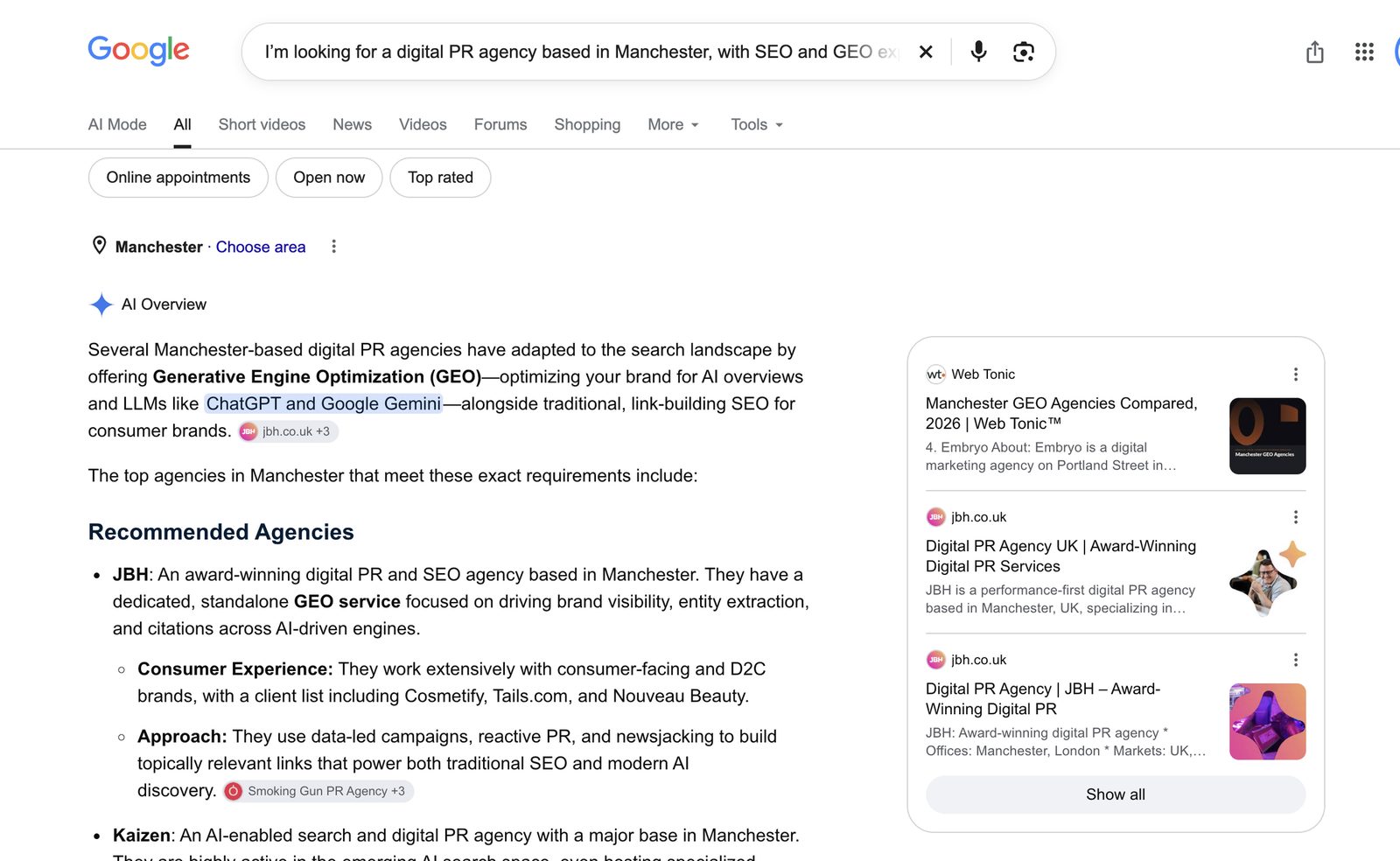
And look…we show up.
But what if we didn’t?
If our agency fits those requirements but doesn’t appear, that is worth investigating.
Who does appear?
How are they described?
What evidence supports their inclusion?
Does your own website explain those capabilities? Do other sources corroborate them? Is the agency being associated with a narrower or different category?
Ok, but we show up… so what next?
We remove constraints progressively.
Drop the Manchester requirement. Test again.
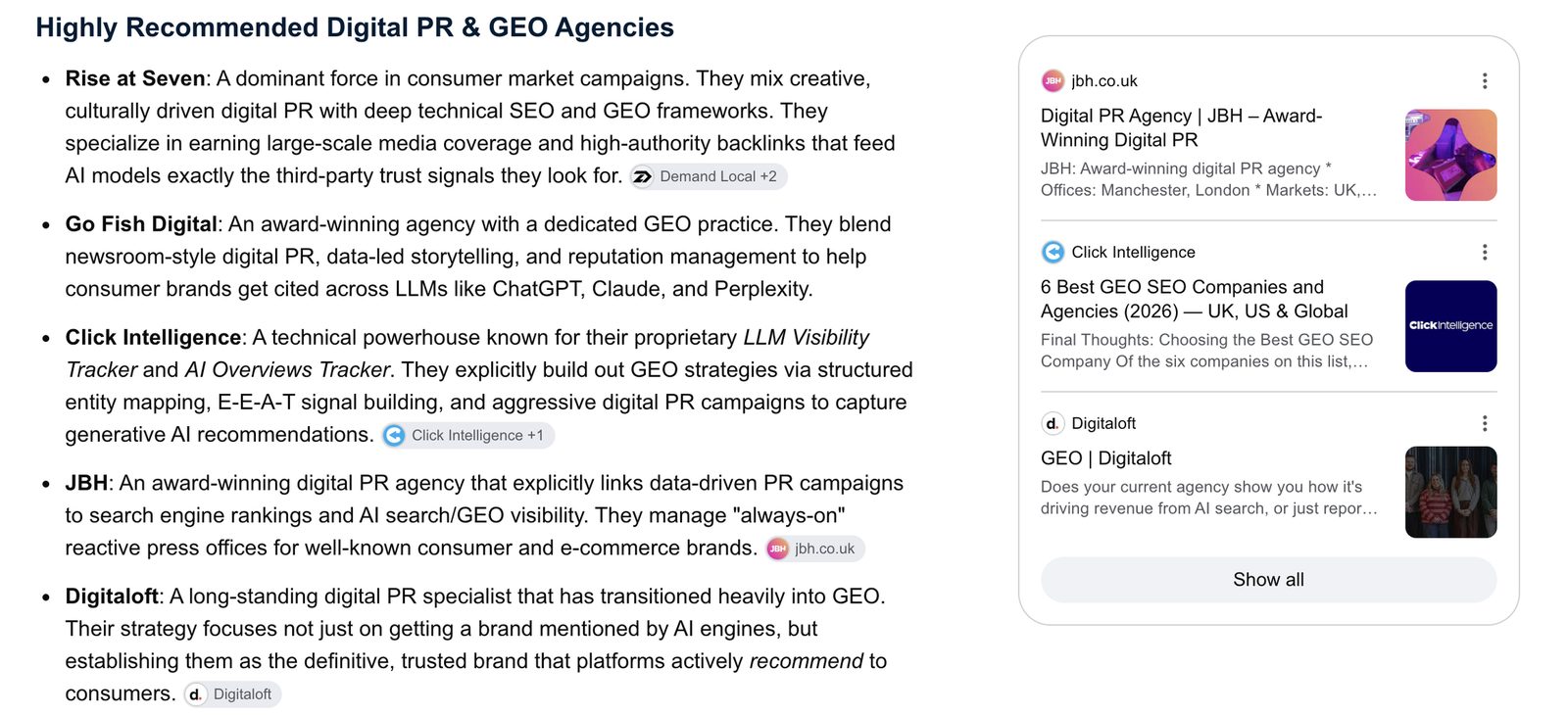
Remove the consumer-brand requirement. Test again.
Broaden the specialism.
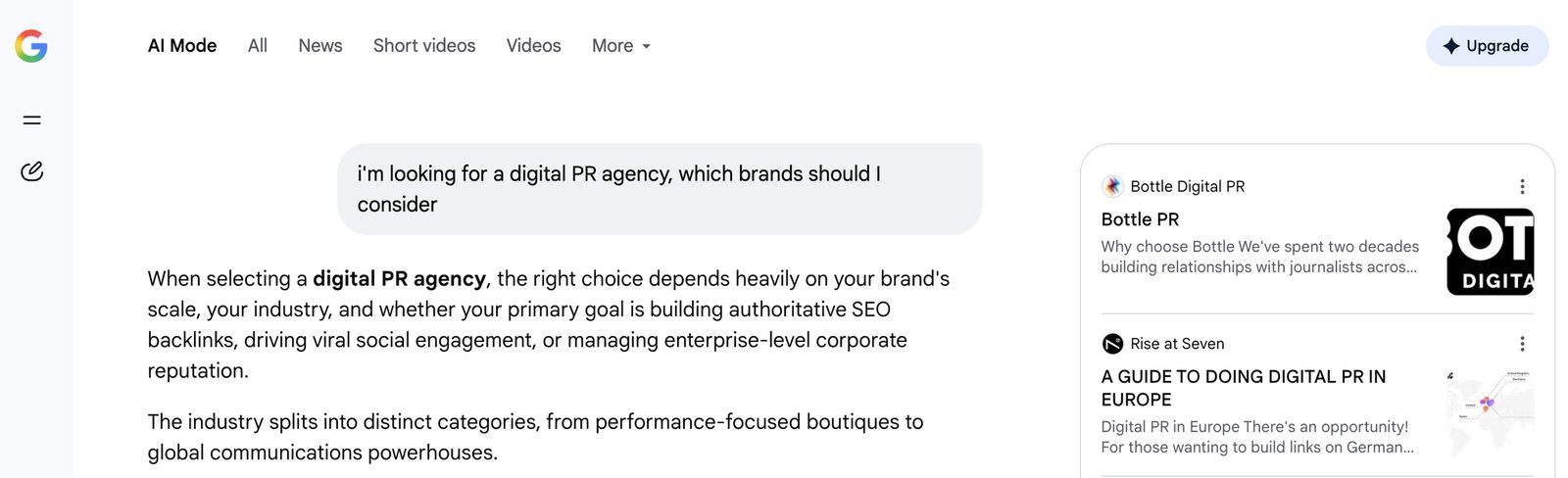
You are investigating how the recommendation set changes as the question becomes less specific.
Luckily…we keep showing up. We don’t always.
When we reduce the constraints, we don’t always show up for broad prompts, because AI systems are unstable and volatile. That’s why you do GEO.
Because the ball moves on the pitch.

If you do this long enough, you’ll learn that a brand might appear consistently when the requirements closely match its offer, then disappear when the question becomes a broad category request.
That gives you a useful boundary to examine.
Perhaps its specialist relevance is clear, but its wider reputation is weak. Perhaps competitors have more corroborating evidence. Perhaps one frequently retrieved comparison page is shaping the shortlist.
Those are hypotheses to investigate.
They are also considerably more useful than announcing that visibility is 37%.
I find this approach particularly helpful when it connects the questions to specific product and service pages. You can examine whether the information needed to establish suitability exists, and where it exists.
But this isn’t a universal prompting system.
I’ve used comparisons, funnel-based questions, sentiment prompts, simulated buyer requests and deliberately artificial diagnostic questions.
Some prompts are written to elicit a recommendation set, even though a customer would probably phrase the request differently.
That can still be useful.
Buyer realism and diagnostic usefulness are separate qualities.
The important thing is to label the test honestly and interpret the result accordingly.
But what are we actually looking at? If all of this is just ‘us’ sending messages into API’s, what do we get back?
The output is marketing intelligence
What you get back from prompting is valuable information. It is AI marketing intelligence that helps you to make better marketing decisions.
And once the responses come back, I look at two layers.
The first is the answer.
Which brands appear? What qualities are associated with them? What requirements seem important? What reasons are given for recommending one option over another?
The second is the cited evidence.
Which publications, reviews, communities, reference pages or brand websites appear?
Citations provide clues, rather than a complete account of the process. We know more is going on than we can see.
But you are examining observable outputs from a complex system.
Investigating AI recommendations can help you identify language and evidence in a market.
Are suppliers being recommended for reliability? Technical capability? Specialist experience? Price transparency? Compatibility with a particular use case?
Is your brand associated with those qualities?
Can anyone substantiate them?
This is where prompting becomes useful to marketers.
You have information that can improve positioning, content, communications and investment decisions.
Turning it into a score is one possible use. It shouldn’t be the only one.
Intelligence should change where the budget goes
Every business has a limited budget.
Even if AI makes production faster, you still have limited money, time, attention and distribution.
The question is which activity deserves the next pound.
Your prompt investigation might suggest that specialist publications repeatedly appear in relevant responses.
It might reveal that product comparisons are prominent.
It might point towards communities, video, local business information or your own website.
The next step is to examine those opportunities and decide what the brand can usefully contribute.
In my own work, one of the most common weaknesses I see is the brand’s product and service pages.
They may have been written to rank for a keyword. They may have been written as polished brand copy. They may have been reduced to a headline, three benefits and a contact form.
But they don’t adequately explain things that would increase likely recommendations by AI systems. They largely imply things without stating them explicitly.
Who is it for?
What requirements does it meet?
Where is it available?
What does it include?
What are its limitations?
And many more performance attributes.
If those details are missing, it becomes harder for both people and retrieval systems to establish suitability.
Technical access matters too. Content that is unavailable in the retrieved version of a page cannot help that retrieval. But an accordion isn’t automatically a problem merely because a human must click to expand it.
This work often provides a useful starting point because the brand controls the page. It’s often the easiest, most cost-effective GEO approach you can take.
To make web pages better.
It also has a clear human benefit: a potential customer can make a better decision.
But it’s not the only GEO approach I see.
One of the things I’m observing often is that decision-making content, or should I say content designed to help machines and humans, is what LLMs love to cite.
And many teams can be involved in creating that type of content.
Popular content and relevant evidence are different achievements
A social team might produce three funny posts that reach thousands of potential customers.
That can be valuable marketing. It can build recognition, familiarity and memory. But it may provide little information about whether your product meets a particular requirement.
Meanwhile, a detailed demonstration might reach fewer people and supply exactly the evidence needed to assess suitability.
Both can have a purpose.
The task is to understand what each contributes.
If prompt research repeatedly surfaces detailed comparisons, bring that intelligence to the content team.
If demonstrations appear useful, discuss them with the video team.
If reviews reveal recurring strengths or concerns, take that information to the people responsible for the customer experience.
The useful question is what you should create, improve or encourage others to say.
This also explains why GEO can involve many specialisms.
A technical consultant might improve access to product information.
A copywriter might make the offer clearer.
A PR team might secure relevant coverage.
A community specialist might help the brand participate constructively.
A local SEO practitioner might improve the information customers need to choose a nearby business.
My expectation is that GEO will increasingly be an intelligence role: someone who investigates, interprets and helps coordinate these decisions.
The person gathering the intelligence doesn’t have to execute every activity.
They do need to understand its purpose. And the purpose of this intelligence is to increase a brand’s meaningful visibility online.
Meaningful is the key word.
Create something worth encountering
The important change that AI search brings is that customers increasingly have more ways to access and interpret information.
That makes it necessary to understand how AI systems represent your business.
It also makes it dangerous to confuse a test of those systems with the whole market.
Your dashboard observes a selected set of answers.
Use it to ask better questions.
Use it to investigate what your market values, which sources appear relevant and where your brand’s evidence is weak.
Then decide what visibility you will create.
Three social posts can shape how people see you. A piece of reporting can build memory and credibility. A useful product page can help someone choose.
Those same assets may also inform a future AI answer.
That is where I would put the budget: into meaningful encounters with potential customers, supported by evidence machines can access and interpret.
We cannot know every future prompt or guarantee every recommendation.
We can improve the information available about the brand and the quality of the marketing people encounter.
Your AI visibility score may go up as a result…great. But the business deserves more than a greener dashboard.
It deserves better marketing and increased online visibility.
Use AI to understand where your brand needs to be. Then create something worth encountering when it gets there.
That’s what GEO actually is.
Andrew Holland
Originally published on LinkedIn on 4 October 2026.