
I’ve been running more GEO audits this week. And every time I do, I reach the same uncomfortable conclusion: this is not a neat, solved discipline, and anyone suggesting otherwise is either very new to it or very motivated to sell you something.
The audits actually showed this.
1. Most websites were built to rank, not to be chosen
This was the theme that kept resurfacing.
The client’s core pages were reasonably clear about what the business did, and in places, how it did it. What they didn’t do was explain why the brand was materially better than the alternatives.
That missing element is mechanism – the explanation of how your product, service or process creates a better outcome. It’s where your performance attributes live: the signals that tell a model what you’re good at, who you serve and why someone should choose you.
Most websites are weak here. Pages were built by looking at what ranked, copying the same structure and adding more words. In competitive categories, that produced landing pages running to 6,000 or even 10,000 words. The implicit logic: if the ranking page covered a subject, you covered it too, only longer.
That made brands legible within a category. It did almost nothing to make them distinctive inside it.
You see the consequences everywhere.
“Leading.” “Trusted.” “Best in class.” “Customer focused.”
These are not performance attributes. They’re verbal packing foam – they take up space while communicating almost nothing.
The gap between what the website says and what would actually make someone choose this firm over the next is often enormous.
What are you famous for? What do you achieve? What’s your process? Why does it work? Most websites answer those questions with language that could sit unchanged on 500 competitors.
The opportunity, though, is real. AI search allows users to describe their full problem rather than compressing it into a keyword.
A parent can ask a generative engine for a bakery that makes only Thomas the Tank Engine cakes and get an answer. A genuinely specific business can become the best answer for a commercially viable niche that conventional search made awkward to find.
That doesn’t mean discarding every SEO element. Rankings still produce revenue and AI isn’t yet the default interface for most searches. The job is to improve pages so they can still rank while giving models a stronger reason to select the brand.
2. You have to belong to the category without disappearing into it
This week I found a 2026 paper, Bound by Semanticity, from researchers at the Network Science Institute, Princeton, Dartmouth, Microsoft Research and Politecnico di Torino.
It introduced a concept I’ve been thinking about since I read it.
The paper isn’t about brands or GEO. I want to be clear about that. It examines a genuine technical problem in intelligent systems: the trade-off between broad generalisation and precise identification.
The argument is that systems with finite semantic resolution face an unavoidable tension. Broader representations help a model connect related things and generalise across them. But as those representations overlap, individual items become harder to distinguish. The researchers call it the generalisation-identification trade-off and find evidence of it across multiple model architectures.
The branding implication is mine, not theirs. But it’s hard to ignore.
To be recommended, a brand needs sufficient association with a category to be considered relevant. But if every signal around your brand is identical to every other player in that category, you create semantic blur. You’re related to the space, but not clearly identifiable within it.
Broad relevance gets you into the consideration set. Distinctive performance attributes give the model something with which to actually identify you.
You have to belong to the category without dissolving into it.
3. You’re fighting the giants and the specialists at the same time
The client was competing with some large, well-known brands. These companies have significant fame, accumulated authority and, in some cases, millions of backlinks. Unsurprisingly, they dominated a large share of the prompts we tested.
What was more interesting was the competition from below. Small retailers and niche specialists were also being recommended, including for comparatively broad prompts.
That’s an uncomfortable place to be. Large brands win through fame and authority. Small players win because they look like a precise answer to the prompt. The mid-sized brand in the middle is being squeezed from both directions.
The audit also showed where the client had left space open. We used our internal Fame Engine to look at its PR history.
The coverage was solid from a conventional link-building perspective – good publications, technically sound. But semantically, the coverage didn’t consistently connect the brand with its strongest performance attributes. It didn’t repeatedly explain what the company did, which problem it solved or why it was better.
A backlink can strengthen authority without strengthening meaning.
For GEO, the question isn’t only whether you earned coverage. It’s what that coverage taught humans and machines to associate with your brand.
Does your PR connect you to the problem you solve? Does it reinforce your mechanism? Does it help build a recognisable semantic signature? Or have you accumulated a pile of solid links that say very little about why anyone should actually choose you?
This is one of the clearer reasons SEO and GEO are separate disciplines. The link may work for rankings. The mention may still be too weak to drive a recommendation.
4. Content can shape the terms on which your brand gets judged
We can see retrieval happening. We can analyse fan-outs, observe which sources are surfaced and watch content being cited in response to broad commercial prompts. That creates both an opportunity and a problem.
The publishing ecosystem has already taken a battering. Many sites were destroyed by Google’s helpful content updates. Others are watching search engines consume more of the user journey through AI-generated answers. If third-party content becomes increasingly important to generative recommendations, credible publishers may start charging heavily for brand inclusion – which could create either a valuable market for expert publishing or a swamp of overpriced advertorialS.
The more important lesson for brands is narrower: content can shape the narrative around the buying decision itself.
Take a boxing glove company with a sparring glove featuring a distinctive wrist strap.
The strap reinforces the wrist, speeds up fitting and reduces vulnerability during punching and blocking. The old SEO response would be another generic article targeting “best sparring gloves.” A better response is to publish the argument behind the product.
Write about wrist injuries in boxing. Research their prevalence and causes. Explain what happens during sparring and what buyers should consider before choosing a glove. Then show how the product’s construction addresses that specific problem. Turn the research into a video. Send it to your email list. Give it to customers who are already considering a purchase.
That content is useful before any model encounters it. It helps the customer, supports sales and gives the brand something worth distributing. It also creates repeated co-occurrence between the brand, the problem and the mechanism.
We should be honest about causality. Nobody can guarantee that publishing one article changes a model’s recommendation. These systems are opaque and the route from content to output isn’t linear.
But GEO is a probability exercise. You increase the probability by creating meaningful encounters. Content that can genuinely alter how a human or a machine understands the problem, the category and your role within it.
Content shouldn’t be anchored to a keyword list or designed to replicate whatever’s already there. It should sell the brand, build fluency around its performance attributes and make it easier to understand why someone should choose it.
5. Different models make measurement less certain, not more
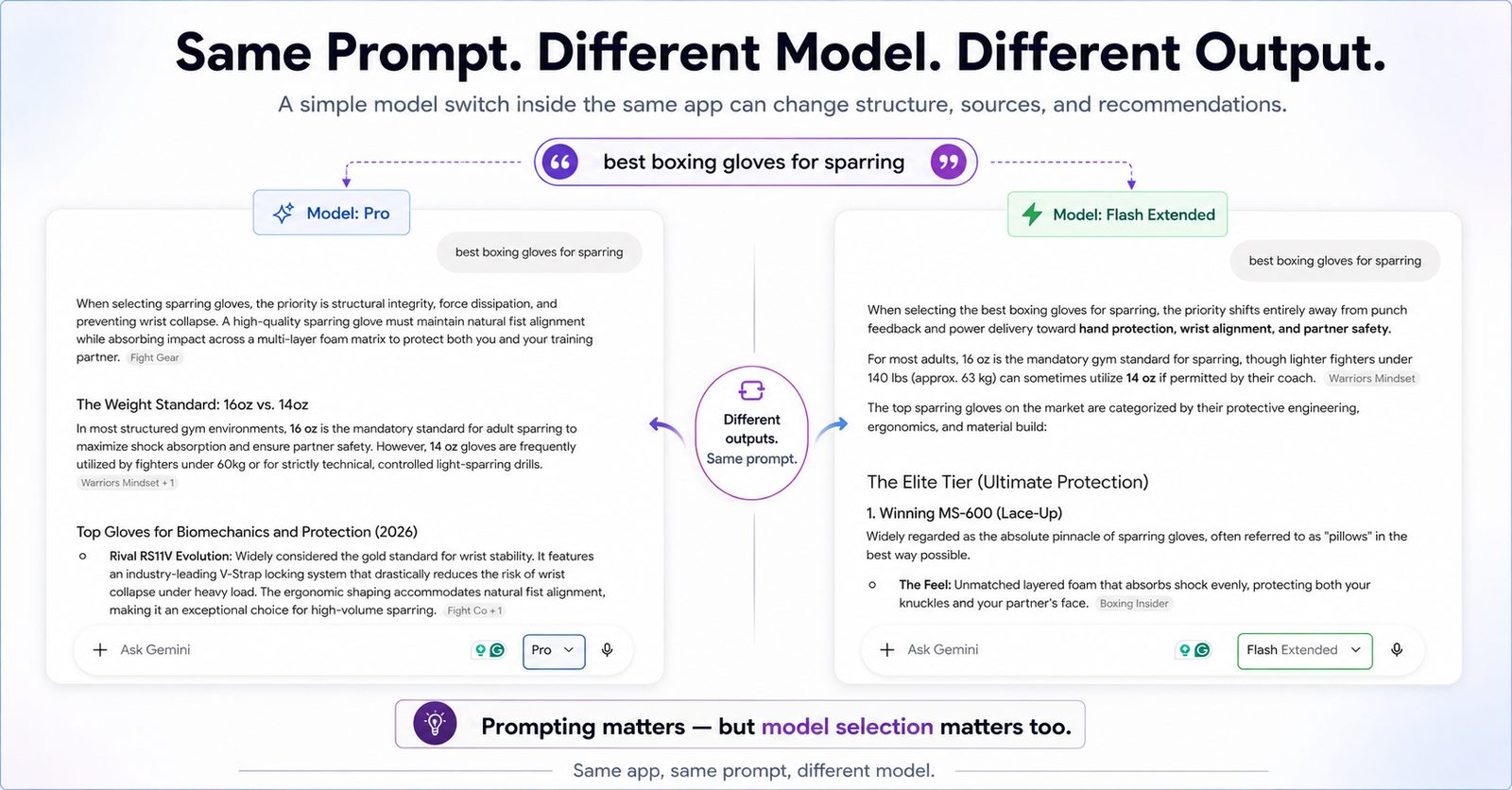
The most straightforward lesson came from the simplest test.
I put the same prompt into Gemini and changed only the model. The brands recommended in the two responses didn’t overlap. The brands recommended were completely different.
Marketers rarely know which model is operating within any given AEO product, how it’s retrieving information, or, more importantly, which model their customers actually use.
A B2B buyer might use ChatGPT in a high-reasoning mode. Another uses Claude. A third uses Gemini. Each interprets the same prompt differently, retrieves different evidence and recommends different brands.
Model-level monitoring could be useful. It shows patterns, reveals gaps and helps you understand where a brand is and isn’t appearing. But it’s not an absolute strategic truth.
It’s directional intelligence to give you a bit more context around your strategies.
But it’s an important nuance if you’re treating AEO tools as a fountain of truth. There are marketing intelligence tools for the AI era. Highly useful, but also lacks the personal and model data that real AI users prompt from.
This is also where GEO diverges most clearly from the worst habits of SEO. SEO was always a hard sell because the pitch often boiled down to: invest now and perhaps see a result in six to twelve months.
GEO adds another layer of uncertainty on top. The interface is hidden, outputs vary, and changes may take time to surface.
So the work has to create real marketing value at the point of publication.
A rewritten landing page should convert better now. A strong article should be worth emailing to customers now. Useful research should support PR pitches now. Better product explanations should help salespeople now. A clearer position should make the brand easier for humans to understand now.
This is also the only credible future for agencies. Clients can produce mediocre AI content themselves. They don’t need an agency to sell them a prompt database or another bundle of generic blog posts.
The agency’s value lies in diagnosis, positioning, copy, research, production, and distribution. Helping an in-house team create better marketing faster so they can focus their limited time on what actually requires their expertise.
Measurement still matters. Referral traffic, branded search, visits to core assets, engagement, assisted conversions, directional visibility across a designed prompt set – these all tell part of the story. But none of them removes the central uncertainty.
The only rational response is to keep tipping the scales.
GEO is starting to look suspiciously like proper marketing
The more of these audits I do, the less GEO looks like a bag of technical tricks and the more it looks like the kind of marketing that should have been happening all along.
It starts with positioning. It demands a clear mechanism. It depends on PR that reinforces what the brand is genuinely good at, content that shapes the terms on which buyers make decisions and assets that create real value before an AI system ever encounters them.
There’s no single prompt to own. No model to control. No guaranteed route from publication to recommendation.
There’s only the accumulated evidence around your brand and the probability that, when a model is asked to solve a relevant problem, your name looks like a credible answer.
The goal isn’t to hack the answer.
The goal is to become the obvious answer.
Andrew Holland
Originally published on LinkedIn on 12 June 2026.