Kevin Kelly saw this coming.
Back in The Inevitable, published in 2016, he made a prediction that now looks less like futurism and more like a man reading the internet’s autopsy report ten years early:
“By 2026, Google’s main product will not be search but AI.”
Well, here we are.
Google is no longer just a search engine. It is becoming an answer engine, an assistant, a recommendation layer and a machine that would often rather satisfy the user itself than send that user to your carefully written article.
The old search bargain is being dismantled before our eyes.
And the marketing industry, being the marketing industry, has responded in the usual way.
Panic. Made up metrics. Dashboards. LinkedIn prophets.
The obvious question remains mostly unanswered.
If Google and AI systems stop sending the same traffic, how does a brand grow?
That is the question I saw sitting inside a locked Google Search Console help thread recently.
Someone had asked the thing everyone is thinking: if we stop writing keyword-targeted commodity articles and start producing “helpful”, “non-commodity” content instead, where does the traffic come from?
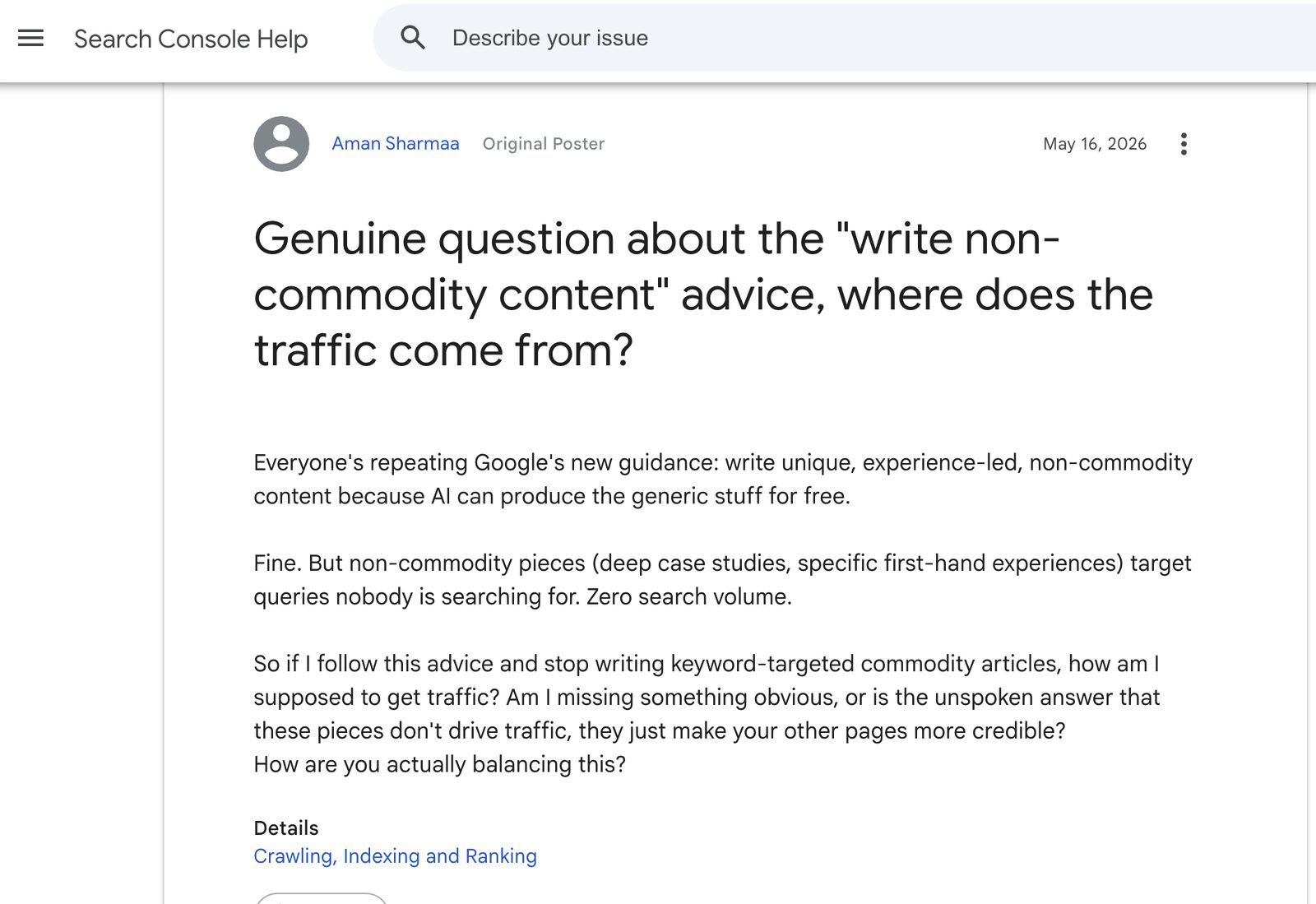
It was a basic question.
It had no proper answer.
Which is a neat little metaphor for the whole bloody mess.
For years, traffic was a flawed metric. Of course it was. A visit to your website did not automatically mean brand growth, revenue, memory, trust or demand. The SEO industry produced mountains of articles that ranked, attracted clicks and achieved absolutely nothing useful beyond making a chart go up in a monthly report.
But traffic still meant something.
It meant someone had arrived.
Now even that is under threat. Google answers more questions itself. AI tools summarise the market. Social platforms suppress links. LinkedIn wants attention to stay on LinkedIn. Meta wants attention to stay inside Meta. TikTok, YouTube, Reddit, Amazon and every other platform want the same thing.
Your content is useful to them.
Your click is optional.
So we need a better way to think about growth.
And that brings us back to Kelly.
The real question is not traffic. It is value.
Kelly’s most useful idea was not simply that AI would become central. It was his argument about what becomes valuable when copies become free, instant and infinite.
When anything can be copied, the copy itself loses value. The article. The code. The image. The video. The how-to guide. The checklist. The generic advice. The bland explanation. The “ultimate guide to whatever” that nobody asked for and everyone has already written.
That stuff gets cheaper.
AI accelerates the collapse.
Kelly’s answer was what he called generatives: qualities that have to be generated, grown, cultivated and nurtured. They cannot simply be copied, cloned, faked or reproduced.
His eight generatives were immediacy, personalisation, interpretation, authenticity, accessibility, embodiment, patronage and findability, or discoverability.
That is the bit marketers need to sit with. Because the implication is brutal.
Your job is not to create more copyable content.
Your job is to create value that cannot be copied easily.
That is how brands grow in the AI era.
Not by tricking the machine. Not by feeding another algorithm with another content calendar full of beige. Not by pretending you’ve figured out some kind of secret AI ranking factor code to win clients.
The job is to become more valuable, more visible and more recommendable in ways that are difficult to replicate.
Kelly’s eight generatives give us the playbook.
But we should start at the end.
Because discoverability is now the hardest problem.
1. Discoverability: become recommendable, not merely findable
Kelly wrote that unfound masterpieces are worthless. That line should be stapled to the forehead of every marketer still confusing publishing with distribution.
Being good is not enough.
Being useful is not enough.
Being right is not enough.
You have to be found.
And in the AI era, being found increasingly means being recommended.
That is the shift. The old search world was built around ranking. You wrote the article, optimised the page, earned links, improved authority and hoped Google put you somewhere useful.
The AI-search world is different. It does not just retrieve pages. It interprets the request, compares options, summarises the market and increasingly tells the user what to choose.
That sounds new.
It is not.
TV Guide did this decades ago. The programmes were free, but people paid to be guided towards the right ones.
Michelin did it for restaurants because it wanted people to drive further and wear out tyres. Amazon reviews do it for books and products. YouTube creators do it every day when they become the trusted filter for AI news, fitness gear, restaurants, software, politics or whatever niche they own.
Discoverability has always had value.
AI just makes that value more obvious.
This creates two jobs for your brand.
First, become more discoverable yourself. That means being remembered, searched for, cited, reviewed, linked to, talked about, recommended and trusted enough that when a human or machine has to make a choice, your name enters the answer.
Second, consider whether you can become a recommender. Can you help your market discover the best tools, partners, suppliers, ideas, restaurants, tactics, people or products? That can become a newsletter, a directory, an award, a community, a media platform, a buyer’s guide or a trust layer.
The mistake is thinking discoverability is just SEO with shinier dashboards.
Discoverability is the commercial outcome of being useful enough, specific enough and trusted enough to be recommended.
Everything else in this playbook serves that goal.
2. Immediacy: reduce wait
Immediacy is not speed.
It is reducing wait.
The wait for an answer. The wait for confidence. The wait for proof. The wait for delivery. The wait for value.
Deliveroo did not invent food. Uber did not invent taxis. ChatGPT did not invent answers. They made the waiting feel shorter, and the process feel easier.
That is what people pay for.
The old SEO industry trained clients to accept delay. “Give it six to twelve months” became the standard line. Sometimes that was honest. Sometimes it was a useful fog machine hiding weak work, vague strategy and a content calendar full of bland articles nobody needed.
AI changes expectations.
People can now ask, compare, summarise, shortlist and decide faster than before. They do not always want the fastest answer. They want the fastest useful answer.
That matters for brands.
Can your content help someone understand something faster? Can your proof help them trust you faster? Can your service reduce the wait between problem and progress? Can your operations deliver faster because AI helps you systemise, document and improve?
This is where content stops being “five blog posts a month” and becomes a business asset.
Can you explain the market faster than your competitors? Can you publish a point of view while everyone else is still waiting for sign-off? Can you give buyers tools, examples, proof and interpretation that collapses the time between curiosity and confidence?
That is immediacy.
Speed to value.
Not speed for its own sake.
3. Personalisation: become perfect for someone specific
Broad prompts reward broad brands.
Ask an AI tool for “the best trainers” and Nike, Adidas and the usual famous suspects will elbow their way into the answer. That is cumulative advantage doing what cumulative advantage does. The rich get richer. The known get recommended. The visible becomes more visible.
But detailed prompts change the game.
When someone tells an AI tool exactly what they need, the machine gets a better brief.
“Find me a quiet independent restaurant in Manchester for a birthday dinner, good vegetarian options, not too formal, near the tram, under £40 a head” is not a keyword. It is a buying situation. It contains context, constraints, taste, budget and intent.
And when the query gets more specific, the winner does not always have to be the biggest brand.
It can be the most relevant one.
This is positioning.
Not the LinkedIn version where someone changes their bio to “helping ambitious founders unlock growth” and pretends they have discovered strategy.
Proper positioning means deciding who you serve, what problem you solve and why you are a better answer for that group than the alternatives.
Imagine a UK bakery that only makes Thomas the Tank Engine birthday cakes. Ridiculous? Maybe. But strategically clear. It knows who it serves. It knows the occasion. It knows the emotional job. It knows the buyer is probably a stressed parent trying to make a small child’s birthday feel magical without spending three nights wrestling with blue icing and regret.
In the old search world, that bakery would have struggled to be discovered. The audience was specific. The media was expensive. The keywords were scattered. The customer had to search in exactly the right way.
In the AI-search world, a parent can describe the exact need, and the machine can go looking for the most relevant answer.
That is the opportunity.
AI search allows highly specific businesses to become discoverable to highly specific demand.
But do not turn this into fantasy. A niche is not a strategy unless enough people exist, care and pay. And the moment your niche starts making money, the copycats arrive.
Look at baked potatoes. Spud Man and Spud Bros turn the humble jacket potato into social content, queues and fame. Suddenly, every town has a bloke with a tray of loaded spuds, a ring light and dreams of carbohydrate dominance.
That is what happens when a position works.
Others copy it.
So you move, deepen, adapt and defend.
4. Interpretation: information is cheap, meaning is expensive
Information is no longer the scarce bit.
AI can produce definitions, summaries, lists, comparisons and first drafts until the servers melt. Code gets cheaper. Research gets cheaper. Copy gets cheaper. Analysis gets cheaper. The great content landfill expands by the hour.
But meaning does not get cheaper.
Kelly’s point was that when the copy becomes abundant, the manual becomes valuable. The thing itself might be free, or close to free, but the explanation of what it means and how to use it becomes worth paying for.
That is interpretation.
Take AI itself. It is absurdly powerful and absurdly underused. Not because the tools are unavailable, but because most businesses have no idea what to do with them. They have access to the engine but no map, no mechanic and no clue which pedal does what.
That creates a huge market for interpretation.
Not another idiot selling “10 ChatGPT prompts to 10x your business”. Actual interpretation. Sitting with a bakery, a law firm, a healthcare company, a manufacturer or a recruitment agency and showing them what AI changes, what it does not change, what to automate, what to protect and where the money is.
A small bakery does not need a futurist. It needs fewer late invoices, faster order handling, better seasonal planning, clearer customer communication and maybe a way to stop the owner writing Instagram captions at midnight while slowly resenting buttercream.
AI can help with that.
But only if someone interprets the tool into the reality of the business.
This is also where brands can grow in AI search. Stop producing information and start producing interpretation. Do not just answer “what is X?” Explain what X means for a specific customer, in a specific situation, with a specific decision to make.
The machine can summarise information.
But it still needs useful sources of judgment.
Be the brand that helps customers figure out the world relevant to what you do.
Make it make sense to choose you, make it make sense for them to search for you.
5. Authenticity: reduce risk through proof
The word “authenticity” makes me want to crawl into a skip.
It has been ruined by LinkedIn poets, founder selfies and people confusing oversharing with strategy.
But beneath all that inspirational landfill sits an important commercial truth:
Authenticity reduces risk.
Customers are not wandering around looking for your authentic soul. They are trying not to make a bad decision.
They want to know you are real. They want to know you can do the job. They want to know you will not vanish after the invoice clears. They want to know the offer is not another AI-search grift wrapped in a 47-page PDF and a smug webinar.
That matters because the economy is soaked in uncertainty.
Businesses are nervous. Households are nervous. Budgets are tighter. Growth is slower. Everyone is being told AI will save them while also quietly wondering whether it will delete their job.
In that environment, the biggest thing a brand can do is reduce the customer’s sense of risk.
That is what brand does.
Not the fluffy version. Not “our values are curiosity, courage and collaboration” bollocks. Proper brand. The memory structure in the buyer’s head that says: I know them. I trust them. I have seen their work. People like me use them. They are less risky than the alternative.
So how do you build that in an AI-search world?
You show your work.
Relentlessly.
Show the process. Show the thinking. Show the customer problem. Show the before and after. Show the offer. Show the result. Show the awkward trade-offs. Show what you did when things went wrong. Show enough evidence that the market starts to believe you are not just another consultant with a ring light and a hallucinated methodology.
Authenticity is not a vibe.
It is accumulated evidence.
And evidence requires graft.
Yes, it is going to be harder for your work to be seen. That is true, but that doesn’t mean you shouldn’t still keep trying and keep doing it because getting a tiny bit of algorithmic love can go a long way.
6. Accessibility: make yourself easier to buy, use and understand
I used to own videos. Then DVDs. Then, like every other middle-aged idiot with a collapsing shelf and a suspiciously large number of films bought twice, I realised I did not want to own films.
I wanted to watch them.
That is the difference.
Netflix, Amazon Prime, Paramount, Sky and the rest did not win because people suddenly hated cinema. They won because they removed the burden of access. No shelf. No storage. No broken player. No scratched disc. No driving to Blockbuster in the rain to discover some bastard had already rented the film you wanted.
People pay for accessibility.
In marketing terms, this links directly to availability. The easier you are to find, buy, access and use in more buying situations, the more chance you have of being bought.
In the AI-search era, accessibility expands. It is not only about shelves, locations or opening hours. It is about whether people can access your expertise, your data, your product, your proof, your price, your service and your answer in the moment they need it.
So ask the hard question.
What are you making customers work too hard to access?
Can they book you easily? Can they understand your offer? Can they see your prices? Can they access your thinking before they buy? Can they use your service outside normal hours? Can they get the data without emailing three people and waiting four days? Can they buy through Amazon, Etsy, Shopify, a marketplace, a partner, a subscription, a dashboard, a community or an API?
But accessibility isn’t about where you are, it’s about how people can access your business.
JD Gyms being open 24 hours is not a gimmick. It changes the buying and usage situation. It makes the gym available to shift workers, parents, insomniacs, early risers and people who would rather lift weights at midnight than fight for a bench at 6pm surrounded by tripod goblins.
That is accessibility.
More situations. Less friction. More usage.
In AI search, accessibility also means making your brand legible to machines. Clear services. Clear audiences. Clear proof. Clear locations. Clear comparisons. Clear expertise.
If an AI system has to work too hard to understand what you do, who you serve and why you matter, do not be surprised when it recommends someone else.
Accessibility is not just being online.
It is being easy to find, easy to understand, easy to trust, easy to buy and easy to use.
Being more accessible for consumers is valuable; people pay for more access.
From consulting sessions to in-person events, accessibility has value because it can’t be copied. It is literally doorways into your brand.
7. Embodiment: make the digital physical, and the physical digital
Embodiment sounds suspiciously like the kind of word a consultant writes on a whiteboard before charging £18,000 for the privilege, but stay with it.
Embodiment means making the digital real. And, just as importantly, making the real digital.
Music is free, or close to it. You can listen to almost anything, anywhere, for a monthly fee that would once have bought you two CDs and a carrier bag. Yet people still pay hundreds to stand in a stadium, drink warm lager and watch the same artist perform the same songs in the flesh.
Why?
Because the embodied version is different. It is scarce. It is social. It is memorable. It is an event.
The same pattern exists everywhere. Consultants give away ideas online, then charge for workshops. Speakers publish talks for free, then sell tickets to the room. Authors give interviews, podcasts and excerpts away, then charge for the book, the seminar, the community, the advisory session.
And the cycle runs the other way too.
BrightonSEO is a physical event, but if you cannot attend, you can buy the recordings. Theatre companies can stream plays to people who cannot travel, cannot afford hotels, or simply do not fancy remortgaging their home for a night in London.
During the pandemic, schools and universities were forced to convert physical education into digital access almost overnight.
Some of it was awful.
Some of it opened up possibilities that should have existed years earlier.
This is a growth lever because it multiplies buying situations.
If you are digital, ask: what is the physical version of this? A dinner, a workshop, a conference, a clinic, a launch night, a printed book, a private briefing, a live teardown, a retreat, a roadshow.
If you are physical, ask: what is the digital version of this? A recording, a subscription, a livestream, a template, a tool, an archive, an online class, a members’ area, a searchable library.
P Louise understood this beautifully. She created a free TikTok documentary that could have remained just another piece of digital content. Instead, she turned it into a physical launch night with singers, dancers, dinner, influencers, affiliates, announcements and shared attention.
The content became an occasion.
The occasion became content.
In AI search, embodiment matters because machines can summarise your words, but they cannot replace the accumulated proof of real-world participation. Events create mentions. Mentions create memory. Memory creates searches. Searches create recommendations. Recommendations create more visibility.
Stop acting like the internet is the whole market.
Get into the room. Then make the room travel further.
8. Patronage: stop selling information the chatbot gives away for free
Patronage makes traditional marketers twitch because it sounds creator-economy and therefore unserious.
That is a mistake.
People like paying people they believe in. Fans pay creators. Students pay teachers. Founders pay advisors. Members pay communities. Customers pay brands not only for the thing, but for access to the thinking behind the thing.
This matters because AI is destroying the value of generic how-to content.
Tim Ferriss made that point directly in his recent article, Has AI Already Killed How-To Nonfiction? His argument is not that all nonfiction is dead. It is that a particular type of prescriptive, step-by-step information is being dragged into the chatbot.
“How do I write a press release?” ChatGPT can answer that.
“How do I make sourdough?” ChatGPT can answer that.
“How do I create a content strategy?” ChatGPT can answer that too, usually with the confidence of a junior marketer who has just discovered HubSpot and needs a lie down.
The market is not going to keep paying premium prices for basic instructions that a chatbot can produce in four seconds.
The value moves from information to transformation.
From “here is how to do X” to “here is a better way to think, decide, act and improve.”
That is why models like Every are interesting.
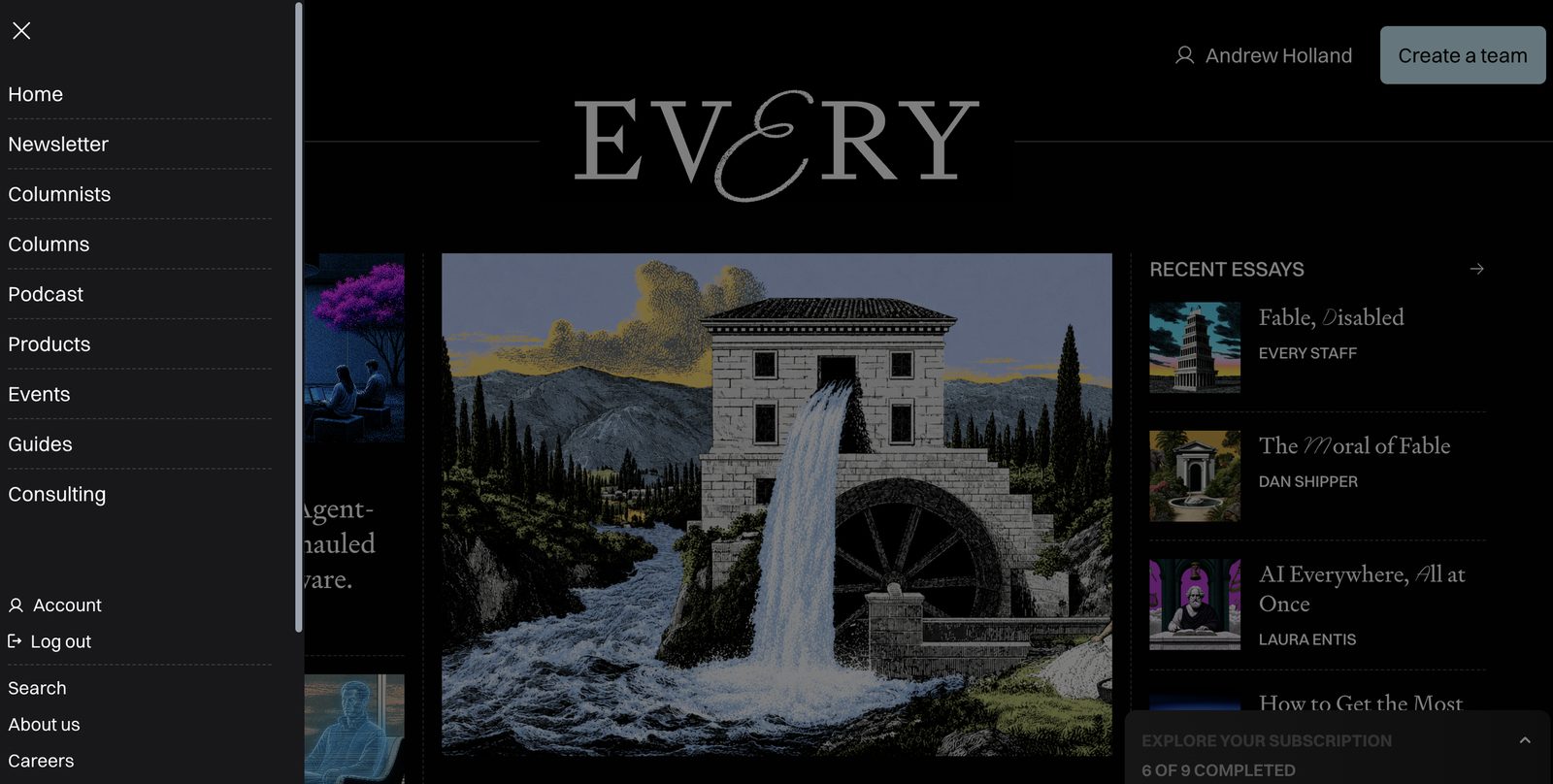
It is not just a newsletter. It is media, consulting, tools, paid access and a point of view wrapped into one business.
The subscription is not simply paying for articles. It is paying to be closer to the thinking, the tools and the people shaping that thinking.
More businesses should look at this model, without immediately turning it into another grim online course funnel.
A bakery could create a paid membership teaching home bakers seasonal recipes, cake decoration, party planning and behind-the-scenes product development.
A digital PR agency could build a training community for traditional PRs who need to understand digital PR, reactive campaigns, data-led stories and journalist outreach. A B2B SaaS company could create a paid operator community around the problems its product solves.
Not every business needs a subscription.
Do not turn your plumbing company into a “membership ecosystem” because some growth bro said recurring revenue on a podcast.
But most businesses have more valuable knowledge inside them than they realise.
The question is whether that knowledge is commodity information or transformational access.
Patronage works when people are not merely buying content.
They are buying proximity to judgement.
And in an AI-search world full of infinite answers, judgement becomes worth paying for.
The mechanics of growth have not changed. The interface has.
The mechanics of brand growth have not magically changed because a chatbot can write your meta descriptions.
Brands still grow through availability. Mental availability: being thought of in buying situations. Physical availability: being easy to find and buy. They grow through fame, memory, distribution, trust, salience, proof, reach and repetition.
They grow because more people know them, remember them, search for them, mention them, review them, cite them and recommend them.
The interface has changed.
The internet is no longer something we only search. It is becoming an intelligence layer. ChatGPT, Gemini, Meta, Perplexity, Google, YouTube, TikTok, Reddit, marketplaces and private communities are all part of a messy recommendation network.
The battle is for visibility inside that network.
And visibility is getting harder.
Organic reach is down. Paid media is expensive. Search clicks are under pressure. PPC is increasingly automated. Social media is turning into TV with comments. The old lazy playbook of “publish five blog posts and wait” is dead, and good riddance.
But the answer is not panic.
The answer is to build things that cannot be copied easily.
That is Kelly’s real lesson.
AI can copy your words. It can summarise your articles. It can imitate your structure. It can produce a thousand versions of your how-to guide before lunch.
But it cannot easily copy your speed to value, your specific positioning, your judgement, your accumulated proof, your accessibility, your real-world presence, your direct audience or your reputation as a trusted recommender.
Those things have to be grown.
Cultivated.
Earned.
That is why they are valuable.
Do work that matters for people who care.
Seth Godin said that years ago. It still holds up.
Because in the AI era, the machine might summarise everything.
But it will still have to recommend someone.
Andrew Holland
Originally published on LinkedIn on 18 June 2026.