
I opened LinkedIn the other day and saw that another entire SEO department had been canned.
Not one junior. Not a restructuring euphemism. A department.
And, honestly, it did not surprise me. It was simply another visible consequence of the SEO industry spending the last two years repeatedly punching itself in the face while insisting it was adapting.
The rise of generative engines gave the industry a rare opportunity. Search was clearly changing. Google was putting generated answers inside the search experience. ChatGPT had trained millions of people to ask complex questions instead of typing two-word queries. Brands were beginning to appear inside answers, shortlists and recommendations rather than merely beneath ten blue links.
The intelligent response would have been humility.
“We do not fully understand this yet. The system is changing. Let’s investigate it.”
Instead, a familiar collection of SEO influencers (you know who they are) reached an immediate and remarkably confident conclusion: generative engine optimisation was not a thing. GEO was “just SEO”. Anyone suggesting otherwise was a grifter.
There was no diagnosis. No meaningful debate. Just a meme.
Then, with exquisite predictability, many of the same people who said GEO did not exist began describing themselves as AI SEO experts, GEO consultants and authorities on LLM visibility.
Phenomenal.
The important part is the commercial damage this denial caused.
The SEO industry had a chance to explain a genuinely new problem, create interest around it, build new budgets and develop better services. Instead, it told clients that nothing had changed while the economic foundations of traditional SEO were changing underneath them.
Then came the tactics.
The great AI visibility pantomime
The first big idea was “AI visibility”.
Tools took keyword lists, converted them into prompts and repeatedly asked language models questions. They then reported which brands or pages were cited.
This was presented as visibility.
But visibility to whom?
You do not know the prompts I use. You do not know the prompts your customers use. You do not know what personal context a platform has, which retrieval queries it generates, which sources it reaches, what recent history it considers or how its answer changes across billions of possible conversations.
The platforms selling these measurements do not know all of that either.
That does not make the tools useless; they genuinely are. It just made the first grab metric commercially useless. And business owners and marketers realised it.
Synthetic prompts are intelligence samples. They are not the market. They provide directional evidence about how models may respond to plausible buying situations. That is useful. Pretending they show your true share of AI visibility is not.
Worse, the objective quickly became increasing citations.
Not increasing recommendations. Not increasing branded demand. Not getting onto a buyer’s shortlist. Not creating preference or sales.
Citations. Getting your content cited in an AI response you can’t see.
That is not a commercial strategy. Any half-decent marketing manager saw that one easily.
Next came content chunking: reorganise pages into neat sections so AI systems could consume them more easily.
Again, not inherently stupid. Clear information is useful. But where was the commercial story? Why should a business optimise its content purely to become more digestible raw material for a machine?
Then schema. Schema for this. Schema for that. Schema for everything.
Structured data can be valuable, of course. Most competent websites already use it. But no quantity of markup can rescue weak positioning, an invisible brand and an internet footprint built from paid guest posts.
The industry had spent years selling a simple economic chain:
Rankings create traffic. Traffic creates leads, audiences and sales.
Generated answers weakened that chain. Fewer informational journeys needed to reach the publisher’s website. Yet the industry did not build a convincing replacement. It offered citation counts, technical files and machine-readable helpfulness.
Businesses are not stupid. Eventually, someone in finance asks what the activity is supposed to produce.
That is why the industry’s current problems cannot be blamed entirely on AI, Google or difficult economic conditions. SEO has damaged itself by refusing to describe the change honestly and failing to produce a coherent commercial response.
This is an information problem, not merely a ranking problem
I see this change through a different lens because, before marketing, I spent 20 years as a police officer. A large part of that career involved covert intelligence.
My job was to recruit informants, gather fragments of information and build a picture around criminal networks that were mostly hidden from us.
We could see the outcomes. Burglaries. Vehicle theft. Drug supply. Criminals becoming wealthier.
What we could not see was the complete network underneath: who was working with who, where stolen goods were moving, when drugs would arrive or which address would hold the evidence.
We had to increase certainty.
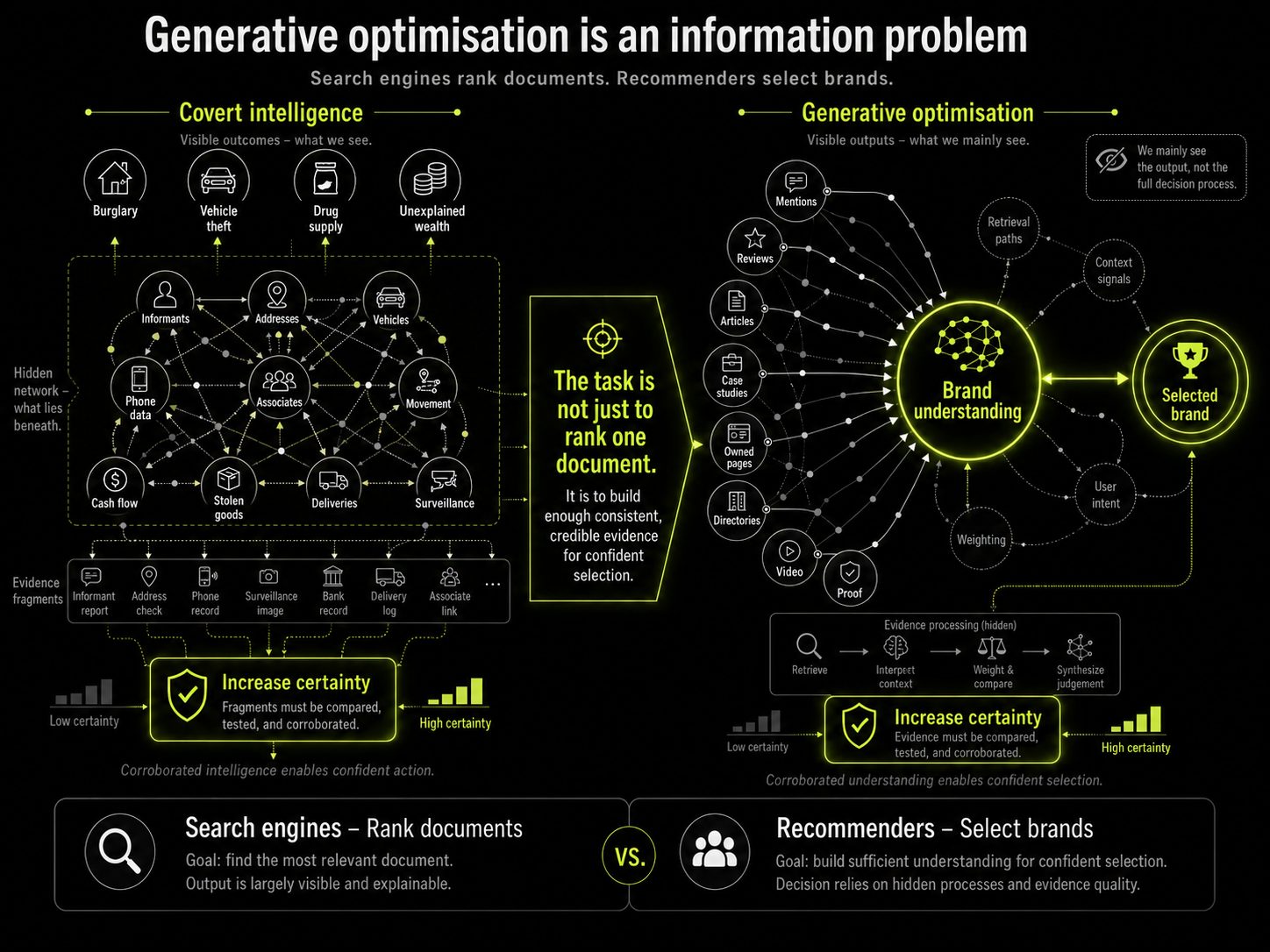
Before a force committed expensive surveillance teams or put officers through a door, the intelligence picture had to become strong enough to justify action. One fragment was rarely enough. Information had to be compared, tested and corroborated.
That experience is directly relevant to generative optimisation.
AI systems sit across a vast information network. We cannot see the whole decision process. We do not know every source, every retrieval path, every weighting or every piece of personal context. We mainly see the output.
The task, therefore, is not simply to make one document rank first.
It is to build enough consistent, credible evidence across the information environment that a system can confidently understand what your brand is, which problems it solves and when it should be selected.
Generative optimisation is not primarily a ranking problem.
It is an information problem.
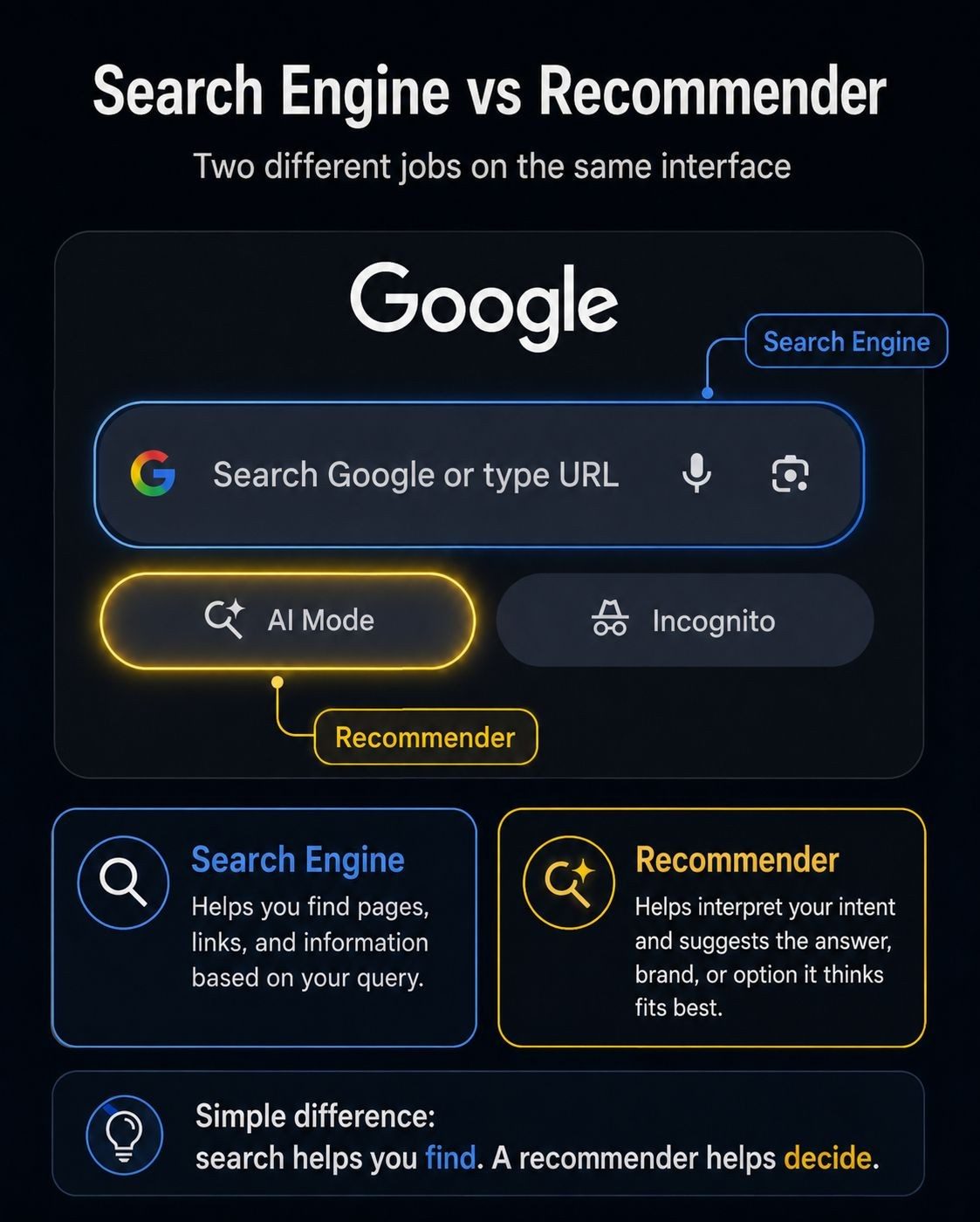
Search engines rank documents. Recommenders select brands.
This is the distinction the “it’s just SEO” crowd keeps refusing to confront.
Traditional search primarily ranks documents. A user types a query. The engine identifies relevant pages and orders them. SEO improves a page’s chances of appearing near the top.
A recommender performs a different task.
It interprets the user’s situation. It may break the request into smaller questions. It retrieves evidence, identifies candidate products or services, associates those candidates with attributes and selects the options that appear most suitable.
Search asks: which documents should be presented?
Recommendation asks: which options best fit this person, problem and context?
The outcomes can overlap. A ranking page may become evidence for a recommendation. But a ranked page and a selected brand are not the same thing.
YouTube has demonstrated this for years.
Yes, YouTube has a search engine. Brands used to ask me how to optimise videos for specific queries. Titles, descriptions and topics could help. But search was never the biggest growth opportunity.
The real prize was recommendation: the home feed, suggested videos and the next video the system believed a viewer would watch.
MrBeast did not become MrBeast by discovering a better keyword spreadsheet. He created videos that generated enough viewer response for YouTube to keep recommending them.
Ranking gets you listed.
Recommendation gets you chosen.
Google is moving further into this world. Its generated search experiences do not simply provide pages. They interpret needs and recommend brands, products and services. ChatGPT does the same.
So do Netflix, Facebook, TikTok and almost every major platform forced to choose from more content than any human could possibly inspect.
The internet is becoming a recommender environment. Yet much of SEO is still pretending the page ranking is the entire game.
A two-second experiment that breaks the “just SEO” argument
I ran a deliberately small test when writing this article.
I opened Google in incognito mode and searched for “best digital PR agency”. Then I compared the conventional organic results with the agencies recommended by Google’s AI Mode.
Under that broader comparison, the AI Mode set was approximately 83% different from the visible organic result set.
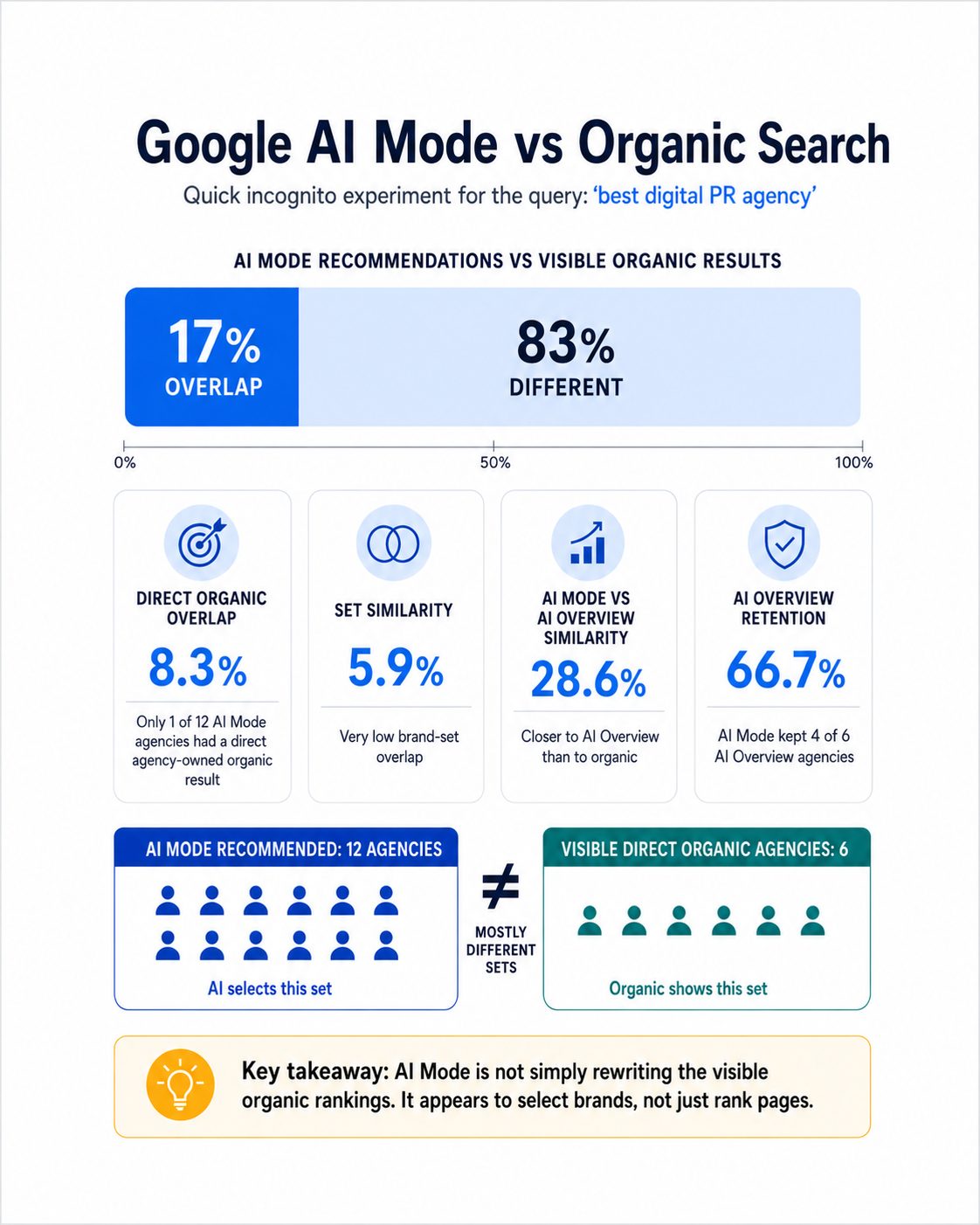
Interestingly, AI overviews were more closely aligned with AI mode, a 66% match. But still, highly different from the organic results.
This was not an academic study. It was one query, performed once. Location, freshness, query interpretation and Google’s own experimentation can all change the answer. Incognito mode does not remove every contextual signal.
But the test does not need to prove a universal divergence rate.
It only needs to destroy the simplistic claim that AI Mode merely takes the top organic results and rewrites them into prose.
Perform your own tests, I urge you to. But what you’ll find is that AI does not produce stable responses. It changes like the wind, does not reflect organic results, and differs from AI overviews and organic rankings for like-for-like searches.
Proving beyond any doubt that ‘it’s not just SEO’.
Once you realise this you can move forward, and here’s a plan you can use.
Step one: gather recommendation intelligence
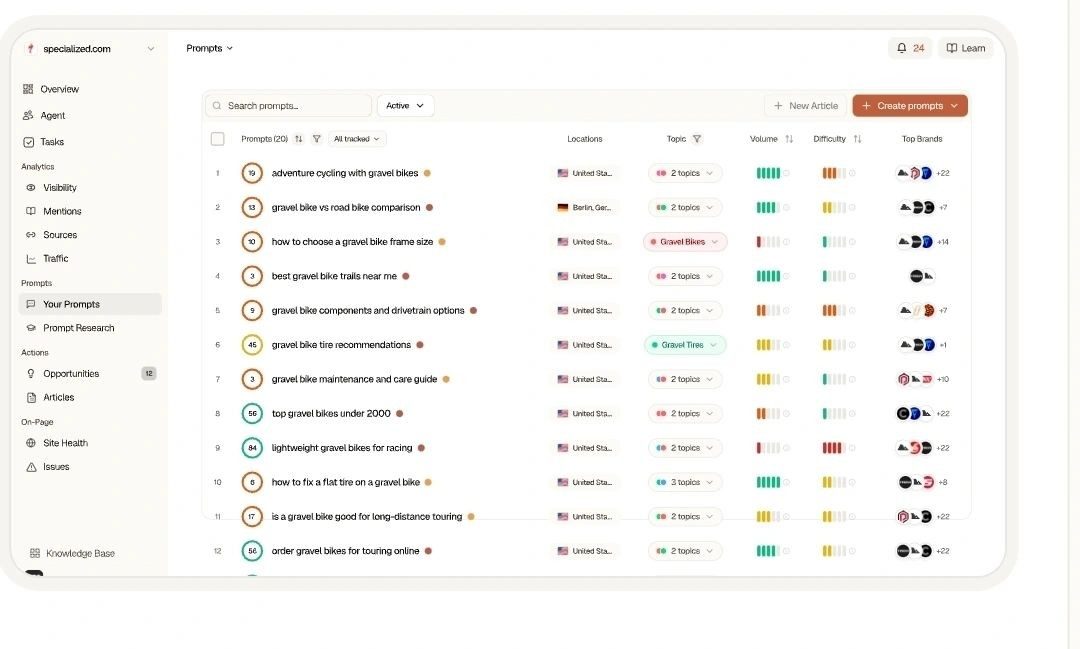
Because the system is opaque, the first practical task is intelligence gathering.
Tools such as Profound Searchable Semrush Ahrefs and our own JBH Fame Engine can probe plausible buyer-intent scenarios and show which brands survive into the recommendation process.
Use them to ask:
Which brands are being recommended?
For which situations?
What attributes are attached to them?
Which sources appear to shape the answers?
What changes when a broad request becomes highly constrained?
Where is your brand absent, misunderstood or weakly evidenced?
This is not omniscient visibility measurement. It is market intelligence.
It is incomplete. Marketing data often is. That does not make it commercially useless. It gives you a directional picture of the recommendation landscape and helps you make better decisions about where to invest.
Broad requests will often default to the largest, most famous brands because those brands have enormous information footprints. Constrained requests force the system to work harder. That is where smaller, well-positioned brands can become plausible candidates.
The goal is not to appear for every imaginable prompt.
It is to maximise the number of relevant purchase situations in which your business genuinely deserves to be selected.
Step two: fix your positioning
Most brands are not just under-optimised. They are under-positioned and under-described.
Positioning is marketing 101:
What problem do you solve?
Who do you solve it for?
How do you solve it better than the alternatives?
What proof shows that your approach works?
For years, many websites answered those questions badly because good copy was expensive. A competent copywriter could add thousands of pounds to a relatively small website build.
Large ecommerce catalogues made bespoke product copy economically painful. I once spoke to a luxury bathroom retailer with roughly £7 available per product page. There was no viable way to produce excellent individual copy at that budget.
SEO made the problem worse.
The industry inspected ranking pages, copied their topics, expanded the word count, built links and called the result optimisation.
Search for car insurance and you will find pages repeating the same explanations in slightly different orders because everybody copied the pages already ranking.
Pages became longer without brands becoming clearer.
Recommendation systems need something different. They need performance attributes: the features, capabilities, materials, processes, audiences, use cases and evidence that explain why a product or service suits a particular situation.
Start with the pages that define the business:
Your homepage. Product pages. Service pages. Category pages. About page. Important use-case pages.
Audit them from a recommendation and copywriting perspective.
Do they clearly explain what the product is, who it serves, why it exists, how it works, what makes it different and what evidence supports the claims?
This is closer to conversion optimisation than traditional SEO.
No one says a page change made to improve conversion is “just SEO”. The same logic applies here. The surface may be a webpage, but the objective and success criteria are different.
The copy should be informationally efficient. This is not permission to add another thousand words of sludge. Supply the decision-relevant information with as little waste as possible.
Sometimes that means improving an existing page. Sometimes it means creating a new asset for a genuine recommendation situation.
A steak restaurant in London might need a pre-theatre dining page because that is a real customer need. If it has exceptional allergy procedures, it may need a dedicated page explaining them.
Do not create infinite pages because a tool generated infinite prompts.
Create assets where a distinct, commercially relevant customer situation justifies them.
Step three: create content with real-world marketing value
My rule is simple:
Everything you publish must have real-world marketing value at the point of publication.
Put the asset in front of a genuine potential customer. Does it help that person understand what you do, why it matters, how you solve the problem or why they should choose you?
If not, do not create it merely to feed a machine.
Recommendation intelligence should generate content ideas, not dictate automated production.
Suppose you sell boxing gloves with a wrist-wrapping system specifically designed to reduce injury. That attribute should be encoded clearly on the product page.
But it should not stop there.
Create useful material explaining common wrist injuries in boxing. Run a data study. Ask real boxers to test the glove against alternatives. Publish the methodology and results. Turn the findings into video, email, social posts and sales material.
That is useful to consumers. It gives the brand something meaningful to say. It also creates repeated evidence connecting the product, the injury problem, the wrist-support attribute and the proof.
This is not another generic article about why dogs wag their tails because a keyword tool showed volume.
It is non-commodity content built from the brand’s positioning.
SEO was primarily a pull model. Publish content and wait for people to retrieve it through search.
Brands now need to push a coherent narrative into the market.
Use email. LinkedIn. YouTube. TikTok. Communities. Events. Paid social. Turn articles into videos and videos into articles. Put genuinely useful assets in front of the audiences they were created for.
Some content deserves paid amplification because it educates the market and builds demand. That is not a failure of organic reach. It is distribution.
Meaningful interactions with people create meaningful evidence for machines.
Step four: get credible people to talk about you
What a company says about itself matters.
What independent people say about it matters more.
This is the earned-media part of the framework: reviews, journalist coverage, expert commentary, creator testing, customer stories, research citations, events and relevant links.
You must become a credible source of knowledge about the problem you solve.
That authority is earned through graft. Put the product into the market. Produce evidence. Help journalists understand the category. Respond to relevant requests. Give specialists useful information. Encourage legitimate reviews. Create activity that causes further activity.
A hotel in Jamaica might invite a relevant travel creator with a genuinely engaged audience to experience the property and review it.
A software company might publish research that journalists need.
A specialist consultancy might supply expert commentary when a news story touches its area of expertise.
This is not industrial link building.
For years, much of “authority building” meant paid guest posts, anchor text and placements acquired because a domain had an attractive score in an SEO tool. Sometimes the brand was barely mentioned at all.
A recommender needs contextual evidence.
It needs credible third parties repeatedly connecting the brand with the right category, audience, capability, problem and result.
Links remain useful. But they should increasingly be an outcome of meaningful publicity, not the only reason the publicity exists.
Look at your current evidence architecture.
How often is the brand mentioned by relevant media?
When was the last meaningful linked mention?
Are people reviewing the product?
Is the brand repeatedly associated with the attributes it wants to own?
Is anyone searching for it?
If the answer is “not much”, schema will not save you.
Measure business outcomes, not machine applause
Recommendation optimisation is harder to measure than rankings because the complete input and decision process are invisible.
That does not mean you abandon measurement.
Track a stable sample of plausible buyer scenarios over time. Monitor recommendation presence, associated attributes, cited sources and competitor movement. Treat that as an intelligence panel, not universal truth.
Then monitor the outcomes that matter.
Share of search is one of the first places to look. Are more people searching for the brand relative to competitors? Tools such as MyTelescope can help examine branded demand across Google, YouTube, TikTok and other platforms.
Track meaningful media mentions, not merely link counts.
Track traffic to product and service pages.
Track branded organic traffic, direct traffic, enquiries, assisted conversions, reviews and natural link acquisition.
LLM referral traffic is useful too, but it is only one signal. Many AI-influenced journeys will not produce a neat referral. A recommendation may lead someone to Google the brand, visit later, ask a colleague or purchase through another channel.
I recently used ChatGPT to help identify a hair product matching my wife’s colour. We supplied images and context. The system narrowed a vast category to a small number of suitable products and explained what to buy and what to avoid.
That interaction then triggered branded Google searches and a purchase.
ChatGPT shaped the shortlist. Google completed part of the journey. The retailer got the sale.
That is how messy recommendation-led discovery can be.
Never celebrate rising synthetic visibility while branded demand, commercial traffic and sales are falling.
Why GEO has to exist
The predictable response to all of this is that improving pages, creating content and doing PR are already parts of SEO.
But which part is uniquely SEO?
A copywriter improving a page for conversion is not doing SEO merely because the page exists on a website. A PR team earning coverage is not automatically doing SEO because an article contains a link.
The distinction lies in the objective, diagnosis, method, budget and measurement.
SEO seeks ranked visibility for documents.
GEO seeks brand selection across relevant recommendation situations.
SEO can be one input. So can digital PR, content marketing, conversion work, research, paid distribution, reviews and brand building.
Someone has to decide which activity deserves budget based on what the recommendation landscape is showing. That person cannot simply protect an SEO retainer and call every possible tactic SEO.
This is why the SEO industry needs to become much bigger than SEO.
Many practitioners are not currently equipped for that job because they were trained to optimise documents, build links and report traffic. The new task requires market intelligence, positioning, copywriting, content strategy, PR, distribution, brand measurement and commercial judgment.
That will require more serious budgets, not less, because many businesses have spent years failing to build a proper brand online.
They look identical to competitors.
Their positioning is weak.
Their product pages are thin.
Their backlink profiles are held together by paid placements.
Nobody meaningful talks about them.
Nobody searches for them.
And then they add an llms.txt file and wonder why ChatGPT does not recommend them.
The good news is that the answer is not a secret technical hack.
It is real marketing.
Clarify the position. Improve the product and service story. Create useful evidence. Distribute it. Earn credible coverage. Measure whether demand and commercial attention are growing. Keep probing the recommendation network and use the intelligence to make better decisions.
Search marketing now has to account for selection, not just retrieval.
Brands do not need more content for machines. They need clearer positioning, stronger proof and more credible encounters across the market.
Rankings made pages visible.
Recommendations make brands viable.
Learn the difference before the next SEO department disappears.
Andrew Holland
Originally published on LinkedIn on 8 June 2026.