
Most GEO strategies are not strategies. They are measurement programmes dressed up as plans.
Someone buys a tool. The tool produces numbers. The numbers go into a deck. The deck gets presented. Someone asks what we’re doing about it. Someone else proposes more content and better prompts. The numbers are tracked. The cycle repeats. Nobody asks whether any of it is working commercially, because the question would require admitting the whole thing is optimised around the metric rather than the mission.
That is the GEO problem.
The AI Visibility technology and tools are genuinely useful – they let you probe buying situations, see which brands are being recommended, identify which sources are being pulled into answers, spot which publishers appear repeatedly, and understand the types of content that reduce uncertainty for buyers and algorithms alike. Used properly, they’re intelligence machines.
The problem is that too many people are using them to produce vanity metrics. Prompt visibility. Citation share. AI rankings. Recommendation scores. A nice little circus of new numbers that look impressive in a board deck and may or may not have anything to do with whether customers choose you.
When you chase the wrong metrics, you build the wrong strategy. And the wrong GEO strategy won’t just waste your budget. It’ll make you invisible in the exact buying situations you need to win.
GEO is not SEO in a New Jacket
The first mistake is treating generative engine optimisation as SEO in a new jacket.
It’s not.
Classic SEO was built around pages, keywords, rankings, links and clicks. Yes, good SEO was always more sophisticated than that, but the operating model was relatively clear. A user typed a query. Google returned results. You appeared in those results. The user clicked.
AI search is different. When a buyer goes to ChatGPT, Google’s AI Mode, AI Overviews or any other large language model, they’re often not looking for a list of blue links. They’re trying to solve a problem. They want advice, a shortlist, a recommendation, a comparison, a decision pathway, or the confidence to move forward.
In other words, they want the information to solve the problem.
A buyer asking “What is the best running shoe for my first marathon?” is not merely typing a keyword. They’re revealing a problem. They know they need a product. They know the context. They probably have constraints, budget, injury concerns, terrain, brand preferences, previous purchases, and all kinds of hidden information the model may or may not know.
You don’t see the full buying situation. You don’t see the user’s personal context. You don’t see every variation of the prompt. You don’t see the model’s training data. You don’t know exactly when it retrieves external sources, how it weights them, or which hidden signals shape the answer.
So the strategy cannot be “rank for prompts”. That’s keyword chasing with a shinier badge. We have enough of that already.
The better question, the strategic question, is: Does the model have enough information to confidently recommend you in as many buying decisions as possible?
That is the real GEO problem.
Information reduces uncertainty
This is where we need to leave the search conference stage for a moment and enter the much more useful world of information theory.
Jun Wu, the former Google engineer and author of The Beauty of Mathematics and Computer Science, makes a point that should be tattooed on the forearm of every marketer currently babbling about GEO. Information matters because it reduces uncertainty.
It’s the only way and is essentially what all GEO should be based on, the supply of enough information around your brand and its products/ services that an AI system recommends your brand because it’s the best fit to solve the user’s problem.
In his book, Wu uses the example of the Second World War. Stalin had Soviet troops stationed in Siberia but couldn’t easily move them to defend Moscow because he didn’t know whether Japan would attack north into Russia or south towards the United States. The uncertainty was existential. If he guessed wrong, the consequences were catastrophic.
Then came intelligence from Richard Sorge: Japan would move south. That single piece of information reduced uncertainty and allowed Stalin to shift troops west. The information changed the decision.
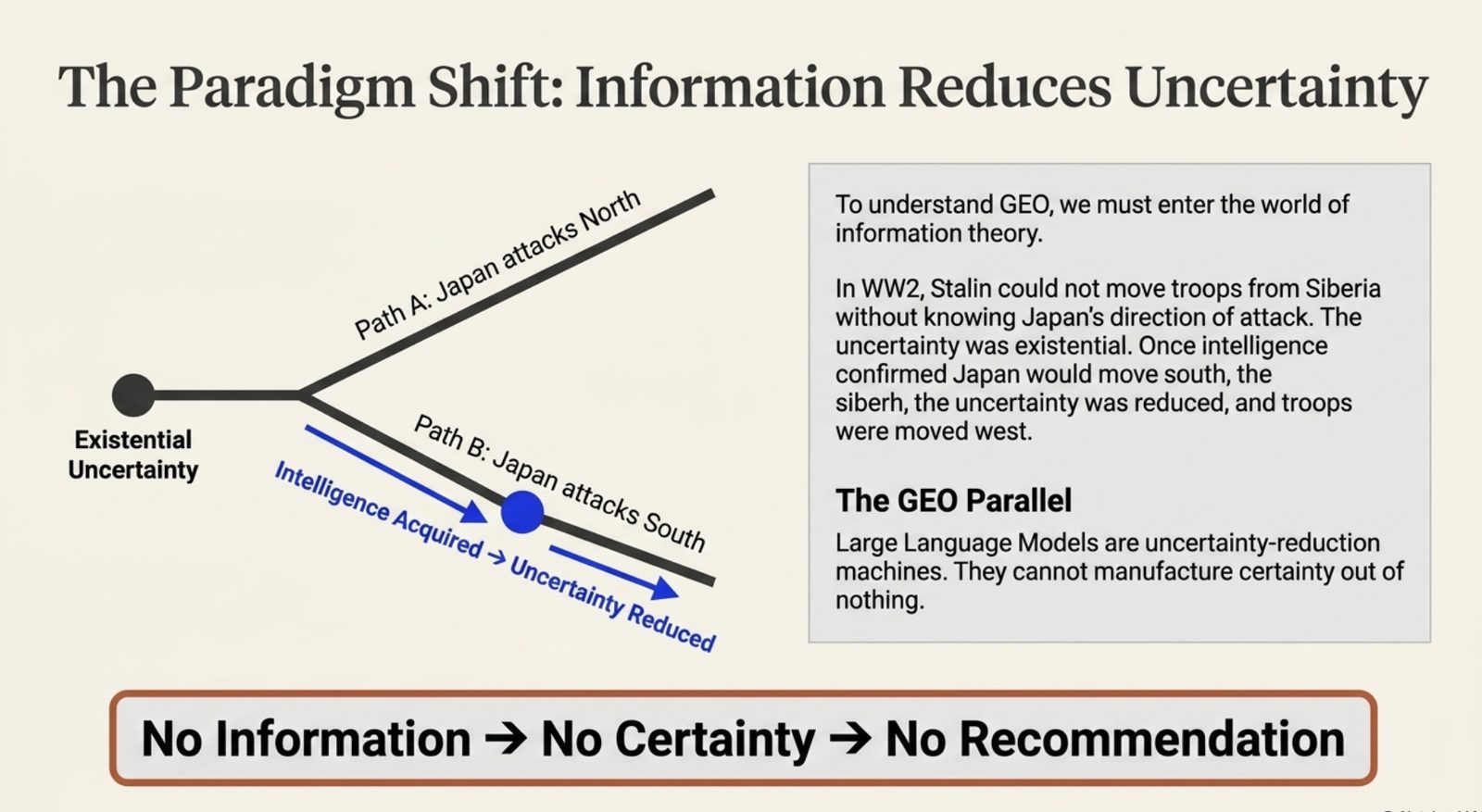
That is the principle. Information reduces uncertainty.
Without information, no expert, algorithm, formula, dashboard or self-appointed LinkedIn guru can manufacture certainty out of nothing.
This matters because large language models are uncertainty-reduction machines. A buyer asks a question. The model attempts to answer it. In commercial contexts, it must often decide which products, services or brands are worth recommending.
If the information around your brand is thin, generic, contradictory, absent, or buried in some self-indulgent SEO article nobody in their right mind would send to a customer, why exactly should the model recommend you?
No information. No certainty. No recommendation.
The rule for GEO content
Here is the rule.
Any content created for GEO must have real-world marketing value at the point of publication.
Not six months later. Not in the fantasy land where an article ranks for some long-tail query and a stranger magically turns into pipeline. Now. At publication.
Could you send it to your sales team? Could a customer learn from it? Could a prospect use it to make a better decision? Could a journalist cite it? Could a large language model use it to reduce uncertainty about the market, the problem or your brand?
If the answer is no, don’t publish it.
This is the great cleansing effect of AI search. It exposes how much content marketing was never really marketing at all. It was search litter. Commodity sludge. Articles created because a tool found a keyword gap and someone needed to hit a monthly content quota.
That game is dying. Good.
GEO content must be non-commodity. And yes, I know the Google search team are still calling it SEO, but newsflash, Google isn’t the only LLM. Meta AI has 1 billion monthly users, and nobody talks about it. Throw in Claude, Snapchat, ChatGPT, and others, and you see how GEO is a far better term.
It’s an expansive term. And it sits under the broader, more relevant term of brand visibility.
Brand visibility is the output. The channels and roles are going to be a colab of GEO, content, copywriting, PR, and yes…SEO.
Back to content.
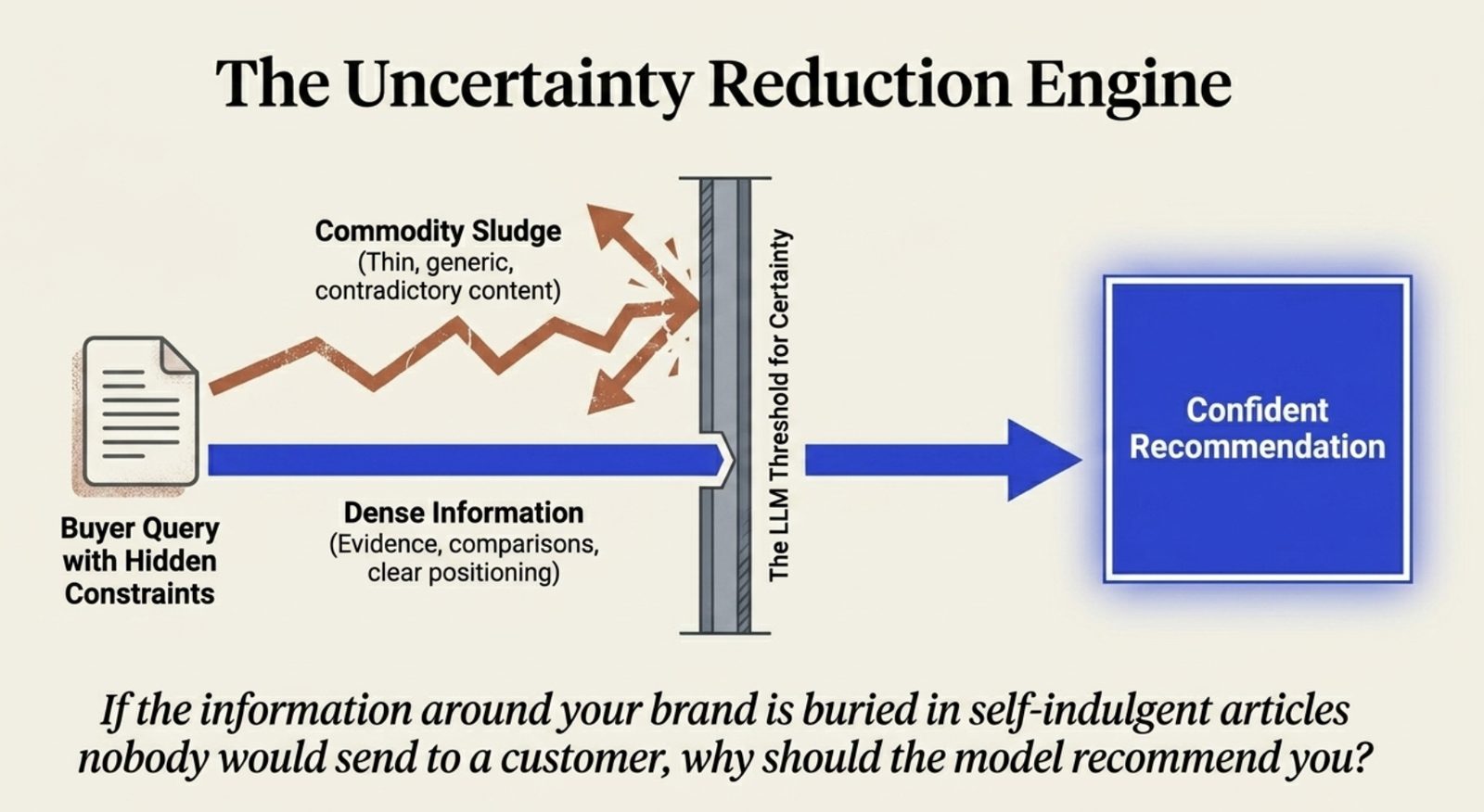
It must contain information the market actually needs. It must explain, evidence, clarify, compare, contextualise or prove something. It must help humans. And because it helps humans, it has a better chance of helping machines understand why you matter.
There are two types of information that do this most effectively: mutual information and mention information.
And these content types are central to your search strategy.
1. Mutual information: the content that makes you easier to recommend
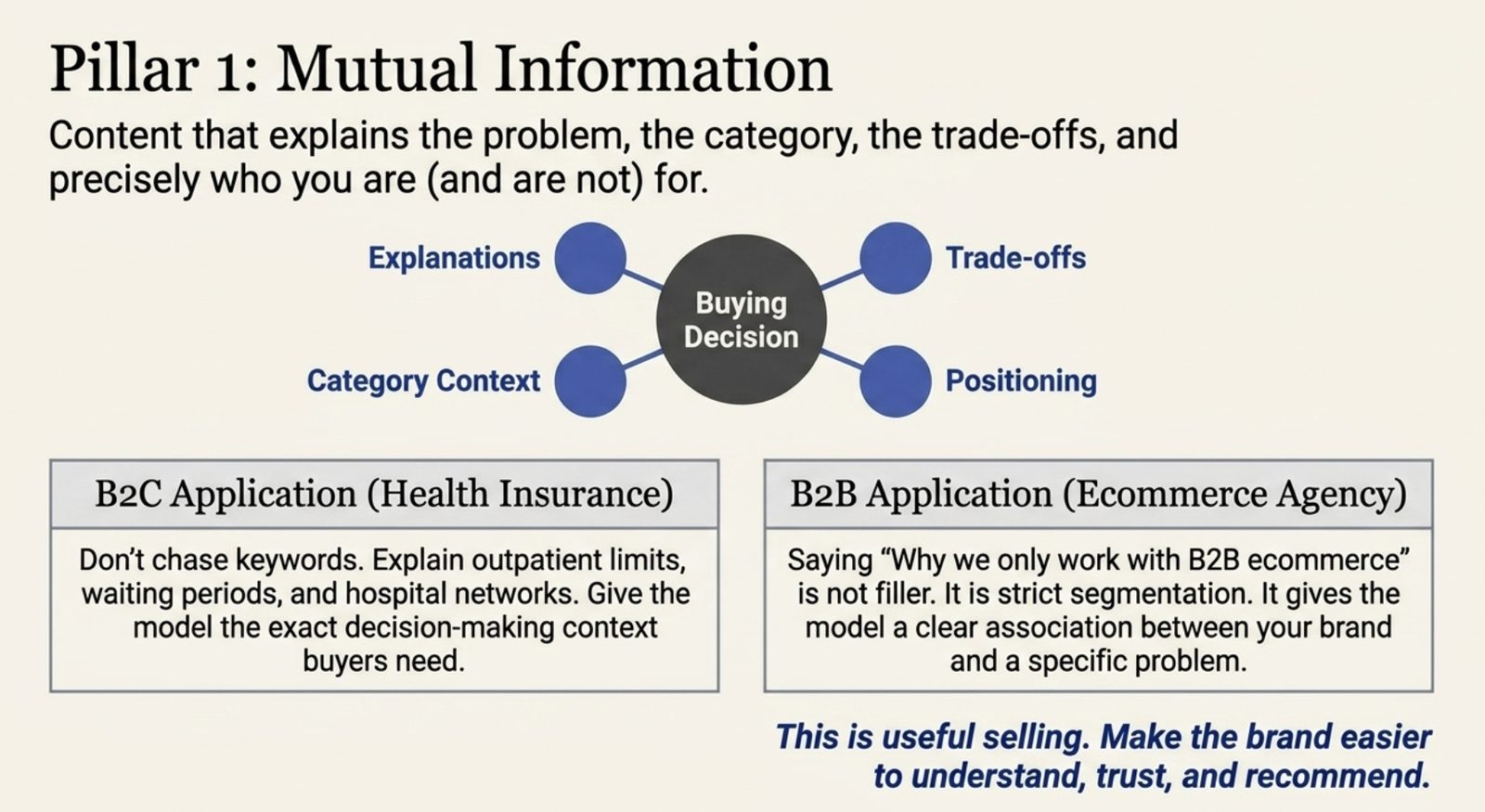
Mutual information is the content that reduces uncertainty. For brands, this means around a buying decision.
It explains the problem. It explains the category. It explains the trade-offs. It explains what buyers should consider. It explains why your product or service behaves the way it does. It explains who you are for and, just as importantly, who you are not for.
This is promotional content, but not in the cheap, shouty sense. It’s useful selling.
Say you’re a private health insurance provider and your analysis of AI answers around “best family health insurance” keeps surfacing content about outpatient limits, excesses, waiting periods, hospital networks and cover exclusions. That’s not random noise. That’s decision-making context.
The model is showing you the types of information being used to reduce uncertainty in the system. Your content plan becomes obvious.
You need owned content explaining those issues clearly. You need comparison content. Guides. Proof. Third-party references. You need to appear in relevant listicles and buyer guides. You need to explain why your cover is structured the way it is.
That’s not keyword chasing. That’s market orientation.
Or imagine you sell a cream for psoriasis. AI answers may pull from articles about ingredients, triggers, winter skin care, steroid versus non-steroid creams, customer reviews, dermatologist advice and best-product roundups. The point isn’t to slavishly copy the citations. The point is to understand the uncertainty being reduced.
What does the buyer need to know before choosing? What does the model need to understand before recommending?
That is your content brief.
The same applies in B2B. If you’re an agency that only works with B2B ecommerce brands, an article titled “Why we only work with B2B ecommerce brands” is not filler. It’s positioning.
It explains your market choice, your trade-offs, your expertise and your fit. It tells prospects whether they’re in or out. It gives the model a clearer association between your brand and a specific problem.
This is proper marketing. Segmentation. Targeting. Positioning. Not the usual “ultimate guide to digital transformation” stuff that nobody asked for and nobody finishes.
Mutual information should sit around your commercial pages like a support system.
At the centre is the revenue-generating page – your product page, service page, category page or brand page. Around it sits owned content explaining the claims, attributes and proof points on that page. Around that sits earned media, PR, influencer content, reviews and third-party commentary reinforcing the same themes in the wider market.
A two-layer hub and spoke model, if you insist on making it sound more complicated than it is.
The objective is simple: make the brand easier to understand, easier to trust and easier to recommend.
2. Mention information: the content that makes the network believe you exist
Mention information is different.
Mutual information can talk about the market, the problem and the decision. It doesn’t always need to mention you. Mention information does.
Mention information is when your brand is referenced by others in contextually relevant places. A journalist mentions you. A reviewer compares you. A customer talks about you. A trade publication cites you. A podcast discusses you. An influencer includes you. A listicle names you. A forum thread debates you. A publisher quotes your expert.
This is not just link building. That’s far too narrow and far too SEO-brained.
Links matter, of course. A link is a doorway. A link from a publisher can send real readers to your site and can also act as a signal in systems that care about authority. But mentions matter too, because they place your brand inside a topic, a problem and an expertise cluster.
“According to the experts at…” is not just a nice PR line. It’s contextual association. It tells humans and machines that your brand belongs in that conversation.
If you sell dog food for sensitive stomachs, you want to be mentioned in content about sensitive digestion in dogs, ingredient tolerance, vet advice, breed-specific problems, feeding routines and product comparisons. You don’t just want random links from random websites because someone found a cheap digital PR angle about “the most popular dog names in Britain”.
That might get links. It might even get a little coverage. But does it reduce uncertainty around the problem you solve? Does it reinforce your expertise? Does it help a buyer or a model understand why your brand should be recommended for sensitive-stomach dog food?
Probably not.
This is where a lot of digital PR has lost the plot. It became obsessed with acquiring links rather than building contextual authority. A skincare brand creating a strong psoriasis statistics report has relevance if it sells products for psoriasis or dry skin conditions. A skincare brand creating a generic “facts about feet” campaign because journalists might link to it is a different animal. Yes, feet have skin. Congratulations. So does your arse. That doesn’t make it strategically useful.
Mention information must be contextually relevant.
That means reviews matter. Listicles matter. Expert commentary matters. Advertorial can matter. Influencer content can matter. Social conversation can matter. Trade media can matter. Customer advocacy can matter.
Not because they’re all magic ranking factors, but because they increase the amount of relevant information in the network about your brand.
And the network matters.
The visible become more visible
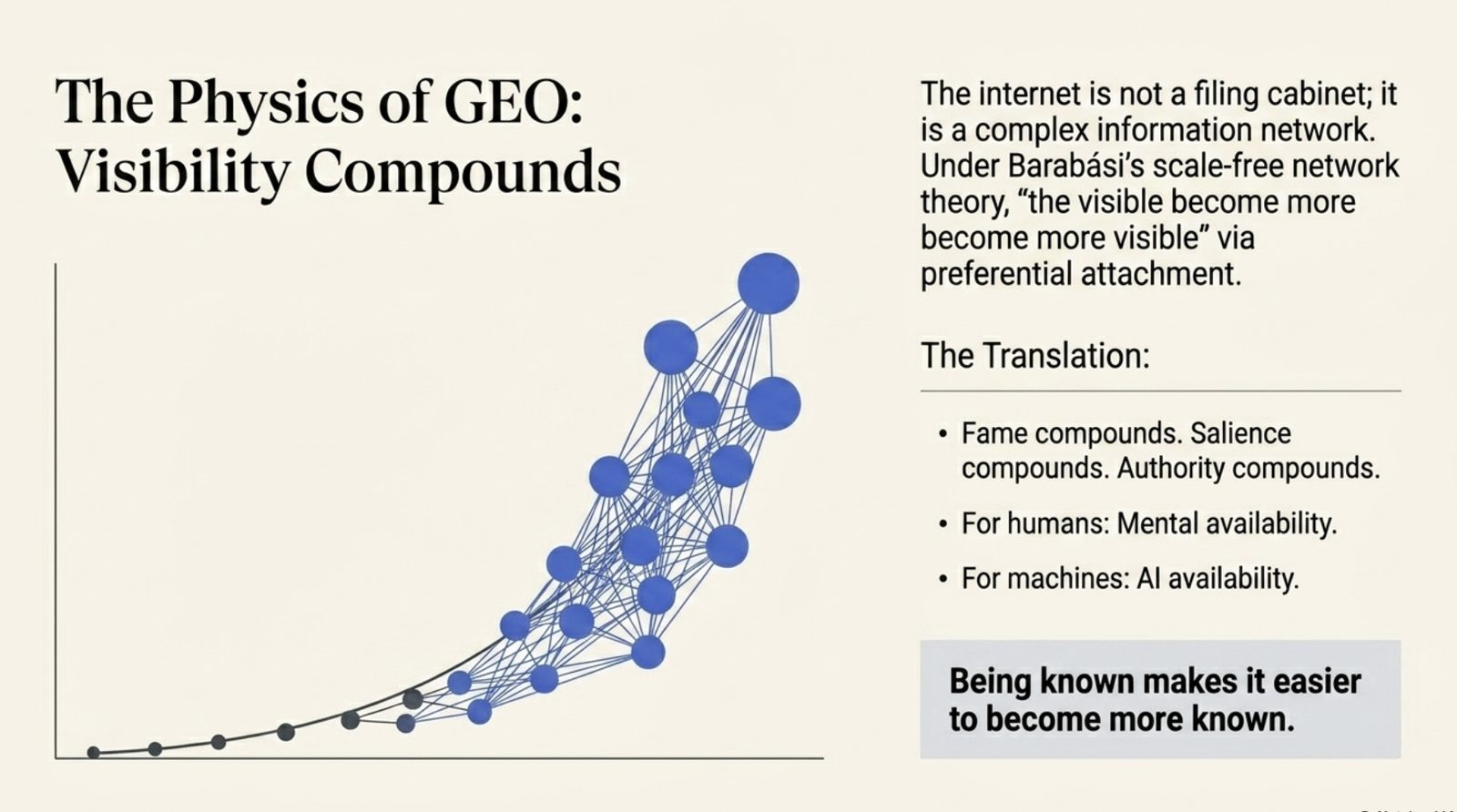
The internet is not a filing cabinet. It’s a complex information network.
Network science – particularly the work of Albert-László Barabási on scale-free networks – gives us a useful way to think about this. In these networks, visibility compounds. The visible become more visible through preferential attachment. Nodes that are already connected tend to attract more connections.
In marketing language, fame compounds. Salience compounds. Authority compounds. Being known makes it easier to become more known.
That is why GEO is much closer to brand building than most search people want to admit.
You’re not simply optimising a page. You’re trying to become more encountered across the network. More searched for. More mentioned. More linked to. More cited. More reviewed. More associated with the problems you solve and the buyers you serve.
For humans, we call this mental availability.
For machines, we might call it AI availability.
Different mechanics. Same strategic direction.
Be easy to think of. Easy to find. Easy to trust. Easy to recommend.
How to use LLM analysis tools as a strategy system
This brings us back to the tools – and to the strategy problem we started with.
The best use of LLM analysis tools is not to obsess over whether you appeared as citation number three in one synthetic prompt on a Tuesday afternoon. That’s useful to know, but it’s an input, not an an output. A diagnostic, not a strategy.
Here is how to use them properly.
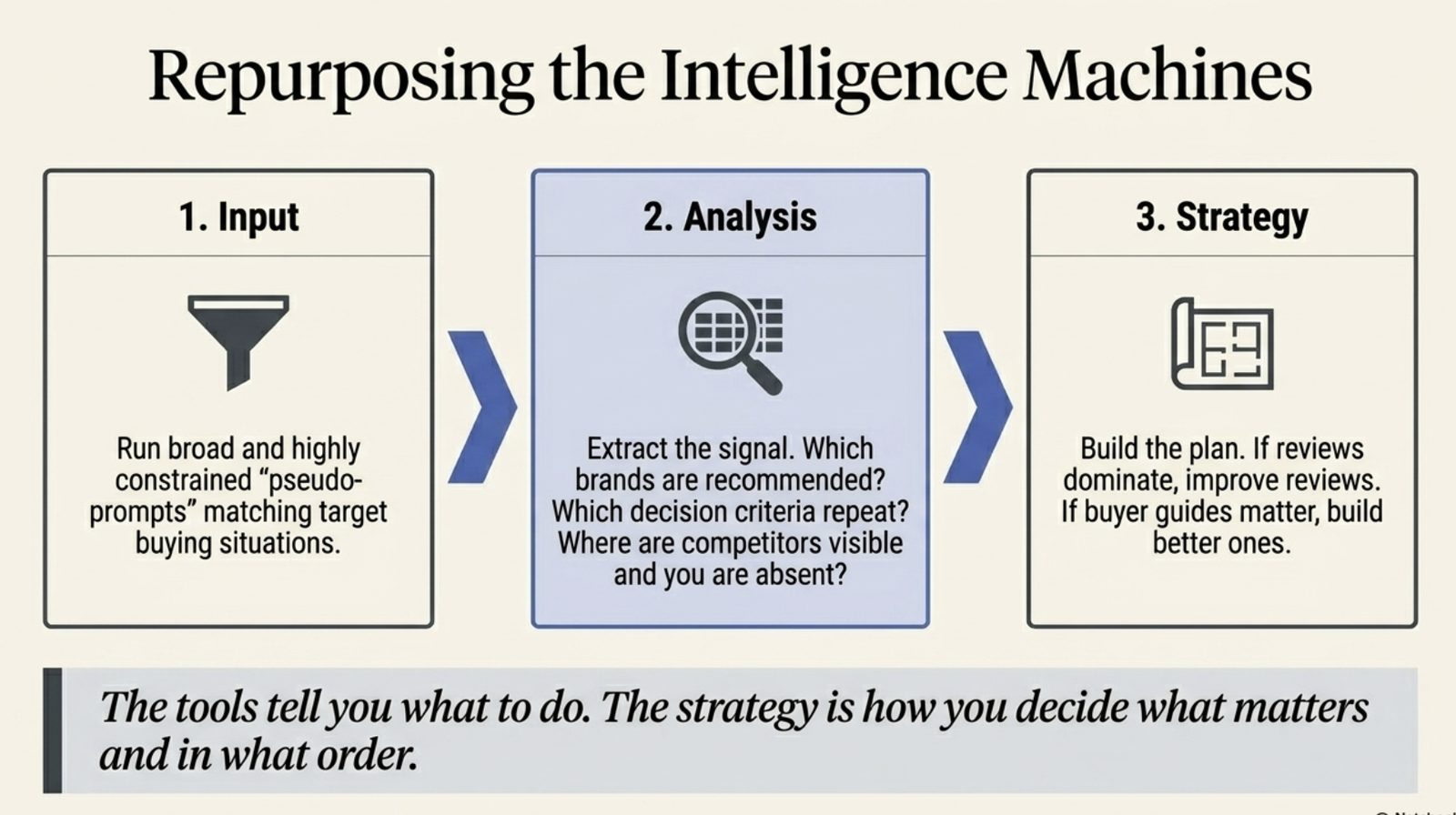
Create broad, medium-constrained and highly constrained pseudo-prompts around the buying situations you care about.
Analyse what comes back. Which brands are recommended? Which sources are cited? Which types of publisher appear? Which decision criteria keep repeating? Which proof points are present? Which content formats seem to matter? Where are competitors visible and you are absent?
Then build a content and PR plan from that intelligence.
If the model repeatedly uses buyer guides, get into buyer guides or create better ones. If comparison pages matter, build comparison content. If reviews dominate, improve review generation. If expert commentary appears, become a better source for journalists. If certain product attributes matter, explain them properly. If your commercial pages don’t make your positioning obvious, fix them.
The tools tell you what to do. The strategy is how you decide what matters and in what order – and whether the decisions you make are moving the commercial needle.
That requires separating the metric from the mission.
The mission is not “increase citation share”.
The mission is to increase the probability that buyers and machines understand, trust and recommend your brand in commercial decision moments.
Citation share may correlate with that outcome. It may not. You will only know if you’re measuring the right things further down the funnel.
What to measure instead
You still need metrics. Of course you do. We’re not finger-painting here.
But you need the right metrics.
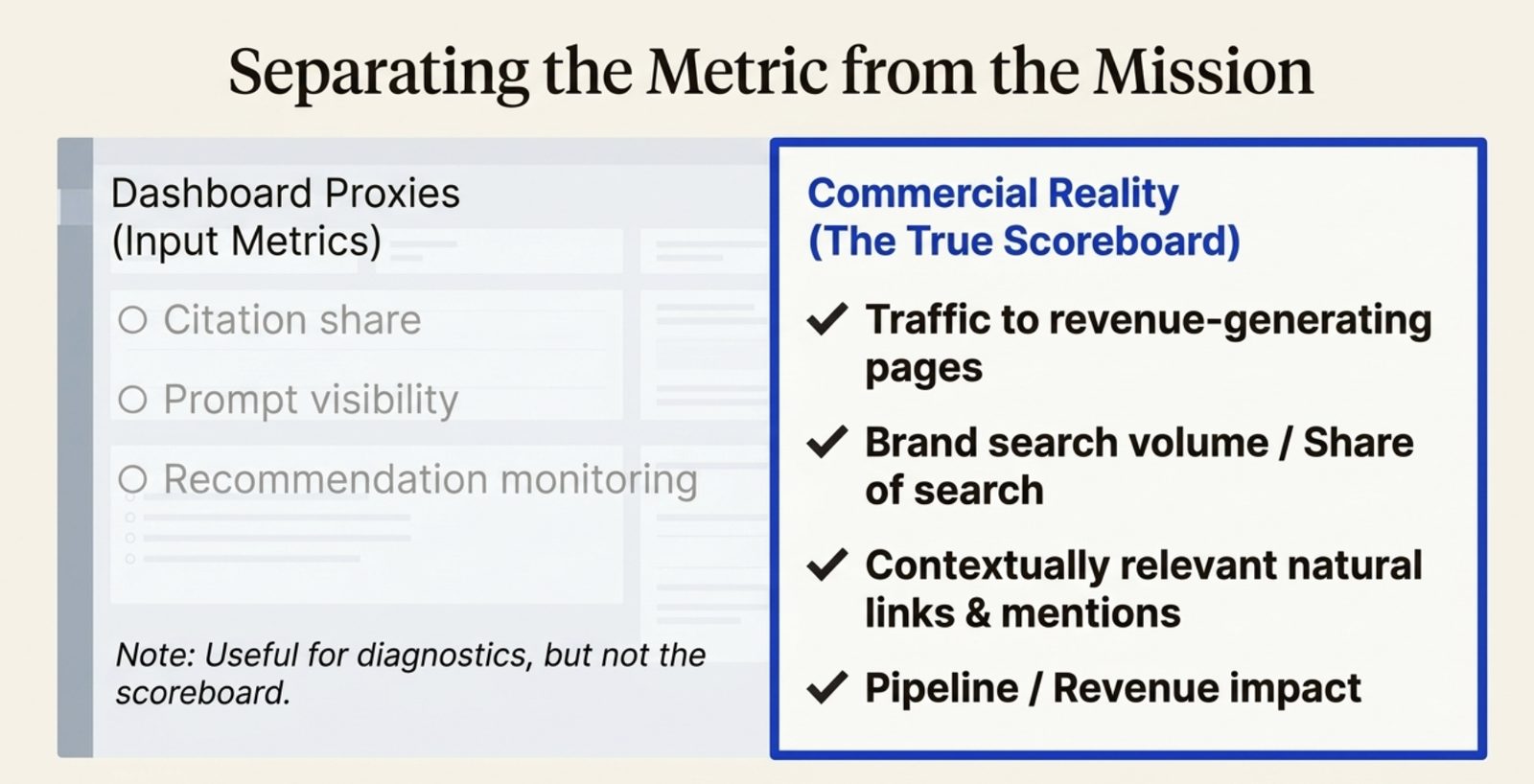
Track brand search. Track share of search. Track traffic to revenue-generating pages. Track natural links. Track contextually relevant brand mentions.
Track publisher coverage. Track reviews. Track whether you appear in buyer-intent pseudo-prompt analysis. Track whether the right product and service pages are being visited. Track revenue.
Citation tracking is useful. Prompt visibility is useful. Recommendation monitoring is useful. But they’re proxies. They’re not the scoreboard.
The scoreboard is commercial effect.
Are more people looking for you? Are more relevant places mentioning you? Are better sources linking to you? Are your revenue pages getting meaningful traffic? Are you being recommended more often in the buying situations that matter? Are sales improving?
If not, change the work.
That’s strategy. Diagnosis, action, measurement, correction. Not dashboard worship.
Stop producing content sludge
The implication of all this is wonderfully uncomfortable.
You can no longer hide behind content volume. You can’t publish generic articles and pretend you’re building authority. You can’t chase keywords, prompts, citations or links in isolation and call it GEO.
You need to supply the market with information.
Mutual information reduces uncertainty around the decision. Mention information reduces uncertainty around your authority. Together, they make your brand more visible, more understandable and more recommendable.
This is not a trick. It’s not a hack. It’s not a secret prompt framework sold by a man on LinkedIn with “AI futurist” in his bio and a Canva carousel addiction.
It’s marketing.
Understand the buyer. Understand the decision. Understand the category. Understand your positioning. Create useful information. Get mentioned in relevant places. Measure whether the market responds.
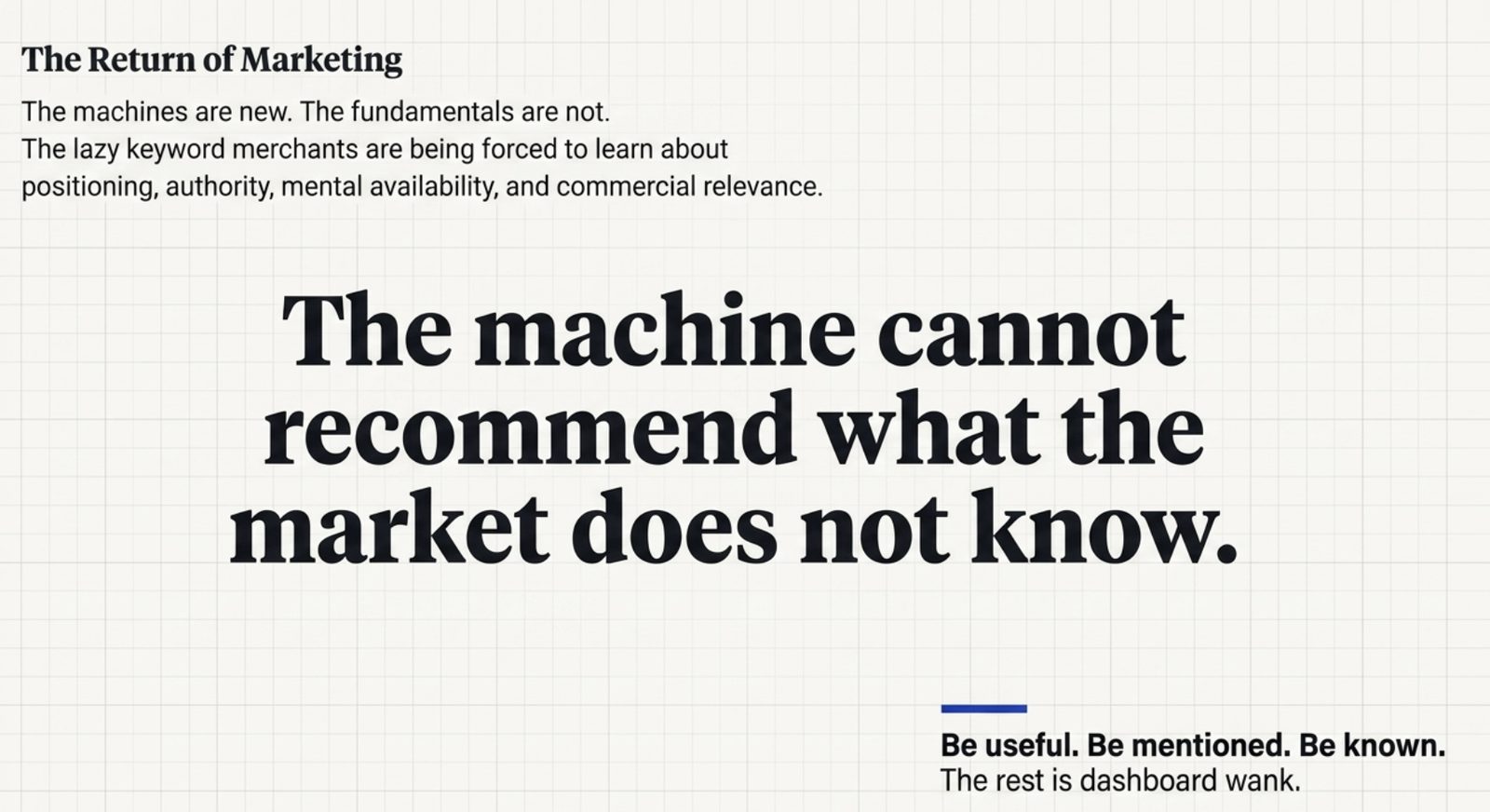
The machines are new. The fundamentals are not.
And that’s the bit many people in search still don’t want to hear.
GEO is not the death of marketing. It’s the return of it. The lazy keyword merchants are being forced to learn about positioning, authority, mental availability, category entry points, proof, distinctiveness and commercial relevance.
Welcome. You’re late, but we kept a seat.
Just remember the rule.
The machine cannot recommend what the market does not know.
Be useful. Be mentioned. Be known.
Andrew Holland
Originally published on LinkedIn on 3 June 2026.