Over recent weeks, the term Generative Engine Optimisation (GEO) has emerged as a hot topic, with SEOs, VCs, and tech specialists promoting it as distinct from traditional search engine optimisation.
While some SEO professionals have pushed back against this new terminology, GEO actually serves as an excellent framework for understanding how to optimise content for LLMs/ AI Search engines.
In this guide, I’ll guide you through the fundamentals of Generative Engine Optimisation, starting with a crucial revelation: keywords, as we know them, are no longer the driving force in search.
What is GEO?
GEO stands for Generative Engine Optimisation.
It’s the optimisation of websites for discovery in generative engines or LLMs, such as ChatGPT, Google’s AI mode, Gemini, and others.
The term started to gain traction following the release of this article on GEO by the Andreessen Horowitz (aka a16z) VC fund.
Is GEO Different From SEO?
One of the most significant battles in SEO right now is that people want SEO to apply to the entire AI search industry.
We are hearing how SEO is being called ‘Search Everywhere Optimisation’.
This is a mistake.
LLMs are entirely different beasts from traditional search platforms and social media, and as such, may emerge as a new default for search.
Also, SEO has a tarnished reputation in the marketing world.
So, GEO not only makes sense, because we are optimising brands for discovery by generative engines. Additionally, it allows the SEO industry to evolve.
Another thing to consider is that GEO is distinctly different from SEO.
Yes, there are crossover skills, but for many in SEO, namely content SEOs, this will require a massive shift in both thinking and skill set. As such, GEO provides SEOs with a new focus and indeed specific products to sell to customers.
The remainder of this article will be dedicated to how GEO is so radically different.
You will learn about the basis of GEO, along with other key concepts such as strategy and relevant examples.
But first, we need to head back to 2016.
By 2026, Google’s Main Product Will Not Be Search but AI
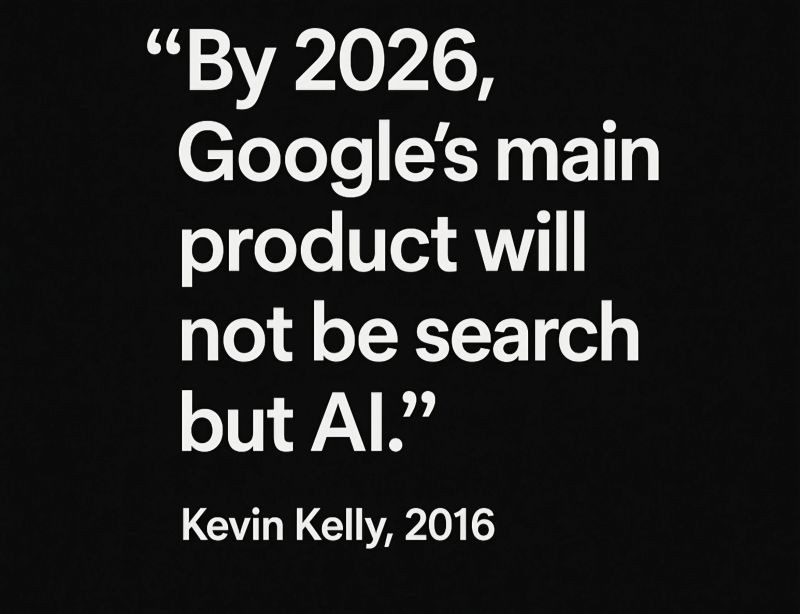
The above quote comes from Kevin Kelly in his 2016 book, ‘The Inevitable: Understanding the 12 Technological Forces That Will Shape Our Future.’
And yes, the accuracy of that quote is frightening.
The book is a must-read and, at the time of its publication, would have been considered a work of futurism.
However, there is one statement in the book that is possibly the most powerful for all working in search:
Being found is valuable. And given the exploding number of works created each day, being found is increasingly unlikely.
LLMs make it increasingly unlikely to be found.
We’ll discuss this further later in the article. However, it’s worth noting that LLMs pose a challenge to Google’s dominant position in paid search advertising.
At this time, LLMs are expensive to run, and while this cost will significantly decrease in the future, the paywall for usage remains a key issue.
LLMs might be loss-makers now, but they generate revenue through subscriptions.
And to steal a quote from the 16oz article referenced earlier:
While it’s possible that an ad market may eventually emerge on top of LLM interfaces, the rules, incentives, and participants would likely look very different than traditional search.
This is because LLMs change how humans access and use information.
And the science of information underpins everything behind LLMs.
So we need to give you a crash course.
The Evolution of Information (the fast track)
This is not an article on information theory, but to understand how massive GEO and LLMs are, you need to consider just how fragile the search market is.
Google’s usage only started to explode in 2000, after Yahoo had adopted it as their search engine.
In contrast, the Yellow Pages was founded in 1886 and printed its last issue in 2019.
So, while we consider Google a monopoly of search, in terms of human history, it’s just a baby.
Information science and theory have existed long before Google came along and will continue to exist long after; however, it’s also true that Google has made accessing the world’s information vastly easier.
And that’s part of their motto.
Their mission is well known:
“To organise the world’s information and make it universally accessible and useful”.
But as it turns out, being the best at organising the world’s information does not mean you have the best AI product.
And that’s because while organising information is great. Humans with problems to solve had to read and filter the information themselves.
Each click takes time.
Each page has to be read. (Well, those on page 1 of Google, anyway.)
AI changes this. Saving humans potentially hours in the future.
Information Foraging Theory
The foundation of my approach to GEO is built upon the groundbreaking work of Peter Pirolli and Stuart Card in Information Foraging Theory.
While I encourage you to explore their fascinating research independently, understanding the basics of information foraging will prepare you for the future of search optimisation.
Information Forging Theory (IFT) proposes that humans, as “informavores,” adapt their information-seeking strategies to the information environment to maximise the “gain” (relevant information) while minimising the “cost” (effort, time, cognitive load).
AI, therefore, becomes the dominant means for humans to gather information because it maximises the gain dramatically and minimises the cost.
This is also known as information gain rate.
I wrote about Information Gain Rate in May 2024 for Search Engine Land.
The equation is:
Rate of gain = Information value / Cost associated with obtaining that information.
In that same article, I stated that Information Foraging consists of several key parts:
“Patch
We decide on what source of information would best deliver our goal. This could mean that we go to Tripadvisor, TikTok, YouTube or any website/ search engine that comes to mind.
Forage
Here, we search for the information we need on the platform of choice. For this example, we’ll stick with Google. You type into the search engine keywords to try and find the information you need.
Scent
When we head to search engines, we’re looking for the scent of good information sources; signals such as reviews, higher rankings and page titles that encourage clicks.
We click on sites, scan information and decide whether to invest time reading the resource.
Diet
We consume information from multiple sources before making decisions. This is what Google refers to as the messy middle of search.
For brands/ sites, being part of your consumers’ information diet increases the propensity that they will come to depend on you for information and trust you.”
And it’s this that likely has Google so worried about ChatGPT and AI solutions.
AI takes care of all of our foraging for us.
It eliminates the ‘messy middle’ of search and eliminates the need for humans to search.
AI gathers data from its internal training. It also performs numerous searches, depending on personalisation and the user’s needs.
Fewer searches, less traffic, fewer clicks and of course, at the moment, there is no paid search in platforms such as ChatGPT and Google AI mode/ Gemini.
The result. AI poses a significant threat to Google’s current search model, and although the company has been utilising AI in its systems for years, it was caught off guard by ChatGPT and the emergence of LLMs.
So much so that in the last 20 months, Google has allegedly issued a ‘Code Red’ warning around AI platforms that could affect its value and has seen huge losses in shares.
The Motley Fool reported Google had lost 14% of its share value in June 2025.
In that same article, they state:
In a recent survey conducted by consultancy firm Bain, it found that about 80% of consumers now rely on zero-click results in at least 40% of their searches. They estimated that this new phenomenon has reduced organic web traffic by between 15% to 25%.
And:
According to Bain’s research, approximately 40% to 70% of LLM users use the platforms to conduct research and summarise information, find the latest news and weather, and ask for shopping recommendations.
Across the marketing industry, generative engine optimisation or GEO is becoming the new buzz term. This is in recognition of the growing role of bots trawling the web to train LLMs.
And while many SEOs seem to have their heads in the sand…this is still happening.
People are using LLMs, and that number is only going to grow.
SEO is ‘Kind of’ Dead (or at least how you did it)
Keywords used by humans in search engines represent a human’s attempt to find solutions to their problems.
And GEO doesn’t operate on traditional keywords.
Large Language Models (LLMs) and generative AI systems approach information gathering in much the same way humans do.
By examining problems from multiple angles to find optimal solutions.
In the past, humans would translate their problems into keywords to find solutions through search engines.
Today, this process has evolved.
A 2024 research paper on the use of LLMs as a tool to facilitate information seeking stated:
The conversational interface of LLMs enables users to make more nuanced, contextual queries beyond mere keywords, a significant departure from the functionality of search engines and databases. These models are not just about retrieving documents but can generate or summarize information, providing explanations and personalized recommendations based on prior interactions.
Users can now articulate their problems through natural language, whether via voice search or typing, and AI systems can leverage user context and memory to better understand their needs.
LLMs can even engage in dialogue, asking clarifying questions to precisely identify the user’s problem.
This is known as Conversational Information Seeking (CIS).
LLMs handle search queries in 3 distinct ways:
Query Expansion
Query Decomposition
Query Fan-out
These work as follows:
Query Expansion
LLMs generate multiple “pseudo-references” (semantically relevant texts) from an initial query using zero-shot prompting. These are then integrated with the original query via adaptive reweighting (for lexical retrievers) or feature pooling (for dense retrievers).
Benefits: Enhances Information Retrieval (IR) efficacy by enriching sparse or ambiguous queries, bridging vocabulary gaps, and capturing nuanced intent.
Query Decomposition
Complex user prompts are broken down into smaller, manageable subtasks or sub-questions. This can be sequential (for logical progression) or simultaneous (for independent facts). Utilises techniques like Chain of Thought or Tree of Thoughts.
Benefits: Improves accuracy and explainability by reducing cognitive load on the LLM, enabling focused processing of each component. Addresses limitations of single, overwhelming prompts.
Query Fan-out
A complex user query is “fanned out” into multiple, more specific sub-queries that are dispatched in parallel to various retrieval systems or subagents. Results are then synthesised.
Benefits: Enables deeper and broader information exploration, handles nuance, and incorporates diverse perspectives by concurrently addressing different facets of a complex inquiry.
This brings us to the first principle of GEO:
Keywords are largely obsolete.
The new paradigm is about problem-solving.
And GEO is all about something called a Problem Space.
Keywords are Dead: Welcome to Problem Spaces
Understanding problem spaces is fundamental to GEO.
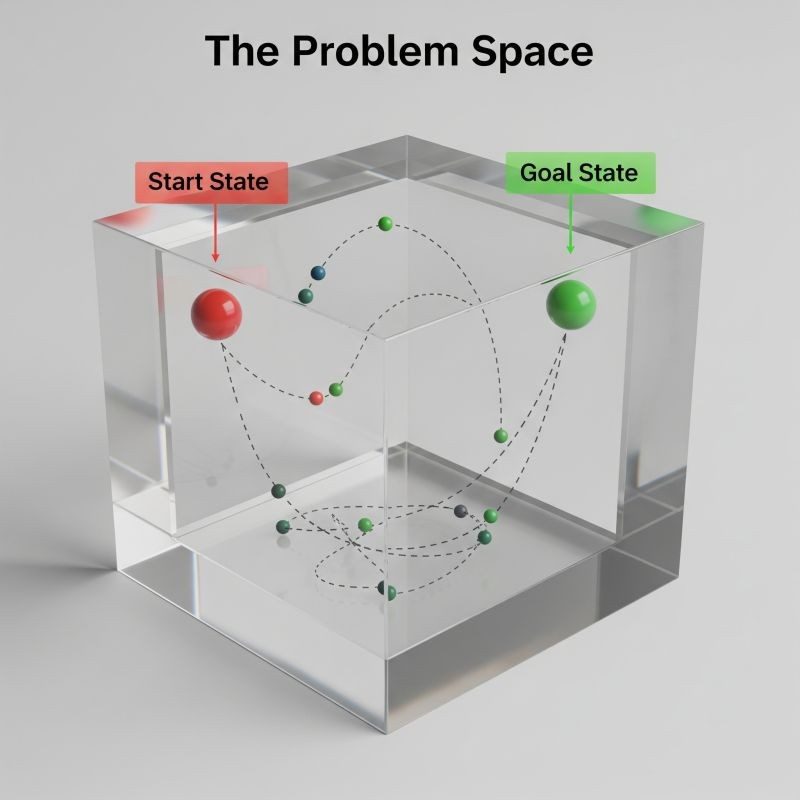
According to problem-solving rationale (and as featured in IFT: Information Foraging Theory), the problem space is the realm humans enter when they encounter a problem.
According to Pirlloi in Information Foraging Theory.
A problem space consists of two essential components:
A start state.
A goal state.
The start state is where everyone starts once they have identified a problem, such as “I’m in London and need food, where should I eat?”
The goal state is the person consuming their food.
Typically, there are 2 types of problem spaces.
Structured and ill-structured.
A structured problem would be something like a game, a test, or a puzzle.
There are rules and a defined process for moving through these problems.
However, an ill-structured problem, such as choosing which weight loss drug to use, will require additional information.
This additional information helps the user to structure their problem to move to a goal state.
This is known as ‘knowledge search’.
A search user will seek more knowledge to make intelligent decisions with a caveat known as ‘satisficing’.
Satisficing combines the words “suffice” and “satisfy” and was first introduced by economist and psychologist Herbert A. Simon. He explained that people do not aim for optimal solutions but instead work within the framework of “bounded rationality,” where constraints such as time, cognitive limits, and situational control influence decision-making.
In short, we don’t need to have the best information.
We want ‘good enough’ information to make a decision, or at least not make a bad decision.
Going back to our food example, a person in the start state will first use their mind, memories, and visual data from their eyesight to filter through solutions.
And if they can’t think of or see a suitable solution, they are likely to go to a search engine or now an LLM.
Satisficing is why we rarely scroll past the first page of Google, and it is a key part of why LLMs can disrupt search.
If LLMs become the dominant way for humans to obtain information, this will dramatically disrupt the usage and therefore monetisation of search engines.
How Knowledge Search Works
The internet transformed knowledge search.
Previously, people had to rely on visiting stores, reading books, consulting with experts, and visiting libraries, among other methods.
Today, we often take for granted the sheer scale of the internet and the vast amount of knowledge it provides.
For users with problems, the internet has allowed them to navigate the problem space far more cheaply and efficiently than at any point in history.
For the best part of the last decade, brands have attempted to capitalise on this process by generating vast amounts of information, hoping that publishing it would lead to an increase in either revenue from advertising (the publisher model).
Or being chosen as a supplier of goods or services.
This forced brands to seek to maximise traffic, because increased traffic could lead to increased revenue.
The SEO industry fought hard to ensure that users found information related to their clients, while Google fought equally hard to prevent SEOs from manipulating search results.
However, over the last few years, everything went wrong.
How SEOs Impacted Knowledge Search
There’s a saying that marketers ruin everything.
And we sometimes do.
SEOs are also blamed for ruining the internet.
Once SEOs were able to figure out Google, they created huge, overly optimised skyscraper posts.
Every article was massive and full of fluff.
And every online publication is loaded with so many ads that your laptop would overheat.
The problem with this approach is that it undermines the benefits of the internet and increases the costs associated with acquiring knowledge for both users and search engines.
This hugely increases information gain rate.
If I have to read through 4,000 words to find knowledge that helps me move from the start state in the problem space to the goal state. The cost of obtaining the information has increased.
Or in other words, I have to read through information I already know, to find the information I don’t.
This reduces the value of search and causes users to leave search engines, instead opting to go to social media or forums to find answers.
The solution for Google was to transition to a zero-click environment, incorporate short videos into search results, and also strike a deal with Reddit.
This has transformed Google from a place where users struggled to find information to one where information is easily accessible (as it once was).
Yes, SEOs might hate this, but Google is only doing the right thing for search users.
SEOs made it harder to gain information.
Google must continue to make it easier and at a lower cost.
However, what Google didn’t see coming was OpenAI.
LLM’s Transform knowledge Search
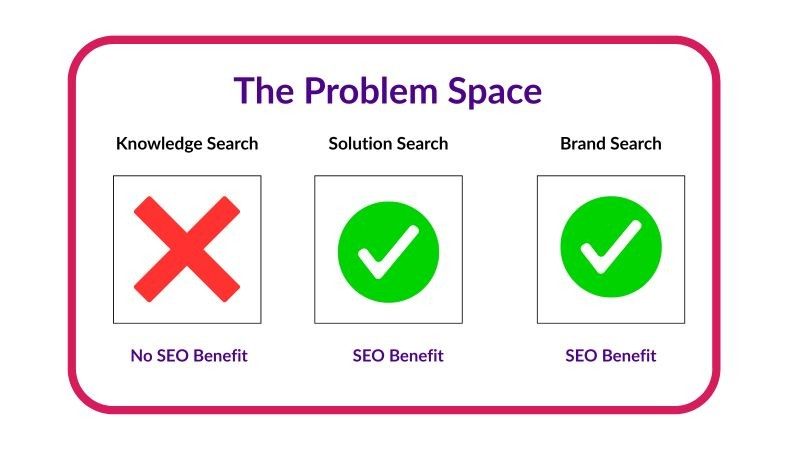
When OpenAI launched ChatGPT, they created a product that revolutionised knowledge search.
They eliminated the need for a user to make multiple searches, allowing AI to enter the problem space and retrieve information for users.
No more clicking on loads of web pages.
This is highly efficient.
This, along with the emergence of other AI platforms, has compelled Google to act.
Make no mistake, Google will be on war footing because humans will adopt the most optimal method to solve their problems.
And we’ve already seen it.
Yellow pages.
Yahoo.
Google.
There have been countless products and services deeply embedded into our culture that are now extinct.
Netflix killed Blockbuster because the latter overestimated the pleasure of going to a video/DVD store as a physical act.
The Yellow Pages didn’t invest in the internet (soon enough), and Yahoo didn’t come up with the PageRank algorithm.
For anyone unsure of where this is heading, we are moving to a complete removal of humans from knowledge search.
AI agents will soon navigate our problem spaces for us.
Need a pizza? Just tell AI and it will order for you.
Need a new job? Tell AI, and it will not only find the roles but also apply for them on your behalf.
I could go on, but brands need to understand that your goal will be to optimise for AI-powered search.
In short, GEO/ Generative Engine Optimisation is the practice of describing your solutions so clearly and completely that an AI can prove, within its reasoning, that your goal state is the exact destination a user needs to reach from their current problem state.
So, now that we understand the why we need GEO, let’s learn how to do this.
The Basics of GEO
GEO will always have 2 sides.
The LLM user who seeks to solve a problem.
The brand/business seeks to gain more customers and revenue.
The user’s perspective:
Every user goes to search engines with a problem. This is where they enter the problem state.
If a user finds better solutions at a lower cost to their cognitive resources, then naturally, humans will stick with the platform that provides that energy saving.
Currently, ChatGPT is winning this battle.
Yes, they only represent a tiny amount of search, but the speed and use of ChatGPT is staggering, and it is this that scares Google.
This brings us to the second aspect of GEO.
The business perspective:
A business also has a problem space, which consists of the start and goal states.
The problem typically is that a business wants more users.
The goal state is increased revenue.
GEO works within a multidimensional vector embedding space where success occurs when a business’s goal state aligns with a user’s goal state.
You could call this a ‘mutual goal state’.
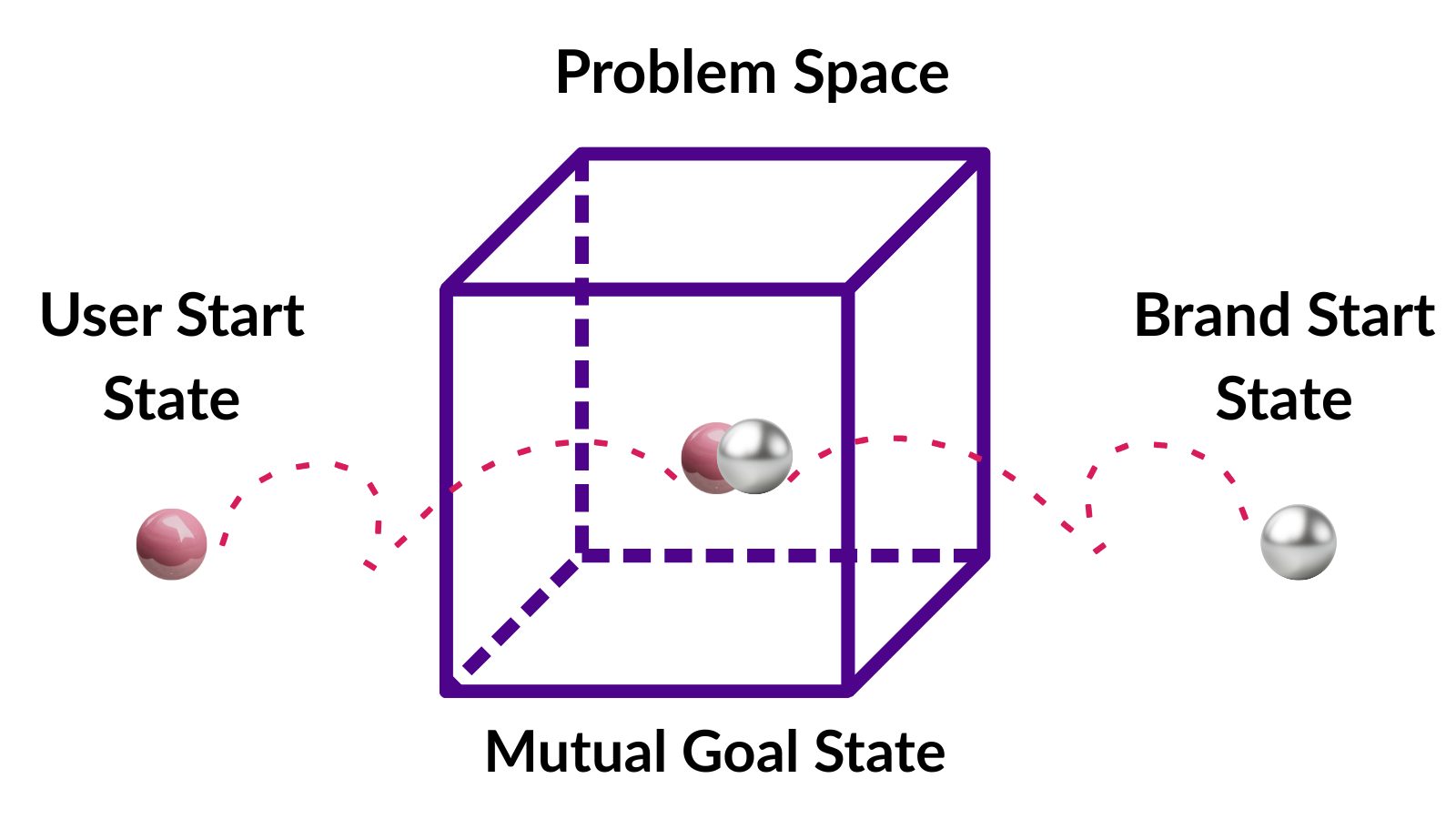
This alignment creates a perfect match: users find solutions to their problems, and businesses get selected to provide those solutions.
As a GEO or SEO specialist, your primary task is to understand and optimise for both these problem spaces.
You must thoroughly understand not only your business’s or client’s start and goal states, but also those of your target users.
But we can break this down into 2 parts.
GEO Optimisation for the User
To optimise for the user, you first need to understand the problems that your goods or services solve for the user.
In the past, a larger man looking for summer clothing would need to conduct multiple searches using specific keywords:
“XXL summer shirts”
“best fit shirts for large men”
“stylish summer shirts big and tall”
“breathable summer shirts plus size”
Each search would require the user to piece together information from various sources, essentially doing their own research and problem-solving.
Today, the same user might simply type or speak into an LLM: “best summer shirts for dad bods.”
This natural language query triggers a completely different response from generative AI. The LLM understands:
The context (“dad bod” physique)
The seasonal requirement (summer)
The implicit needs (comfort, style, fit)
The AI then approaches the task holistically, providing:
Initial considerations for the user’s specific situation
Curated recommendations based on body type
Contextually relevant styling advice
Specific product suggestions that meet all criteria
This shift illustrates a crucial principle of GEO.
Optimise for user problems in their natural language, not keyword combinations.
The generative engine handles the complex task of understanding, framing, and solving the problem from multiple angles, considering all contextual elements simultaneously.
Understanding Product Solutions and Category Entry Points
Effective GEO requires thinking beyond the products and services themselves to understand the problems they solve.
Let’s expand our summer shirt example:
When a man needs an XXL summer shirt, the underlying reasons matter:
Some men are larger due to muscular builds from regular gym training
Others, particularly busy fathers, gain weight due to lifestyle changes:
This deeper understanding reveals how GEO aligns with established marketing principles:
The Ehrenberg Bass Institute’s availability theory
Category entry points
Consumer thought patterns during selection
Instead of focusing solely on keyword research and object definition, GEO specialists must become experts in problem spaces.
This means:
Understanding why consumers need your product.
Recognising the language they use to describe their needs.
Identifying the thought patterns that lead to discovery.
Understanding the circumstances and situations in which your products and services are thought of.
Understanding and knowing the core attributes of your products and services.
Understanding the positioning of the business.
Success in GEO requires mastering these problem spaces and aligning your optimisation strategy with genuine consumer needs and their natural language expressions.
Ok, so let me give you a quick example.
Restaurant: After Theatre Dining near London’s Sondheim Theatre
Let’s say you are going to London and have tickets to Les Misérables.
Your problem is that you need food either before or after the theatre.
So, you head over to ChatGPT and use this prompt:
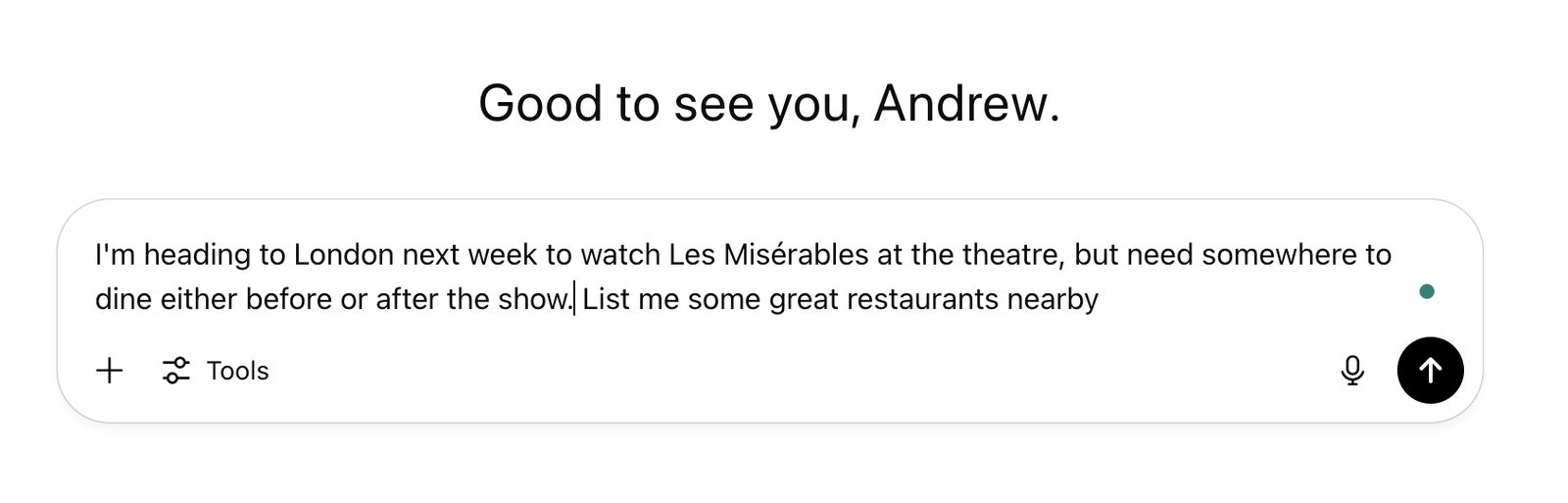
Here’s what happens next.
ChatGPT went through a consideration process:
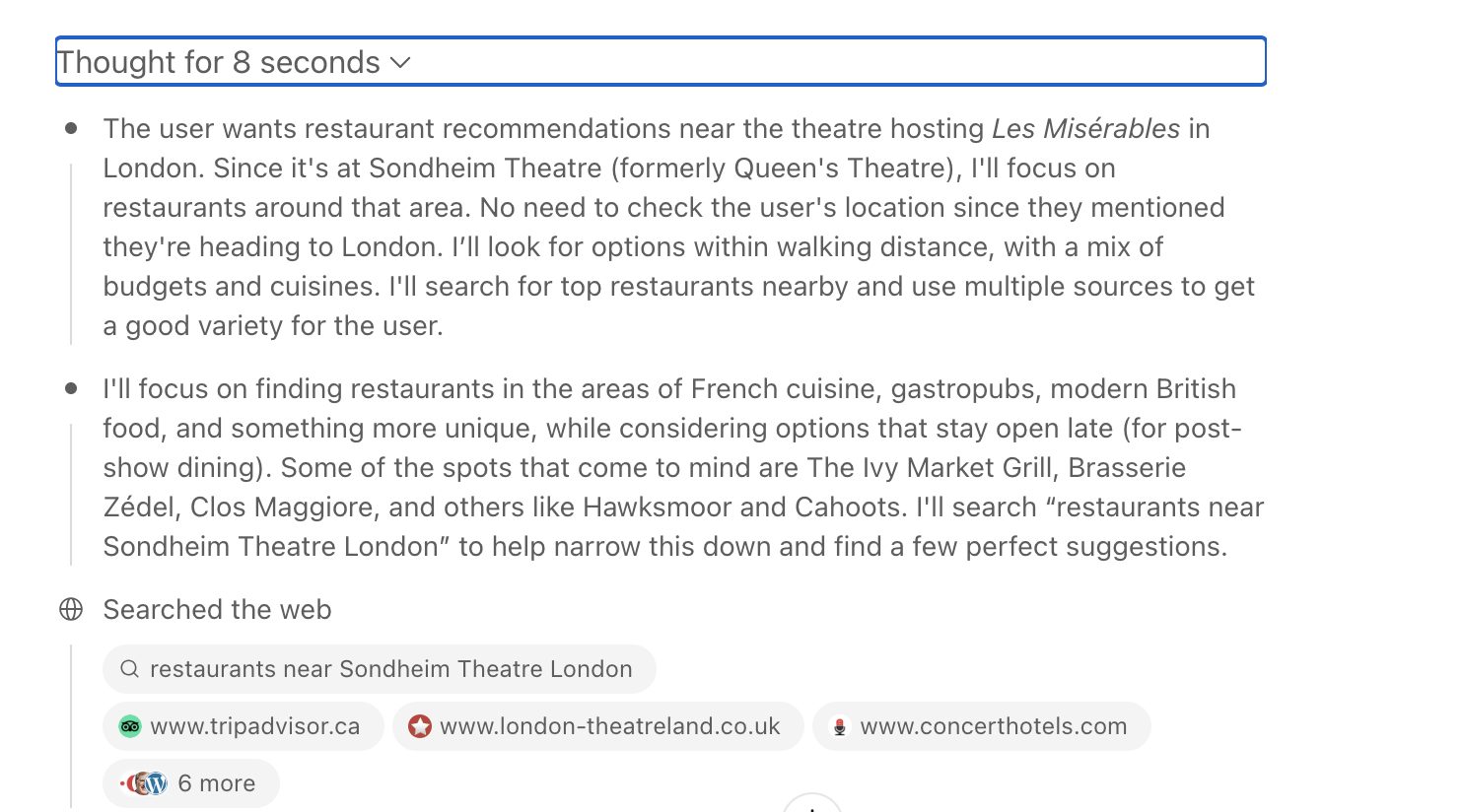

This research took 8 seconds and saved me potentially hours of research.
In the results, multiple websites are referenced to build the final list.
Including this restaurant:
www.brasseriezedel.com/soho-area-guide/

They have created an entire web page based on a category entry point (more on CEPs later) that their customers would use.
The page titled ‘Restaurants near Sondheim Theatre’ is a single page on the site, designed to rank for a key search term.
And yes, it ranks.
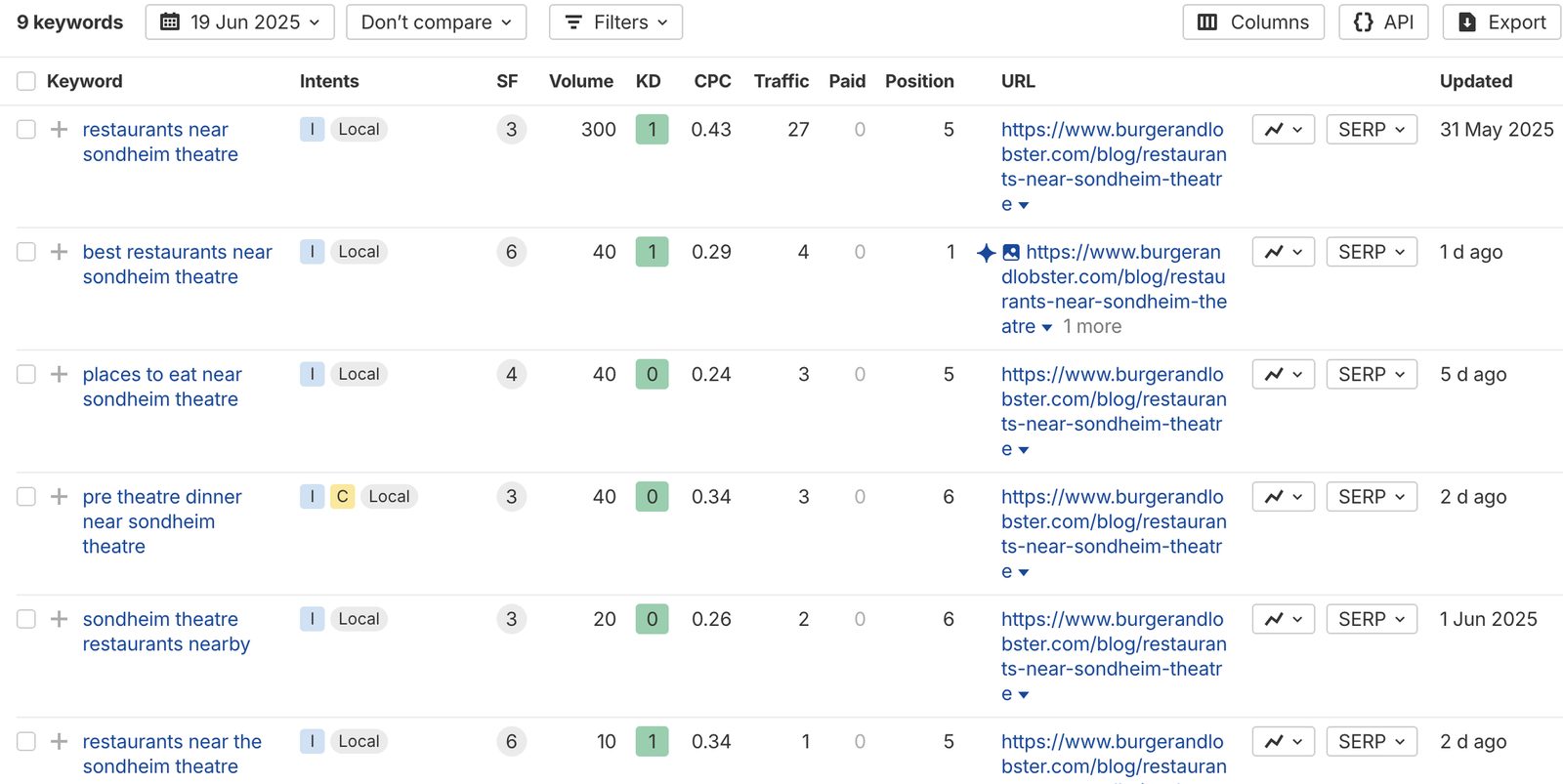
This page doesn’t sit as a category page or location page, but is a clever use of a site’s blog page.
Yes, it’s not competitive, but many precise queries that users have won’t be that competitive.
And yes, this does illustrate the potential crossover with SEO.
However, often, terms that appear in search tools as having low or zero search traffic are ones you would pursue in GEO.
And this is due to category entry points.
GEO: Optimising the Brand/ Business
The dual nature of problem spaces in GEO creates a fascinating dynamic between user needs and business goals.
And this is the second optimisation need of GEO. Optimising the brand to solve their problems, by meeting the user in their problem space.
The Business Problem Space
As stated, the business problem space also has 2 parts to it.
Start state: Having products/services that solve specific user problems
Goal state: Connecting with more users who have these problems to generate revenue.
This represents a fundamental shift in optimisation strategy.
Instead of optimising for what a product or service is, businesses must optimise for what are known as category entry points.
What Are Category Entry Points and Why They Are the New Keyword Research?
To quote the research company Salience:
Category Entry Points (or CEPs) are the reasons, motivations, and occasions that prompt consumers to consider a specific product category. They represent the triggers or situations that lead customers to recognise a need and explore options within that category.
Essentially, Category Entry Points are thoughts that a person has when they enter the buying process.
In How Brands Grow 2, Professor Jenni Romaniuk states:
“You can think of CEPs as mental distribution outlets. You want your brand to be present in as many shopping channels as possible”.
“The aim is to maximise the chance a brand is thought of, no matter what CEP pathway a buyer might go down”.
As people use AI to reduce cognitive load and save on mental resources, GEO revolves around a similar approach.
To maximise the chance that a brand is thought of, you must maximise the brand’s presence within pathways that AI uses to find answers for its users.
This is essentially what GEO (Generative Engine Optimisation).
So, how do you do this?
Research conducted by the Ehrenberg-Bass Institute shows that there are a series of questions that should be asked by brands to establish CEPs:
WHY Question: Why are you buying a product? Example: “I want an energy boost”
WHEN Question: When are you buying the product? Example: “Before the gym”
HOW Question: How are you feeling? Example: “I’m feeling lethargic”
WHERE Question: Where are you buying the product? Example: “Corner shop, near the gym”
WITH WHOM / WHAT Question: With whom (or what) are you when buying the product? Examples:
WHILE Question: While doing something. Example: “On the way to the gym”
CEPs are the ‘new keyword research’ and understanding them aligns GEO with general brand marketing.
To break down the core differences between GEO and SEO.
Traditional SEO:
Focuses on product descriptions
Optimises for product features
Centres on keyword-based searches
GEO Approach:
Focuses on problem-solving capabilities
Optimises for Category entry points
Centres on user scenarios
Focuses on brand positioning
Focuses on product and brand attributes
This shift creates new opportunities for SEO professionals trying to break into SEO, as businesses need to:
Identify all problems their products/services solve
Understand the CEPs
Create content around specific use cases and solutions achieved
Build pages and off-site signals focused on problem-solving for those use cases, not just product features
The key advantage of GEO is that LLMs can now:
Capture the core problem that the user has and understand contextual relevance.
Using a range of LLM approaches, such as fan-out queries the LLM will use its own training data and web search to match solutions to specific user situations.
This evolution demands a new approach to optimisation, where success depends on understanding and addressing the complete problem space rather than just product or service descriptions.
How to Start GEO Research
GEO research requires a top-down analysis of both sides of the problem space equation:
Business Analysis:
What problems does the business solve?
What constitutes a successful resolution for users?
How do solutions vary across different user and usage segments?
Product/Service Level Analysis:
What are the product or service category entry points?
Do our products or services solve multiple uses, and if so, what are they?
Does our on-page content reflect these category entry points?
The key shift is moving from feature-focused content to use-case-centred content and attribute and solution-focused content.
Or in other words, if you’re a business selling water that retails at £10 a bottle because it’s been infused with hydrogen. You’ll want to include on your brand website that your product isn’t only infused with hydrogen, but also what the outcome of drinking the water is.
It’s this outcome that an LLM might ‘hook onto’ and return to a user based on their query/ prompt.
To better understand this approach, let’s examine some practical examples:
The Red Dress Test
Let’s assume you own an e-commerce store that sells red dresses for any occasion.
A potential customer has booked a holiday on a cruise ship, and there will be a formal event, where the dress category is described as ‘evening dress code’.
A CEP (category entry point analysis) might reveal that your red dresses are being purchased for cruise ship attire on nights where the dress code is formal.
The analysis might look like this:
WHY Question: Why are customers buying a red dress? Example: “Customers purchase our red dresses for cruise ship attire”
WHEN Question: When are they buying the product? Example: “After booking a cruise and learning about the types of formal dress worn during cruise dinners”
HOW Question: How are they feeling? Example: “Our customers are concerned about size fittings, returns, materials and whether it is the right dress for the event”
WHERE Question: Where are they buying the product? Example: “We only sell online via a single category page, which is focused only on red dresses.”
WITH WHOM / WHAT Question: With whom (or what) are you when buying the product? Examples: “They need a dress to go with their shoes”
WHILE Question: While doing something. Example: “sat on the sofa at night”.
By analysing use cases of your products and CEPs, you can start to understand what type of content and context is needed on a page, thereby maximising the chances of showing up for more complex searches used by customers with long-tail queries.
An LLM-based search might be a voice search or written like this:
“I need a formal dress for a cruise ship evening event next month. List some examples of red evening dresses sold online that are suitable for cruise ship dining events. I might need to return it if it doesn’t fit, so make sure they have free returns”.
The ChatGPT response was a list that focused on numerous elements that matched.
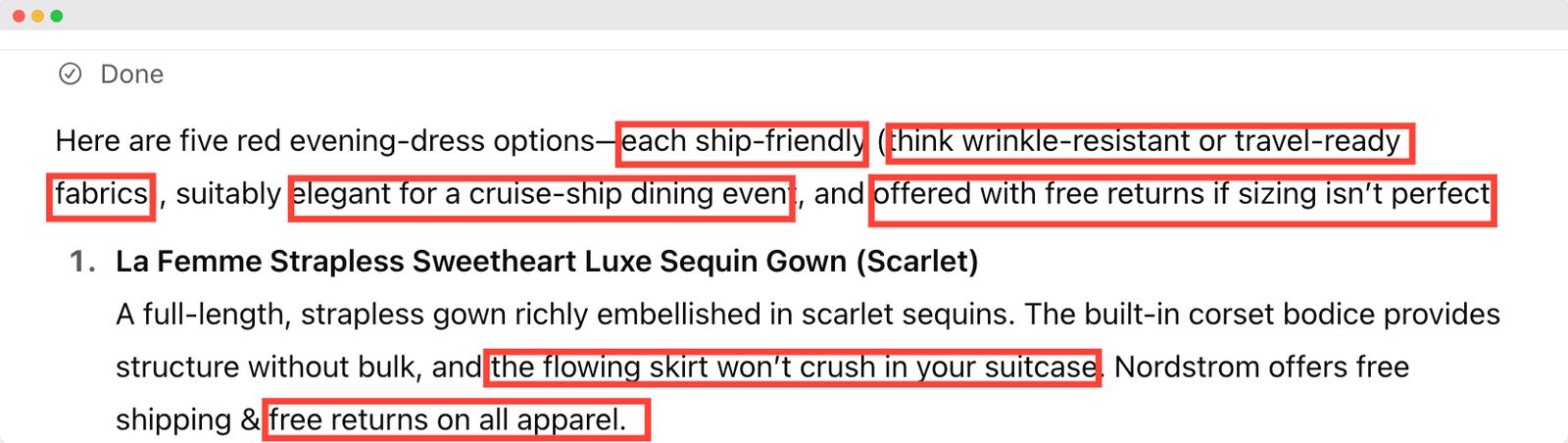
GPT considered the use case and applied a simple logic based on the product attributes for the usage situation, rather than conducting a direct search for ‘red evening dresses for cruise ships’.
And the results in the links

That was a good response.
Gemini, however, returned wordy waffle with zero links:
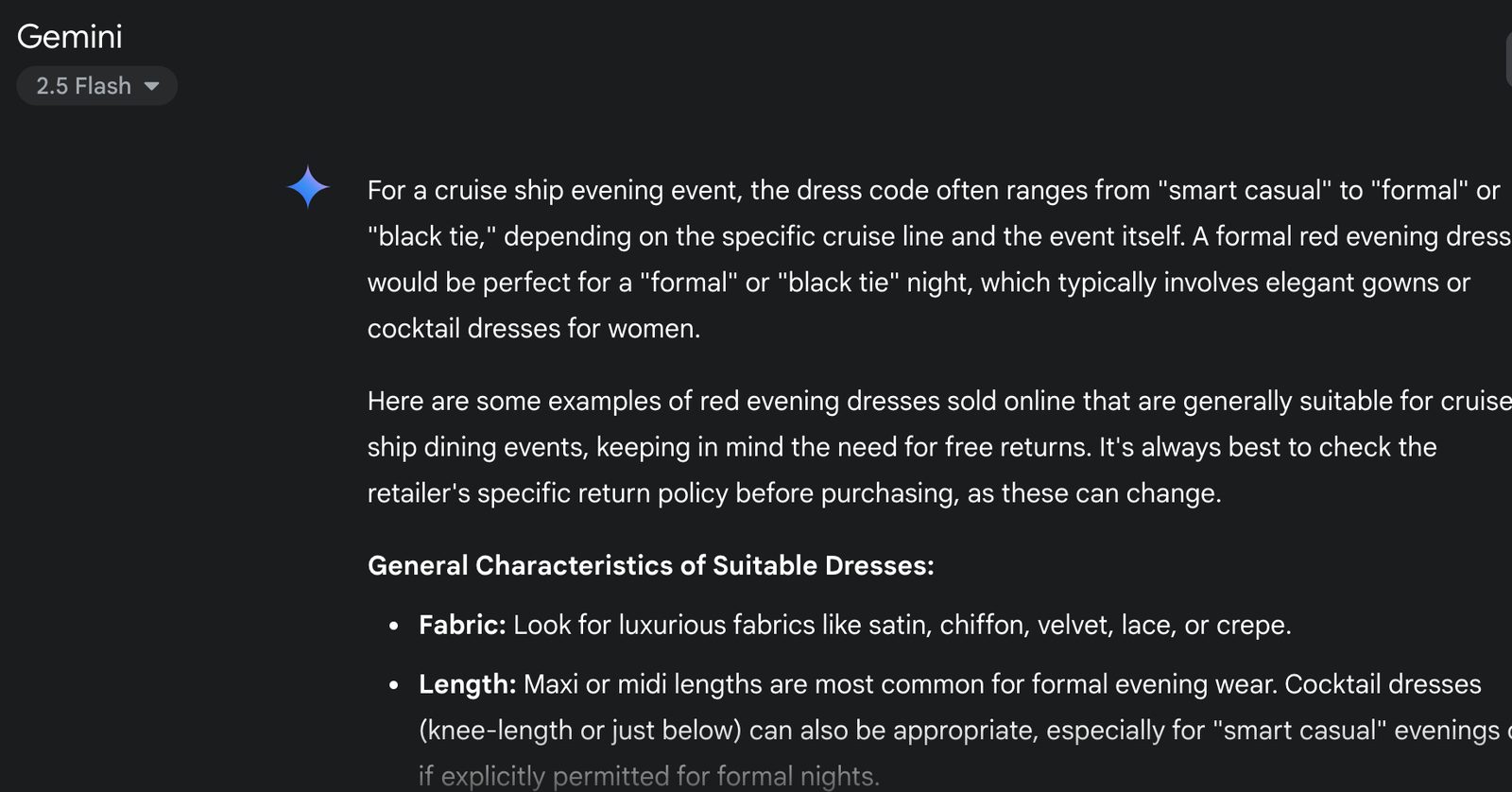
Now, if we use a shorter, more keyword-focused approach in traditional SEO, this is the return:
A wall of ads:
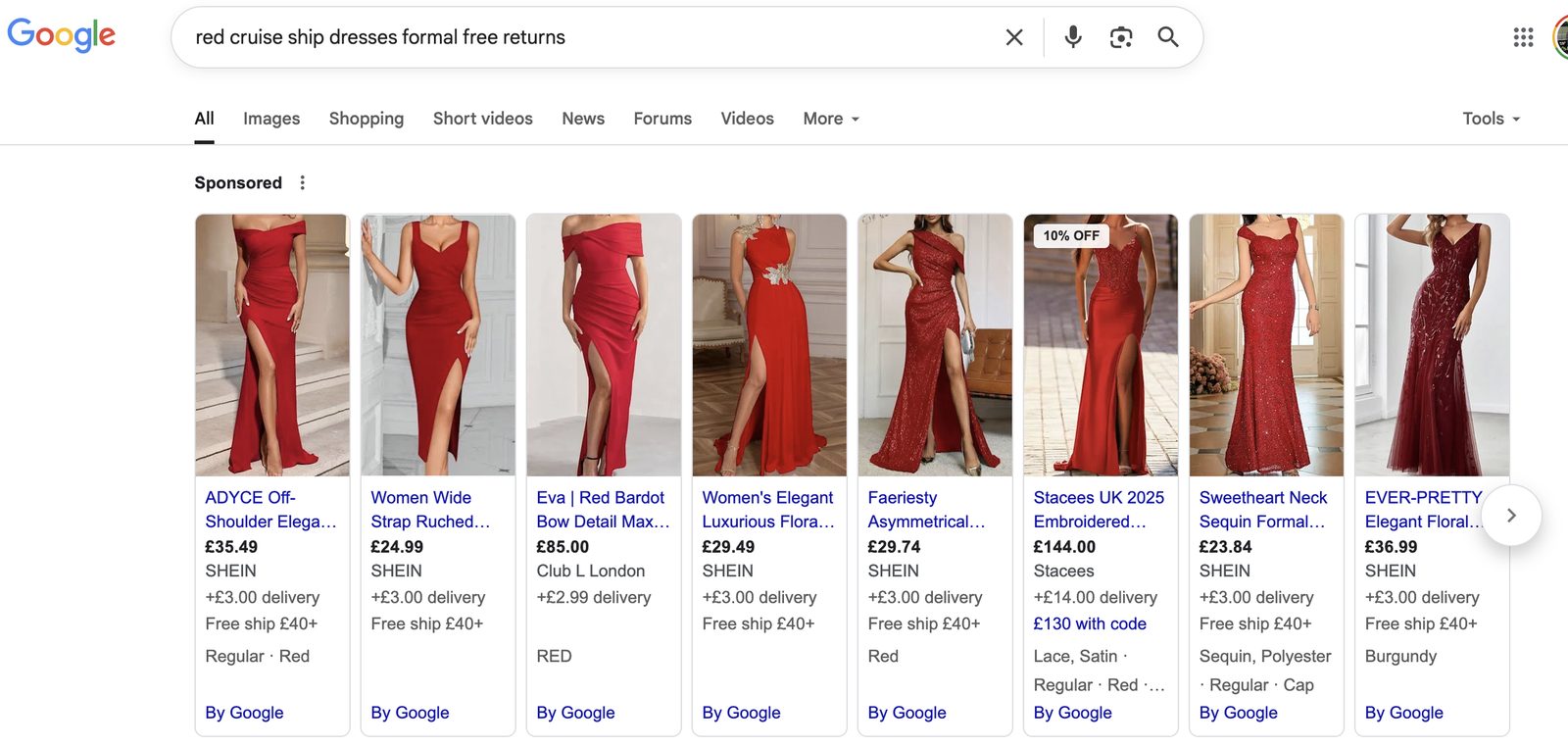
And zero image SERP listings.
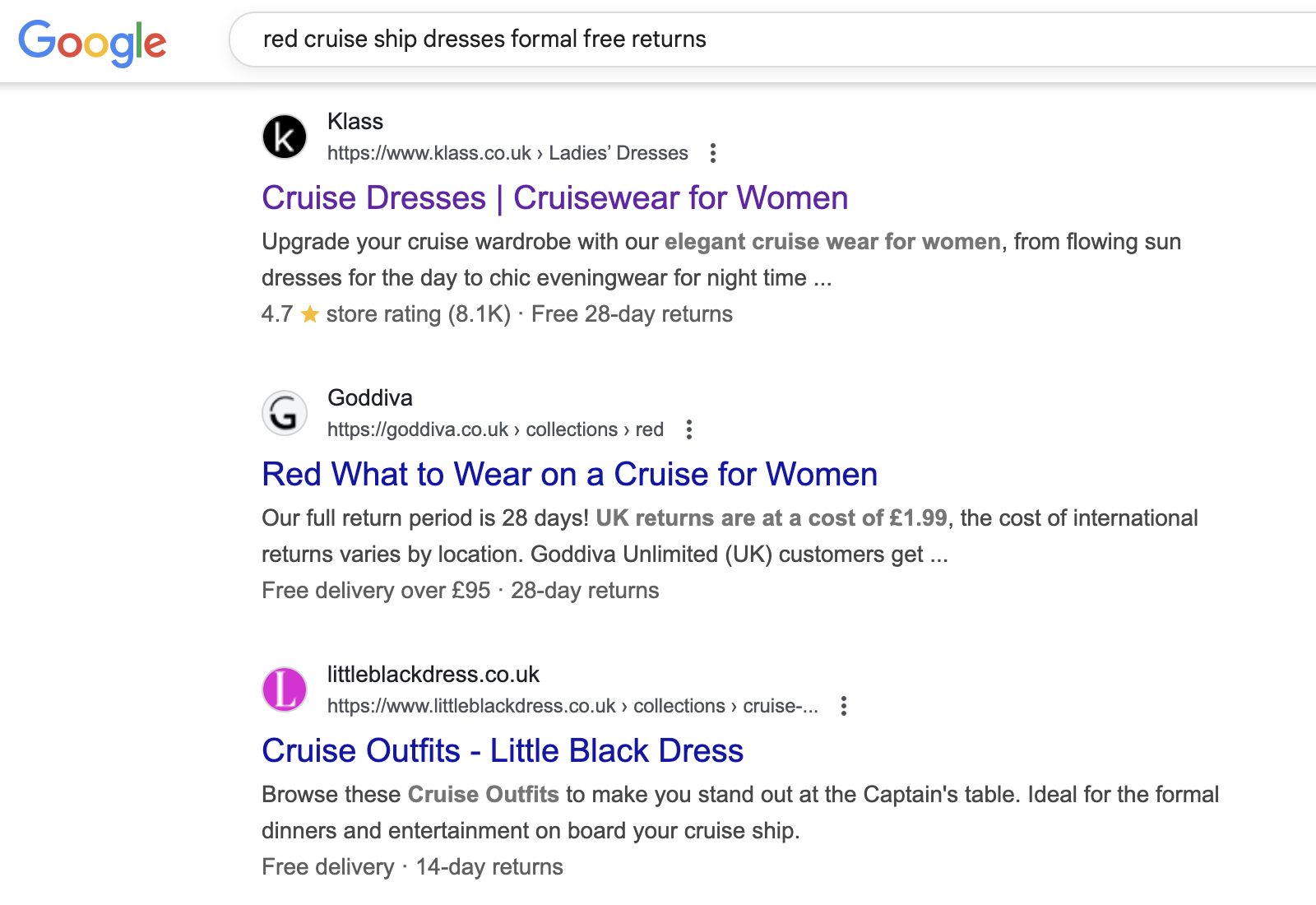
The traditional search engine option requires users to sift through results, which a person might want to do.
But many will want that sorting done for them.
If you’re thinking, “ok, Andrew, how do we optimise for this exactly?”.
You’ll love this next bit.
Understanding Mutual Information
LLMs work by trying to reduce signal noise and ambiguity.
This is called information entropy.
Mutual information is any supporting evidence that helps machines make decisions about the relevance and quality of your content.
It comes in many forms:
LLM stored memory.
Website search
SERPS
Product-Specific Content
Service page content
Digital Publicity (Digital PR)
Forums
Blog content
And more
The thing is, you can’t possibly know which sources an LLM might need or use, or indeed the approach the LLM will take to help a user reach their goal state.
But you can make an educated guess.
Once you determine the uses and CEPs (category entry points), you can begin to develop a map of the types of mutual information required for your products and services to be discovered and referenced by LLMs.
But generally, GEO comes down to 2 types of optimisation.
On-Page
Off-page
In the following article, I’ll show you how to optimise for on-page optimisation.
But It’s Just SEO
If, after reading this, you think that GEO is just SEO, you’re still missing the point.
The way that LLMs interact with search engines and leverage their own data means that you are not optimising brands for search engines but for LLMs.
Yes, there are a lot of crossover skills.
The output remains the same; you’re doing on- and off-page optimisation, but the context is entirely different.
This fits more nicely under the umbrella of website optimisation, but that’s not a goal.
Websites are optimised for discovery within environments, and yes, that’s why GEO offers a nice hook for SEOs to hang their hats on.
Because brands can perform well in organic Google search but poorly in LLM-based search.
The Big Prediction of GEO
Nobody knows how this will turn out, but information theory can be considered as the guiding North Star.
LLMs/AI-powered search represent such incredible gains in time and cognitive effort that it’s hard to see that they wouldn’t become the dominant methods of gathering information to solve our problems.
And this is coming fast.
OpenAI is now valued at $300 billion with its recent $40 billion funding round.
So, there are some huge numbers behind this, and as such, it’s not likely to be going away.
For brands and businesses of all sizes, being discovered becomes more, not less, difficult in this AI era.
Because LLMs provide superb, contextually relevant responses, you will see an increase in traffic directed to a broader range of businesses.
For many, this will be good news.
You will generate leads that would typically not have found you.
For brands that are performing well in traditional search or are focused solely on paid search, this presents significant issues.
You may find a large reduction in leads or, indeed, increased costs of obtaining them.
So, my advice is not to sleep on GEO.
Plan now, because the speed at which this is happening is catching everyone off guard.
Conclusion: The Future of Search Optimisation
This guide introduces the fundamental principles of Generative Engine Optimisation (GEO), marking a significant evolution from traditional SEO practices.
Let’s recap the key concepts:
Problem Spaces vs Keywords
Content Creation Strategy
Mutual Information
As we enter this new era of search, success will come to those who can effectively align their products and services with user needs while providing clear, authentic evidence of their solutions’ effectiveness.
Thanks for reading
Andrew Holland
Originally published on LinkedIn on 26 June 2025.