
I’ve been writing on LinkedIn for close to a decade, and one post was possibly my most read:
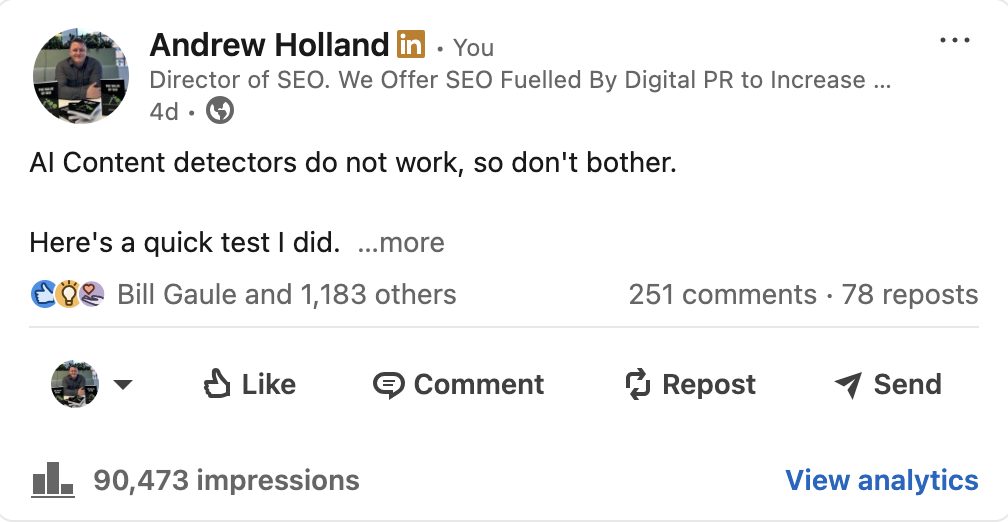
Weirdly, this post took me less than a few minutes to write, but I would never have expected the subject of AI content detectors to generate such passion.
However, a review of the comments (251 of them) revealed why.
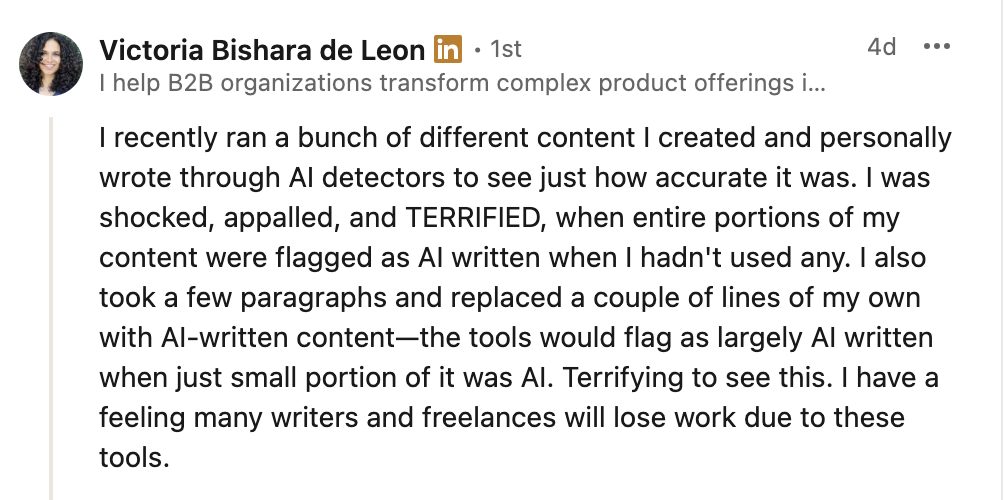
Genuine comments on human-written content being flagged as ‘AI written’.
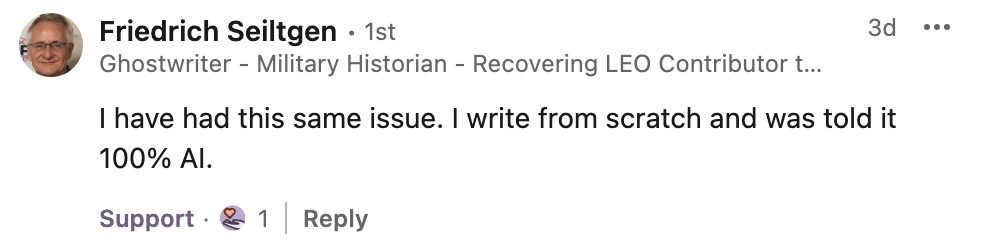
There were so many writers sharing the same view:
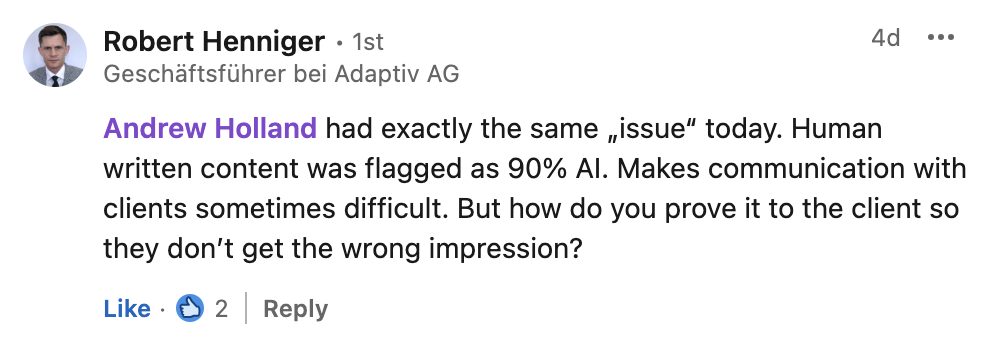
As the post gained traction, I was offered free access to originality.ai to test their content detection tool, since my original post essentially stated that ‘AI content detectors don’t work’.
So, in this article, I’ll share my findings and examine the whole issue of using AI Content detectors.
Let’s dive in.
AI Content Detectors Are a Trust Issue
It was 2022, and I was conducting a phone screen of a potential writer for my agency.
The writer told me they were doing a whopping 7000 words daily for their current agency.
And this was when AI tools were in their infancy.
Admittedly, she said the content wasn’t good.
The SEO industry was paying her agency for cheap content, and her role was to continually produce it.
These are the salt mines of the SEO industry.
But today, writers can churn out 5 times that amount using AI. And so, people have created AI content detectors to see if writers use AI.
But why does it matter?
The answer lies in trust.
Human Only Content as a Quality Signal
I’ve seen people sell content as ‘human only’ as a means of differentiation.
Many are using the positioning that your content is 100% human, and the writers only use AI for research.
So, if people say this and sell it, it does seem fair that the buyer of the content gets to check.
But here lies the issue.
When it returns as either fully or partially generated with AI, this creates an issue.
If you have a writer who is saying, “I wrote that myself”, and a machine telling the content buyer that they didn’t.
Who are you going to believe?
So what’s going on here?
AI Content Detectors Are Stupid

As I write this post, I’m using Originality.ai to demonstrate how these tools work.
So far, I have not used anything but my tired fingers to type this content, and it is giving me a score of 100% likely original.
Phew.
However, it has picked out a few sections where it’s telling me that there is a 39% to 40% chance AI is generating the text.
Why?
Those are the sections that my Grammarly Pro subscription is highlighting as poor writing, and I agree with its suggested changes.
Originality.ai admits the reason for this in their blog post;
“When users of Grammarly use the “Rephrase” or “Rewrite” suggestions, it is likely to trigger AI detectors to identify the content as AI-written. If it is used for spelling, not so much. “
OK, so things just got weird.
You have one AI tool telling us that another AI tool was used because erm…it made my writing better?
And yeah, that’s pretty much the crux of the issue.
AI content detectors work on detecting poor human writing.
Here’s how.
Why Your Writing Gets Flagged As AI
AI content detectors work in 2 ways.
The first is achieved by watermarking the content, and the second is accomplished through pattern analysis.
Watermarking is set to become a significant aspect of content, and Google is launching its own watermarking system, which it calls SynthID.
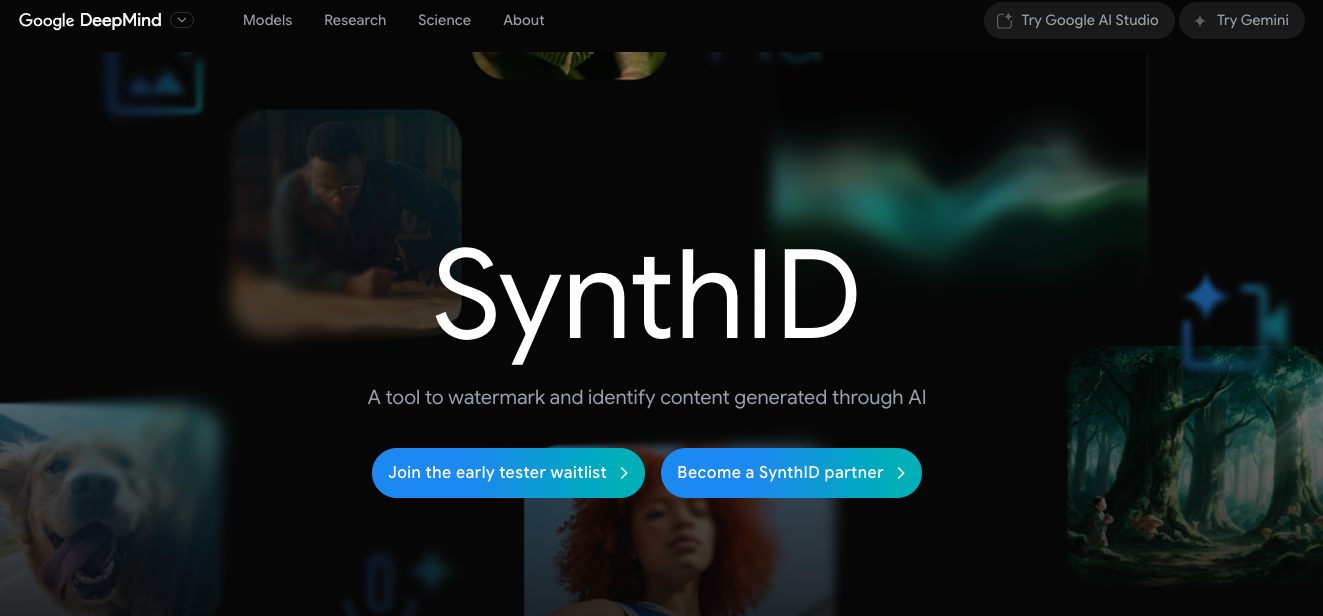
I expect the same will be rolled out across many platforms as governments seek to combat ‘deep fakism’.
So, in this post, we’ll stick to looking at systems that analyse patterns.
AI content detectors have been developed by comparing vast amounts of human-written content against extensive AI-generated content and identifying patterns.
Those patterns are defined as:
Burstiness: how the words used are placed within the document. Humans tend to write in bursts, whereas machines tend to have their words more spaced within a document.
Frequency: how often certain words and types of words appear in a text.
Punctuation: to explain this, I’ll let you read the text from ‘originality.ai’.
“AI-generated text often exhibits correct and potentially predictable use of punctuation”.
There are others, but essentially that’s it.
(I’ve now switched to voice typing, at this point of the doc to test AI detectors)
Here’s the irony: when your writing gets flagged as AI, it’s often because you’re writing too well.
Much of the internet’s content has been produced rapidly by writers who may not be native English speakers – a common scenario in the SEO content industry over the years.
So what happens?
If you’re either a skilled writer or one of the 30 million daily Grammarly users improving their writing, your content might get flagged as AI-generated.
The very tools and skills that make your writing clearer and more professional are triggering these detectors.
This creates a paradox: write better, get flagged as AI. Write worse, pass as human.
So, why bother with this?
Do We Need AI Content Detectors?
The answer isn’t simple, but it centres on transparency and human involvement.
AI content detectors serve an important purpose: they help identify whether a machine was involved in content creation.
This transparency allows content buyers to ask critical questions about the human role in the process.
Here’s why this matters:
Quality Control: Google has explicitly stated that “scaled content abuse” is a spam problem that their systems will detect. AI content detectors can help identify content that might trigger these concerns.
Trust Verification: The fundamental question these detectors help answer is: “Was a human meaningfully involved in creating this content?”
However, the real question isn’t just whether AI was used, but rather how much human oversight and expertise were involved in the final product.
Current AI detectors might help start this conversation, but they can’t tell the full story of content quality or value.
So, what really matters?
You’re No Longer Paying For Writing, You’re Paying For a Human in the Loop
The reality is simple: AI content detectors have become a value-verification tool.
Clients want to know if they’re getting what they paid for – human expertise and oversight, not just machine-generated text.
Other organisations, such as schools, will want to know how much ‘effort’ a child or student has placed into their work.
But does that really matter?
AI writing tools are becoming universal because they’re faster and increasingly sophisticated
Even this article uses AI-powered voice typing and formatting, you can see I placed a line earlier in the text, to let you know when I started using AI voice typing.
The future of content creation is human-AI collaboration
But there is a twist.
While clients might be willing to pay more for human involvement, AI detectors can’t actually measure this.
They can only tell you if AI was used.
What they don’t tell you is:
How much human expertise shaped the content
The quality of human oversight
The value added by human creativity and experience
We’re entering an era where the value isn’t in the writing itself – it’s in the human judgment, expertise, and oversight that shapes that writing.
But detection tools haven’t caught up to this reality.
They might never do.
But what about my test, what happened?
AI Content Detector Test Results
When a member of the Originality.ai team contacted me, I was clear.
I would be 100% honest about my tests of their system.
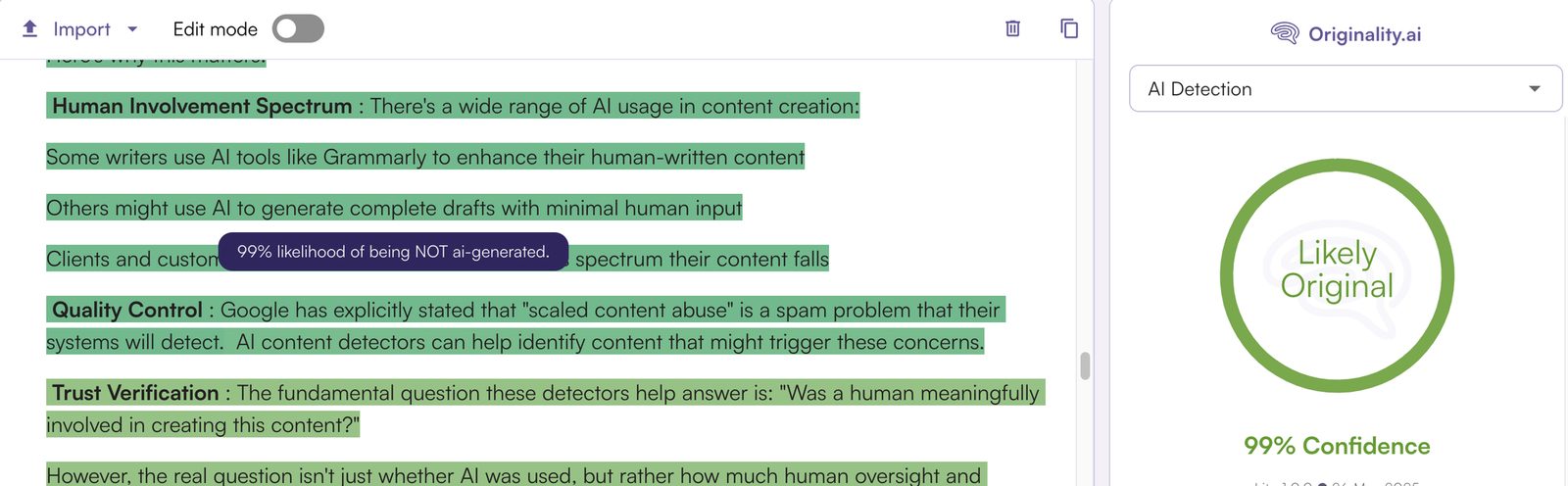
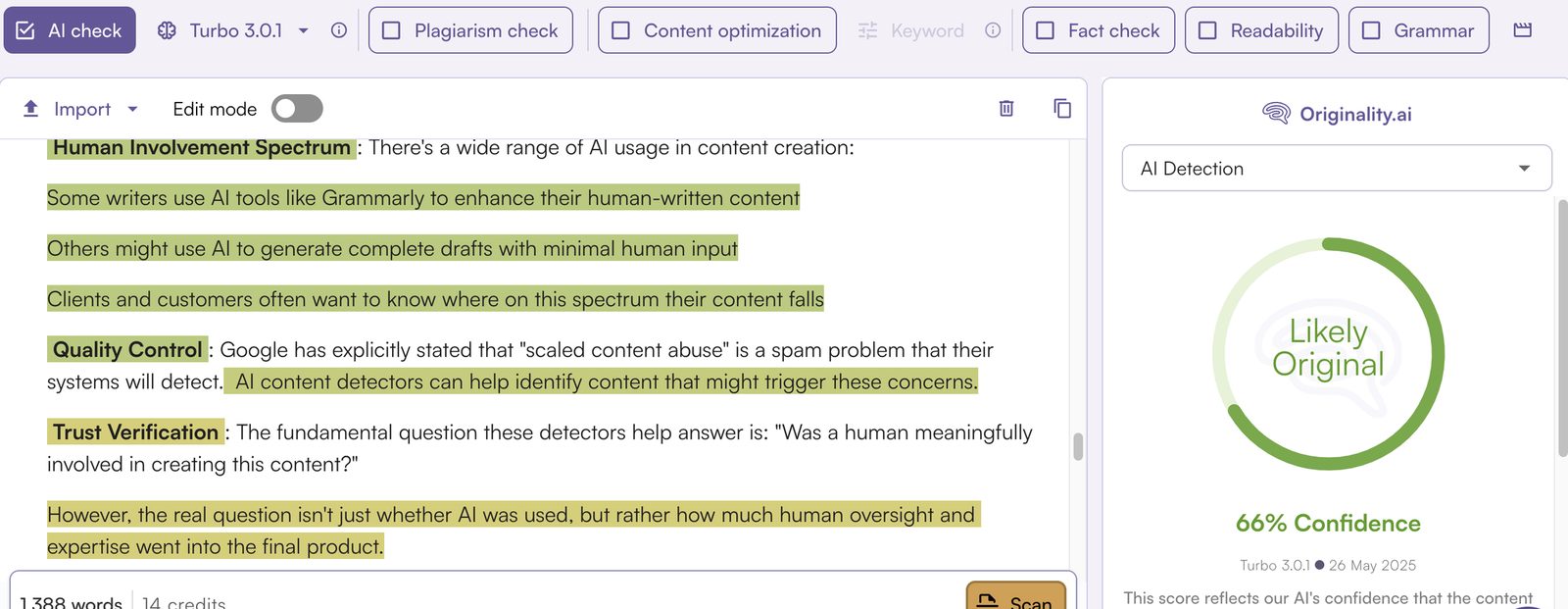
Currently, this document has had significant sections written by AI based on my voice notes.
And in their ‘light mode’, the document is showing as 99% confident that it’s original.
This then moves up to 66% in their Turbo model:
Some other tests I ran included:
The Donald Trump 2025 Inaugural address, which I analysed 500 words, was reportedly 99% likely to be AI-generated content.
But once I fed it 2500 words, it swung the opposite way, as was correct.
And that’s pretty much what happened.
When originality.ai was only given a few words, such as 500 or so, it often said the content was 99% likely AI-created.
When I gave it more, it switched and got it right.
However, I did give it 10 Seth Godin blogs and it passed with flying colours, stating a human wrote them.
This is likely because Seth writes in such a conversational tone.
I also went further.
Using our in-house content tool, Orpheus, I took content that we created and is ranking on page 1 of Google. However, it struggled to detect it as AI-created until I provided more of the content.
So, I removed a few AI elements, such as ’em dashes, and added a few more ‘conversational phrases, and it passed detection.
In fact, in one test, removing the em dash took the content from 66% to 99% likely of being human.
Yes, em and en dashes are used by AI heavily, perhaps too heavily.
But they are also used by great writers and editors.
For example, James Ellroy’s L.A. Confidential (the book, not the film) is full of em dashes.
And this all makes sense.
The vast majority of the internet consists of content uploaded without the oversight of an editor.
And both AI content and Grammarly rewritten content passages will be grammatically correct.
So, my ultimate test of Originality showed it struggles with less text unless written in a conversational tone, but it seems to be accurate with longer text.
However, you can use AI-generated content and pass the detection with some minor editing.
So, what’s the point?
AI Content Detection is More Like Content Analysis
Through extensive testing, I’ve discovered something crucial: these tools aren’t effectively distinguishing between AI-generated and human-written content.
Instead, they’re analysing content structure and quality markers:
Grammatical Precision: They identify highly structured, grammatically perfect content
Writing Patterns: They detect the natural “burstiness” of unedited human writing versus more balanced, structured approaches
Editorial Polish: Content that’s gone through multiple edits often flags differently than raw drafts
This reveals that we’re asking the wrong question.
Instead of “Is this AI-generated?” we should be asking, “Has AI been used effectively in the content process?”
Why This Matters
Using AI in content creation can actually be a positive signal:
It indicates investment in quality control.
Shows attention to grammatical precision.
Suggests a modern, efficient production process.
Think about traditional publishing: a book isn’t just written – multiple rounds of editing and professional oversight shape it.
Online content rarely gets this treatment. AI tools are filling this gap, providing a level of polish previously reserved for professional publishing.
The Real Bottom Line
We should reframe AI content detection as content analysis tools. Here’s why:
They’re already functioning as virtual editors
They help improve content quality
They encourage better writing practices
The question isn’t whether content is AI-created or human-written – it’s whether AI was used effectively as part of the content creation process. How much this matters depends entirely on your goals as a content creator or purchaser.
Therefore, I believe we should shift our focus from AI content detection to AI content analysis.
AI use is only going to increase in scale.
So, the future isn’t about detecting AI use, it’s about leveraging AI to create better content while maintaining human oversight and creativity.
The analysis tools will enable marketers to evaluate the quality of the content in terms of its grammar, fact-checking, and the potential use of humans versus AI.
Which would be a great addition to Originality.
A score about how much human presence was detected in the document.
And that’s something that many will want to pay for and be aware of.
As for the final test of this article with Originality.ai?
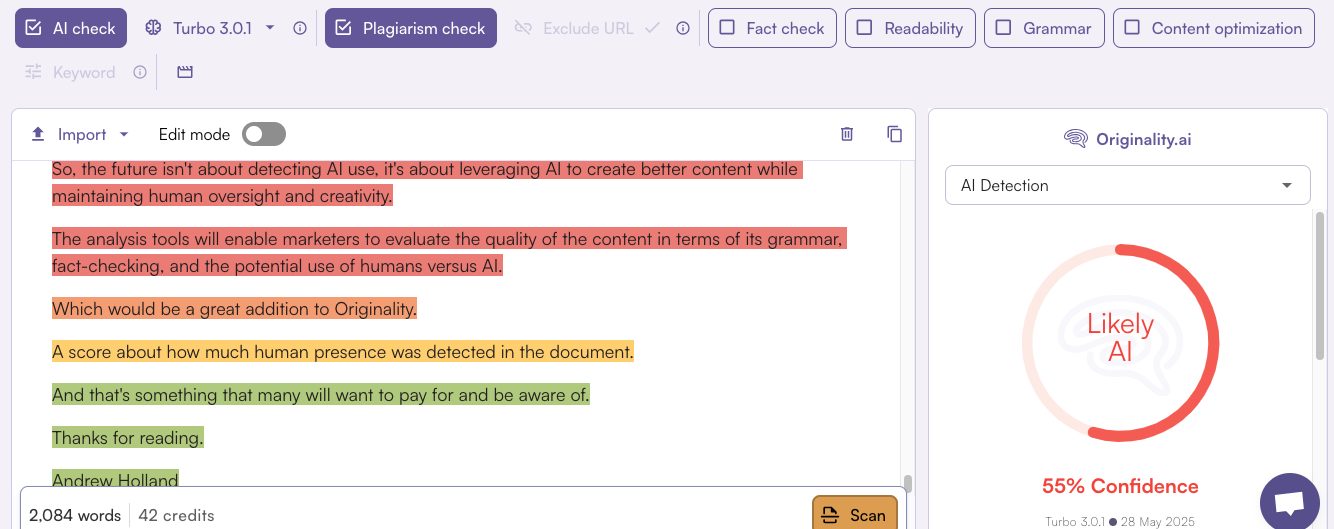
Their turbo model detected with a 55% confidence that it was likely to be written with AI.
And that’s bang on.
Part me, part voice typing transcribed and formatted by AI and part Grammarly suggestions being approved.
The question now is, if you’d paid for content with a score of 55, what would your next questions and actions be?
And this is what brands need to consider next.
Thanks for reading.
Andrew Holland
Originally published on LinkedIn on 28 May 2025.