
For the past decade, SEO has been sold as an industrial process.
Identify keywords. Produce content. Measure traffic. Repeat.
If the charts go up, the strategy must be working.
This belief survived countless algorithm updates, entire waves of marketing fashion, and the steady decline in organic click-through rates. It survived because it was easy to sell, report, and confuse with progress.
What it never really delivered was the outcome SEO was supposed to support in the first place.
Sustainable authority. Commercial preference. Revenue that did not depend on paying Google rent forever.
Today, that gap has become impossible to ignore. AI has exposed how fragile most SEO strategies already were.
Content did not stop working because machines got smarter. It stopped working because it stopped being the source of advantage people claimed it was.
To understand why, we need to stop talking about tactics and start talking about how attention, authority, and growth actually work.
And in this article, I’ll explain:
What works in search today.
The tactics you must use.
How to build fame.
The future of SEO.
and more.
But first, we need a history lesson.
The uncomfortable economics behind modern visibility
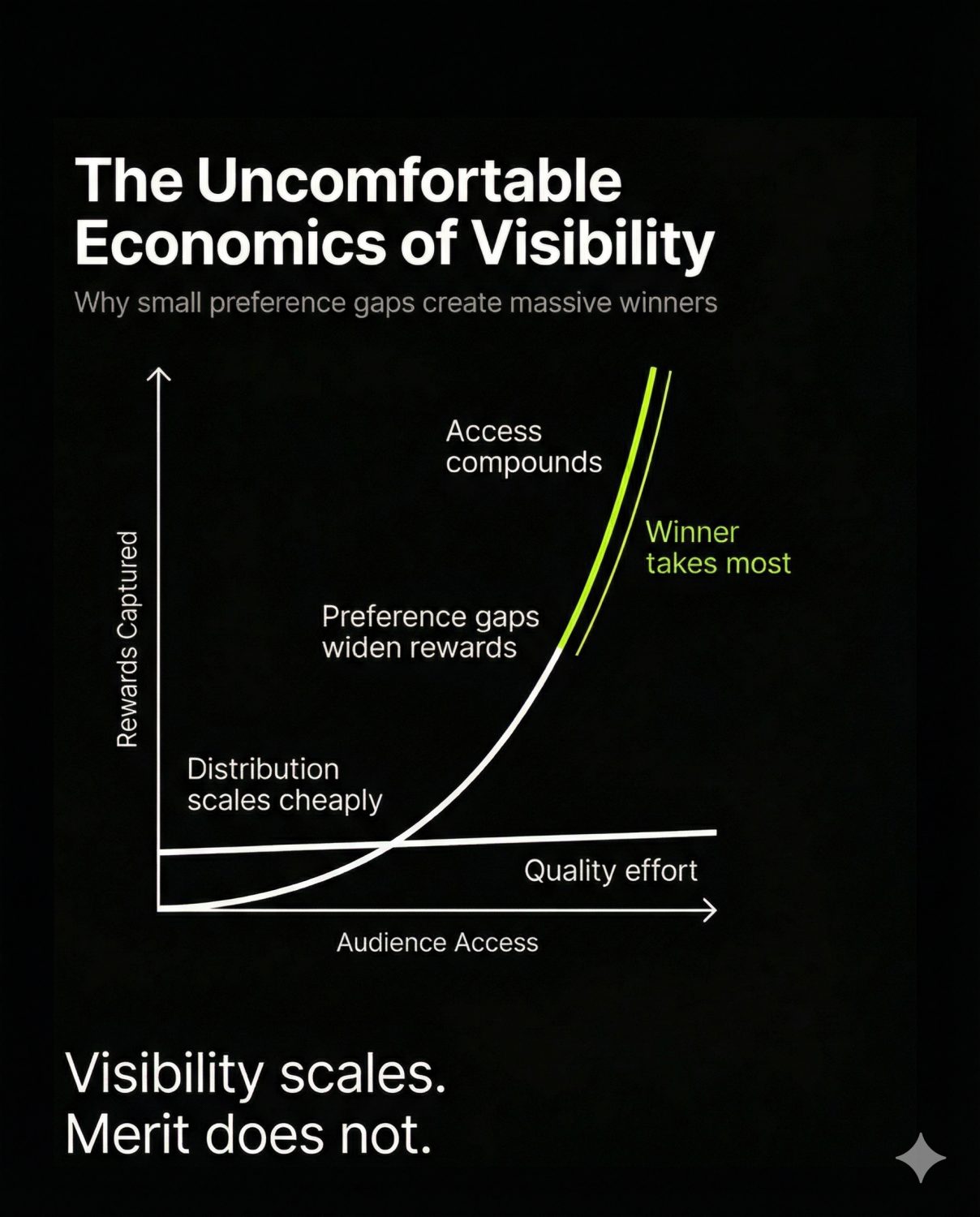
In 1981, economist Sherwin Rosen published The Economics of Superstars. His core argument was not about celebrities or talent. It was about scale.
When technology allows output to be reproduced cheaply and distributed widely, markets do not become fairer. They become more unequal. Small differences in perceived preference lead to enormous differences in reward.
A few players dominate. Everyone else competes for scraps.
Crucially, Rosen pointed out that quality does not need to scale for power to scale. What needs to scale is access to an audience.
That insight maps perfectly onto modern SEO.
Content is now infinitely reproducible. AI has pushed the marginal cost of production close to zero. Every brand can publish thousands of articles, guides, glossaries, and hubs.
Effort is no longer a constraint.
Visibility is.
When everyone can produce content at scale, content ceases to be a competitive advantage. It becomes background noise. Indexed, summarised, absorbed into systems, or ignored altogether.
This is why content returns began to collapse long before AI overviews appeared. AI has accelerated the process, but it did not create it.
The economics were already broken, need proof, look at your reach on this platform lately.
While it’s true that in the early days of SEO, many people made a lot of money by generating traffic from informational blog posts. This was largely because insufficient information was available on almost every subject.
Access to information before the internet and search engines was largely through encyclopaedias you purchased and put on a bookshelf, or through a trip to the local library.
Look no further than Neil Patel, HubSpot, Moz, and Backlinko. These are websites that achieved massive success during a period of high demand for online written content, when little was written.
Tools such as SEMrush and Ahrefs did exactly the same. They were early to market in an industry that was low on knowledge and high in need. I used to love reading articles from Backlinko; Neil Patel’s guide on links was amazing, and Moz produced amazing SEO content.
And yes, these same tactics worked for others in some industries at that time. But at that time, there was little content on many subjects.
This, in turn, led SEOs to adopt content as a strategy because others had used it to build fame. It then turned into a mass tactic used by all SEOs for everything.
But we live in a very different world now. Facebook no longer likes you to click on links and go and visit them, and Google now doesn’t even want to send traffic to your website.
And all that’s before you look at the amount of content targeting the same keywords.
Growth is not going to come through SEO content anymore. That ship has sailed long ago.
Once you accept that, the SEO problem changes entirely.
The question is no longer “how much content should we produce?”
It becomes “how do we become known at all?”
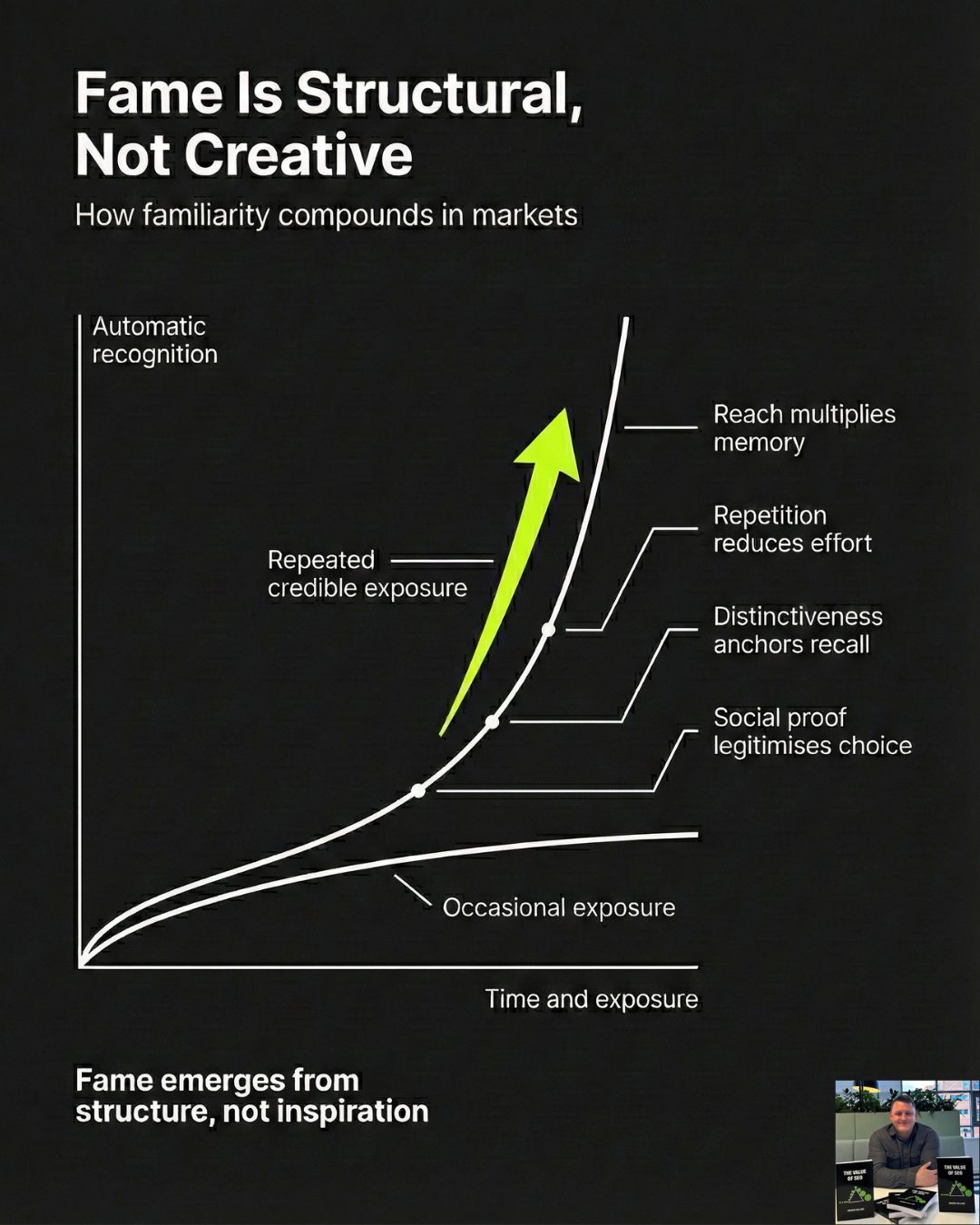
Fame is not a creative concept. It is a structural one.
Daniel J. Boorstin saw this long before the internet. In The Image (1960), he defined celebrity as familiarity induced and reinforced by public means.
The most familiar becomes more familiar because familiarity compounds.
Paul Feldwick later stripped the romance out of this idea entirely. Fame, in his formulation, is reach, repetition, distinctiveness, and social reinforcement.
In reality, fame simply means this:
A brand is encountered often enough and in credible enough contexts that recognition becomes automatic.
That is why fame matters.
Because recognition changes how systems and people behave. And this is key to fame. It applies to both machines and humans alike.
Take little old me.
I don’t consider myself famous. And yet, I do have a personal brand. People search for me on LinkedIn; people know I exist; and when I’m at SEO events, people come to my talks, come up to me, and say they enjoy reading my content. And these are people I’ve never met before.
It’s the tiniest amount of fame. And yet that fame has generated me clients for years, which is why fame is so important. It’s also why so many SEOs are desperate for it and keep building it for themselves.
So if it is this powerful, why aren’t we pursuing fame as an industry?
To hammer my point home, we need to understand how authority, recognition and fame actually work.
Why authority is never self-declared
To understand how recognition forms at scale, you have to leave marketing theory and look at network science.
Albert-László Barabási’s work on scale-free networks shows that attention does not distribute evenly. It clusters.
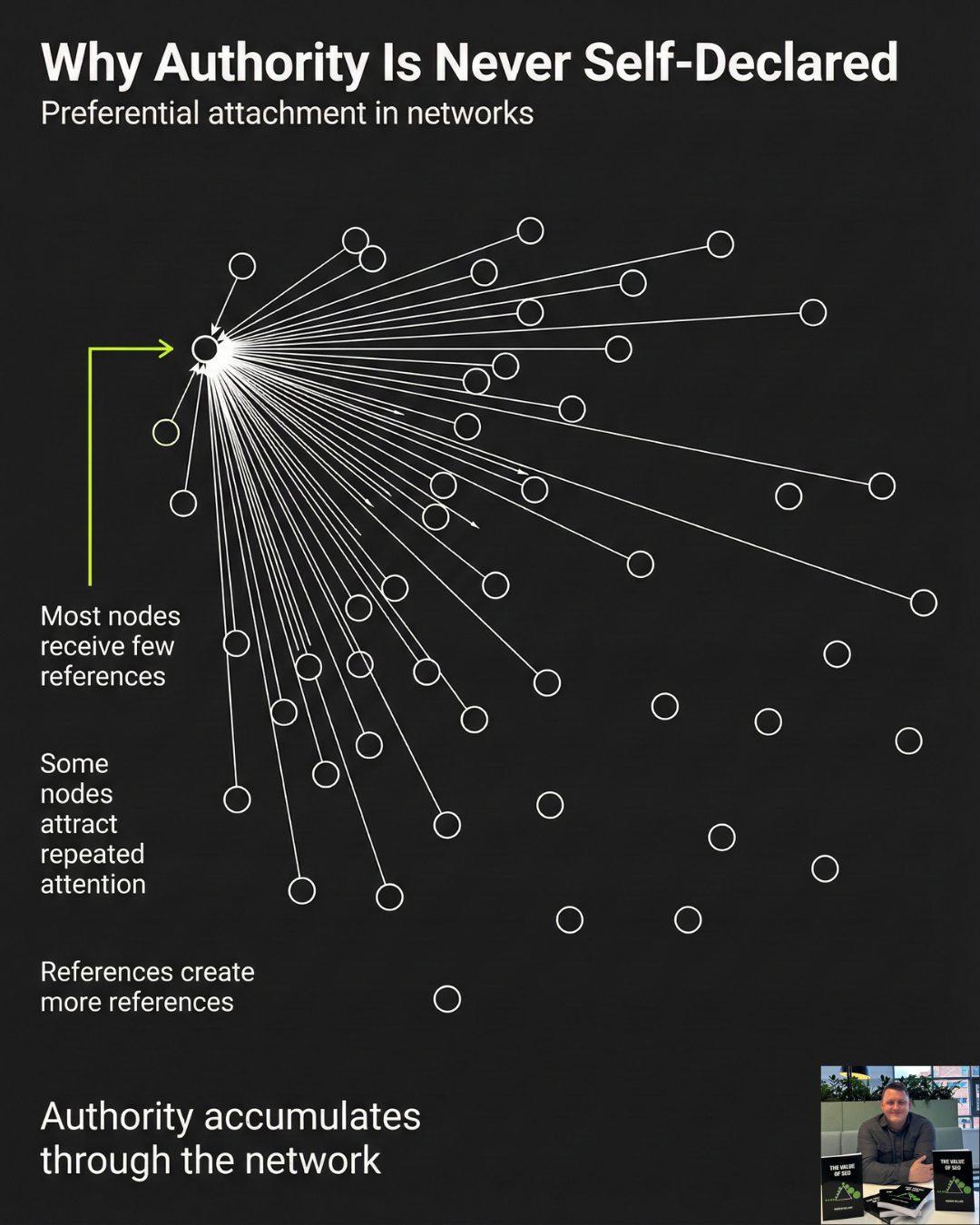
Nodes with more connections attract more connections. This process, called preferential attachment, creates power laws.
Authority is not something you announce. It is something the network confers.
This is why authority through semantic/ topical SEO has always been conceptually flawed. Being well-described or related to a subject does not make you important. Being referenced does.
Search engines, media systems, and now AI models all learn authority the same way: by observing how often others point to you as a source.
Jun Wu, a former Google engineer, has been clear about how authority is judged: third-party websites. Those third-party websites mention your brand as a source of information in relation to a topic or subject.
And whilst, of course, it’s good to have information on your website. And you should create content around the subject area you care about to show expertise.
But being an authority is largely judged by others.
Which is again part of the fame issue.
You need to become famous, and only when you get mentioned can you become famous.
And this matters more now because AI cannot judge performance.
AI search does not judge performance. It aggregates reputation.
Large language models cannot test products. They cannot evaluate services. They cannot experience outcomes.
When asked for recommendations, they resolve uncertainty by looking for consensus signals. Mentions. Reviews. Lists. Media references. Repeated association with a category.
In other words, they do exactly what humans do when they lack direct experience.
This is why AI-driven discovery intensifies the importance of fame rather than reducing it. Systems do not “understand” quality. They infer it from recognition
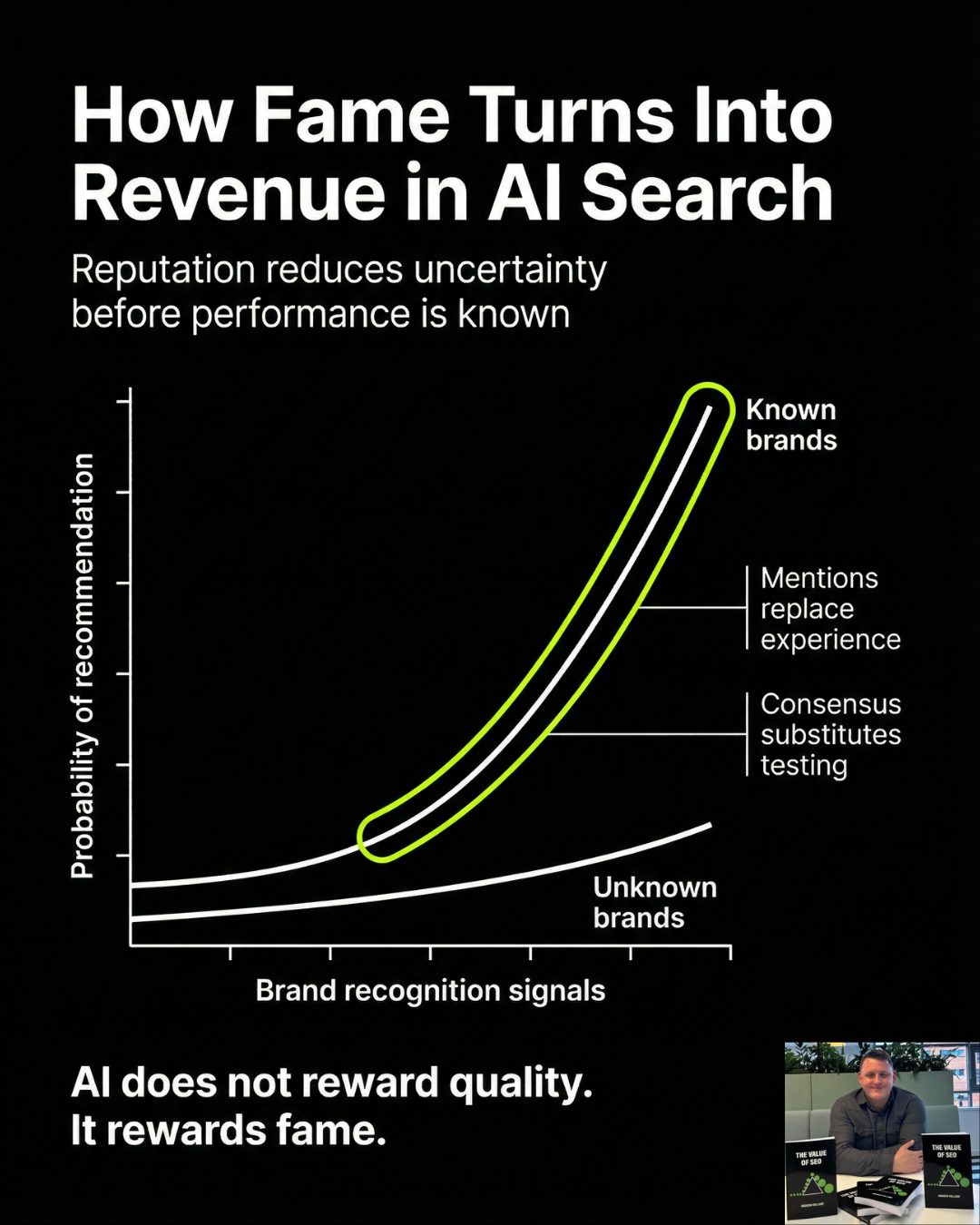
GEO, whether people like the term or not, is simply reputation-weighted retrieval.
Something Barabassi refers to as ‘reputation signalling’.
Reputation Signalling exists in society, not just how large language models see the world. A book from a famous author sells more copies than one by an unknown author.
From educational establishments to the business you work for, reputation matters massively in society.
And reputation can only come through being mentioned by others.
But how does fame translate to revenue?
The Ehrenberg-Bass connection marketers keep missing
This is where the argument stops being abstract and becomes empirical.
Decades of research from the Ehrenberg-Bass Institute show that brands grow by expanding their customer base, not by deepening relationships with a few loyal fans.
Growth depends on two things:
Mental availability: being thought of in buying situations.
Physical availability: being easy to encounter and buy when those situations occur.
Fame directly increases mental availability. Presence across search and industry environments increases physical availability.
In B2B markets, this problem is acute. Brand salience is low. Decision cycles are long. Buyers default to what they recognise when uncertainty rises.
The data consistently shows that branded search delivers dramatically higher returns than generic search. Yet most budgets are poured into non-branded terms because brand demand does not exist.
That is not an optimisation problem. It is a fame problem.
If you want to increase your revenue or chances of being chosen, fame is the aim.
Success is simple:
Be thought of first.
Be searched for first.
Be recognised in non-brand search (or found for the first time).
Be recommended by AI.
So, why are agencies and SEO gurus fighting this?
Why SEO agencies struggle with this shift
Most SEO agencies were built to deliver outputs, not influence. Content calendars. Keyword lists. Monthly reports.
Fame does not fit neatly into a retainer.
It accumulates unevenly. It cannot be guaranteed. It cannot be outsourced to anonymous link farms, AI and content mills.
There is also a quiet hypocrisy at play.
SEO agencies understand fame perfectly when it comes to themselves. They publish studies. Speak on stages. Comment publicly. Cultivate visibility.
What they often deliver to clients is production without promotion.
The result is predictable. Lots of work. Little impact.
Yes, the whole logic was built on the past SEO industry, where some became famous through content.
But that was 10 to 20 years ago.
We need a reset.
The strategic reset: fame engineering
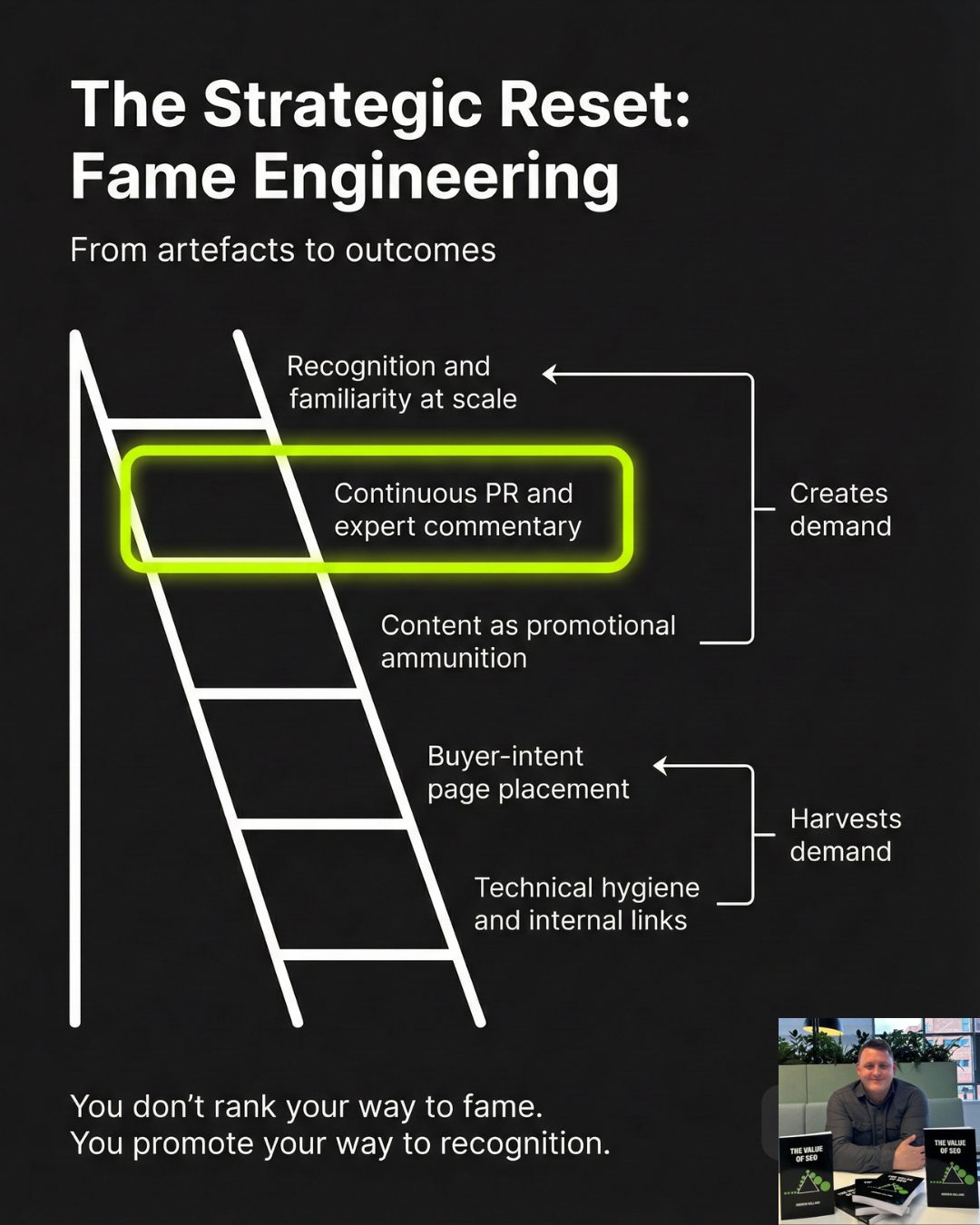
If SEO is to remain commercially relevant, it needs to be reframed around outcomes, not artefacts.
A workable system looks like this:
1. SEO is about placement
Buyer-intent pages still matter. Internal linking still matters. Technical hygiene still matters. This work captures demand when it exists.
But it does not create demand, it harvests demand.
2. PR is about promotion
Earned media, expert commentary, data-led stories, reviews, and third-party mentions are what create familiarity at scale. This is how fame is gained (at first).
3. Content is ammunition, not inventory
Content exists to support promotion. To give journalists something to cite. To give sales and social teams something to distribute. To shape how the brand is talked about.
The organising objective across all three is simple: become known.
Not occasionally. Not campaign by campaign. Continuously.
What brands should actually do differently?
This is not about chasing vanity PR or becoming famous for the sake of it. It is about engineering recognition where it matters.
That means:
Constant expert commentary in your category.
Regular presence in industry and mainstream media.
Data and insight that journalists can reuse.
Assets that are promoted, not published and forgotten.
Measurement focused on brand search, share of voice, and third-party mentions, not traffic alone.
Ask your agencies one question:
“How are you making us more known this month?”
If they cannot answer clearly, you are paying for activity, not growth.
The uncomfortable conclusion
In a world of infinite content and constrained attention, fame is the only scalable advantage.
It shapes human choice. It shapes machine retrieval. It reduces dependency on paid media. It compounds.
The future of SEO is a better-known brand.
And that is a far harder, and far more valuable, problem to solve.
So…what’s your next step?
A Simple Strategy for Compounding Search Success
The phrase ‘generative engine optimisation’ (GEO) has caused considerable upset in the SEO community.
With many SEO gurus claiming AI SEO and GEO is just SEO.
And whenever you give them examples of tactics such as third-party mentions, SEOs are quick to say, “We do that in SEO.”
And of course, that is true. But the reality is that most SEO contracts consist largely of content, structured data, and some outsourced link building.
Most SEO agencies are composed of either account managers or a team of writers. Most link building is outsourced to digital PR companies or purchased links through guest blog posts.
Therefore, most SEO agencies are not set up to build fame.
They’re built to adhere to a content keyword chasing content model that created fame and fortune years ago for certain people and brands.
What I propose is a very different approach to this. One where SEO agencies will have to change how they do things.
Here’s how this looks.
SEO = Placement
If we are to start a fame-first approach, we need to understand how brands are discovered.
Many brands are discovered on the shelf for the first time. Just walk down your local supermarket, and you’ll pick things up and put them in a basket you’ve never seen before.
This is no different from what search rankings are.
You are paying Google for search placement at the top of the search rankings for keywords when you buy paid search.
Organic rankings are the alternative option to paying in Google, and you go after them because of keyword yield.
This is when a single page can generate more rankings for buyer-intent searches than paying per click.
Or to give you an analogy, this is like being on multiple shelves in many different supermarket branches.
This approach is perfectly valid, and you should be doing this as a brand. High keyword yield on buyer intent search pages should be one of the main things you are going after as a brand to drive organic search revenue.
The tactics for this are content optimisation of core buyer intent pages, internal links, optimised headers and page titles—the usual SEO stuff.
But you need fuel, and that fuel is fame.
Fame = PR (Links and Mentions)
Where we diverge from traditional SEO tactics is that we do not use blog posts to gain topical authority in the slightest.
Many SEOs will strongly disagree with this, and I’m not saying that we don’t create content. I’ll come to that shortly.
But the vast majority of your SEO work and budget should be focused on building fame.
If you were to ask me what the best way to build fame would be, it would be to get into the media and on TV.
The second best way is TV advertisements.
But budgets are tight. Many brands don’t have enough revenue to run advertisements that reach as many people as they need to build that fame. So PR becomes the fuel for fame.
As stated, digital PR tactics such as commentary, newsjacking, stories, and data are by far the most effective ways to consistently build these links and brand mentions.
And you need to do it all the time, with always-on digital PR, because the web is a free-scaling network. Links come and go. They get deleted. They get lost.
So you constantly have to be building new links, new brand mentions to keep growing your fame.
Yes, other link-building activities will happen, which I’ll talk about in a second.
But primarily, what you want is to get links and mentions from the media, be that national, local, or industry-focused. Whatever your customers are reading, you need to be present.
But what about the content you create?
Create Content to Build Fame, Fluency, Positive Feelings, Influence AI(and build revenue)
You might then be asking yourself, “What content should we create for our websites?”
Content itself, the stuff you create, used to be about chasing keywords to build fame through search discoeate Content to Build Fame, Fluency, Positive Feelings, Influence AI(and build revenue)
You might then be asking yourself, “What content should we create for our websites?”
Content itself, the stuff you create, used to be about chasing keywords to build fame through search discovery. I do not believe that is a useful way of using your content budget or SEO budgets any longer.
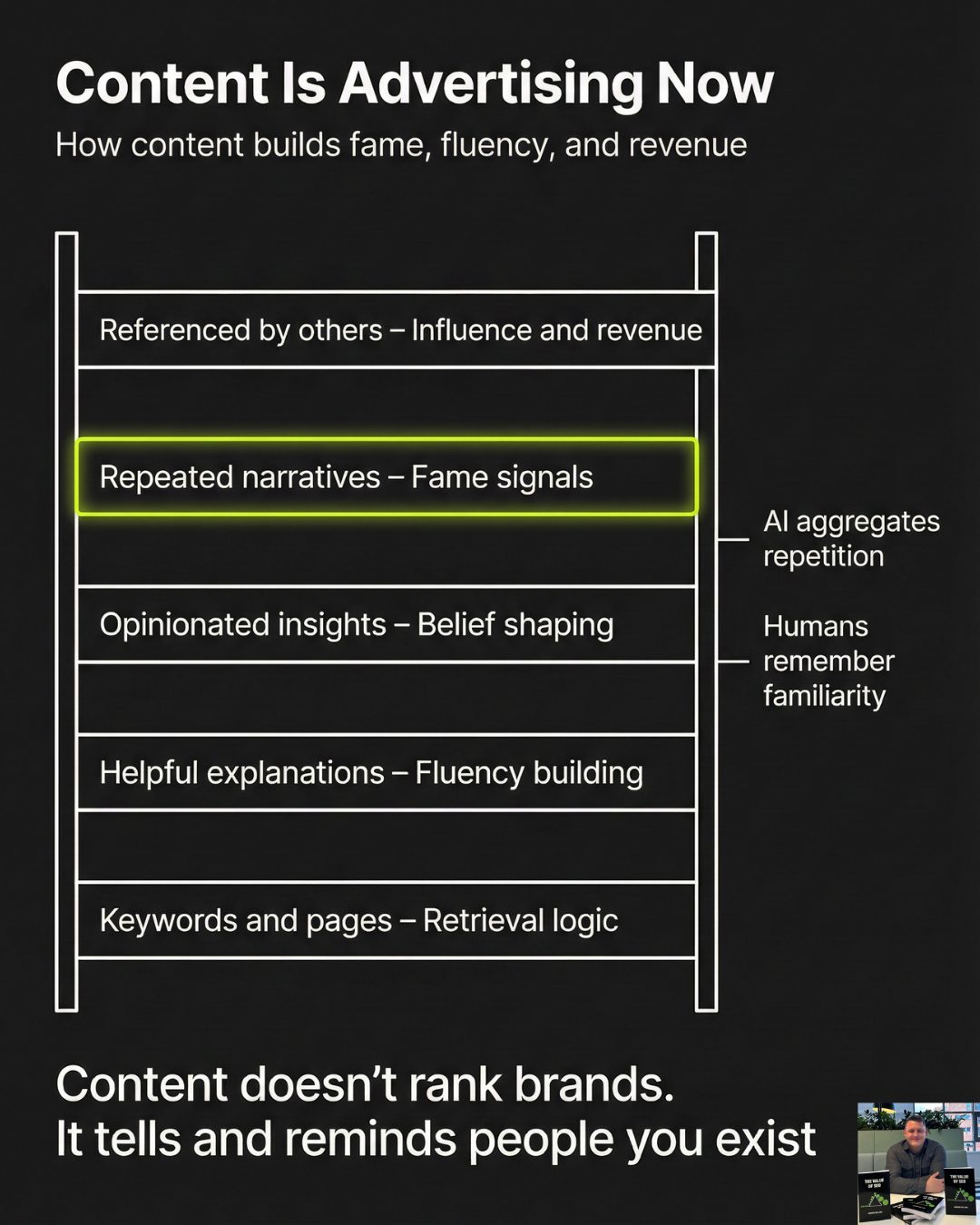
Content today should be used as advertising.
And just like normal advertising will nudge some buyers today, telling and reminding them you exist and encouraging them to choose you and take the next step.
Your content should primarily aim to build fame, fluency, and positive feelings toward your brand.
This completely frees up your ability to create any kind of content you want, the kind your audience would crave, enjoy, and use. And in some cases, link to.
But that doesn’t mean that we throw keywords completely out of the bath.
You are not going to get many clicks from keywords any longer if you rank for them. Therefore, the goal of spending money to rank for them is not a logical step.
But AI overviews can be influenced where it matters for your brand.
Certain subjects can be written about which would influence them in your favour, because you need a voice in AI to be speaking up for what you believe in and your specific approaches or products.
But this is content you should be creating anyway because it is helpful. And ultimately, that is what you should be doing.
Yes, keywords might help to guide you. But if it makes sense to create it because it is relevant and helpful for your audience, just go ahead and do it.
The good thing about the cost of creating content now is that it has come dramatically down. All you need is AI and some voice transcription software, and you can create content in minutes.
But what about GEO?
FAME Engineering for AI = GEO
If you follow the above formula and your site is technically healthy, you are going to be fine and are going to see organic search success.
That said, there are terms you want AI to recommend for your brand. You won’t see the prompts your users are using in AI mode, or in ChatGPT, Claude, or Gemini. Well, not yet anyway.
These are the problems users have, and they go to large language models and AI platforms for purchase support.
The thing is, you know what the general problems that your businesses solve are. That is your strategic positioning as a business.
GEO really is some housekeeping around this. What you’re doing is understanding consumer problems and formulating pseudo-prompts that your audience can use, because the problem might have lots of different prompts, but the problem is still the problem.
And you’re seeing whether you are present and, if not, which specific pieces of information or information styles large language models use to ground themselves when presenting their recommendations.
And usually, this will mostly be third-party websites and mentions.
But if you follow all the steps outlined here, you will automatically increase your chances of appearing in those recommendations.
What Search Success and Internet Fame Look Like
If you’ve made it through to the finale of this post, I congratulate you. It’s been long and certainly detailed, but I want to give you as many opportunities for growth as possible.
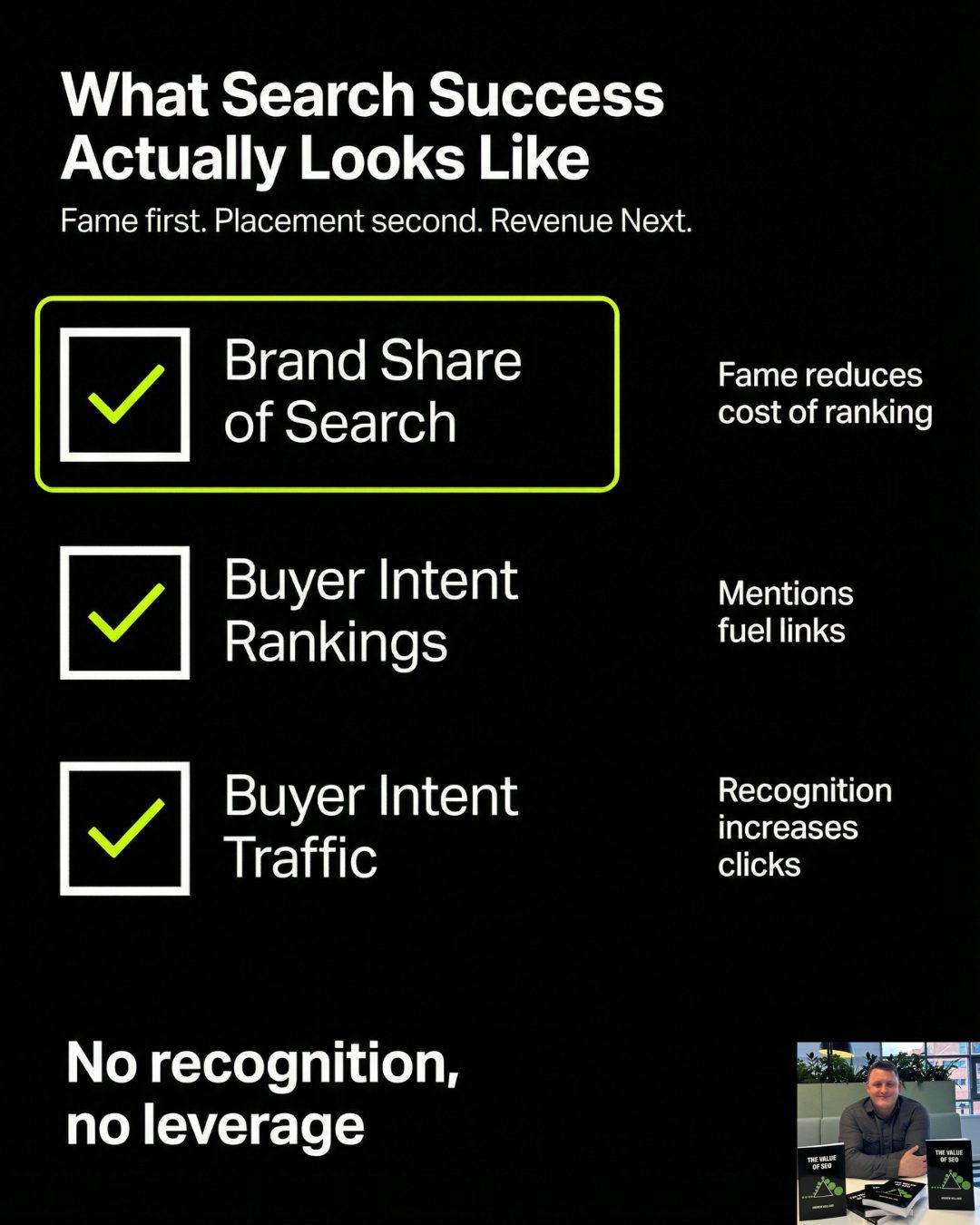
Success in the future of search is simple. It is judged by a few very easy-to-understand metrics.
These are:
Your share of search. That is the total number of searches for your brand in your category.
Your rankings for buyer intent keywords (these are the keywords you pay or would pay Google for).
Your traffic to buyer intent pages.
While other metrics, such as impressions to buyer-intent content, newsletter sign-ups, and, of course, conversions, are all metrics to look at.
Brand search, buyer intent rankings and traffic have to happen for the revenue to grow.
But what makes the fame-first approach work is its logic.
You want to be known and considered before people come to search engines. And if they do come to search engines without searching for your brand, you want to show up on page one for the terms that are relevant and to be remembered.
This will lead to clicks.
However, if somebody doesn’t know who you are, who hasn’t heard of you before, ranking for those non-brand buyer intent search terms will help you to be discovered because of your placement on the search engines.
The economics of pursuing a fame-first approach fuel your rankings through links and brand mentions. You also increase the likelihood of being mentioned by AI systems.
What this does for your brand is increase your business’s profits.
Now I finish with an example of success in the wild, something we’ve done the work for on a digital PR format. For those looking at what’s possible with digital PR, our case study around Select Car Leasing is a must-read.
You can check the car leasing PR case study here.
But what you need to do is adopt a fame-first approach to your organic search marketing.
By moving to a fame-first approach, you will cover all bases.
Fame with your prospects, fame with AI and being found through search.
The choice is yours.
Do you want to become famous?
Message me.
Andrew Holland
Originally published on LinkedIn on 9 January 2026.