
In this article, I look at the SEO funnel.
You’ll learn:
How to align your SEO department with marketing science.
How to use the right platforms for your growth and budget.
A new approach to SEO that is fit for the AI era.
And a lot more.
Let’s dive in.
But first, if you want to see how we increased revenue by 60% for our Digital PR client, click here: https://jbh.co.uk/digital-pr-outreach-case-study/how-better-increased-revenue-with-digital-pr/

Ok, that’s the admin done, let’s carry on.
The Funnel: Why Everything You Know Is Wrong
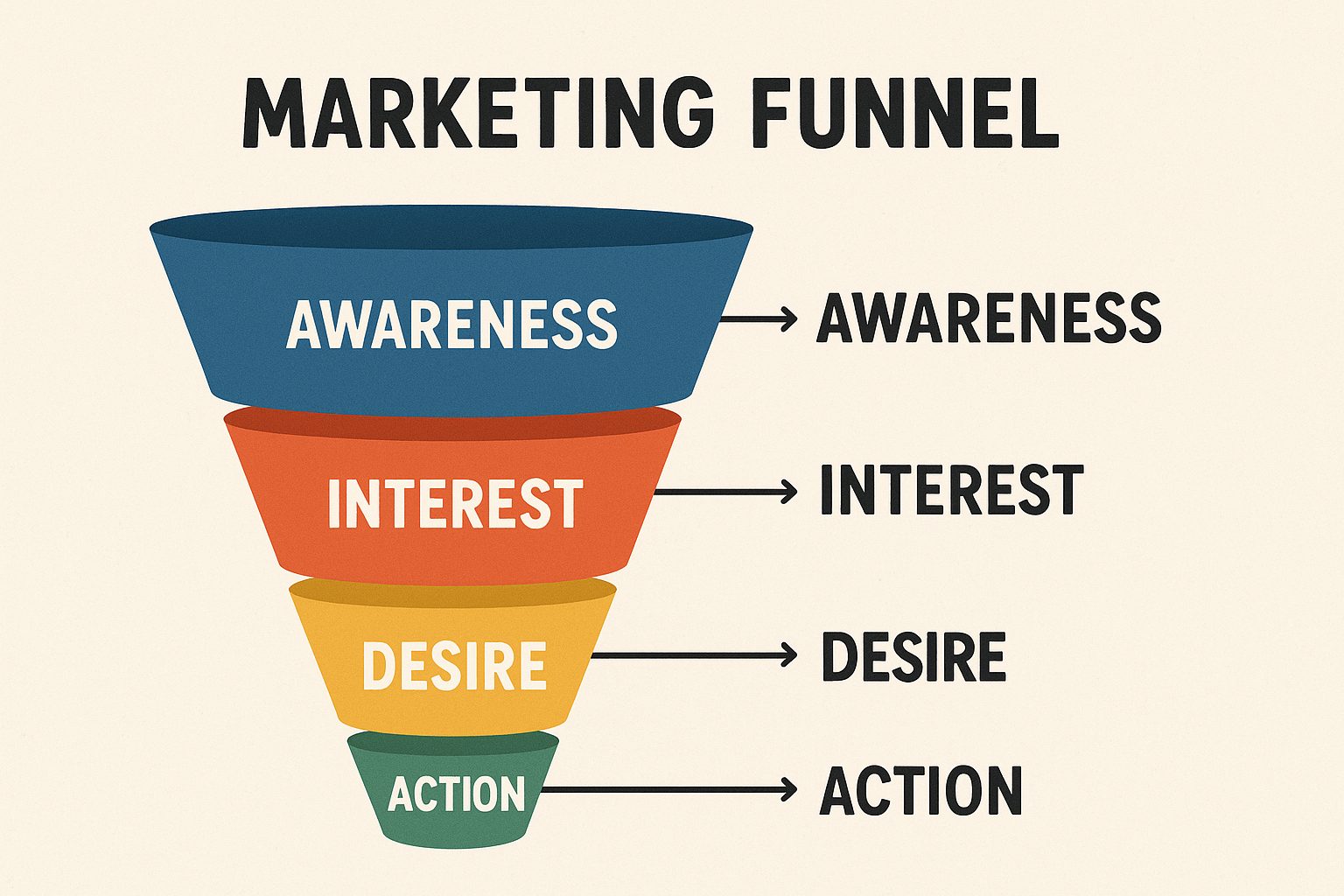
In 2025, businesses will waste millions of dollars trying to make SEO work across the entire marketing funnel.
Now, before we dive in, let me say this.
If you Google search for images of the marketing funnel (like the one above), you’ll see this:
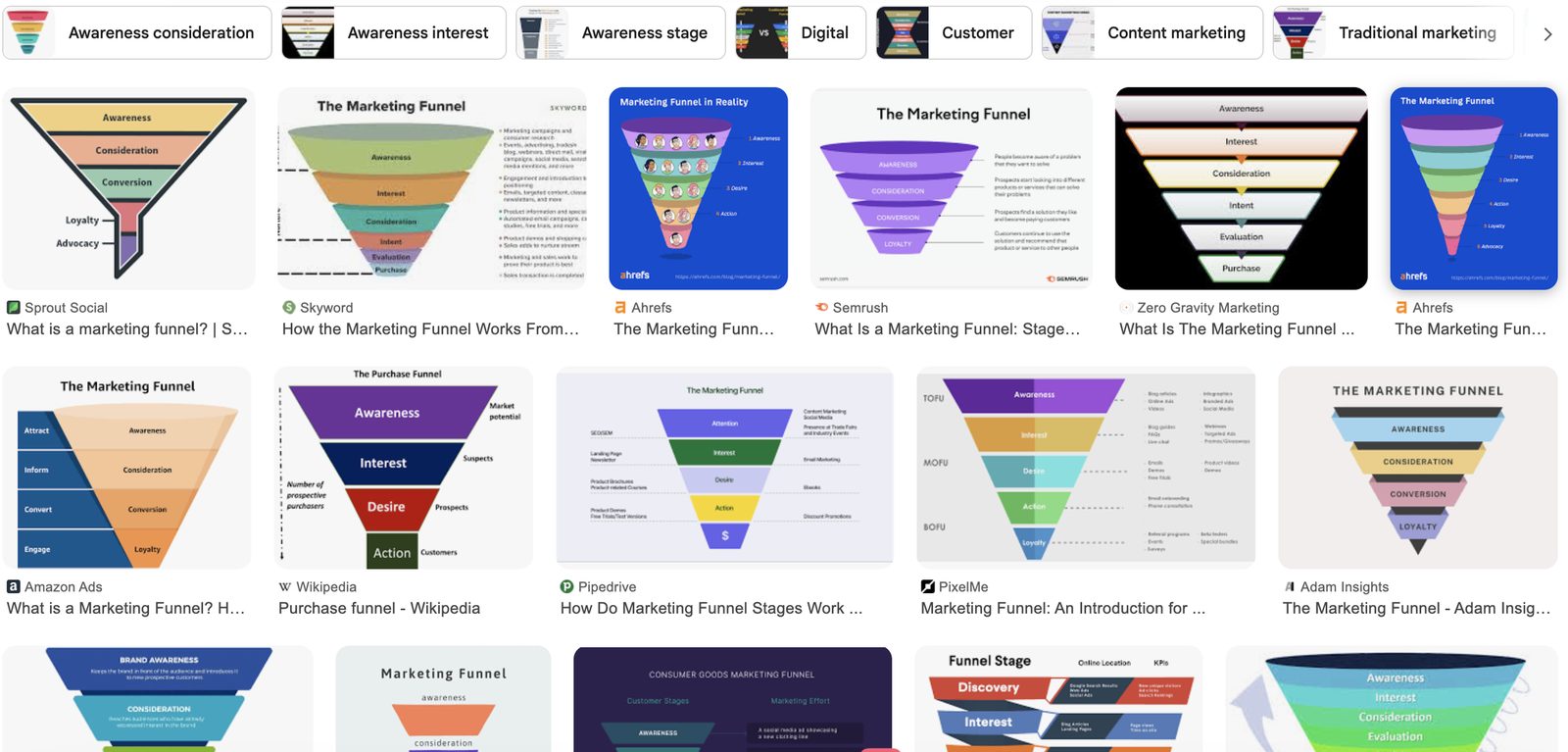
Countless images and variations of the ‘funnel’.
Marketers can barely agree on what the funnel actually is, but to make things simple, most think it’s some form of:
Awareness.
Interest or consideration of products, brand or service.
Conversion/ action.
So, when I talk about ‘the funnel’ in the traditional sense, I’m referring to that type of model.
And it’s this that many are trying to make SEO work at all levels.
This is a mistake.
SEOs have fallen into a trap of attempting to position search as an all-encompassing channel that can independently drive awareness, consideration, and conversion.
They’ve tried to force-fit the entire marketing funnel into search marketing, acting as if SEO alone can and should fulfil every stage of the customer journey.
This misguided approach has warped our understanding of how SEO actually works and drives results.
So, we’re going to break down the real SEO funnel and explain why you should ignore much of the conventional wisdom that’s being shared.
The Evolution of Funnel Thinking
The traditional marketing funnel has been interpreted in various ways over the years. The basic model – awareness, consideration, and conversion – has spawned numerous variations, including the AIDA formula (Attention, Interest, Desire, Action) and others.
However, when examined through the lens of marketing science, these rigid frameworks begin to break down.
Modern marketing experts have proposed more nuanced approaches.
Tom Roach’s modified funnel acknowledges the complexity of customer journeys.
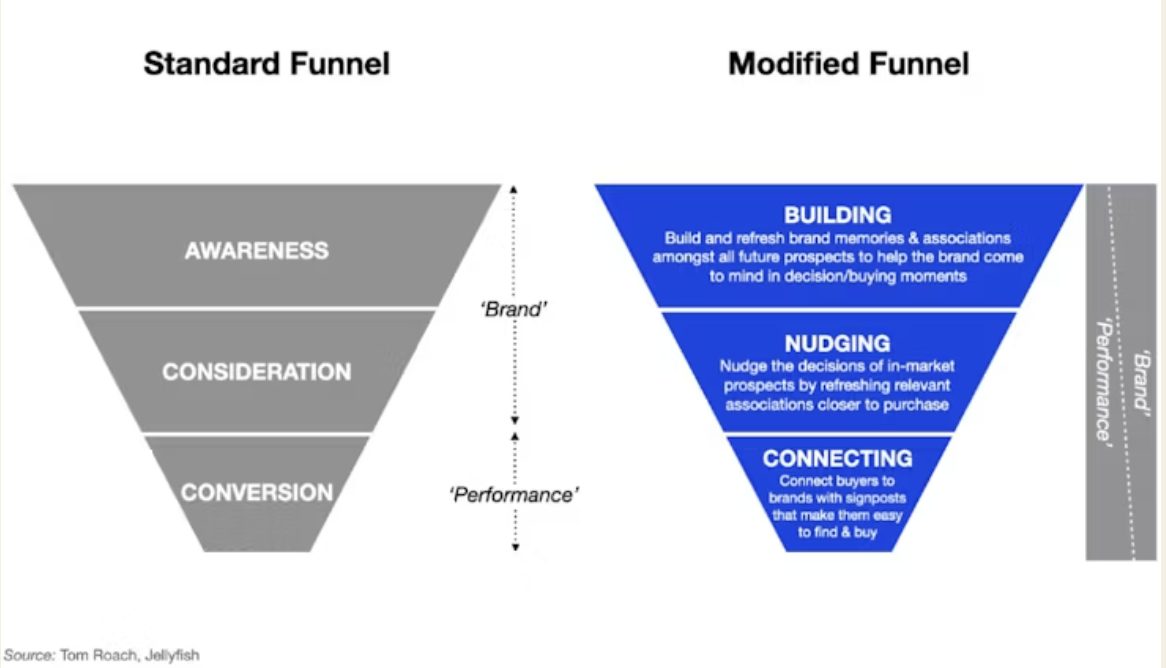
In Tom’s funnel, we adhere to marketing science and look to build brand memories and associations while nudging and connecting buyers to brands that exist in the middle and bottom.
Dr Grace Kite’s simplified two-stage approach strips away unnecessary complexity.
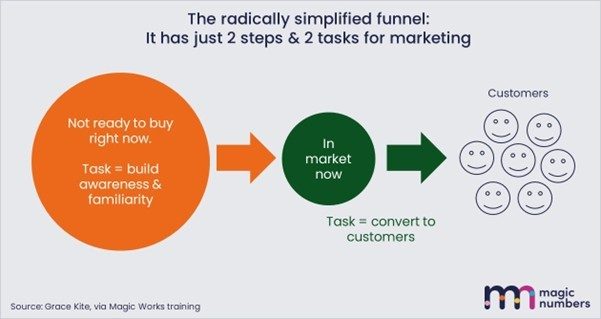
Each of these models better reflects how marketing actually works in practice.
There are others out there, too, all of which are valid.
Yet, SEO practitioners continue to force-fit their channel into a full-funnel approach, a framework that fundamentally misrepresents how search behaviour actually operates.
The Reality of Search Behaviour
SEO is not, and should not try to be, a full-funnel marketing service.
So, let’s tackle what SEOs have wrongly been selling for several years:
That topical authority leads to brand awareness.
I get why.
SEOs have grown up with the likes of Neil Patel, Backlinko, Hubspot, Ahrefs, and Semrush, all publishing content at a massive scale to build their brands.
But this fundamentally misunderstands human search behaviour.
Search queries fall into two distinct categories:
Information-seeking searches
Task-completion searches
Someone searching for information isn’t necessarily in your market to buy from you, and providing them with content about a topic related to your brand, product or service won’t guarantee they’ll remember your brand. Especially at that all-important moment to buy.
This is down to the memory phenomenon known as the forgetting curve.
The forgetting curve shows that people rapidly forget information they don’t immediately use.
Think about your own search behaviour: how often have you found useful information through Google, only to later forget where you read it?
This isn’t a flaw in SEO or content strategy; it’s simply how human memory works.
Even if your content is perfectly crafted and easily comprehended, the forgetting curve works against you.
People don’t run around gushing about your brand.
We forget most brands most of the time because we’re busy and our brains are bombarded with attempts to grab our attention.
It’s for this reason that advertising is used to grow brands.
But I hear the naysayers on this debate scream the usual examples of content and search (the Hubspot-esque ones I mentioned earlier).
So what’s going on there?
Information Gain is a Human Addiction
As the saying goes, ‘knowledge is power, ‘ and as such, humans have used information to evolve throughout history.
Indeed, if we are better informed, we should make better life decisions.
So, we constantly exist in a state of information consumption.
We are ‘informationvores’.
The goal of ranking informational content on Google is that, in ranking for search terms your ideal customer would search for, they discover you.
Rank for enough terms and they’ll discover you repeatedly.
Do this often enough, and you’ll grow your organic search, be recalled when clients are interested in buying, open up retargeting options, and, of course, grow the email list.
That’s the deal, and that’s the tactic.
If you’re an SEO SaaS, rank articles about SEO.
If you’re an HR SaaS, rank articles about HR.
If you’re a…
You get the idea.
And so, huge swathes of the budget were spent on that logic.
But it’s backfired for decades, and it’s flawed logic.
It backfired because when searching for information online, we exist in what is called a Problem State.
And we’re trying to reach a Goal State.
An HR employee might want to refresh their knowledge of HR law before a big meeting. So they search for the search results and click on the SaaS platform’s article.
But then a few things happen.
They either go on about their task.
Or more likely, they read a few articles on the subject and then go about their task.
It might be days, weeks or even months before they conduct an informational search again where they find your brand’s content.
And once you add in the forgetting curve, you can see how limited the impact of this is.
It could take years to accumulate enough topical content to meaningfully affect brand growth through this approach.
And that costs a significant budget.
Which is why content marketing takes a different approach.
Content Marketing is Different

If I were to describe content marketing, it would always revolve around this statement from the late Howard Gossage:
“Nobody reads advertising. People read what interests them; and sometimes it’s an ad.”
Since the time of Gossage, things have changed.
We live in an abundance of content and algorithmically powered platforms that entice us to click, consume, listen, watch, or read.
All so that the platforms can earn money through a revenue system, often through advertising.
This has made creating content easier than ever.
I say easier, what I mean is cheaper.
While advertising is expensive, content creation is cheap, and indeed, promoting content on a platform is cheaper, too.
As AI evolves, the price of creating great content for your target audience and promoting this to them at scale is far more effective and less wasteful than churning out hundreds of articles with SEO.
What would you rather have?
10 amazing pieces of content that are promoted to your target audience and drive immediate clicks and brand recognition, or 100 that you have to create and rank, hoping that your ICP remembers you as they are knee deep in a task.
That’s not to say you can’t have the best of both worlds.
There is often an overlap.
In some sectors, like SEO, for example, there is a lot of traffic and keywords geared toward solving SEO issues.
If you’re a SaaS that improves SEO performance, then it makes sense to target this traffic.
But this is because the searchers ‘goal state’ is closely aligned with your product.
However, these markets are exceedingly rare and only apply to a small section of traffic available via SEO.
Which makes the idea of using SEO ‘content’ to drive awareness for brands a fringe tactic.
And this contradicts how most SEOs have been using and selling content for years.
Once you add AI overviews and AI search into the equation, the model dies anyway.
Traffic is vanishing, and the brand effect from AI overview impressions is minimal.
So, we can ditch this and focus on what brands really want.
An SEO funnel that works.
The Real SEO Funnel
Let’s be clear: if you’re running a publishing business, this framework won’t apply to you.
But for e-commerce, service-based businesses, and product sellers, the truth is that the SEO funnel works backwards.
Forget about creating awareness.
The real power of SEO lies in reaching people who are already in or entering the market for your product or service.
We are, fundamentally, a product placement channel.
Our primary function is positioning goods, services, and products in front of users with buyer intent.

This means two things:
Bottom-funnel activity targeting buyer-intent keywords should be your primary focus.
Content creation should align with the problem you solve, not general awareness.
Creating “awareness” through SEO is largely ineffective unless you’re addressing someone who has an immediate need for your solution.
Without that immediacy, you’re fighting a losing battle against the forgetting curve and human psychology.
The Power of Buyer Intent
Buyer intent keywords create valuable awareness at exactly the right moment.
Many customers discover brands for the first time through buyer intent searches – if they already knew your brand, they would have searched for you directly.
In essence, brand marketing is SEO for the human mind. And our minds are the first search engines we visit.
Without established brand recognition in the mind, customers use search engines to find solutions to their problems.
They use buyer intent keywords first, which are often basic and broad search terms.
They then begin exploring their problem, investigating DIY solutions, evaluating professional help, and weighing their options.
This is where SEO becomes powerful because you’re creating awareness closer to the point of purchase, when the information is most likely to stick.
The key is alignment: your informational content should focus tightly on the specific problem you solve.
This creates two crucial forms of availability:
Digital/ physical availability: being easily found and purchased by showing up at the bottom of the funnel.
Mental availability: being remembered when the need arises by showing up as the prospect is gathering information to purchase.
This focused approach works because it connects with users when the information is most relevant and valuable to them, significantly increasing the chances of both retention and conversion.
OK, that’s the science bit.
What about the funnel?
Introducing the SEO Funnel
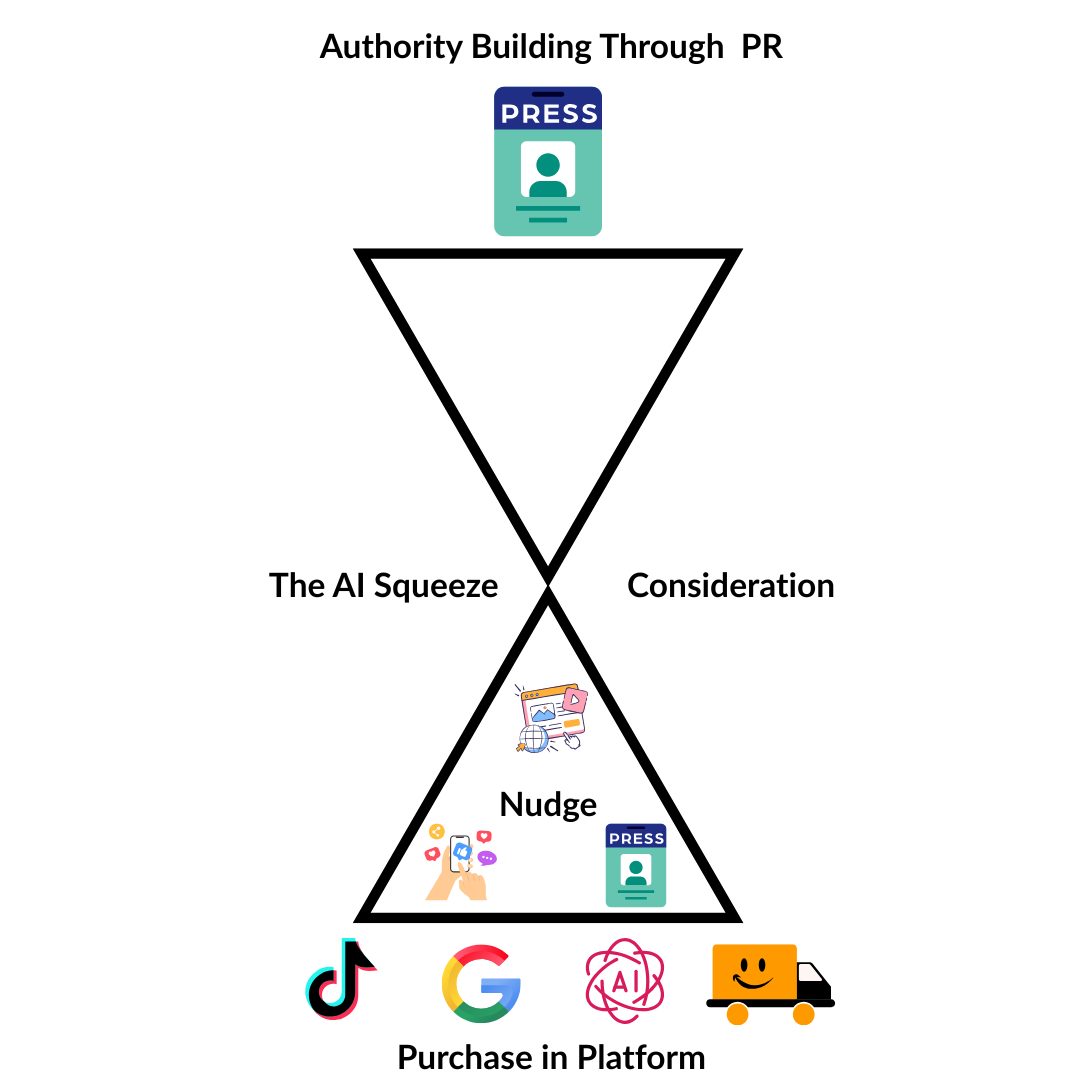
Starting at the top of the funnel and working our way down.
Top of Funnel = Digital PR
The reason digital PR sits at the top of the SEO funnel is that it can be used to:
Build brand awareness.
Build brand mentions.
Build links.
Provide brand information to LLMs.
There is No Middle in the SEO Funnel (here’s why)
You’ll notice that in this funnel, the middle doesn’t exist.
It doesn’t exist because AI will eat up consideration search and do the ‘considering for you’.
As we move to an automatic ‘deep research’ model of search, AI will tackle a lot of consideration for us, searching the first 3 pages of Google/ Bing and analoyusing options based on our needs.
This doesn’t mean you shouldn’t write or have content that answers consideration-style traffic or queries; it’s just that you should give up watching rankings like a hawk; they’re not as important moving forward.
AI will use your entire site and also visit the first pages of search engines to better solve a user’s issue anyway, so don’t worry about solving the consideration aspect.
The Messy Middle of search is over; AI will handle this for you.
Nudging: The New Weapon of Content
As Tom Roach states in his funnel, the role of ‘Nudging’ is to refresh the memory structures of ‘in the market buyers’.
It’s reminding people you exist.
To do this, you’ll use:
Content on your website.
Digital PR (it’s the same PR as at the top, so you have an added benefit.
Social media, both paid and organic.
Email marketing.
Display advertising.
Bottom of the Funnel: Increased Platform Digital Availability
You have all the places your buyers search at the base of the SEO funnel.
And yes, this will depend on the product or category.
Some people will start a buyer search on TikTok, others on Google.
What matters is that you’re present where the buyers search.
So, how does this work in reality?
A New Approach to SEO Strategy
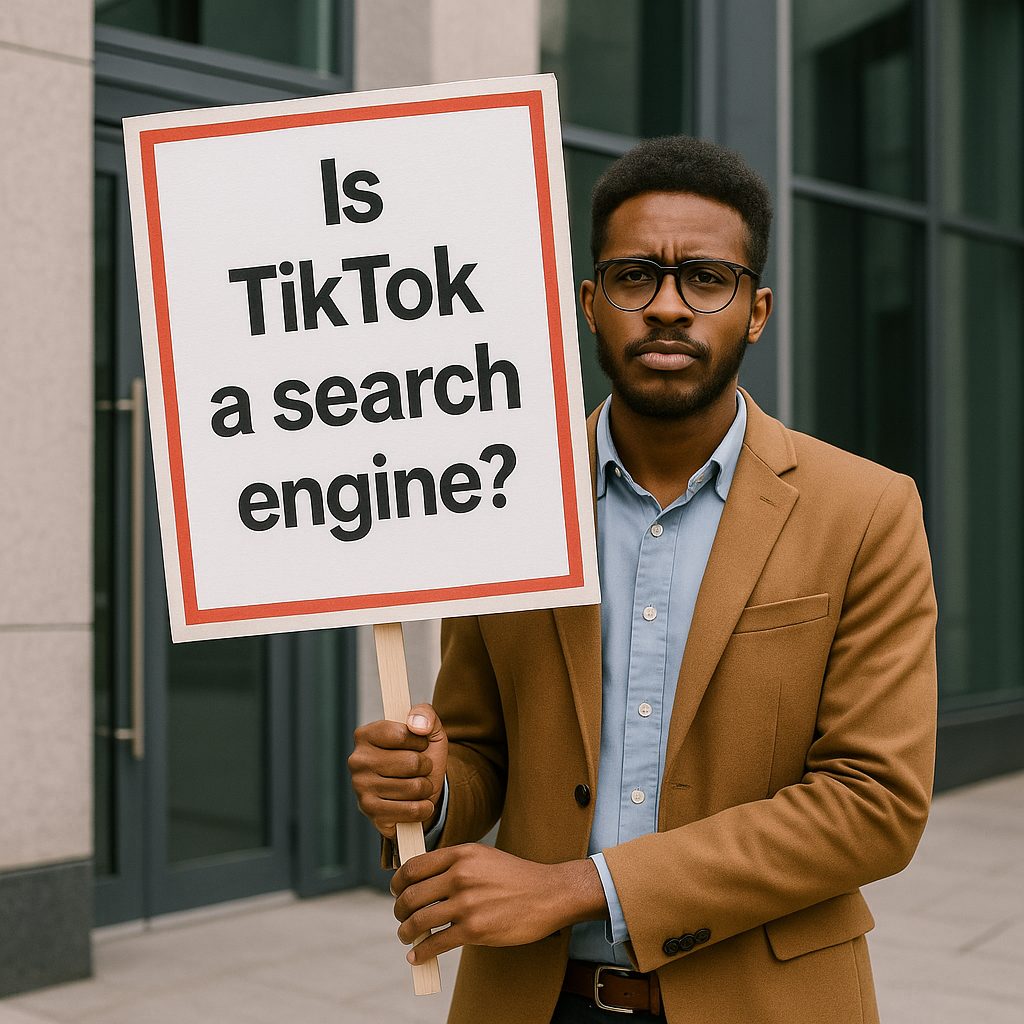
OK, unless you’ve been living under an SEO tree, you’ll have seen agencies start to talk about ‘social search’.
The logic is that people search everywhere.
And that’s right.
Except your buyers don’t search everywhere when they’re buying.
A good rule of thumb is this:
Some people, search for some things on social media.
The key is understanding which platforms your buyers are searching on and making strategic budget decisions.
Whether to invest in TikTok SEO, YouTube SEO, or any other platform-specific optimisation always comes down to data.
Every platform from Amazon to insurance comparison sites could be considered a search engine (of sorts) but that doesn’t mean you need to optimise for all of them.
It doesn’t mean you must own the search category across all platforms.
You can influence or nudge buyers on platforms through ads, content or influencers.
The strategy around ranking is key here.
You have to maximise your budgets.
Follow Your Buyers, Not Trends
I always suggest in any situation, follow your buyers and place your budgets where they buy.
Build your nudges and digital/ physical activity around where your buyers buy.
Then decide to go elsewhere if the data supports this.
Budget Reality Check
Marketing resources are finite.
The key to effective SEO investment isn’t trying to be everywhere – it’s being precisely where your buyers are searching with intent to purchase.
The most effective SEO strategy isn’t about being discoverable everywhere.
It’s about being visible where it matters most to your bottom line.
Key Takeaways
The ‘new’ SEO funnel is budget-focused. You must place your SEO efforts where the buyers are. Where is the highest buyer intent search volume? TikTok or Google? Amazon or YouTube? Start there.
Digital PR is SEO’s weapon at the top of the funnel, as it has many broad benefits across platforms.
There is no middle of the funnel. AI will clear up the messy middle of search and consider our options.
You should use ‘nudges’ in platforms to refresh memories and activate buyers. These nudges can be achieved through content, social media, influencers, and more.
One final thing.
The SEO funnel is not a replacement for the ‘funnel model’.
It is how to maximise success through SEO in a multi-platform search world.
And it can be used as a guide to maximise budgets in a fast-moving world.
Thanks for reading.
Andrew Holland
Originally published on LinkedIn on 21 May 2025.