
Recently, OpenAI released GPT-5.6. And having used it extensively since then, I can happily report that it is mind-blowing.
The team at Every.to described Anthropic’s Claude Fable as a warp drive: extraordinary for the enormous, long-running jobs you might want to fire across the galaxy. GPT-5.6 Sol, by comparison, is a Porsche. Fast, powerful and sufficiently practical to use every day. That description is bang on. I am already using it constantly.
But the interesting thing is not whether ChatGPT is currently better than Claude, Gemini, Grok or whatever arrives next Thursday.
The interesting thing is what happens to search every time one of these models becomes more intelligent.
While waiting at Rhodes airport, I ran a small and admittedly unscientific test. I asked ChatGPT, Google’s AI Mode and Gemini whether they could identify the departure gate for my return flight.
I was not going to entrust my journey home to an AI system, obviously. I am adventurous, not a complete fucking idiot.
Google did not find it. Gemini could not identify it. ChatGPT nailed it.
That does not prove ChatGPT is universally superior. It proves something far more important: the quality and usefulness of AI search depend on the system, the model, the tools it can access, the mode selected and the depth of reasoning applied.
OpenAI now offers several GPT-5.6 variants and levels of effort. Google’s AI systems use their own search index, grounding systems and query fan-out. One person’s search for your brand can therefore be materially different from another’s, even when the wording is similar.
That creates an enormous problem for anyone claiming they can “optimise” your company for the future of search.
You do not know which system the customer will use.
You do not know which model will answer.
You do not know how much reasoning it will apply.
You do not know which secondary searches it will run.
You do not know whether it will rely primarily on an index, live web retrieval, training data, product feeds, maps, reviews, social content or some combination of the lot.
And yet, while I was lying on a sunbed, my friends continued sending me articles from the usual SEO crew making wonderfully confident claims about how to manipulate these systems.
Chunk your content.
Increase your “citation score.”
Optimise for the model.
It is mostly bollocks.
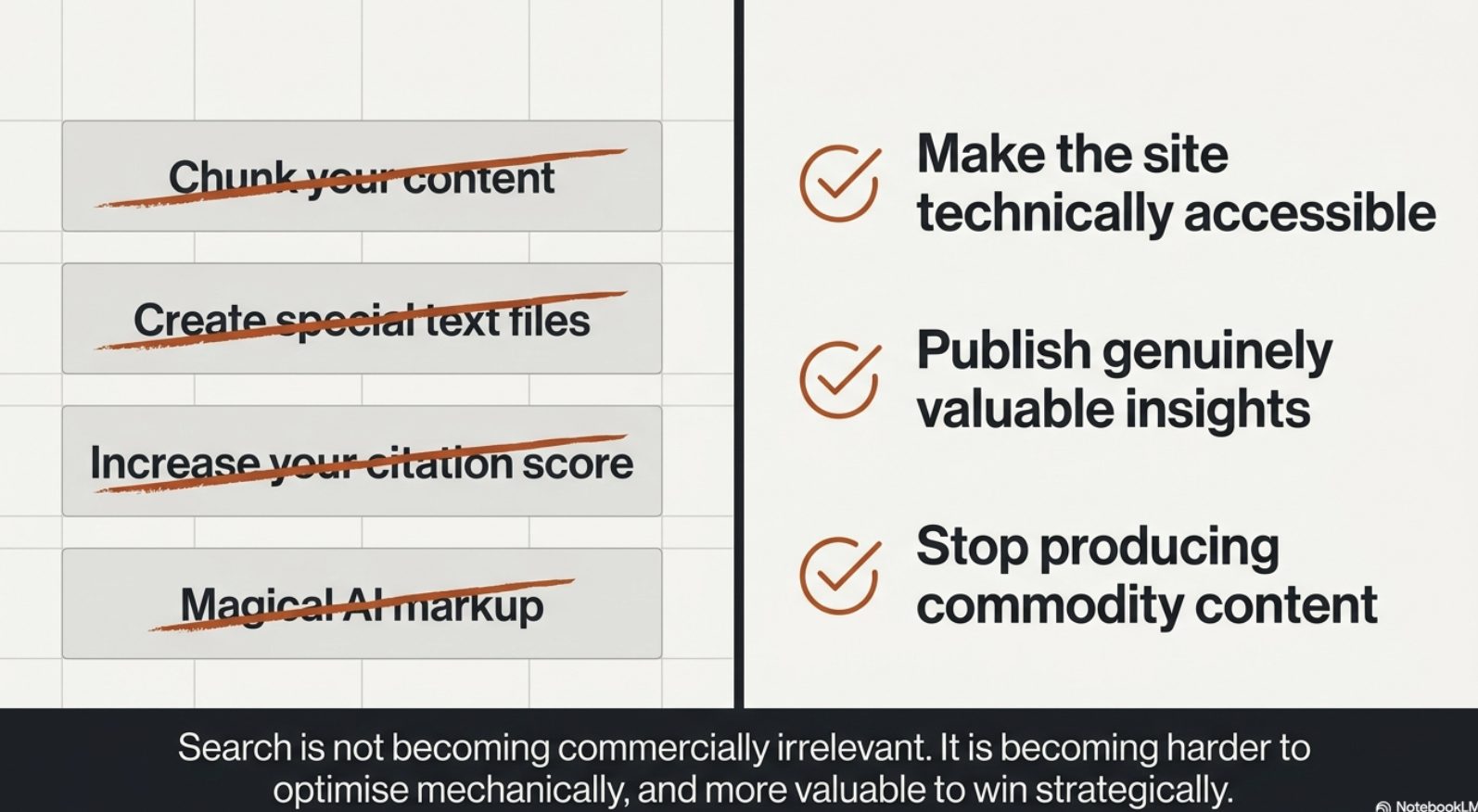
Even Google now explicitly says there is no requirement to chunk content into tiny pieces, no special writing style required for generative search, no ideal page length and no magical AI markup that will propel a brand into its answers.
Its advice is surprisingly traditional: make the site accessible, publish something valuable and stop producing commodity content.
We are leaving the era of tweaks.
The new competitive weapon is visibility.
Search has split in two
At the moment, two forms of search are operating simultaneously.
The first is the familiar index.
Humans type keywords. Google returns results. Businesses bid on search terms. Customers click local listings, product pages and websites.
As long as that behaviour continues, SEO remains incredibly valuable.
The second system is the AI recommender.
You do not necessarily ask it for a website. You arrive with a problem.
“I need a cordless vacuum that will not wake a sleeping baby.”
“I need accounting software for a three-person consultancy that sells into Europe.”
“I need to hire a suit for a wedding near me, but I am unusually tall and need it altered by Friday.”
The AI system does not merely return ten blue links. It attempts to recommend a solution to your problem.
OpenAI’s shopping research product makes this change explicit: users can describe a need or constraint and ask the system to research the appropriate products. Google similarly describes AI Mode as a tool for recommendations, comparisons and complex questions.
For broad, lazy prompts, the biggest and most visible brands will usually enjoy an advantage. Fame is a wonderfully effective retrieval system.
But constrained prompts create a different opportunity. The more specific the need, the harder the model must work to find the business, product or service that genuinely fits.
That is incredibly powerful for consumers. I have discovered products through AI that I did not know existed because I could explain the problem without knowing the category name.
It is also why being discoverable is becoming more valuable, not less.
There is more content, more competition and more fragmentation. Reaching people is harder. Being remembered is harder. Being found is harder.
Search is therefore not becoming commercially irrelevant. It is becoming harder to optimise and more valuable to win.
The piranha tank of traditional SEO
For most of its history, SEO had three practical pillars:
Technical work.
Content.
Links
The job was to ensure a page could be crawled, make it highly relevant to a valuable keyword and build enough internal and external authority for it to rank.
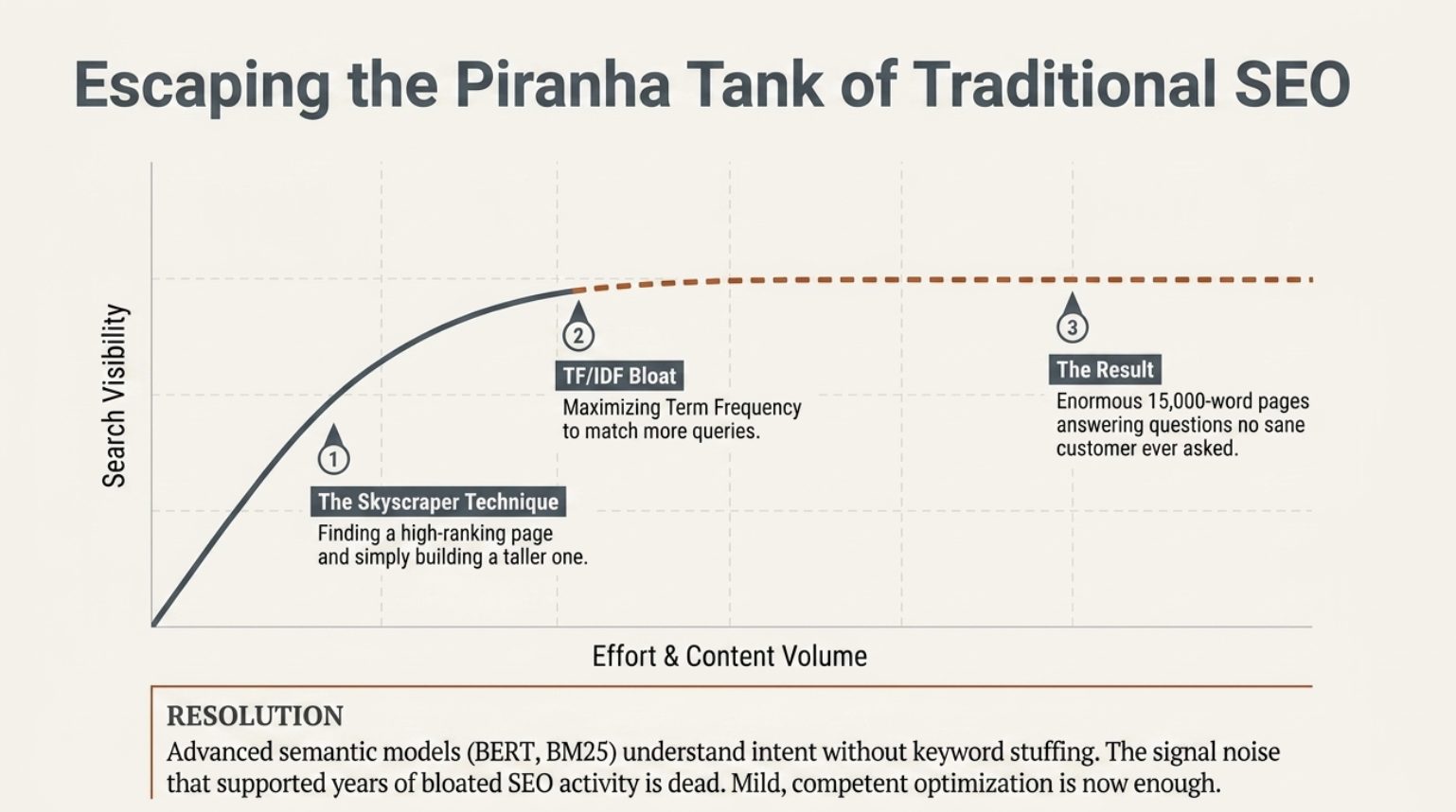
In fiercely competitive categories, optimisation became a bloodthirsty piranha tank. Every competitor examined the same keywords, added the same headings, commissioned the same backlinks and produced an even larger page.
The industry called one version of this the skyscraper technique. Find the highest-ranking page for a topic, copy every useful section, add more detail, and build something taller.
The result was predictable: enormous pages containing 6,000, 10,000, or even 15,000 words that answered questions no sane customer had asked.
This worked thanks to something called TF/IDF. More text often increased the number of queries a page could match.
Term Frequency (TF): Measures how frequently a word appears in a document. Since documents vary in length, it is usually normalised by dividing the word’s count by the total number of words in that document.
Inverse Document Frequency (IDF): Measures how important or rare a word is across the entire corpus. Common words (like “the” or “is”) are penalised, while unique, topical words get higher scores.
Longer text meant more topical words, and so the industry built skyscrapers.
But search systems have become considerably better at understanding language, context and intent. Google began applying BERT to Search years ago specifically to interpret queries more naturally, and updates like BM25 systems can understand synonyms, meaning and multiple topics without every conceivable keyword variation being stuffed into the copy.
That does not mean links no longer work.
It does not mean keywords no longer matter.
It does not mean technical SEO has disappeared.
It means the signal noise that supported years of bloated SEO activity is being reduced.
Mild, competent optimisation will increasingly be enough for many businesses. The difficult and expensive work will shift towards building the authority and visibility around it.
Like it or not, SEOs will no longer have the control or ease they once had in generating results. The work will change, AI will do much of it, and we move from work of output to allocation of AI technology.
This changes the retainer structure and what is considered value in SEO.
The suit-hire test
Whenever I develop a marketing argument, I try to ground it in a real business.
My friend Paul recently acquired a suit-hire shop in a small town. It is not a global SaaS platform with an addressable market of 14 billion imaginary users. It is a straightforward local business.
So what should Paul do?
The traditional SEO answer is relatively simple.
Research the high-intent local keywords. Optimise his commercial pages around terms such as “suit hire,” “wedding suit hire” and relevant searches connected to his town. Fix the site’s technical hygiene. Ensure it is crawlable. Set up and improve his local listings. Pursue the map pack. Build sensible foundational links through directories, the chamber of commerce and local partners.
That work matters because people still search using keywords, and someone searching for suit hire nearby is demonstrating a useful degree of purchase intent.
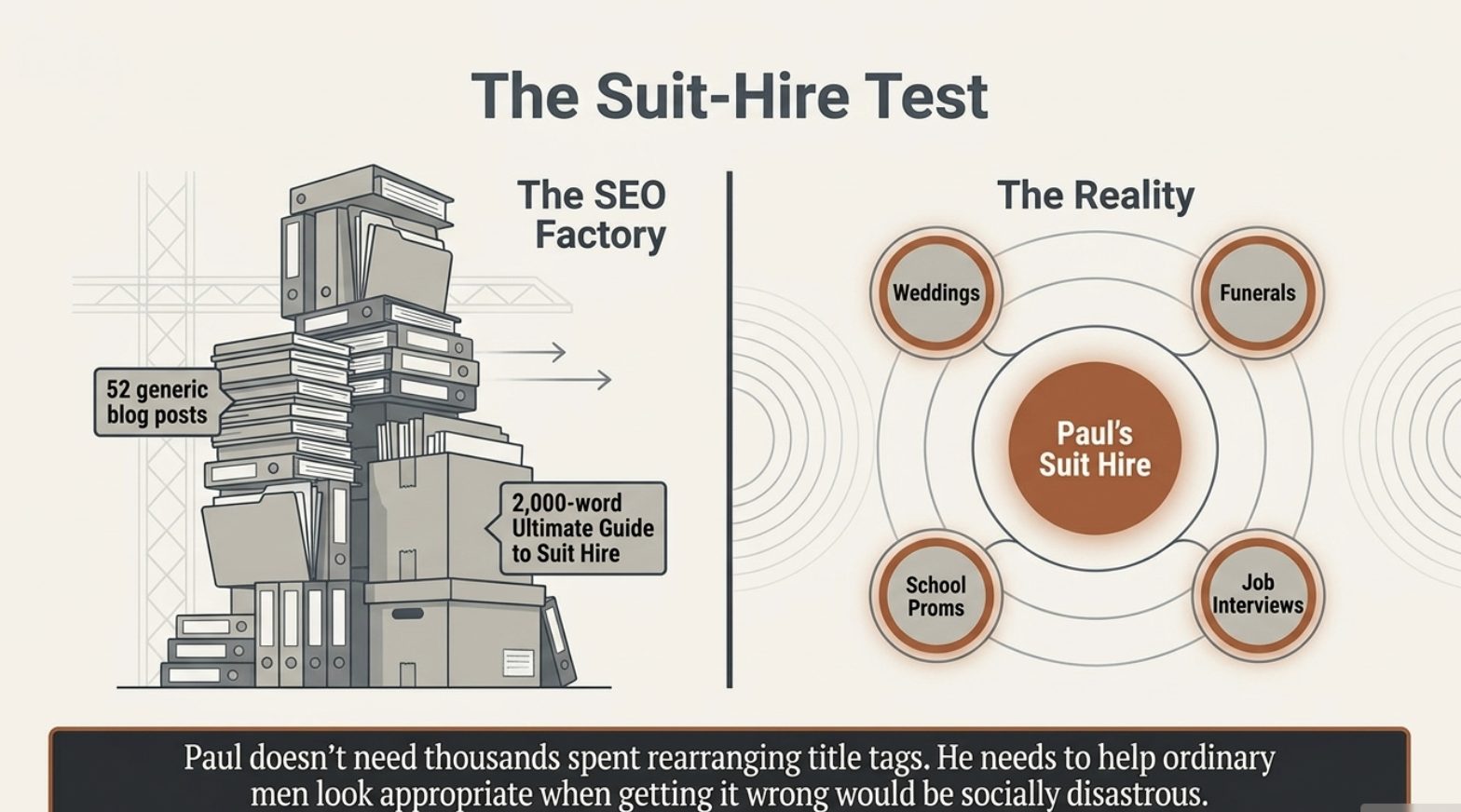
But Paul does not need 52 blog posts.
He does not need a 2,000-word guide titled “The Ultimate Guide to Suit Hire?”
He does not need an agency charging thousands every month to rearrange his title tags and send him a PDF containing loads of green arrows.
At his scale, competent SEO may involve a one-off piece of work and a modest amount of maintenance. AI will increasingly help businesses make straightforward on-page changes, diagnose simple issues and improve code. The price of routine optimisation must fall because the cost of producing it is falling.
But that only handles the index.
What happens when somebody asks an AI system for the best place to hire an affordable wedding suit locally, with personal fitting and last-minute alterations?
That is where Paul must move from keywords to positioning.
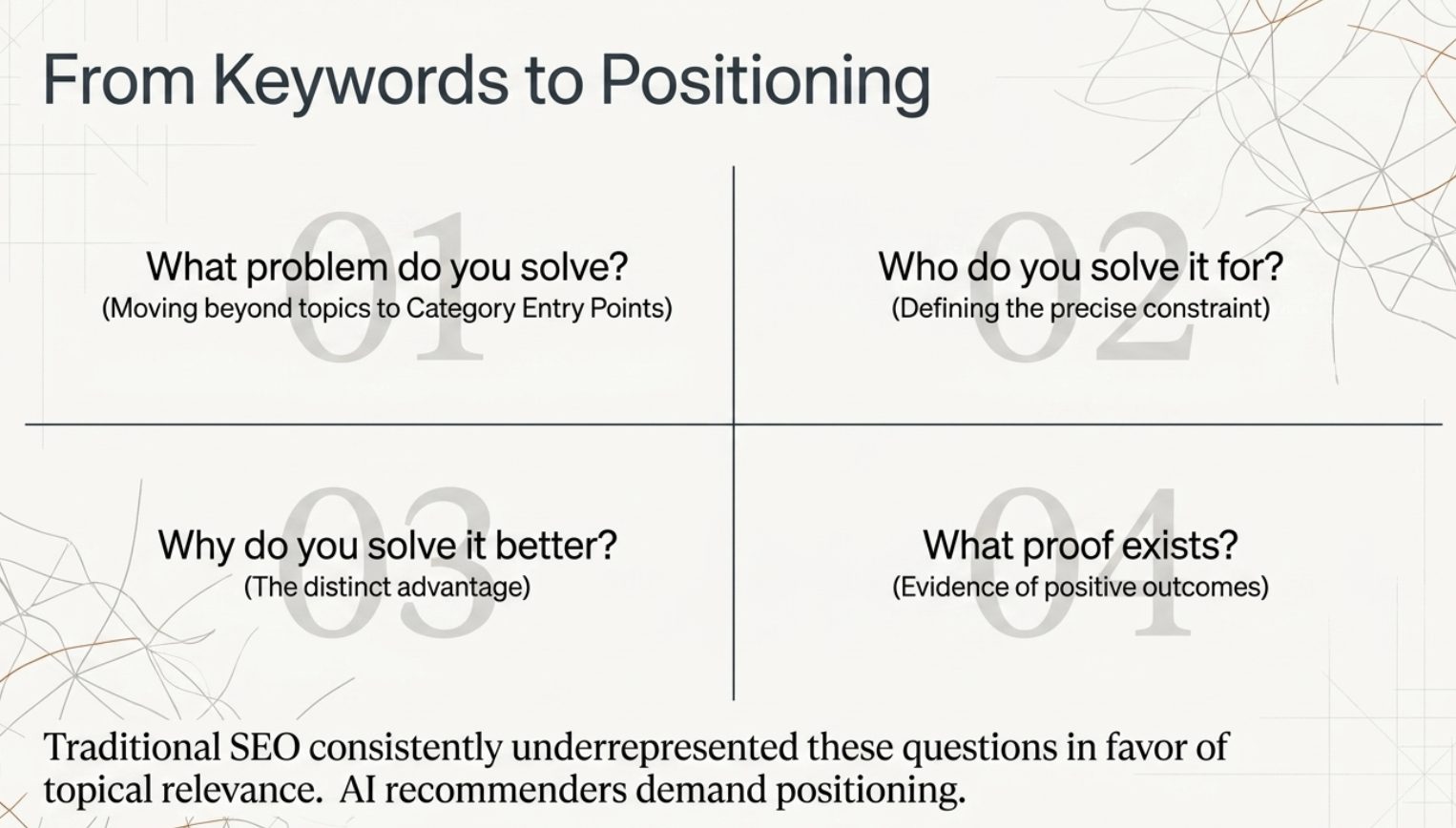
He must answer four questions:
What problem does he solve?
Who does he solve it for?
Why does he solve it better than the alternatives?
What proof does he have of positive outcomes?
Traditional SEO has consistently underrepresented these questions because it focused on topical relevance. GEO is forcing businesses to focus on brand performance and positioning.
Paul does not merely hire suits.
Perhaps he helps ordinary men look appropriate and feel confident during the occasions when getting it wrong would be socially disastrous.
Weddings.
Funerals.
Job interviews.
Christmas parties.
School proms.
Award ceremonies.
These are not just content topics. They are category entry points: the situations in which someone begins thinking about the category.
And search starts before Google, ChatGPT or Gemini enters the picture.
The human mind is the first search engine.
When memory fails, or the problem becomes too complex, we outsource the task to a search platform.
That means SEO, GEO and brand marketing are no longer separate conversations. They are parts of the same visibility system.
The three stages of visibility
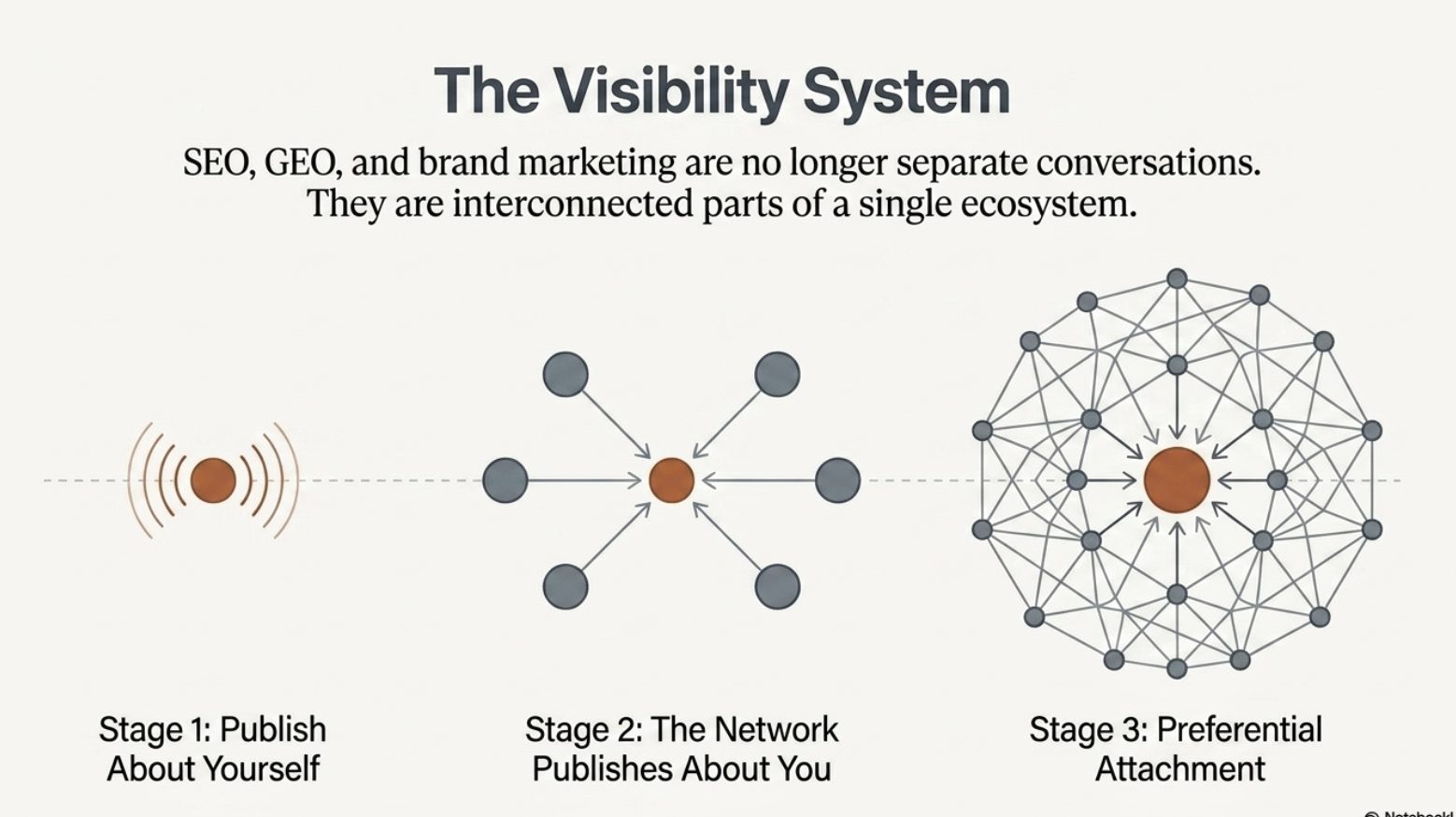
My approach to GEO has three stages.
Stage one: Publish about yourself
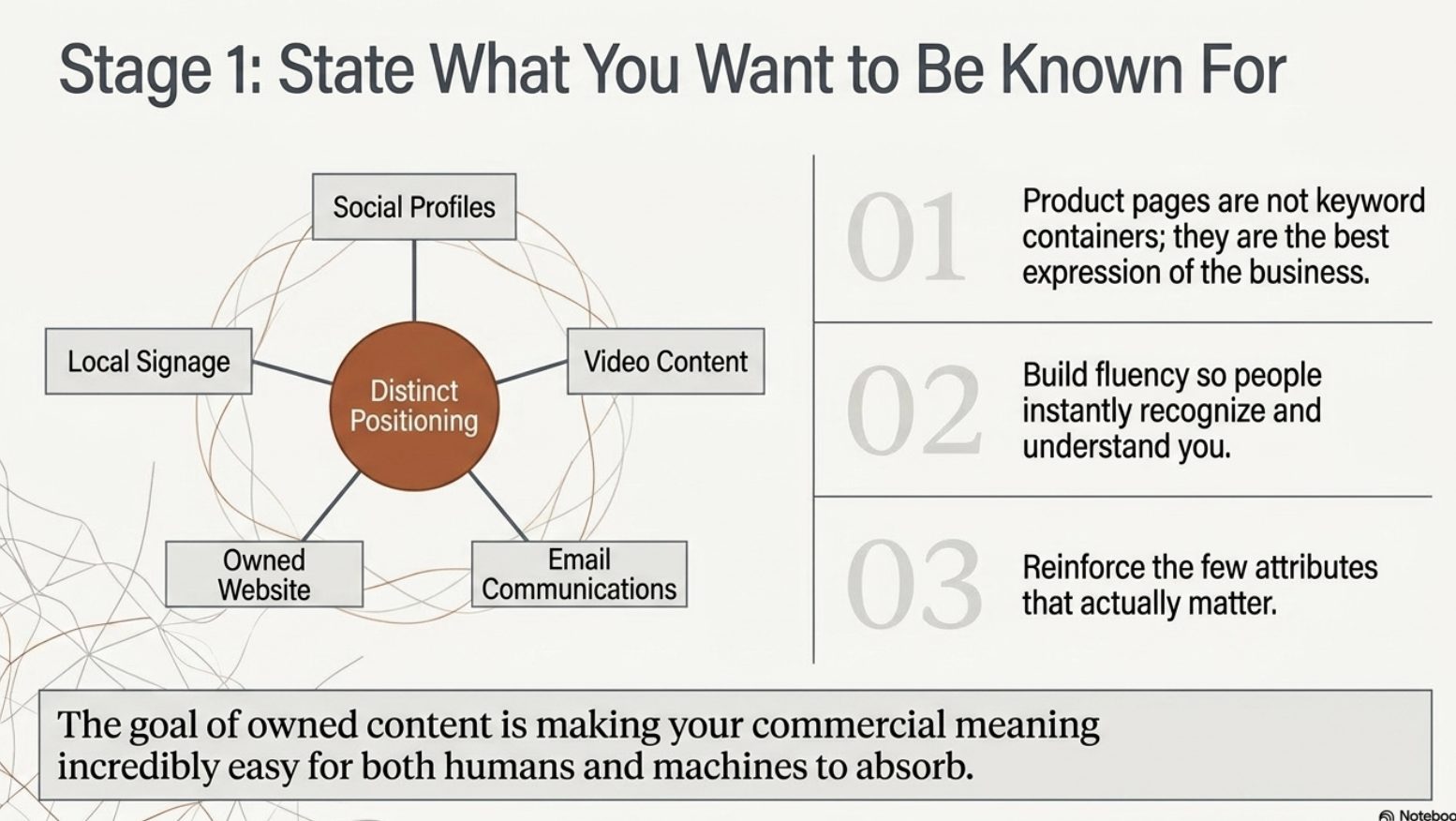
An invisible brand must first state what it wants to become known for.
That sounds painfully obvious, but many companies have filled their websites with generic topical content while barely explaining their own value.
Paul must make his positioning visible.
His website should explain who the service is for, the occasions it covers, how fittings work, what is included, what customers can expect, what makes the experience different and why anyone should trust him.
His product and service pages should be the best expression of the business—not merely containers for keywords.
The same positioning should appear consistently in his social profiles, videos, emails, photographs, signage and local communications.
This is not about repeating a robotic slogan until everyone wants to punch you. It is about reinforcing the few attributes that matter.
Build fame.
Build fluency, so people recognise and understand you.
Build positive feelings around the brand.
The point of content is not simply to rank. It is to make your commercial meaning easier for humans and machines to absorb.
Stage two: Get other people to publish about you
This is the difficult bit.
You cannot proclaim yourself into authority. At some point, the network must carry the message.
Paul needs reviews from genuine customers. He needs photographs of people wearing his suits. He should work with wedding venues, photographers, barbers, florists, event planners and local businesses.
He might sponsor a football team.
He might invite local creators to the shop.
He might give a wedding vlogger a suit in exchange for an honest account of the fitting process.
He might hold a launch evening that creates photographs, conversations, local coverage and social content.
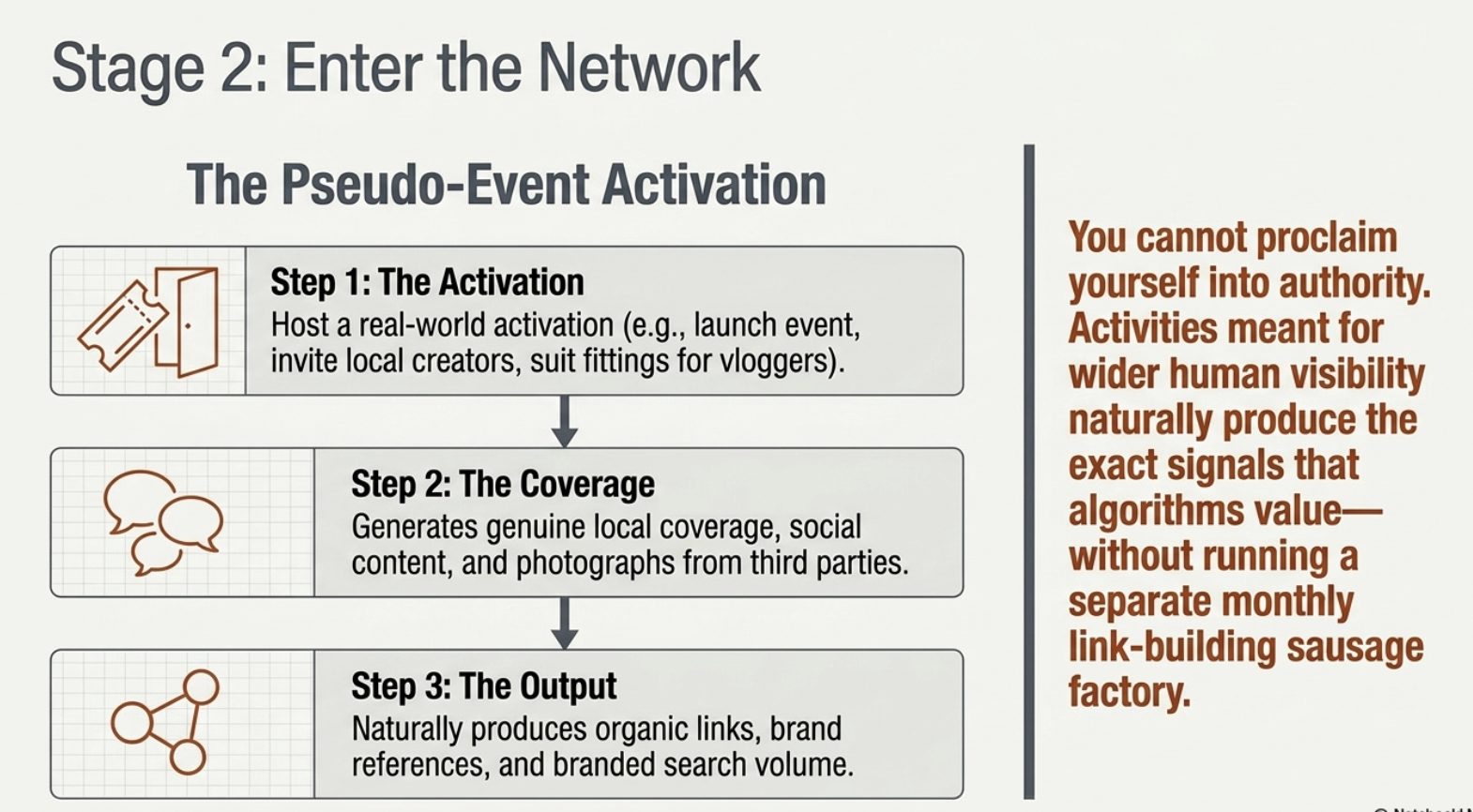
Marketers sometimes call this a pseudo-event: an event designed partly to generate communication around it. It sounds manipulative because marketers have a rare talent for giving normal human activity a sinister name.
The point is simple. Paul has to enter the network.
He needs other people to encounter the business, experience it and describe it.
Those activities can also produce the things traditional SEO values: links, references, authority and branded searches. The work performed for wider visibility improves the search foundation without link-building becoming a separate monthly sausage factory.
Stage three: Preferential attachment
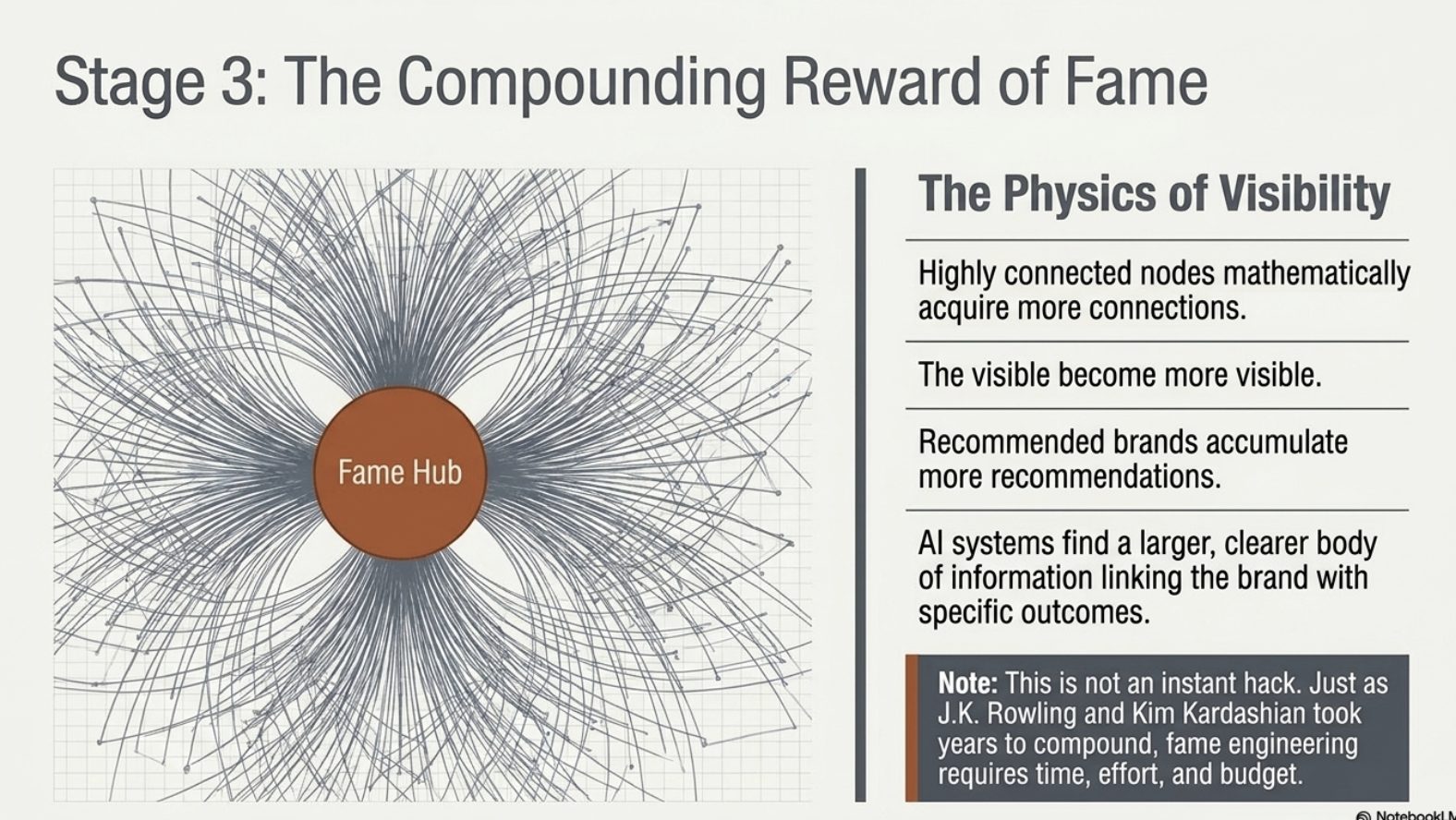
Eventually, something begins to compound.
Network science calls it preferential attachment: highly connected nodes tend to acquire more connections. Online, the visible become more visible. The brands that are mentioned become easier to mention again. The businesses that are recommended accumulate more opportunities to be recommended.
Humans remember them.
Search engines encounter more evidence about them.
AI systems find a larger, clearer body of information linking the brand with particular needs, attributes and outcomes.
This is not an instant hack. It is the reward for a body of work.
It is fame engineering.
And it operates through the same basic mechanics that have always driven brand growth: making a business easier to think of and easier to buy.
The £30,000 lesson
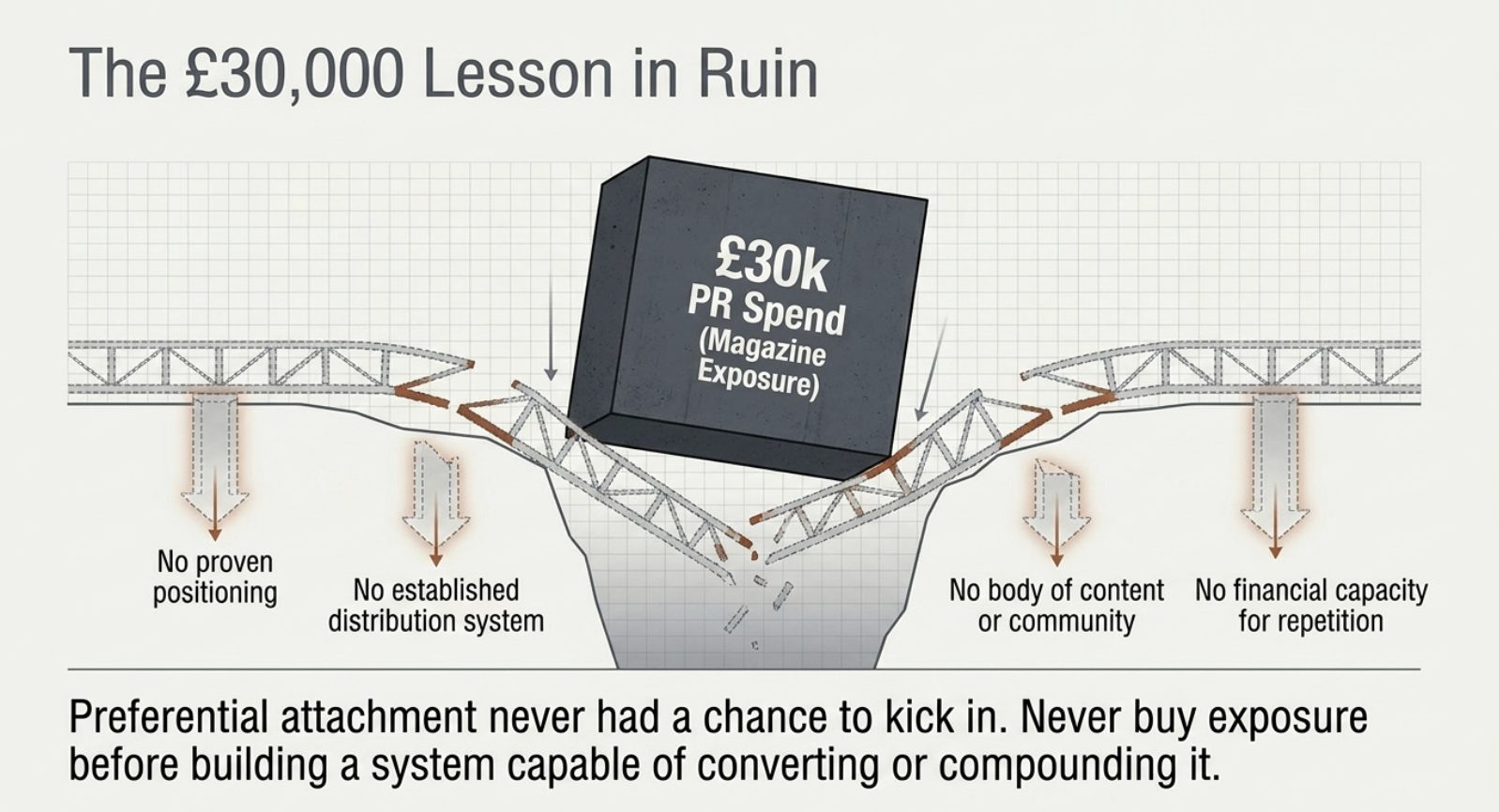
Ten years ago, when I was starting my digital agency and knew very little about running a business, I received a referral through the chamber of commerce.
A man and his wife had developed a nail product. He wanted to know how I would market it.
I told him we needed a strategy before he spent money. At the time, I charged £500 for one.
On the other side of the equation was a PR agency. It wanted thousands in fees and had proposed a relationship with a nail magazine that would cost about £15,000. By the time every cost was included, the founder was preparing to spend approximately £30,000.
His entire savings.
Advertising in the magazine was not inherently a bad idea. The problem was sequencing, scale and risk.
He had no proven positioning.
No established distribution system.
No body of content.
No community.
No financial capacity for repetition.
No meaningful evidence that one burst of magazine exposure would generate sufficient sales.
I didn’t get hired for strategy. He had already been sold the dream and wanted to proceed.
Twelve months later, I messaged him to ask how it had gone.
He had lost everything he invested. Virtually no sales arrived. Preferential attachment never had a chance to kick in. He bought exposure before building a system capable of converting or compounding it.
Small businesses cannot afford that kind of mistake.
And the danger is increasing because meaningful visibility is becoming scarcer.
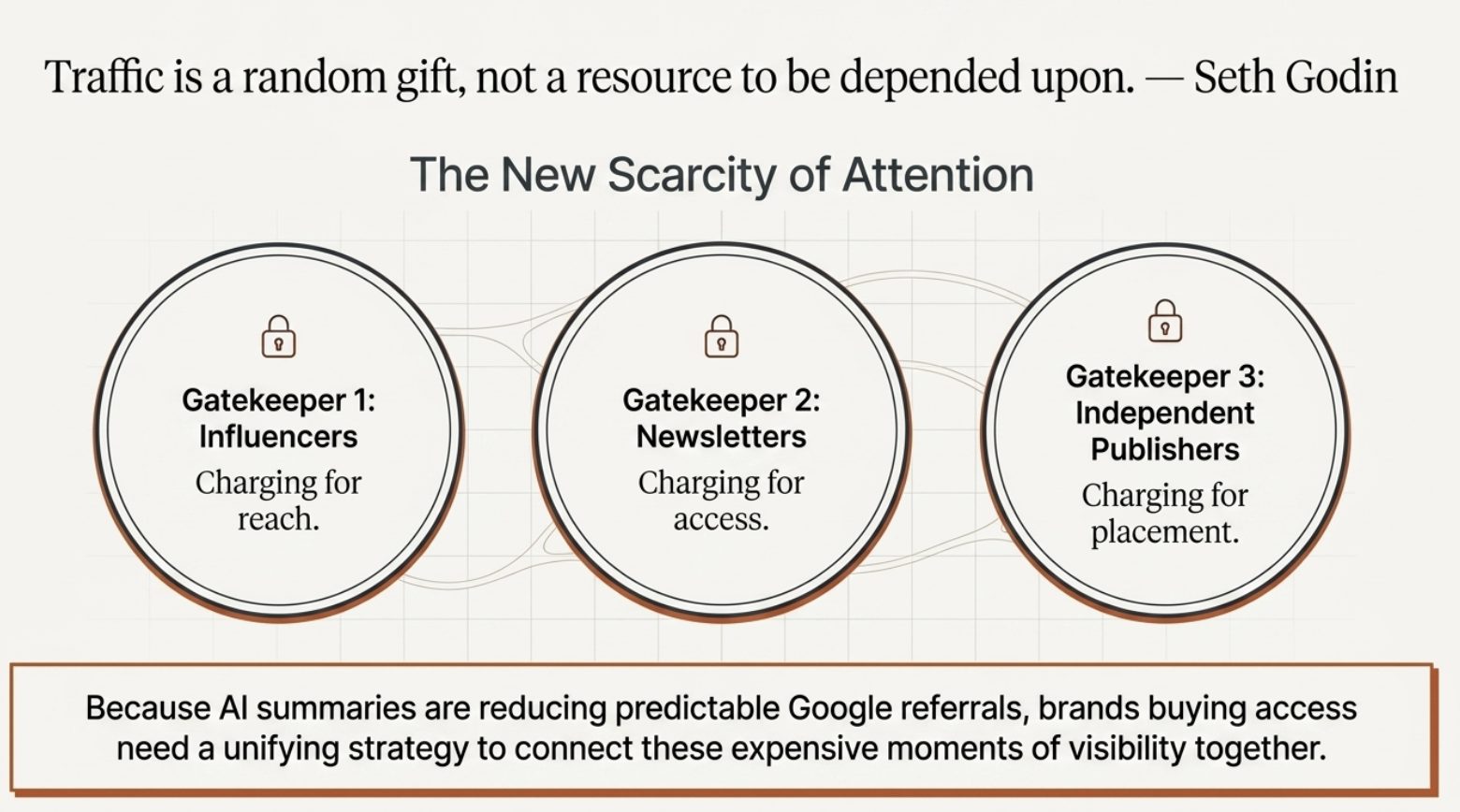
Independent publishers and creators can no longer assume Google will provide a predictable stream of clicks. Seth Godin recently advised publishers to treat traffic as “a random gift, not a resource to be depended upon.” Publishers have become sufficiently concerned about AI summaries reducing referrals that regulators in the UK have intervened to give them greater control over how their work is used.
The people who still own reliable attention understand its value.
Influencers charge for reach.
Newsletters charge for access.
Publishers charge for placement.
Creators with trust, an audience and direct distribution may do extremely well from this shift.
But brands buying that access need a strategy. Otherwise, they are simply purchasing expensive moments of visibility with no mechanism connecting those moments together.
None of this is New
It would be easy to think that this is all new, that AI is working in a different world.
It’s not.
In the 1950s, the father of modern PR (and propaganda), Edward L Bernays, wrote about this. He used the term “visibility” and discussed the web of communications.
I’ve mentioned several times that network science aligns with the Ehrenberg-Bass models of mental and physical availability.
And I’ve spoken about my own career in police intelligence, showing how criminals grow their personal brands through building networks.
Bernays laid PR out perfectly when he suggested that the work was to sell an organisation’s words to the media and to integrate that organisation with the community where it functions and the key social groups within that community.
The modern version of this is to sell words to the media, and to integrate with influencers and groups.
And this is not as easy as you think.
Bernays himself noted that the success of any PR campaign will be limited by budgets. Professor Barabassi talks about how preferential attachment can take years to kick in.
JK Rowling’s Harry Potter was not an overnight sensation.
Kim Kardashian did not become a star in just 1 year.
You won’t hit a switch and suddenly be famous, thought of by both AI and humans. It takes time, effort and budget.
And here lies the issue facing us all. Budget and waste.
The agency of the future
I have long argued that the agency of the future will be outcome-based.
The outcome is not more rankings.
It is not more citations.
It is not a larger number inside a GEO dashboard generated from 400 synthetic prompts that no customer has ever used.
The outcome is more business.
That may happen because more qualified people visit revenue-generating pages.
It may happen because the brand is remembered more often.
It may happen because search engines rank it more prominently.
It may happen because AI systems recommend it.
But the commercial outcome is the point.
That creates a harsh requirement for SEO, GEO, PR and content agencies: somebody must be able to think strategically.
Strategy prevents a company from wasting money.
It diagnoses the market, identifies the customers that matter, clarifies the positioning and selects the activity most likely to generate a return.
Then comes execution.
Start with the assets the business controls. Improve the product pages, service pages and landing pages that generate revenue. Use AI where it improves the work, but combine it with human judgement, customer insight and proper copywriting.
Make the website technically accessible.
Optimise it for relevant purchase-intent searches.
Explain the positioning.
Provide evidence.
Remove reasons not to buy.
Then create content that builds fame, feelings and fluency around the brand. Not endless commentary about the category. Content that communicates the company’s worldview, performance and distinctive value.
Finally, generate third-party visibility through PR, partnerships, creators, customers, events, advertising and real-world marketing.
As Byron Sharp recently observed, many people question the value of advertising until their cat goes missing. Suddenly, reach and visibility seem rather useful.
The exact activity will differ by business. There is no universal GEO roadmap because there is no universal positioning, audience, budget or market.
That is why strategy matters.
SEO becomes part of something bigger
SEO is becoming a channel of diminishing marginal returns.
As more discovery moves into AI systems, the upside available from endless traditional optimisation will reduce. Basic SEO will remain. In many cases, it will be absorbed into GEO or whatever name the industry eventually settles on.
Technical hygiene will matter.
Crawlability will matter.
Commercial keywords will matter.
Local search will matter.
Authority will matter.
But optimisation will represent a smaller proportion of the total work.
The larger investment will go into creating the visibility that humans, indexes and recommenders can all encounter.
That means the new value of SEO is not that it retains its old borders.
Its value lies in its becoming part of digital brand marketing for the AI era.
SEO, GEO, content, social media, PR, partnerships and advertising do not become one giant tactic. They become coordinated activities serving one objective: make the brand more likely to be known, found, understood, recommended and chosen.
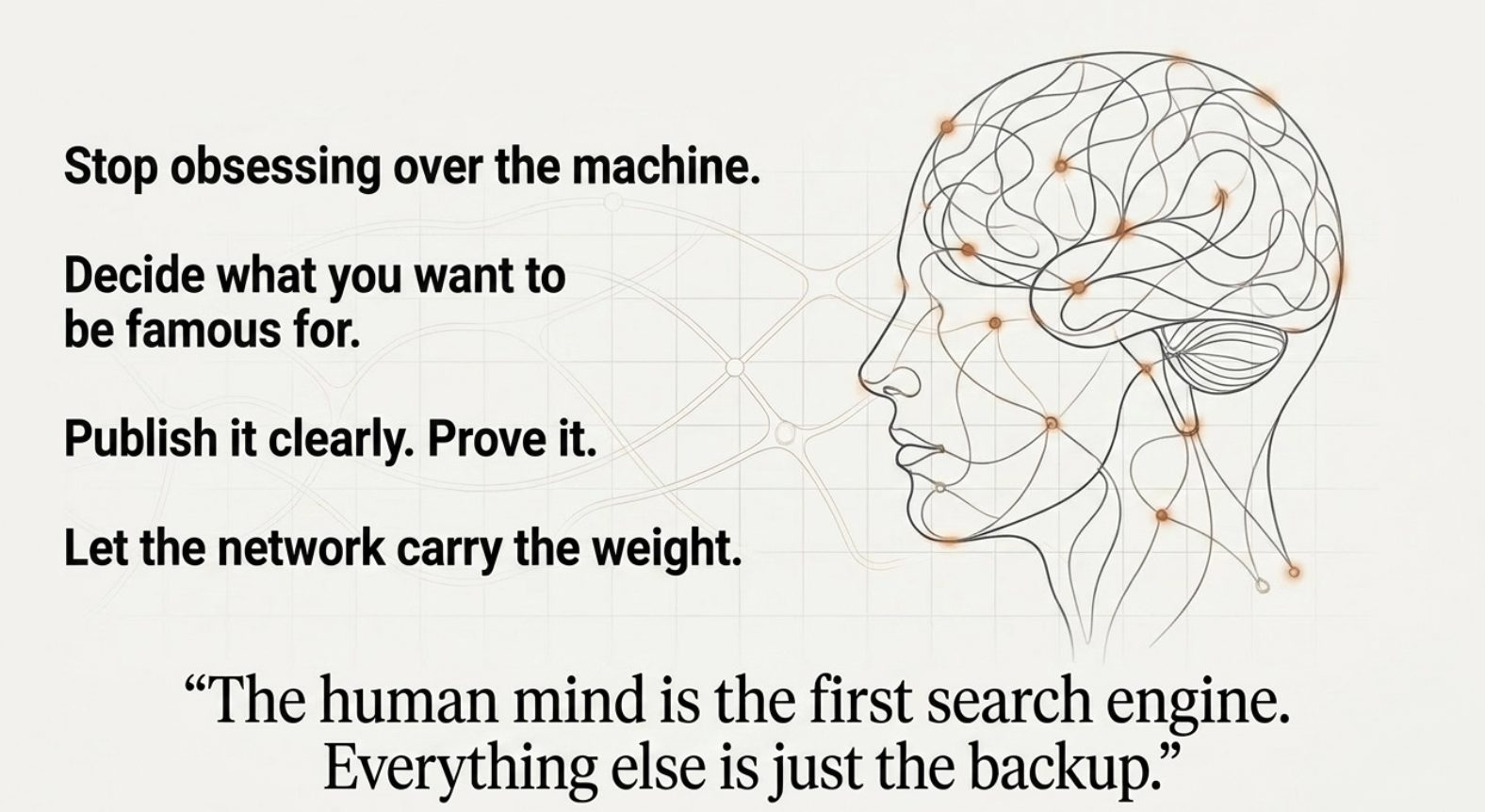
Stop obsessing over the machine.
Stop pretending another technical tweak will create a lasting advantage.
Decide what you want to become famous for. Publish it clearly. Prove it. Get other people talking about it. Repeat the process until the network begins carrying some of the weight for you.
The human mind is the first search engine.
Everything else is the backup.
Andrew Holland
Originally published on LinkedIn on 15 July 2026.