
On Friday, I was in Manchester, speaking at the SEO Masterminders event.
The event was hosted by Kasra Dash, held in a hotel grand enough to make most conference venues look like a Travelodge with mood lighting, and packed with people who understand search far better than the LinkedIn priesthood gives them credit for.
Traditionally, some of that crowd would have been called black hats. That phrase still gets wheeled out by white-hat SEO influencers who need a villain in the story. It helps them feel morally superior while they post another thread about helpful content, ethics and whatever Google told them to believe that week.
But I am not sure black hat and white hat mean very much anymore. Search has changed. Google has changed. AI has changed the interface, the buyer journey, the source of answers and the commercial value of being known. The old moral pantomime feels increasingly useless.
When asked what hat I wear these days, I explain simply. I’m a brand marketer who happens to specialise in search (for now). This means that my goal is to use search to help brands grow.
And this means I don’t care where good and practical advice comes from, I just take it.
If people want to talk in terms of hats, that’s fair enough, but let’s not pretend Google is playing fair either…they aren’t.
So, it was nice to be at a conference where people aren’t afraid to say and share what’s working. The event is superb, and I feel it’s going to become one of the largest in the UK.
On the way home on the hottest June day in UK history, amongst the melting train tracks and finally on the train home with barely functional air conditioning and awful wifi, I opened LinkedIn and immediately regretted it.
There it was again.
Another massively liked post from an SEO influencer explaining that GEO, AEO, AI SEO or whatever acronym is being dry-humped for reach this week is simply the evolution of SEO.
Cue the applause. Cue the agency owners commenting “100%”. Cue the consultants’ cheering.
This has become the new comfort blanket for the SEO industry. Generative Engine Optimisation is just SEO. Same discipline. Same budgets. Same owners. Same deliverables with “AI” placed carefully in front of the old nouns.
It is a lovely commercial story.
It is also mostly bollocks.
And my talk at The Masterminders event was the science behind the true story I’m about to share.
The Story of Fame Engineering
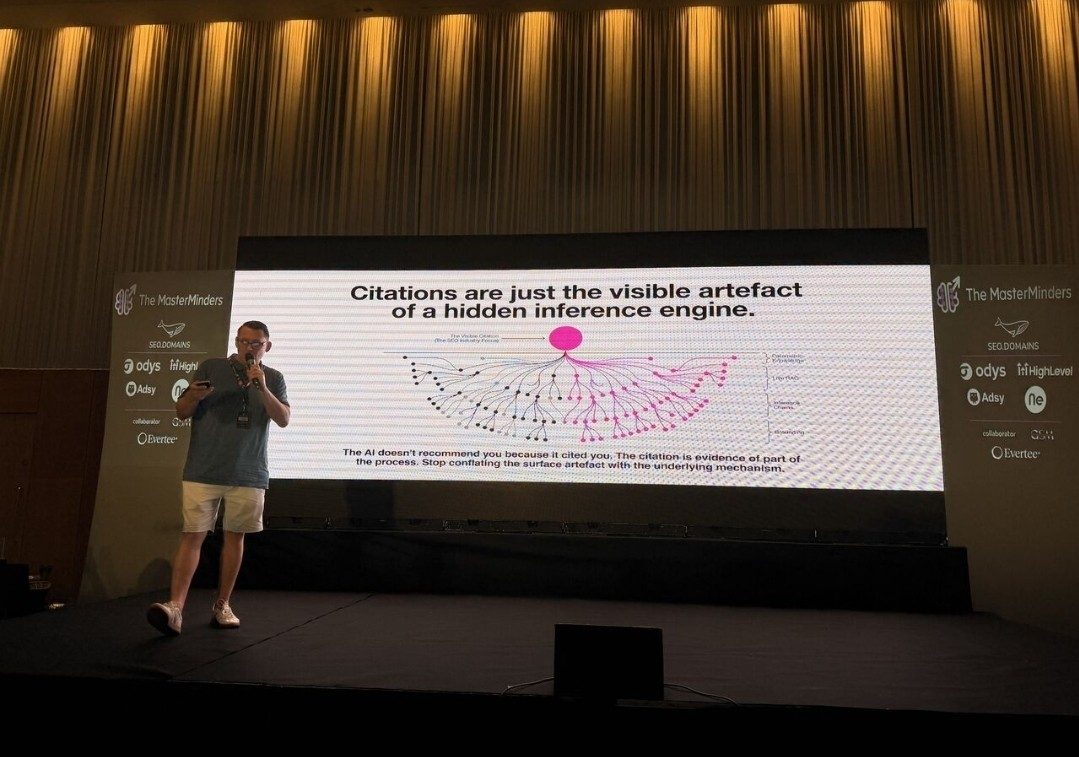
A while ago, I started using the term Fame Engineering.
The acronym soup is already poisoned. GEO, AEO, and AI SEO are being reduced to little tactical boxes before the market has even understood the scale of the shift. So, I wanted a phrase that describes the actual work brands need to do in a generative AI era.
Fame Engineering means deliberately increasing the supply, clarity and repetition of information around a brand so AI systems learn what the brand should be known for, who it helps, what it solves and why it deserves to be recommended.
The inspiration for the phrase comes from Edward L. Bernays, the father of modern public relations, and his famous phrase the engineering of consent.
Bernays was not merely talking about press coverage when he used the term engineering of consent. He was talking about communication as a system.
In 1947, long before the internet, he wrote about a “web of communications”, one that was “duplicating, crisscrossing, and overlapping”, and called it a “condition of fact, not theory”. He also described the engineering approach as “action based only on thorough knowledge of the situation”, using “scientific principles” and “tried practices”.
That wording matters because Bernays understood the thing most marketers are still missing. Communication is a network. Influence does not sit politely inside one channel. It spreads through repeated signals, institutional authority, media, social proof, timing, language, repetition and public familiarity.
Bernays was writing about newspapers, radio, public platforms, direct mail, pamphlets, specialist publications and organised groups.
We are dealing with websites, YouTube, TikTok, Reddit, review platforms, media databases, podcasts, social posts, comparison pages, listicles, newsletters, Google, ChatGPT, Perplexity, Gemini, Meta AI and whatever fresh machine appears next week with a silly name and a valuation big enough to make everyone stupid.
The machinery has changed. The principle has not.
Public relations was the engineering of consent through the communications network.
Fame Engineering is the engineering of AI preference through the digital information network.
AI Preference Is Built From Information Supply
The SEO industry keeps trying to pull this discussion back to the page because the page is where SEO feels comfortable.
The page can be audited. The page can be scored. The page can be rewritten, chunked, marked up, internally linked and placed into a report with green ticks.
AI preference is much less obedient.
Generative systems assemble answers from information supply. They are influenced by what exists about a brand, where it exists, how often it appears, who repeats it, how credible those sources look, how consistent the language is, what customers say, what reviewers say, what publishers say, what creators show, what communities discuss and what the brand says about itself.
That makes Fame Engineering bigger than website optimisation.
It can include your site, but it does not end there. It includes PR, product marketing, founder visibility, customer proof, reviews, category positioning, expert commentary, comparison content, partnerships, creator activity, trade media, local media, social video, research, events and every other public signal that helps a brand become known for something specific.
This is why the “GEO is just SEO” crowd struggles. The answer does not live inside one department. It sits across the whole reputation system of a business.
A brand that wants AI systems to recommend it must first decide what it wants to become famous for. That sounds obvious until you inspect most websites and realise they are a slurry of vague claims, interchangeable adjectives and old SEO content written for topics rather than positioning.
How Fame Engineering Became Famous
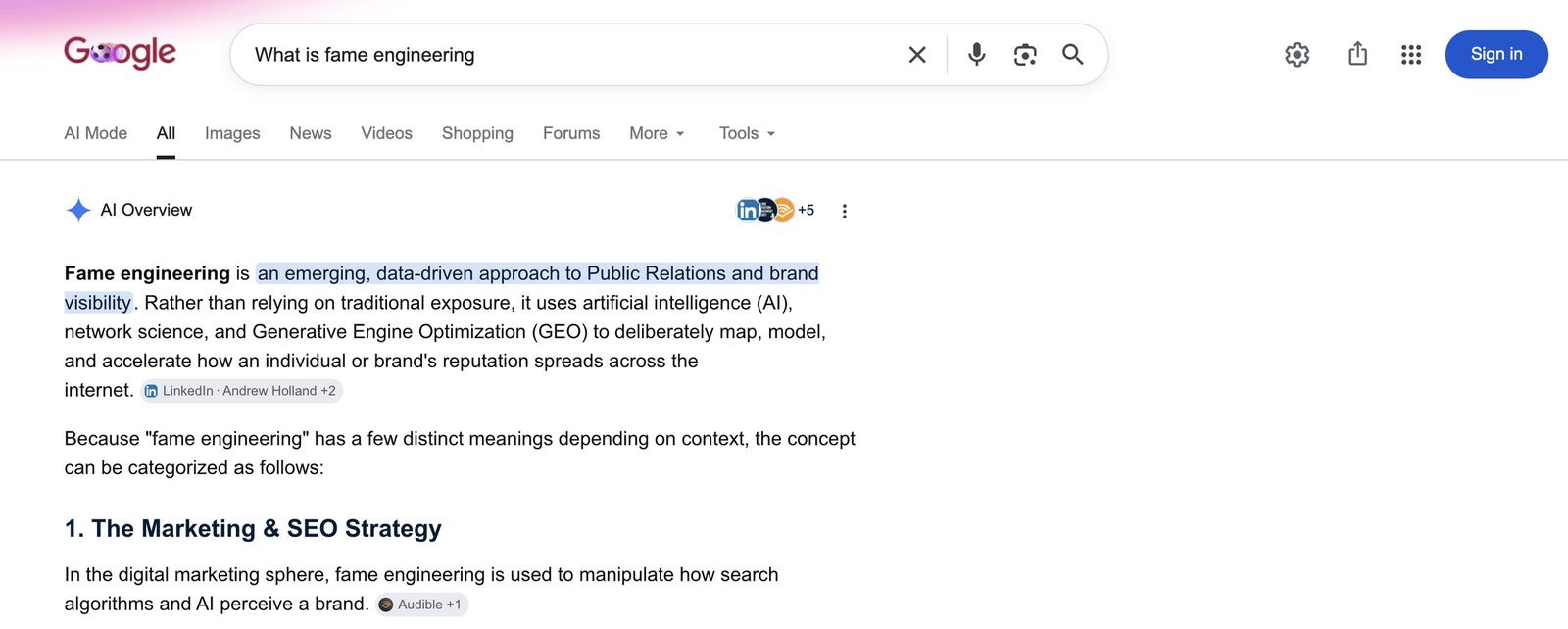
Let’s be clear. Fame engineering is not famous.
But how Google’s AI systems understand it matters. If you ask about Fame engineering, you get a half-decent answer.
If you ask who invented it, my name is likely to appear.
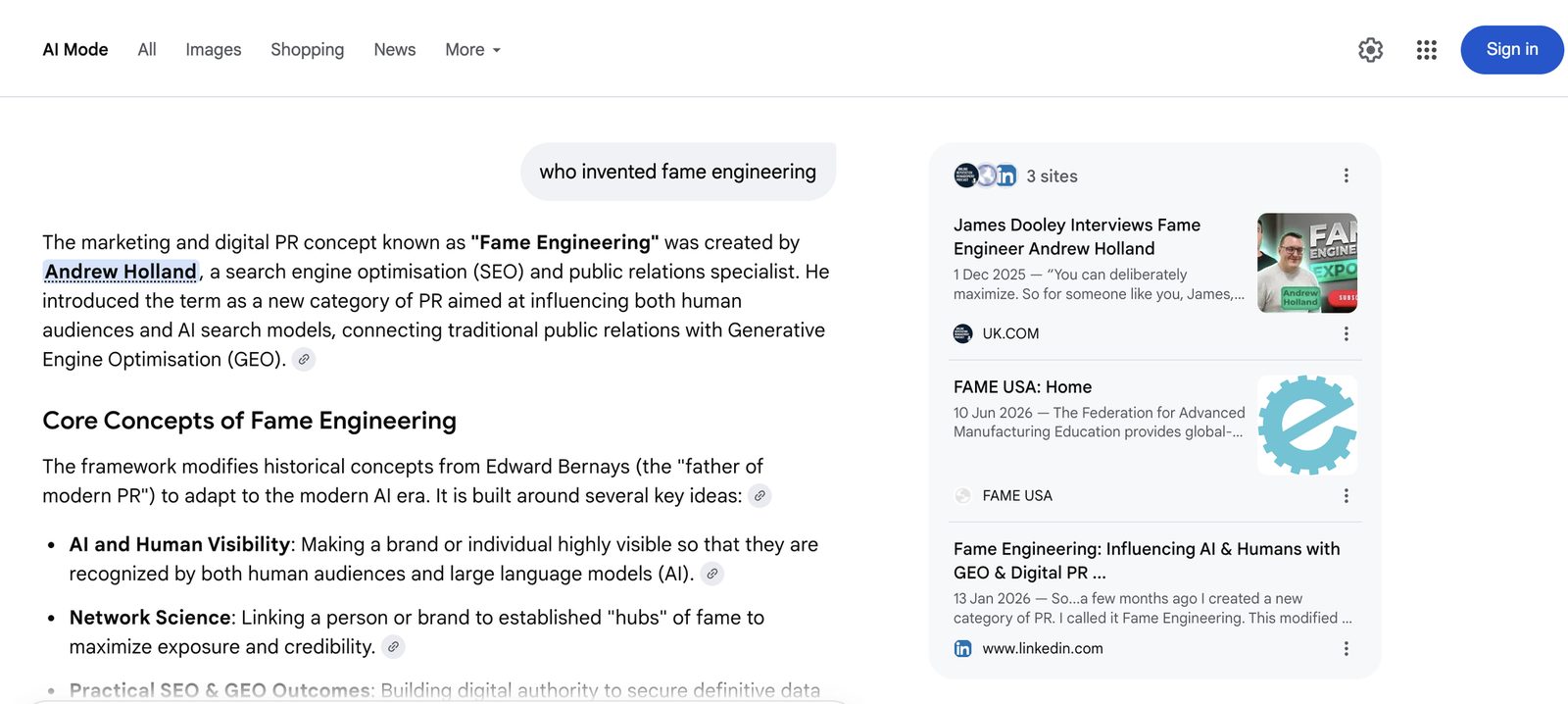
But how?
I have managed to achieve this through doing GEO work.
As I’ve said repeatedly, GEO is simply the supply of mutual information to reduce entropy in a system.
Or, in other words, you supply repeated information in a variety of places so that when someone asks an AI tool a question, the probability that you are the answer increases.
Fame engineering has no central website. I didn’t build links around the term. I simply posted about it, wrote about it, talked about it on podcasts and mentioned it in columns.
That’s all I did.
And yes, that’s all GEO actually is.
You undertake marketing activities within the network to become known for what you want to be known for.
The GEO side is strategic for reducing waste in your budget from the wrong activity.
Fame engineering is my term for GEO. It’s my approach.
The point is, the term provides an example of GEO. Because Fame Engineering doesn’t have any of the advantages of a real brand, it’s just a term.
And yet, that term is known by AI systems, understood by AI and encountered when it goes looking. All because I increased the supply of information around the word.
But what about a real brand?
Start With the Text Around Your Name
A simple test will tell most brands how much trouble they are in.
Search your own website for your brand name. Look at every place the name appears. Then read the words around it.
What is the text teaching a machine? What category are you placing yourself in? What problems are you attaching to your name? What proof is nearby? What language gets repeated? What claims do you make more than once? What does the site say you are famous for?
Most businesses have never done this. They have checked rankings, traffic, Core Web Vitals, backlinks, meta titles and blog output. They have not checked whether their own website consistently teaches the market what the brand does.
That is one of the great fractures between SEO thinking and Fame Engineering/ GEO.
SEO often rewards topical coverage. Publish around the subject. Build the hub. Fill the cluster. Answer the query. Produce another guide. Hope Google sees authority in the pile.
Fame Engineering starts with brand clarity. Your own site needs to describe the business, the customer, the problem, the method, the proof and the position in language that can be understood, repeated and connected across the network.
If your brand sells specialist legal advice for AI companies, stop hiding behind “innovative legal solutions for fast-growing businesses”. Say what you actually do. Show the use cases. Name the risks. Publish the cases. Explain the method. Get the partners on podcasts. Put the language in places the market can repeat.
If your brand is a cake shop in Amsterdam selling viral pastries, the job is different. Show the product in action. Show the queue. Show the customer reaction. Show the recipe story. Get food creators in the room. Get local media talking. Make the thing impossible to discuss without naming the shop.
Both examples are Fame Engineering. The shape of the work changes because the category, budget, competition and proof requirements change.
Trying to become known as the best squirrel walker in Stoke-on-Trent is easy because the category is almost certainly empty. Trying to become the most recommended PR agency in London is a knife fight with nicer shoes.
But fame engineering starts with a brand talking about itself and not the topic.
I talked about fame engineering as if it were a branded concept. All you have to do is talk about your business. That’s where it starts.
Other People Have to Say It Too
A brand publishing about itself is only the beginning. The second movement is getting other people to say the right things about it.
This is where PR stops being a nice add-on and becomes central to generative engine optimisation.
A brand needs third-party repetition. It needs reviews, rankings, listicles, interviews, trade press, local press, podcasts, creator content, partner pages, customer stories, analyst mentions, comparison articles, awards, industry commentary, events and public conversations that reinforce what the brand wants to be known for.
This is reputation signalling.
Not link building with a better haircut. Not “brand mentions” as a vanity metric. Reputation signalling means increasing the amount of credible, repeated, external information that connects your brand to a particular problem, audience, category or buying situation.
If AI systems keep encountering your brand in the context of “best family hotel in York”, “specialist B2B SaaS PR agency”, “emergency plumber in Leeds”, “technical SEO consultant for publishers” or “AI compliance lawyer for startups”, those associations become part of the information environment.
The market says it. Your site says it. Customers say it. Journalists say it. Reviewers say it. Creators say it. Lists say it. Communities say it.
Eventually, the machine has a pattern to work with.
This is why listicles are getting so much attention. Anyone watching commercial AI answers can see that third-party rankings and “best of” pages often seem to influence what gets recommended. But listicle inclusion alone is not a strategy. It is a tactic inside a wider reputation system.
Chasing listicles without positioning is just panic with a spreadsheet.
Barabási, Preferential Attachment and Why Fame Compounds
Albert-László Barabási gives us the scientific backbone for why Fame Engineering matters. His work in network science popularised preferential attachment, the mechanism by which better-connected nodes in a network tend to attract more connections over time.
His Network Science work describes hubs as the result of a rich-get-richer phenomenon: new nodes are more likely to connect to nodes that are already well connected.
That is a beautiful description of how brand fame works in a digital information network.
The mentioned become more mentioned. The cited become more citable. The reviewed become more reviewable. Brands already included in category conversations become easier to include in future ones.
Fame Engineering aims to create that compounding effect around a business.
You want your brand to be recommended because it is already visible in the places that shape recommendations. You want to be included because you already appear in the sources that people and machines use to understand the category. You want your old PR, case studies, reviews, interviews and third-party mentions to keep working after the original activity has ended.
That is where the economics become interesting.
You pay for an event once, but the coverage sits online. You publish the case study once, but the proof keeps being read. You earn the podcast appearance once, but the transcript, clips and mentions keep circulating. You secure the category list inclusion once, and that page may continue shaping buyer decisions and machine answers long after the invoice is forgotten.
This is the rich-get-richer effect brands should be chasing. Not one citation. Not one mention. Not one prompt test. A compounding reputation network around the things the brand wants to be famous for.
Barabási has also described AI as “brain dematerialized”, a phrase that lands because it forces you to stop thinking about AI as a search box and start thinking about it as an information-hungry networked intelligence trained on patterns.
If AI is trained on patterns, your job is to create the right patterns around your brand.
The Only Rule That Stops This Becoming Spam
There is a very obvious danger here. The SEO industry has an unmatched ability to take a useful idea and turn it into a landfill within six months.
So Fame Engineering needs a rule.
And the rule is:
Everything must have real-world value at the point of publication.
If a piece of content does nothing for a human being when it goes live, do not pretend it becomes useful because a model might eat it later. If a listicle is fake, thin and embarrassing, do not call it a generative strategy. If a Reddit post requires you to pretend you are “Dave from Bristol” who just happened to discover your own client, please go outside and rethink your life.
The work has to make commercial sense before AI enters the room.
A strong case study helps sales. A useful comparison page helps buyers. A good podcast appearance builds trust. A proper review strategy improves conversion. A smart PR story creates awareness. A creator video can drive footfall. A clear positioning page improves understanding. A distinctive methodology helps people remember you.
The machine benefit comes from useful information entering the network.
That is the grown-up version of generative engine optimisation.
Do work that helps humans, then measure how that work affects branded search, referral traffic, landing page visits, AI visibility, assisted conversions, sales conversations and recommendation presence.
The lazy version is spamming the web and hoping the machines are too stupid to notice.
The lazy version will be very popular. The lazy version will also work until it doesn’t.
Budget Will Decide How Much Force You Can Apply
Nobody wants to talk about budget because budget ruins fantasy.
SEO became efficient because SEO budgets were often tiny. A few audits, some technical recommendations, some content, some links, a monthly report and the whole machine kept moving.
There were good reasons for that. Many businesses were not prepared to fund serious marketing through search because they had been taught to treat SEO as a cheap acquisition channel.
Fame Engineering is a bigger commercial opportunity because the stakes are bigger.
AI will influence which hotels people book, which restaurants they visit, which products they buy, which agencies they shortlist, which software they trial, which lawyers they trust, and which brands they never hear about.
You cannot seriously influence that future with a piddly optimisation budget and a few rewritten headings.
Some businesses will be able to apply brute force. They will commission research, run events, hire PR teams, pay creators, build media partnerships, publish serious content, invest in video, secure reviews, sponsor category conversations and dominate the information supply.
Smaller businesses will need more creativity. They will need sharper niches, better local signals, stronger founder presence, smarter partnerships, more distinctive proof and activities that create attention without needing a giant budget.
But nobody escapes the basic rule. Fame Engineering requires information supply. The brand must put more useful, consistent, brand-relevant information into the world and get more of the market to repeat it.
SEOs Can Win Here, But Only If They Stop Shrinking the Job
The best SEOs will adapt because they are curious, commercially minded and not precious about the old boundaries. They will learn brand. They will learn PR. They will learn positioning. They will learn how to judge a story, a claim, a proof point and a distribution opportunity.
The worst SEOs will keep posting that GEO is just SEO, then quietly deliver schema, blog briefs and citation reports until clients realise nothing much has changed.
A serious Fame Engineering specialist needs a bigger skill set. They need to understand how a brand becomes known, how a market repeats language, how credibility is built, how content earns attention, how PR shapes reputation, how reviews influence buying, how social proof spreads, how entities are connected and how commercial outcomes are measured.
This is brand marketing digitised for the AI era.
It is also PR with machines listening.
The future does not belong to the person who can make the most complicated diagram of query fan-outs.
It belongs to the person who can answer a harder commercial question: how do we get the right people, publications, platforms, and systems to say the right things about this brand often enough for it to become the preferred answer?
That is Fame Engineering.
Make the Machines Remember You
Fame Engineering is how you make AI prefer your brand.
You clarify what the brand should be famous for. You publish the evidence. You make the business legible. You get other people to repeat the right associations. You create acts worth covering. You build reputation signals across the network. You earn preferential attachment. You measure the commercial impact and keep going.
Bernays understood that communications formed a web before the internet existed. Barabási showed us why networks create winners that keep winning. AI has now turned those old truths into a new commercial battleground.
The SEO industry can either grow into that opportunity or keep pretending the future can be handled with the old checklist.
Fame Engineering is not a new name for SEO. It is the work of making a brand famous enough, clear enough and repeated enough for machines to prefer it.
Stop fiddling with the page while the network decides your fate.
Engineer the fame. Make the machines remember you.
Andrew Holland
Originally published on LinkedIn on 29 June 2026.