
Generative Engine Optimisation has caused more pointless debate in the search industry than anything I have seen in the last two years.
Not because it is unimportant.
Because it is important enough for everyone to have an opinion, and lucrative enough for everyone to bend the definition toward whatever they already sell.
The SEO crowd says it is “just SEO”. Which is convenient, because if everything is SEO, then the same people get to keep the same budget, sell the same audits, and pretend nothing has changed. Some of these same people are keynote speakers on the future of search. Some are selling GEO audits. Some still post online that GEO is nonsense.
Then you have the tool vendors. Many of them have decided GEO means “AI visibility”, which often means whether your content appears as a citation in an AI answer. That sounds useful until you ask the obvious adult question: how does being cited in a footnote make us money?
And that is where the whole thing starts to collapse.
Because boards do not care about footnotes. CFOs do not care about “visibility” unless visibility eventually becomes revenue. CMOs do not need another metric that looks clever on a dashboard and embarrassing in a budget meeting.
So let’s make GEO simple enough for anyone to understand.
SEO is about being found. GEO is about being chosen.
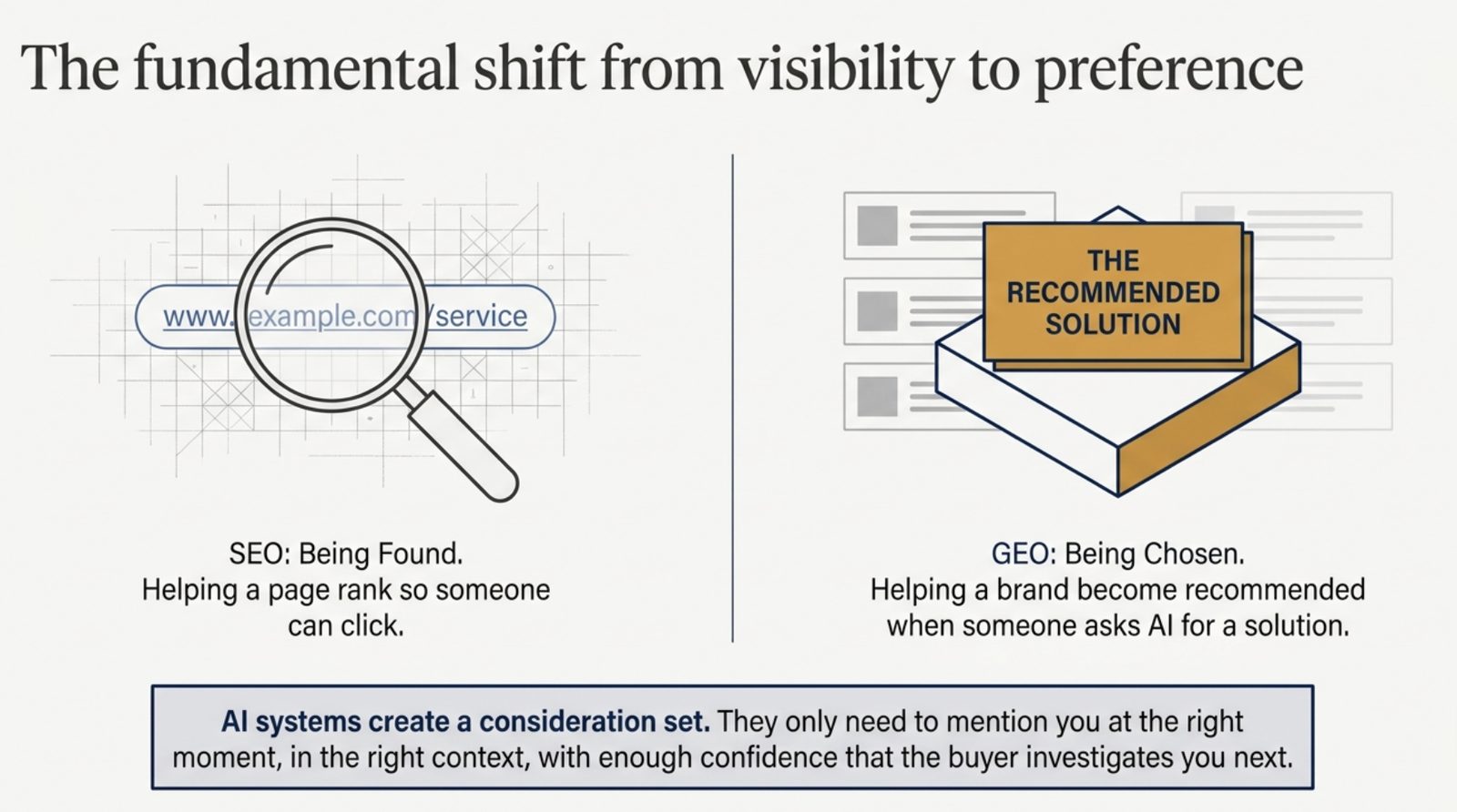
That is the difference.
SEO helped a page rank so someone could click. GEO helps a brand become recommended when someone asks AI for a solution.
Once you understand that, the fog clears.
What GEO Actually Is
Generative Engine Optimisation is the work of making your brand, product or service more likely to be recommended by AI systems when buyers ask for help.
That is the cleanest definition.
Not cited.
Not mentioned.
Not scraped.
Recommended.
A person goes to ChatGPT, Gemini, Perplexity, Claude, Google AI Mode, or whatever interface comes next, and asks a question:
“What is the best CRM for a small B2B sales team?”
“Which law firm should I use for a commercial lease in Manchester?”
“What are the best outdoor kitchens for harsh weather?”
“Who is the best SEO agency for a Shopify beauty brand?”
“What catering options are good for a corporate meeting near me?”
The AI system then does something commercially massive. It creates a consideration set.
That is the value.
If I ask my mum what to buy my dad for his birthday, and she gives me three options, those options are now in my head. I might search for them. I might compare them. I might buy one of them. My consideration set has changed because of the recommendation.
AI recommendations work in the same basic way.
The model does not need to send you a thousand visits to create value. It only needs to mention you at the right moment, in the right context, to the right person, with enough confidence that they investigate you next.
That is why GEO matters.
It is not because AI search is shiny. It is not because some vendor invented a new dashboard. It is because recommendations influence buying behaviour.
Google is already pushing search further into AI-led answers through AI Overviews and AI Mode, describing AI Mode as useful for complex questions, recommendations and product comparisons. Google has also continued to update AI search experiences to help users explore information across the web and connect with sources, brands and websites.
So the question for a business is not, “Are we cited?”
The question is, “When our buyers ask AI who to consider, are we one of the answers?”
Why the Value of GEO Is Economic
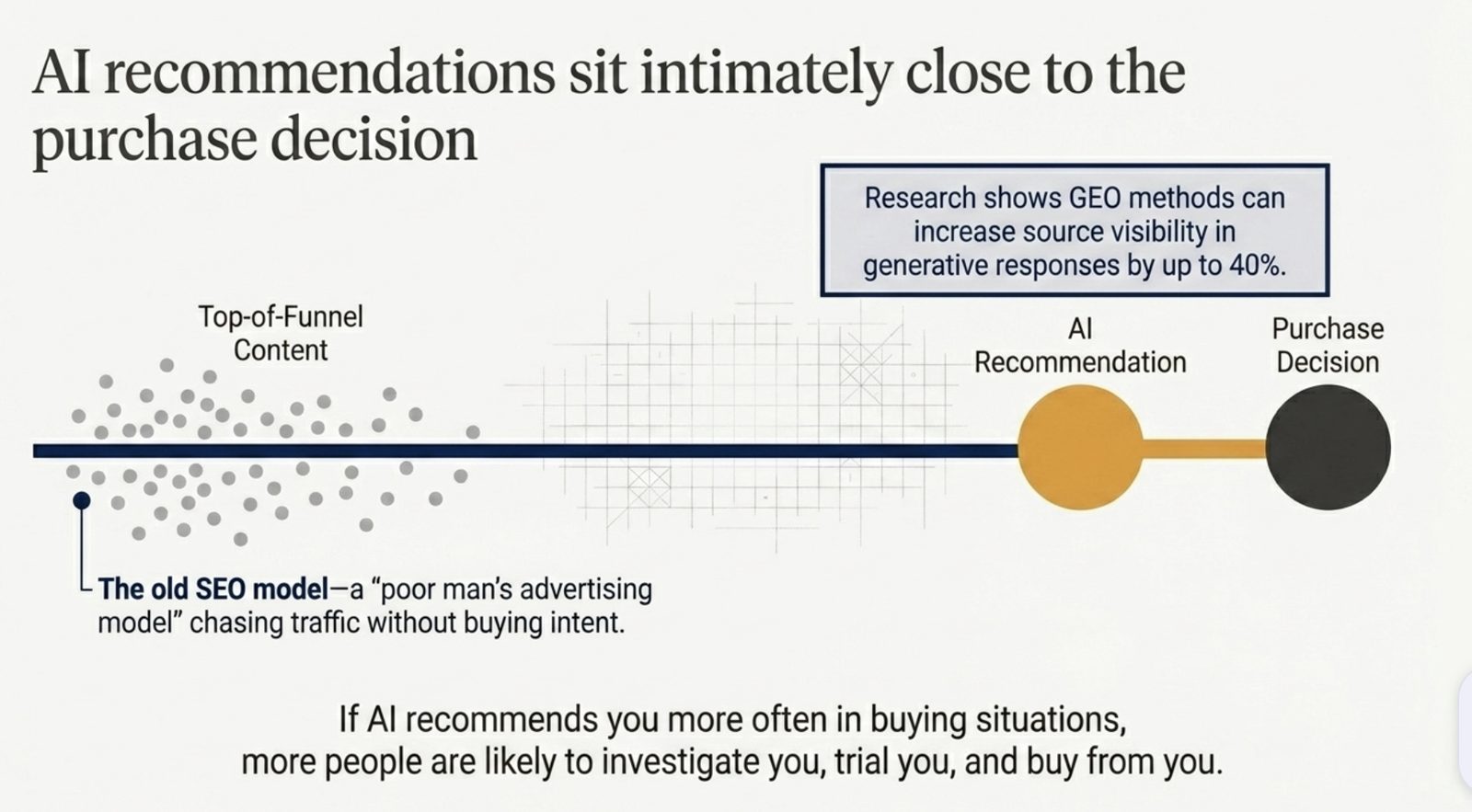
The value of GEO is simple: it sits close to purchase.
Someone asking an AI tool for “the best X for Y” is not casually browsing. They are often trying to make a decision. They may not buy immediately, but they are moving toward evaluation.
That makes GEO commercially different from a lot of old SEO content.
For years, businesses created endless top-of-funnel articles because traffic looked like growth. The logic was usually: rank for topic, get traffic, hope some of it converts. Sometimes it did. Often it did not.
A lot of SEO content became a poor man’s advertising model. Create more pages. Get more clicks. Show the board an upward traffic graph. Ignore the fact that half the traffic had no buying intent and the other half was cannibalising the site.
That model is now under pressure.
AI search synthesises information. It may answer the question without sending the click. It may retrieve from several sources, compare options and present a recommendation. The old “rank, click, convert” model does not disappear overnight, but it stops being the only model that matters.
The academic paper that helped formalise Generative Engine Optimisation describes generative engines as systems that synthesise information from multiple sources to answer user queries, creating a new visibility problem for content creators and brands. The same research found GEO methods could increase source visibility in generative responses by up to 40%, though effects varied by domain.
That is useful academically. But for a board, the commercial version is easier:
If AI recommends you more often in buying situations, more people are likely to investigate you, search for your brand, visit your revenue pages, contact you, trial you, or buy from you.
You will not track all of it.
That annoys performance marketers because they like pretending the world only exists if it appears in an attribution model. But marketing has never worked that neatly. PR, word of mouth, brand advertising, referrals and reputation have always influenced behaviour in ways that are not perfectly trackable.
GEO is the same.
You may not see every AI-led recommendation. But you can see residual effects.
More branded search.
More direct traffic.
More visits to product, service and category pages.
More sales conversations where prospects already know you.
More natural links and mentions.
More inclusion in lists, reviews and comparisons you did not directly create.
More revenue.
That is the point. Not the footnote. The cash register.
Why GEO Is Not Just SEO
The “it’s just SEO” argument relies on strategic ambiguity.
Make SEO broad enough and everything collapses into it. PR? SEO. Brand? SEO. Copywriting? SEO. Reviews? SEO. Social media? SEO. Your nan mentioning your business at bingo?
This is absurd at best and dishonest at worst.
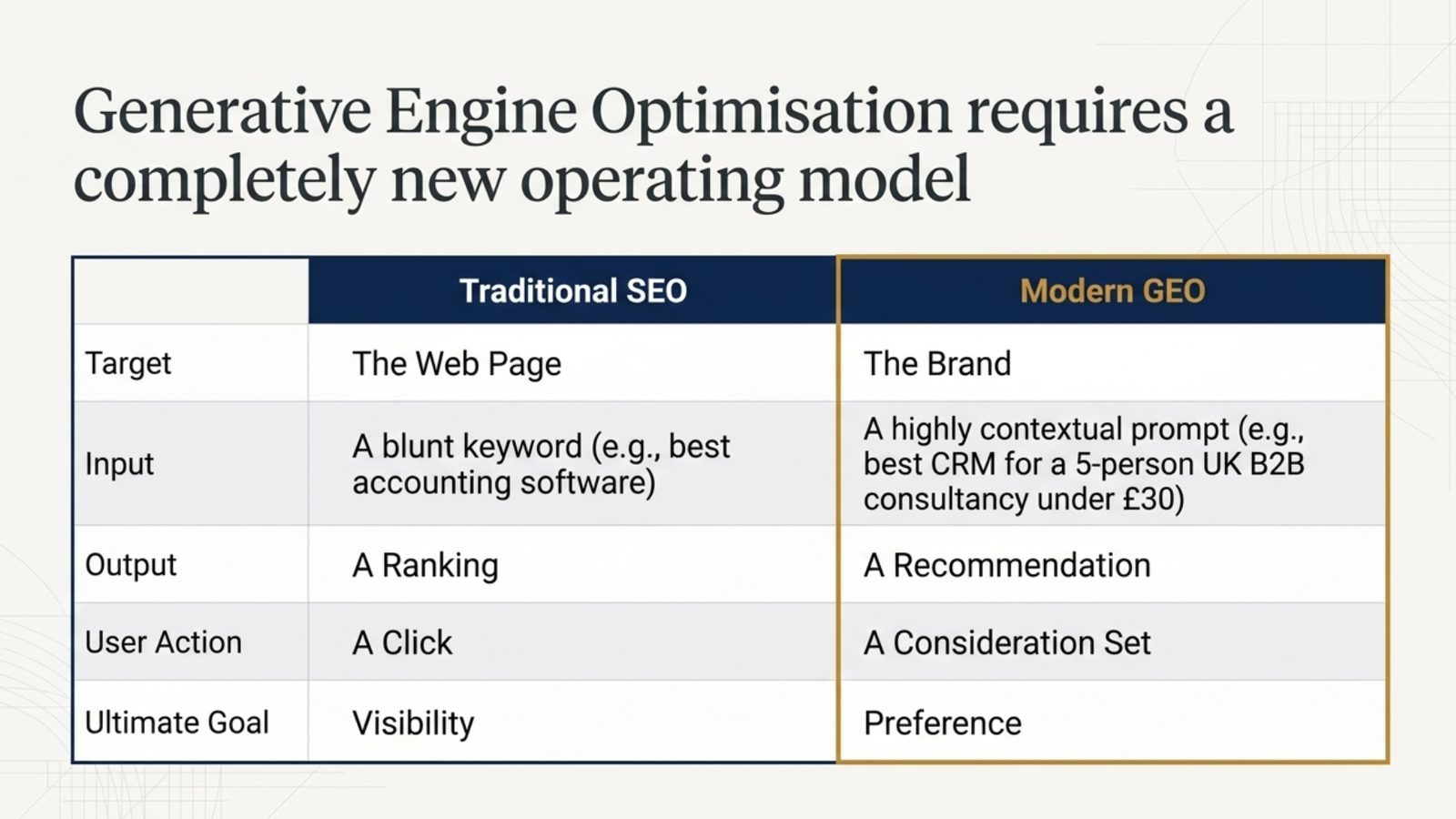
SEO was traditionally about improving the visibility of web pages in search engines. In commercial terms, the basic model was clear: match keywords to pages, improve relevance, build authority, rank higher, win clicks, generate revenue.
Again, yes, that is simplified. But it is the model most businesses bought.
GEO has a different outcome.
SEO wants the page to rank.
GEO wants the brand to be recommended.
Those things can overlap. Ranking well may increase the chances of being encountered, retrieved or trusted. SEO still matters. Google’s own guidance for AI features tells site owners to focus on making content eligible and useful across Search experiences, including AI features.
So do not throw SEO in the bin. That would be foolish.
But do not pretend GEO is identical.
A ranking is not a recommendation.
A keyword is not a prompt.
A click is not a consideration set.
And a citation is not a sale.
AI systems operate in a richer decision context. They may know more about the user’s goals, constraints, previous questions, preferences, location, budget or situation. A traditional keyword like “best accounting software” is blunt. A prompt like “I run a five-person consultancy in the UK, hate complex dashboards, need simple invoicing and want something under £30 a month” is a completely different animal.
The answer is not just about which page ranks. It is about which brand appears to fit the situation.
That is why GEO needs to be named.
If it is not named, it is not owned.
If it is not owned, it is not budgeted.
If it is not budgeted, it is not measured.
And if it is not measured, it becomes another bit of marketing vapour that everyone discusses and nobody does properly.
The Simplest Way to Explain How GEO Works
Large language models cannot know the future.
They cannot truly know whether your agency, product, restaurant, software or sandwich shop will be the best choice for a specific buyer next Thursday.
So they approximate.
They look for evidence.
Some of that evidence comes from what the model has already absorbed in training. Some comes from retrieval, where the system goes out to find current or relevant information to ground the answer. Google’s AI search documentation describes how AI features may help users understand information from a range of sources and explore more deeply across the web.
Forget the technical plumbing for a second. The commercial implication is simple.
The machine needs evidence to recommend you.
Your job is to supply that evidence.
That is GEO.
It is not tricking AI. It is not spamming Reddit. It is not publishing 500 AI-generated blog posts because some tool told you “content velocity” was the future.
It is increasing certainty.
A buyer has a problem. The AI system needs to recommend a solution. The more clear, consistent, credible evidence there is that your brand solves that problem for that type of buyer, the safer it becomes to recommend you.
This is where the useful technical language enters, but only if we keep it plain.
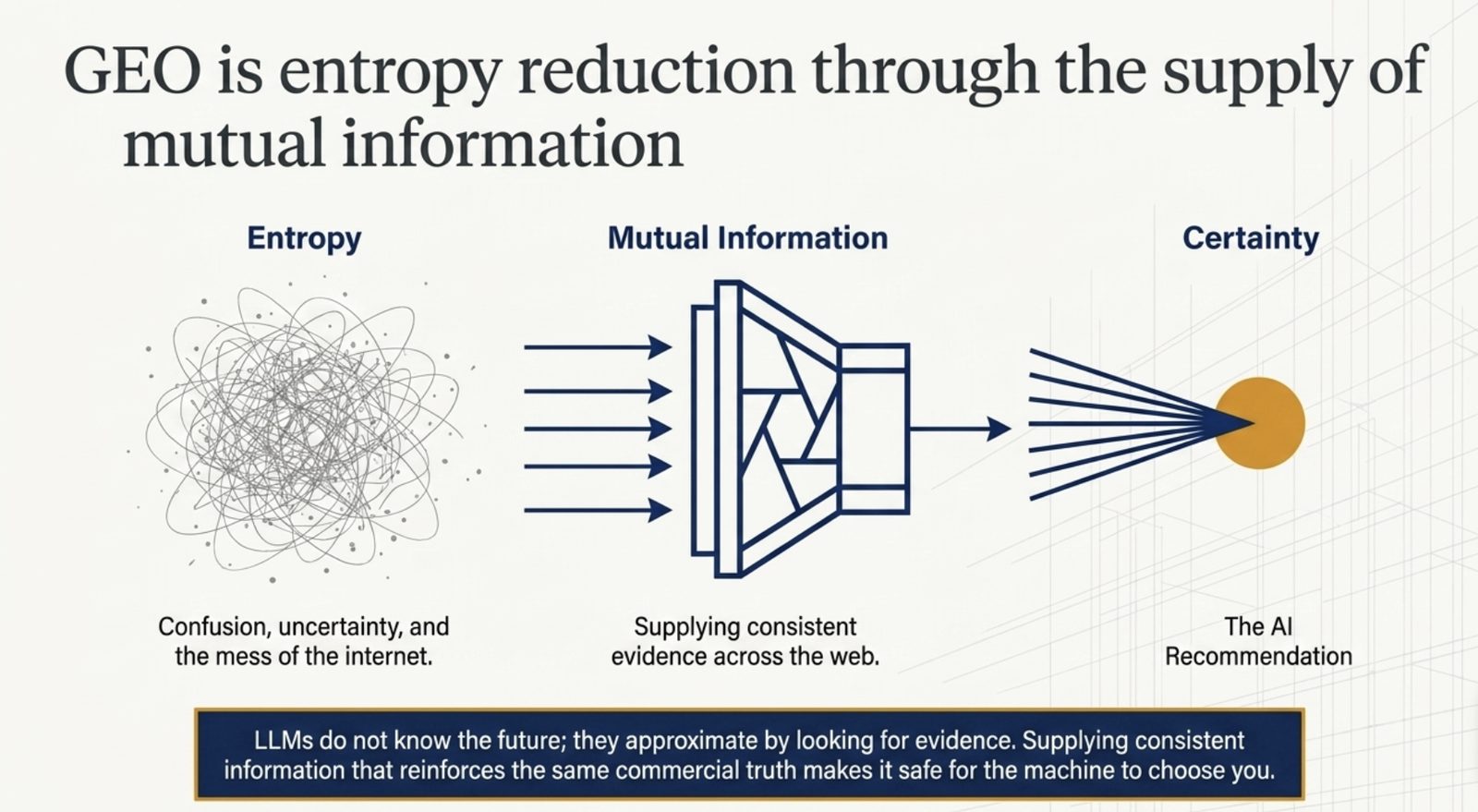
Think of GEO as entropy reduction through the supply of mutual information.
That sounds more complicated than it is.
Entropy is confusion. Uncertainty. Mess. The machine does not have enough confidence to choose you, so it looks elsewhere or defaults to the famous incumbent.
Mutual information is the supporting evidence that reduces that confusion. It is the repeated, consistent information that reinforces what you do, who you do it for, why you are different, how you solve the problem, and whether you have proof.
So yes, in boardroom English, GEO is uncertainty reduction. But the more precise term is this: entropy reduction through the supply of mutual information.
You are supplying information that reinforces the same commercial truth across the internet.
That information should be useful to humans and machines.
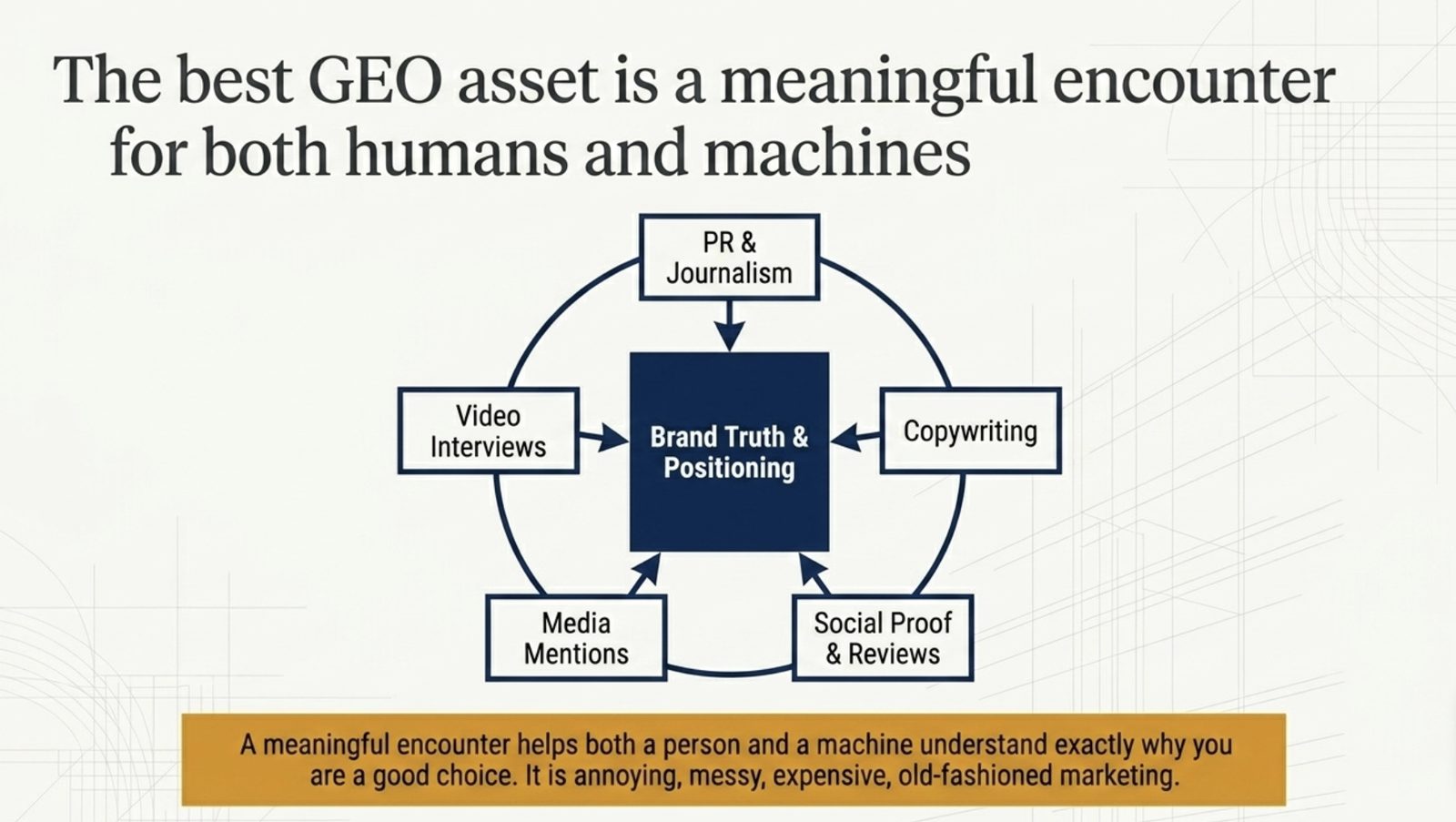
Because the best GEO asset is not some weird page written for a bot. It is a meaningful encounter. A page, review, case study, interview, guide, article, video, comparison, award, testimonial or media mention that helps a person and a machine understand why you are a good choice.
That is the part many SEOs struggle with. GEO is not primarily a search trick. It is marketing.
Annoying, messy, expensive, old-fashioned marketing.
Copywriting. Positioning. PR. Reviews. Social proof. Distribution. Fame. Repetition.
The stuff everyone pretended was too fluffy while they gave all the money to Google Ads.
Start With the Page
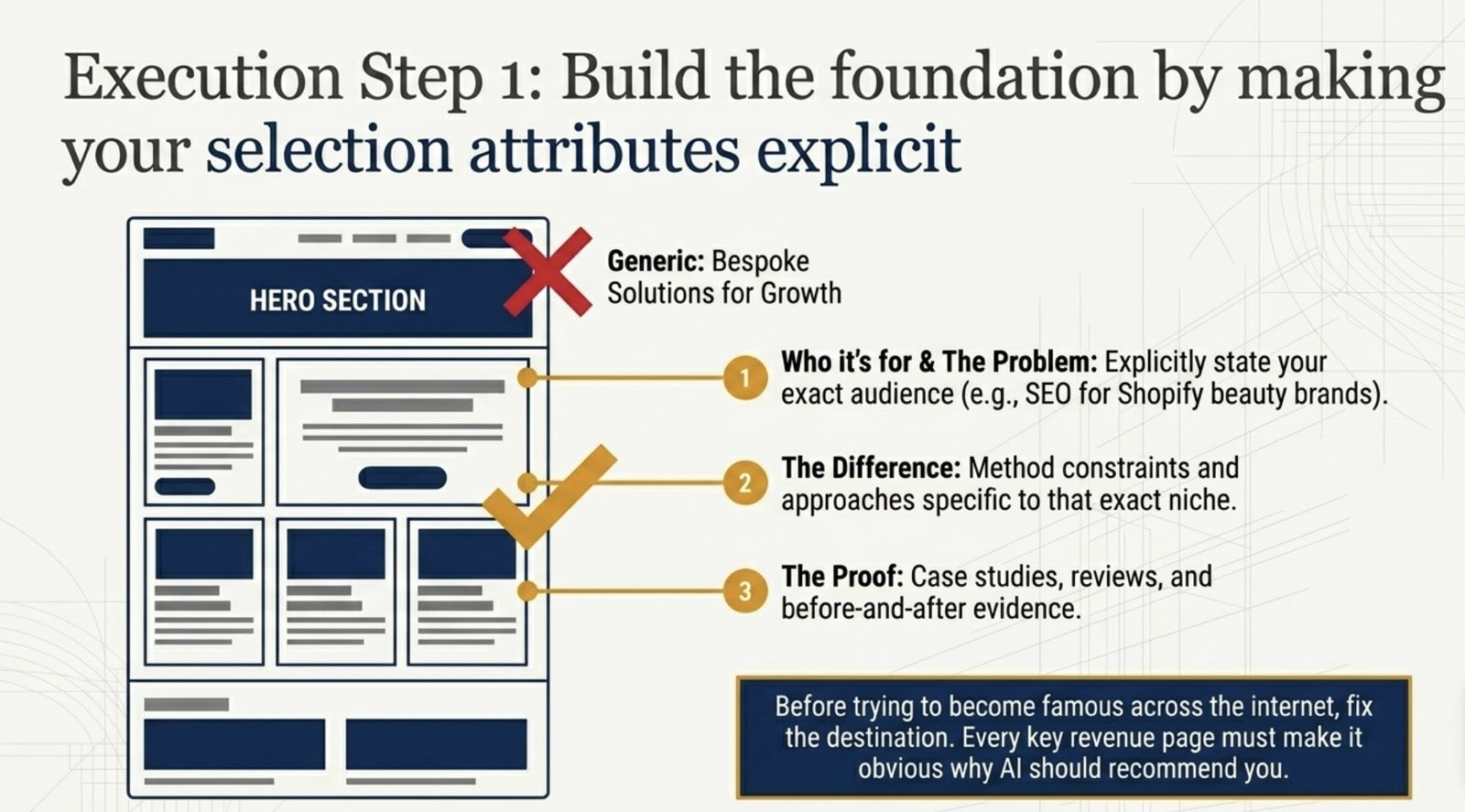
Before you start trying to become famous across the internet, fix the place you control.
Your own website.
Most websites are terrible at explaining why the business should be chosen. They list services. They mention “bespoke solutions”. They claim to be “passionate”. They use the same dull phrases as every competitor. Then they wonder why neither humans nor AI systems understand what makes them recommendable.
Every important revenue page should make your selection attributes explicit.
That means the page should clearly answer:
Who do you solve the problem for?
What problem do you solve?
How do you solve it?
Why is your approach better or different?
What proof do you have that you have solved it before?
This is basic copywriting. It is also basic positioning. And now it is basic GEO.
Imagine an SEO agency that wants to win beauty e-commerce brands using Shopify.
The old SEO instinct might be to write “The Ultimate Guide to Keyword Research” because it can rank and show expertise.
Fine. But that does not sell the agency.
The GEO instinct is different. Create a clear page that says, in effect: we help Shopify beauty brands grow organic revenue. Show the problems you solve. Show the constraints of that market. Show the proof. Show the case studies. Show the method. Show the reviews. Show the before and after.
Now, when someone asks an AI system for an SEO agency specialising in Shopify beauty e-commerce, there is something explicit to retrieve, interpret and recommend.
The same applies everywhere.
An outdoor kitchen company should not merely say it sells premium outdoor kitchens. It should explain if its kitchens are built for harsh climates, which materials make them durable, what certifications or tests support that, what customers say, how installation works, and why cheaper alternatives fail.
A local sandwich shop that wants corporate catering should not hope AI guesses that from a generic homepage. It should create clear pages and proof around office lunches, corporate meetings, funeral catering, local delivery, reviews and examples.
A barber that wants more wet shave clients should show wet shaves. Pages. Photos. Reviews. Videos. Customer comments. The service made visible.
Simple rule:
Every key page should make it obvious why AI would recommend you to the people you want to serve.
Not just why you rank.
Why you should be chosen.
Then Build Owned Media Around the Same Message
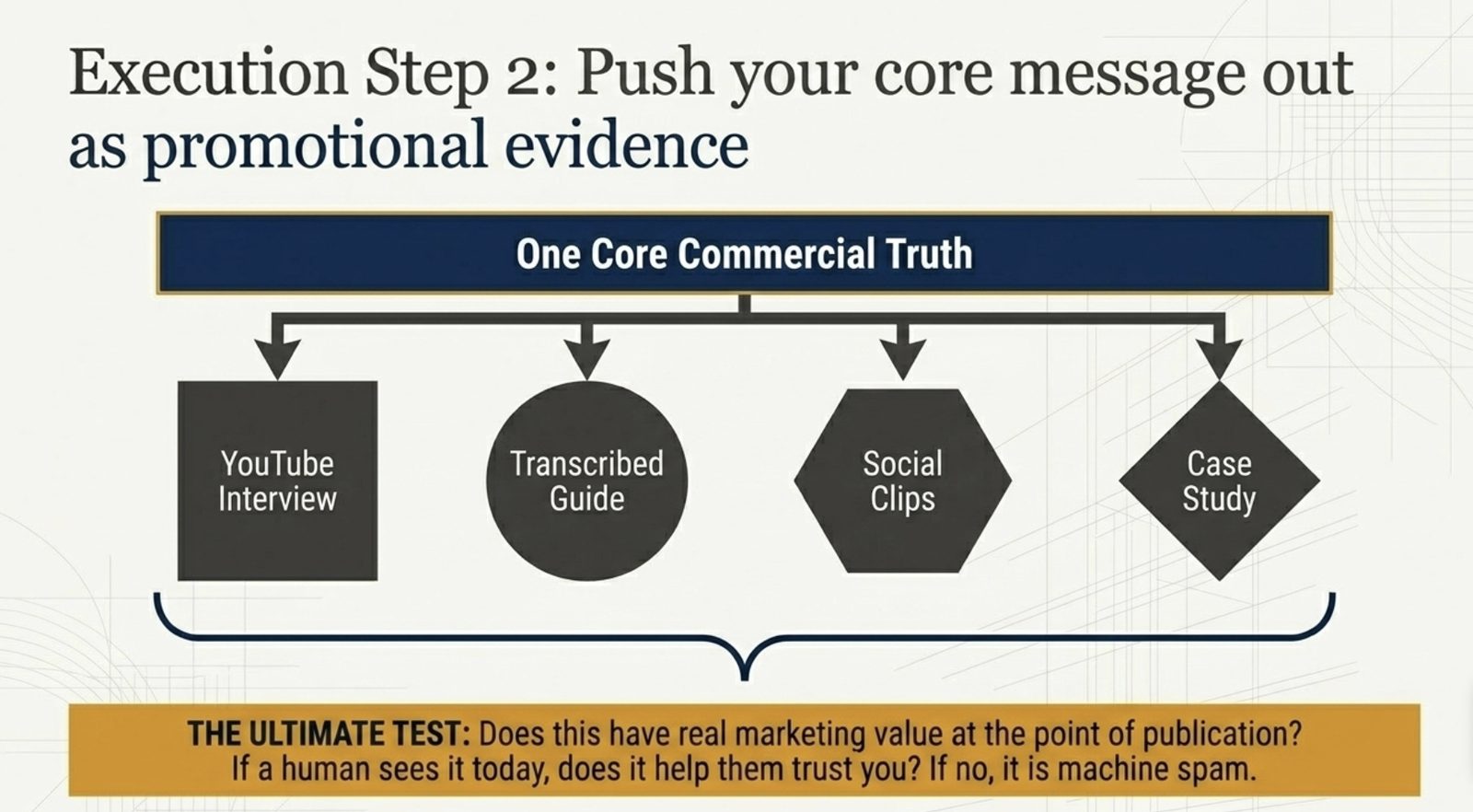
Once your positioning is clear on your site, you need to push the same message into the world.
This is your owned media.
Your blog. Newsletter. LinkedIn posts. YouTube channel. Substack. Medium. Podcasts. Events. Tools. Reports. Books. Social media handles. Digital real estate you control.
But the goal is different from the old SEO content treadmill.
You are not creating content to look clever.
You are not publishing generic topical content because a keyword tool said there is volume.
You are creating promotional evidence around the problems you solve and the reasons you should be selected.
That means repeating the same commercially useful message in different formats and places.
If you are the Shopify beauty SEO agency, publish case studies. Interview clients. Break down specific beauty e-commerce SEO problems. Put the videos on YouTube. Transcribe them. Cut them into social clips. Turn the method into a guide. Enter relevant awards. Publish examples of the work.
If you are the outdoor kitchen company, create videos comparing materials. Publish a guide to outdoor kitchen durability. Show failed installations. Explain gas safety. Commission a small data study on outdoor kitchen damage in harsh weather. Turn it into PR. Use it on social. Build the association between your brand and durability.
If you are the sandwich shop, show the corporate catering trays. Photograph the office deliveries. Ask businesses for reviews. Post local examples. Create a simple guide to ordering food for meetings. Make the thing you want to be chosen for visible.
All GEO work should pass one test:
Does this have real marketing value at the point of publication?
If a human sees it today, does it help them understand, trust or consider you?
If the answer is no, you are probably making machine spam and dressing it up as strategy.
Earned Media Makes the Claim Believable
Owned media is you talking about yourself.
Useful, but limited.
Earned media is other people talking about you.
More powerful.
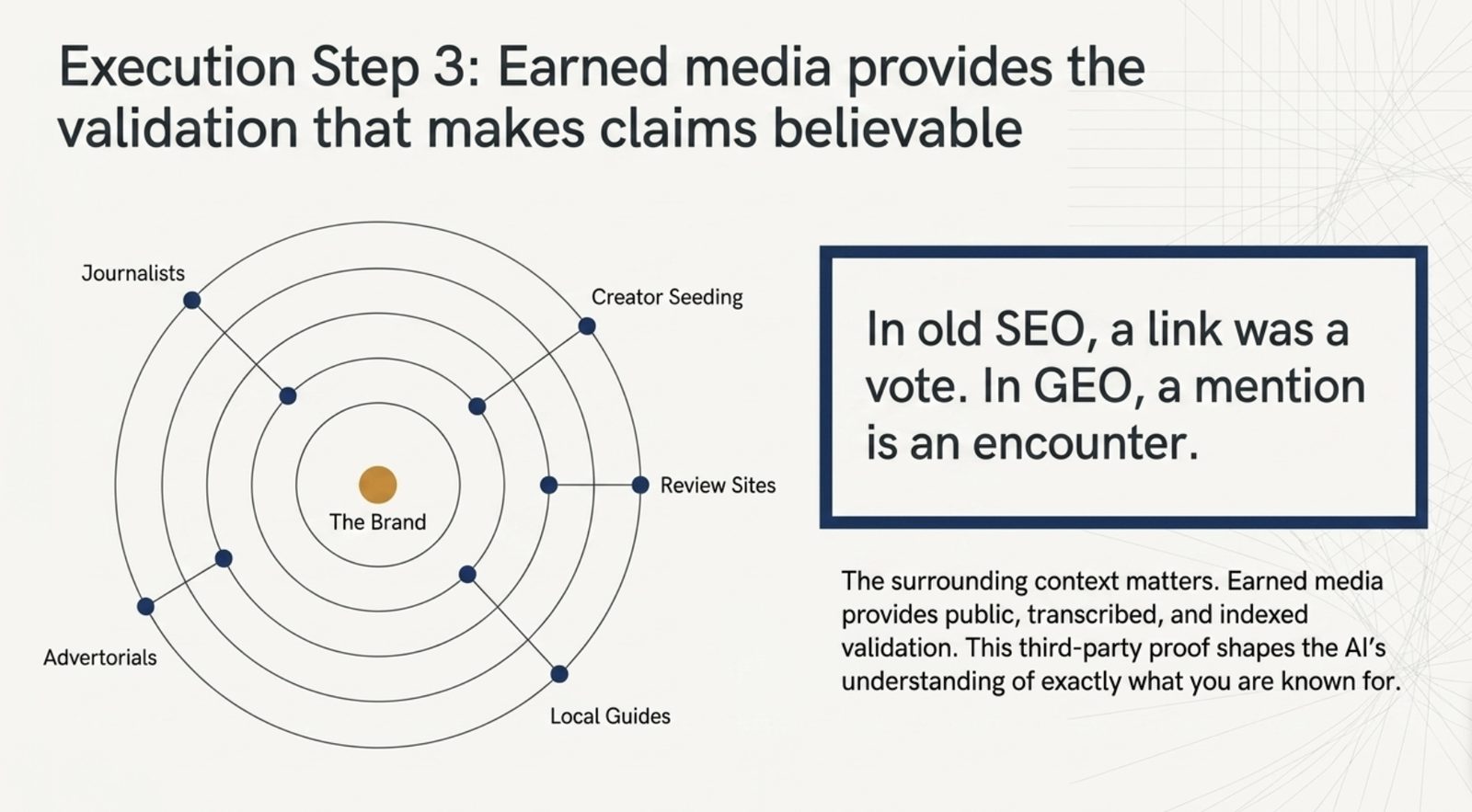
That includes PR, journalism, reviews, influencers, creators, awards, expert roundups, industry lists, comparison sites, customer stories, analyst mentions, local guides, directories, marketplace reviews, affiliate content, advertorials, paid placements and third-party validation.
This is where GEO starts to look a lot like good PR. Because it is.
PR matters because trusted publications and third parties create contextually relevant encounters with your brand.
If you are a dog food company specialising in sensitive diets, you want to be quoted in articles about sensitive stomachs in dogs. You want vets, pet publications, reviewers and customers discussing you in that context.
If you are a Manchester restaurant, you want to be in guides to the best restaurants in Manchester. You want food journalists reviewing you. You want local creators visiting you. You want people naming you in the contexts where buyers and AI systems go looking for proof.
And this is where social media and creator seeding become much more important than most SEO people want to admit.
A creator talking about your product is not just “social content”. It is a public, transcribed, indexed, repeated encounter with your brand. A YouTube review, a TikTok demonstration, a LinkedIn post, an Instagram Reel, a podcast mention, a newsletter inclusion — all of these can help supply mutual information into the market if they reinforce the thing you want to be chosen for.
That may mean seeding products with influencers. It may mean inviting creators to events. It may mean building affiliate relationships. It may mean sponsoring newsletter placements, paying for advertorials, or using paid social to amplify content that already has a clear strategic message.
Cue the predictable purist whining. “But that’s paid.” Yes. And? Paid distribution has always been part of marketing. The question is not whether money changed hands. The question is whether the placement creates a meaningful encounter in a relevant context and whether it helps humans and machines understand why you should be chosen.
An advertorial in the wrong publication, saying nothing useful, is just expensive self-indulgence. An advertorial in the right publication, explaining a real problem, positioning your brand clearly and giving people a reason to consider you, can be useful. Same with creator content. Same with sponsored newsletters. Same with paid amplification.
In old SEO, a link was treated like a vote.
In GEO, a mention is an encounter.
The link still matters. Of course it does. Links remain useful for discovery, authority and referral traffic. But the brand mention, the context, the surrounding language and the credibility of the source all matter because they help establish what you are known for.
This is also why “AI visibility” as citation tracking is too narrow.
Citations in AI answers can be directionally useful. They show you some of the sources being surfaced and can help you understand what types of evidence shape responses. But they are visible artefacts of a larger inference process. They are not the whole game.
The game is broader.
Are you being encountered in the right places?
Are trusted sources describing you in relation to the problems you solve?
Are customers reviewing you for the attributes you want to be known for?
Are creators and journalists reinforcing your positioning?
Are you appearing in the lists, comparisons, guides and conversations that matter?
That is earned validation.
And yes, it is harder than publishing another blog post. Tough. Good marketing usually is.
The Bigger Goal: Preferential Attachment
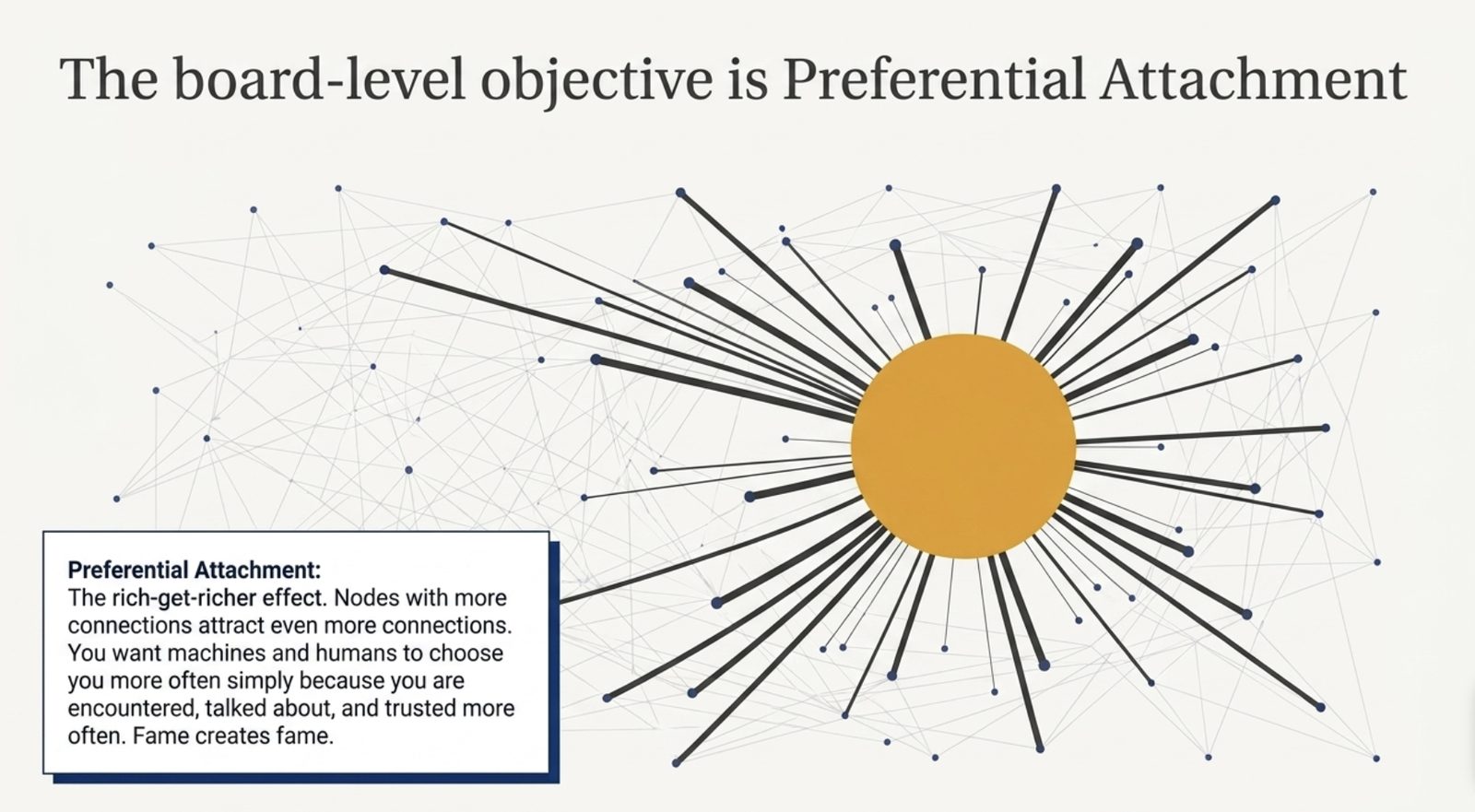
Now we need the board-level goal.
The goal of GEO is not activity. Activity is how you get there.
The goal is preference.
More specifically, the goal is to create what network science calls preferential attachment.
Albert-László Barabási, one of the defining figures in modern network science, helped popularise this idea through his work on the theory of scale-free networks. In simple terms, scale-free networks explain why some nodes in a network become vastly more connected than others. Not slightly more connected. Disproportionately more connected.
Preferential attachment is the mechanism behind that rich-get-richer effect. Nodes that already have more connections become more likely to attract even more connections. Visibility creates more visibility. Connection creates more connection. Fame creates more fame.
That is the actual goal of GEO.
You want to become more preferred because you are more visible, more encountered, more talked about, more searched for and more trusted. You want humans to choose you more often. You want machines to recommend you more often. And those two things are increasingly linked because search, social, PR, reviews, creators, content and brand all collapse into one connected visibility system.
This is the hard part. Preference does not magically appear because you uploaded a blog post and prayed to the algorithmic gods.
You have to build the visibility manually before it starts to compound naturally.
That is the work of the marketing team, the PR team, the social team, the content team, the agencies and the GEO specialist. They are not just “doing content”. They are increasing the number of meaningful places where your brand can be seen, encountered, understood, discussed, cited, reviewed, linked to and recommended.
At the start, almost all of this visibility has to be forced into the market. You publish the page. You create the video. You pitch the journalist. You seed the product. You run the event. You ask for the review. You sponsor the newsletter. You build the case study. You get the creator to talk about you. You put the brand into the network.
Then, if the work is good enough and consistent enough, the flywheel starts to move without you pushing every single spoke.
People mention you without being asked.
Journalists include you without being pitched.
Creators reference you because you are already part of the category conversation.
Customers search for your brand by name.
AI systems encounter more evidence that you are a credible choice.
You get chosen more often because you are seen and thought of more often.
That is why bigger brands often win. They are not magically better. They are more visible. They are encountered more often. They are discussed more often. They are remembered more often. And because they are remembered and encountered more often, both people and machines are more likely to choose them.
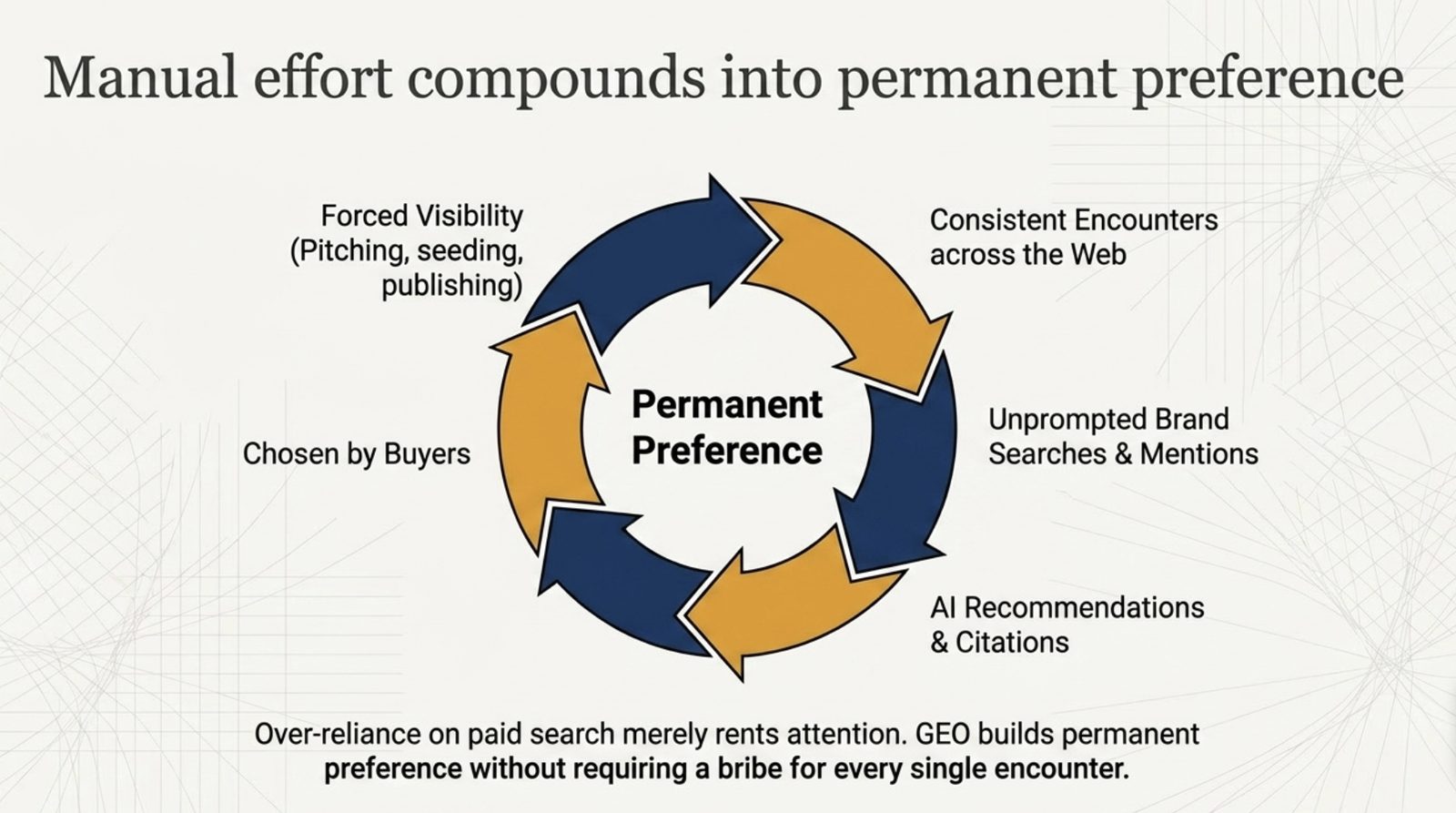
That is the flywheel.
Fame creates fame.
Mentions create mentions.
Recommendations create recommendations.
Searches create searches.
The machine sees the brand more often. People see the brand more often. Both become more likely to choose it.
That is why over-reliance on paid search is dangerous.
Paid search rents attention. GEO builds preference.
Yes, there will be ads inside AI search. Google is already explaining how ads can appear with AI Overviews and AI-powered Search experiences. And brands will buy them, because of course they will.
But if your entire strategy is to rent every encounter, while competitors become the natural recommendation, you are building a very expensive dependency.
GEO is the work of becoming the brand the market and the machine choose without being bribed.
How to Measure GEO
This is the part where everyone wants one neat metric.
Sorry. You do not get one.
GEO is not a single-channel tactic. It is a system of visibility, evidence and preference. So you measure it as a system.
Start with prompt monitoring.
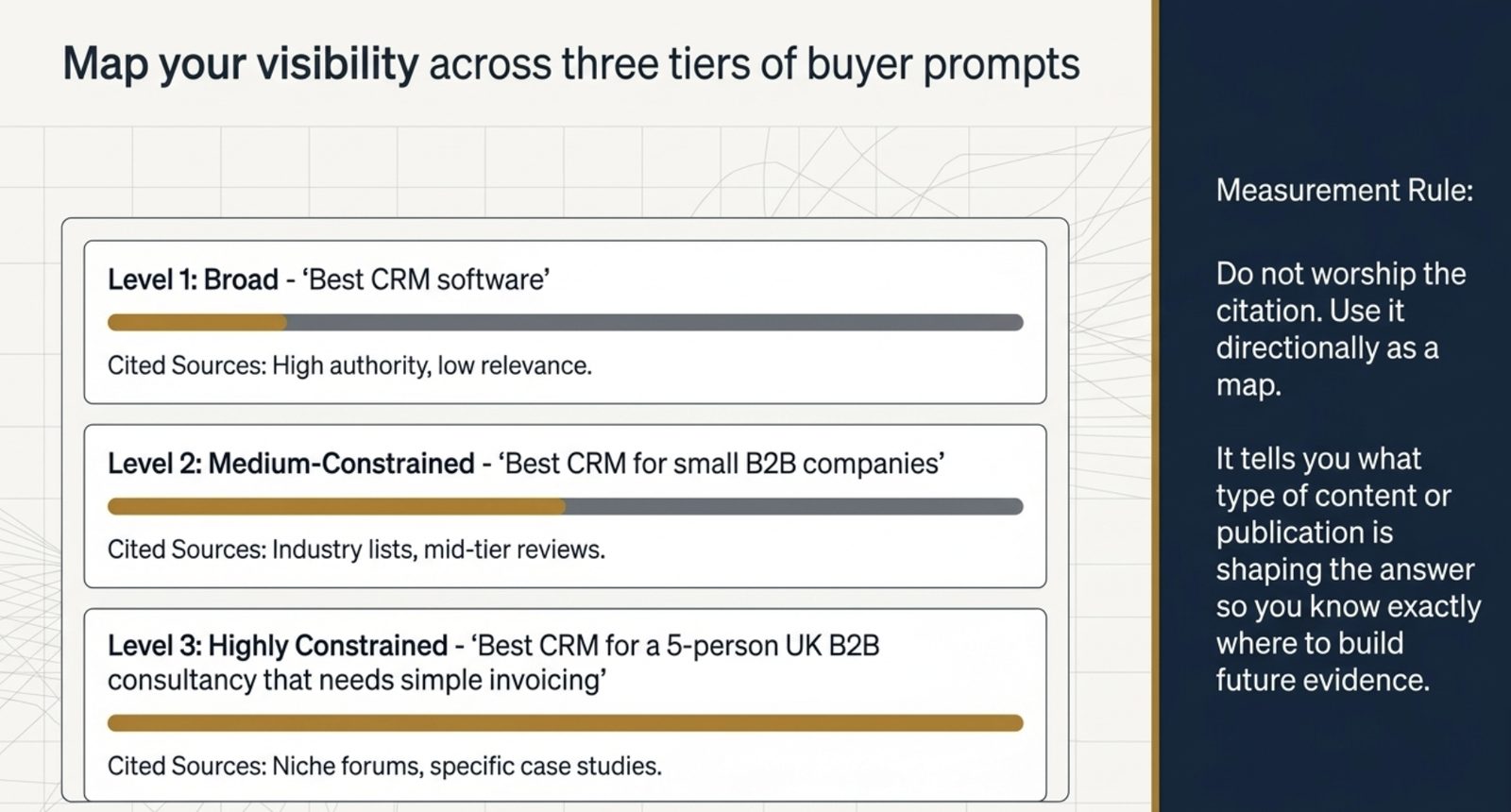
Build a list of prompts your buyers might use. Not just broad prompts, but three types:
Broad prompts: “best CRM software”
Medium-constrained prompts: “best CRM software for small B2B companies”
Highly constrained prompts: “best CRM for a five-person UK B2B consultancy that needs simple invoicing and hates complex dashboards”
Then test them across relevant AI tools. Track who gets recommended. Track whether you appear. Track which sources are cited. Track the language used to describe competitors. Track what evidence seems to support recommendations.
Do not worship the citation. Use it directionally.
It tells you what type of content, publication, review, comparison or page may be shaping the answer. That gives you a map of where you need to build evidence.
Then measure the commercial signals.
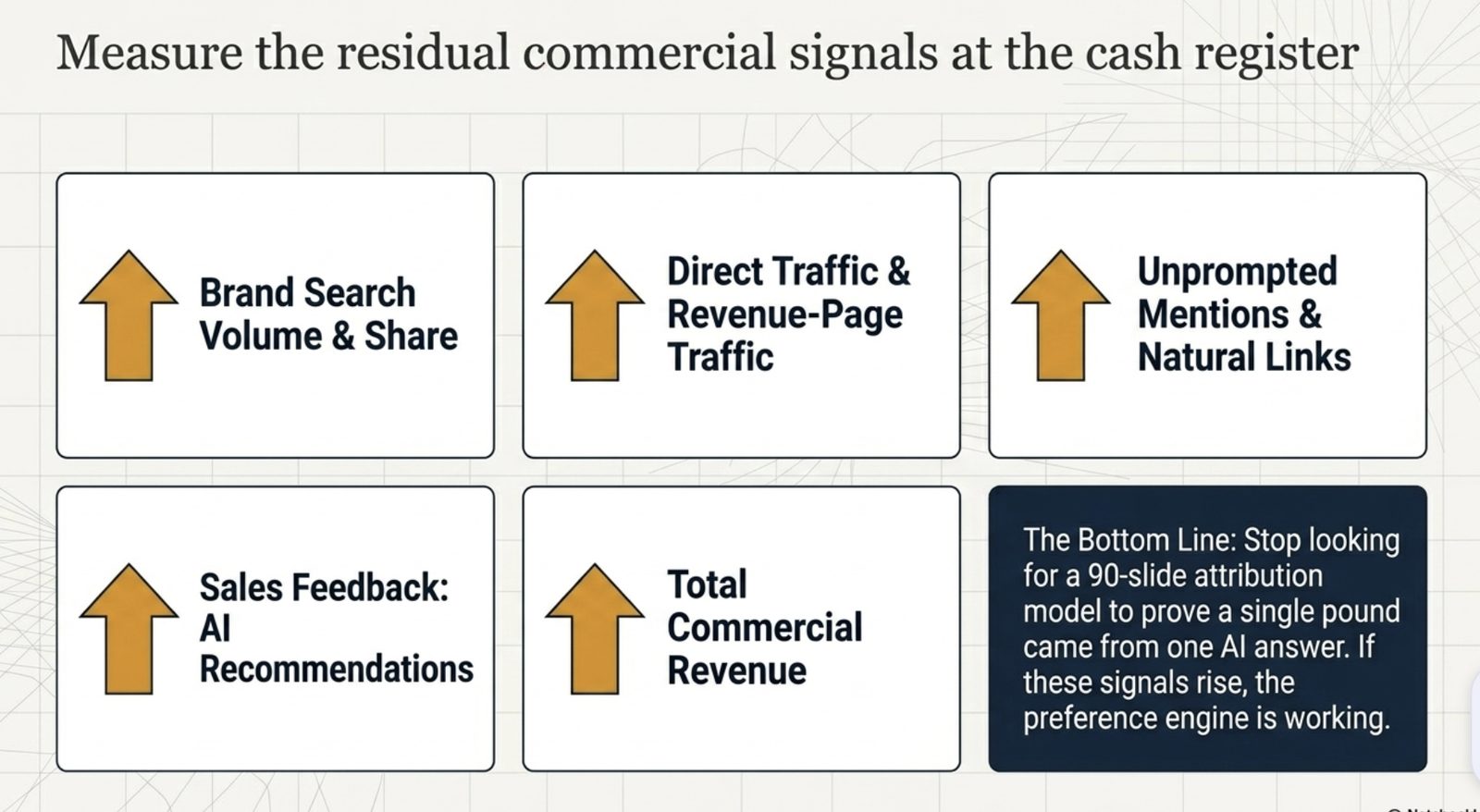
Brand search.
Share of search.
Direct traffic.
Revenue-page traffic.
Product and service page engagement.
Sales-qualified leads.
Conversion rates from branded and direct demand.
Natural links acquired.
Unprompted brand mentions.
Review volume and review language.
Earned media frequency.
Inclusion in relevant lists and comparisons.
Influencer and creator mentions.
Customer feedback: “Where did you hear about us?”
Sales feedback: “Did prospects mention AI tools, comparisons or recommendations?”
And, obviously, revenue.
The point is not to prove every single pound came from one AI answer. That is attribution fantasy. The point is to understand whether your activity is increasing preference and whether that preference is showing up in the market.
If branded search rises, revenue-page traffic rises, earned mentions rise, natural links rise, AI recommendations improve and revenue rises, you probably do not need a priest, a shaman and a 90-slide attribution model to tell you something is working.
Who Should Own GEO?
Someone has to own it.
That person does not replace SEO. They sit across SEO, content, PR, brand, digital, social and analytics.
A good GEO specialist or team looks at:
The copy on revenue pages.
The clarity of positioning.
The evidence supporting selection.
The owned media output.
The consistency of the message.
The earned media strategy.
The review and validation engine.
The prompt-monitoring data.
The links and mentions being acquired.
The movement in brand demand.
The connection to revenue.
This is why GEO does not fit neatly into the old retainer model. It is scrappier than that. It touches too many areas. It requires judgement. It requires hustle. It requires actual marketing.
And that is precisely why it matters.
Final Word: Stop Thinking Like a Search Engine
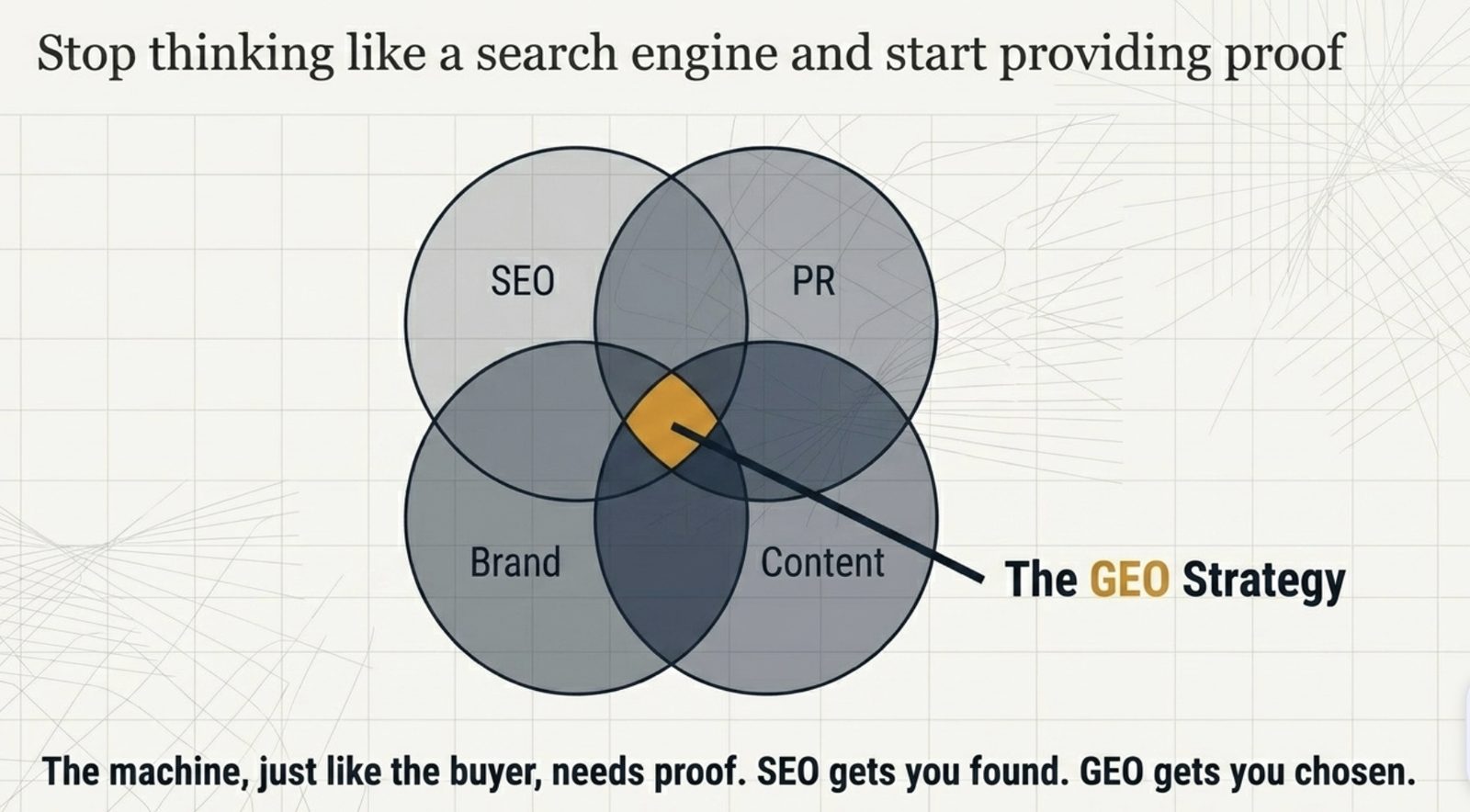
The easiest way to misunderstand GEO is to think like an old SEO.
Keywords. Rankings. Clicks. Citations. Dashboards.
That world still matters, but it is no longer enough.
The better way to think about GEO is this:
A buyer has a problem.
An AI system needs to recommend a solution.
Your job is to make your brand the most certain, credible and contextually relevant answer.
You do that through clear pages, strong positioning, useful owned media, earned validation, reviews, PR, social proof, creators, links, mentions and repeated evidence across the internet.
Not because the machine needs to be tricked.
Because the machine, like the buyer, needs proof.
That is the difference between SEO and GEO.
SEO gets you found.
GEO gets you chosen.
Remember that, and most of the industry noise starts to sound exactly like what it is.
Noise.
And If you need help figuring this out, send me a message.
Andrew Holland
Originally published on LinkedIn on 13 May 2026.