
The cat is finally out of the bag.
JBH and I are now publicly sharing what we’ve been building behind the scenes to help brands prepare for an AI-search future.
Not in the abstract. Not in the usual “AI is changing everything” conference-slide noise.
I mean the actual process. The tools. The thinking. The bits that are working. The bits that are not working. The things we have learned from getting our hands dirty with brands, trying to understand why they are, or are not, being recommended by AI systems.
Because let’s be honest: most of the industry is still struggling to explain GEO properly.
Even Google seems to be tying itself in knots. The official line appears to be that generative engine optimisation is basically SEO, while SEO is apparently just “creating helpful content”. Which is fine if you enjoy strategy delivered at the intellectual depth of a fridge magnet. Helpful to whom? For what problem? In which category? Against which alternatives? Supported by what evidence? Measured how?
That is the bit most people are missing.
GEO is not simply SEO with an AI sticker slapped on the bonnet. It is a new layer of brand, content, PR and search strategy designed to make a business more likely to be recommended by generative systems. The old game was largely about matching queries to documents. The new game is about proving problem-solution fit across the network.
Put more simply: SEO rewarded query-document relevance. GEO rewards problem-solution fitness.
(Note, this is a long article, but if you want a starter guide to GEO, read this https://geoguide.jbh.co.uk/)
The Geeky Bit: How We Got Here
OK, so if you aren’t a search or marketing geek, feel free to skip this part. It will probably bore you, but it’s important that I ground the rest of this in actual science.
When this whole ‘GEO’ thing merged, I had a choice. I could join camp, “it’s just SEO”. That camp would grow my following online further, get me loads of likes, and indeed get me more speaking gigs.
Or I could trust my gut, investigate, and see how this all worked. I did the latter. However, I needed GEO to align with some kind of science. There needed to be some kind of strcuture behind it all that would explain everything.
And as I dug, there was.
GEO aligns several documented scientific and widely held theories. The main ones being.
Information foraging theory.
The theory of scale-free networks.
Ehrenberg-Bass Mental and Physical Availability.
I won’t go massively deep here, as the above concepts are widely known, but the key part to understand is that LLMs use their own version of information foraging that, while mechanically different from humans, has the same underlying scent and patch model.
And as the models rely on the internet for both training and grounding, they would be subject to the same laws observed in the Barabasi-Albert model.
The theory of scale-free networks essentially explains why concepts of mental and physical availability work. Which you can read more about here.
However, Ehrenberg-Bass in their ‘Easy to Find Report’ sum up GEO quite nicely:
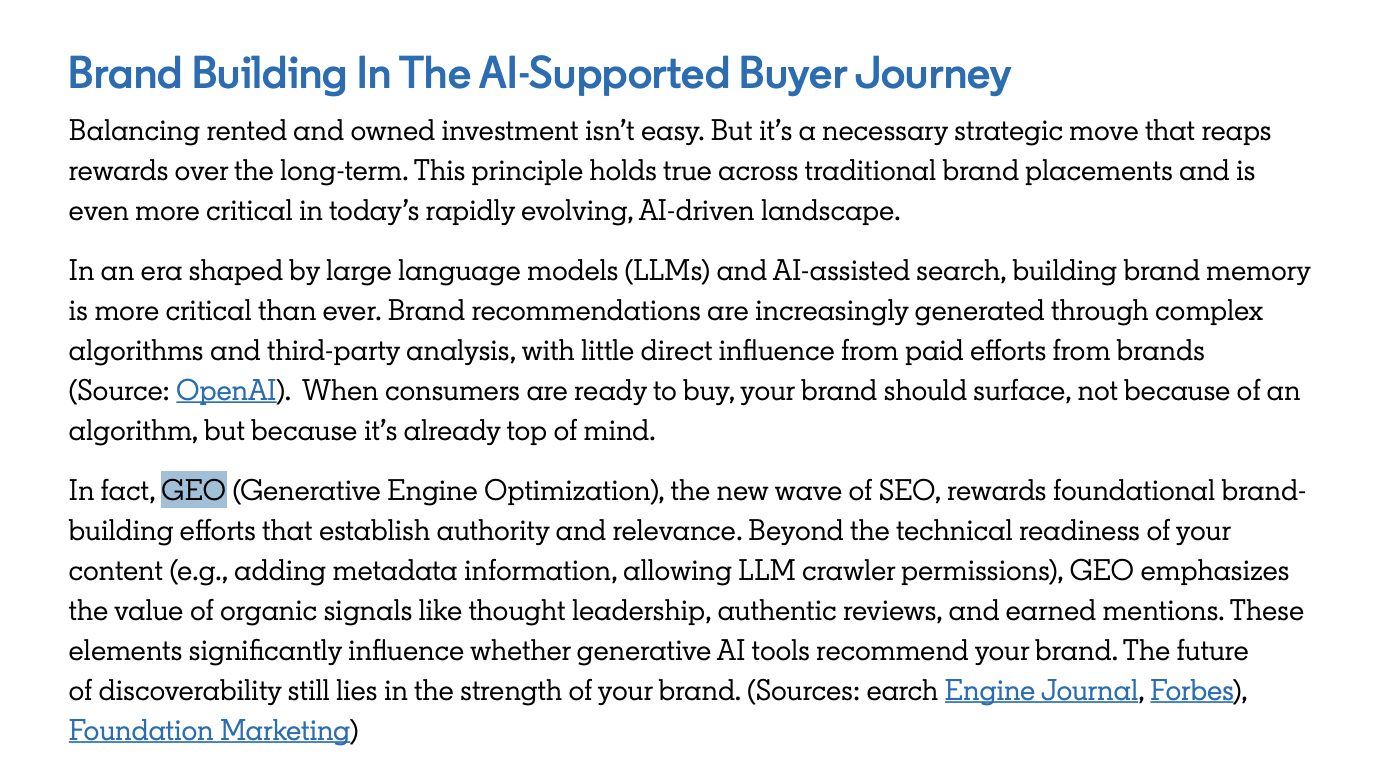
The key takeaway here is that ‘GEO emphasizes the value of organic signals like thought leadership, authentic reviews and earned mentions’.
The term “signals” is key to GEO. Essentially, that is the core mechanism of generative engine optimisation, which aligns all the previously discussed scientific theories and concepts.
I appreciate I’ve dumbed the above down; I could go deep… really deep. And if you want to understand this more, watch this video.
It’s 50 minutes of depth on how GEO works. It’s a massive subject, and we’re only just scratching the surface.
OK, now onto the actual work in GEO.
Prompts have changed the game
The first thing to understand is the prompt. Prompts alter search.
A prompt is not just a longer keyword. It is a user asking a large language model to do a job. Research this for me. Compare these options. Filter the market. Tell me what to buy. Recommend the right provider. Help me make a decision.
That is incredibly powerful because the user is no longer just looking for a page. They are entering a problem space.
In old search, someone might type:
best marathon shoes
In generative search, they might ask:
I’m running my first marathon and need a good pair of black training shoes under £100. I prefer Nike or Reebok but I’m open to other brands if they have strong reviews.
That is a totally different situation.
Prompts tend to fall into three types: broad, mildly constrained and highly constrained.
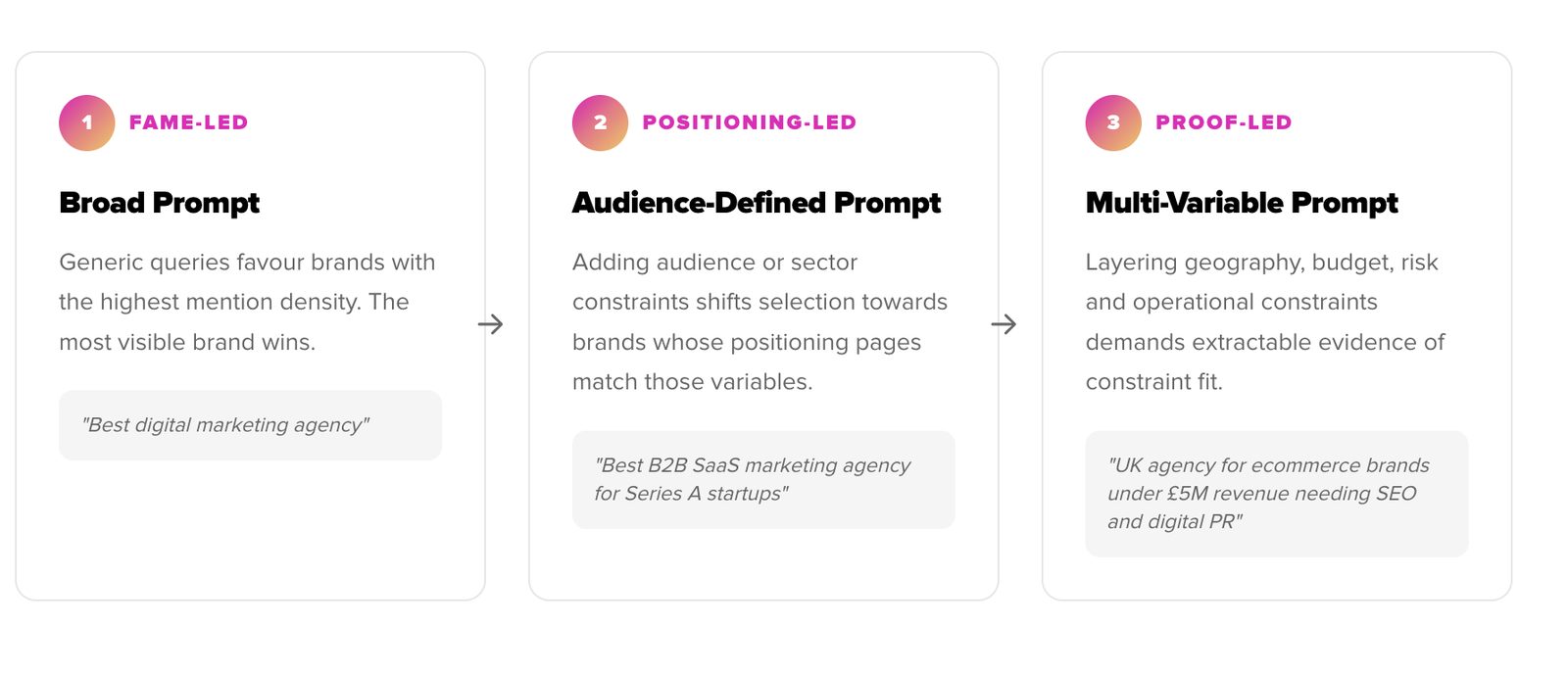
A broad prompt might be: “List me the best marathon shoes.” When the prompt is broad, the model has very little to go on. So it often defaults to famous, widely distributed, well-mentioned brands. Nike, Adidas, Asics, Reebok. The usual suspects. Not because the model is stupid, but because broad uncertainty tends to reward fame.
A mildly constrained prompt adds another filter: “List me the best marathon shoes under £100.” Now the system has to consider category fit and price. Fame still matters, but it is no longer enough. The model needs evidence around value, availability, reviews and suitability.
A highly constrained prompt gives the system a much harder job.
First marathon. Black shoes. Under £100. Preference for certain brands. Open to alternatives with good reviews.
Now the model has to compare attributes, assess trade-offs and recommend a solution that fits the user’s specific situation.
This is where things get interesting.
Prompts are infinite. Problem patterns are not.
You cannot know every prompt. Anyone claiming they have all the prompt data is selling dashboard theatre. Yes, we can observe patterns. Yes, we can use Search Console, Bing data, user research, sales calls and AI testing to infer a lot. But you do not get a neat keyword planner for the generative web.
So the job is not to optimise for every possible sentence someone might type or speak into an AI system. The job is to understand the recurring problems, constraints, buying criteria, objections and proof points that shape those prompts.
And you only know that by understanding your customers and the problems you seek to solve better than others.
Why old SEO instincts are not enough
To see why this matters, you have to understand where SEO came from.
Traditional search rewarded query-document relevance. At a simplified level, much of the early logic was based around TF-IDF: term frequency-inverse document frequency. In human language, that means: do the words on your page match the words people are searching for, and do they appear in a way that makes this document more relevant than other documents?
Yes, search evolved. PageRank, links, entities, user signals, machine learning and a thousand other factors came into play. But the SEO industry built a lot of its muscle memory around the same basic scaffolding: page titles, meta descriptions, headings, internal links, backlinks, FAQs, keyword density, topical coverage and longer pages.
That is why we got skyscraper content. This is why tools like Surfer and Frase became popular. Look at what ranks, reverse-engineer the headings, add more words, answer more obvious questions and create a better-optimised version of what is already there.
And to be fair, that worked. Humans searched in clipped little phrases. “Car insurance.” “Best CRM software.” “Kitchen ideas.” “SEO agency Manchester.” If you ranked well for high-intent terms, you got traffic. If you got traffic to the right pages, you probably got leads or sales.
But generative engines do not just retrieve pages. They form answers. They compare options. They recommend.
That means your page is no longer just a page trying to rank. It is an interview with the machine.
And most brand pages walk into that interview mumbling the same generic crap: “We provide innovative, bespoke solutions for ambitious businesses.” Which is a sentence so useless it should be taken outside and humanely destroyed.
Generative systems are looking for fit.
Who do you serve? What problem do you solve? Why are you better suited to solve it? What trade-offs do you make? What proof exists? What do others say about you? Where are you mentioned? What context are you mentioned in? Are you genuinely associated with this problem in the wider network?
That is a different optimisation challenge.
What 18 months in the trenches taught us
Over the best part of 18 months, I conducted granular research into prompts, AI recommendations and what was coming back across more than 30 categories. This was not one of those Python-esque studies where an SEO consultant asks ChatGPT 10,000 questions, exports a spreadsheet and declares a new ranking factor before lunch.
This was slower, messier and much more useful.
We looked at broad prompts, constrained prompts, product categories, service categories, local categories and B2B categories. We also worked with real clients and watched what happened when brands tried to improve their generative presence in the wild.
The pattern became clear.
Broad prompts reward fame. Constrained prompts reward fitness.
When prompts were broad, large language models tended to return the most famous, widely distributed and heavily mentioned brands in the category. That makes sense. Famous brands have larger digital footprints, more reviews, more PR, more links, more social chatter, more historic mentions and more associations sitting inside the network.
But when prompts became more constrained, the game changed.
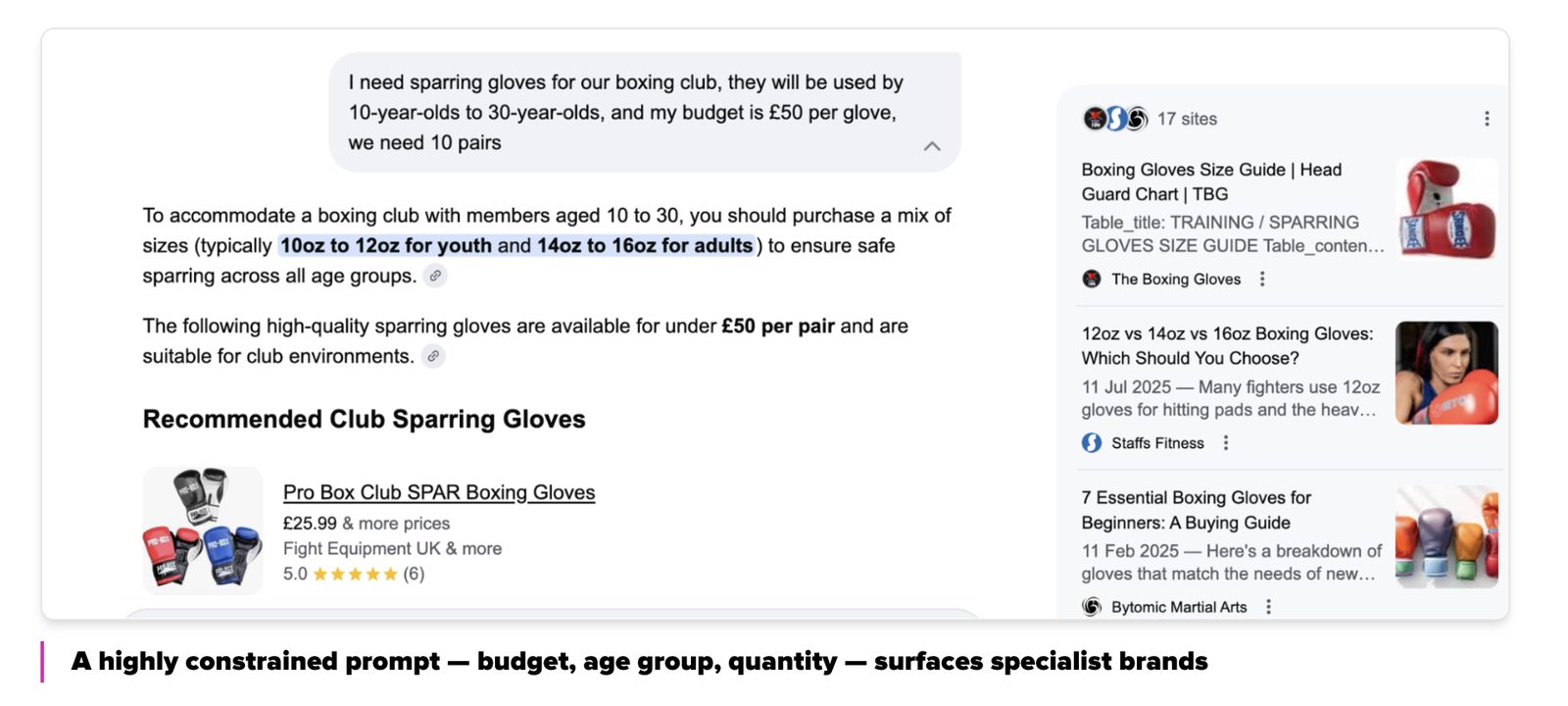
Specific product copy started to matter. Service pages started to matter. Review signals mattered. PR presence mattered. Third-party mentions mattered. Social proof mattered. The way a brand explained its difference mattered. In some cases, lesser-known businesses surfaced because they were a better fit for the actual problem being described.
This is a crucial distinction.
You might be recommended by an AI system without ranking first in Google for the old keyword. Equally, you might rank well and still not be selected as the best recommendation for a constrained prompt. Why? Because ranking and recommendation are not the same outcome. One is visibility against a query. The other is selection against a problem.
That is why businesses are finding this so confusing. They are looking at rank trackers while the market is moving into recommendation systems.
And equally, what we discovered was that it was highly competitive. Many products and brands simply do not have enough information about them, which makes sense. Smaller brands, products and services do not have big marketing budgets or broad reach, therefore recommendations can actually be shaped by a little bit of content in the right places.
This is one of the reasons why self-referencing listicles worked. SEO agencies have jumped on this primarily because they saw it working. The reason why self-referencing listicles work is that there is very little difference between many things online.
Go look at 10 SEO agencies, and they will largely describe themselves and what they do in very similar ways. This is also replicated in many other sectors because of the same processes of optimisation the search industry has used for the last 20 years.
We saw what was ranking, we saw what was on the pages, and we replicated that, making it bigger, often adding topical information rather than the information that large language models need to select and recommend a product or brand.
This was replicated in informational content strategies. The term topical authority describes the very difference I’m talking about.
SEOs have sought to create websites based on the authority of a topic, which doesn’t help a large language model to recommend a brand. And as we’ll see later in the article, content now has to be about training and teaching the internet and large language models why you are better than others.
That’s not talking about a topic, that’s talking about you, the problem you solve, why you solve it better than others, and how you solve it. That’s very different from informational blog content.
This is also why it’s so important to start GEO now. You’re about to enter a battleground where a little bit of optimisation can massively increase the volume of recommendations.
It’s because other people just aren’t doing what needs to be done, and why this is a huge opportunity for brands, especially small and medium enterprises, to jump on now.
The formula that works
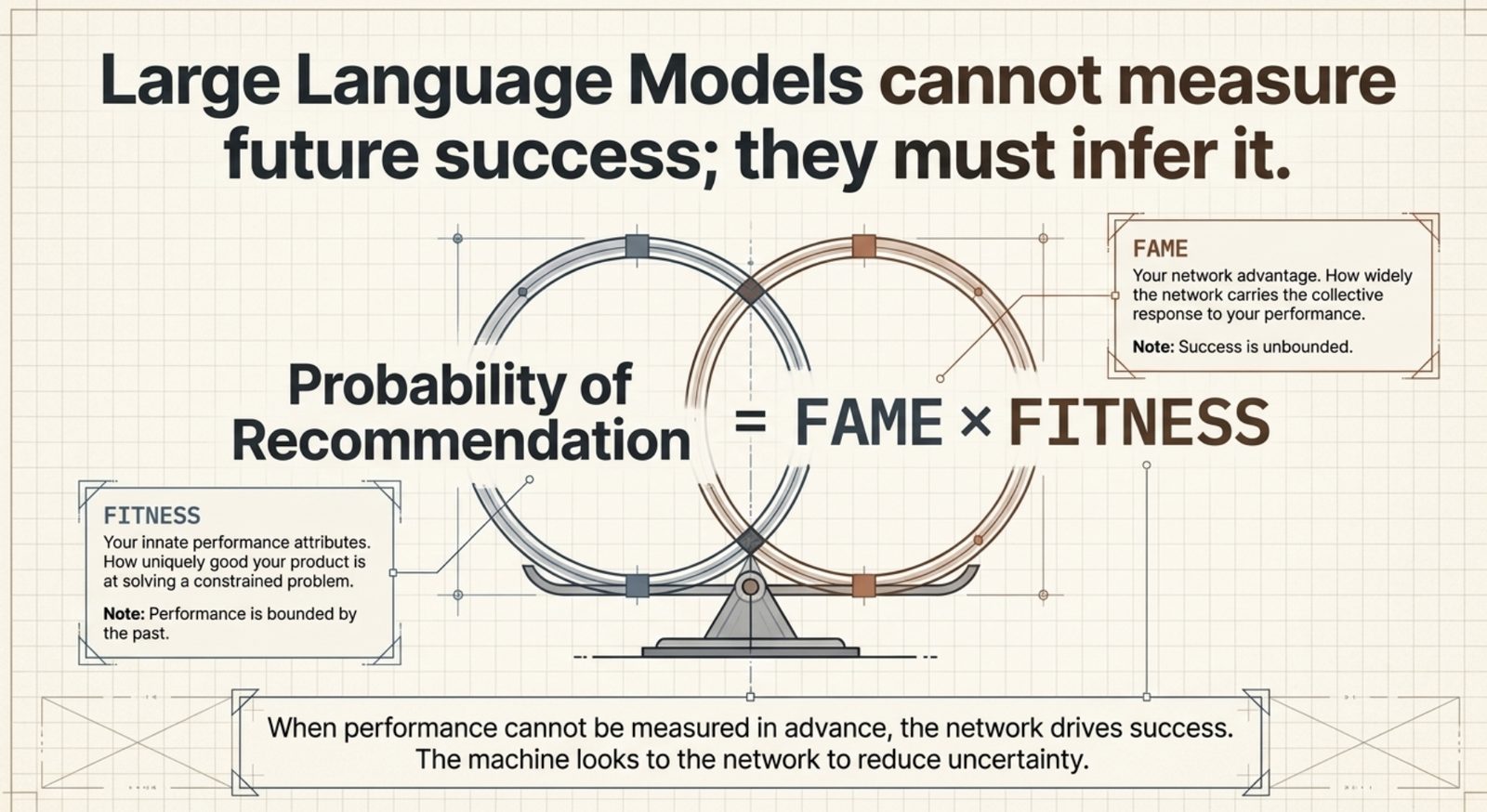
Through our constant studying and testing, we stumbled upon a model which explains exactly what’s happening with large language models and GEO.
If you want to increase the likelihood that you are recommended in a buying situation by an AI system, you need to become two things: you need to increase the levels of FAME for the problem you solve, and you need to increase your fitness.
That is, you need to ensure that your pages encode your brand’s or product’s performance attributes in a way that helps it to be chosen and recommended by large language models. You also need proof that your product or service is successful. And you need this information to be widely known and distributed online
We created a simple solution for this: FAME × FITNESS will increase the number of recommendations you receive from large language models, or at least increase the probability of receiving them.
The thing is, you can only become famous by increasing your brand’s visibility.
But visibility alone isn’t enough for large language models in the traditional sense. Advertising and broad-reach advertising builds mental availability in consumer minds. The goal of generative engine optimisation is, therefore, to increase your brand’s meaningful visibility in relation to the problems that your products or services solve. It’s becoming more visible in the network in relation to your brand’s positioning
The reason this works is that when we ask large language models to recommend something for us, we’re asking them to judge something they’re not capable of doing. You’re asking it to judge how a product or service will perform in the future for a user.
As a result, a large language model can only access its internal training data and the internet, and look at the available evidence to support a recommendation. And that’s what they’re doing with RAG and also looking at their own parametric training data.
We know large language models use reciprocal rank fusion and other methods to approximate the best solution. The only way you can be the best solution is by clearly defining why you’re the best, promoting that, and increasing brand co-occurrence around it on the internet.
The JBH F.A.M.E system
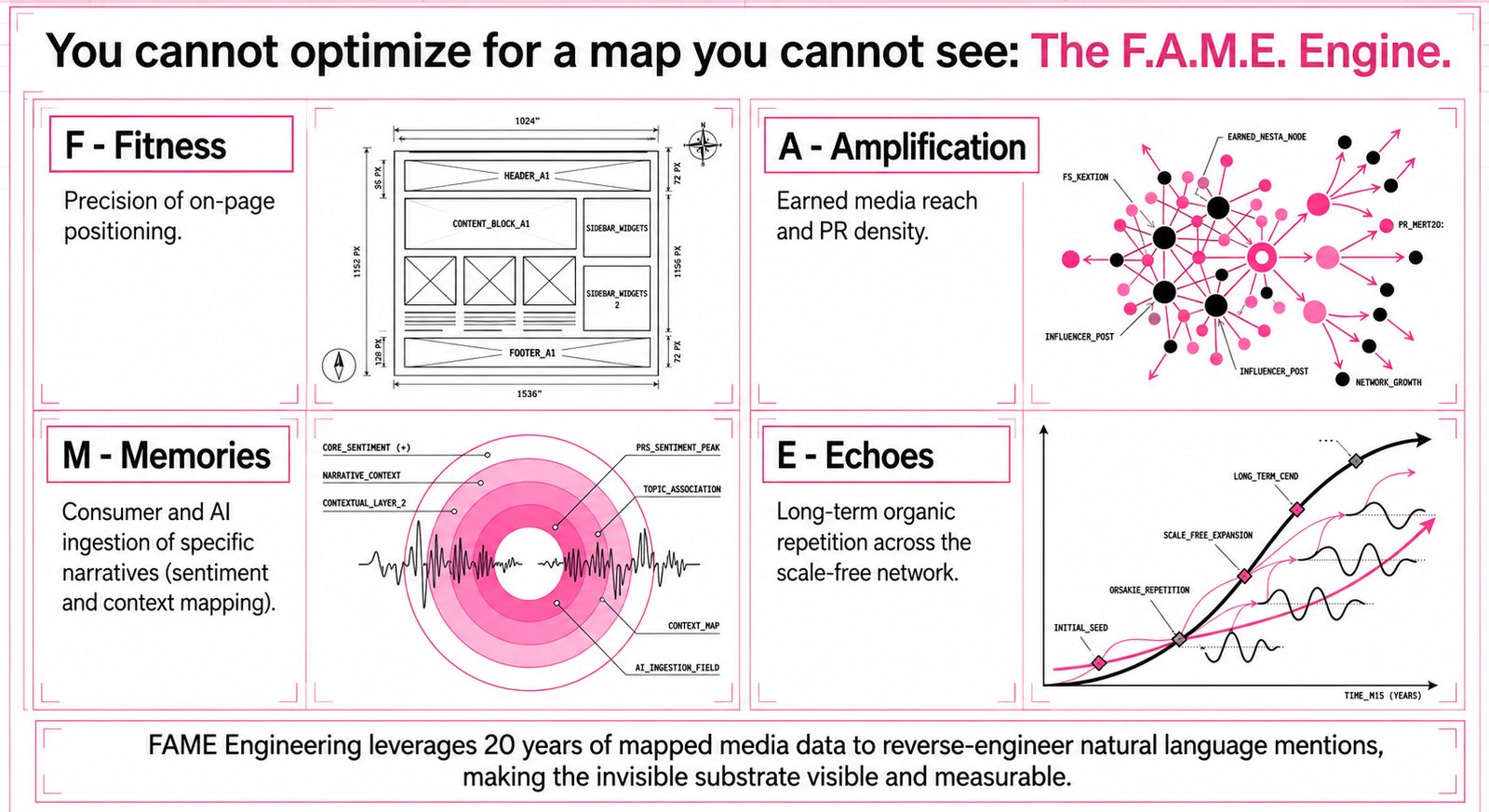
To make sense of this, we built the JBH F.A.M.E system.
F.A.M.E is our way of representing what is happening across the network. It starts with a simple idea: if generative engines are going to recommend your brand, the network has to contain enough of the right signals to make that recommendation more likely.
There are four parts.
Fitness is your owned problem-solution fit. It is your strategic position made visible. Who do you serve? What problem do you solve? How do you solve it better? What do you not do? What proof do you have?
Amplification is how you push that positioning beyond your own website. PR, visibility, reviews, influencers, partner content, interviews, events, media coverage and wider distribution.
Memories and Moments: are the narratives, sentiments, and associations that build up around your brand in the minds of humans and machines through relevant brand encounters.
Echoes are the repeated signals over time. Because doing this once is not enough. One campaign is not enough. One blog post is not enough. One AI visibility audit is not enough.
Think of the internet like a sponge. Your brand signals are water. If you stop pouring, someone else’s signals soak into the space instead. And if their signals are more recent, more relevant or closer to the problem, do not be surprised when they start getting recommended more often than you.
OPTIGEN: where the work starts

The first practical part of our process is OPTIGEN.
When I first built OPTIGEN, it came from a simple need. Clients were asking us to analyse pages for SEO, and more of them were asking about GEO. The problem was that most tools were still looking at pages through a traditional search lens. Useful, but incomplete.
OPTIGEN started as a simple tool. It has evolved into something much more useful.
It analyses a page for both SEO and GEO because we are in a bridge period. Traditional SEO still matters. Rankings still matter. Buyer-intent traffic still matters. Throwing SEO away would be stupid. But GEO adds a different layer.
OPTIGEN looks at the page’s performance attributes: the problem it solves, who it solves it for, how clearly the solution is explained, why the brand is a better fit, what trade-offs are made, what the page does not claim to do and what proof exists.
In other words, it looks for fitness signals. Fitness signals is a term from the theory of scale-free networks that describes the innate qualities and performance characteristics that allow one thing to outcompete the competition for resources.
In marketing, we call these performance attributes, and collectively they are known as positioning or USP.
Before you amplify anything, you have to encode those signals properly on your own assets. Otherwise, you are just amplifying mush.
The tool also checks traditional SEO elements such as page titles, headings and keyword alignment, because those things still matter. But the GEO layer asks a different question: does this page make the brand more likely to be selected as a recommended solution?
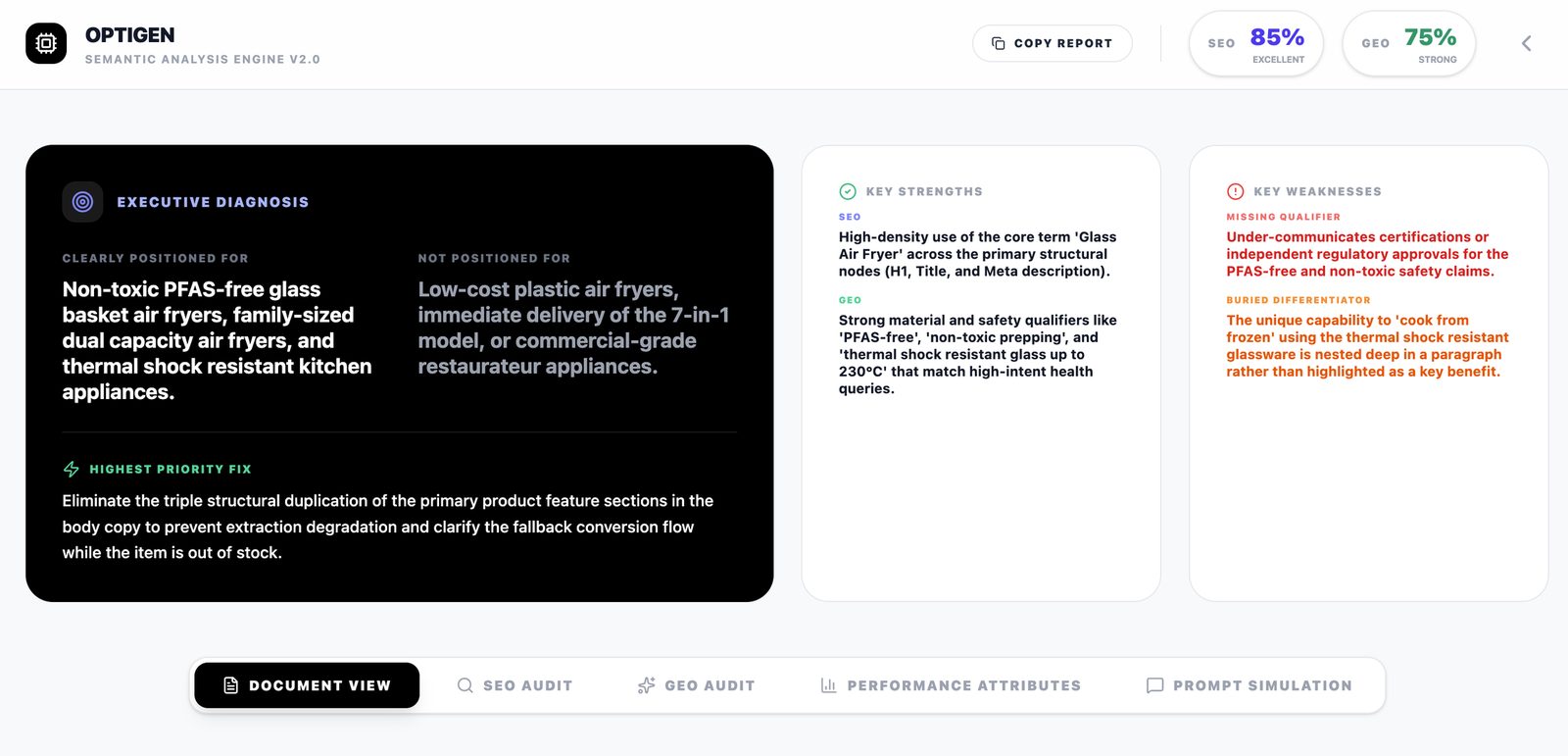
That is not the same as asking whether the page is long enough, whether it has the right H2s or whether it has copied the same FAQ structure as the current ranking pages.
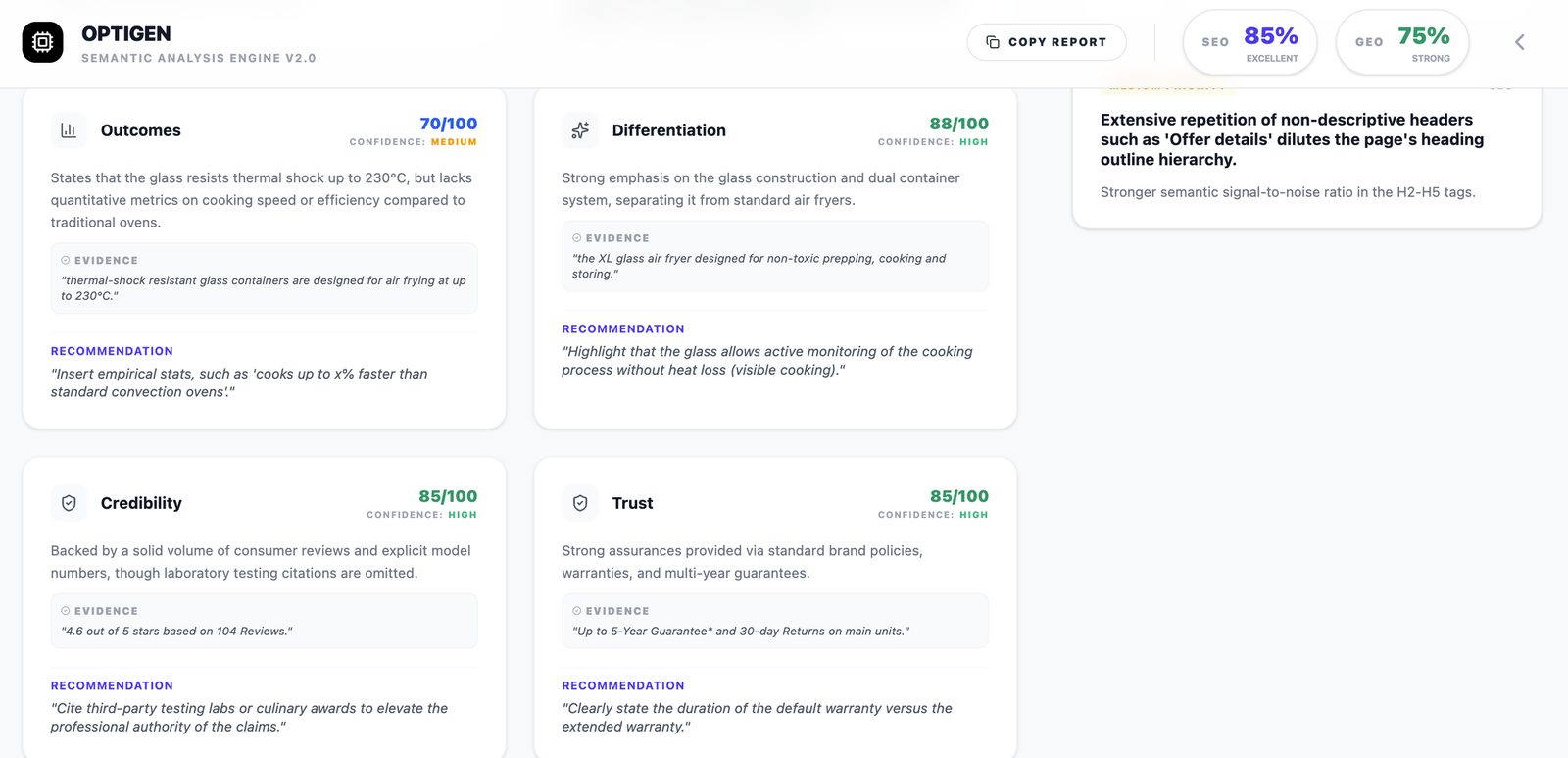
OPTIGEN also generates representative buyer-intent prompts. These are not “real prompts”, because nobody has perfect prompt data. They are pseudo prompts based on the problem, user, geography and intent of the page. Broad prompts. Mildly constrained prompts. Highly constrained prompts.
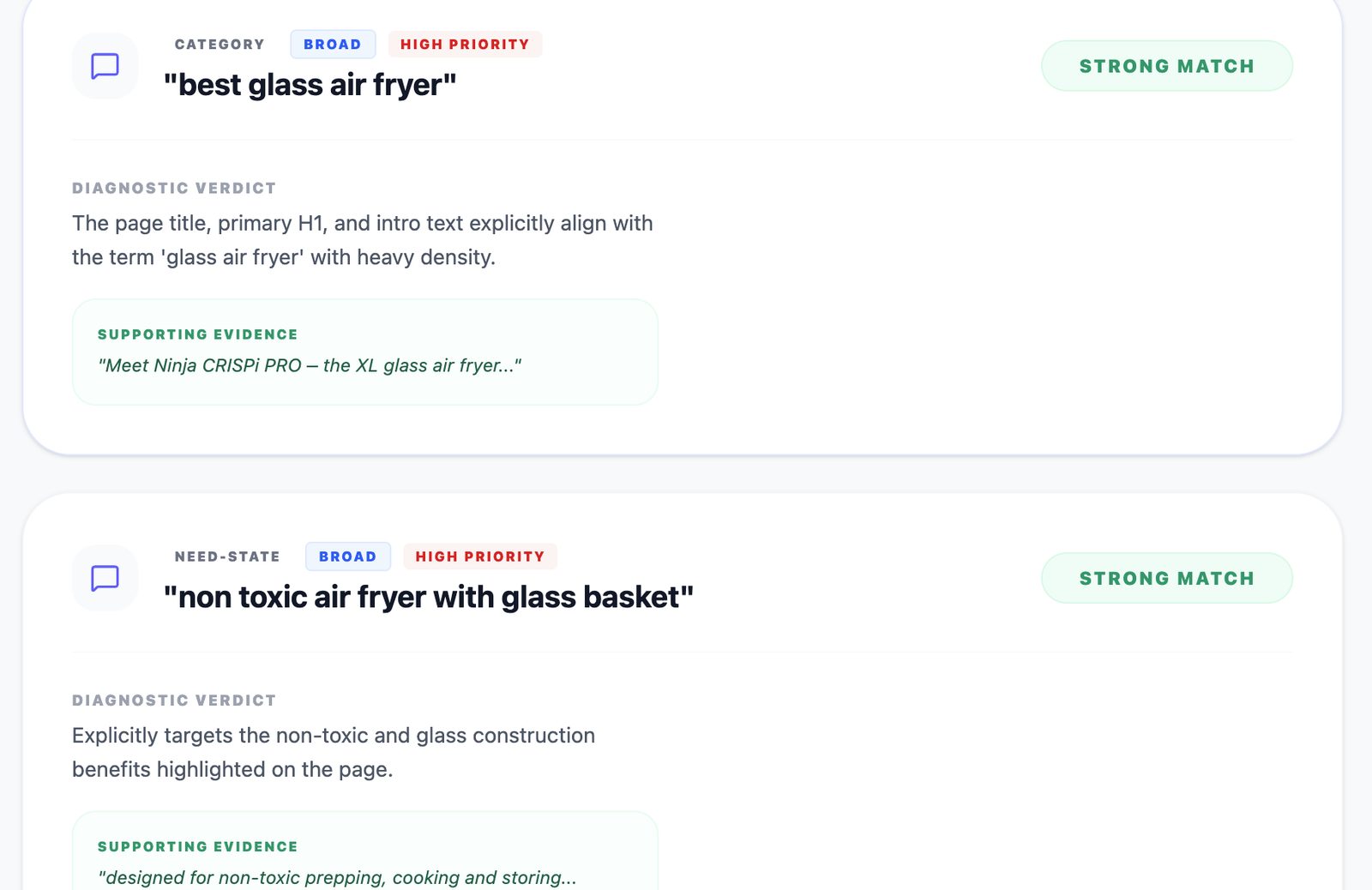
That gives us something to test against. It gets us out of the world of vague theory and into practical optimisation.
In a typical audit, OptiGen identifies about 80 to 150 things you can optimise on a page to improve rankings and increase the likelihood that a large language model will recommend your brand or product/service to a user.
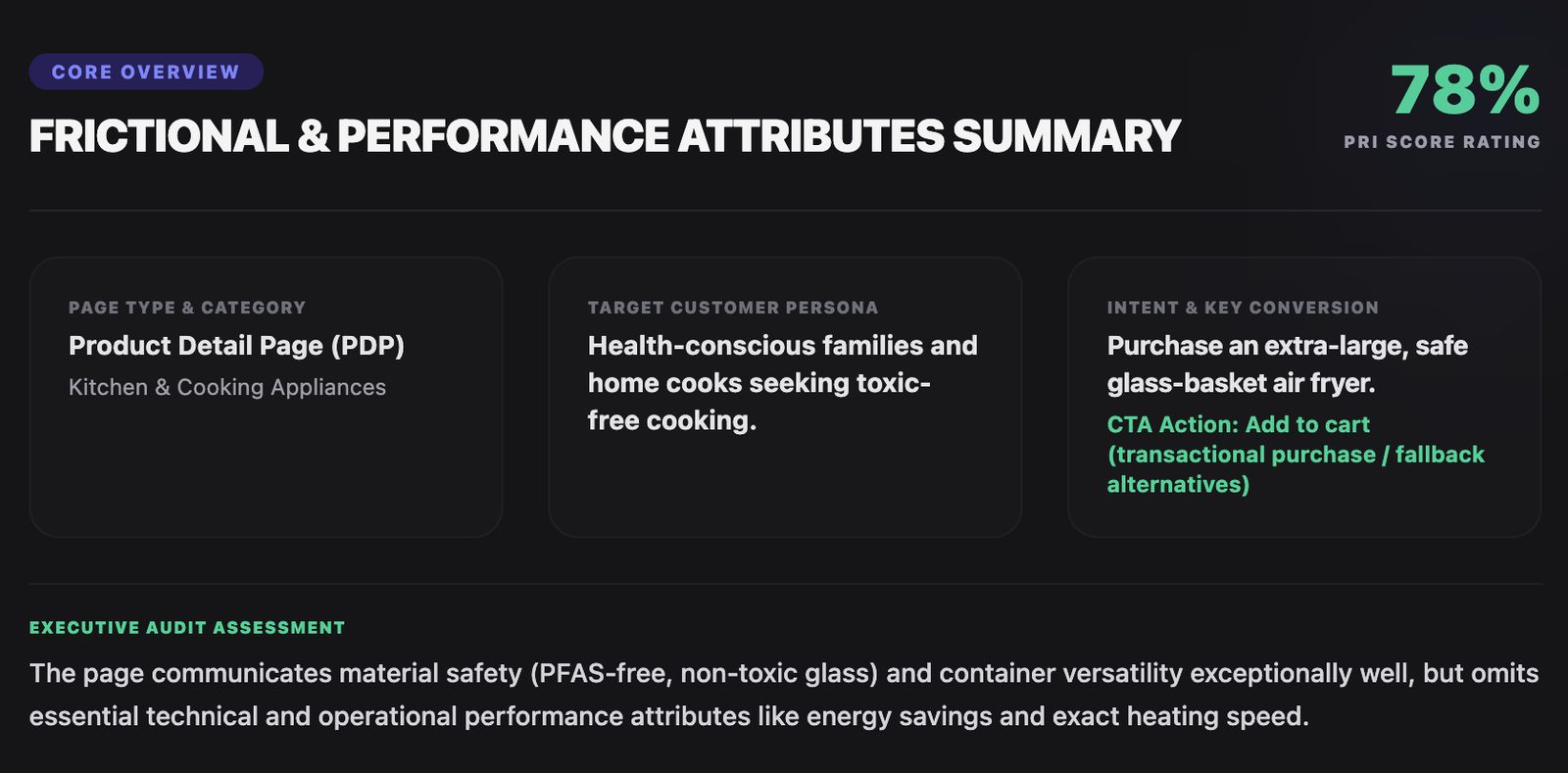
Essentially, it helps human writers better ‘encode’ a page for LLMs to understand. It tells you what to add, and why you should add it. The skill, then, is understanding how it should be written and if it should be added at all. That’s where human judgment comes into play
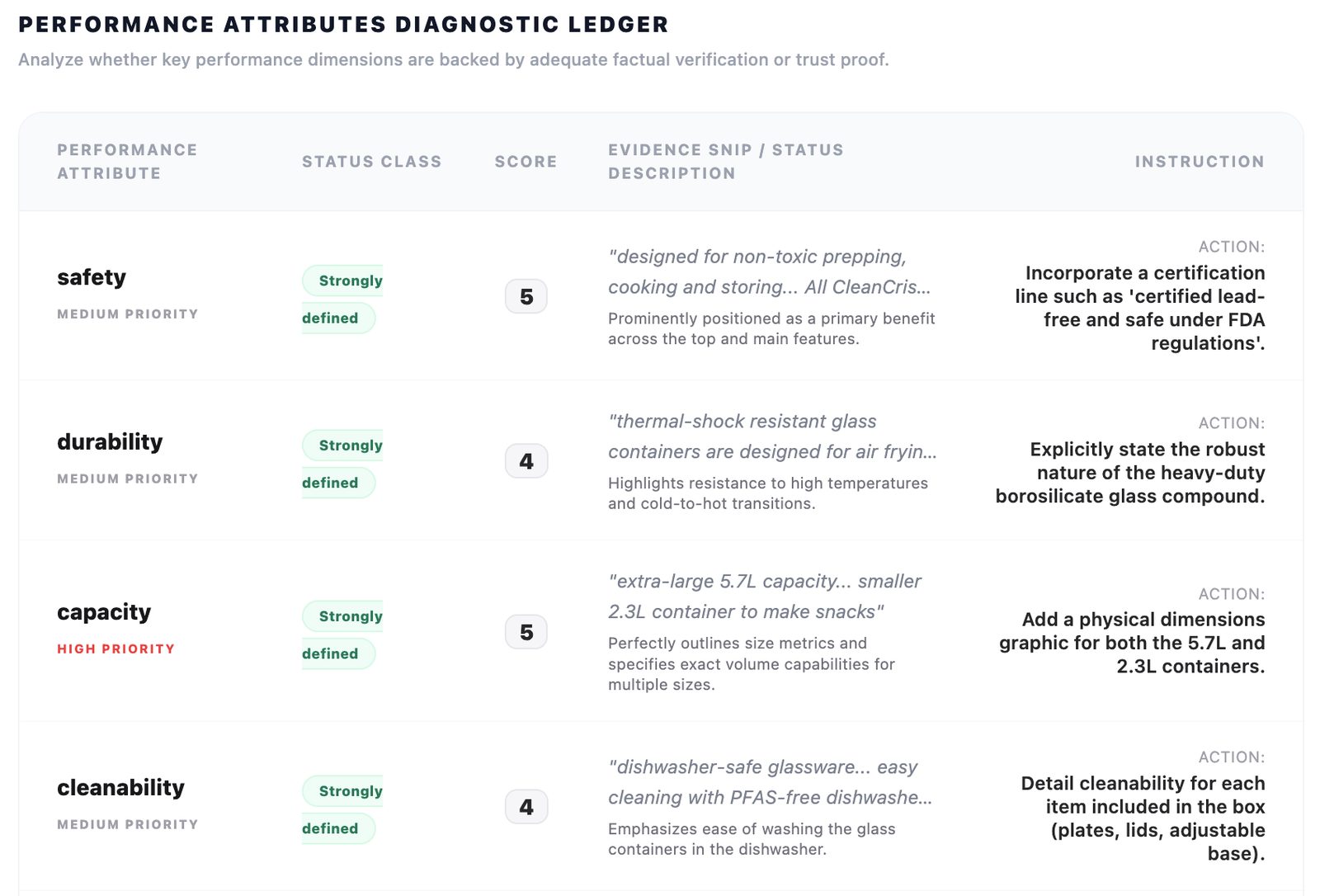
Now, I’ll also be honest, it’s taken a long time to get it to this point. As AI app-building technology has improved, so has the tool.
However, we’ve been using it for clients for a while now, and they really like the outputs and ideas it provides. It’s logical, it makes sense, and it’s evidence and data driven.
Now onto the next step.
The F.A.M.E Engine: mapping the wider network
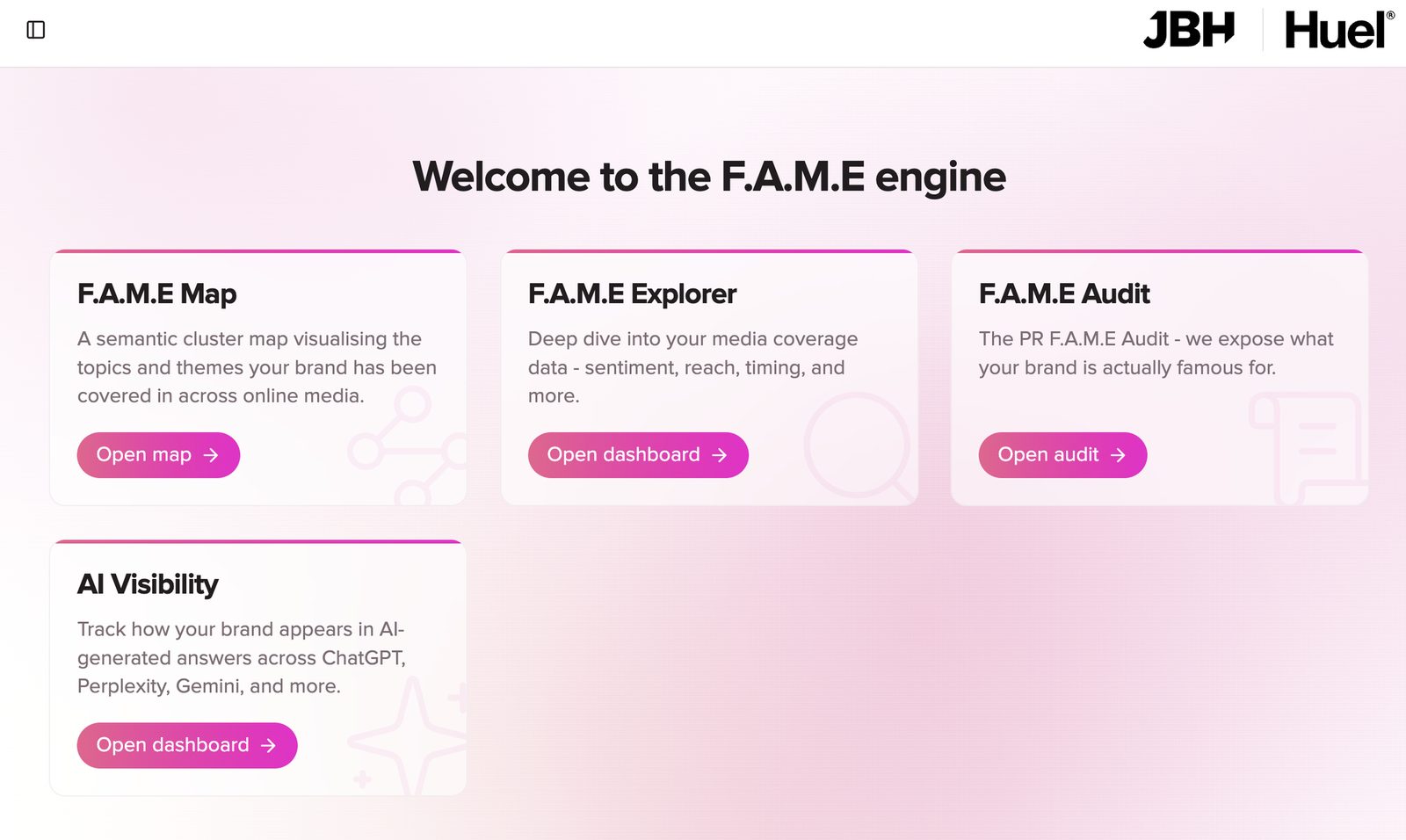
OPTIGEN helps us improve the owned asset. The FAME Engine maps the wider network.
The original question behind the FAME Engine was simple: can we map a brand’s co-occurrences over time?
In other words, what does the media repeatedly place next to a brand, person, topic or category? What associations are being built? What narratives are forming? What keeps appearing beside the name?
And we now can.
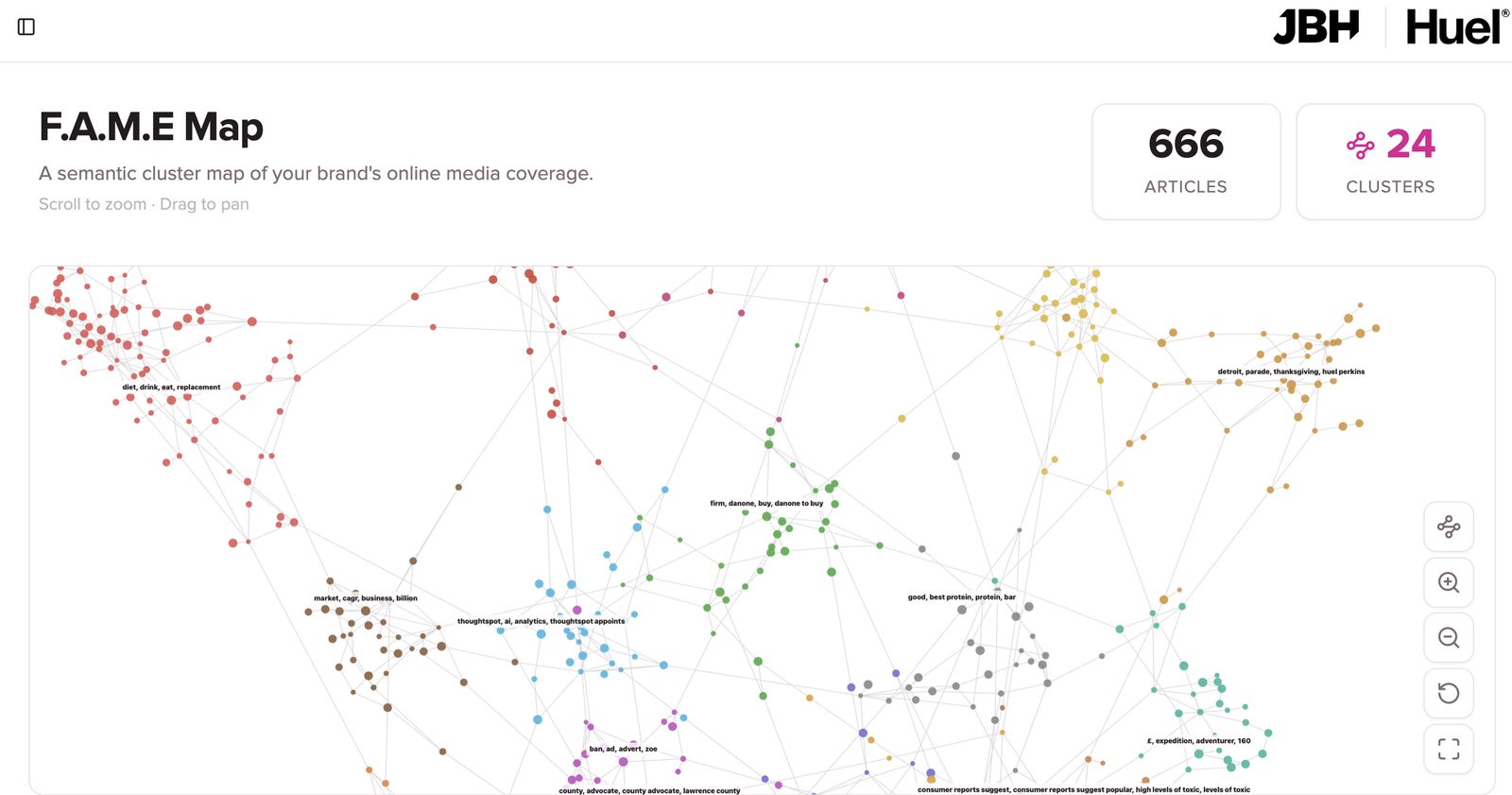
We can analyse large-scale media databases going back up to 20 years, or as recently as yesterday. Tier one, tier two and tier three media. Brands, topics, individuals and personal brands.
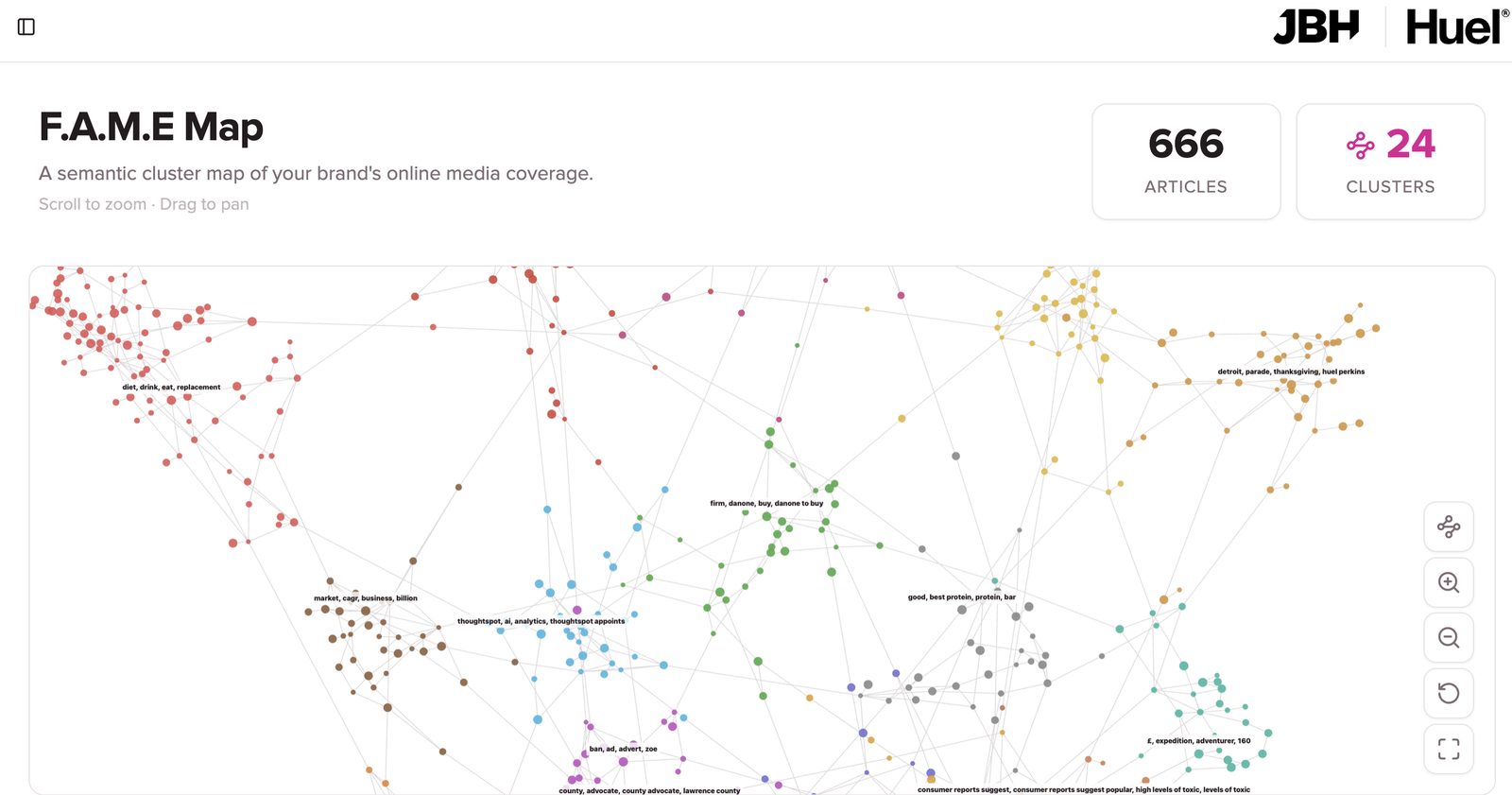
The patterns are fascinating.
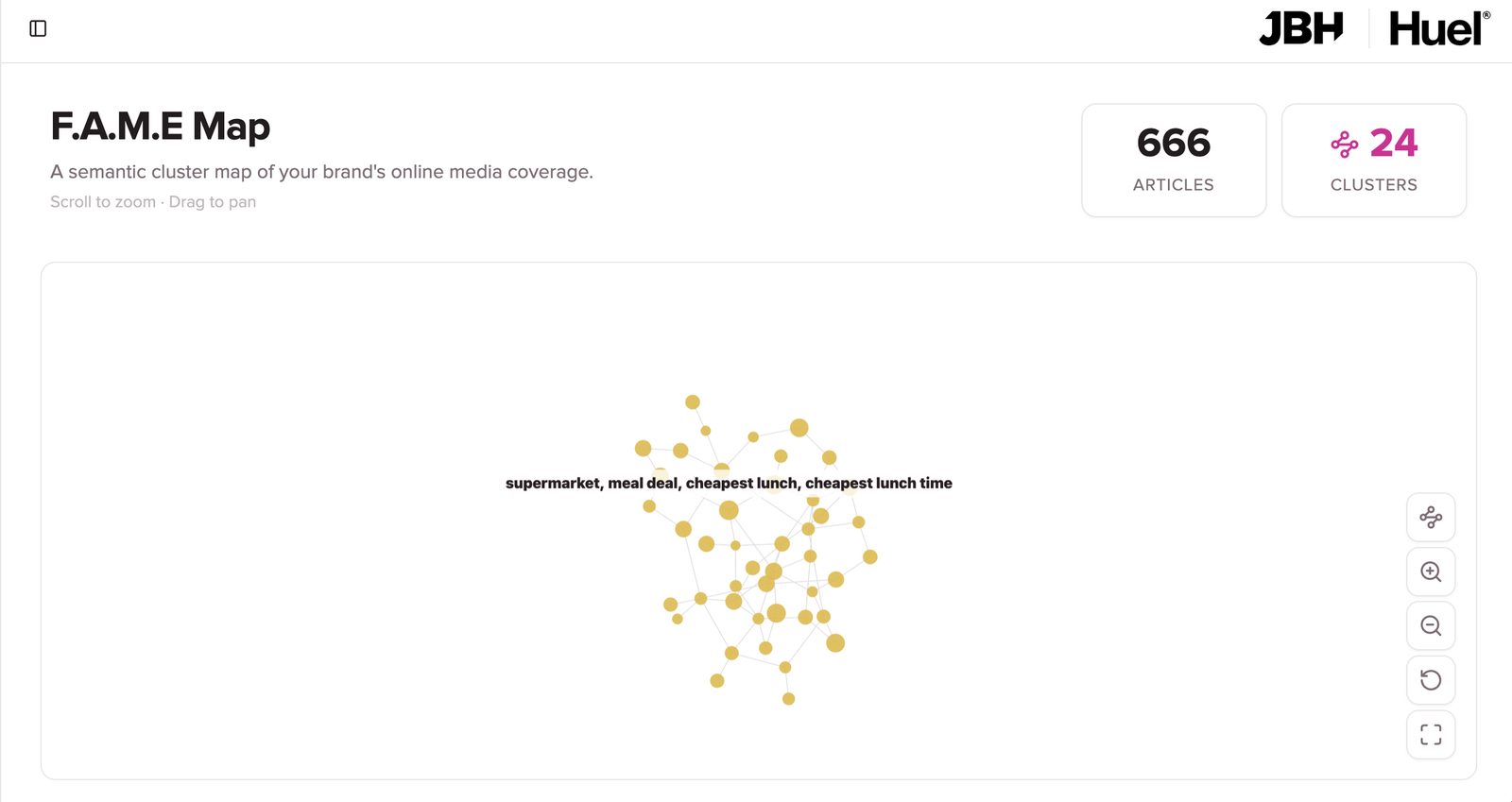
We analysed Huel for a recent newsletter and could see how strongly it was linked to Stephen Bartlett. We could also see how it was increasingly being linked with meal deals because of newspaper coverage. That might be fine if Huel wants to own convenience and value. It is less useful if the desired association is nutrition, performance and health.
We also looked at Tyson Fury, Tommy Fury and Molly-Mae. Fury’s fame is not just about boxing. It is reinforced through his brother, his father, Molly-Mae, Love Island, Netflix, Amazon Prime and his apparently endless retirements. Whenever one part of that fame system activates, it creates doorways into the others. Fame compounds because visibility creates more visibility.
Along with the map, we can analyse fame in incredible detail using our fame explorer. It’s a tool that allows us to analyse media in ways that have previously been impossible to do.
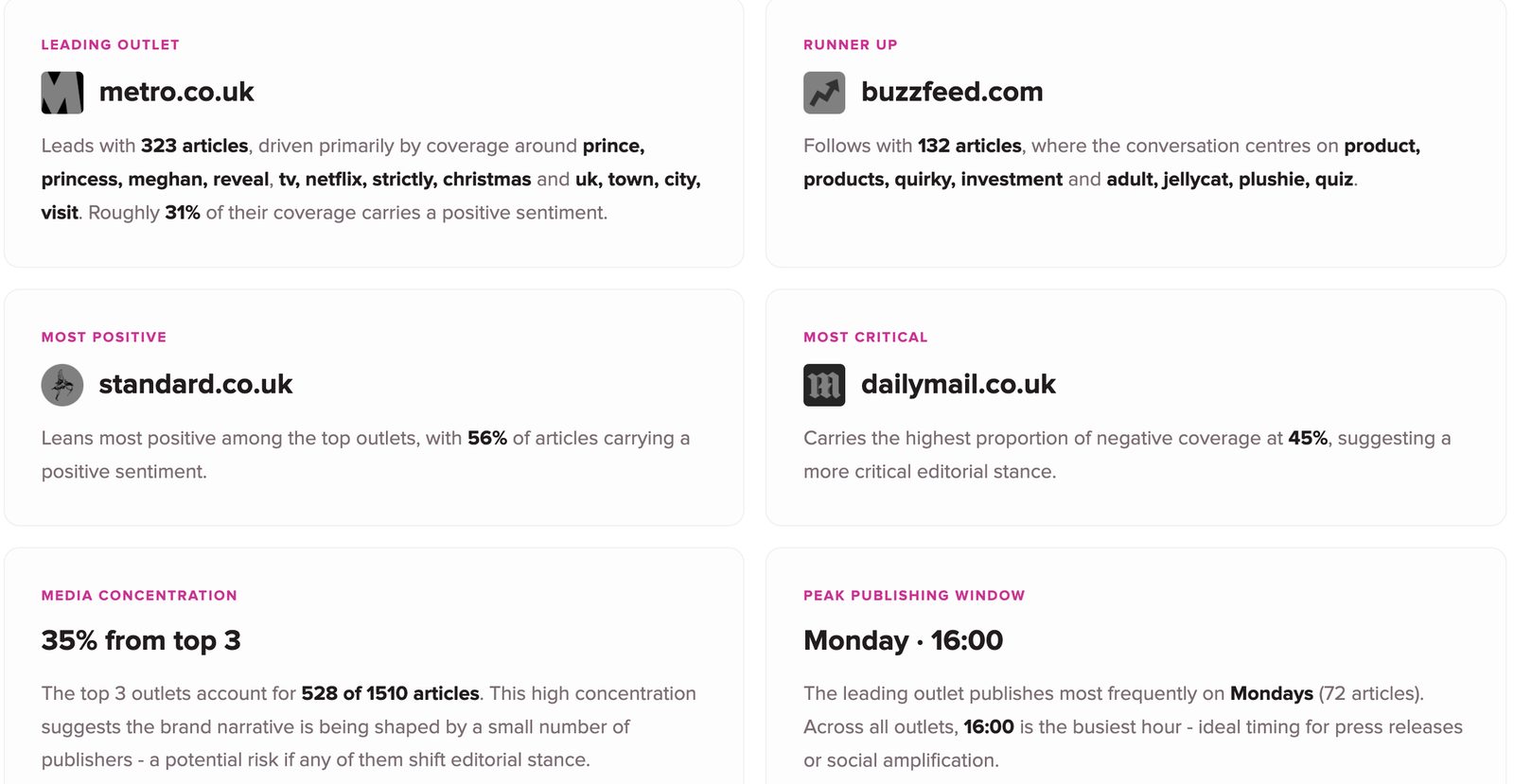
That matters for GEO because generative engines are not looking at your website in isolation. They are approximating from what is available in the network. Training data matters. Retrieval matters. Mentions matter. Reviews matter. Co-occurrences matter. Context matters.
You need to understand the narrative that’s being built over time online by third parties. The F.A.M.E Map does that.
But that’s not all the FAME engine does.
The FAME Engine takes those representative prompts created by OPTIGEN, analyses AI visibility, looks at which brands are present, studies answer patterns, and then tells us what owned content and earned media are needed to increase the likelihood of recommendations.
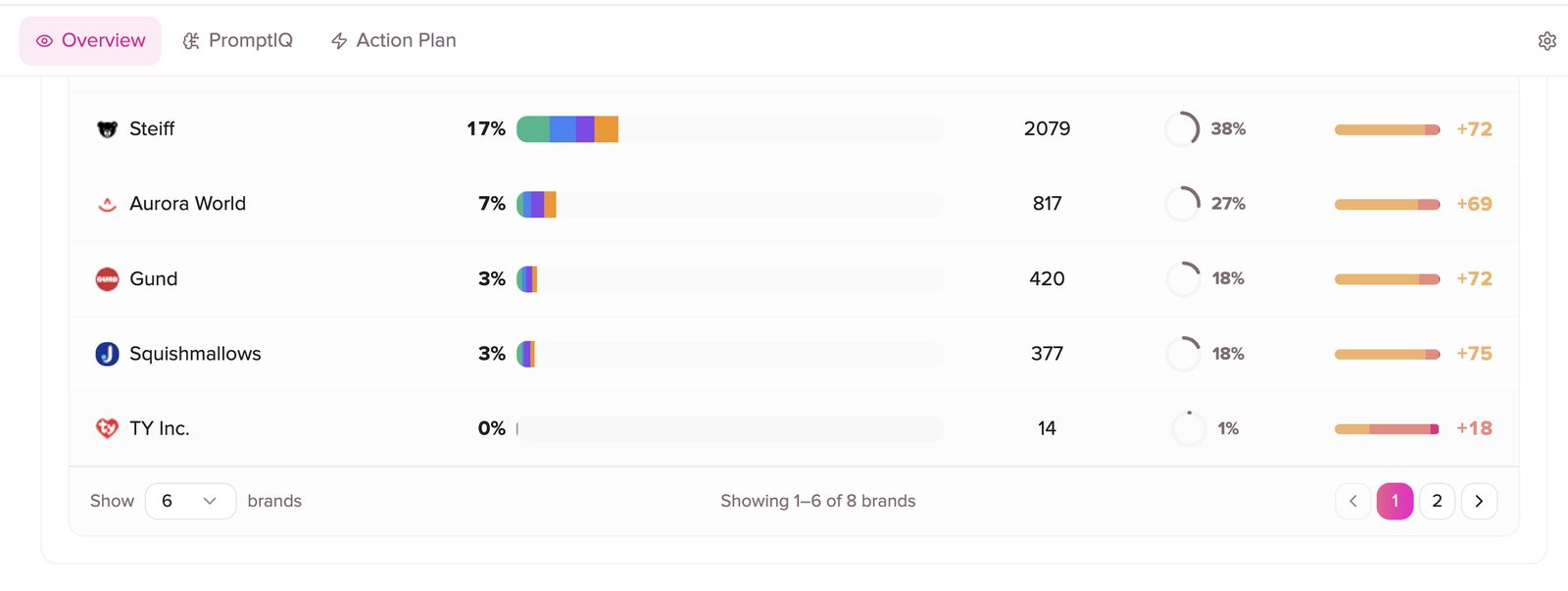
We are not chasing citations. We are chasing the type of evidence that makes brand recommendation more probable.
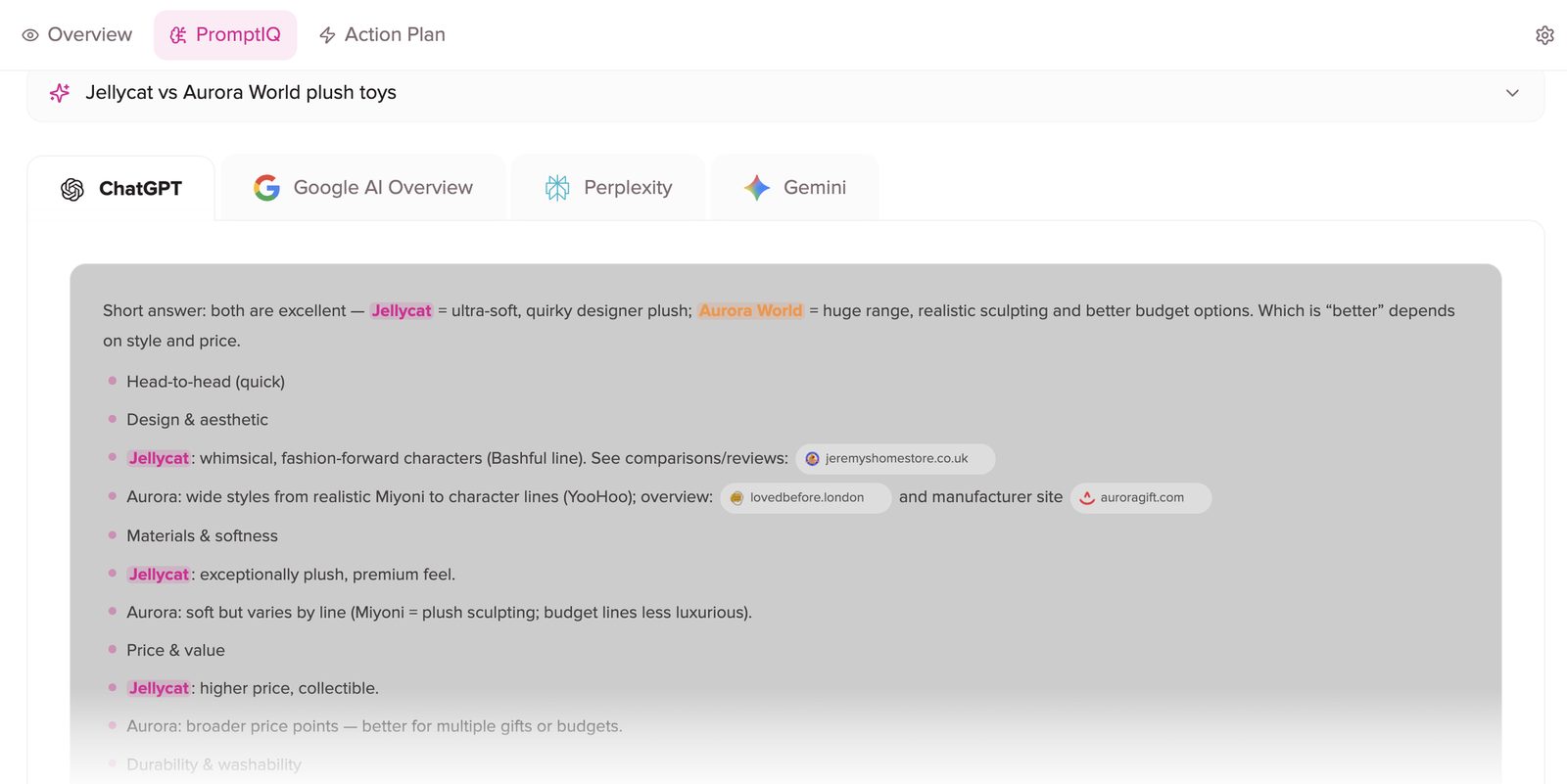
This analysis allows us to build a real-world, actionable plan to generate success in large language models.
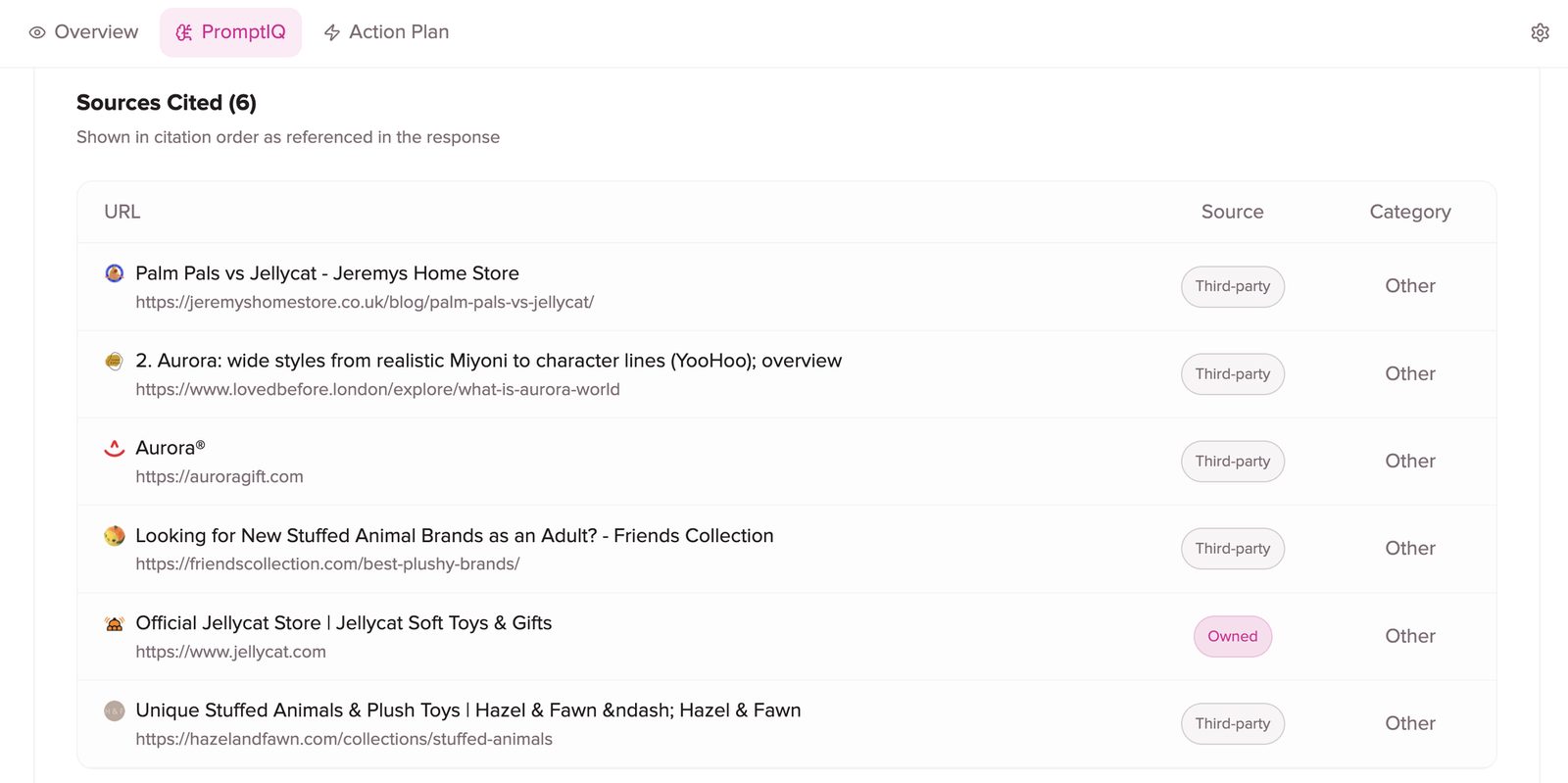
The Fame Engine will tell us exactly what content we need to create from a PR perspective, and it will also explain what owned content should be created for clients to reinforce their brand’s fitness signals.
This is reinforcing exactly what matters for a large language model to recommend a brand or product in a buying situation.
What we have learned from client work: the lessons
The client work has been the most useful part. Theory is lovely, but theory does not have a revenue target, a worried CMO, or a board asking why leads are down. Real brands do.
So here is what we have actually seen. It’s a few lessons from the trenches.
The first lesson is that GEO performance is not binary.
A brand is not simply “visible” or “invisible”. It can be strong for highly specific prompts and weak for broad ones. It can rank well in Google and still not be selected by an AI system. It can be recommended by an AI system and not rank first, second or third for the old keyword. That is because ranking and recommendation are different jobs.
Search ranking is often about whether a page is the best match for a query inside an index. AI recommendation is about whether a brand, product or service looks like the best fit for a problem, based on the available evidence. Sometimes those two things overlap. Often they do not.
One US kitchen brand showed this clearly.
They had lost a lot of top-of-funnel traffic. Previously, content around “kitchen ideas” brought thousands of visitors. That mattered because their kitchens were being seen. People arrived for inspiration and, without necessarily realising it, the brand entered their consideration set. The page was not just informational content. It was a showroom with a search box attached.
When that traffic disappeared, leads fell. The old discovery pathway had been damaged.
But when we analysed AI recommendations manually, something interesting happened. The brand showed up for highly constrained prompts far more often than broad ones.
If a user knew what to ask for and described the kind of kitchen they wanted in detail, the brand could appear in the recommendation set. If the prompt included constraints around style, material, budget, geography, installation type, quality, or the kind of home the buyer had, the system had enough shape to work with. The brand’s fitness signals started to matter.
For broader prompts, though, the models defaulted to famous, widely distributed brands with bigger footprints. The sort of brands listed everywhere, mentioned everywhere, reviewed everywhere and already embedded in the category conversation.
The lesson was clear: they had fitness, but not enough fame.
That is an awkward but important diagnosis. Their problem was not simply “the page needs more SEO”. In some cases, the page and the brand were good enough to be recommended when the user described the problem properly. The issue was that, when the prompt was vague, the system had no reason to pull them forward ahead of the brands with bigger footprints.
So the strategy changes.
Yes, improve the website. Yes, strengthen the commercial pages. Yes, make the product and service copy clearer. But that alone will not solve the broader problem. They need market and AI education. They need PR. They need broader category visibility. They need to create and distribute content that teaches buyers and LLMs what to value before the buyer ever writes the prompt.
That is a very different job from “rank for kitchen ideas”.
This is an important concept to understand because large language models use RAG. They often are looking at what information people have created to help them select the best brands or products. And in some of the testing, it was discovered that there appeared to be almost a two-stage element to RAG. One which absorbed content, and that content then helped the models better select a product or brand. It goes to show that you need to sell yourself and your approach, and explain why you’re better in your own content.
A second client, a supplement brand, had a more subtle problem. They were not showing for certain product prompts because their dosage differed from the category consensus. Competitors clustered around a more common dosage, and the AI systems appeared to treat that consensus as part of the expected answer.
This is one of the more interesting things we have seen. The model was not necessarily saying the client was bad. It was simply looking at the available market pattern and deciding that the more common dosage looked like the safer recommendation. The brand’s difference had not been explained clearly enough in the network.
The wrong conclusion would be: copy the competitors.
The better conclusion is: explain the difference.
If your dosage is different for a good reason, your content has to say why. Why that amount? What trade-off are you making? Who is it better for? Who is it not for? What evidence supports it? What does the category usually get wrong? What should a buyer understand before comparing you against the alternatives?
If you do not explain that clearly and repeatedly, the model may treat your difference as a weakness rather than a deliberate strategic choice.
That is GEO in practice. It is not just “write a blog”. It is using content to defend and reinforce your position against category consensus. It is also a good reminder that distinctive positioning is not always automatically rewarded. Sometimes the market needs to be taught why your difference matters.
A third client had strong distribution. They had spent years building a fantastic distributor network. In old search terms, that sounds like a dream. Lots of pages. Lots of mentions. Lots of doors into the brand.
But the problem was that the network was not telling the story correctly.
Distributor pages described the products differently. Some used the wrong emphasis. Some failed to explain the key use cases. Some flattened the brand into generic category language. Some made the product sound like every other product in the category. The brand was visible, but not properly represented.
That is a horrible place to be, because on the surface everything looks healthy. You have distribution. You have mentions. You have pages in the network. But the actual meaning being created around the brand is weak, inconsistent or wrong.
So the job became narrative correction. Dense buyer guides. Better product pages. Product education. PR. Content that forced the correct story into the network often enough for both buyers and machines to encounter it.
The lesson: distribution is not enough if the network is telling the wrong story.
And there is a fourth lesson that keeps coming up: social and video signals are more useful than many SEO people want to admit.
In several categories, YouTube content, social content and influencer explanations appeared to support the way brands were understood and recommended. Not because posting three TikToks magically gives you GEO. Don’t be ridiculous. But because useful, specific, repeated content in places people and machines can encounter helps reinforce the brand’s association with a problem.
A good video explaining why your product is different can do more strategic work than another dead-eyed SEO article titled “What is [category]?”
The overall pattern from the trenches is this:
Broad prompts expose your fame problem.
Constrained prompts expose your fitness problem.
Distribution exposes your narrative problem.
Category consensus exposes your explanation problem.
Measurement exposes whether any of this is actually moving.
That is why GEO cannot be left to a single tactic. It is not just technical SEO. It is not just content. It is not just PR. It is not just brand. It is the coordination of all of those things around the specific job of becoming more likely to be recommended.
That sounds complicated because it is. Sorry. The simple answer is usually the one being sold by someone who has not done the work.
What content should brands create?
This is where many brands will make the next mistake. They will hear GEO and assume the answer is more blogs.
It is not.
The job is to reinforce your fitness signals. You need to create content that sells what you do and why you do it. Constantly.
Talk about the problem you solve. Talk about who you solve it for. Talk about how you solve it better than alternatives. Prove that you have solved it before. Explain what you do not do. Explain the trade-offs. Explain why your approach is different.
This is content marketing, but with a generative focus.
All content marketing acts as advertising. It creates fame, positive feeling, fluency and recognition. GEO adds another job: reinforcing the context that makes your brand more likely to be recommended.
A good rule of thumb is simple: if the content has no real-world marketing value, do not publish it.
Useful GEO content includes fitness content such as product pages, service pages, buyer guides, comparison pages and use-case pages.
It includes explanation content: why your method, dosage, material, process, pricing model or delivery approach is different.
It includes constraint-matching content around budget, location, audience, use case, risk, industry, size, speed or specification.
It includes narrative-shaping content: strong viewpoints, category education and critiques of alternatives.
And it includes evidence content: case studies, reviews, testimonials, data, proof and examples.
Google might want to call some of this “helpful content”. Fine. Seth Godin was talking about expected and unexpected content years ago. Expected content is the thing someone already knows how to search for. Unexpected content is what the market does not yet know to ask for, but it teaches buyers why your approach matters.
GEO needs both.
PR and earned media matter more than people think
Owned content is not enough.
You also need earned media: PR, reviews, brand mentions, influencer mentions, expert commentary, events, podcasts, newsletters, comparison articles and third-party guides. Paid or unpaid matters less than whether the signal is contextually useful and credible.
The key is not just being mentioned. It is being mentioned in the right context.
You have to become famous for the thing you want to be recommended for.
PR gets you awareness. PR gets you links. Good GEO PR gets you recommended.
The FAME Engine helps us see which signals, publications and contexts are actually shaping answers. That matters because PR budgets can be wasted very easily. A nice piece of coverage might build a link and please the board, but do nothing to improve recommendation likelihood.
For GEO, PR has to educate the market. It has to place the brand inside the right problem, with the right explanation, near the right alternatives, often enough for the network to notice.
How to measure GEO
Everyone likes a dashboard. The temptation is to measure citations and call the job done.
That is too narrow.
Yes, you should track prompt presence over time. Are you being recommended? Who else appears? Which competitors are refreshing associations faster than you? Are you gaining or losing visibility for the representative prompts that matter?
But you also need to measure buyer-intent page traffic. Informational traffic is being stripped away in many categories, so commercial page traffic becomes more important. If nobody reaches the pages that sell, you have a commercial problem.
You need to track LLM referral traffic from systems such as ChatGPT, Perplexity, Gemini and others where possible.
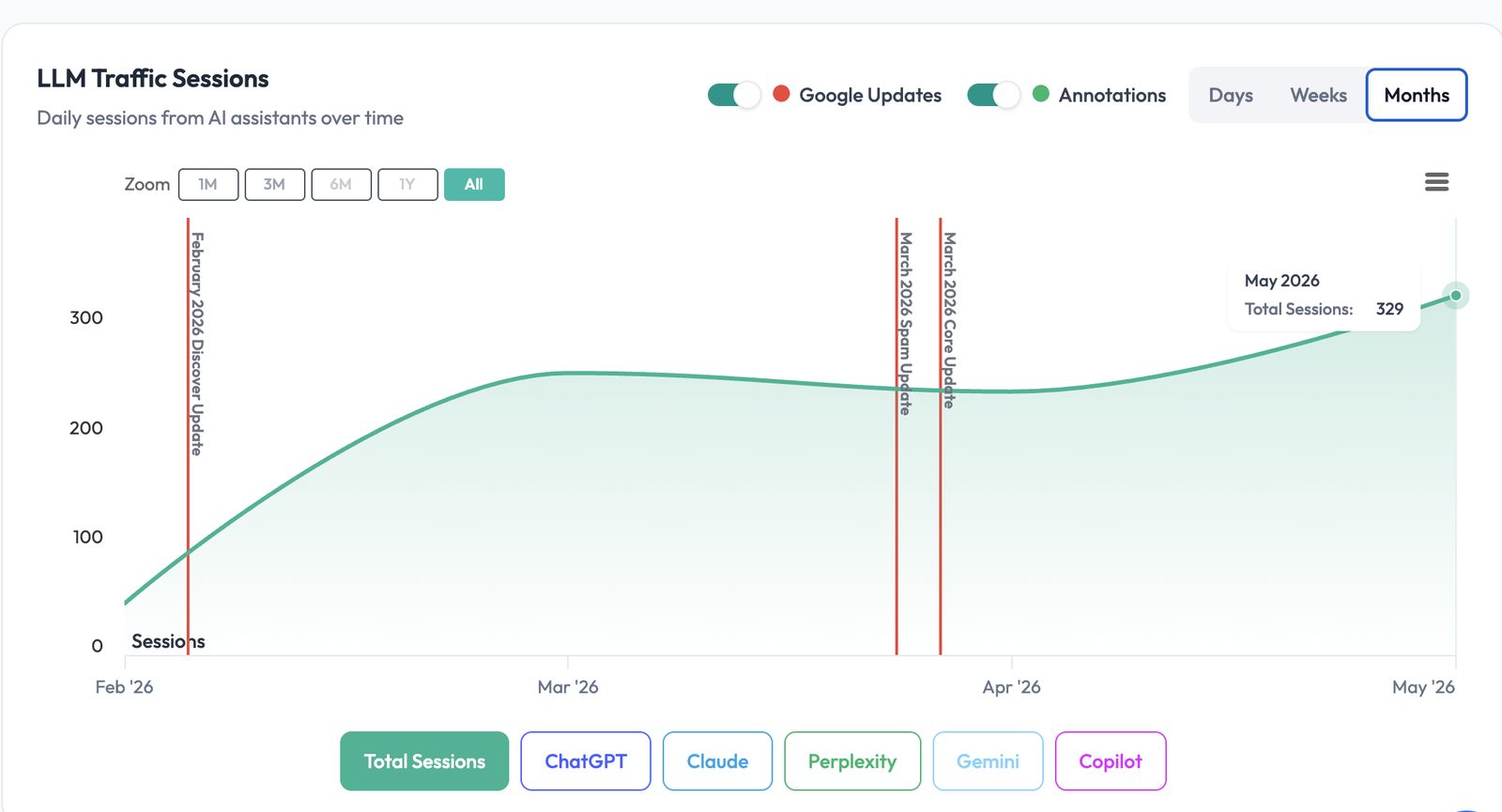
We’ve been using SEO testing with clients and in experiments for some time now, and it provides a really good look at how llm traffic sessions are evolving.
You need to track brand search and share of search. If your work is building fame, more people should search for you directly or in relation to the category.
You need to track links, shadowed links, brand mentions and contextual mentions. Natural links and mentions created by your marketing activity are a sign that visibility is compounding.
Again, our fame engine does this and allows us to map performance over time.
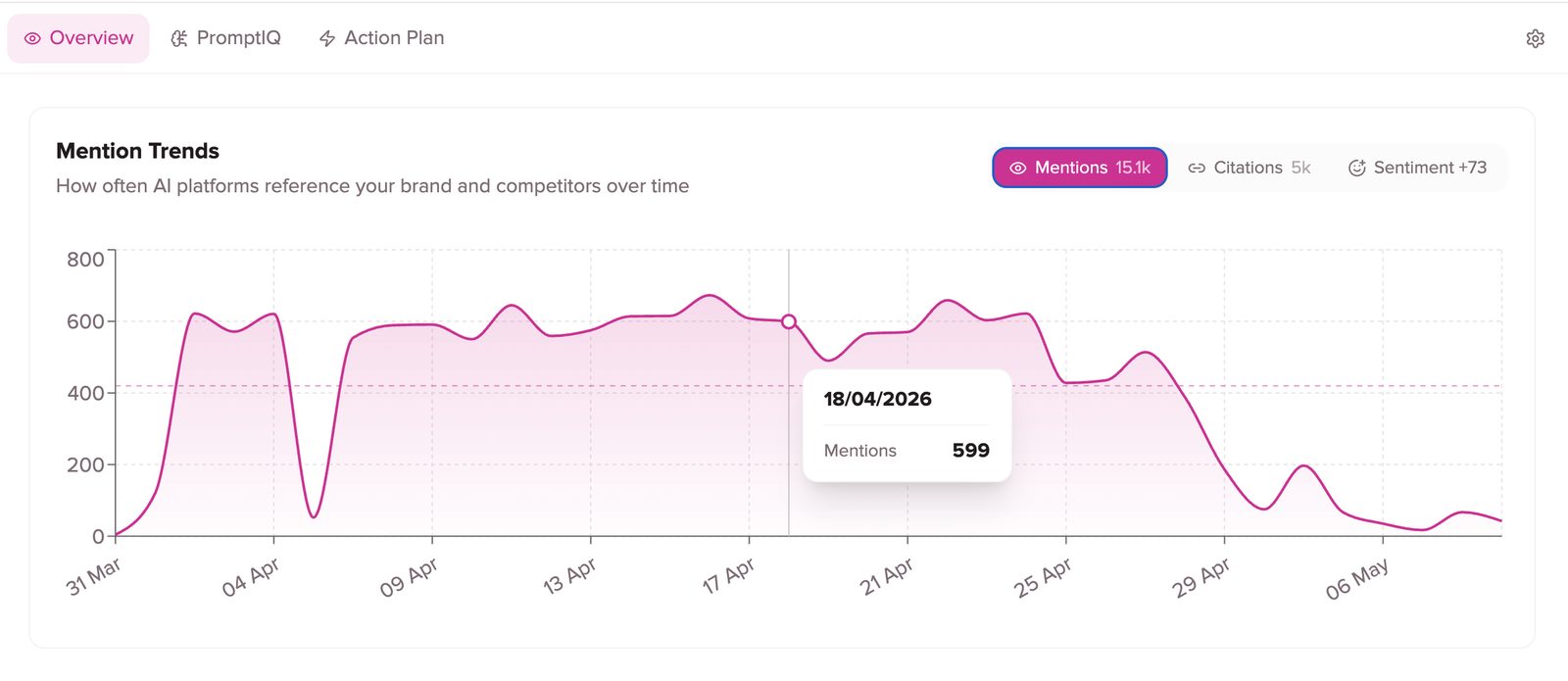
In network science, this is preferential attachment. The more visible become more visible. When the network starts mentioning you, linking to you and recommending you without being forced, you are becoming a preferred node.
A GEO dashboard should not just tell you whether AI cited you. It should tell you whether the market is beginning to prefer you.
GEO is not a campaign
One final point.
In SEO and PR, we have become used to campaigns. Link campaigns. Content campaigns. PR campaigns. A burst of activity. A report. A pause. Another burst.
GEO does not work like that.
It is always on.
Yes, you optimise pages. Then you create more pages. Then you refresh content. Then you build earned media. Then you measure prompts. Then competitors move. Then the market changes. Then models change. Then you go again.
You have to keep prodding the market. If you are not talking about yourself, do not be surprised when the machines learn from everyone else instead.
Someone needs to own this. Internally or externally. It cannot sit vaguely between SEO, content, PR and brand with nobody accountable.
And no, this is not “just SEO”.
SEO still matters. There is still an index. Rankings can still help recommendation. Buyer-intent search traffic is still valuable. But the goal is different.
CRO changes web pages too, but nobody sensible says CRO is just SEO. The difference is the desired outcome.
SEO optimises for rankings and search visibility. CRO optimises for conversion. GEO optimises for recommendation.
There is overlap. Of course there is. But pretending they are the same thing is lazy.
I am proud of what we have built at JBH with OPTIGEN and the FAME Engine. We can now show brands more about their generative presence, network associations, and recommendation opportunities than I think anyone else can.
So here is the offer.

If you are a brand, we will give you a free FAME Audit. Brands only. No agencies, please.
We will analyse your generative presence, show you how you appear, walk you through the FAME Engine and give you a practical view of what to optimise, what to create, what to earn and what to measure.
GEO is not coming. It is already here. The only question is whether the machines are learning your story from you, or from everyone else.
One final point: the naysayers will have read this and say it’s just on-page and off-page stuff we’ve been doing for years in SEO. That’s the wrong way to think about this because the goal of SEO was rankings.
The goal of GEO is recommendations, and we’ve seen in countless examples that the two things do not go hand in hand. If your SEO is the thing driving recommendations for you, fantastic, but that doesn’t mean that it’s going to stay that way, and it doesn’t mean that it is for other people.
GEO requires study, it requires owning, and it requires innovation. That’s why we’re well ahead of the game with our processes, and if you want to find out more, send me a message.
Andrew Holland
Originally published on LinkedIn on 28 May 2026.