
There are bad marketing metrics. There are useless marketing metrics. And then there are metrics so fundamentally stupid that you almost admire the confidence required to sell them.
AI visibility sits firmly in that final category.
It is not a misunderstood innovation. It’s not an early-stage proxy that will mature with time.
It is a desperate, commercially motivated invention designed to keep certain elements of the search industry alive while the ground beneath it collapses.
And the frightening thing is not that it exists. The frightening thing is how quickly it is being swallowed whole by marketers who should know better.
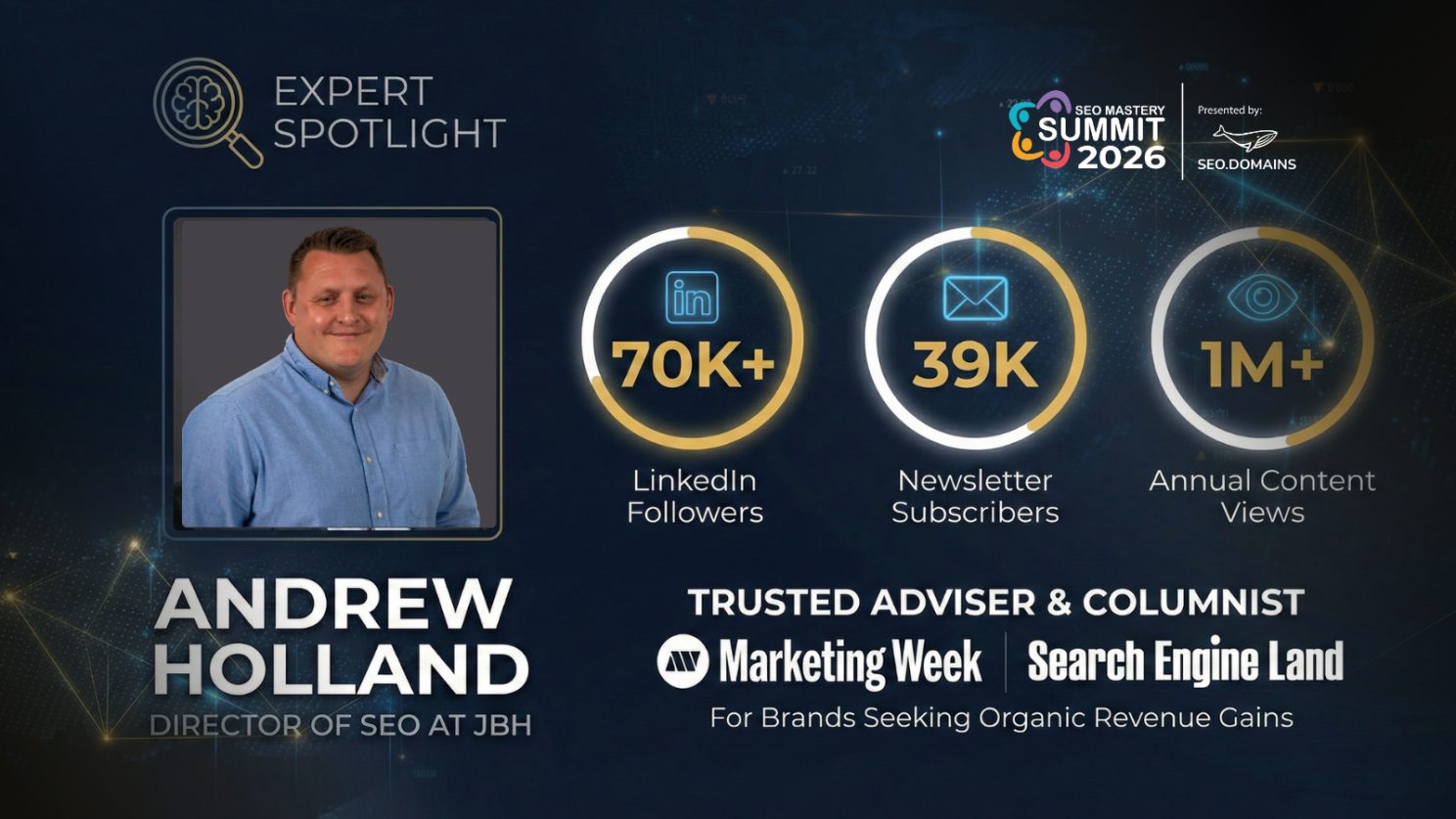
(Side note: I’m speaking at Mads Singers amazing event SEO Mastery Summit in March. Grab your tickets as I’ll be delivering my best talk yet).
How we got here, and why none of this is accidental
To understand why AI visibility is such dangerous nonsense, you first need to accept an uncomfortable truth about modern SEO.
SEO stopped being optimisation years ago. It became manufacturing.
Links were once the sharp end of search. They were hard to earn, expensive to buy, and deeply tied to reputation and relevance. They were also where enormous sums of money quietly changed hands.
That era is largely over.
Today, most SEO account managers do not build any links. They outsource them to link vendors who churn out guest posts, blog network links, and recycled publisher relationships at industrial scale.
I know this because I work in the industry. I am offered these links daily. I know the people selling them, the agencies buying them, and the clients unknowingly paying for them. Some agencies are buying links in such volume that it borders on absurd.
The result should surprise no one. Search quality declined. Expertise disappeared. Original thought was replaced by templated content. SEO output became overwhelmingly simple.
Retainers consisted of 3 pillars.
Links (outsourced).
A bit of tech (often plug-in based).
Blog content.
In the end, SEO, whether for the small business or the large corp, was mainly about blog content with a sprinkle of internal links.
Why? Because content gave SEO agencies a fat graph yardstick to show clients.
Even today, SEO agencies will show traffic graphs with the same level of pride a 5-year-old has wearing a Batman T-shirt.
But in the process of chasing it, the industry devalued traffic and created an industry built around it.
Which is where the problems start.
When traffic stopped being a measure and became the product
Content itself is not the enemy here.
Content matters. It shapes understanding, builds familiarity, and fuels public conversation. This article is content.
You read content. I read content.
Content is not the problem. The problem is what SEO turned content into.
Traffic.
Traffic went from being a signal to being the goal. And the moment that happened, SEO crossed the same line that advertising crossed decades earlier.
Because when a measure becomes a target, it stops being useful.
SEO agencies sold traffic as advertising exposure. One million visits became one million brand impressions. Glossary pages became “top of funnel awareness”. Boardrooms were shown charts and told that the brand had been “seen”.
Most of those visitors, of course, had no commercial intent.
They came to solve a pressing informational need.
They did not remember the brand. They did not care about the brand. They did not buy from the brand.
People rarely remember the person they ask for directions; they only remember the final destination.
But the dashboard looked good. And for a long time, that was enough.
Then AI took the traffic away
Large language models have not killed SEO. They’ve simply exposed the smokescreen that huge sections of the industry and its gurus hid behind.
By answering informational queries directly, AI stripped away the very traffic that SEO had been inflating and monetising for years. The effect was immediate.
Informational clicks collapsed. Blog performance cratered. The content writing economy panicked.
Suddenly, selling blog posts that nobody clicked on became very difficult.
And this also meant the SEO ‘tool’ sector was also in panic.
Keywords and content drove a huge part of their value chain, and if you can’t see what people are prompting in AI tools, you can’t measure, track or monetise around it.
So the industry did what threatened industries always do.
It invented a new metric.
The birth of AI visibility
AI visibility did not emerge because it was needed. It emerged because something had to replace traffic.
On the surface, AI visibility tools appear sophisticated. In reality, they all work in roughly the same way.
They take your existing keyword footprint. They elongate those keywords into pseudo-prompts. They fire those prompts into AI systems. They record whether your brand or content is mentioned. They convert that output into a score.
That score is then presented as AI visibility.
This is not measurement. It’s not measuring anything. It’s the AI equivalent of asking your employees if they’ve heard of your business.
The problem is obvious.
We do not see real user prompts. We do not know what people are actually asking. We do not know frequency, intent, or commercial proximity.
We are measuring responses to synthetic inputs and then optimising against them as if they represent reality.
This is wishful thinking with a SaaS subscription.
And if you’re basing any search strategy on this approach, you’re basically building a house on a sandy beach while the tide is out.
The house looks great until the water comes back.
Why AI visibility cannot be optimised in any meaningful sense
Traditional search data, for all its flaws, was grounded in observable behaviour. Queries existed. Volumes existed. Trends could be inferred with some confidence.
AI does not work like that.
Prompts are private. They are conversational. They change based on context, history, personalisation, memory and follow-ups.
They cannot be reverse-engineered at scale.
Optimising for something you cannot see is not clever. It’s absurd.
So what do SEO agencies do instead?
They default to the only lever they control.
They publish more content.
The same tactic that inflated informational traffic is now being repackaged as AI optimisation.
Structured data. Content clusters. Topical authority. Volume. Fan out query matching.
Nothing has changed except the label.
The boardroom reckoning that is coming
This is where AI visibility stops being harmless and starts becoming professionally dangerous.
Because metrics do not live in dashboards. They live inside organisations. And organisations, contrary to popular marketing belief, are not patient playgrounds for experimental nonsense.
They exist to grow.
For a while, AI visibility will provide cover.
Reports will look busy. Percentages will rise. Consultants will talk confidently about “early adoption” and “owning the space”.
And then the CFO will look up.
Revenue will be flat. Market share will be unchanged. Customer acquisition costs will still be climbing.
At that moment, nobody will care how often an AI mentioned your blog in an informational answer that no customer remembers or clicked on.
When marketing fails to drive growth, budgets get cut. When budgets get cut, headcount gets reviewed. And when headcount gets reviewed, people disappear.
Not agencies. People.
Real people with real jobs and families to feed.
Most of the loudest voices pushing AI visibility today will not be around to defend it when that reckoning arrives.
They will have moved on, rebranded, or quietly deleted their thought leadership.
Just look at the “it’s just SEO” crowd of gurus that stoked a culture war in the search industry against any SEO who used the term GEO.
Each and every one of them has backtracked. Except ‘it’s just SEO’ has now been swapped for AEO or AI SEO.
Bless em, they still can’t bring themselves to use the G word, but they’ve all changed their tune.
And they’ll do the same with AI visibility.
Because AI visibility is the new vanity metric.
Why visibility has never been the point
Marketing has never been about being seen.
It has always been about being chosen.
Being cited in an AI response does not build brand salience. It does not create emotional association. It does not generate mental availability in any meaningful sense.
At best, it produces a fleeting mention that the user neither remembers nor attributes.
That is not brand building. That is not demand creation. That is not growth.
So what does matter if it’s not AI visibility?
The ironic redemption of traffic
Here is the irony most people are missing.
As AI strips away low-intent informational clicks, traffic becomes useful again.
What remains is intent.
Brands that stop writing for algorithms and start writing for their actual customers are seeing traffic patterns change in interesting ways.
Overall volume might drop, but relevance increases. Visitors land on pages that matter. Service pages. Product pages. Category pages. About pages.
These visitors stay longer. They convert more often. They return.
This is not luck. It is what happens when you stop chasing keywords and start serving markets.
And yes. You will start to see clicks come to your content again.
This is what happens when AI deals with all the low-intent search.
AI kills the short click, but the long click still survives.
And if you’ve done a good job of creating content for your target audience, AI will help it be found and clicked.
Because these people want to read what you’ve written.
They always did. That’s why they searched in the first place. To find content to read. They never wanted an AI response; they wanted depth.
And this type of traffic is still valuable and out there.
But we still need to use AI, because like it or not AI is now the first interaction for customers.
However, we need to use it for our goals, not vanity.
Recommendation is the only AI metric that matters
If you insist on measuring something in an AI-driven world, measure recommendation.
Not whether your brand is occasionally mentioned. Not whether your domain appears in a citation list. But whether you are recommended when someone is choosing.
Buying situations are finite. Problems are predictable. Decision criteria are stable enough to understand if you bother to do the work.
When someone asks an AI which provider to use, which tool to buy, which service to trust, do you appear consistently and credibly?
That question is measurable. It is defensible. And it has a direct line to revenue.
Everything else is theatre.
Recommendation visibility is the only visibility you need to look for, monitor and track.
And you don’t build that from SEO.
The return of PR and old-fashioned marketing discipline
Here is the truth the SEO industry does not want to hear.
AI does not trust your blog. It trusts the world talking about you.
Third-party mentions. Authoritative citations. Reviews. Contextual links. Media coverage. Expert commentary.
This is what feeds AI systems. This is what builds credibility. This is what turns mentions into recommendations.
Which means the future of search is not more SEO content.
It is better PR, sharper positioning, clearer copywriting, and a ruthless focus on brand fundamentals.
This is not regression. It’s an industry correction.
For a decade, SEO was allowed to pretend it existed outside marketing. AI is ending that fantasy very quickly.
But it’s not all doom and gloom for SEO.
Where SEO actually goes next
SEO is not dead. But it is being dragged back to where it should have been all along.
Buyer intent pages. Commercial relevance. Brand demand. Share of search. Links that actually matter.
In other words, SEO is being forced to compete with paid search on its own terms. And that is exactly where it belongs.
Paid search accounts for the largest share of marketing budgets, yet organic search drives more revenue.
Anyone with an ounce of commerciality around search knows this. Sadly, this isn’t the SEO gurus.
All of whom are suddenly trying to reinvent themselves as AI brand marketers, AI growth advisors or anything else they can come up with so they can sell the Substack subscriptions and speaking gigs while avoiding the hard, in-the-trenches work of SEO.
Because actually ranking for buyer intent search terms is as glamorous as stacking shelves in supermarkets.
And yet, that’s what drives £200 billion in advertising revenue for Google.
It’s also where SEO should go. Because that’s where the real money is and always has been.
Helping brands to win buyers when they’re buying. Helping brands reduce paid search costs, increase profits, and win more business.
AI visibility, as it is currently sold, pulls the industry in the opposite direction.
Away from buyer intent. Away from accountability. Away from growth.
And it’s important that you don’t fall for the guru noise or the search tool employees building their personal brands one stupid idea and comment at a time.
Search tools themselves are aggressively raising costs to cover this AI visibility tracking bill.
And it’s not that these tools aren’t useful…they can be.
It’s just that whoever’s advising on the inside on product development is thinking of search like it’s 2012.
It’s classic Peter Principle on display.
Incompetence in the search industry has risen so high in the food chain that search tools are dictating metrics that make no sense because their internal teams still think a brand can keyword blog its way to revenue.
It doesn’t have to be this way.
SEO, AI search, GEO, PR, copywriting, brand marketing, content marketing and more.
All can be tied together simply, easily and commercially.
All can be aligned with Ehrenberg Bass marketing principles.
All can be used to help brands grow.
But not if we let the drunk drive the car.
A final warning
AI visibility is not just a bad metric. It is a dangerous one.
It allows marketers to look busy while achieving nothing. It allows agencies to protect revenue while avoiding responsibility. And it allows organisations to delay hard decisions until the consequences are unavoidable.
But gravity always wins.
Growth is the only metric that truly matters. And growth still comes from the same unfashionable principles it always has.
Understand the market. Build a distinctive brand. Earn credibility through others. Be recommended when it matters. Being available where buying happens.
Everything else is just another dashboard that will be forgotten when the budget review begins.
And by then, it will be far too late.
Andrew Holland
Originally published on LinkedIn on 9 February 2026.