
AI is not making marketing cheaper.
It is making content cheaper.
Those are not the same thing. Yet an entire industry is behaving as if shaving a few hours off a first draft means the marketing budget can now be cut.
That is the mistake.
AI has made it easier to produce a competent article, image or video. A 2023 study by Shakked Noy and Whitney Zhang put 453 professionals through realistic writing tasks. The people using ChatGPT finished 40% faster and produced work rated 18% higher in quality.
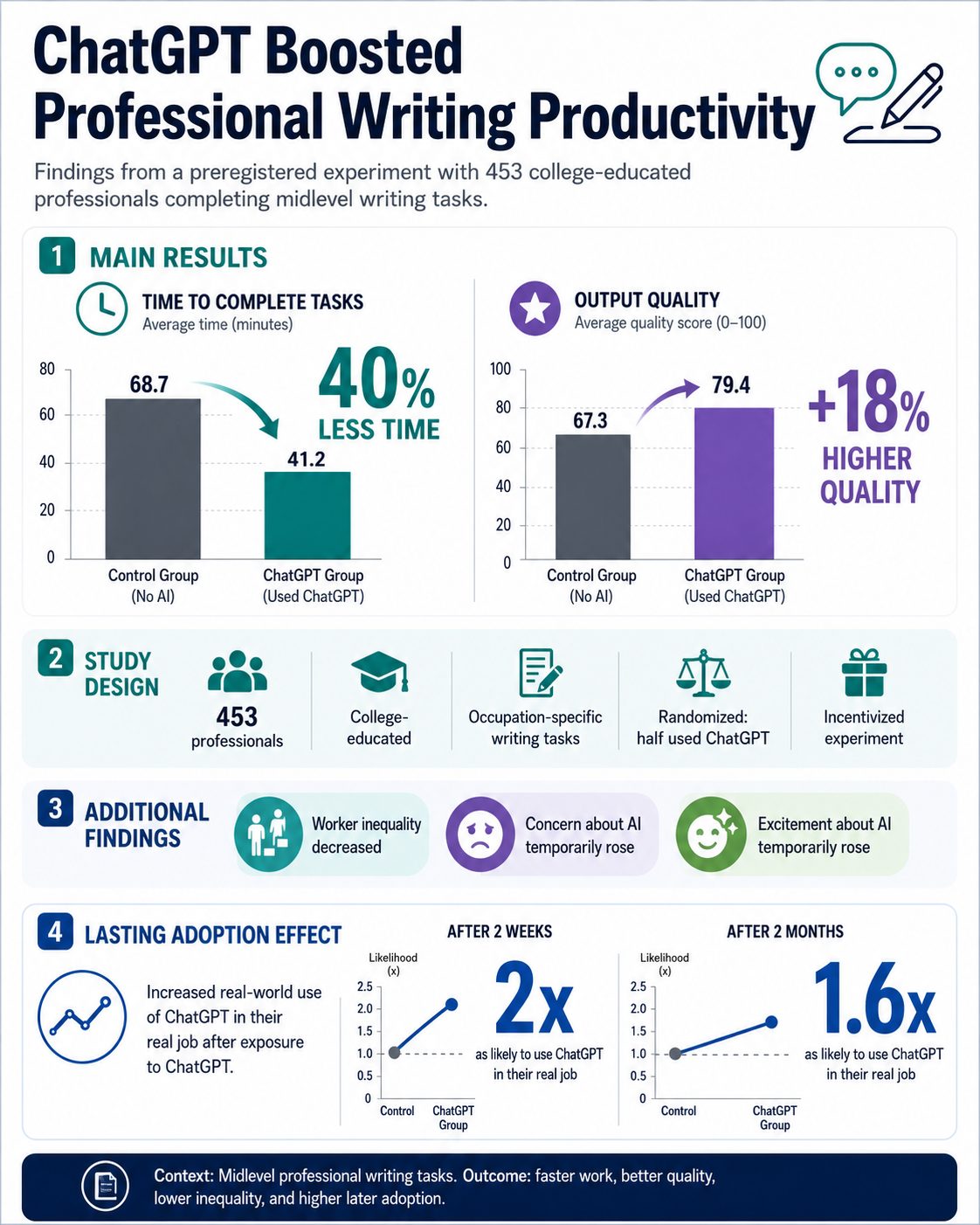
But while the study proves that AI can help people complete bounded writing tasks. It does not prove that anybody will notice the extra content, trust the company behind it or recommend the product being sold.
AI has solved a production problem. It has not solved the visibility problem.
In fact, by making competent content abundant, it is making visibility more expensive. Your CFO might love the reduction in production time. The market will not care.
Meaning your CFO is about to feel the real cost of marketing.
Visibility used to have weight
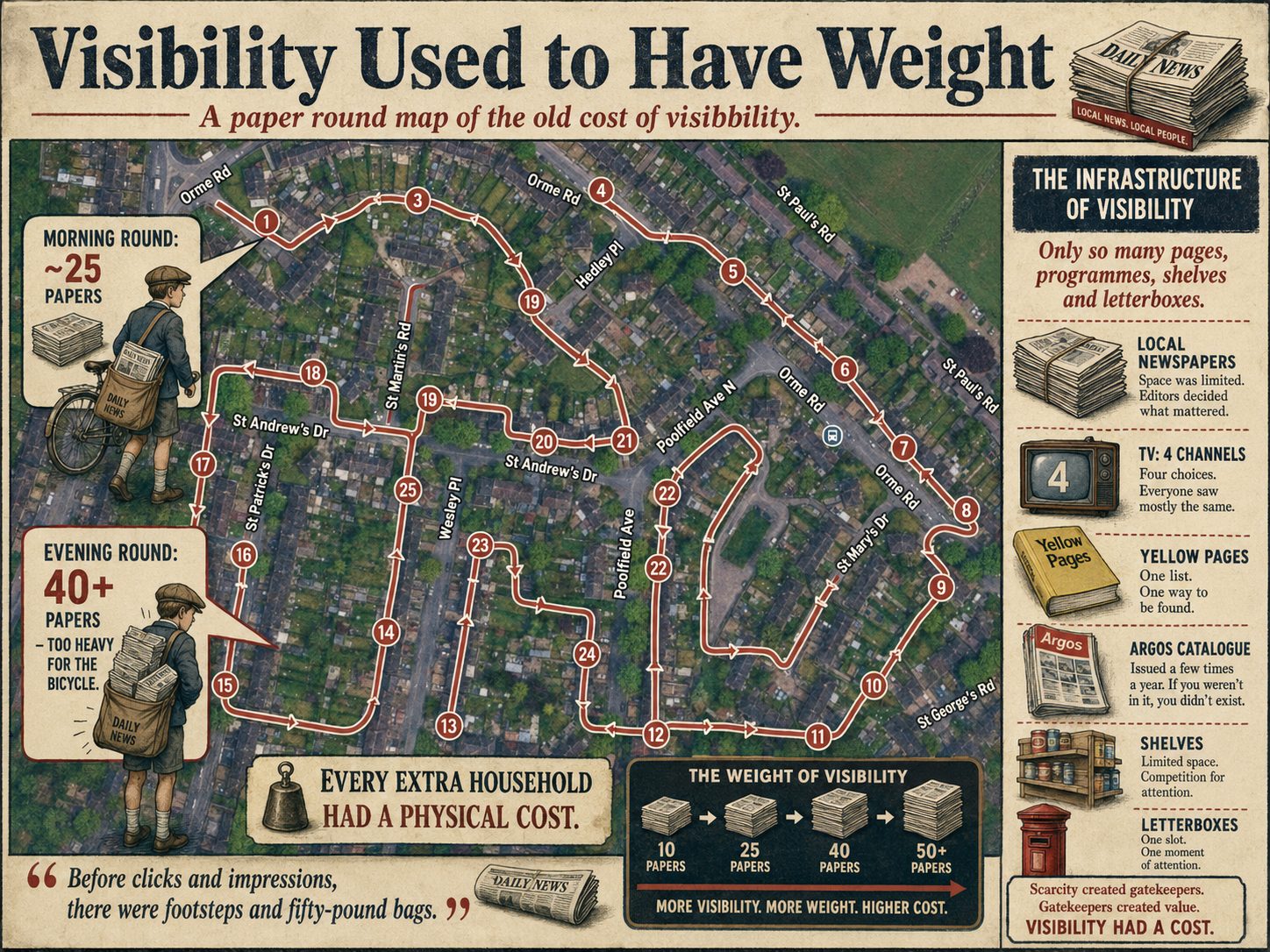
I know visibility used to be expensive because I carried it around on my shoulder.
When I was 13, I delivered newspapers. I had about 25 papers on the morning round and more than 40 on the evening one. The evening bag was too heavy for my bicycle.
Every extra household had a physical cost.
There was the free Advertiser and the Evening Sentinel. There were four television channels until Channel 5 arrived. If you wanted a local business, you opened the Yellow Pages. If you wanted to browse products, you opened the Argos catalogue.
These were not quaint bits of nostalgia. They were the infrastructure of visibility.
There were only so many pages, programmes, shelves and letterboxes. A business either paid a gatekeeper for access or did something interesting enough for the gatekeeper to carry its story.
Nobody pretended visibility was free.
Then the internet arrived, and the old economics collapsed. I am old enough to remember attending workplace training on email while a colleague confidently announced that it would never catch on.
It caught on.
So did websites, blogs, search engines and social media. Suddenly, a business could publish without buying a newspaper advert, printing a catalogue or convincing an editor that it deserved a few column inches.
For a while, we got an extraordinary deal: cheap production and cheap distribution.
Then we made the classic marketing error. We confused a temporary market condition with a permanent law.
The free visibility era was the exception
The internet did not abolish gatekeepers. It replaced them.
Google, Facebook, LinkedIn and the rest made it possible for almost anyone to publish. But publishing was never the valuable part. Deciding what people would actually see was.
Once millions of businesses were creating websites, posts and videos, the scarce resource moved. It was no longer the ability to put something online.
It was attention.
The platforms did not need to become evil for this to happen. Their business models worked perfectly well. Give businesses reach as the platform grows. Concentrate the audience. Then sell access to the attention you helped them become dependent on.
We built marketing strategies on rented land and then acted surprised when the rent went up.
The search industry made this worse by teaching businesses to treat rankings and traffic like assets sitting on the balance sheet.
They never were.
A ranking is permission to borrow attention from a platform whose interface, incentives and rules you do not control. It can be commercially valuable, sometimes enormously valuable, but it is not owned distribution.
That distinction was easy to ignore while the clicks kept arriving. It is impossible to ignore when an AI answer absorbs the information, completes the informational journey and leaves the source with nothing except the warm feeling of having been useful to somebody else’s product.
This is why “we are ranking” is no longer a complete answer to the visibility question.
Ranking where? For what kind of intent?
Does the buyer encounter the brand, or merely the information it supplied?
Does the result create recognition, or has the company become an unpaid research assistant hiding behind the answer?
Around 12 years ago, my agency Zoogly ran low-budget video adverts featuring an elephant. We spent no more than roughly £100 a month. People recognised the adverts. They called us. We got leads.
The creative mattered, but so did the economics. Repeated visibility at that price would be much harder to reproduce today.
I had already learned the opposite lesson years earlier.
At about 24, I tried to start a self-defence club. I had almost no advertising budget. I spent £55 on one small local newspaper advert. It produced one lead. That person attended a free class and never returned.
The club failed.
That is the brutal simplicity of visibility. You can have a useful offer and good intentions. If too few of the right people encounter it, the business still dies.
AI does not repeal that rule.
The content savings are being spent somewhere else
This is the part most AI efficiency arguments miss.
If an article that once took a day can now be drafted in an hour, the spreadsheet shows a saving. Wonderful. Unfortunately, every competitor has access to the same saving.
The number of acceptable articles rises. Inboxes get fuller. Feeds move faster. Search results become harder to earn and easier for platforms to summarise.
So the cost moves downstream.
You spend less getting to a first draft and more proving the idea deserves attention. Better experience. Better evidence. Sharper positioning. More memorable creative. More deliberate distribution.
The cheapest content in history is being released into one of the most competitive attention markets in history.
Producing more of it is not a strategy.
It is an arms race in which the main prize is making everybody easier to ignore.
This is where the budget argument becomes uncomfortable.
The obvious corporate response to AI is to reduce production cost and bank the difference. That looks efficient because content is the easiest line to measure. Hours fall. Output rises. Somebody puts a green arrow on a presentation.
But if the savings are not reinvested in evidence, creative, positioning, and distribution, the business has improved the efficiency of making things nobody sees.
That is not a productivity gain. It is cheaper waste.
The sensible budget question is not “How much content can AI save us?”
It is “What will it now cost to make the market notice, trust and remember us?”
Those are harder outcomes to put into a tidy production dashboard. They are also the outcomes marketing exists to create.
Search traffic shows what is happening. Seth Godin’s advice is to “assume that ‘traffic’ is a random gift, not a resource to be depended upon”.
That should make anyone whose growth model depends on Google traffic sit up.
In a Pew Research Center study involving 900 US adults and 68,879 Google searches, users clicked a traditional result in 8% of visits where an AI summary appeared. Without an AI summary, the figure was 15%. Links inside the AI summary were clicked in just 1% of visits.
One US study is not the entire future of search. But the commercial warning is obvious: a platform can use information from across the web to complete more of the journey inside its own interface.
Your content can help create the answer without your business receiving the visit.
That is not visibility.
AI search is not a second index. It is a new gate
There is plenty of confused talk about AI search being a second index.
It is not, at least not in the simple way that claim is usually made.
Google says its AI search features use its core indexing and ranking systems, alongside retrieval techniques such as query fan-out. Other AI products work differently. Training, retrieval, ranking, generation and visible citations are different processes.
The plumbing matters, but the strategic change matters more.
Search used to present a list of places you might visit. AI systems are increasingly being asked to interpret the options, compress the evidence and recommend what to do.
The unit of competition is shifting from the blue link to the answer.
This does not kill SEO. Buyer-intent rankings, accessible pages, clear information and technical discoverability still matter. If a system cannot find or understand you, it is unlikely to recommend you.
But much of what is now being sold as GEO is simply technical housekeeping dressed as strategy.
Make the page crawlable. Add structure. Answer the question clearly. Become easy to quote.
Congratulations. You are now eligible to be ignored.
Being understood is not the same as being chosen.
Fitness × fame
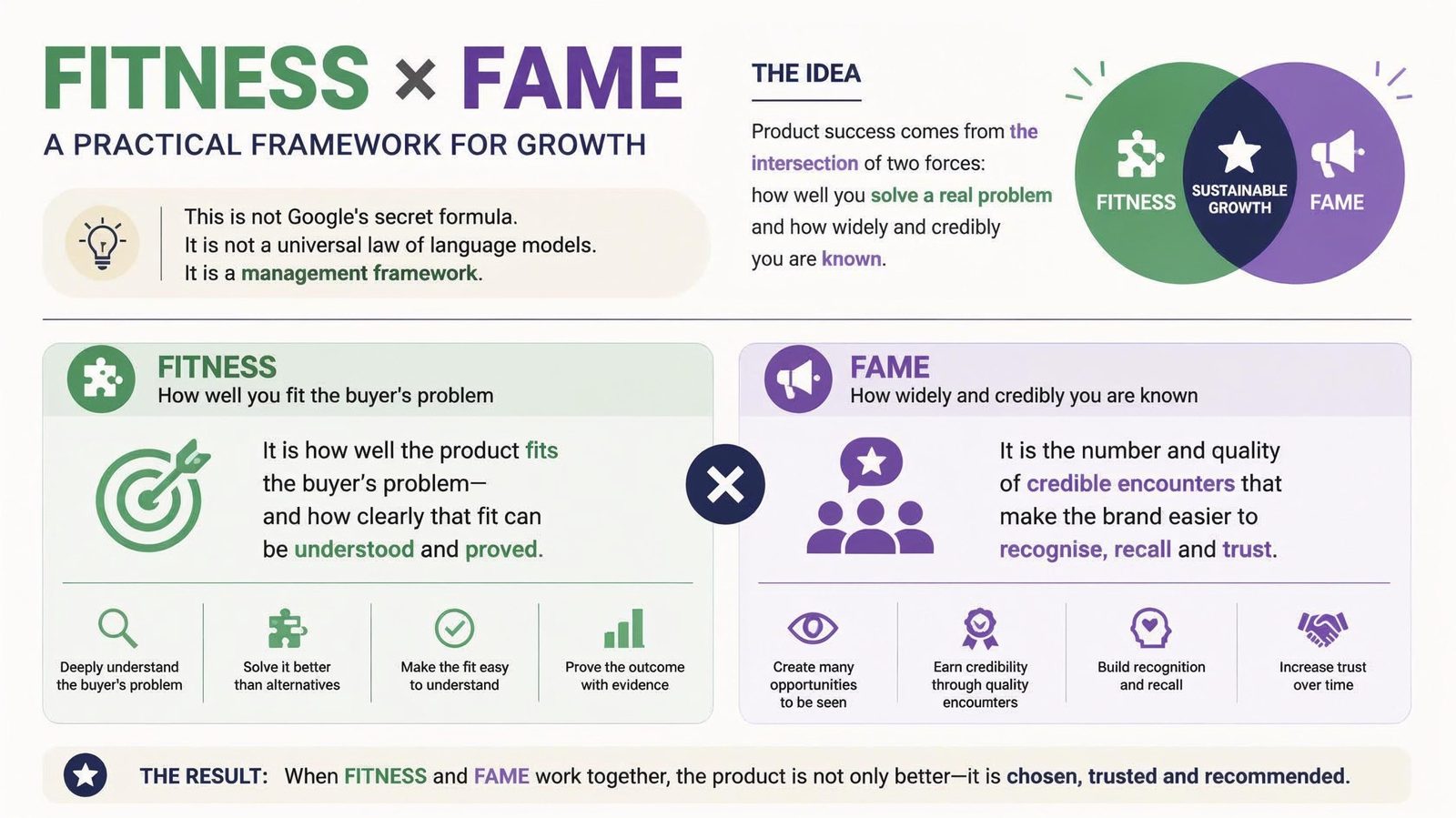
I use Fitness × Fame as a practical way of explaining this.
It is not Google’s secret formula. It is not a universal law of language models. It is a management framework.
Fitness is how well the product fits the buyer’s problem—and how clearly that fit can be understood and proved.
Fame is the number and quality of credible encounters that make the brand easier to recognise, recall and trust.
Fitness without fame is a brilliant solution nobody knows exists.
Fame without fitness is a well-known disappointment.
The multiplication sign matters. If either side is close to zero, the other side has to work absurdly hard.
Fame does not mean becoming a household name. A specialist software company does not need national recognition. It needs to be known among the customers, practitioners, journalists, partners, analysts and publishers that influence its buying category.
That kind of fame is built through repeated, relevant encounters.
A buyer might read an article on your site, see your data quoted by an industry publication, hear a customer mention you and then meet the brand again when asking an AI system for options.
No single encounter closes the sale. Together, they make choosing you feel less like a leap into the unknown.
There is research showing popularity bias in large language models. That does not prove the biggest brand always wins. Niche expertise can beat broad fame. A constrained prompt can favour a specialist. Systems and retrieval methods differ.
But “famous brands do not always win” is not the same as “fame does not matter”.
It matters because buyers and machines both need evidence that a brand exists beyond its own website.
Publish yourself. Then do something worth repeating
Most content strategies stop at stage one.
Publish the article. Post on LinkedIn. Send the newsletter. Optimise the page. Repeat until everybody involved is too exhausted to ask whether any of it is working.
Publishing yourself is necessary. It gives you control over the explanation. It creates useful source material. It lets you answer the buying questions that affect a decision and show the evidence behind your claims.
But it is still you talking about you.
Stage two is getting other people to carry the story.
Edward Bernays wrote in 1923 that “An overt act is often necessary before an event can be regarded as news.”
In modern language: you must do something worth reporting.
Create the research. Run the experiment. Publish the data. Challenge an accepted idea with evidence. Create an event with a consequence beyond “we wanted some coverage”.
This is where PR belongs. Not as a magic button that guarantees AI citations; no honest agency can promise that, but as a way to create credible third-party encounters.
Owned, paid and earned activity do different jobs.
Owned content gives you depth and control.
Paid distribution buys relevant reach and speeds up learning.
Earned coverage provides independent attention and credibility.
The channel specialists will all tell you their channel is the answer. The SEO agency will sell SEO. The PR agency will sell PR. The paid team will ask for more media budget.
They may all be right about the value of their work. They are wrong when they pretend their part is the whole system.
Publishing hundreds of AI-assisted articles does not fix a distribution problem. Buying reach for an unclear offer does not fix a fitness problem. Winning press coverage without a useful owned destination wastes the attention you paid to earn.
The work has to join up.
Yes, AI still gives small businesses leverage
The strongest objection is also true.
AI gives smaller businesses access to research, writing, design and analysis that once required more people and more money. A small team can test ideas, build prototypes and create credible assets at a speed that would have been impossible a few years ago.
That is a real advantage.
But cheaper entry is not guaranteed attention.
If every competitor receives similar production leverage, competence becomes less scarce. The saving should not simply fund a larger pile of content. It should fund the parts AI has not made abundant: original evidence, a stronger position, better creative and wider distribution.
This does not mean every small business needs a giant agency retainer and an indiscriminate advertising budget.
It means staged investment.
Start with a strong point of view and a real buyer problem. Publish the best version you can. Put it in front of a small relevant audience. Watch what earns attention, questions and recall. Then put more money behind the ideas that prove they can travel.
AI makes those first steps cheaper.
It does not make the later steps optional.
The test nobody wants to run
At the end of each week, ask four questions.
What did we publish that makes us a better fit for a real buying situation?
What did we do to get it beyond the audience we already have?
What did we do that gave a credible third party a reason to mention us?
What did people remember, repeat or ignore?
If the only answer is “we made more content”, you do not have an AI visibility strategy.
You have a production schedule.
AI is making content cheaper. Good.
But the easier content becomes to make, the less remarkable its existence becomes.
The next advantage will not belong to the company that produces the most.
It will belong to the company that becomes worth finding, worth remembering and worth recommending.
Andrew Holland
Originally published on LinkedIn on 17 July 2026.