Google finally said the quiet bit out loud.
At its latest I/O event, the company showed us the future of Search. And, despite the breathless demos and predictably syrupy product language, the direction is pretty bloody clear. Google is no longer trying to send users to the best answer. Google is trying to be the answer.
The old search bar is becoming an “ask Google” box. A simple interface into a Star Trek-style computer where you ask messy, complicated, human questions and the machine answers, compares, summarises, recommends, builds tables, creates graphics, generates little apps and generally does the work that once required you to click around the internet like a caffeinated squirrel.
Google says AI Mode has already passed one billion monthly users. It says queries are growing. It says Search is stronger than ever. Fine. But the important point is not whether search volume goes up or down. The important point is what happens after the query. Google’s new AI Search is designed to contain more of the user journey inside Google itself. Agents. Generative interfaces. Personalised answers. Custom dashboards. Search that does not just retrieve information but interprets it, reformats it and acts on it. That is the shift.
And for two years, I have been telling SEOs this was coming.
For two years, I have had the same tedious arguments with the same industry experts, many of whom seemed more interested in protecting their legacy deliverables than understanding the obvious strategic direction of travel. “It’s still just SEO,” they said. “AI search will use rankings,” they said. “Just optimise for prompts,” they said.
Bollocks.
Search is not dead. But SEO as we have known it is. The old model is collapsing. Keyword calendars. Informational blog sludge. Ranking reports. Metadata fiddling dressed up as strategy. Shitty link packages. Traffic graphs waved around as if they were revenue. That game is not disappearing overnight, but it is losing its commercial centre of gravity.
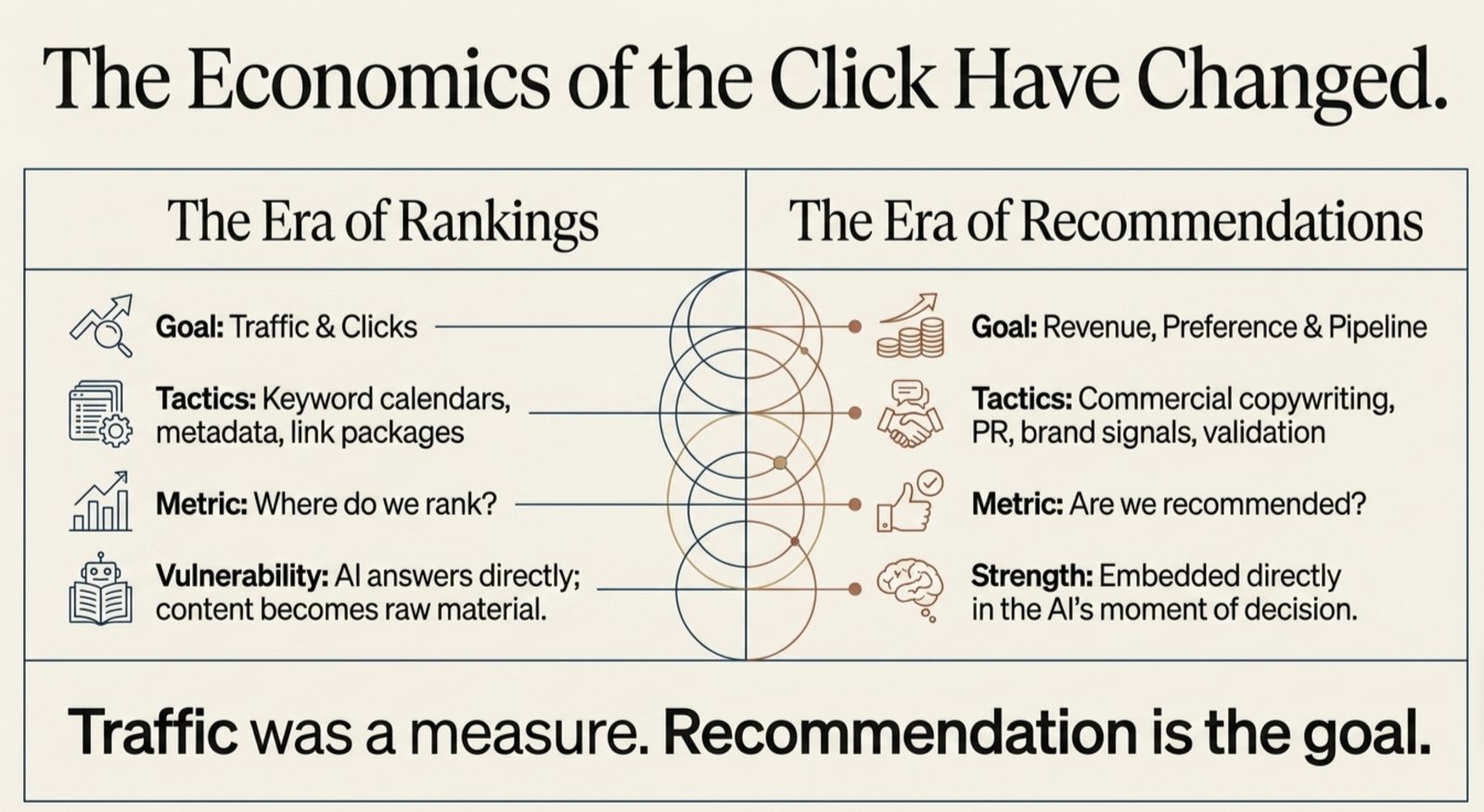
The era of rankings is giving way to the era of recommendations.
And that means the object of optimisation has changed. You are no longer optimising for the interface. You are optimising for the internet.
Traffic was never the goal
Let’s get one thing straight. Traffic was never the goal.
Traffic was a measure. Sometimes a useful one. Often an over-celebrated one. But it was never the business outcome. The outcome was revenue. Leads. Sales. Pipeline. Customers. Margin. Growth. The stuff that actually pays wages and keeps the lights on.
Traditional SEO got away with confusing the scoreboard for the sport because, for a long time, the model worked well enough. Rank on page one. Get the click. Capture the visitor. Convert a percentage. Report traffic growth. Repeat until the client either got bored or the algorithm kicked you in the teeth.
But AI Search changes the economics of the click.
If Google answers the question inside the interface, the user may not need to visit your site. If Google builds the comparison table, the user may not need your buyer guide. If Google creates the checklist, summarises the regulations, generates the itinerary, interprets the data or recommends the supplier, your lovingly optimised informational content may become little more than raw material for the machine.
That is a staggeringly weird situation for marketers. Anything you publish may be used against you. Not in the dramatic police-interview sense, although given my previous life, I know a bit about that too. But in the simple commercial sense that the content you create can help Google, ChatGPT, Claude or Perplexity answer the user without that user ever visiting your website.
And this is why traffic can no longer be the single goal of search marketing.
Yes, you should still measure traffic. Of course you should. You should understand what traffic you are getting, where it is coming from, whether buyer-intent pages are growing, whether LLM referrals appear, whether brand search increases and whether the traffic converts.
But the goal is not traffic.
The goal is to be recommended.
Stop optimising for the interface
The great mistake most of the SEO industry is making is that it keeps trying to optimise for the interface.
Google. AI Mode. ChatGPT. Perplexity. Claude. Gemini. Pick your shiny box.
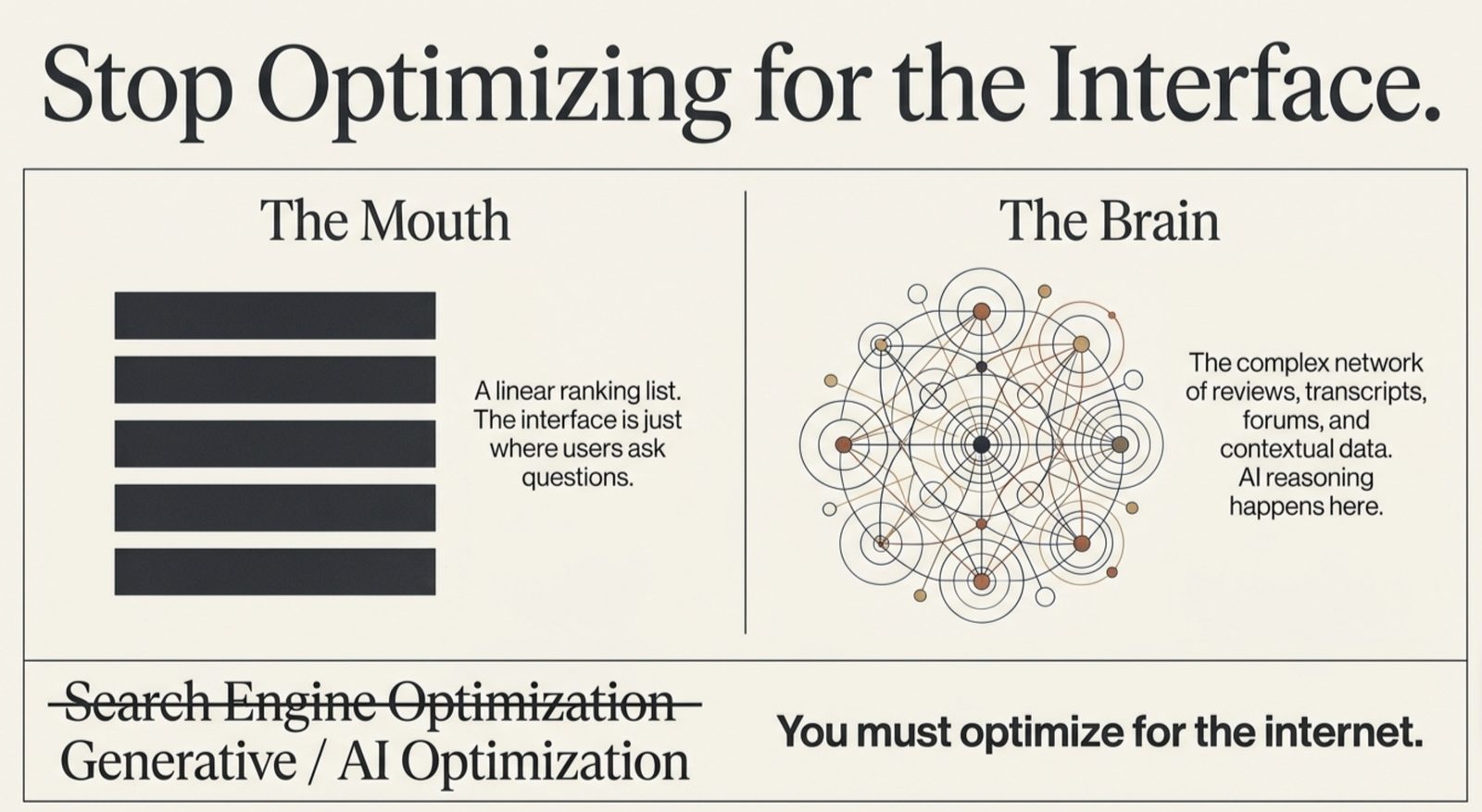
But the interface is not the market. The interface is just the mouth. The internet is the brain behind it.
Large language models and AI search systems are trained on, retrieve from and reason over the messy network of the internet. Websites. Reviews. Social posts. Videos. Podcasts. Transcripts. Forums. Directories. News articles. Customer comments. Product pages. Case studies. Mentions. Links. Unlinked brand references. Images. Context. History. Fresh search results. Old training data. New retrieval data.
This is not a neat little database waiting for your H1 tag to impress it. It is a complex network.
That is why the phrase “search engine optimisation” is now inadequate. You are not simply optimising a page for a keyword in a search index. You are trying to make a brand more likely to be understood, trusted, selected and recommended by AI systems when buyers ask questions around the problems you solve.
Call it generative engine optimisation. Call it AI optimisation. Call it AI SEO if you must, though that phrase makes me want to put my head through a patio door.
The label matters less than the principle.
We are moving from rankings to recommendations.
Old SEO asked, “Where do we rank?”
AI optimisation asks, “Are we recommended?”
And if not, why not? Who is being recommended instead? What does the machine understand about them that it does not understand about us? What signals do they have in the market that we lack? Where are they mentioned? Who validates them? What proof exists? What associations are repeated around their brand?
A ranking tells you where you sit on a list.
A recommendation tells you whether the market, and now the machine, believes you deserve to be chosen.
AI availability is the new battleground
Marketing science has already given us the right mental model.
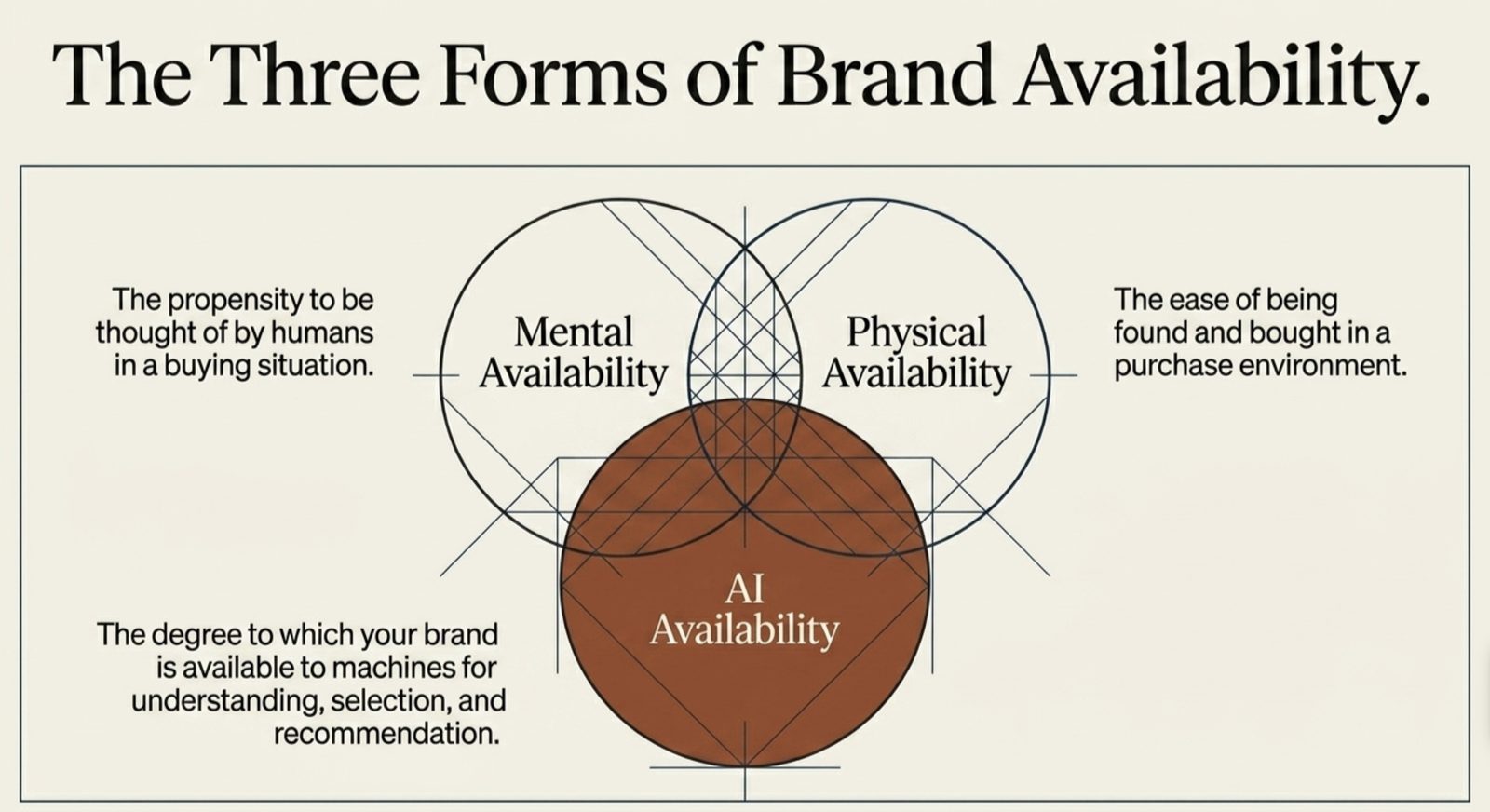
The Ehrenberg-Bass Institute has spent years teaching marketers about mental and physical availability. Mental availability is the propensity of a brand to be thought of in buying situations. Physical availability is the ease with which a brand can be found and bought in purchase environments.
Both still matter. Massively.
But AI adds a third form of availability.
AI availability.
AI availability is the degree to which your brand is available to machines for understanding, selection and recommendation.
It is not just “do we rank?” It is not just “are we cited?” It is not just “did we get traffic?”
It is whether an AI system, when asked by a buyer about a relevant problem, can understand who you are, what you do, who you serve, how you are different, whether you are credible and whether you deserve to be recommended.
That is a very different game.
In the old world, brand marketing influenced humans and SEO influenced machines. That division is disappearing. AI can now interpret the human-facing evidence of your brand. It can understand language, images, context, reviews, transcripts, social posts, customer conversations and third-party commentary in ways old search engines never could.
Your real-world brand marketing is being sucked into the digital machine like some weird Tron reboot for marketers.
Everything you do now leaves a signal.
The question is whether those signals make you more recommendable.
The internet is a network, not a list
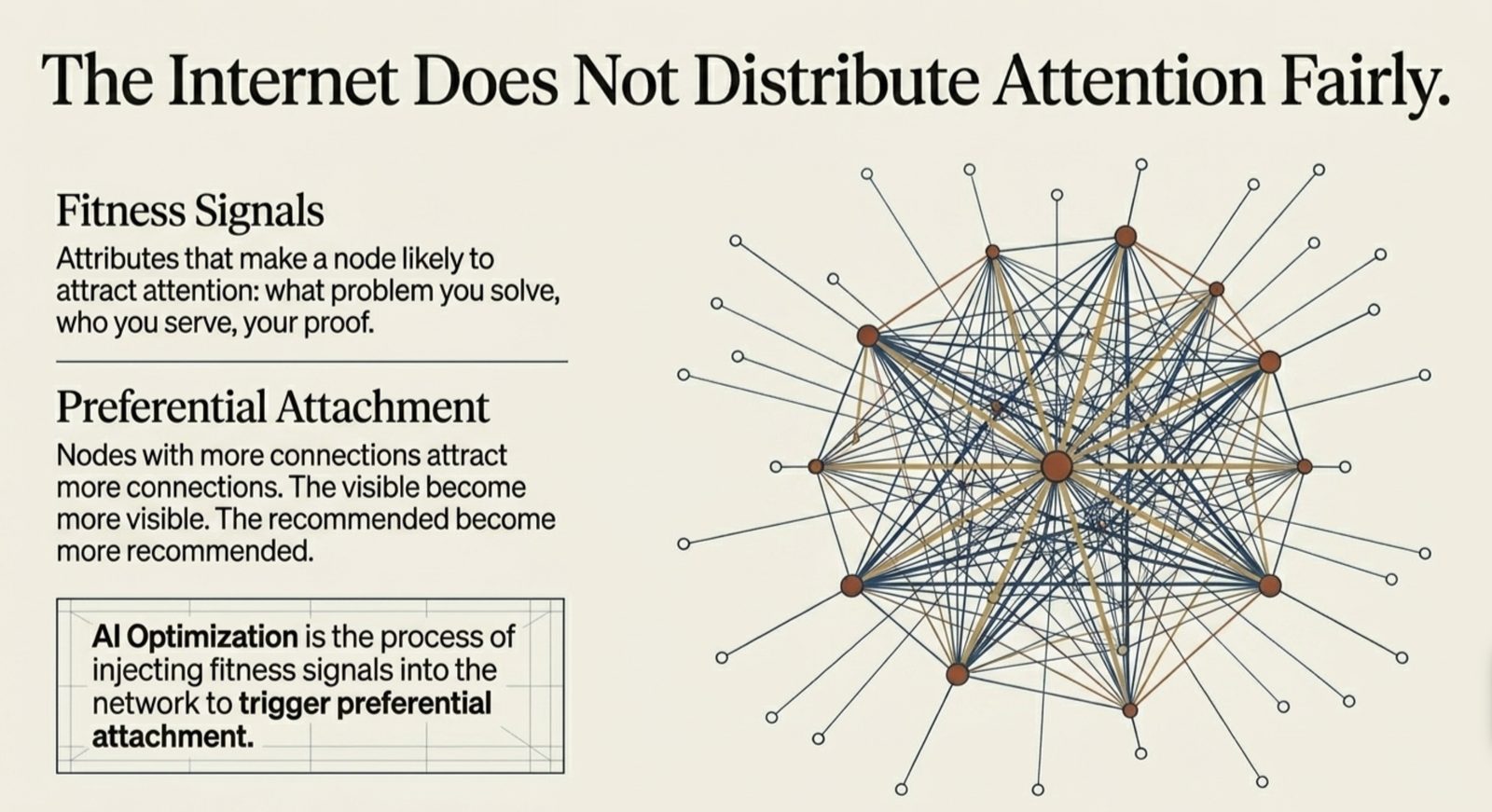
To understand what is happening, you need to understand something from network science.
The internet is a complex network. And complex networks do not distribute attention fairly. They grow through connection, visibility and reinforcement. One of the most important principles is preferential attachment.
Preferential attachment means that nodes with more connections tend to attract more connections. The visible become more visible. The mentioned become more mentioned. The recommended become more recommended.
You can see this everywhere.
Sydney Sweeney is not merely famous because she is in things. She is in more things because she is famous. Brands choose her because she is visible. Films choose her because she is bankable. Media covers her because people click. Each appearance increases the likelihood of another appearance until fatigue eventually kicks in and the wheel slows.
Jake Paul is not the best boxer in the world. Don’t be ridiculous. But he is one of the most commercially powerful because visibility compounds. His YouTube audience, media machine and existing fame create more opportunities, more money, more fights, more coverage and more business ventures.
Tamworth’s Spud Man did not make jacket potatoes fashionable because he had a beautifully optimised title tag. He stuck a camera on his chest, made visually satisfying food content, hit a set of performance cues the algorithms loved and became more visible because people kept watching, sharing and talking. The visible became more visible.
But visibility alone is not enough.
Network science also talks about fitness. Some nodes outperform others because they possess attributes that make them more likely to attract links, attention or adoption once exposed. In brand terms, these are your performance attributes. Your fitness signals.
What problem do you solve? Who do you solve it for? How do you solve it differently? Why are you better? What proof exists? Why should anyone believe you?
This is why AI optimisation cannot just be “get mentioned everywhere”. That becomes another dumb tactic divorced from strategy.
The goal is to be mentioned in relation to the things you want to be preferred and recommended for.
Mentions are not vanity. In a networked market, mentions are memory, evidence and distribution.
The three stages of AI availability
So how do you actually do this?
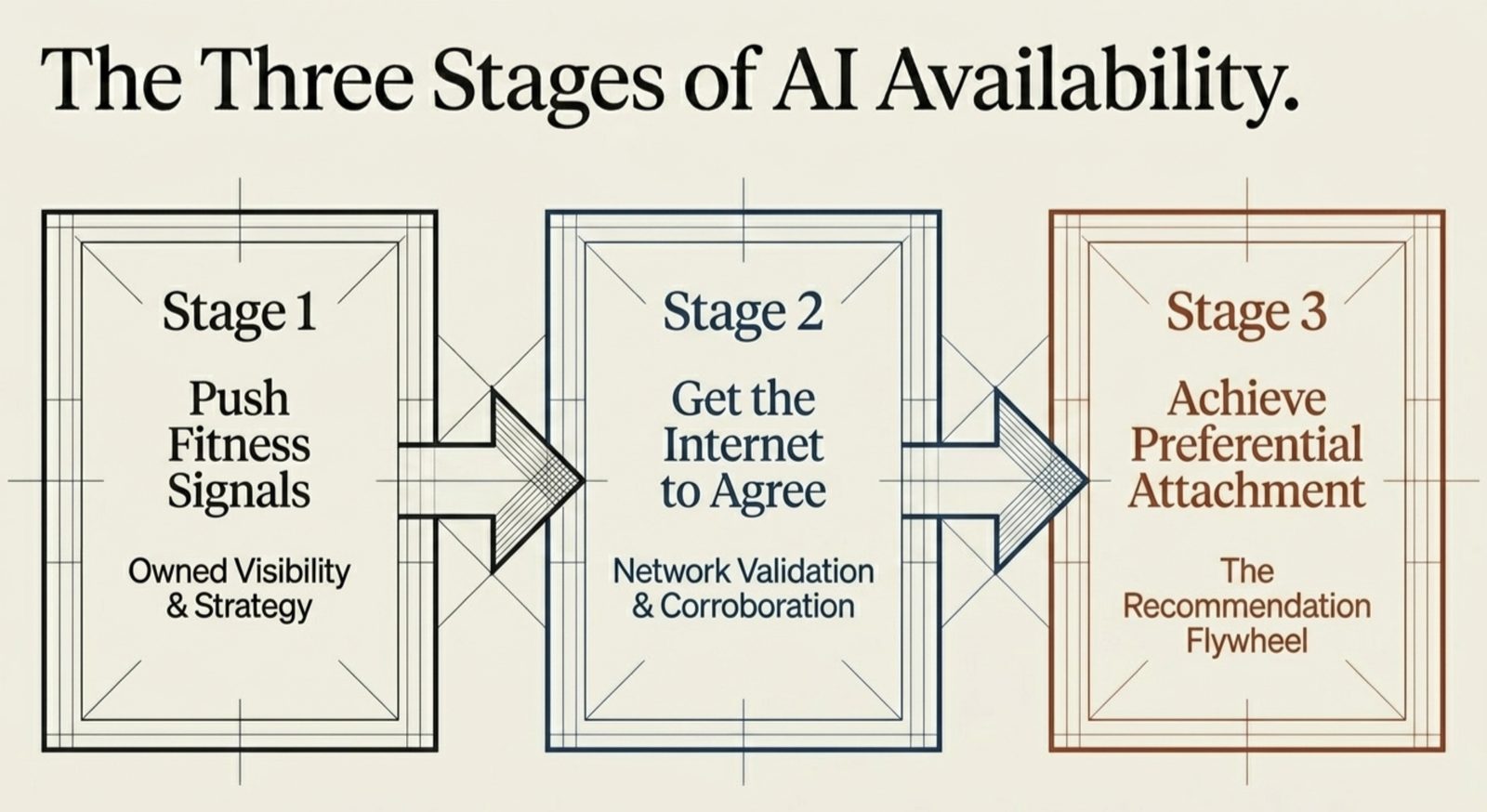
You build AI availability in three stages.
Not by chasing prompts. Not by publishing 300 blog posts no one asked for. Not by buying another guest post on a website that looks like it was built in a hostage situation.
You build it by pushing your fitness signals into the network, getting the market to validate them, and then achieving preferential attachment.
Stage one: push your fitness signals into the internet
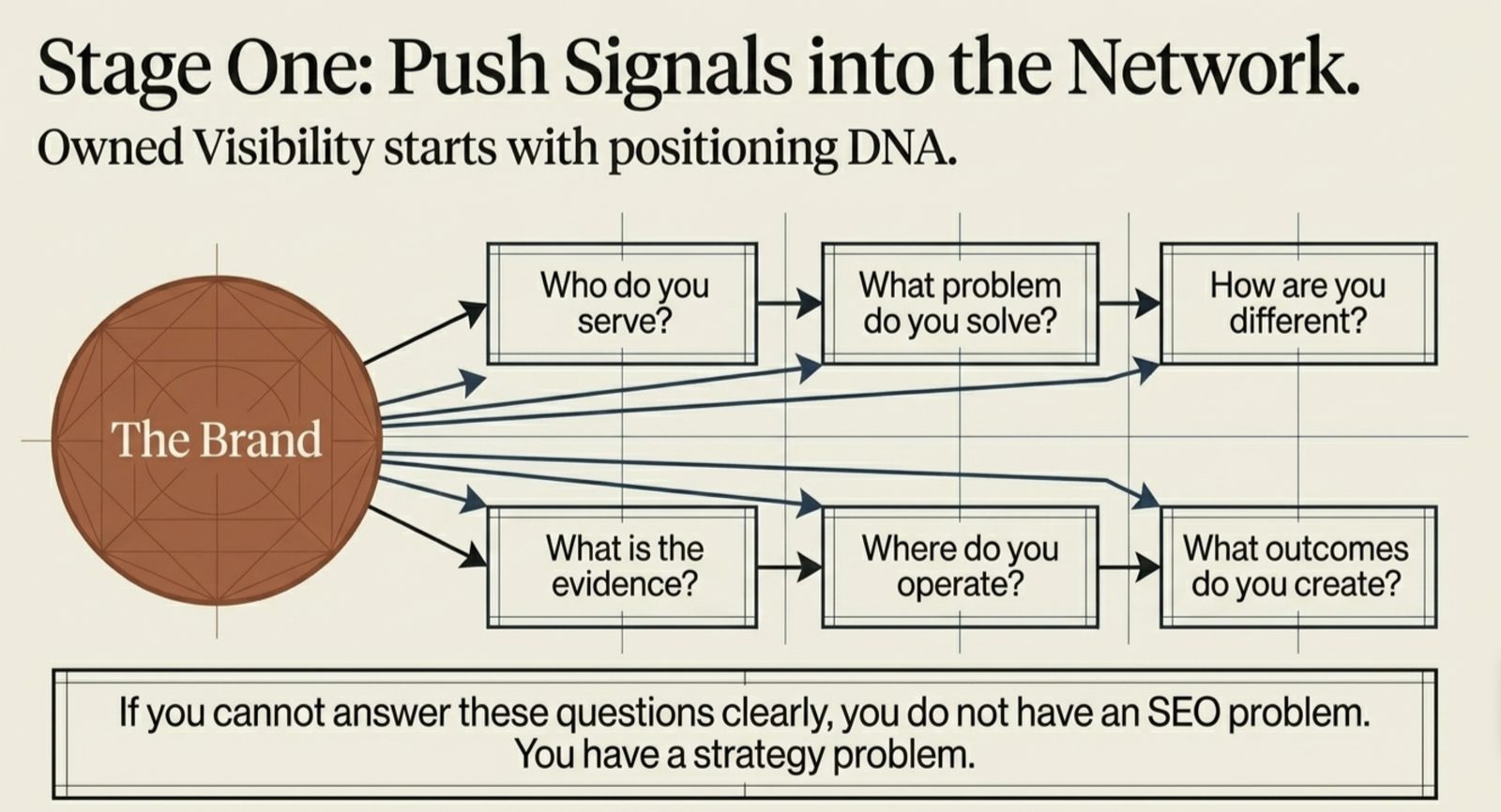
The first stage is owned visibility.
You start with positioning. Because positioning is the DNA of the whole thing.
Who do you serve? What problem do you solve? How do you solve it better or differently? What evidence proves that? Where do you operate? What outcomes do you create? Why should anyone choose you?
If you cannot answer those questions clearly, you do not have an AI optimisation problem. You have a strategy problem.
Once those answers exist, you push them into the internet. Your website. Service pages. Product pages. Case studies. Social media. YouTube. Google Business Profile. Local directories. Industry directories. Buyer guides. Comparison pages. FAQs. Sales pages. Customer stories. Founder content. Video content. Paid social. Paid search. Wherever it makes sense for your market.
This is not old SEO copywriting where you shovel semantically related terms onto a page until Google mistakes the stench for relevance.
This is commercial copywriting.
It is making the reasons you deserve to be chosen obvious to humans and machines.
Take a small suit hire business. It does not need a 2,000-word blog post called “Best Suit Hire Near Me: Ultimate Guide 2026”. That is the kind of content that makes the internet worse and clients poorer. It needs to show the suits. The fittings. The customers. The weddings. The proms. The owner. The location. The service. The quality. The reviews. The process. The difference.
It needs to look like a real business because it is one.
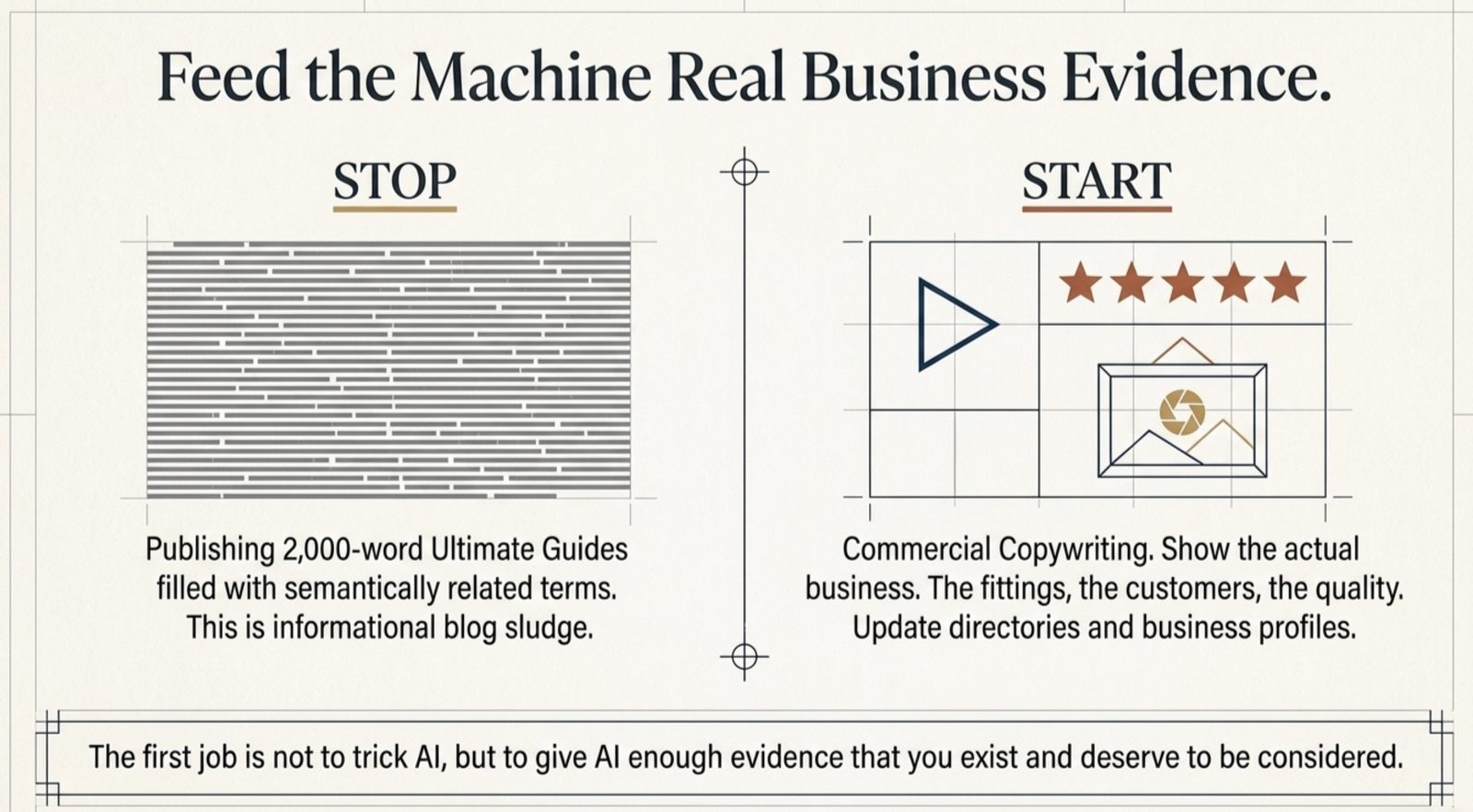
That means posting regularly. Showing the work. Recording the fittings. Publishing the transformations. Sharing customer stories. Updating the website. Being present in local directories. Using Facebook, Instagram, TikTok and Google Business Profile properly. Maybe putting £50 or £100 a month behind the best assets so people in the local area actually know the business exists.
None of this is revolutionary. It is just good marketing.
But now good marketing feeds the machine.
The first job of GEO is not to trick AI. It is to give AI enough evidence that you exist, that you are relevant and that you deserve to be considered.
Stage two: get the internet to agree with you
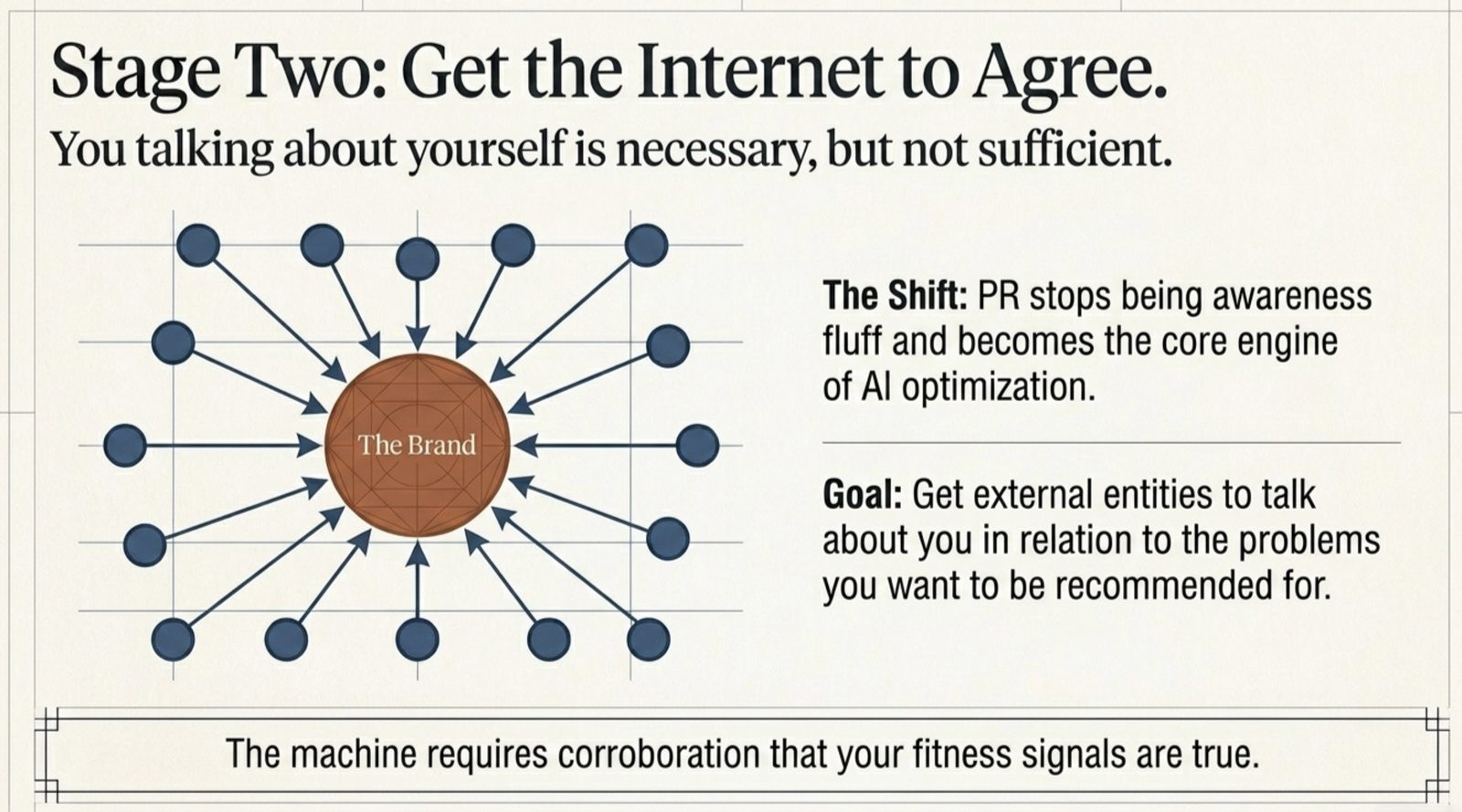
The second stage is validation.
You talking about yourself is necessary. But it is not sufficient. In competitive markets, you cannot achieve AI availability if the only person saying you are good is you.
Other people need to talk about you.
That means reviews. PR. Local press. Journalists. Influencers. Podcasts. Events. Industry bodies. Customer stories. Forums. Reddit threads. Social posts. Directory listings. Partnerships. Data studies. Awards. Links. Unlinked mentions. All the messy external corroboration that tells the network you matter.
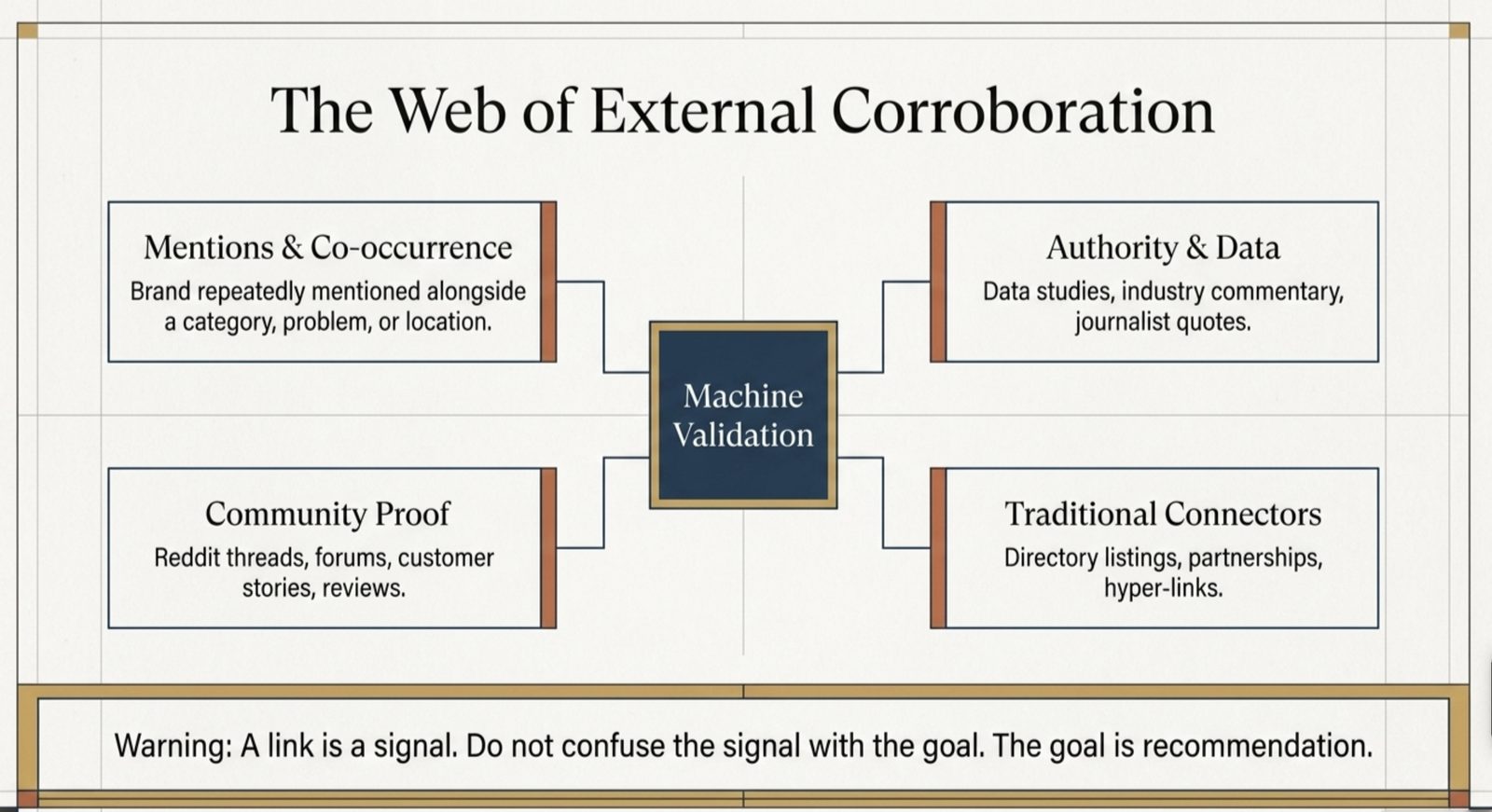
This is where PR stops being awareness fluff and becomes central to AI optimisation.
PR is the art of getting other people to talk about you in the way you want to be known. And in the AI era, that is not just useful for humans. It is useful for machines.
If you are an expert business, show expertise. Publish data. Comment on the industry. Help journalists. Run events. Create studies. Explain the problem better than anyone else. If you are a local business, create reasons for local people to talk about you. Open days. Competitions. Partnerships. Customer stories. Review funnels. Local creator visits. Community events.
A language platform creating a data study on the fastest-talking cities makes sense because it connects directly to the brand’s category. A tailor running a wedding suit event makes sense because it creates local proof, local content and local discussion. A PR agency talking about successful campaigns makes sense because it turns capability into visible evidence.
The SEO industry used to understand a sliver of this through links. Links worked because they were connections in a network. Then SEO turned link building into a grubby little marketplace of paid guest posts, fake authority metrics and transactional nonsense.
But AI systems understand more than hyperlinks. They understand language. They understand co-occurrence. They can see that your brand is repeatedly mentioned in relation to a category, a problem, a location, an audience or an outcome.
A link is still useful. A citation is still useful. A mention is useful. A review is useful. A journalist quote is useful. A customer recommendation is useful.
But do not confuse the signal with the goal.
The goal is not to be cited.
The goal is to be recommended.
Stage three: become preferred and recommended
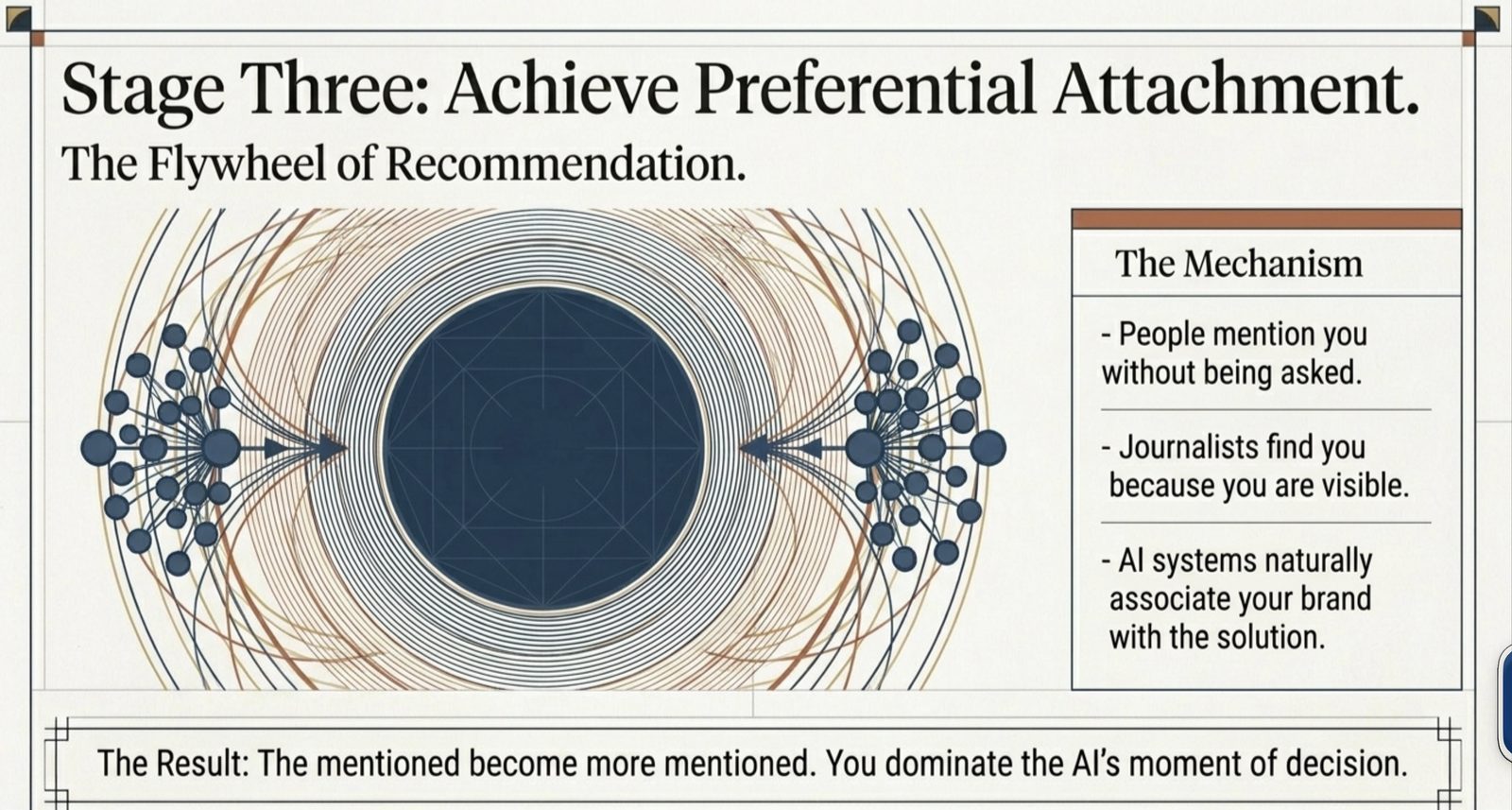
If you do stage one and stage two well enough, stage three starts to happen.
Preferential attachment begins to work in your favour.
People mention you without being asked. Customers recommend you without a prompt. Journalists find you because they have seen you before. Creators include you because you are part of the category conversation. Other businesses reference you. AI systems begin to associate your brand with the relevant problem, audience and outcome.
The mentioned become more mentioned.
The visible become more visible.
The recommended become more recommended.
This is the point of the whole exercise. Not traffic. Not rankings. Not citations. Not a lovely little dashboard full of impressions that everyone pretends to understand in the monthly meeting.
Preference.
Recommendation.
When a buyer asks an AI system, “Who should I use for this?” or “What is the best solution for my situation?” you want your brand in the recommended set.
That recommendation is commercially powerful because it happens at the moment of decision. It is close to an advert, a referral and a comparison-page placement rolled into one. And unlike your paid campaigns, you may not be able to see every time it happens.
That is annoying. Welcome to marketing. Not everything valuable is perfectly attributable. Anyone who tells you otherwise is usually selling attribution software.
But you can measure directional evidence. Brand search. Share of search. LLM referral traffic. Buyer-intent page traffic. Conversion rates. Review growth. Mentions. Prompt testing. Recommendation presence. Pipeline. Revenue.
The measurement will be imperfect. The commercial requirement is not.
You need to become preferred and recommended.
SEO hygiene is not dead. Just the traditional SEO delivery model.
This is where some SEO people get upset, usually on LinkedIn, where nuance goes to die.
So let’s be precise.
Search is not dead. Technical SEO is not dead. Paid search is not dead. Local search is not dead. Structured data is not dead. Merchant Center work is not dead. Site speed, internal linking, migrations, crawlability, indexing, page optimisation and buyer-intent landing pages all still matter.
Your website remains a key business asset. It needs to be technically healthy. It needs to be understood by bots. It needs to load properly. It needs to communicate clearly. It needs to convert.
But SEO as traditionally delivered is dead.
The old retainer model built around keyword lists, informational blog calendars, volume content, ranking screenshots and traffic reports is not fit for this new world. It will survive for a while because zombie models always do. They keep walking long after the brain has gone.
But the value has shifted.
SEO now needs to collapse into something bigger: AI optimisation, content marketing, PR, copywriting, analytics and brand strategy. The SEO person of the future cannot just know how to optimise a title tag. They need to understand positioning. They need to understand copy. They need to understand how buyers choose. They need to know how to audit a page for recommendation potential, not just keyword relevance.
A page can rank and still be commercially useless.
It can match a keyword and still fail to explain why the brand should be chosen. It can have the right headings and still contain no differentiation, no proof, no fitness signals and no reason for an AI system to recommend it over a competitor.
That is the new standard.
Ranking is not enough.
Recommendation is the goal.
Somebody has to own this
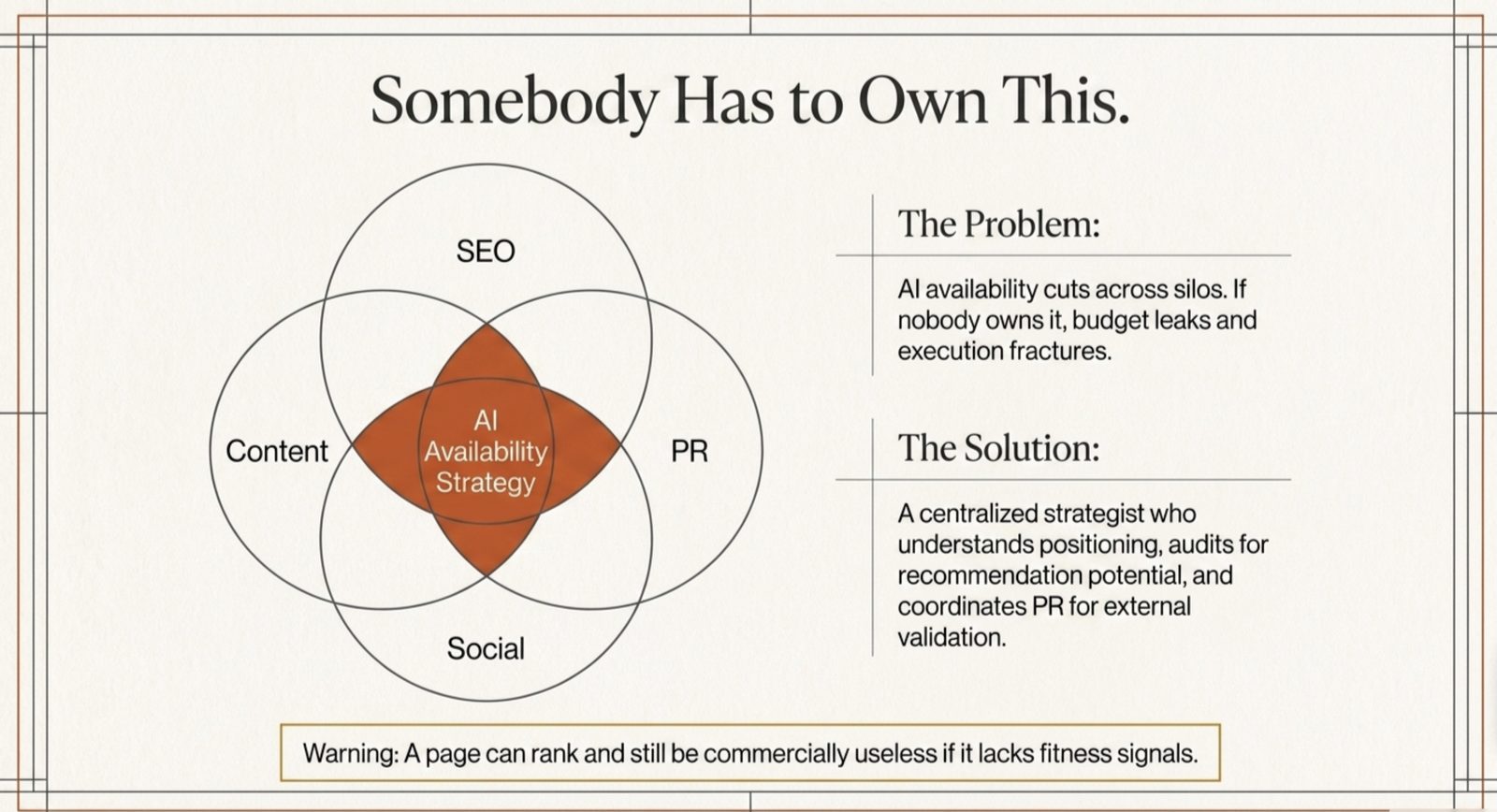
One of the biggest mistakes businesses will make is assuming this can sit neatly inside one existing channel.
It cannot.
AI availability cuts across SEO, PR, content, social, paid media, copywriting, analytics, brand and sales. Which means if nobody owns it, everybody will do a bit of it badly and the budget will leak out of the business like piss from a broken bucket.
Somebody has to coordinate the work.
That person or team needs to understand your positioning. They need to audit your buyer-intent pages. They need to identify missing fitness signals. They need to analyse who AI systems recommend and why. They need to work with copywriters to make pages more selectable. They need to guide social teams on what signals matter. They need to work with PR to earn external validation. They need to monitor brand mentions, reviews, share of search, LLM traffic, recommendation presence and revenue outcomes.
They do not necessarily have to create every social post, write every press release or fix every technical issue.
But they need to own the strategy.
Because if your SEO agency still thinks this is just traditional SEO with a few prompt reports stapled to the side, you have a problem. If your PR agency has no idea how earned media influences AI visibility, you have a problem. If your content team is still chasing informational keywords that Google will answer inside AI Mode, you have a problem. If your leadership team still asks for “more traffic” without asking whether any of it turns into revenue, you have a very expensive problem.
The future of search is not a channel problem.
It is a market orientation problem.
The customer’s view is the only view that matters. And increasingly, that customer is using AI to frame the market, understand the options and decide who deserves consideration.
You are not entitled to traffic. You are not entitled to rankings. You are not entitled to be clicked.
You earn recommendation by becoming clear, visible, validated and preferred across the internet.
The new law of search
Google I/O did not kill search.
It killed the comforting lie that SEO could remain a traffic machine forever.
The interface has changed. The economics have changed. The buyer journey has changed. And the strategic goal has changed with it.
Do not optimise for Google. Do not optimise for ChatGPT. Do not optimise for Perplexity. Do not optimise for whatever shiny interface gets announced next week by a man in expensive trainers talking about the future of humanity.
Optimise for the internet.
Make your brand easy to understand. Easy to validate. Easy to believe. Easy to prefer. Easy to recommend.
Push your fitness signals into the network. Get the market to validate them. Build preferential attachment until the mentioned become more mentioned, the visible become more visible and the recommended become more recommended.
Rankings were the old game.
Recommendation is the new one.
Act accordingly.
Originally published on LinkedIn on 21 May 2026.