
For ten years, a large part of the SEO industry built its worldview, its pricing, and its status on a simple belief: publish content, win traffic, call it growth.
It was tidy, scalable, and highly billable. It also produced a generation of SEO people who think SEO equals content, and content equals commercial value.
Now the click is being removed from the equation by AI platforms and Google. And yet a large portion of the industry is trying to sell the same thing without the only part that made it vaguely defensible…Traffic.
This is why you are seeing the current scramble around “AI visibility.” Citation counts. Prompt tracking dashboards. A new layer of reporting designed to keep the old machine running.
This is killing the SEO industry at scale.
The reality is harsh.
Interest in SEO has decreased by more than 50% over the last 12 months.
Search interest in hiring SEO agencies is down even further.
People aren’t idiots.
CFOs, marketing managers, CMO’s, business owners…they all got where they are today by making smart decisions with good ROI.
And now here’s the SEO industry. After years of trying to sell you on traffic as a good metric, while PPC sold revenue, SEO industry leaders are now telling you that you should optimise for AI citations.
Anyone with half a brain is looking at the SEO’s spouting this absurdity and thinking, “I’ll keep my money, thanks”.
Nobody wants to spend on optimising their content so AI can ‘cite it’. We still live in a harsh world of budgets and ROI.
But there is an alternative.
And in this article, I’ll give you the new search playbook.
The Problem: SEO Turned Content Into a Religion
Most people did not choose SEO. They fell into it. A role in an agency, a job in-house, a course, a tool, a few loud voices online, and suddenly they inherit a worldview about how the internet works.
That worldview was shaped by a specific era, when online information was scarce and ranking for informational queries was genuinely lucrative.
Early movers built real businesses because there was a gap between what people wanted to know and what existed on the web.
Publishing decent answers created disproportionate returns. Tools and agencies flourished because the market was undersupplied.
Then, as always happens, the industry saturated itself.
Every keyword that mattered got targeted. Skyscraper content arrived. Non-experts rewrote experts.
The internet filled with interchangeable pages that said a lot, proved little, and existed mainly to capture a query.
Traffic then became the goal. But when a measure becomes a target, it stops being a useful measure.
Whole-agency models were then built on content volume because it was easy to produce, bill for, and report on.
You could show “growth” without proving commercial impact.
Now AI has arrived and done what any consumer would do if they could… skip the pointless middle step.
The Agitation: We Ran the Numbers and the Market Has Lost Faith
This is where the “it’s just SEO” crowd needs to stop comforting themselves.
I partnered with the search data platform MyTelescope to see what’s really happening in search.
We ran the numbers. Not by eyeballing a few core keywords, but by using artificial intelligence layered over real search demand to group topics by meaning and intent.
This matters because it captures the full cluster around buying and researching SEO, comparing agencies, and exploring adjacent services, rather than a handful of headline terms.
What it shows is not a gentle decline.
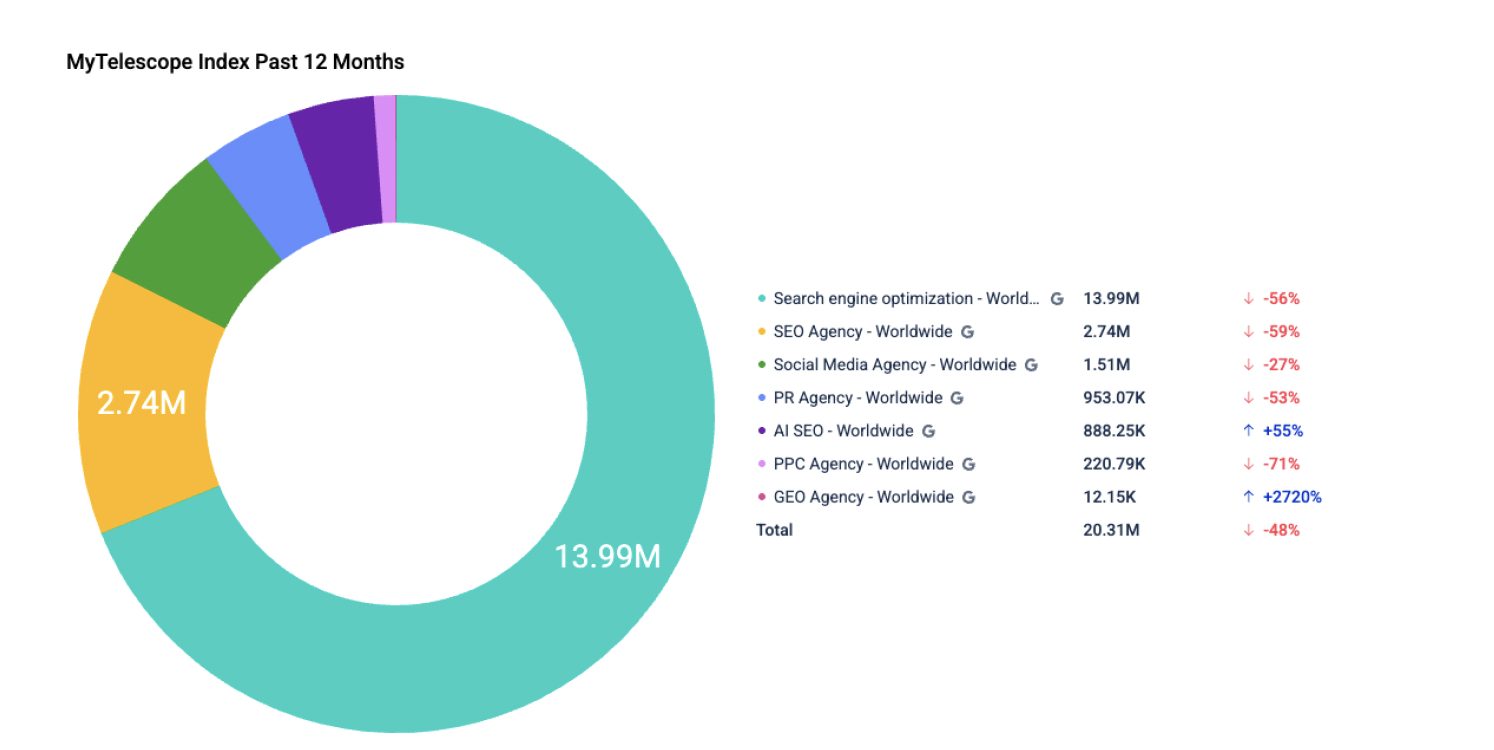
Search demand around search engine optimisation is down 56% year on year.
“SEO agency” is down 59%.
“PR agency” is down 53%.
“PPC agency” is down 71%.
Across the broader category, the contraction is close to 50%.
At the same time, interest in the emerging layer is rising fast from a smaller base. “AI SEO” is up 55%.
“GEO agency” is up 2720%. That volume is still small, but the signal is obvious.
The market is shifting its attention to “how do we get found in AI-driven discovery,” while losing faith in the old promises around content and traffic.
This is the danger.
When the most visible people in your sector respond to that shift by selling citations as a business outcome, they do not just harm their clients.
They reduce the credibility of the entire discipline.
The Worst Response: “AI Visibility” as the New Vanity Metric
Into this chaos comes the most predictable product imaginable: a new metric that cannot be tied to money yet is sold as if it is the future. It’s name…AI visibility.
The reality is that citations yield zero marketing or economic returns.
A citation is not a customer.
Having your content synthesised in an answer is not the same as being chosen in a buying situation.
For content-led SEOs, citations are the new traffic. They are a substitute KPI designed to keep the report looking busy while the commercial value declines.
The problem is not only that citations are weak as a business outcome. The bigger problem is that they are terrifying to sell to any serious operator.
When a CFO asks what they are getting for their spend, “we were cited” is not a credible answer. It sounds like paying for applause.
So the industry ends up undermining itself. It takes something that still has genuine commercial value and wraps it in a reporting-theatre package.
But why is this happening?
Your SEO Gurus Are Not Marketers
If you follow the search industry, you’ll see something odd happening.
I call it a collapse of credibility.
Behind all the bluster of Google patents and topical maps, you are seeing SEO’s left exposed.
Traffic was always a vanity metric, but it was a fairly good one. Boards liked it, marketing managers liked it. SEOs loved it.
But did that content lead to meaningful marketing success? Not really, and certainly not in recent years.
It’s not that you shouldn’t create content…you absolutely should.
It’s just that the idea of chasing informational keywords is dead.
The likes of HubSpot, Moz, Neil Patel, Ahrefs, and more… all won with their informational content.
Why?
Because they published close to their problem and in an era of low competition.
If you were an SEO tool that helps people improve their SEO performance, publishing content that also helps prospects improve their SEO performance makes sense, and targeting the keywords around that does too.
This rule applies to any market.
An HR SaaS that helps people solve HR management issues should target HR management-related keywords.
A bank could target keywords around savings advice.
But there are only so many keywords and only so much economic and marketing return from going beyond them.
To give you an example, there are plenty of SEOs who have won awards for creating glossaries.
One I know built a glossary for a bank and scooped up a bag of awards.
And while yes, you might gain traffic, nobody is getting a loan because they found your website for ‘how many current accounts can I have?’
The cost of that kind of SEO outweighs the marketing benefit because brand exposure can be achieved through display or social advertising at a far better ROI.
And when you remove the click (which AI does), the marketing benefit drops to zero.
And this is the great paradox.
The big play by content-focused SEOs was to treat content as ‘brand’ advertising.
The idea that you created content so helpful that the reader fell in love with your business and never forgot you.
Fine… I’ll buy into that for a few seconds. But even if you do buy into that, the reality now is that AI crushes it.
There is no advertising benefit of having your content cited by AI, or at least nothing worth having. And certainly not worth an SEO reatiner.
Yes, create content for your customers… absolutely.
Yes, create content that shows your expertise.
But AI search forces SEOs to become marketers. And sadly, the gurus with the loudest voices are showing a lack of real-world marketing expertise.
And this AI citation nonsense stems from a lack of marketing expertise.
But it doesn’t have to be like this.
There are perfectly logical explanations for the value of SEO and GEO; you just can’t hear them because the emptiest drums in the business are making the loudest noise.
Here’s the fix.
The Real Split: Two Search Disciplines With Two Jobs
The confusion around SEO ends when you separate the two jobs that have been mashed together.
SEO is Place

Commercial SEO is placement.
It is putting your brand on the shelf, on the digital aisle, where buyers are walking. Paid search proves the economics. Brands spend billions renting the top spots on transactional queries because those queries signal demand.
That means the organic shelf space on the same aisle carries real value.
This is why the fundamentals of SEO still matter.
Page titles. Header structure. Internal linking. External authority. Clear page segmentation so Google understands what each page is about. Clean information architecture. A site that does not leak meaning.
Yes, search results are more crowded. AI modules take more real estate. Ads take more real estate. “People also ask” takes space. Organic listings are squeezed.
That makes placement harder, not irrelevant. The response is to be more disciplined about where you compete and how you win.
GEO is Promotion

Generative Engine Optimisation is promotion.
It is not “SEO with prompts.”
It is positioning, validation, and fame expressed in a way that large language models can retrieve and recommend.
The engine here is constrained intent.
The more specific the prompt, the more likely a highly positioned business is to be surfaced.
GEO rewards difference. It rewards clarity on who you serve, what you do, and how you do it better.
It also rewards third-party information, not just what you say about yourself but what the world says about you.
This is why bland, interchangeable providers struggle.
If you present as “we do everything for everyone,” a model cannot confidently recommend you for a specific problem. When you are sharply positioned, you become the obvious answer for a constrained need.
This is not theory. We see it in practice.
At JBH, we ask prospects where they found us. Around half of our leads now come from AI-driven discovery because we serve a particular need well, and our market signals support that positioning.
The Solution: Stop Debating Search and Start Building a Revenue System
Here’s the mistake the industry keeps making. It tries to replace one religion with another.
Content SEO becomes “AI visibility SEO.” Traffic becomes citations. Reports change, but the commercial logic stays broken.
A serious solution is different.
It accepts that search has split into two linked systems.
One is about placement where demand is explicit.
The other is about promotion, so you are chosen when demand is described in human language.
You do not choose one. You integrate both into a revenue system.
And here’s how.
Step 1: Build the “Place” plan first
If you want a revenue engine, you start where the money already is. Buyer intent.
This means mapping the transactional aisles.
These are the terms that paid search teams fight over because they produce leads and sales. Category terms. Service terms. Comparison terms. Location plus service. Product plus attribute.
These are not educational queries.
The deliverable here is not “more content.” It is a commercial shelf plan.
Which aisles matter?
Which pages own them?
Which competitors currently hold the shelf?
Where are the gaps?
Where do you have an unfair advantage?
Where can you take share from paid?
Then you do the unglamorous work that actually wins placement.
Clean page titles that reflect intent. Header structures that reduce semantic noise. Internal links that clearly signal page relationships. External authority to the pages that matter. Structured data where it supports clarity. Fixes that remove ambiguity, not “optimisations” that create more.
This is what revenue-focused SEOs have always done. It is why e-commerce and local SEO have remained economically relevant while content-first models are wobbling.
Step 2: Treat GEO as a positioning audit, not an SEO trick
Now you build the “promotion” layer.
GEO starts with constrained prompts.
Not broad keywords. Constrained buying situations.
You pick prompts that represent the exact customers you want.
“Shopify SEO agency specialising in subscription brands in Manchester” is a constrained prompt mapped to a buying situation.
It is a segment, an offer, a platform, and a location. It is a real buying situation.
Then you test whether the brand shows up.
If it shows up, you do not celebrate and stop. You ask why.
What signals are causing inclusion?
What pages exist?
What third-party sources exist?
What reviews, mentions, or validation appear?
This is the start of your mutual information map.
If it does not show up, you do not panic and publish a blog post. You diagnose.
Who is showing up? What do they have that you do not? What language are they using? What evidence exists? What external validation exists?
That is where your “promotion gap” is.
Step 3: Reverse the constraints to find the boundary of your relevance
Start at the most constrained prompt. Then remove constraints one by one.
Remove the city.
Remove the platform.
Remove the segment.
Broaden step by step.
Each time, check whether the brand remains present.
What you are doing is mapping the boundary of relevance. Where the model is confident enough to recommend you, and where you dissolve into the generic crowd.
That boundary tells you whether your positioning is sharp or mushy. It tells you whether your promotion signals are consistent or scattered.
This is not the old keyword funnel. It is a positioning ladder.
Step 4: Build assets that increase “discoverability” without recreating the content trap
Once you have the boundary map, you build the assets that strengthen inclusion. This is where most people go wrong because they revert to volume.
Your website becomes a web. The bigger and clearer the web, the more chance it catches the right prey.
But a bigger web is only useful if it is organised. Otherwise, you get cannibalisation. Pages collide. Meaning dilutes. Both SEO placement and GEO promotion suffer.
So the deliverable is not “more pages.” It is the right pages, built around your positioning.
Service pages that clearly state who you serve, what you do, and how you do it differently.
Segment pages where the segment is real and commercially relevant.
Product and category copy that is explicit about attributes, not generic fluff.
Case study pages that are evidence-led, not vanity storytelling.
Brand exposure still matters.
If the ecosystem is showing image packs, panels, carousels, and visual elements, then your images should be named, described, and structured to carry brand signals. Not because it replaces revenue, but because it increases the chance of recognition in compressed attention environments.
Your own content still has a role here, but it changes purpose.
It stops being written to win a keyword. It starts being written to reinforce the positioning narrative and prove expertise.
Evidence, examples, demonstrations, and explanations that are useful because they clarify why you are the right answer for a constrained need.
Step 5: Increase mutual information with third-party validation
This is the part the SEO industry keeps skipping because it is harder to productise than blog posts.
Large language models do not trust you because you wrote “we are the best.” They trust you when the market corroborates it.
So GEO requires a validation plan.
Reviews that speak to the positioning.
PR that reinforces the category you want to own.
Mentions on relevant sites.
Partnerships.
Founder visibility when it supports expertise.
Case studies that are referenced externally.
This is why GEO borrows from PR and brand marketing. Because it is promotion.
It’s about becoming known for something specific and having that “known-ness” distributed across the network.
If you are interchangeable, you need to choose.
What do you want to be famous for?
What segment do you want to win?
What benefit do you want to own?
The model rewards that discipline.
Step 6: Measure outcomes that connect to money
This is where you kill the citation obsession without sounding ideological.
Citations can be a diagnostic signal. They can help you understand whether your information is being used. But they are not the goal.
The goal is recommendations in buying situations.
So the reporting stack follows the split.
For “Place” SEO, you track commercial shelf performance.
Share of visibility on buyer-intent terms. Traffic to commercial pages for buyer intent keywords. Rankings for buyer intent keywords. Organic conversion rates on category and service pages. Revenue influenced by organic. Cost per organic acquisition relative to paid.
For GEO promotion, you track inclusion across constrained prompts, but you connect it to outcomes.
Qualified leads that originate from AI discovery.
Traffic from AI search. Revenue from those leads.
The prompts that create them (you get these if you ask customers).
The increase of external validation assets that correlate with inclusion. PR, mentions, reviews etc.
If a metric cannot be explained as a path to commercial impact, it stays out of the board deck.
The Payoff: Search Becomes Two Levers Instead of One False God
Once you understand “place” and “promotion,” the industry noise becomes easier to ignore.
SEO is still the shelf. It is still about being present where demand is explicit.
GEO is the new promotion layer. It rewards positioning, proof, and third-party validation when demand is expressed as a real human need rather than a two-word keyword.
The tragedy is that the industry has the material to explain this clearly and sell it commercially, but too many people are trying to preserve the old content machine by inventing new vanity metrics.
That is why search demand is contracting across the category. The market is bored with reporting theatre. It wants commercial logic.
The new playbook is not more content. It is not “AI visibility.” It is not a semantic argument.
It is a revenue system built on two levers.
Placement where buyers walk. Promotion so they choose you.
Do both properly, and you do not need to guess whether SEO will die. You will already be building the next version of search that replaces it.
Andrew Holland
Originally published on LinkedIn on 4 March 2026.