The SEO industry has had a remarkable twenty-year run.
It built careers, companies, and entire ecosystems of tools, training, and tactics. It helped millions of businesses get discovered and helped countless practitioners sharpen skills that genuinely mattered.
But the next decade of search is not going to look like the last one.
AI is reshaping how people shop, how they discover, and how they make decisions. And instead of undermining SEO, it’s opening a much wider landscape — one that rewards those who think beyond rankings and start thinking like full-stack marketers.
This isn’t a story about SEO dying. It’s a story about SEO expanding.
The shift from search optimisation to search maximisation is already underway.
And the SEOs who make that transition, who move from “How do I optimise this page?” to “How do I maximise our visibility, credibility, and presence across the entire digital shelf?”
Are the SEO’s who will define the next era of search.
If you work in SEO, your career doesn’t get narrower from here. It gets broader, richer, and more valuable — if you embrace the bigger marketing lens that AI now demands.
The day the interface changed
Over the last year, we’ve watched a weird new shopping habit emerge.
Instead of going to Google, typing in “best boxing punch pads” and trudging through 47 identical e-commerce sites, you now say to an AI assistant:
“I need new punch pads for boxing – mid-range, good for home training, fast delivery.”
And then you leave it alone.
It asks a couple of follow-up questions, disappears into the web, does all the comparison, filters the junk, and comes back with:
The best-rated options
From retailers it judges to be trustworthy
At prices it believes are fair
In a single, neat feed
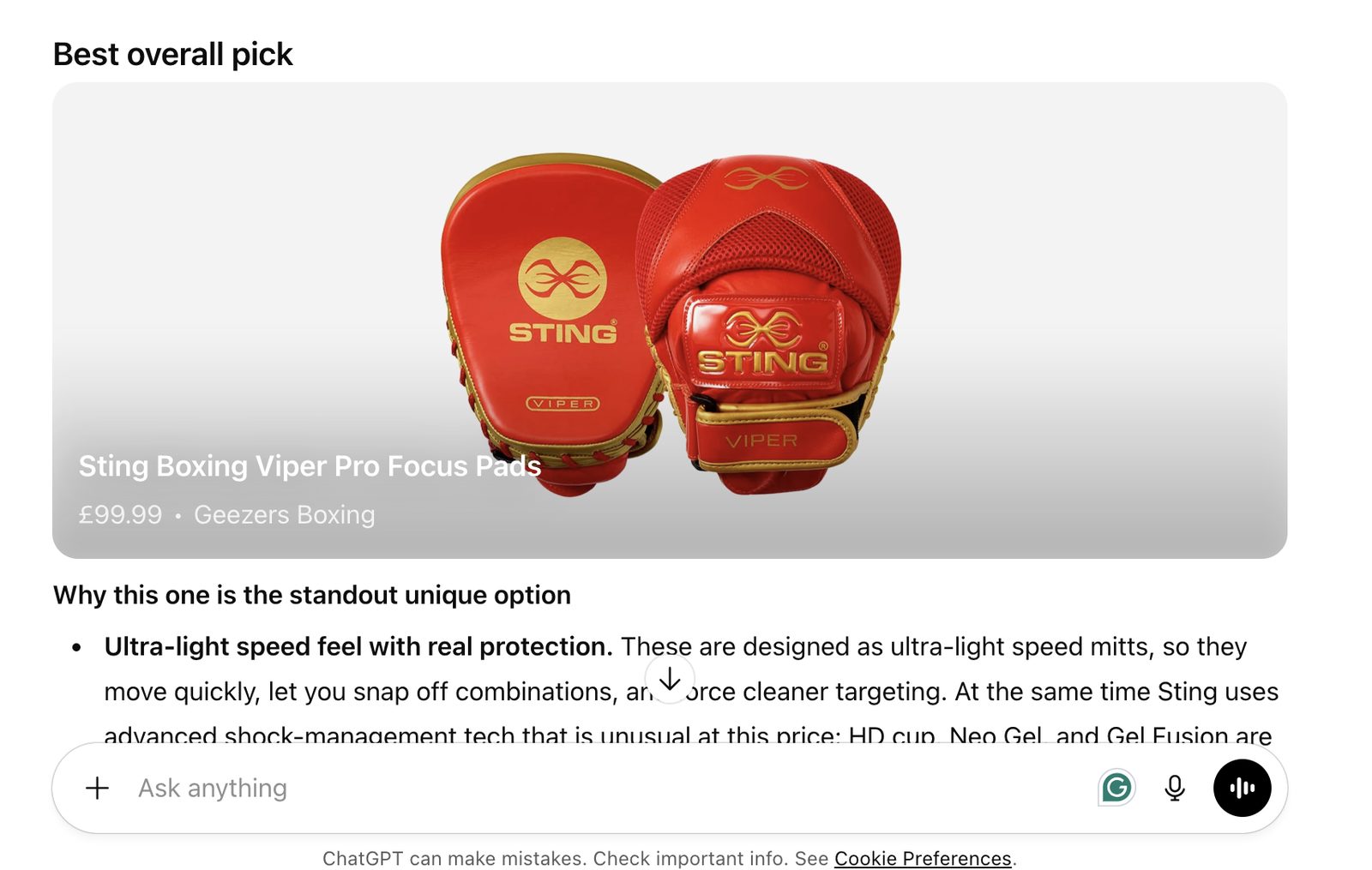
No banner blindness. No ten blue links. No scrolling past three pages of “sponsored” clutter.
That’s a complete change in the user interface of shopping.
Rory Sutherland has been banging on for years about how much interfaces matter. Uber didn’t change taxis. It changed the experience of ordering one. You tapped a screen instead of waving at traffic. The entire industry bent around that small fact.
AI shopping assistants are doing the same thing to search.
They are not a new results page. They are a new middle person.
And that is very bad news for old-school SEO.
SEO was always about “place”, not “promotion”
If you strip the jargon out, e-commerce SEO has been a very simple game for a very long time.
In the classic four Ps of marketing – Product, Price, Place, Promotion – SEO lived firmly in Place.
Your job was to get your product onto the best spot on the digital shelf:
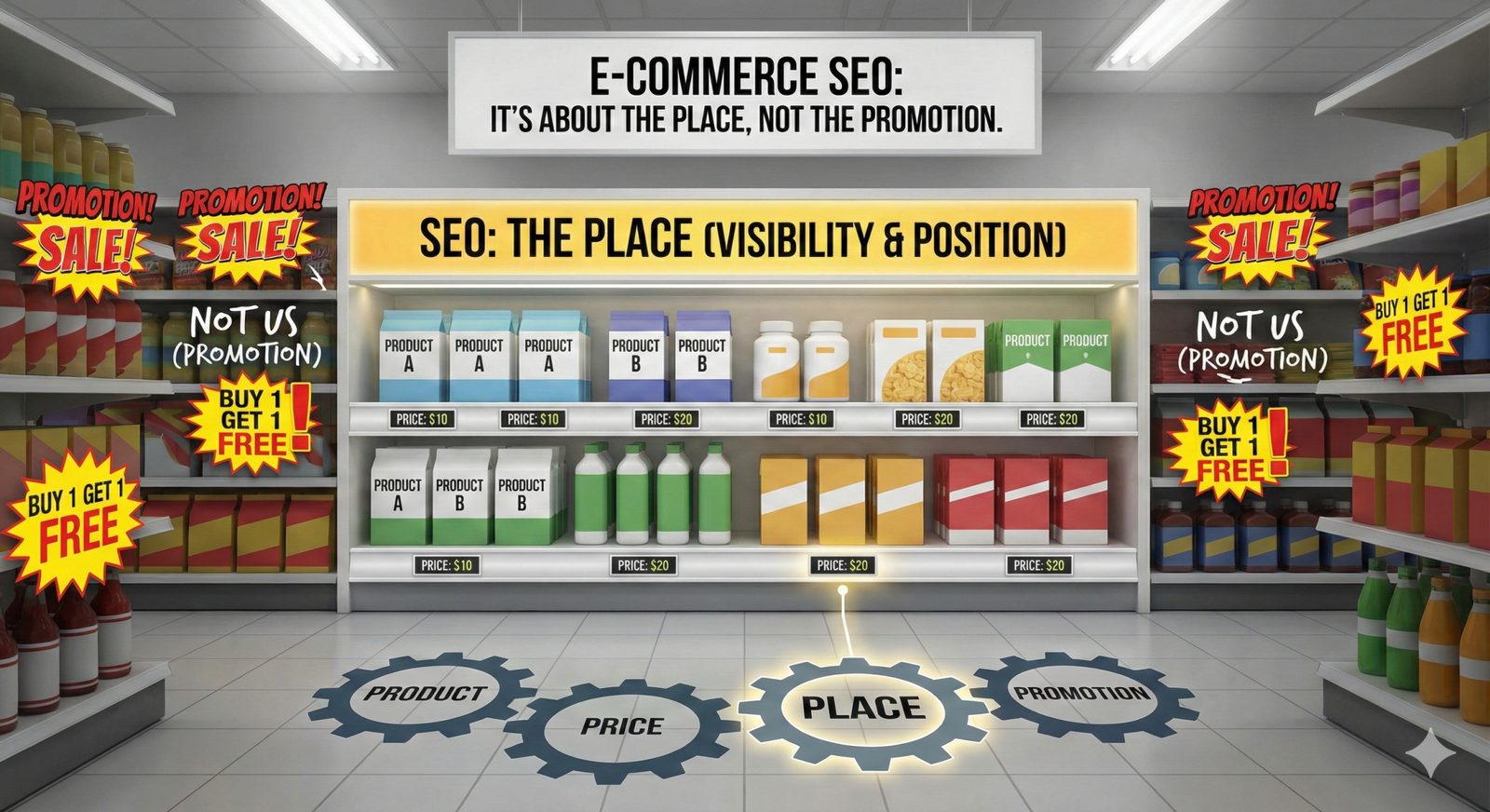
Keywords were the aisle numbers.
Category pages were the aisles.
Your product listing was the box sitting at eye level.
Paid search was the slotting fee to be on the endcap.
Rank higher on the shelf → get more clicks → get more sales. If your product and price were decent, this was almost boringly mechanical.
So we built a whole industry on this.
Fleets of near-identical sites selling near-identical products and services at near-identical prices, making their margin entirely from:
Paid search arbitrage, or
Organic rankings from technical tweaks and link games.
It worked because Google’s interface was stable and predictable enough that you could optimise your way into visibility.
You weren’t building a brand. You weren’t building distinctiveness. You were gaming a shelf.
The algorithm has moved. The shelf is gone.
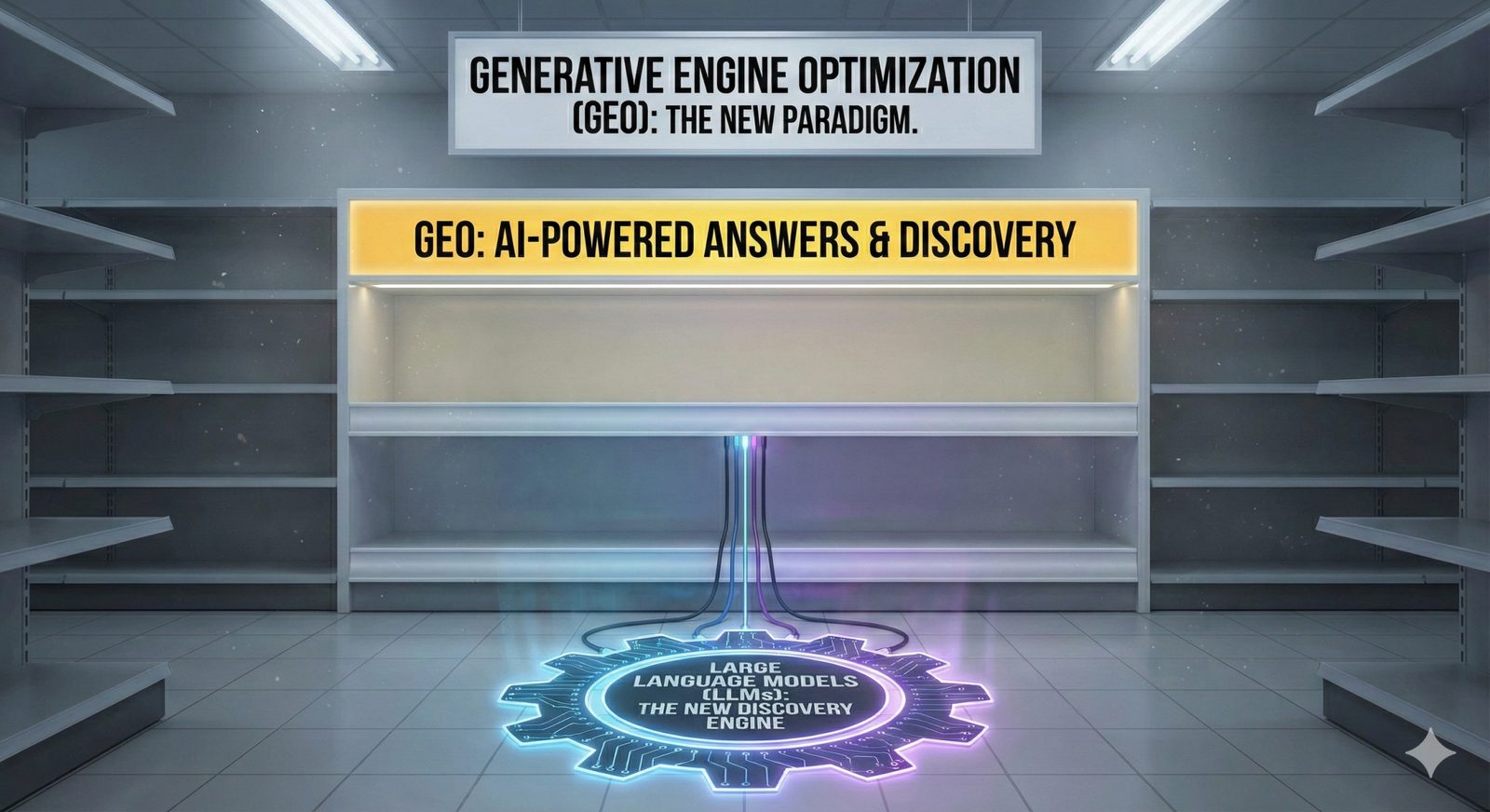
Now ask a much harder question:
How do you “optimise” for a system that:
Won’t tell you how it works
Won’t show you its “results page”
And responds to prompts you will never see?
You don’t know what the user typed in. You don’t know which dimensions the model weighted most. You don’t know which products you were beaten by, or why.
That’s not a ranking problem. That’s a recommendation problem.
The brutal reality for traditional SEO is this:
A new layer now sits between your site and the consumer.
That layer is not interested in whether your H1 tags are tidy.
It is interested in whether you are the best possible answer for a specific human, with specific constraints, trying to save time.
Consumers “satisfice”. They happily pick the least-worst acceptable option to avoid wasting time. AI’s entire proposition is: Let me satisfice for you, instantly.
So the importance of placement – the comfort blanket of “we rank number one for [core keyword]” – collapses when each user’s query is unique and each answer is tailored.
Being on the digital shelf is no longer the win. Being chosen by the assistant is.
From search engine optimisation to search maximisation
This is the key pivot.
Old SEO asked: “How do I optimise this page so the search engine likes it more than the other pages?”
Search maximisation asks: “How do I maximise the probability that any intelligent agent will recommend us over our competitors?”
That moves you out of “Place” and straight into Promotion.
Not “promotion” as in “write a 2,000-word blog post nobody wants to read”.
Promotion as in: engineer the fame and fitness of your product in the market.
To win in a maximisation world, you need to strengthen your fitness signals – the hard, comparative proof points that any rational system (human or artificial) will latch onto:
Are your prices consistently better, and can you prove it?
Is your delivery measurably faster?
Are your reviews clearly superior – and numerous?
Are you carried by more reputable retailers than your rivals?
Is your brand promise sharp, credible, and repeated everywhere?
Is your brand known by AI.
Yes, you still need clean data. Schemas, structured product feeds, all the usual hygiene. That’s the price of entry now, not a strategy. Most platforms can generate the basics automatically. AI can read messy sites. Structure alone is no longer an advantage.
The differentiator isn’t technical tidiness. It’s market truth.
And that pushes you towards real promotion and real marketing.
Distribution beats tinkering
Traditional SEO encouraged a weird kind of centralisation.
“Everything must happen on our website. Our blog. Our funnels. Our forms. Our pixel. Our control.”
Maximisation flips that thinking.
If AI is going to traverse the whole web to bring recommendations back, the obvious question is:
“Why on earth is our product only in one place?”
If your product is on your own site and two marketplaces, why not ten?
If it’s on ten retailers, why aren’t industry publications reviewing it?
If there are reviews, why aren’t creators talking about it?
If creators exist, why is your team posting three dull social updates a week instead of doing something actually interesting with the product in the real world?
Promotion in this new world is not “post more content”. It’s increase your true distribution of presence:
More retailers = more physical/digital availability
More credible mentions = more proof
More third-party coverage = more independent signals
More real product usage in the wild = more stories to surface
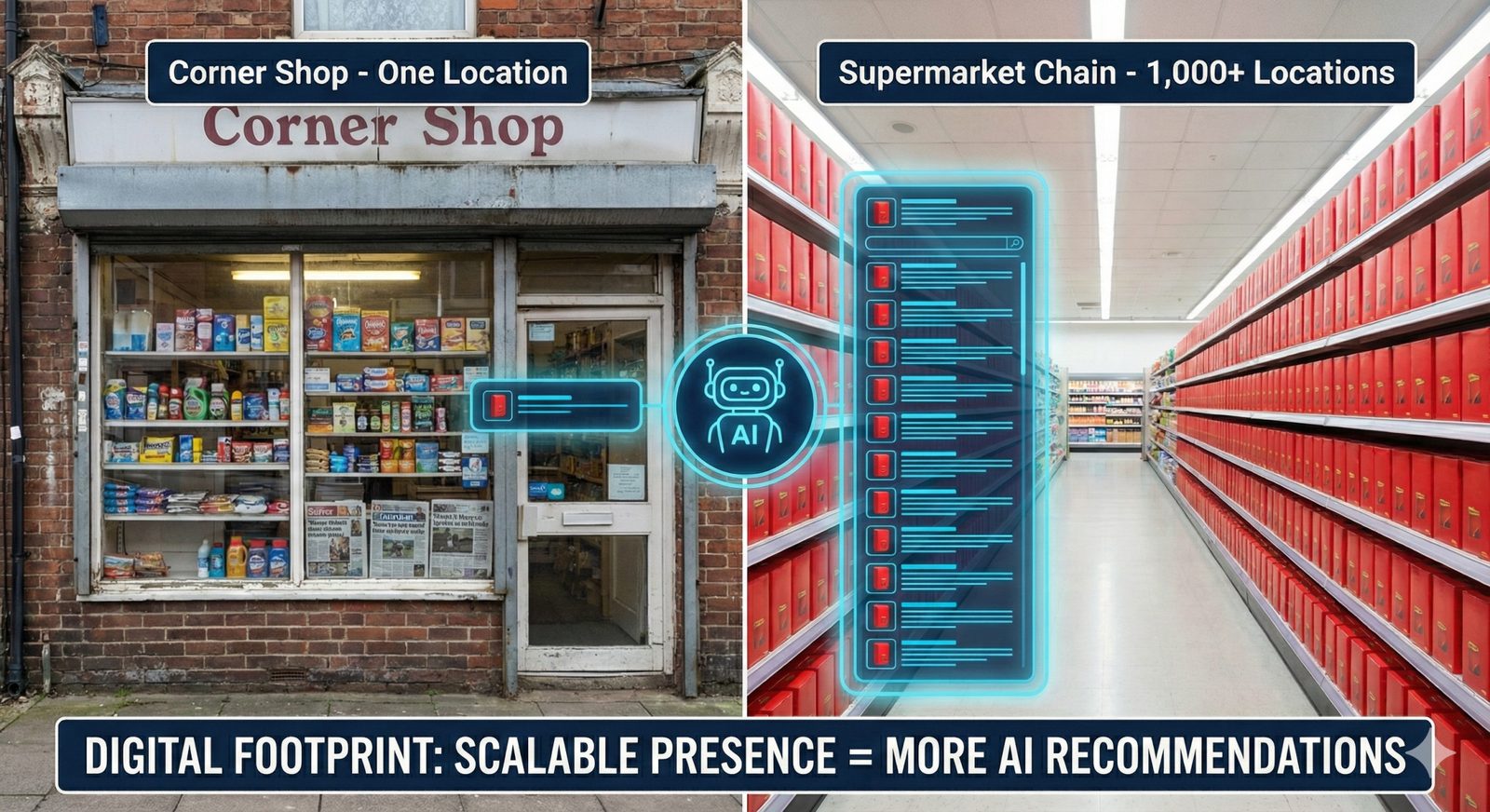
Remember the old retail question: What sells more – a product in one corner shop or a product in 1,000 supermarkets?
Exactly the same logic now applies to your digital footprint. AI assistants are just very fast, very scalable shoppers. The more places you genuinely exist, the more often you’ll be found and recommended.
The uncomfortable bit for SEOs
This is where the “It’s just SEO” crowd runs out of road.
For years, a lot of people have called anything and everything “SEO”:
Copywriting? SEO.
PR? SEO.
Product page rewrites? SEO.
Digital PR stunts? SEO.
New product ranges? Somehow also SEO.
If the output eventually touched organic search, it got relabelled as “SEO”, and the case study deck claimed the credit.
The problem is: inside real businesses, SEO has often had very little genuine influence and this stance doesn’t wash. Other departments know exactly how much the SEO team affects them and what the SEO team does, despite the fact that SEO might claim credit on LinkedIn.
I know large companies with no SEO manager, no SEO agency – and millions in organic revenue.
I know SEO managers whose only power is to request small changes and forward agency audits.
I know agencies claiming strategic glory for outcomes driven by brand, product, and distribution decisions they never touched.
In a maximisation world, that bluff doesn’t survive.
Tweaking titles will not move an AI assistant. Re-ordering H2s will not increase your recommendation rate. A handful of links will not override a weaker proposition.
So SEOs have a choice:
Become marketers. Move upstream into market orientation, positioning, distribution, pricing, real promotion. Accept that organic visibility is an output of many departments, not your personal kingdom.
Or go deeply technical. Head into the emerging world of agentic search, crawling, infrastructure, data pipelines – the plumbing that will feed these assistants. There will be important, specialised work here.
What you cannot be, for much longer, is the person who “optimises pages” in a silo and calls that a strategy.
The humbling lesson: you are not the consumer, and you are no longer the interface
Marketers already struggle with the basic truth: you are not the consumer. Now there’s another one: you are no longer the interface either.
For twenty years, SEO has behaved as if the search results page was a kind of private canvas – something to be nudged, nudged, nudged until it displayed reality the way we wanted it to.
AI wipes a lot of that away.
Consumers will increasingly describe, in their own words, what they want. Intelligent systems will go and fetch it. Your job is to make sure that when those systems look around the market, your product:
Is available in many places
Is clearly better (or clearly something) on the dimensions that matter
Is talked about, reviewed, trusted and repeatedly described in consistent, distinctive ways
That isn’t “hacking the algorithm”. That’s doing proper marketing.
So yes, the era of SEO as a stand-alone, page-tweaking discipline is ending. The era of search maximisation – of building brands and businesses that intelligent systems can’t ignore – is beginning.
Stop thinking like an optimiser. Start thinking like a marketer.
Placement got you this far. Promotion will get you the rest of the way.
Andrew Holland
Originally published on LinkedIn on 27 November 2025.