By 2026, having AI recommend your business will be just as important as ranking on Google (maybe even more).
While most people focus on on-page optimization, the real challenge for AI visibility is happening off the page.
This guide explains how to get AI systems to recommend your business, and the approach may surprise you.
Using insights from major studies and new research, I’ll show you how to build the signals that help AI systems trust and recommend your brand.
Let’s dive in.
What is GEO Trying to Achieve?
Imagine a potential customer asking ChatGPT, “What’s the best project management software for a small marketing agency?”
or
“Which sustainable clothing brands should I check out?”
The AI’s response will recommend specific businesses and whether yours is included depends on your GEO strategy.
GEO (Generative Engine Optimisation) has one clear goal:
To increase the likelihood that AI systems will recommend your business when people are in the market or coming into the market to buy.
This is fundamentally different from traditional SEO in three ways:
Instead of optimising for rankings, you’re optimising for recommendations.
Rather than competing for keywords, you’re competing for trust signals.
Success isn’t measured in traffic, but in how often AI systems cite your brand as a solution.
The question is: how do you become one of those recommended brands?
Why Mutual Information is the Key to GEO Success
To explain how to improve your chances of being recommended by AI, let’s look back to 1948.
A paper created by Claude Shannon titled A Mathematical Theory of Communication introduced the subject of information entropy.
Without getting too technical, information entropy has a significant impact on natural language processing and the optimisation for generative engines.
Because information entropy is a way to quantify uncertainty in a message.
And yes, while 1948 was some time ago, it matters today. Because LLMs are based on mathematics, and if you’re wondering why Claude is called ‘Claude’, the reason is down to the genius of Claude Shannon.
In his 2019 book The Beauty of Mathematics and Computer Science, former Google engineer Jun Wu stated:
“Nearly all applications of natural language understanding, information processing, and signal processing are related to the elimination of uncertainty.
In that same book, he also stated that information entropy and mutual information form a basis for information and information theory, which is vastly important for natural language processing.
What we’re talking about is the mutual information needed by large language models to be certain.
And it’s this information that large languge models need to ‘be certain’ about the results that they provide.
Other concepts also matter such as probablity theory and relative entropy, but to keep things as simple as possible, and also easy to explain. Mutual information remains a useful and broad term that can be applied to both on-page and off- page optimisation for GEO.
And while I may be murdering some of it’s technical terminology and science, I’m grabbing the term for GEO because it’s simply the best fit.
So, what is mutual information (MI)?
Mutual Information = Food For AI
Think of mutual information (MI) like earning ‘word-of-mouth points’ for your brand in the digital world.
Just like personal recommendations among friends can make or break a product, in the AI realm, these ‘points’ signify how much AI trusts your business.
The more credible and relevant information the AI can draw upon about you, the more confidently it can recommend your brand.
Now, diving into the technical aspect, mutual information (MI) is a concept from information theory that measures how much knowing one piece of information reduces uncertainty about another.
In the context of generative engine optimization (GEO), mutual information refers to the signals and evidence that help AI systems feel more confident in recommending your brand over others.
And yes, this also aplies to your on-page efforts but I’ll cover that in another guide.
Simply put, the more unique, relevant, and credible information that exists about your business, such as expert and customer reviews, mentions in authoritative publications, and strong community endorsements.
The more certain an AI system can be that your brand is the right answer to a user’s question.
Essentially, building mutual information is about supplying a rich, diverse, and trustworthy digital footprint that reinforces why your business should be recommended.
Machines hate ambiguity.
They hate uncertainty.
And that’s what you want to eliminate when it comes to GEO.
You want to increase the likelihood or the certainty that a large language model has that you’re the right solution to the problem the user has.
And yes, mutual information is used by search engines and the SEO industry, and we’ve been doing it for some time.
It’s just that large language models are looking for different types of mutual information so that they can recommend businesses.
Of course, if you think about this, human logic also revolves around this.
However due to time and energy constraints we use hueristics (mental shortcuts) and ‘satisficing’ to make decisions.
Or in other words, we rarely go beyind the first page of Google because the first page is ‘good enough’.
LLMs/ AI search doesn’t have these limitations.
What Type of Mutual Information Do You Need to Build
When looking at the types of mutual information you need to build, there are several studies that have been put out into the world which can help you understand this.
The first comes from Yotpo and their brand benchmark study, during which they noted certain categories of citations that helped brand visibility. https://www.yotpo.com/commerce-gpt/brand-llm-benchmark/
They are:
Tier-1 media (30%): WSJ, NYT, Forbes, Bloomberg, earnings, activism, acquisitions.
Category experts (25%): Runners World, Outside, Gear Patrol, buying guides & best of lists.
Consumer validators (20%): Wirecutter, Consumer Reports, Good Housekeeping, lab tests, awards, seals.
Community proof (15%): Reddit/forums, e.g., r/BuyItForLife loves Patagonia; r/running debates Nike vs. Hoka.
Influencers/YouTube (10%): Unboxings, reviews, hauls, e.g., MKBHD; fitness creators in Lululemon.
This would place 75% of the Mutual information needed to increase visibility, based on digital PR activity/ product marketing.
Another study conducted by the University of Toronto revealed similar findings as Yotpo.
In their research, they stated:
“Our key findings reveal that AI Search exhibit a systematic and overwhelming bias to- wards Earned media (third-party, authoritative sources) over Brand-owned and Social content, a stark contrast to Googles more balanced mix”
And they went further to talk about their findings:
“The most consistent and significant finding is the overwhelming bias of AI engines toward Earned media. Claude and ChatGPT are extremely earned-heavy, while Perplexity and Gemini incorporate more brand and social content but still prioritize earned sources”.
To win in AI search, a brand must shift its focus from creating owned content to systematically earning third-party validation. This means investing heavily in public relations, media outreach, and expert collaborations to secure features, reviews, and mentions in the authoritative publications and review sites that these engines favour.”
In addition to this, Profounds Josh Bluyskal conducted an analysis of 40 million AI search results to find that the most cited websites were social/community platforms, reference resources, media outlets, and specialized consumer advice sites.
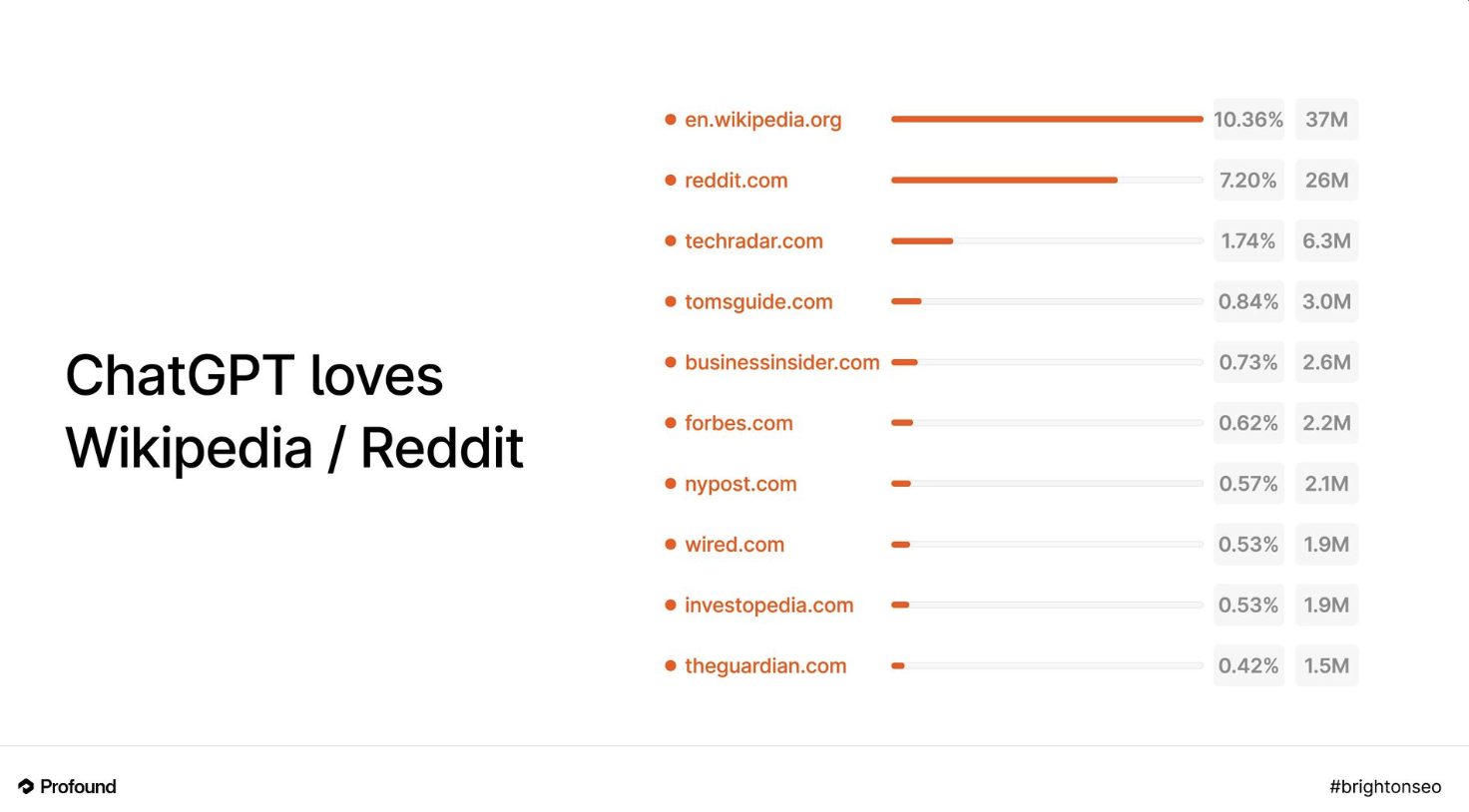
The research done by Profound, the University of Toronto, and Yotpo all line up with pretty much what we’re seeing out there.
Your brand, products, and services need to be talked about by others.
But what about links?
Build Doorways to Your Brand
In my last article on GEO I provided a quote from Kevin Kelly that stated:
Being found is valuable, and given the increasing number of works created each day, being found is becoming increasingly unlikely.
I think that’s true.
The problem is that being found by brand mentions is challenging because you’re not always linked to.
Traditionally, we viewed links as a means of building authority in search engines, and this approach remains practical.
However, we now know that brand mentions and not necessarily links are what drive visibility.
Language models don’t care about links; that’s not what theyre bothered about.
Search engines do.
So if we’re going to talk about links, it’s a good point to understand the science of them.
Perhaps the most classic book ever written on links is called Linked by Albert Laszlo Barabasi.
Barabasi is a distinguished university professor at Northeastern University, where he directs the Centre for Complex Network Research.
Inside the book linked, Barabasi states that the web is a scale-free network where certain hubs attract most of the links.
These hubs, of course, are big brands and well‑known websites. The Wikipedias, the Facebooks, the Times and the New York Post. These are websites that attract a lot of links because they are talked about.
Nike and other big brands are exactly the same.
Many websites have numerous links because they are frequently mentioned and cited.
This is what Barabasi calls the Law of ‘Preferential Attachment’ or the rich‑gets‑richer effect, and you’ve seen it.
If you’ve worked in SEO you know there are businesses that generate and gain backlinks for free simply because they’re big brands.
But not everyone is a big brand, and most SEO is done on a small scale for much smaller brands.
So the question is, how do you get links?
Barabasi suggests you need to display what are called fitness signals about your brand.
Fitness is term used to describe the Intrinsic qualities of a brand, product or even person.
In the book Linked, Barabisi states:
“Fitness is your ability to make friends relative to everybody else in your neighbourhood.
A company’s competence in luring and keeping consumers compared to other companies. An actor’s aptitude for being liked and remembered relative to other aspiring actors.
A web page’s ability to bring us back on a daily basis relative to the billions of other pages competing for our attention.
It is a quantitative measure of a known ability to stay in front of the competition.
Fitness may have a generic root in people. It may be related to product and management quality for companies, to talent for actors or for content for websites.”
In his follow‑up book, The Formula, Albert Laszlo Barabási gives more prescriptive ways to generate this kind of fitness and success.
He states:
Fitness allows us to capture a product’s inherent ability to out‑compete other products clamouring for the same buyers, audiences or admirers.
This, of course, means that your product, service, business and brand need to actually have what we’ve been talking about all along: performance attributes.
You need an intrinsic quality that is better than the competitors; otherwise you will not succeed. Just being average isn’t good enough. However, Barabási states that perception is a massive indicator of success.
Indeed, the first law of success states:
Performance drives success, but when performance can’t be measured, networks drive success.
And yes, we’re back again at the same point of mutual information, the information that the market and the network have about your brand.
Making the job of GEO almost entirely around fitness and reputation signaling.
In real terms, this is almost entirely copywriting, digital/ traditional PR and content marketing.
And yes, I class link building as content marketing.
Get other people talking about your business and representing you in relation to the characteristics you want to be known for.
The problem you generally face is that journalists are becoming increasingly scarce.
We’ve seen redundancies at large publishers, and large publishers who have relied on Google traffic are seeing their revenues decline because they earned money creating content for search engines based on keywords.
The Google monetisation model of SEO that everyone based itself on is now decaying to better represent a scale-free network.
But we’ve ended up in a world where there are fewer journalists and probably a lot more PRs trying to fight for the attention of journalists.
In short, it’s really hard to get anyone to talk about you anymore.
And as traffic and attention become increasingly challenging to obtain, links increase massively in value, not just because those links will have a brand mention talking about you, but because having a physical link that is used by search engines and clickable by humans will help generate the success you want.
So, just because LLMs don’t use links doesn’t mean there isn’t massive value in obtaining and building them.
Links act as signals for search engines around your brand, and they also allow for discovery by humans. Arguably, the latter will be of greater importance in the future.
So the question is, how exactly do you really build these links and mentions?
Content Marketing and PR Are Fuel For Brands
What you’re trying to do with content marketing and PR is to increase the fame, fluency and feeling that people have towards your brand.
You want people to see your business as good, useful and popular.
The difference, however, is that content marketing is something you own and it forms part of your approach on your website.
You want to create content for the very people you want to serve.
This is for buyers, and whilst this isn’t a content marketing article, there’s no end of things you can create that have value.
Yes, you can leverage AI to support this; it’s why content marketing, I believe, is going to be one of the biggest growth sectors in marketing.
PR or digital PR is the same thing.
You’re creating content, commentary, and expert opinion, giving people advice and doing things that also build that fame, fluency and feeling towards your brand, except it’s on other sites.
So your on‑site is content marketing, and your off‑site is your PR here.
If you’re reading this and you’re still thinking, well, this is exactly what we do for SEO, that’s fine. You just have to understand that most people don’t.
Most people don’t have very big budgets for SEO.
Most people don’t actually have a budget for digital PR when it comes to SEO.
Many brands do not engage in extensive content marketing.
And this is really the largest shift in understanding how the off-page science of GEO works.
Essentially, GEO is brand marketing.
The signals that generative engines look for are largely off‑site, and your job is to get as many people as possible to talk about you.
I call this fame engineering.
So, what’s the best approach to Fame Engineering?
How to Engineer Fame
In my recent article for Search Engine Land, I went in depth into fame engineering, so I’m not going to repeat the same information here.
However, advertising legend Paul Feldwick states that fame consists of four essential facets:
The offering must be significantly interesting or appealing to people.
It must find ways to reach mass audiences.
It must be distinctive, unique, and memorable.
The public and media must actively engage with it, though they cannot be forced to do so.
If you break down what Paul Feldwick says in relation to what we’ve talked about, it’s quite clear that fame can be broken down into the signals of mutual information and performance attributes/ fitness signals that we’ve talked about throughout this article.
Of course, fame is relative. As we know, within the SEO agency space, certain agencies are more famous than others, and certain SEOs are more famous than others, but no one on the street would know them.
What we’re talking about here is fame relative to your audience or the customers you want to attract.
But you need to think about SEO, or certainly geo, very differently.
Take link buying. I’ve been anti‑link buying for years, not because link buying didn’t lead to higher rankings, but because it led to risk.
If you were acquiring links on spammy sites, eventually those links would have been caught and you would have lost all the value.
I’ve seen plenty of times when websites have lost all their rankings, but their links are still showing, because in truth, Google has just devalued those links.
But that doesn’t mean that getting a brand mention and a link in the form of an advertorial is necessarily bad, which is arguably what link buying really is.
However, the quality of those advertorial placements matters, and advertorials are ridiculously expensive. It’s not rare to find the cost of an advertorial between £5,000 and £10,000 for one on a website of a popular publisher.
This is one of the reasons I mentioned in my recent Medium article: I believe brand blogs are going to be very powerful for income generation for people in the future.
It’s the cost of advertorials being so expensive that makes digital PR and content marketing so appealing.
If one advertorial costs between five and ten thousand pounds on a popular website, getting a mention for free is absolutely incredible.
And that’s really what you’re trying to do here with your content marketing and your digital PR: you’re essentially trying to reduce the cost of building that fame relative to your target audience.
I assure you that if you’re a website that generates traffic and brand search you are going to be able to charge a heck of a lot more for advertorials.
Call it selling links if you want, Google’s always said that they understood that selling and buying links was a natural part of the ecology of the web.
And if you’re a website with traffic, you’re going to be in an incredibly powerful position moving forward.
That being said, for most of you, content marketing and PR are going to be your go‑tos for generative engine optimisation. Along with that high‑quality, advanced copywriting that you’ll need for your brand’s products, services, and category pages.
For many people, SEO wasn’t a great option, which is why paid search is worth so much money as a market. Paid search gives people rankings instantaneously and helps them acquire buyers, whereas generative engine optimisation does something different.
If SEO was the “buy now, get rankings in 6 to 12 months” time, generative engine optimisation is all about improving and promoting your business’s online presence with instant results.
You’re creating content for users and consumers to nudge them, which is your on‑page elements.
You’re creating high‑leverage copywriting that large language models can hook onto to help your products be seen by more people in buying situations.
And, of course, you’re promoting your businesses and your brand through publicity, digital PR, advertorials and other brand‑marketing efforts such as events, networking, sponsorships, and so on.
If you need support with this, you can click below to see all of our case studies and service offerings.
The reality is that generative engine optimisation is very much PR content and copy‑driven, and less about the technical aspects of search engine optimisation and matching and ranking web pages for keywords.
I think that’s a pretty exciting future and one I’m really happy to be part of.
If you need support, get in touch.
Thank you for reading.
Andrew Holland
Originally published on LinkedIn on 7 October 2025.