The SEO Industry Isn’t Having a Strategy Debate. It’s Having a Budget Crisis.
There is a battle going on in search right now, and most of the commentary about it is complete bollocks.
For the last 12 months, we’ve had the GEO versus SEO debate. Now that argument has largely collapsed into rebranding. The same people who spent months insisting nothing had changed are now stuffing “AI SEO”, “GEO”, and similar into their LinkedIn headers and trying to sell the same thing they always sold, just with a shinier label.
And that’s the real issue.
This was never just a disagreement about tactics. It was never some noble argument about the future of search. It was a fight over ownership.
Ownership of the narrative. Ownership of the budget. Ownership of the profit.
Because when the market changes, agencies don’t just lose rankings. They lose product-market fit.
And that is exactly what’s happening now.
The Content-First SEO Model Is Being Found Out
For a long time, most SEO agencies sold a simple model: content, technical and links.
In theory, that sounds sensible enough. In practice, the model became heavily distorted. Technical SEO was usually a small part of the delivery. Link building was hard, labour-intensive, difficult to scale and not always great for margins. So the thing that became easiest to package, retain, and profit from was content.
That is why so many SEO agencies ended up looking the same. A few account managers. A few writers. Maybe one technical specialist. A production line of blog content. Monthly deliverables. Keyword targets. Reporting decks. And somewhere underneath all of it, the claim that this was “growth”.
Let’s be honest about what much of the industry actually became: content creation dressed up as SEO strategy.
That might have worked when informational search was still wide open. You could find keywords, publish 2,000-word articles, hoover up traffic and claim some version of success.
But those days are disappearing. Google is answering more queries directly. AI is answering more queries directly. Users do not need to read another generic article written by somebody with no real expertise who has stitched together the top-ranking pages into one longer, duller version of the same thing.
Clients Want Revenue. Agencies Need Something to Sell.
This is the tension at the heart of the entire industry.
Clients come to agencies because they want growth. They want more leads, more sales, more demand, more revenue. They do not wake up desperate to fund another 40 informational blog posts.
But agencies need a sellable product. They need a deliverable. They need something they can scope, staff, margin and roll into a 12-month retainer.
That is why content became so dominant. It was the easiest thing to build a service model around. The most powerful commercial lever it was not.
The problem is that real SEO has always been much narrower and much less glamorous than the industry wanted to admit.
Optimise the money pages.
Improve internal linking.
Fix technical issues that matter.
Build authority.
Acquire relevant links and brand mentions.
That is the core of it.
If you are trying to grow a business organically, that is where the serious work sits. Not in endless blog production. Not in “topical authority” theatre. Not in pumping out information for the sake of looking busy.
“AI Visibility” Is the Latest Attempt to Preserve the Old Model
Now we have the next reinvention.
The latest line is that you need your content cited by AI systems. That this is the new frontier. That “AI visibility” is the metric you should now care about. And, conveniently, the answer once again seems to be: create more content.
Funny, that.
But this is where the whole thing starts to fall apart.
Because what exactly is the value of being cited in an informational answer if there is no commercial outcome?
No click. No lead. No sale. No preference. No shift in buyer behaviour. No revenue.
That is not a strategy. That is a vanity metric in a lab coat.
The real shift is not toward citations. The real shift is recommendation.
The future is not winning more informational queries. The future is being recommended by AI in buying situations.
When somebody asks AI which brand, which provider, which product, which agency, which service is best for their needs, that is where the value sits.
And that changes where the budget should go.
The Real Battle Now Is Who Controls the Budget.
The current battle inside SEO is not really about whether SEO and GEO are the same thing. It’s not even really about whether AI changes search. Of course it does.
The real fight is about who gets the budget in a world where traffic is shrinking, but growth is still expected.
If you are an SEO agency built around content, you need the market to keep believing content is the answer. If you don’t have real PR, authority-building, or media capability, your only option is to keep reselling the old model in a new wrapper.
That is why this matters so much.
Because the market is being told to spend on things that suit agency economics rather than client economics.
And those are very different things.
Why Digital PR Is More Powerful Than Ever
This is where Digital PR becomes the most important lever in the room.
SEO still matters. But once your money pages are properly optimised, the next biggest growth lever is authority and recognition. And Digital PR does both better than almost anything else.
Done properly, Digital PR is not just a link acquisition tactic. It is not just “content for journalists”. It is not just another department bolted onto the side of an SEO agency.
Digital PR is the process of inserting your brand into relevant public conversations so that you become associated with the problems you solve and the strengths you want to be known for.
That matters for four reasons.
First, it builds authority in search. Yes, links still matter. But so do brand mentions, contextual relevance, and being associated with a subject by credible sources. When authoritative publishers mention your brand in relation to the category you operate in, that builds the kind of authority that generic on-site content never could.
Second, it puts your brand in front of real people. A piece of coverage is not just a signal for Google. It is media. It’s distribution. It gets seen, read and shared. It drives direct traffic, referral traffic, brand searches and buying intent.
Third, publishers carry their own audiences. They have newsletters, homepages, app audiences, Google Discover visibility, syndication loops and loyal readerships. When you land meaningful coverage, you are not just earning a link. You are borrowing someone else’s reach.
Fourth, it builds familiarity. The more often people encounter your brand in relevant contexts, the more recognisable you become. Familiar brands get considered more. Remembered more. Trusted more. Recommended more.
That is the real power of Digital PR. It does not just build visibility. It builds fame.
Fame Is Not Fluff. Fame Is a Commercial Asset.
Many marketers still treat fame as a fluffy awareness metric with no real commercial weight. That is a mistake.
Fame matters because buyers do not choose in a vacuum. They choose from what they know, what they have heard of, what they have seen before, and what feels familiar at the point of decision.
This is why broader PR still matters enormously alongside Digital PR.
Out-of-home activations. Brand stunts. Launches. Events. Interviews. Reviews. Influencer campaigns. Original studies. Tools. Spectacle. Commentary. All of it matters when it makes your brand more recognisable and more talked about.
Not every piece of PR needs to be tied to a direct keyword or commercial page. Some PR works because it makes your brand bigger in the mind of the market. It creates buzz. It improves recall. It helps people know who you are.
That has value. And in a world where AI systems, search engines and buyers all traverse the public web looking for signals of relevance and recognition, fame is no longer a vague top-of-funnel concept. It is part of how recommendation gets built.
The Best PR Builds Fame in the Right Direction
Not all PR is equal. This is where many agencies get it wrong.
A lot of so-called Digital PR over the last few years has really just been link building with a press list. Generic data studies. Broad stories. Loose relevance. Coverage that technically lands but does nothing to strengthen what the brand actually wants to be known for.
That is not enough anymore.
Good PR does not just get attention. It gets the right attention.
If you are a pet food company specialising in dietary support for dogs, you want coverage around canine dietary issues, dog health, expert guidance, product comparisons and real consumer concerns in that category. You want your brand associated with the exact problem you solve.
That is what directionally correct fame looks like.
You are not just getting your name into the media. You are teaching the market, search engines and AI systems what your brand means.
Fame Engine: The Missing Layer Between Coverage and Commercial Impact
This is exactly why we built Fame Engine.
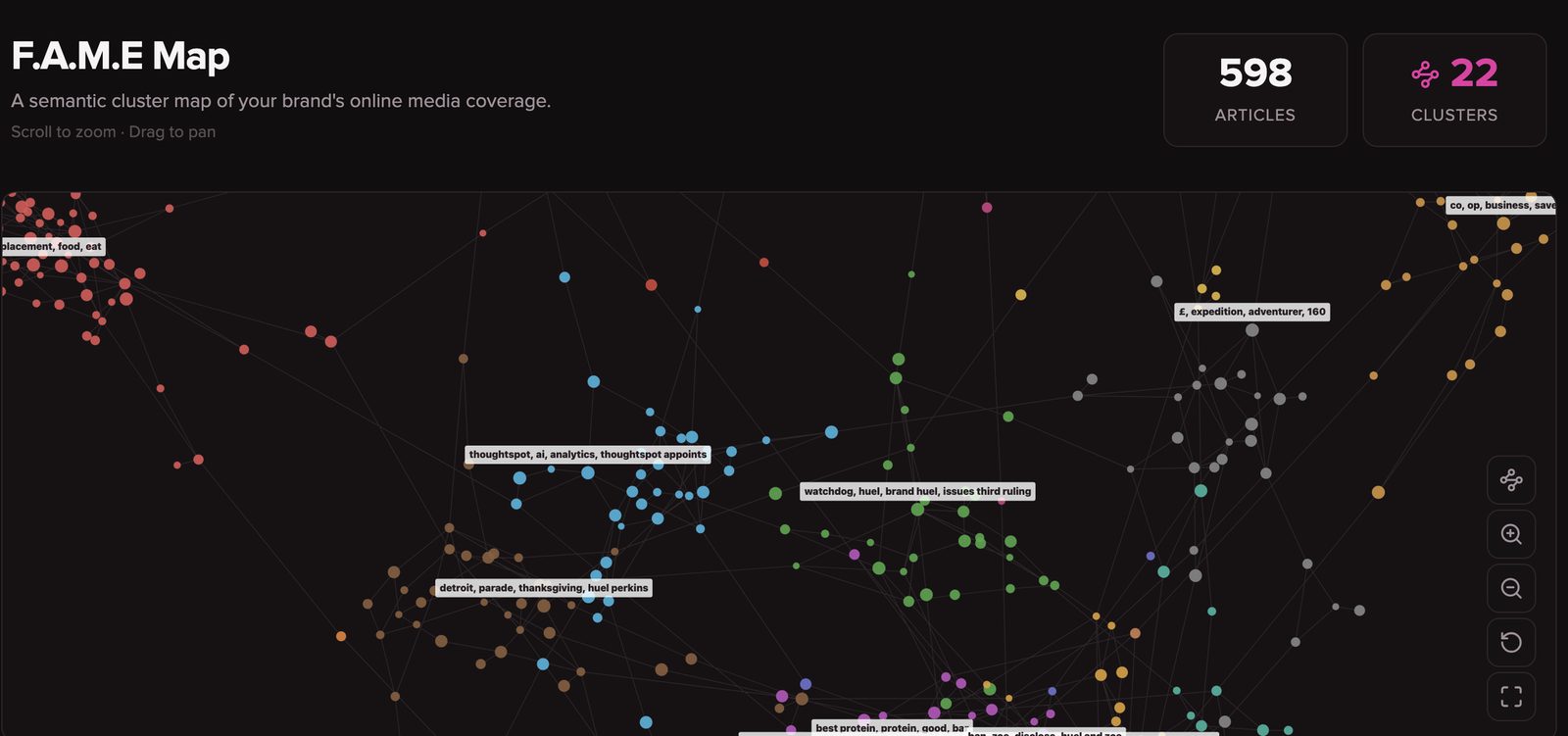
One of the biggest problems in PR has always been measurement. You could see the coverage. You could count the links. You could report the placements. But it was much harder to understand whether all that activity was actually building the right associations around the brand.
The Fame Engine solves that.
It visually maps a brand’s co-occurrences in relation to the subjects it is discussed.
In plain terms: it shows what themes, topics and semantic clusters your brand is appearing within, and whether that coverage connects to the performance attributes you actually want to own.
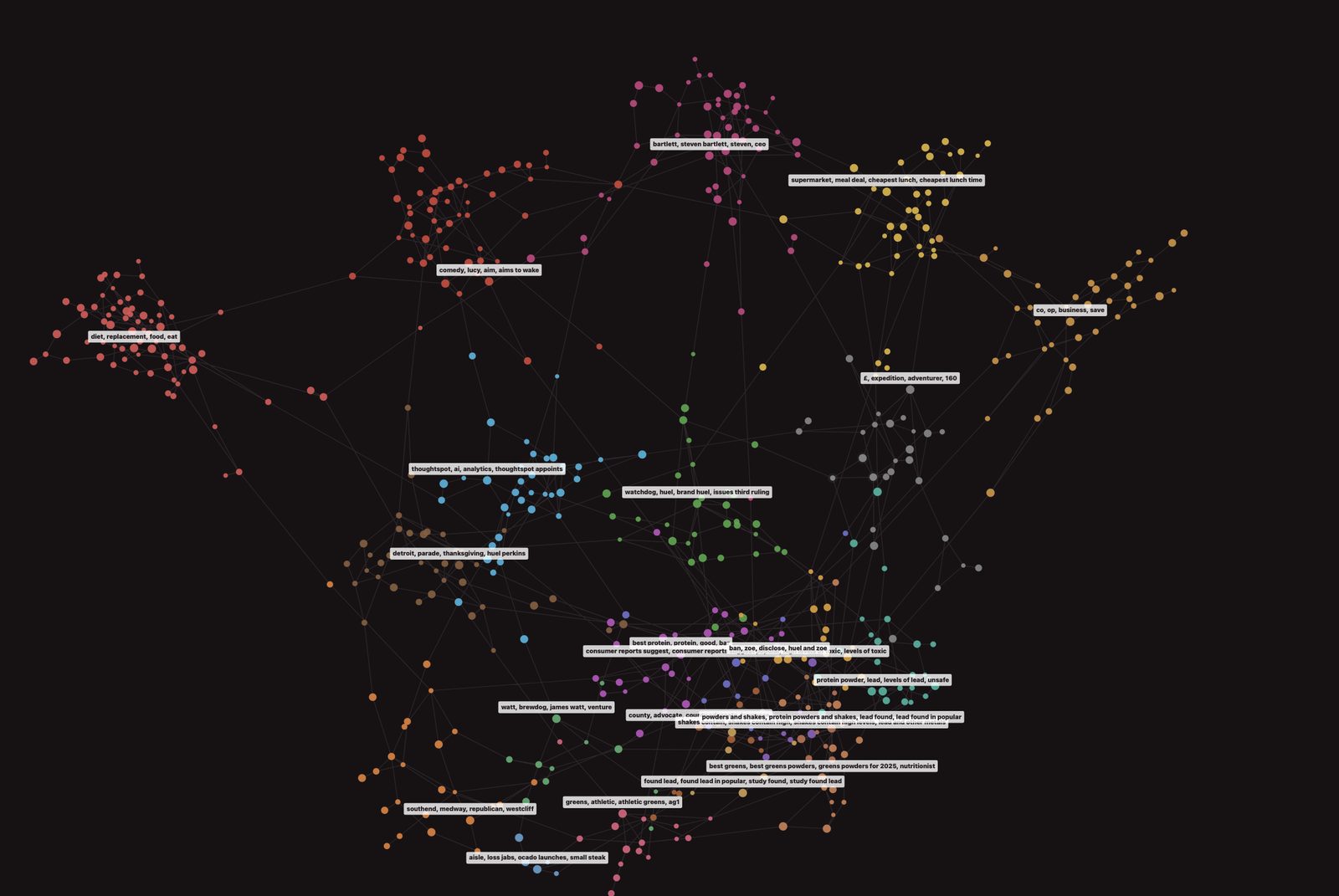
Because now you can see whether your PR is building fame in the right direction or just generating noise. You can see whether coverage is positive or negative. You can see where you are gaining recognition, where competitors are gaining it, and how the landscape around your category has shifted over time.
That matters not just for traditional search, but for generative discovery too.
If recommendation is shaped by the public web, then understanding how your brand is represented across that web is a strategic advantage, not a reporting nice-to-have.
The Fame Engine gives us that layer. It moves PR away from vibes and into something commercially and strategically precise.
And the Fame Engine does much more than that. With 20 years of media data, we can see how fame is built around any person, topic, or subject.
We can see how people and brands become famous, and analyse media data in ways you’ve never seen before.
Yes, I’m bragging because I helped build it… But it’s ace.
Brag over…let’s get back to the future.
The Future Is PR Dominant
Let me be clear. I am not saying stop doing SEO.
You still need technical competence. You still need your site structured properly. You still need your product, category and service pages to be as strong as possible. Those are the pages that convert demand into revenue. That work matters.
But once you understand that, the budget question gets simple.
A portion goes to SEO. A bigger, more serious share should go to Digital PR and PR.
Here’s why.
The future of organic growth is about increasing certainty around your brand. You are giving the web more consistent, contextually relevant signals about who you are, what you do, what problems you solve and why you should be chosen. The more those signals appear in the right places, the easier it becomes for both systems and people to form a stable understanding of your brand.
Buyers choose from the familiar. People do not choose brands through one perfect rational comparison. They choose from a set of options that feel recognisable, credible and available when the moment arrives. The more often your brand appears in relevant contexts, the more likely it is to be mentally available at the point of decision. Repeated exposure builds familiarity. Familiarity reduces friction. Reduced friction increases the likelihood of being chosen.
AI systems recommend from the public web. A system can only recommend from the information available to it. If your brand repeatedly appears in connection with the right needs, attributes and buying situations, recommendation becomes more likely. Those exposures do double duty: they build buyer familiarity and machine legibility at the same time.
PR is now infrastructure, not awareness. It is no longer a top-of-funnel play sitting politely beside performance marketing. Digital PR supplies the web with evidence, attaches your brand to the right conversations, and creates the contextual signals that help search systems understand your relevance. Broader PR does the same thing at a different altitude. All of it, when done properly, creates attention, recognition and familiarity.
The agencies still pushing content-heavy “AI visibility” models are doing so because they need to preserve a legacy service line. Not because it is the most commercially powerful answer for clients.
Their model depends on convincing you that more informational content is still the centre of the growth strategy.
It’s not.
The centre of gravity is moving toward promotion, PR and authority-building.
Toward shaping public understanding.
Toward making your business more famous for the things it actually wants to sell.
Before search engines distorted the discipline, the core task of marketing was promotion in the proper sense: making a brand known, understood and desirable.
Building salience. Building preference. Building the mental shortcuts that help buyers choose you.
Search created an artificial economy where discoverability could be manufactured through informational pages at scale. AI is ending that economy.
The advantage shifts back to brands. Specifically, the brands that are easiest to recognise, easiest to associate with a category, and easiest to attach to a buying decision.
So yes, optimise the pages that make you money.
But then lift your eyes from the website.
The future does not belong to the brands with the most content.
It belongs to the brands that supply the web with the most relevant, repeated and believable reasons to choose them.
That is PR.
And that is why Digital PR is more powerful than ever.
Next time, I’m going to actually tell you how to build a GEO strategy from scratch.
So, make sure you subscribe so you don’t miss it.
Andrew Holland
Originally published on LinkedIn on 20 March 2026.