The SEO industry has completely lost the plot.
Not because SEO itself no longer works. It does. Organic search still drives millions in revenue every single day. The problem is the industry’s view of what SEO is and what it’s supposed to do.
Right now, Google doesn’t even seem to know what it’s selling.
Gemini, AI overviews, “AI mode”. It’s a confusing carousel of half-baked products.
The only thing keeping Google dominant is habit. They’re still the default. The moment someone builds a better model of search, Google’s monopoly will unravel just as Yahoo’s did two decades ago.
But the real issue isn’t Google. It’s us.
The SEO industry has become a self-referential circus.
The same speakers. The same stages. The same slides. And the same outdated advice delivered with the confidence of people who haven’t driven meaningful organic revenue in years.
You’ve heard the lines.
“GEO is just SEO.” “Don’t publish self-referencing list posts.” “Optimise content for AI citation visibility.”
None of this reflects commercial reality.
It’s performance theatre.
A series of repeated phrases that make us sound clever without helping a single client make more money.
The industry’s commercial amnesia
We’ve forgotten what SEO is supposed to do: generate profit.
I learned this the hard way. Years ago, a client called me out directly.
“Andy,” they said, “it’s great you’ve increased our traffic. But we need traffic that makes us money.”
That one comment changed my entire career. I stopped chasing pageviews and started engineering revenue.
I built assets that might attract three visitors a month but generate fifty thousand dollars in revenue.
That experience revealed an uncomfortable truth: most SEO work is commercially irrelevant.
We’ve built an industry optimised for output, not outcome.
It’s Goodhart’s law: When the traffic became the measure, it then became a target, and as a result, became an awful measure.
But it goes deeper.
Agencies sell SEO as a product, not a solution.
Some sell links. Others sell content. Others sell technical audits. A few try to blend them all. But in every case, the agency’s product defines the strategy, not the market situation.
And that is the core of the problem. When your income depends on selling deliverables, you stop thinking like a strategist. You start thinking like a supplier.
But for the vast majority of agencies, content became the gravy, and links were the frozen Yorkshire puddings you bought from the store and passed off as homemade.
The death of the content gravy train

For the last decade, the SEO industry has been living off a content gravy train. The logic was simple: produce more content, rank for more keywords, win more traffic.
It worked, for a time. But the economics of that model are collapsing.
I’ve seen it up close. I was once brought in to audit a site with over a thousand blog posts. All well written. All expensive. And all commercially useless. Not a single one drove meaningful leads.
Another client had hired a well-known “topical authority” consultant. The result was a perfect case study in failure: fewer leads, worse rankings, and an influx of irrelevant enquiries that wasted hours of sales time.
But this is what happens when traffic becomes a measure.
We build products around the measure. Regardless of their larger use for revenue generation.
The real driver behind the madness
Why do SEOs keep doing this?
Because they’re chasing the one thing that still works for them personally: fame.
And honestly, they’re not wrong to do it. Fame works.
Fame increases sales, sales grow profits, profits feed more fame, and the cycle grows.
The top SEOs aren’t writing blogs, chasing keywords anymore.
They’re building personal brands. They post data studies, break down patents, and publish on Substack. They speak at events and push themselves as thought leaders.
That’s how they get leads. That’s how they sell courses. That’s how they win clients.
They’ve accidentally rediscovered what Les Binet has been saying for years — you should aim for fame.
The problem is they haven’t figured out how to translate that principle into a client service.
They’ve learned that fame works.
They can build fame for themselves.
They know that fame is driving their own success.
But they don’t sell fame.
Don’t believe me, go and check them out.
There’s one SEO guru promising to turn your blog into a 7-figure sales channel, but has barely ever written a blog.
Yes, they’re all over X and LinkedIn…but that same thing they sell to people…not a whisper of it.
Another agency I know has its stage guru preaching the importance of content and keyword ranking, yet it gets barely any traffic itself and publishes only thought leadership.
This isn’t a case of the cobbler’s kids’ shoes.
This is the cobbler selling shoes, but he believes walking barefoot is better for your feet.
It’s “this is what we do, but this is what we sell”.
And this is the sad part.
It’s not that they haven’t figured out what works…they have.
They’ve just chosen not to sell what works, and instead, they sell traffic as a measure.
Or, I should say they did.
Now it’s not traffic, but visibility in the guise of citations.
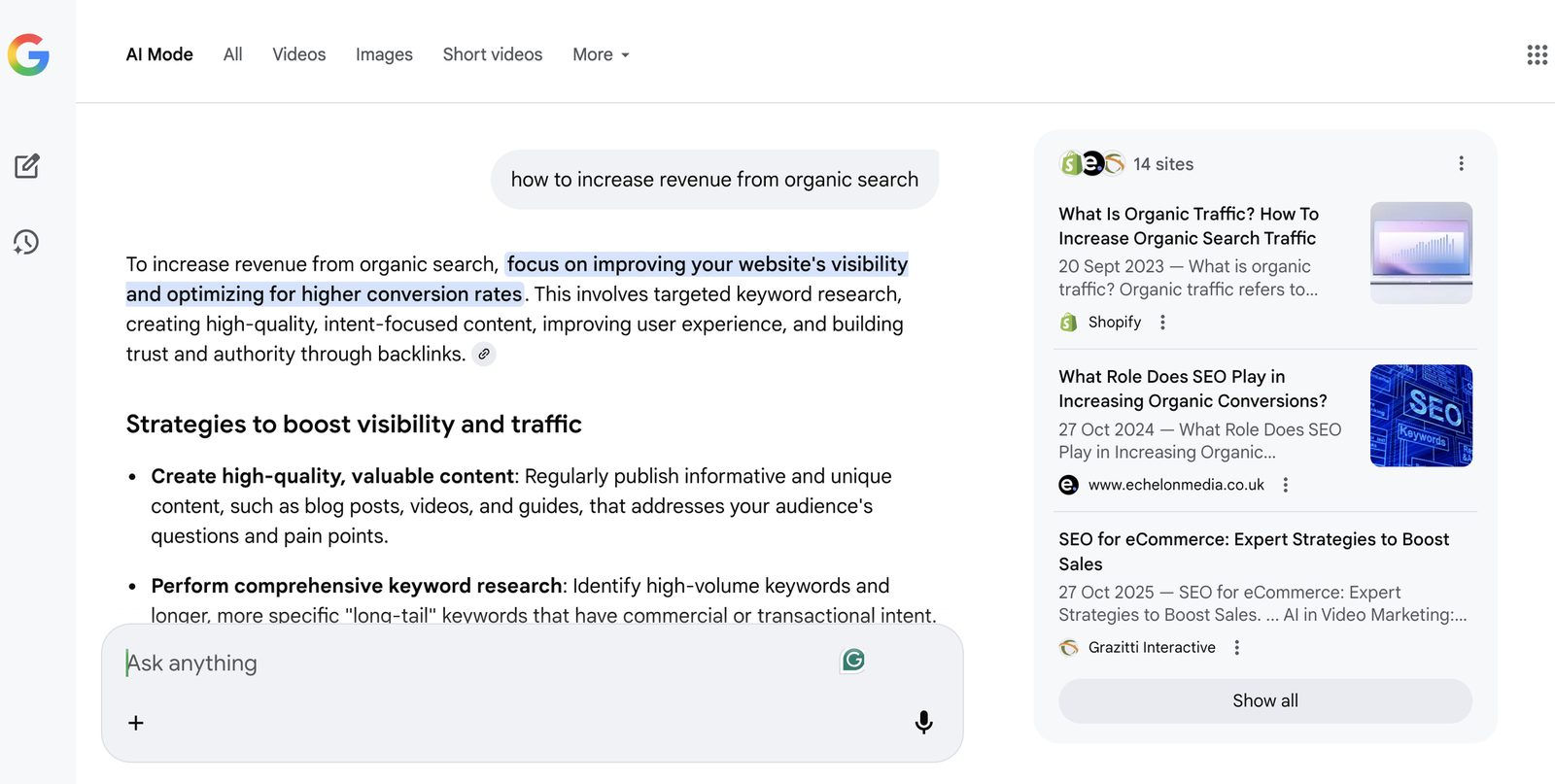
That visibility is the panel on the right of an AI overview or AI mode result.
A tiny slither of brand visibility that changes…here’s the same AI mode in a 30 minute gap between searches.
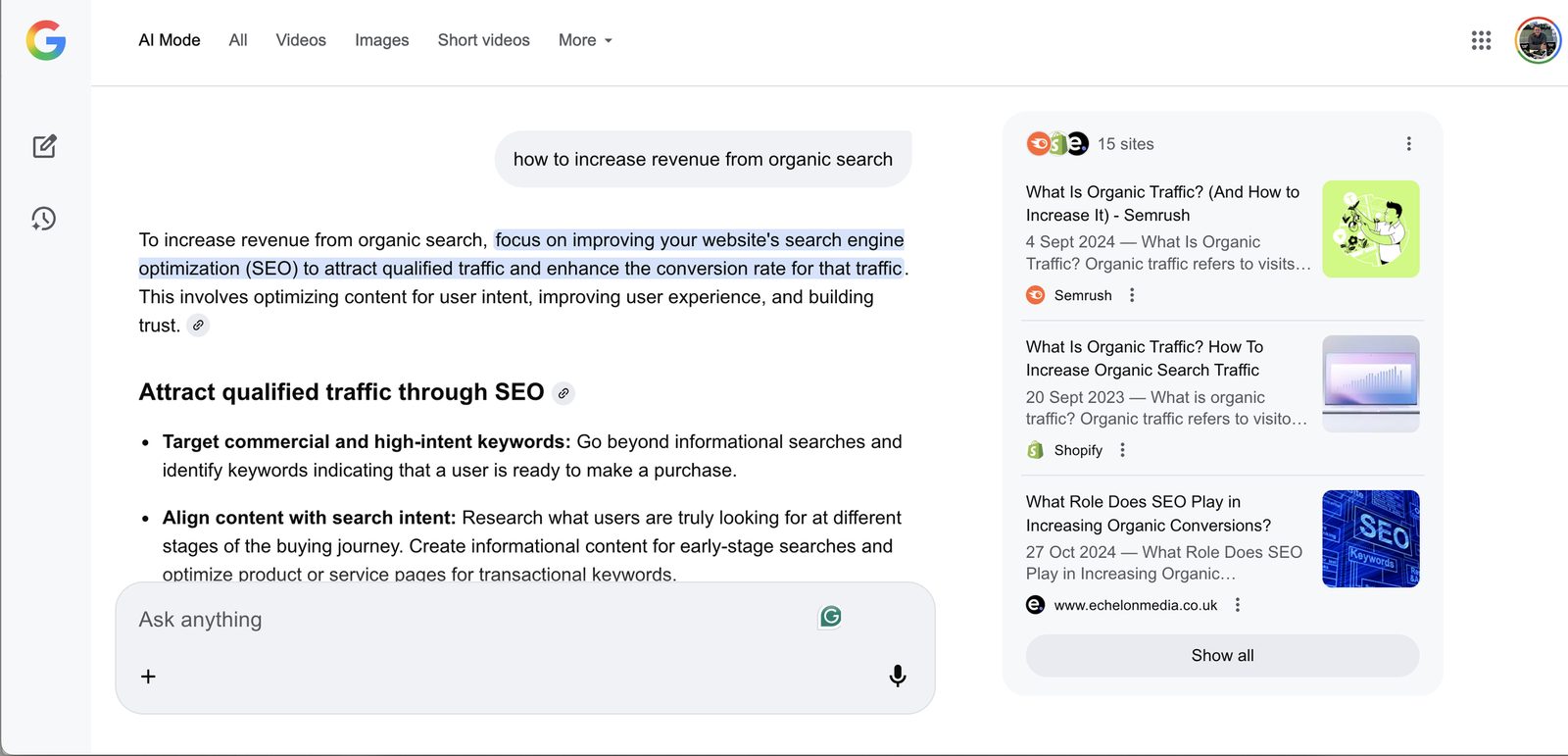
Shopify’s and Echelon Media’s results appeared in the top 3 panel results for both.
But what about AI Overviews?
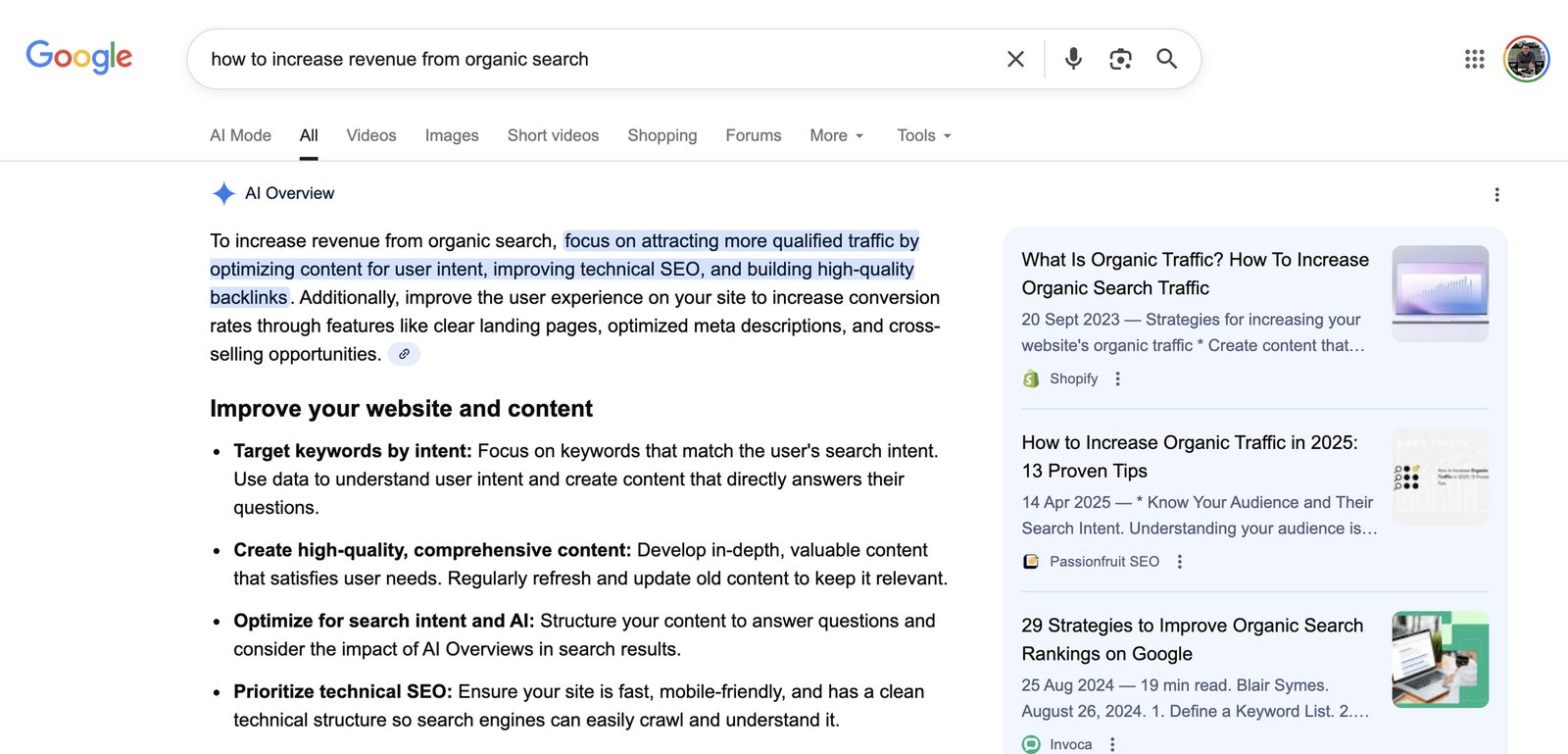
Again, Shopify’s 2023 result wins, but we have 2 new panel results in positions 2 and 3.
And what about the organic results:
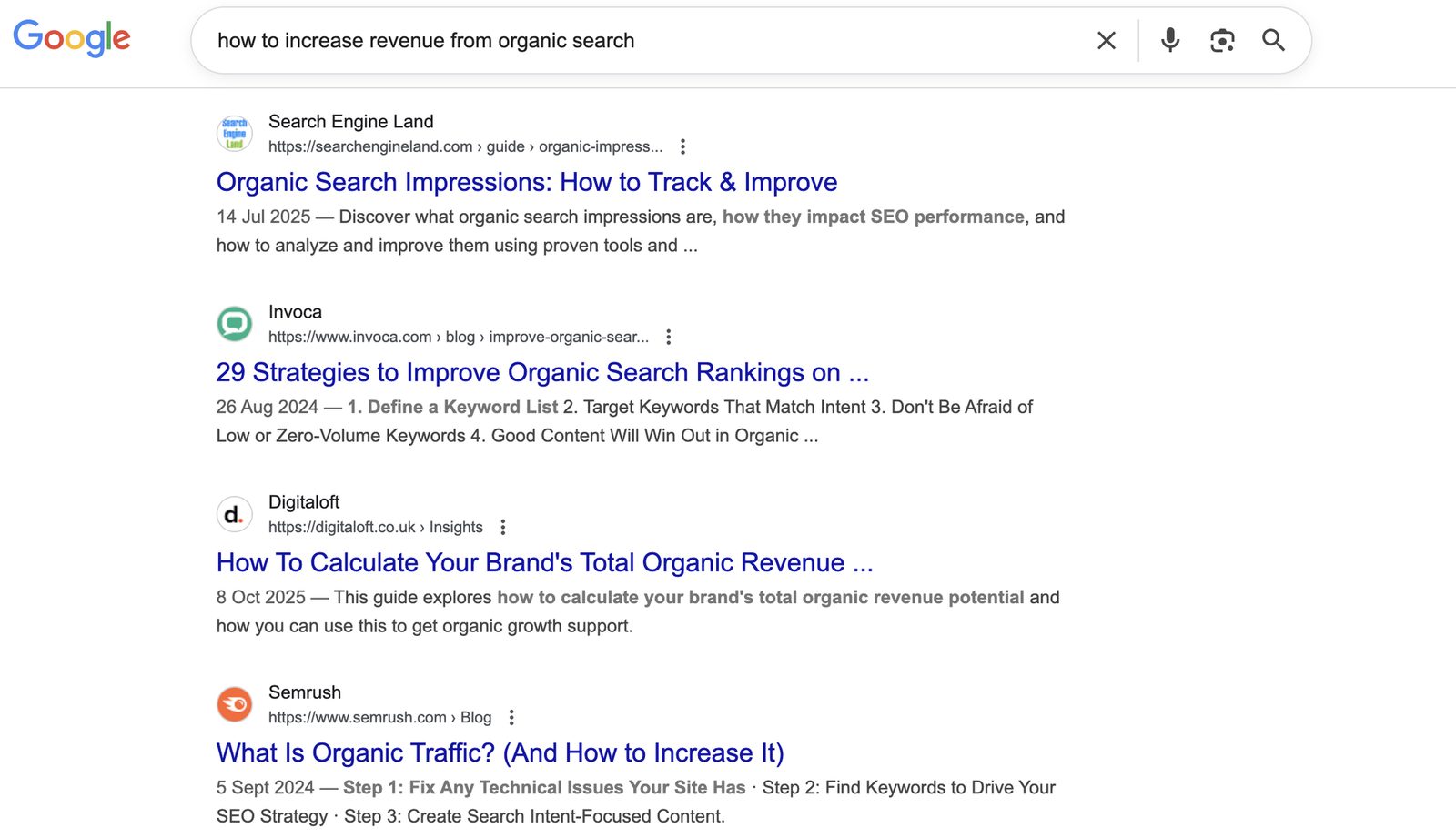
Semrush are there again, with new sites too.
And what about when I’m not signed in?
I don’t even get an AI overview panel.
Logged out in ChatGPT, things didn’t get any better:
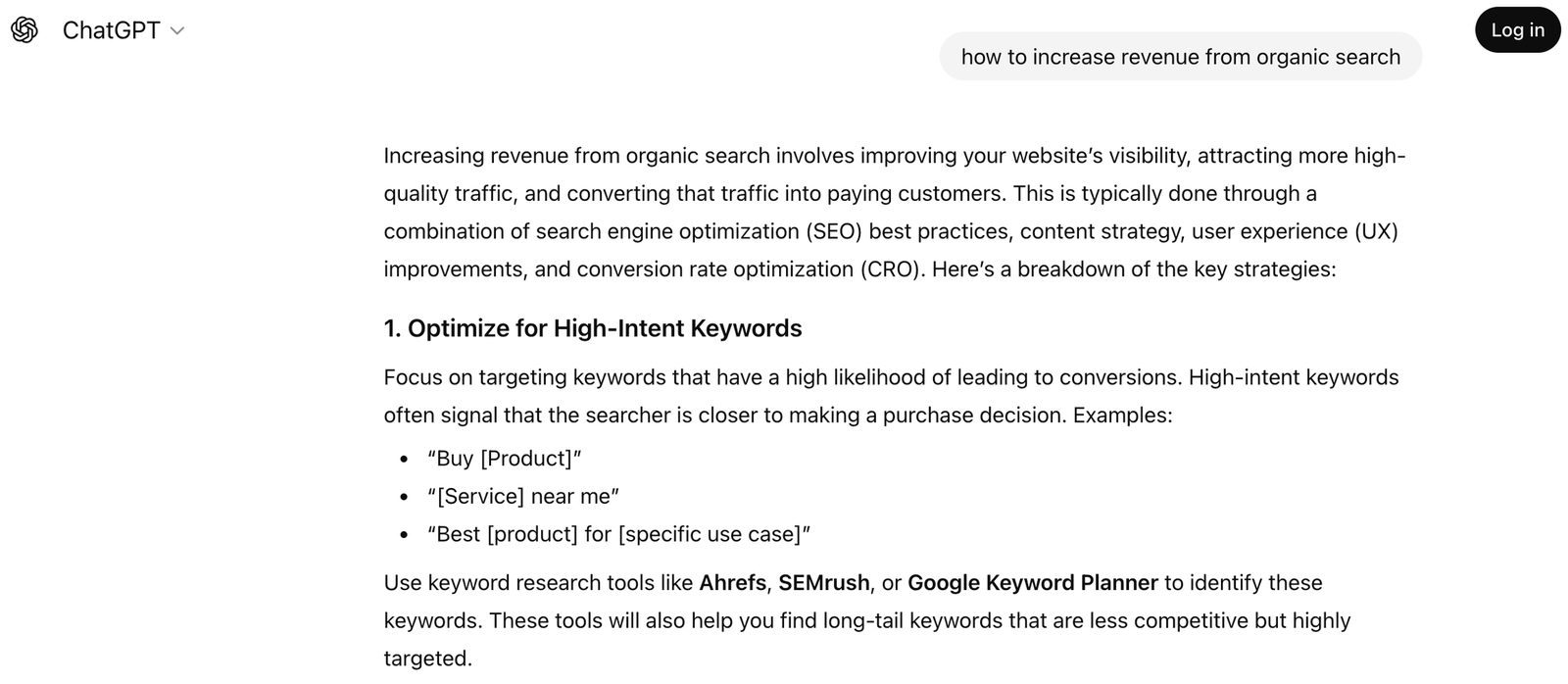
No content visible.
You might think that you’re immune to this, but if you’re following a content visibility SEO strategy for AI search, or think the answer to all your problems is more content for search.
You are doomed.
You can’t optimise for predictably irrational content visibility based on probability.
Your product needs to switch to fame.
Take the ChatGPT snippet returned then.
It mentions Ahrefs and SEMrush directly. They’re getting free publicity, free advertising in ChatGPT.
That’s the goal now.
The SEO product is broken
Most SEO teams sit within larger agencies that don’t want to hear this message. They’re told to “sell more SEO.” Not to rethink the entire model. Not to evolve. Just to keep the machine running.
But the machine is failing.
The traditional SEO product — content, links, and technical tweaks- no longer matches how people find solutions.
AI is changing the customer journey completely.
Generative search compresses the “messy middle.” It removes the zig-zag between research and purchase. Instead, users describe their problem in natural language, and the AI delivers the solution directly.
That changes everything.
It’s no longer about being ranked. It’s about being recommended.
Which means the future of SEO is not keyword optimisation. It’s fame engineering.
The new discipline: Generative Engine Optimisation
We are moving into an era where you need three kinds of availability.
Mental availability: The likelihood that your brand is remembered in a buying situation.
AI availability. The likelihood that an AI system recommends your brand in a buying situation.
Physical/digital availability: The ease and convenience of purchasing.
Fame drives inclusion in consideration sets — whether those sets exist in a human brain or a machine-learning model.
That’s why the future of SEO is GEO — Generative Engine Optimisation. It’s the art and science of being present in AI recommendation systems and conversational search environments.
You’ll achieve it by building genuine brand signals that AI can recognise as authoritative, consistent, and valuable.
Fame is the new aim
To survive this shift, SEOs need to stop selling deliverables and start selling outcomes.
The outcome is organic revenue.
And the drivers of organic revenue are clear:
Fame and brand search (mental and AI availability)
Buyer-intent visibility (in traditional search and new generative environments)
Conversion optimisation that turns that visibility into sales
This is the birth of a new role: the Organic Revenue Specialist.
An Organic Revenue Specialist diagnoses why organic revenue is or isn’t growing.
They assess share of search, buyer intent visibility, conversion friction, and brand strength. They identify which levers to pull — PR, CRO, social, or technical SEO — to drive measurable commercial outcomes.
In other words, SEOs must evolve from technicians to strategists.
From deliverers of tactics to doctors of organic growth.
The new metrics that matter
Traffic is vanity. Profit is sanity.
The next generation of SEO metrics will focus on:
Share of search. The best proxy for fame.
Buyer intent traffic volume. The quantity and quality of clicks from high-commercial queries.
Branded search growth. Proof that people are looking for you, not just your category.
AI recommendation share. The frequency with which your brand appears in buyer-relevant AI-generated responses.
Conversion and lead quality. The final proof that visibility translates into value.
These are the metrics that link SEO to revenue. They’re the numbers that belong in boardrooms and conference slides.
The agency transformation ahead
This shift will be painful. Lean, specialist agencies will adapt faster. Large, bloated agencies will struggle.
Some teams will have to reinvent themselves completely. Others will quietly fade away. But those who make the transition from SEO deliverers to Organic Revenue Specialists will thrive.
Because fame works. It works for people. It works for brands. And it works for algorithms.
The agencies and consultants who learn to engineer and deliver fame — both human and AI — will own the next decade of organic growth.
The closing lesson
SEO is being rewritten.
The product we’ve sold for 20 years — content, technical, links — is no longer enough. Those are tactics, not strategy.
The strategy now is organic revenue growth through fame, visibility, and conversion. That’s what clients actually want. That’s what drives commercial impact.
The name is not important…the shift is.
So stop selling the invisible. Stop pretending that citations without clicks are success. Stop mistaking tactics for strategy.
Start diagnosing, start building fame, and start engineering organic revenue.
Because the future of SEO is simple.
Fame is the new aim.
Andrew Holland
Originally published on LinkedIn on 12 November 2025.