
Four months ago, I wrote an article called Stop Optimising for Google. It’s Time to Optimise for the Internet.
The central argument was pretty simple. Search was moving from rankings towards recommendations. The interface was becoming less important than the information sitting behind it. And if brands wanted to survive that change, they needed to stop obsessing over where they ranked and start thinking about whether they deserved to be recommended.
I still believe all of that.
But the article had an obvious problem.
What does “optimise for the internet” actually mean?
Because unless we explain that properly, the phrase becomes another bit of marketing wallpaper. Another nice expression for somebody to repeat on LinkedIn before returning to their spreadsheet of prompts, citations and alleged ChatGPT ranking factors.
So this article is the next stage of the argument.
And to understand it, we have to go backwards before we go forwards.
SEO was always about optimising for the interface
For most of its history, SEO was fundamentally an exercise in interface optimisation.
And that made perfect economic sense.
Google dominated search to such an extent that most businesses did not need a separate grand strategy for Bing. If you picked up Bing visibility as a consequence of doing well in Google, lovely. But few marketing directors were sitting around demanding a massive incremental investment in Bing optimisation.
Even today, Google accounts for about 90% of search-engine usage.
So marketers concentrated on Google.
We studied its alleged 200 ranking factors. We obsessed over backlinks. We fixed technical problems. We tweaked title tags. We created pages for keywords. We added internal links. We watched algorithm updates as if white smoke was about to emerge from the roof of the Googleplex.
And there was a very clear commercial logic underneath all that activity.
If a company was willing to spend £20, £30 or £50 every time somebody clicked a paid search advert for a valuable buyer-intent query, ranking organically for that same query could clearly generate commercial value.
That part of SEO was never stupid.
If somebody types a query that signals an intention to spend money, being visible at that precise moment is useful. SEO tried to win those moments without paying for every individual click.
Then, inevitably, the discipline expanded.
We got YouTube SEO. Social search. Amazon optimisation. Digital PR. Technical SEO as its own increasingly specialised field. Content-led SEO. Performance SEO. Parasite SEO. Reddit SEO. And enough other prefixes and suffixes to keep conference organisers supplied with panel titles for another decade.
Then ChatGPT arrived, and the naming department went absolutely berserk.
GEO. Generative engine optimisation.
AEO. Answer engine optimisation.
AI SEO.
LLMO.
And probably another acronym invented between me writing this sentence and you reading it.
The name isn’t especially important.
The structural change underneath it is.
The number of interfaces is exploding
Traditional SEO made sense because one interface was disproportionately important.
That assumption is now breaking.
A consumer can ask Google. Or ChatGPT. Or Gemini. Or Claude. Or Grok. They can discover something through YouTube, Reddit, Instagram, TikTok, LinkedIn or whatever platform wins their attention for five minutes while they’re sitting on the toilet.
The systems themselves increasingly retrieve, interpret and combine information rather than simply returning ten blue links.
This creates a rather obvious strategic problem.
You could try to optimise independently for every interface.
You could build a ChatGPT strategy, a Gemini strategy, a Google AI strategy, a Reddit strategy, a TikTok strategy, a LinkedIn strategy and a strategy for whatever some bloke in San Francisco releases next Tuesday while wearing £600 trainers.
Or you could go one level deeper.
Optimise the information environment they all draw from.
Optimise for the internet.
That is the bit we now need to understand.
We live in a hybrid communications world
In the 2013 edition of Communication Power, Manuel Castells wrote: “We live in a hybrid communication world.”
That short sentence is key to understanding GEO.
Castells was describing a communications environment in which different forms of media increasingly overlap, interact and refer to one another. Traditional media, digital networks and person-to-person communication do not operate as beautifully separated boxes. They form networks of communication in which meaning moves between them.
And remember, he was writing this in 2013.
Before TikTok became TikTok. Before generative AI. Before ChatGPT. Before millions of people started filming their lunches, careers, divorces, holidays, businesses, dogs and breakdowns for strangers to consume between episodes of Netflix.
The hybrid communications world has become vastly more hybrid.
A journalist writes something. Someone discusses it on Reddit. A creator turns it into a video. A company responds on LinkedIn. Google indexes the discussion. Someone makes a podcast about the resulting row. The podcast becomes clips. The clips become posts. The posts generate comments. And an AI system can subsequently retrieve parts of that information when somebody asks a relevant question.
These are not isolated channels.
They are overlapping communication networks.
Humans have always lived inside these networks, even if marketing departments preferred neat boxes marked PR, SEO, SOCIAL and BRAND because boxes make budget spreadsheets easier.
We encounter information continuously and absorb meaning from it imperfectly.
We have children to collect, emails to answer, jobs to do, friends to see, bills to pay, football matches to watch and existential crises to postpone until Sunday night.
Nobody except your marketing team spends all day thinking about your brand.
But encounters accumulate.
You see an advert. Hear somebody mention the company. Scroll past a post. Notice a review. See a product in the real world. Hear a friend recommend it. Search for it later.
Some of it sticks. Most of it doesn’t.
That is the fight for mental availability.
AI introduces another participant into the same information environment.
And that’s where GEO becomes far more interesting than another collection of SEO hacks.
Your brand is an information supply
Your website matters.
Let me say that clearly before somebody screenshots this article and posts “SEO MAN SAYS WEBSITES DON’T MATTER” on X.
Your website absolutely matters.
Technical accessibility matters. Crawlability matters. Product information matters. Service pages matter. Commercial copy matters. Search visibility matters.
But your website is no longer the only meaningful online representation of your business.
Your brand exists through a network of information.
Your website.
Your LinkedIn page.
Your staff.
Your founder.
Your reviews.
Your customer comments.
Your videos.
Your photography.
Your media coverage.
Your podcasts.
Your case studies.
Your social content.
Your events.
You get the idea…All of it supplies information into the wider environment. And information carries meaning.
That means the starting point for GEO cannot simply be, “How do we get mentioned by ChatGPT?”
The starting point has to be much more fundamental.
What do you want to be known for?
What do you do?
Who do you do it for?
What problem are you exceptionally good at solving?
How do you solve it?
Why are you better suited to particular customers or situations?
And what proof exists that any of this is true?
That is positioning.
Which is why a large percentage of supposed GEO problems are going to turn out not to be GEO problems at all. They will be positioning problems.
If your business cannot articulate what it deserves to be selected for, no amount of technical optimisation will rescue you from strategic vagueness.
And once that position is clear, you have another problem.
You have to get the information into the world.
Information has to be performed
This is where Professor Albert-László Barabási’s work on networks re-enters the GEO story.
In The Formula, Barabási popularised a wonderfully simple model of how success is achieved:
S = Qr
S is success.
The r represents the underlying potential or value of an idea.
Q represents your ability to turn that idea into something impactful.
The underlying research came from an analysis of scientific careers, where Barabási and colleagues found that a person’s Q parameter—their sustained ability to turn projects into high-impact work- was relatively stable, while the potential impact of individual projects contained a large random component.
Don’t get too hung up on the maths.
The marketing implication is more interesting.
You can have a fantastic idea and execute it badly.
You can be an outstanding operator repeatedly working with mediocre ideas. Remember, Steve Jobs had many flops before the iPhone.
And occasionally you get the glorious combination where the underlying idea is strong, and the execution is exceptional.
Businesses experience exactly the same problem with communication.
Being good at something and being good at communicating that you are good at something are not the same skill.
Which brings me back to one example I keep using: J.K. Rowling.
And yes, I know. Rowling again. Spudman again. Cocktail bars again.
I use these examples repeatedly for a reason.
It isn’t because there aren’t other examples. There are thousands, and I’m going to explore far more in future articles.
I’m using famous authors, jacket potatoes and cocktail bars because we are dealing with some fairly complicated concepts from network science, communications and information theory. Simple examples remove the corporate bullshit and make the mechanism easier to see.
Rowling’s The Cuckoo’s Calling is a magnificent example.
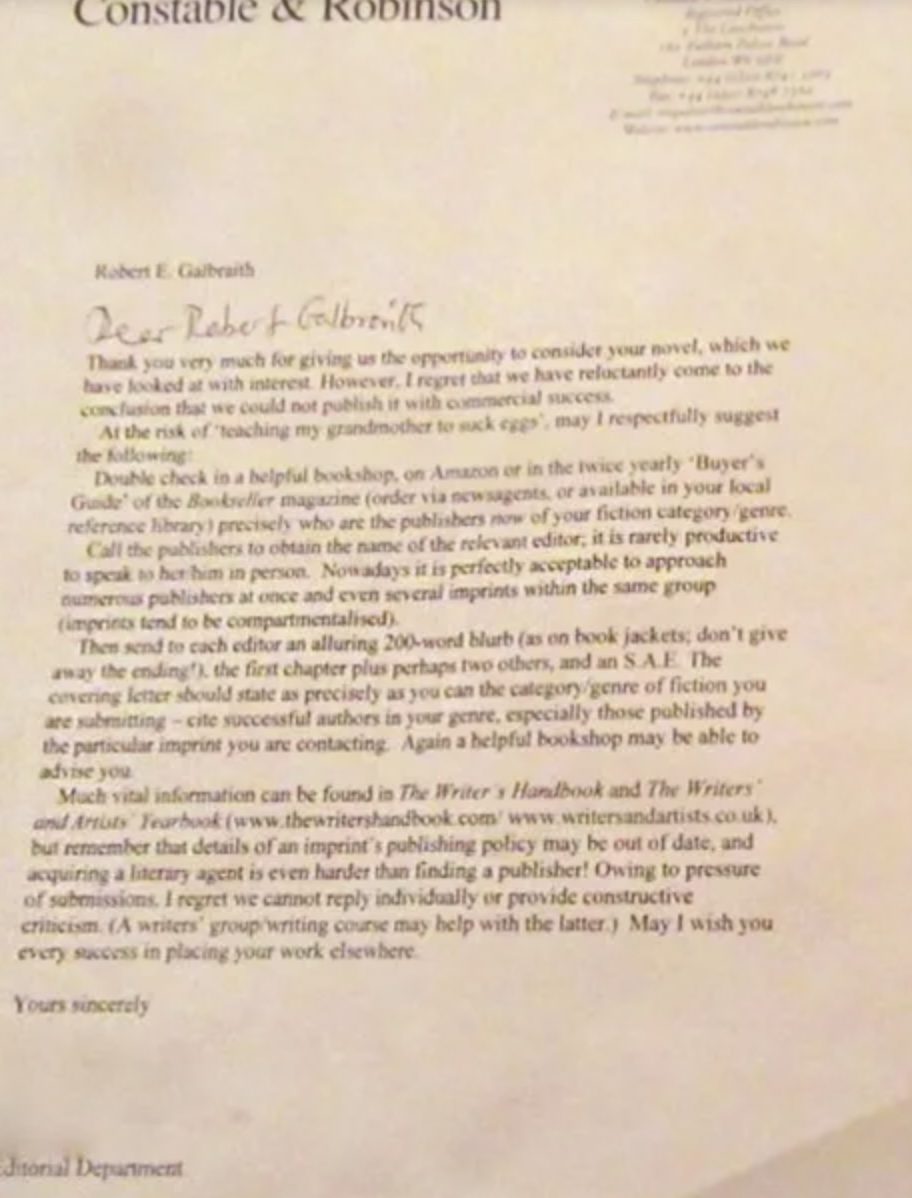
She submitted the novel under the name Robert Galbraith. Publishers rejected it. One rejection even suggested a writing course might help. The novel eventually found a publisher and received respectable reviews, but had sold around 1,500 hardback copies before Rowling’s identity became public. Once the connection to J.K. Rowling was revealed, it rocketed to the top of Amazon’s bestseller ranking.
Same book.
The words did not magically improve overnight.
The information attached to the book changed.
Suddenly the network knew something enormously meaningful: this unknown Robert Galbraith was J.K. fucking Rowling.
The creator carried information.
Reputation carried information.
Previous success carried information.
Existing networks carried information.
And attaching those things to the book radically changed its ability to travel. All it took was connecting Glabraith to the Rowling brand. That’s all that happened; that’s all that changed.
Spudman is the opposite, simpler version of the same principle.
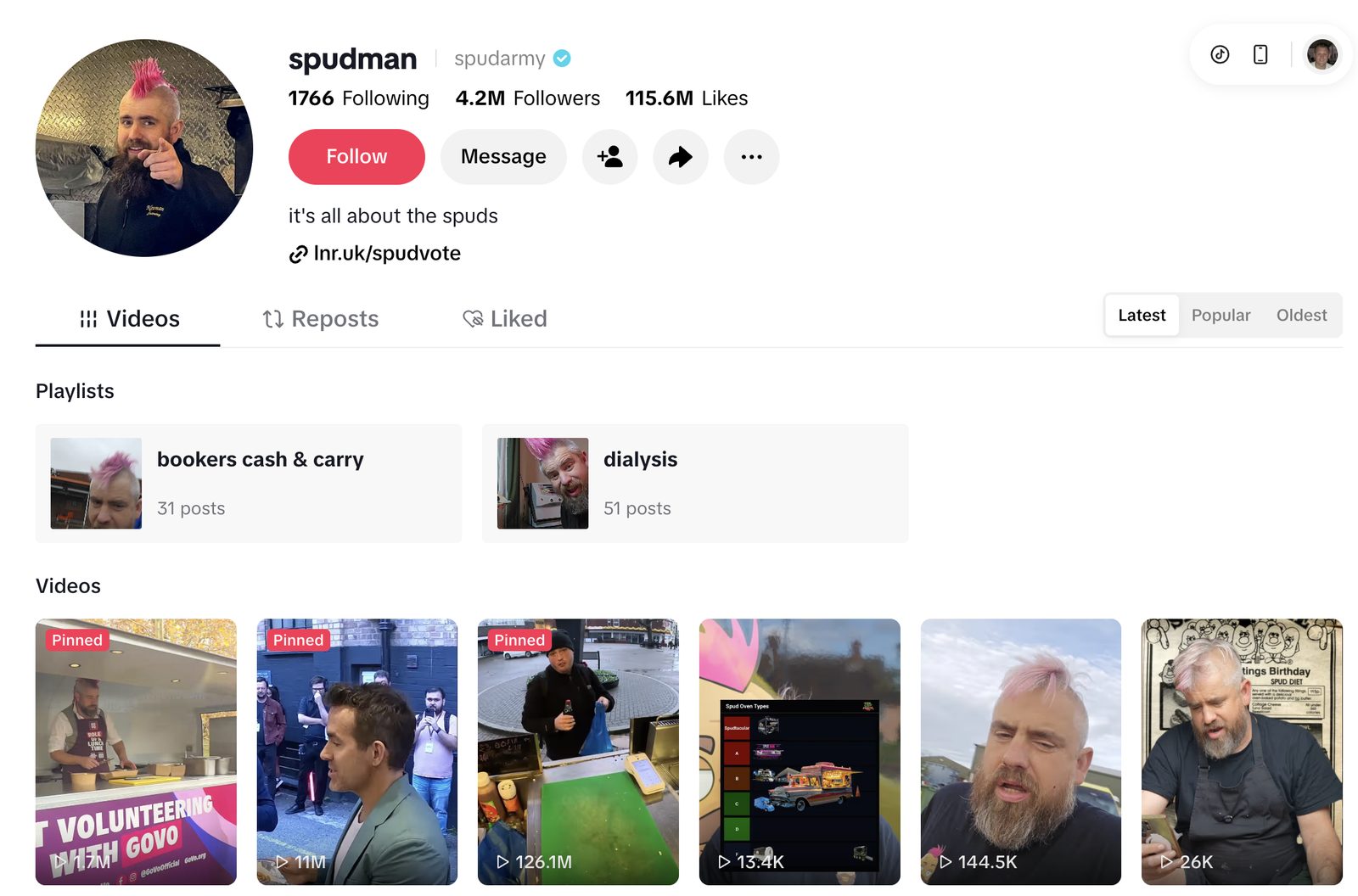
Ben Newman did not invent the jacket potato. He started posting and livestreaming the thing he was already doing in Tamworth. You can watch the video of hism starting the YouTube channel, and while that never blew up like TikTok, you can hear he only had 13,000 TikTok followers then.
Through live streaming, the product’s performance attributes became extremely visible: the toppings, generosity, preparation, personality and spectacle.
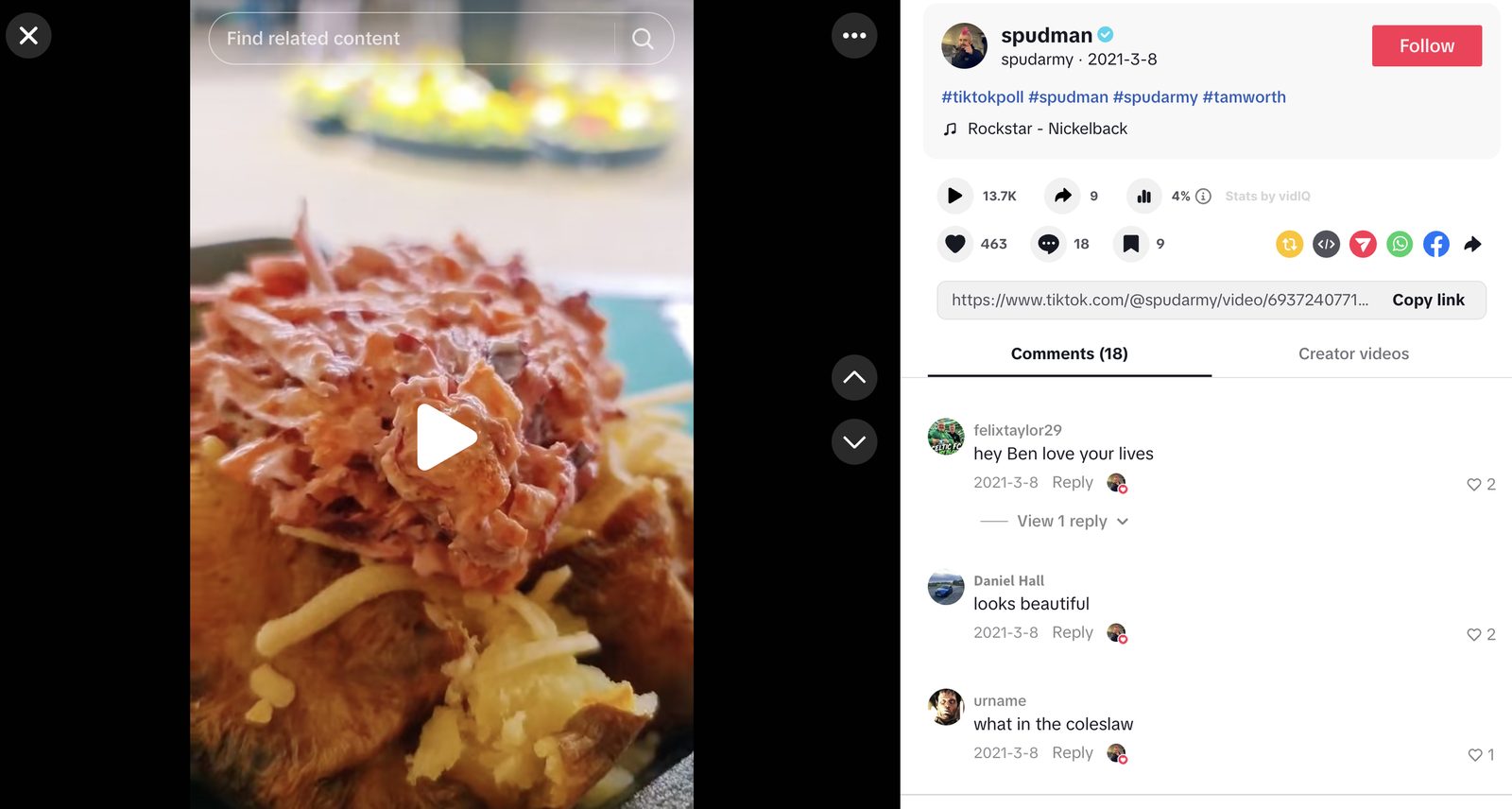
And with a simple look at his channel, you can see the videos that showcased the performance attributes of his product and business started to be carried by the networks.
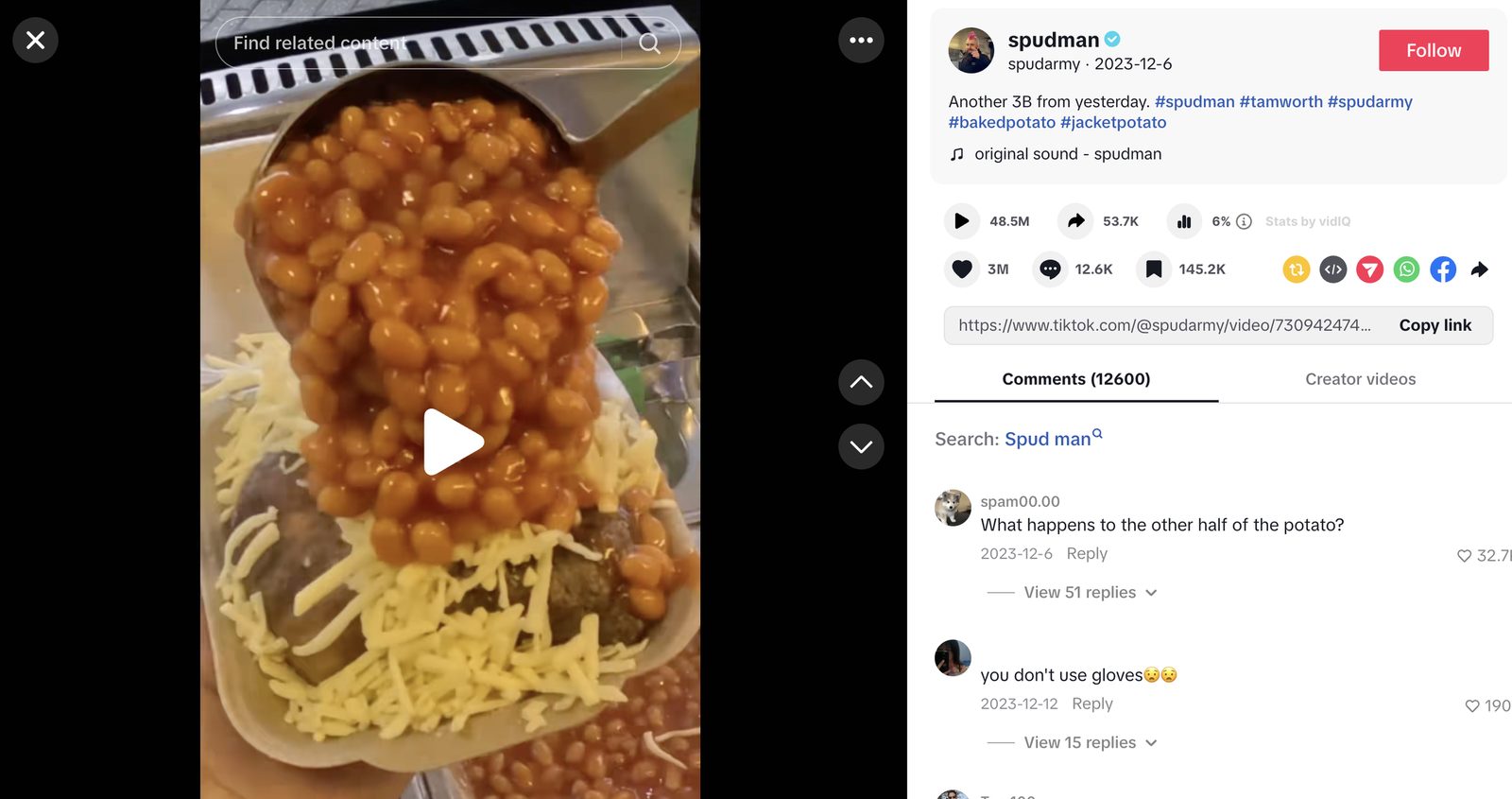
Videos went from a few thousand views to 48 million.
By January 2024 he told the BBC he had sold almost 1,500 potatoes in a single day after his TikTok growth. By 2025 he had millions of followers.
The internet did not make the potato better.
It made the performance attributes easier to encounter.
In reality, Spudman was always good; he was selling spuds for years, but the video and the algorithms allowed networks to carry the key information about his business, and people wanted more ‘spud porn’ in their feeds.
If you are good at what you do and good at communicating it, networks can take that information and send it to others.
But you need to communicate…remember one of my other key rules of GEO. A brand is invisible unless it starts to talk about itself.
Cocktail bars explain GEO better than most SEO conferences
Imagine you open a cocktail bar in an English city.
Before you optimise anything, you have decisions to make.
What kind of bar is it?
Perhaps it is loud, cheap, sugary and designed around a Saturday night crowd.
Perhaps it’s pink, highly visual, gin-heavy and designed around groups who want the drinks and the photographs.
Or perhaps you create a quieter Prohibition-era speakeasy feel. Low lighting. Proper cocktails. Great Old Fashioneds. Somewhere people go to sit down, talk and enjoy the craft rather than scream over a remix of Barbie Girl.
These are not SEO decisions.
They are positioning decisions.
Ingredients matter.
Price matters.
Music matters.
Staff matter.
Location matters.
Furniture matters.
Lighting matters.
Menu design matters.
The customers you want matter.
Once you’ve made those choices, however, you start encoding information about them.
Your website says where you are and when you’re open.
Your menu shows what you sell.
Your photography shows the environment.
Your video shows the drinks being made.
Your language suggests whether the place is formal, lively, exclusive or relaxed.
Your reviews describe the experience.
Humans can interpret all of this, and increasingly multimodal AI systems can interpret far more than text alone.
Now imagine someone is visiting that city for work.
They ask an AI assistant:
“I’m staying in the city centre before a meeting tomorrow. I want somewhere relaxed for a couple of good cocktails, preferably somewhere that does a decent Old Fashioned. I don’t want somewhere rough or packed with students. I’d also like decent food nearby.”
That is an extremely specific information requirement.
If your bar has clearly supplied the relevant information—location, atmosphere, menu, imagery, opening hours, customer feedback—the system has evidence with which to judge your relevance.
Now change the prompt.
“What is the best cocktail bar in Stoke-on-Trent?”
Much harder.
You can declare that you’re the best until you’re blue in the face.
Nobody cares.
Broader recommendations require broader evidence.
Do customers agree?
Are the reviews good?
Do local creators visit?
Do people post about the drinks?
Does the local press mention you?
Do forums discuss you?
Do people search for you by name?
Are you included in local guides?
Are other credible people effectively confirming the information you supplied about yourself?
This is what marketers need to understand:
Relevance can often be encoded. Preference has to be earned.
And earning it requires information to be performed.
Your bartender filming an exceptional Old Fashioned is performing information.
A local food creator visiting is performing information.
A review describing the atmosphere is performing information.
A news article about your unusual menu is an information performance.
Customers uploading photographs are performing information.
Good PR is an information performance.
Good social is an information performance.
Good advertising is information performance.
Good content marketing is information performance.
And, yes, good SEO can be information performance too.
The problem occurs when these disciplines become disconnected from what the business needs to be known for.
You can rank and establish almost no useful meaning.
You can become hilarious on TikTok while nobody has a clue what you sell.
You can generate PR coverage around an irrelevant stunt that makes the agency very excited and the commercial director wonder why everyone is handing out dog biscuits at a railway station.
Activity is not meaning.
Reach is not meaning.
Ranking is not meaning.
The strategic requirement is to perform the right information.
This is where “mutual information” becomes useful—carefully
There is a concept from information theory called mutual information.
Technically, it measures how much knowing one variable reduces uncertainty about another. It is a measure of statistical dependence, not a magical new marketing metric, so please don’t leave this article and start selling “Mutual Information Optimisation Services” by lunchtime.
But the underlying idea is useful.
Think about the associations your brand is trying to create.
If I say Volvo, certain attributes are more likely to come to mind.
If I say Rolex, others appear.
If I say Ryanair, something else happens entirely.
The more consistently a brand becomes associated with particular characteristics, needs, situations and outcomes across an information environment, the less ambiguous its meaning becomes.
That matters to humans.
And it matters when machines try to determine whether an entity is relevant to a particular request.
So your job is not to carpet-bomb the internet with your company name.
Your job is to increase the supply of meaningful, credible information that connects your brand with the situations in which you deserve to be chosen.
That is a much harder task than link building.
It is also much more interesting.
GEO needs someone looking at the whole information environment
This is why I keep pushing back against the claim that GEO is “just SEO”.
It isn’t.
That does not mean SEO disappears.
If you’re spending £10,000 a month buying clicks for valuable commercial queries, you’d be an idiot not to investigate how much of that visibility you can win organically.
Technical SEO still matters.
Indexation matters.
Buyer-intent pages matter.
But GEO asks a larger set of questions.
Everything from ‘What are AI systems saying about us? to ‘When are we recommended?’ And are we actually famous enough to deserve broad recommendation?
Somebody has to investigate that landscape.
They do not need to personally write every article, make every TikTok, pitch every journalist, build every advert or fix every technical issue.
But somebody has to understand the information environment and coordinate the response.
That is increasingly how we are approaching GEO at JBH
Not by pretending we possess a secret list of prompts that unlocks ChatGPT.
Not by claiming we know everything in a market changing this quickly.
But by investigating recommendation environments with brands, measuring what is visible, understanding where meaning is being created, identifying gaps and then working collaboratively with the people capable of changing them.
SEO agencies will be part of this.
PR agencies will be part of this.
Advertising agencies will be part of this.
Social teams, creators, communications teams, analysts and brand strategists will be part of this.
Because the internet does not give a toss about your org chart.
Optimise for the internet
Four months ago, I argued that brands should stop optimising for Google and start optimising for the internet.
This is what I meant.
Choose what you want to be known for.
Make sure the underlying product deserves that position.
Encode the information clearly.
Perform it effectively.
Supply it into the networks your market uses.
Get customers, journalists, creators and other credible third parties to validate it.
Measure where the associations are forming.
Investigate where they aren’t.
Keep going.
The interfaces will change.
New systems will appear and others will vanish.
Building your entire strategy around the current mechanics of one interface is therefore a tactical response to a strategic problem.
The interface is the mouth.
The internet is the information environment feeding it.
Give that environment enough clear, credible and repeated evidence that your brand deserves to be chosen.
Then let the interfaces argue about how to say it.
Stop optimising for the interface.
Start optimising for the internet.
Andrew Holland
Originally published on LinkedIn on 20 September 2026.