
For the best part of 20 years, online growth had a wonderfully simple organising principle: keywords.
People wanted something. They went to Google. They typed a crude approximation of that need into a little white box. Google produced a page of results and, if you were sufficiently clever, sufficiently wealthy or sufficiently persistent, your business appeared near the top.
Paid search allowed you to buy the keyword. SEO allowed you to win it organically. Entire companies were built around occupying a few commercially important phrases better than everybody else.
“Divorce solicitor Manchester.” “Dentist near me.” “Best running shoes for flat feet.”
It was crude and imperfect, but commercially it was fucking magnificent. Keywords turned demand into something visible, measurable and tradable. They gave marketers a reliable way to connect what people appeared to want with an advertising or organic-search strategy designed to capture it.
And now AI is starting to break that model.
Because the relationship between a customer’s need and the brand they eventually chose to solve it is changing, and much of the SEO industry is still trying desperately to pretend it isn’t.
Keywords were never strategy. We just treated them like they were
Google deserves enormous credit for creating the great online demand machine.
Billions of people had needs and Google gave those needs structure.
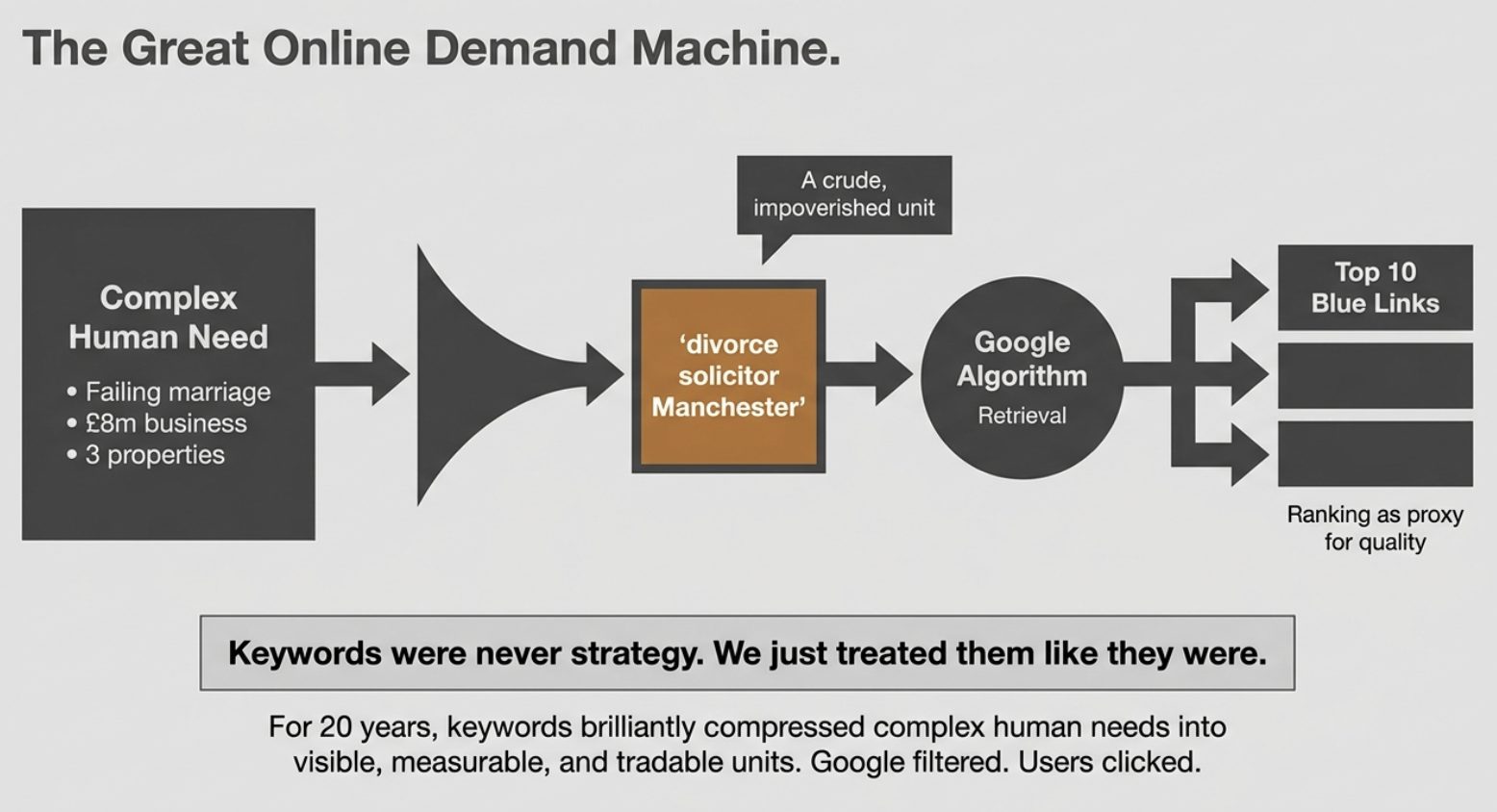
A human might have been experiencing an extraordinarily complicated situation involving a failing marriage, substantial assets, three properties, two children and a business worth £8m.
Search reduced all of that complexity to something wonderfully manageable: “divorce solicitor Manchester”.
That impoverished little phrase was enough.
If you ranked well for it, you could win because the customer was not going to spend Wednesday afternoon opening 60 law-firm websites, compiling a spreadsheet and objectively assessing which solicitor was genuinely most appropriate. They clicked the first few results, which meant Google became the filtering mechanism and ranking became a rough proxy for quality.
Because those keywords were measurable, they slowly became the basis for strategy. Paid-search teams bid on them. SEO teams optimised for them. Forecasts were built around them. Landing pages were created for them. Agencies were hired to move brands from position seven to position three.
The keyword became the unit around which a giant chunk of online acquisition operated.
There was nothing particularly stupid about that. It worked brilliantly. The stupidity begins when a model designed for one interface is carried blindly into the next one.
Because AI does not merely give us a new search box. It changes the nature of the intermediary between customer and brand.
A prompt is not a keyword
This is the conceptual failure at the heart of much of the bad thinking around generative engine optimisation.
People are trying to turn prompts into the new keywords. Take the old keyword database, convert the searches into conversational questions, fire those questions into an AI model, count how many times the brand appears and call the resulting number “AI visibility”.
Lovely. We have recreated SEO. Everyone can go home.
Except we haven’t.
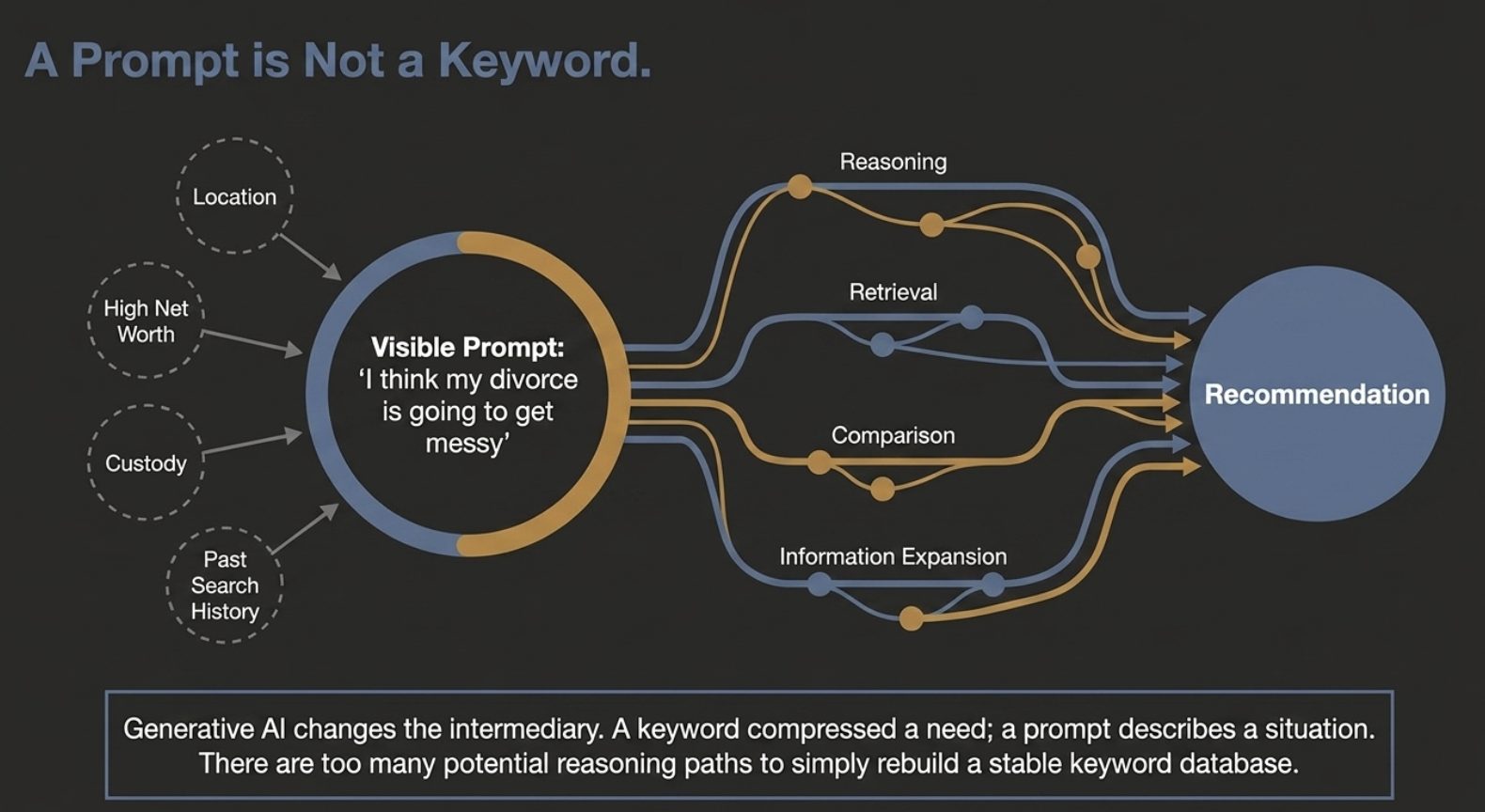
A keyword was the user’s attempt to compress a need into language a search engine could process. A prompt can simply describe the situation.
“I think my divorce is going to get messy, who can help me sort this?”
That sentence might contain no location, no mention of a solicitor, no description of assets and no explicit buying intent. But the AI system may already have context. It can reason, retrieve information, expand the problem, investigate multiple routes and compare alternatives before presenting a recommendation.
The visible prompt is therefore only one part of what is happening.
That destroys the comforting idea that marketers can simply create another giant database of phrases to optimise against. There are too many possible situations, too much personal context and too many potential reasoning paths. Different generative systems also retrieve and construct answers in different ways.
SEO had keyword data at scale because keywords were central to search’s commercial architecture. Google wanted advertisers bidding against them, so a huge ecosystem of keyword planning and measurement grew around that demand.
Prompt data does not exist with anything approaching the same stability.
And if you do not have stable demand units, you cannot simply rebuild keyword strategy with a fashionable AI sticker slapped on the front.
GEO is not SEO with a chatbot attached
The original reaction from large parts of SEO to generative engine optimisation was rejection. Then, predictably, came assimilation.
Apparently GEO was SEO after all. Same thing. Nothing to see here. We just needed some new terminology.
Citations became rankings. Prompt mentions became visibility. AI referral traffic became organic sessions. Thousands of synthetic prompts became the new keyword set.
This is comforting bollocks.
It is understandable bollocks, admittedly, because industries interpret new things through the expertise they already possess. SEO spent decades learning how to optimise digital information environments. Of course it wants generative AI to fit neatly inside that model.
But the commercial objective of GEO is not a citation, a prompt ranking or even necessarily a visit to your website. Those things might matter as evidence, but they are not the ultimate outcome.
The commercial objective is whether an AI system recommends your business favourably in a situation that matters.
That might mean recommending a film somebody should watch this weekend. It might mean suggesting a charity they should support. It might mean selecting a SaaS product for a particular task, recommending a solicitor for a complicated legal problem or helping somebody choose a pair of running shoes.
The recommendation is what matters because recommendations influence choice.
That distinction moves GEO away from the traditional SEO obsession with the individual page and towards something much broader: how the market, and the systems interpreting that market, understand the brand.
Your GEO dashboard is a sonar screen, not a scoreboard
Marketers desperately want stable metrics.
We had traffic, rankings, click-through rates and impressions. These metrics were frequently abused, misunderstood and turned into enormous graphs that impressed nobody except the people presenting them, but at least they existed.
AI creates a nastier problem. You cannot observe every conversation, know every prompt, reproduce every personal context or control the exact reasoning path used to create an answer.
So we create artificial tests. Prompts go in. Answers come back. Brands appear or disappear. Sources are cited. Competitors emerge.
And people immediately want to turn all of that into a performance score.
I think that misses the point.
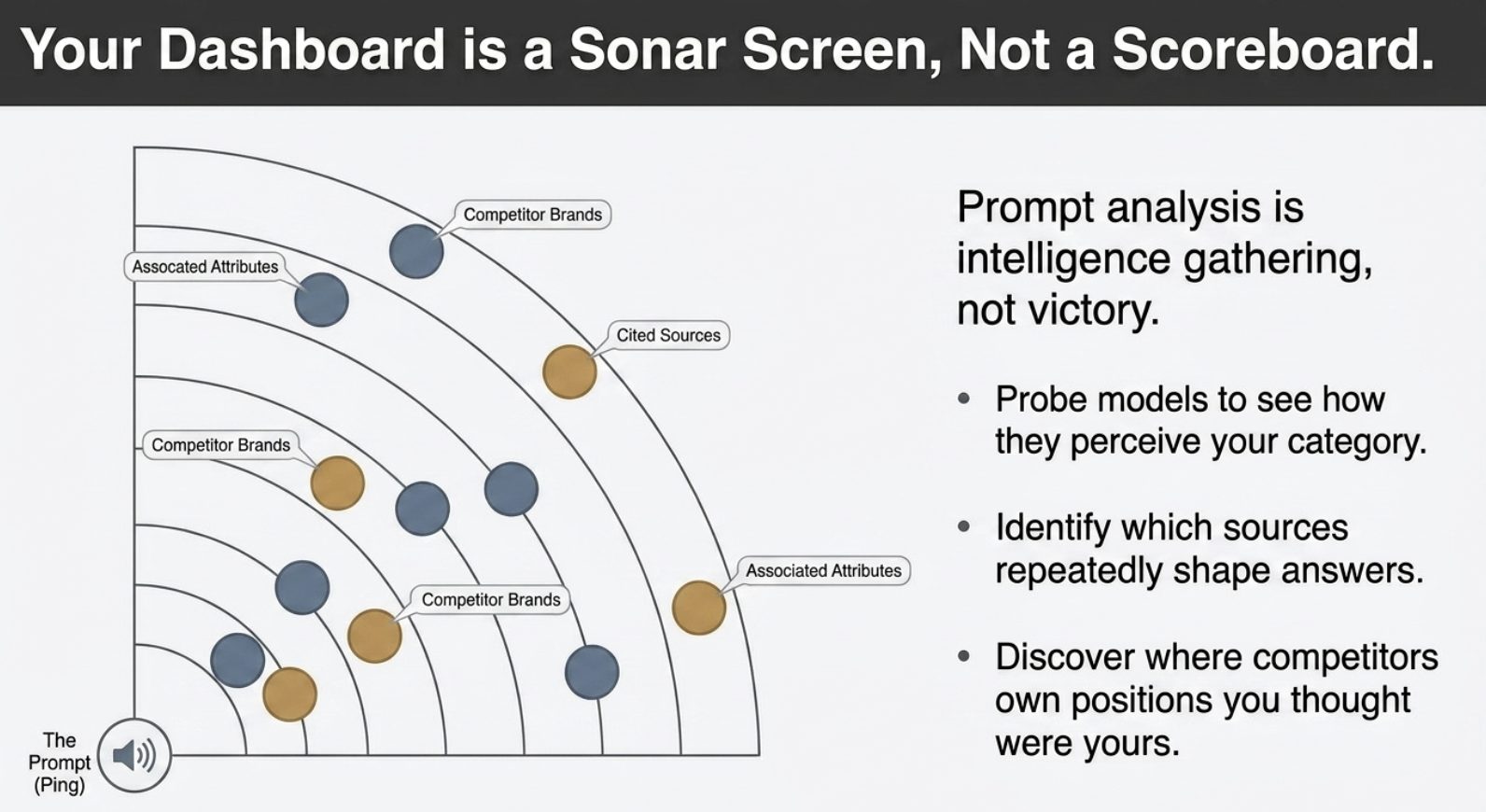
Prompt analysis is intelligence gathering.
Think of it like sonar. A submarine sends out a pulse and the returning signal tells it something about the environment beneath the water. The signal is not the ocean itself. It is information that helps the submarine decide where to steer next.
That is what good GEO analysis should do.
You are probing the models to understand how they appear to perceive your category. Which brands are associated with particular needs? Which sources repeatedly shape answers? Which attributes keep appearing? Which competitors seem to own positions you thought were yours? What does the system appear to understand about you, and where are you absent?
That intelligence can be enormously valuable because it helps shape marketing decisions.
But it is diagnosis, not victory.
GEO starts where SEO rarely did: positioning
If you cannot optimise against billions of stable prompts, where the hell do you start?
You start with the business.
More specifically, you start with positioning.
What are you actually good at? Who are you for? What problems do you solve? What do you do better than competitors? Which circumstances make you more appropriate than somebody else? What evidence supports those claims?
Most brands are depressingly poor at answering those questions.
Go and visit 20 solicitors in the same city, 20 watch retailers or 20 SaaS websites in the same category. After a while they blur into one beige lump of identical claims, identical layouts and identical promises about being customer-focused, innovative and somehow “different”.
This has been building for years because positioning was often forced to fit around everything else. The wireframe came first. Design came second. SEO wanted the H1. Product wanted conversion copy. Then somebody asked the copywriter to articulate the entire commercial reason for the company’s existence inside 11 words above a button marked “Get Started”.
The tail has been wagging the dog for years.
Generative AI exposes that weakness because an intelligent recommendation system needs reasons to distinguish between alternatives.
If all you tell the market is that you are a solicitor in Stoke-on-Trent, congratulations. So are hundreds of other firms.
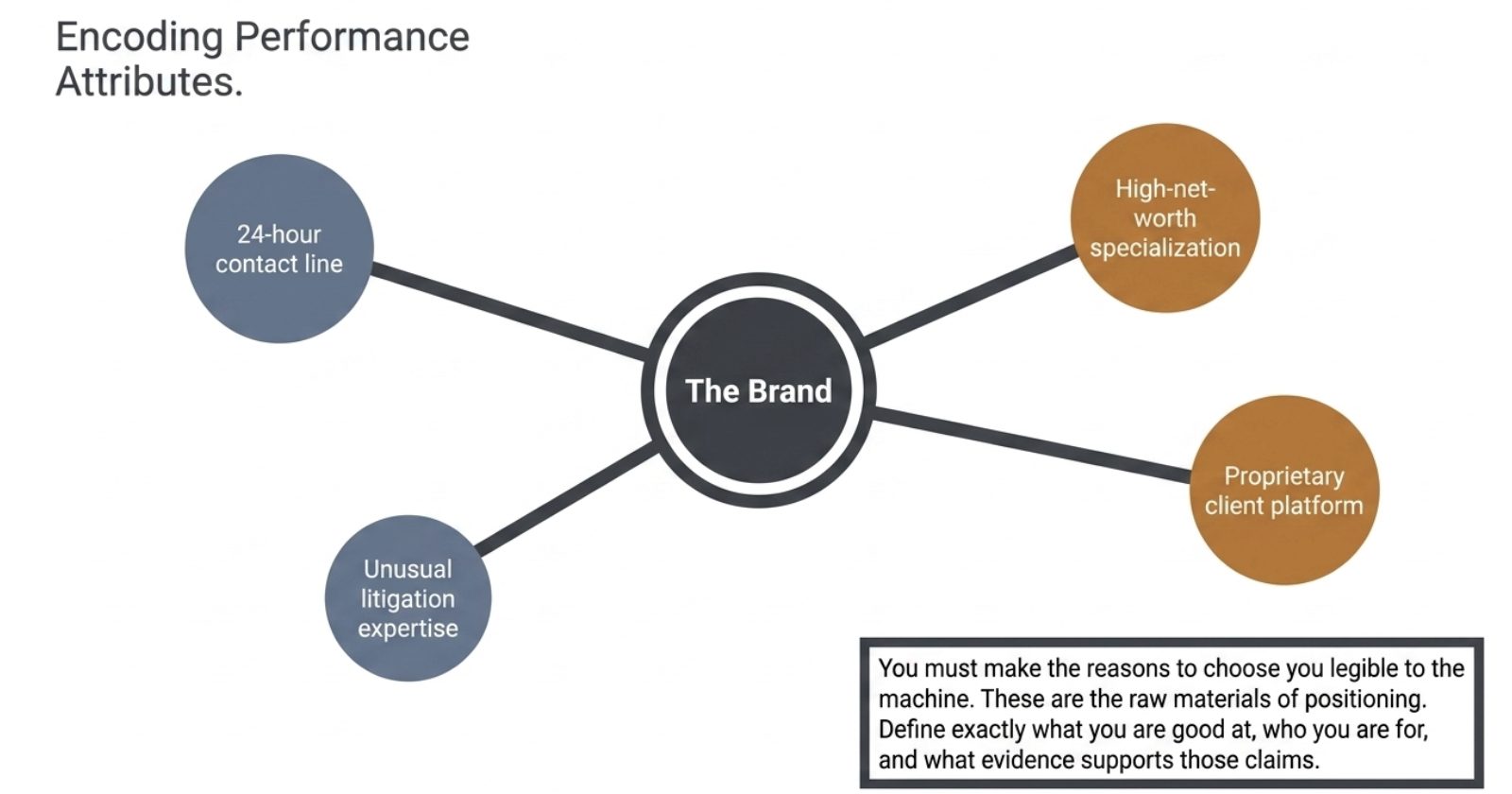
But perhaps you have a 24-hour contact line. Perhaps your client platform is genuinely better. Perhaps you specialise in high-net-worth divorce. Perhaps you have unusual expertise in a particular form of litigation, a stronger success rate or a team with capabilities competitors cannot easily match.
Those are performance attributes.
They are reasons to choose.
And they are the raw materials of positioning.
GEO begins by making those reasons legible.
First test: do you even own the position you claim?
Once you understand your position, prompt analysis becomes useful.
The first question is brutally simple: does AI recommend you for the thing you explicitly claim to be good at?
If you describe yourself as a data-driven digital PR agency, test the systems around that position. If you manufacture a shoe specifically designed to address a particular running problem, test around that need. If you are a restaurant whose distinguishing attribute is an extraordinary ingredient or experience, start there.
Go narrow first.
If you are not being recommended even for the precise position you claim to own, you have discovered something strategically important. Perhaps the positioning is poorly encoded. Perhaps the evidence around it is weak. Perhaps another brand owns that position more convincingly. Perhaps nobody believes the claim except you.
From there you can remove constraints and broaden the prompts. Move into adjacent category-entry points: the situations, needs and triggers that bring somebody into the market.
A restaurant close to a theatre might care about pre-theatre dining. A legal firm may discover that a specialist case has created an unexpected association with a particular type of claim. A software platform might be chosen not because of its broad category but because of one highly specific problem it solves unusually well.
That is where GEO intelligence becomes useful. You start building a picture of where the brand is understood, where it is weak and where competitors dominate.
Then you decide what to do about it.
Visibility strategy has two jobs
Once diagnosis is complete, GEO collapses back into something surprisingly familiar.
Marketing.
There are two broad jobs in the visibility strategy.
The first is making what the brand says about itself clearer, richer and more useful. The second is giving other people reasons to say useful things about the brand.
Owned visibility comes first.
Your website, landing pages, product descriptions, case studies, video, social content, newsletters, research, podcasts and customer evidence all contribute to the body of information surrounding the brand.
The goal is not to pump 600 generic articles onto the internet because a content tool discovered something called “topical authority”. The goal is to increase the density of useful information around the reasons somebody should choose you.
If your software creates better sales intelligence from meetings, talk about the sales intelligence. Show examples, discuss the insights and publish evidence demonstrating why they matter.
If your restaurant imports an exceptional ingredient, explain why it is exceptional and show what you do with it.
If your running shoe solves a specific problem for people with flat feet, talk intelligently about that problem, why it occurs and how your product responds to it.
This is not revolutionary marketing. That is precisely the point.
AI also changes the economics. Updating hundreds of product or category pages used to involve significant writing and production costs. Those costs can now be dramatically reduced, though certainly not eliminated, because somebody still needs to decide what should be said, check whether it is true, and ensure a human can actually tolerate reading it.
The bottleneck therefore moves from production towards judgement.
What is strategically worth saying?
That is a much better problem for marketers to have.
Then get everyone else talking
Owned visibility only gets you so far because brands can say almost anything about themselves.
Apparently every SaaS platform is revolutionary. Every agency is award-winning. Every restaurant uses the finest ingredients.
At some point external evidence matters.
Reviews, journalists, creators, customers, podcasts, industry publications, partners, expert commentary and third-party discussion create an information environment around the brand that is not entirely controlled by the brand itself.
Call it PR. Call it publicity. Call it earned media. Call it whatever you want.
The objective is to give the market a reason to talk about you.
This is where GEO analysis can become particularly useful because testing the models can reveal the kinds of sources repeatedly shaping answers in your category. Those sources can then inform your visibility strategy.
That does not mean a citation from a particular publisher magically guarantees AI supremacy. Of course it doesn’t. It means the intelligence gives you clues about where meaning and authority within the category are being created.
Your job is to decide whether being present in those environments has genuine marketing value.
And that brings us to perhaps the most important operating principle in the whole thing.
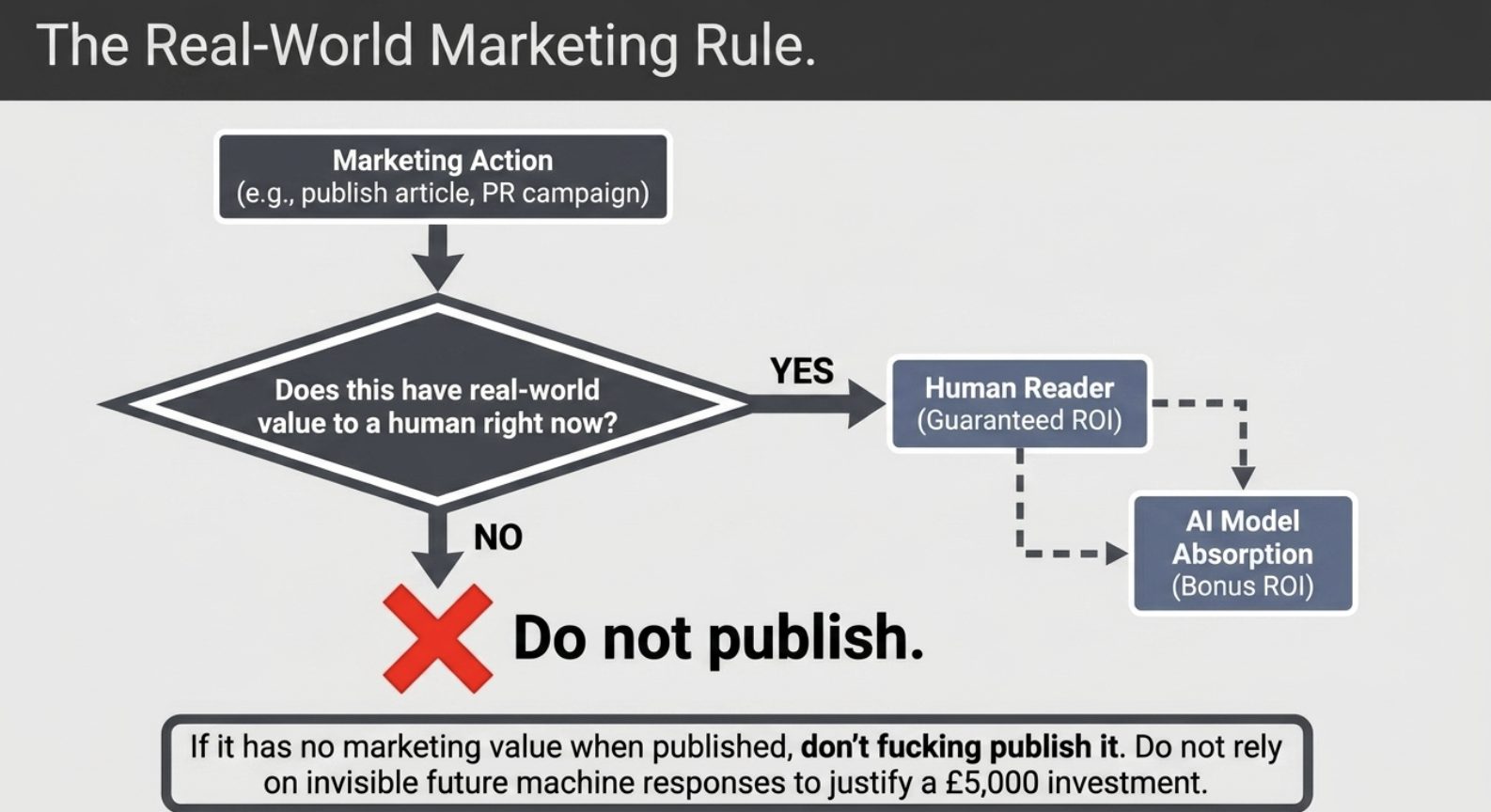
If it has no marketing value when published, don’t publish it
AI recommendations are probabilistic.
You do not control them.
You can improve your chances by increasing evidence, reinforcing associations and improving the clarity of your positioning, but you cannot guarantee that publishing Article X produces Recommendation Y six weeks later.
Anyone promising that level of causality is selling magic beans.
That means every GEO activity should have real-world marketing value at the moment it happens.
A useful article should be useful to humans. A PR campaign should create genuine publicity. A survey should produce credible market intelligence. A video should explain or demonstrate something worthwhile. A customer case study should help buyers understand an advantage. A review programme should make decisions easier for potential customers.
If an AI model later retrieves, absorbs or uses that material when forming a recommendation, excellent.
But the activity should not depend on some invisible future machine response to justify the investment.
This matters particularly because budgets are finite.
A small business does not need 10,000 tracked prompts and a dashboard resembling the control room at CERN. If you have £5,000 to spend, you need enough intelligence to make the next good marketing decision and then you need to spend the money creating visibility.
GEO should reduce waste, not manufacture more analysis.
The losers of Google may become the winners of GEO
Here is the fun bit.
The best brand to start GEO with might be the one that ranks for absolutely nothing.
Think about it.
If your business sits on page two for every important keyword, you have relatively little legacy organic revenue to protect. You can rethink pages, clarify positioning, experiment with category-entry points, build new content and generate external discussion without being terrified that touching a title tag kills half the pipeline.
You have freedom.
The companies with the biggest strategic headache may actually be those that won the keyword era.
If a huge proportion of your pipeline relies on organic and paid search, you are exposed to changes in how people discover and select suppliers. You also cannot casually rewrite high-performing pages because somebody’s shiny AI dashboard says your prompt visibility needs improvement.
Destroying a page generating £2m a year in order to improve an experimental visibility metric would be professional idiocy.
SEO and GEO can complement each other. Good positioning should help both. Useful content can help both. Greater brand fame certainly does not hurt either.
But there will be trade-offs.
Those trade-offs require strategy rather than zealotry.
The least vulnerable companies will probably be those with diversified demand: direct traffic, awareness, referrals, distribution, partnerships, loyal customers, organic search, paid media and genuine brand strength.
In other words, brands that were good at marketing before AI arrived.
Annoying, isn’t it?
I call it fame engineering
This is ultimately where my thinking on GEO has ended up.
Fame engineering.
Not celebrity. Not meaningless awareness. Not posting motivational drivel on LinkedIn until your family blocks you.
I mean commercial fame: creating enough meaningful visibility around a brand that customers, and increasingly the systems helping customers make decisions, understand what it does, what it is good at and when it should be selected.
GEO research provides the intelligence. Positioning provides the strategic centre. Marketing activity creates the visibility.
Owned media explains what you are. Earned visibility gives those claims external weight. SEO can help, paid search can help, PR can help, social can help and advertising can help.
The channels become subordinate to the objective.
That is why GEO potentially sits above them.
The question stops being how many articles were published, how many prompts contained the brand or how much referral traffic AI happened to send last month.
A better question is:
How much meaningful visibility did we create for this brand this week?
Who talked about us? What did we give them to talk about? Which performance attributes became more visible? Which category-entry points did we strengthen, and where did we create evidence that gives customers a stronger reason to choose us?
Those are marketing questions rather than platform questions.
And that is exactly where this discipline needs to go.
SEO has an enormous opportunity, if it can stop being SEO for five minutes
The SEO industry should be incredibly excited about what is happening.
It understands digital information environments better than almost any other marketing discipline. It understands crawling, retrieval, content, web architecture, structured information, competitive visibility and the mechanics of online discovery.
That gives it an extraordinary head start.
But only if it stops trying to prove that everything new was secretly SEO all along.
GEO is still emerging. Anyone claiming to have completely solved it is either deluded or selling software.
We are learning because the systems are changing, the interfaces are changing and consumer behaviour is changing. The intelligent response is to remain open enough to admit that some of our old assumptions no longer work.
Your SEO guru might not become your GEO guru. Your PR agency might understand one part of it better. Your brand strategist may understand another part. Your customers will certainly understand more than all of us about why they actually choose.
That is fine.
Good marketers do not assume they control the market. They study it, diagnose it and then act.
For 20 years, the keyword gave us a shortcut. It told us what people appeared to want and Google gave us a mechanism to stand in front of them at exactly the right moment.
AI removes some of that simplicity because the agent can investigate, compare and interpret on the customer’s behalf.
Which means the strategic question is no longer merely whether you can rank for the demand.
It is whether, after considering all available information, your brand gives the machine and the customer a sufficiently good reason to choose you.
The keyword era made optimisation king.
The AI era puts positioning back on the throne.
Welcome back to marketing.
Andrew Holland
Originally published on LinkedIn on 19 August 2026.