
There is something slightly depressing about scrolling through X or LinkedIn at the moment. Generative engine optimisation is probably the most interesting thing to happen to the SEO industry in 20 years, yet we seem determined to reduce it to SEO 2.0 before we have even properly understood what changed.
The advice is becoming painfully familiar.
Create more bottom-of-the-funnel content. Add schema. Build comparison pages. Do some digital PR. Publish hundreds of articles using AI. Get mentioned on Reddit. Chase citations. Track prompts.
SEO plus PR apparently equals GEO, and when the job is done, we can all return to producing another 50 pages explaining why our SaaS platform is better than its six competitors.
None of those tactics is necessarily wrong.
Bottom-of-the-funnel content can work. Ranking well in Google remains commercially valuable. Links still matter. PR matters. Comparison pages can help buyers and machines understand the market.
The problem is not the tactics themselves. The problem is that we are using an old mental model to understand a much larger problem.
We are trying to think in SEO terms about something that is not solely an SEO problem.
And this is a big issue, because if you misunderstand the problem, you will inevitably misunderstand the role of all the tactics underneath it.
There is another version of the same problem at the more technical end of the industry.
We now have extraordinarily clever people trying to reverse-engineer the black box of artificial intelligence. They are analysing training data, citations, retrieval systems, model outputs and brand mentions at enormous scale. Some of that research is genuinely impressive. But there is also an increasing amount of techno-waffle masquerading as marketing strategy.
Finding out that a brand exists somewhere inside Google’s parametric training data might be intellectually interesting. But what are you actually going to do with that information?
If your ambition is to understand exactly how Google or OpenAI builds and trains its models, perhaps you should go and work for Google or OpenAI.
Marketers have another job. The commercial problem is much simpler to state and considerably harder to solve.
How do you increase the likelihood that your brand is known, understood and recommended?
That is the interesting question.
That is what we’ll talk about today.
AI visibility is not really a thing
The first problem is the phrase itself.
We talk about “AI visibility” as though it is a stable property of a brand. As though somewhere inside the internet there is a giant table with your company name in one column and an AI visibility score in another.
There isn’t.
You do not know what I am prompting. You do not know which model I am using. You do not know whether I am using Google normally, Gemini, ChatGPT, Claude, some form of AI search, a research mode or another tool altogether. You cannot control the precise context I give the system. You cannot know what previous conversation might influence my next prompt. And even if two people enter exactly the same prompt, the response is not necessarily fixed forever.
That means AI visibility tools are not measuring an objective ranking in the way people have historically imagined search rankings.
They are sampling something much bigger.
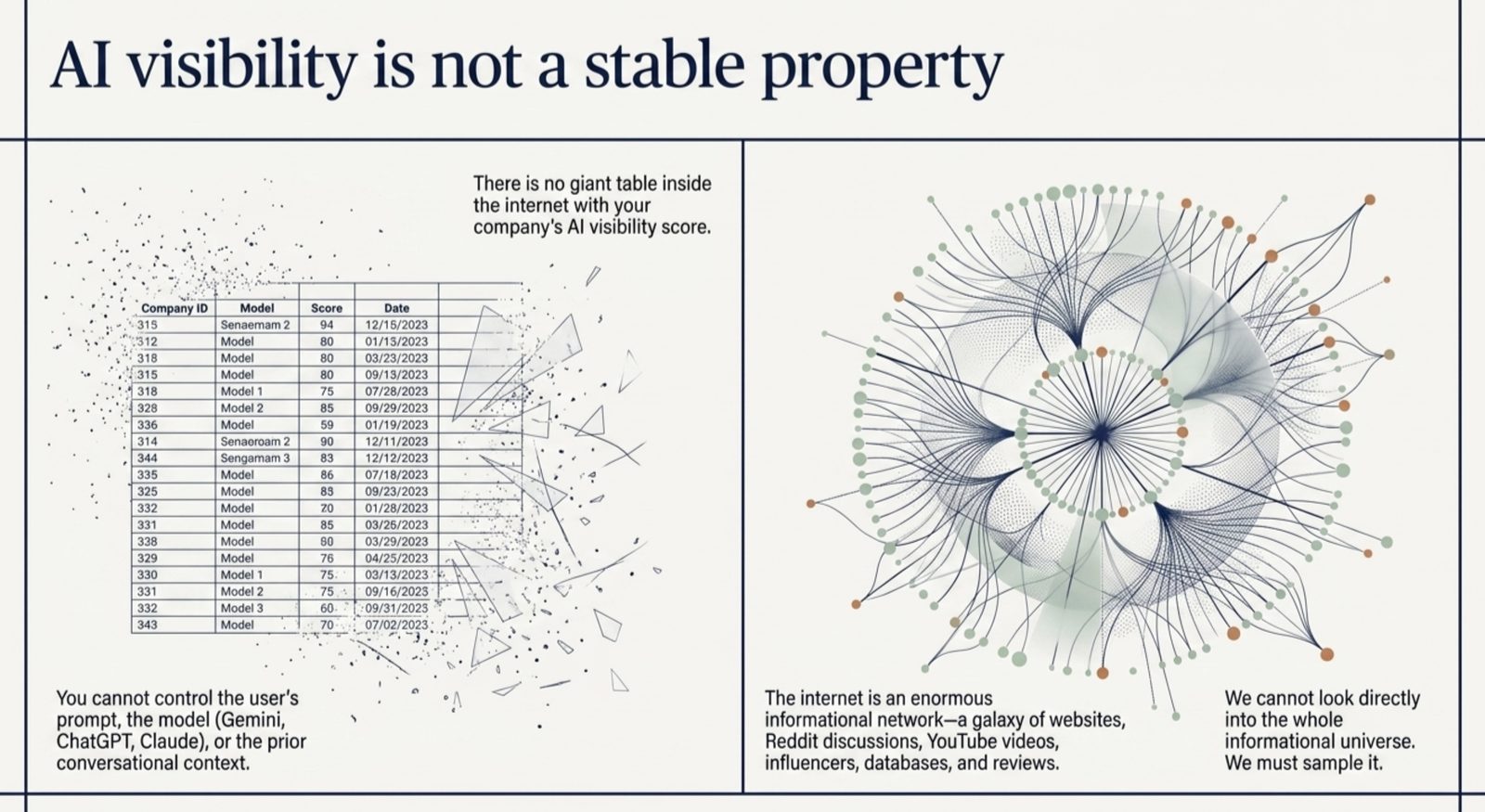
A useful way to think about the internet now is as an enormous informational network.
Imagine a Universe containing websites, businesses, publishers, reviews, customers, Reddit discussions, YouTube videos, journalists, influencers, trade bodies, databases, social platforms, forums and millions of other connected pieces of information. Some nodes are enormous. Others are tiny. Some are highly connected. Some sit almost entirely alone.
We cannot look directly into that whole informational universe.
An AI visibility tool gives us something more like a microscope or radar system. We fire a prompt into that hidden network and observe what comes back.
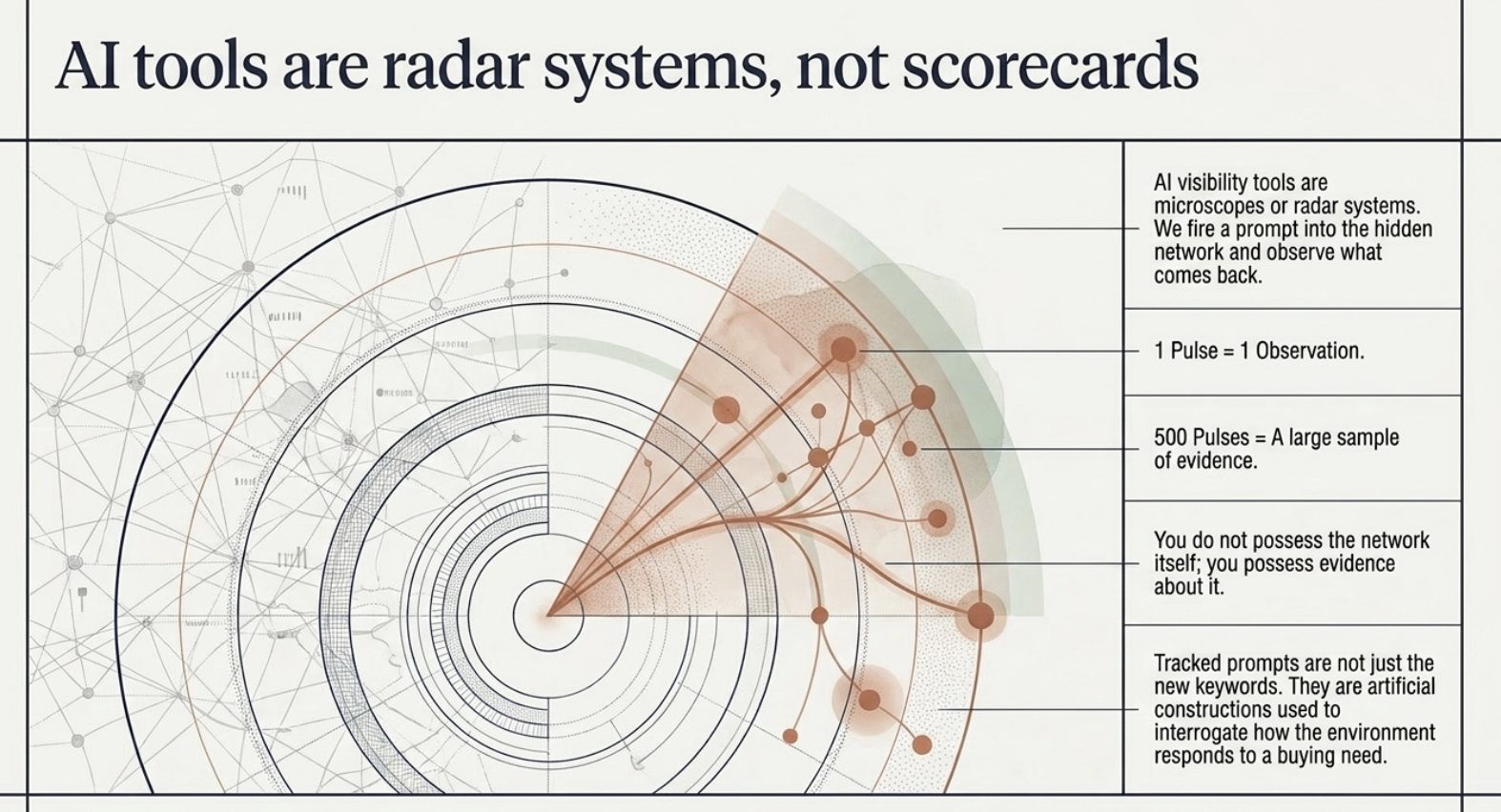
Do it once, and you get one observation.
Do it 10 times, and you get 10 observations.
Do it 500 times, and you have a much larger sample.
But you still do not possess the network itself. What you possess is evidence about it.
This is why I think people become confused when they start treating prompt tracking as if prompts were simply the new keywords. They are not. The prompts we track are artificial constructions. They are pseudo-prompts that represent the kinds of situations in which a buyer might ask for information.
The value is not pretending that one tracked prompt represents exactly what consumers are typing. The value is using it to investigate how the information environment responds to a particular buying need.
Start with category entry points
This is where old-fashioned marketing theory becomes much more useful than another technical acronym.
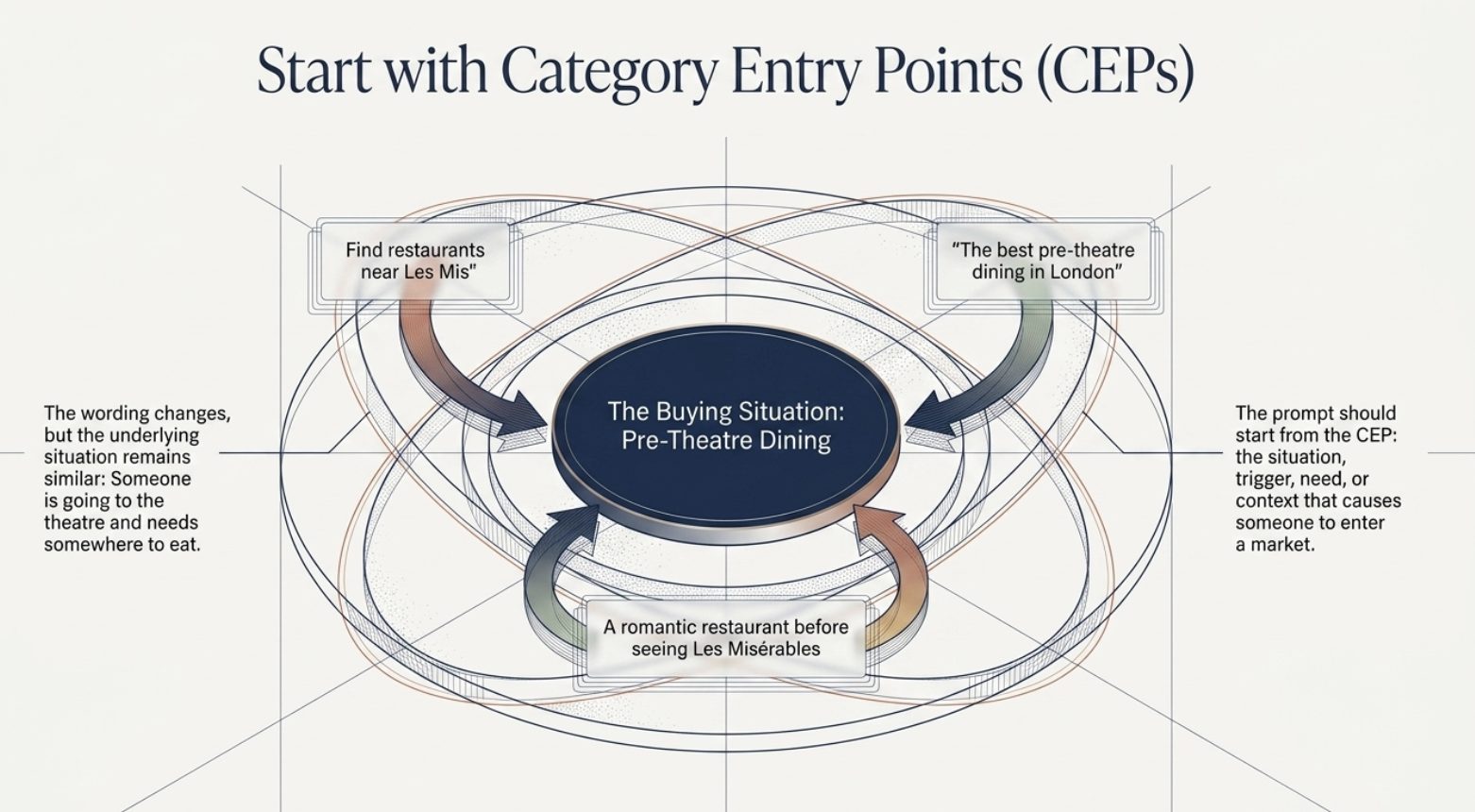
The prompt should start from the category entry point: the situation, trigger, need or context that causes someone to enter a market.
Imagine you own a restaurant in central London near the theatre showing Les Misérables. Someone might ask an AI system to “find restaurants near Les Mis”. Someone else might ask for “the best pre-theatre dining in London”. Another might want “a romantic restaurant before seeing Les Misérables”. A tourist might ask where to eat before the show. A family might want somewhere quick nearby.
The wording changes. The underlying buying situation remains broadly similar.
Someone is going to the theatre and needs somewhere to eat.
That is the useful unit of analysis.
When I think about prompt research, I prefer to start heavily constrained. Start with something you believe you absolutely should be recommended for. If I were doing this for our own business, an example might be: “I am looking for a digital PR agency based in Manchester that specialises in data-driven campaigns and also has SEO expertise.”
That is highly specific.
Then remove a constraint.
“Find me a digital PR agency based in Manchester.”
Then remove another.
“Find me a digital PR agency.”
You are travelling from the specific towards the broad. And as you broaden that buying situation, you start learning something different about your brand.
At the narrow end, the question is whether the model understands that you possess the characteristics you claim to possess. At the broad end, the question increasingly becomes whether you are prominent enough, well known enough and strongly enough associated with the category to be recommended without all those helpful constraints.
The same applies to the restaurant. You might begin with pre-theatre dining near one particular theatre and gradually broaden towards “best pre-theatre dining in London”.
These prompts are not the strategy.
They are probes.
They are ways of interrogating the network.
The dashboard is intelligence, not the objective
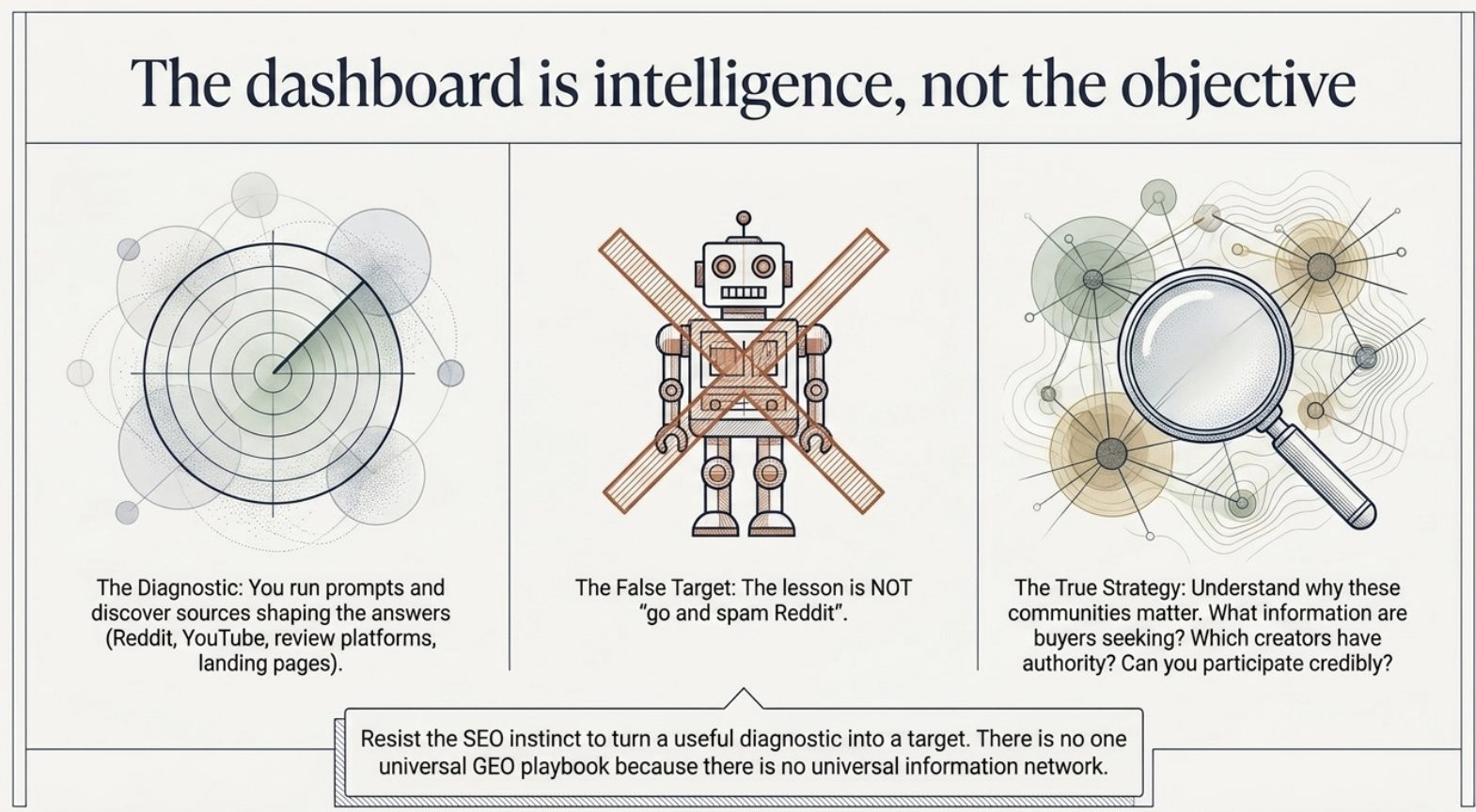
And this is the point at which the industry needs to resist doing what it always does: turning a useful diagnostic into a target.
You run the prompts and discover that certain sources repeatedly appear. Perhaps it is Reddit. Perhaps it is YouTube. Perhaps it is your competitors’ landing pages. Perhaps it is review platforms, national publishers, local media, specialist trade sites, Facebook groups or comparison articles.
Excellent.
You have learned something.
But what you have learned is not necessarily “go and spam Reddit”.
You have discovered which parts of the information environment appear to be shaping the answers in your category.
That is marketing intelligence.
If YouTube videos regularly influence the answers, you need to understand what those videos are doing. Who creates them? What questions do they answer? Which creators have authority? Why does the information appear useful? Can you participate credibly in that network?
If Reddit threads repeatedly emerge, the interesting question is not merely how to insert your brand name into Reddit. It is why those communities are important in the first place. What information are buyers seeking there that they do not receive from company websites? What kinds of claims are trusted? Which experiences are repeatedly discussed?
If landing pages dominate, perhaps there is work to do on your own site. If third-party publishers dominate, perhaps communications and PR deserve greater investment. If reviews consistently contribute, customer experience and review generation become part of the visibility problem.
One business might discover that technical SEO and landing-page improvement are the quickest way to change its position. Another might discover that it has almost no credible presence within the communities that shape its market.
There cannot be one universal GEO playbook because there is not one universal information network.
The diagnostic work tells you where to look.
The strategy determines what you do next.
SEO optimised an interface. GEO is about the network
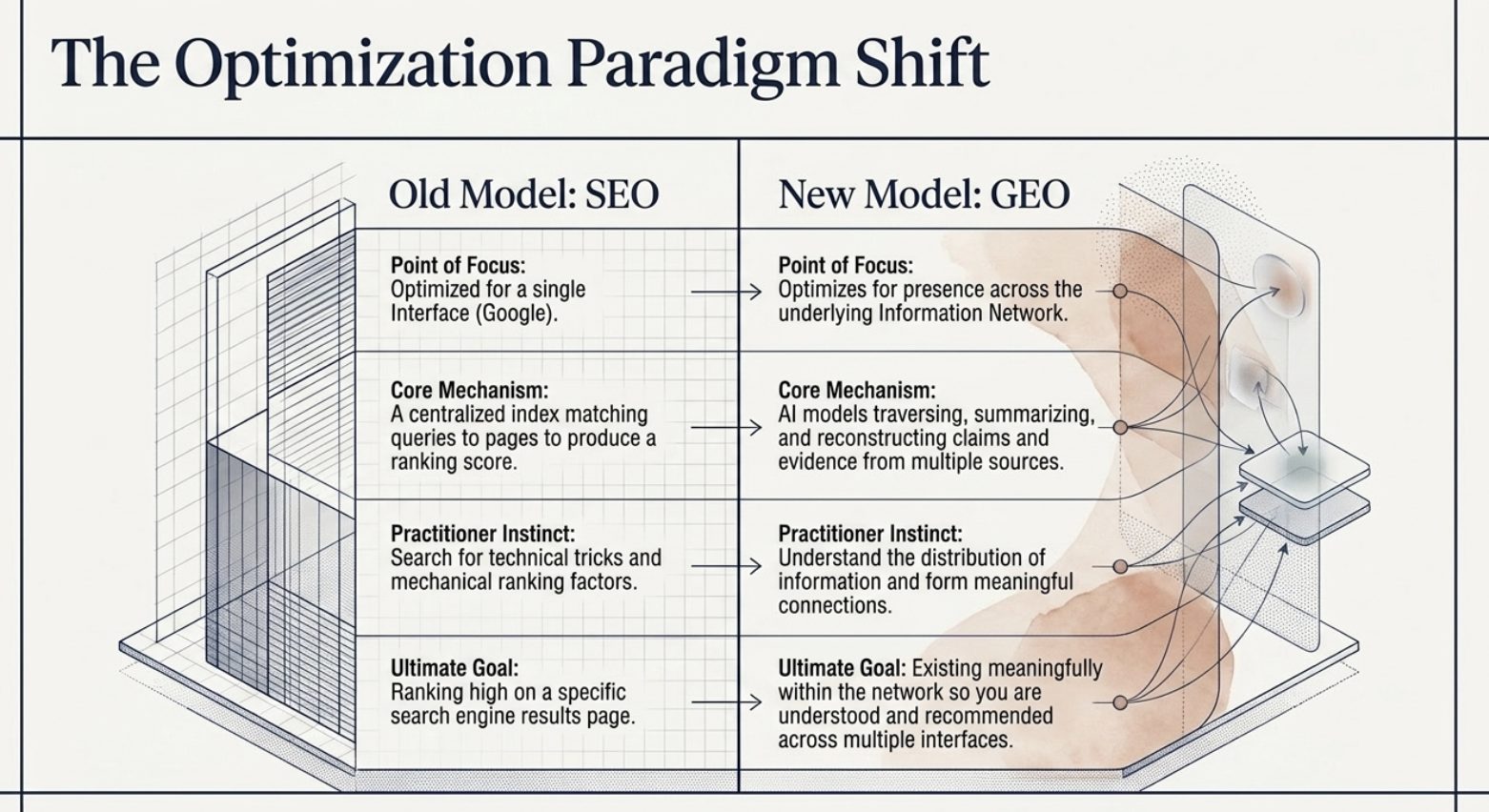
Traditional SEO had an unusually clear point of focus.
Google.
Obviously search was always more complicated than that, but commercially the objective was relatively understandable. Google had an index, users entered queries, the search engine returned results and SEO practitioners attempted to increase a site’s visibility within that system.
You optimised for the interface.
Generative AI changes that relationship because there are now many interfaces into an underlying body of information. People can use Google, ChatGPT, Gemini, Claude, Meta AI, social search, maps, forums and whatever other interfaces emerge over the next few years.
You can spend your time attempting to “optimise for ChatGPT” and then “optimise for Gemini” and then “optimise for Claude”. But eventually you have to notice the obvious.
These are interfaces into something larger.
The larger thing is the network.
That is why I think generative engine optimisation is better understood as an exercise in optimising your presence across the information network itself. Not because every platform works identically. Clearly it doesn’t. But because concentrating entirely on the interface encourages the old SEO instinct to search for technical tricks rather than understand the distribution of information underneath it.
The internet is not simply a collection of pages waiting to be ranked. It is a collection of interconnected entities, people, businesses, communities, publishers, claims and evidence.
AI systems are increasingly useful because they can traverse, summarise and reconstruct that information for users.
The marketing problem therefore becomes broader than ranking.
You need to exist meaningfully within the network.
The space of places and the space of flows
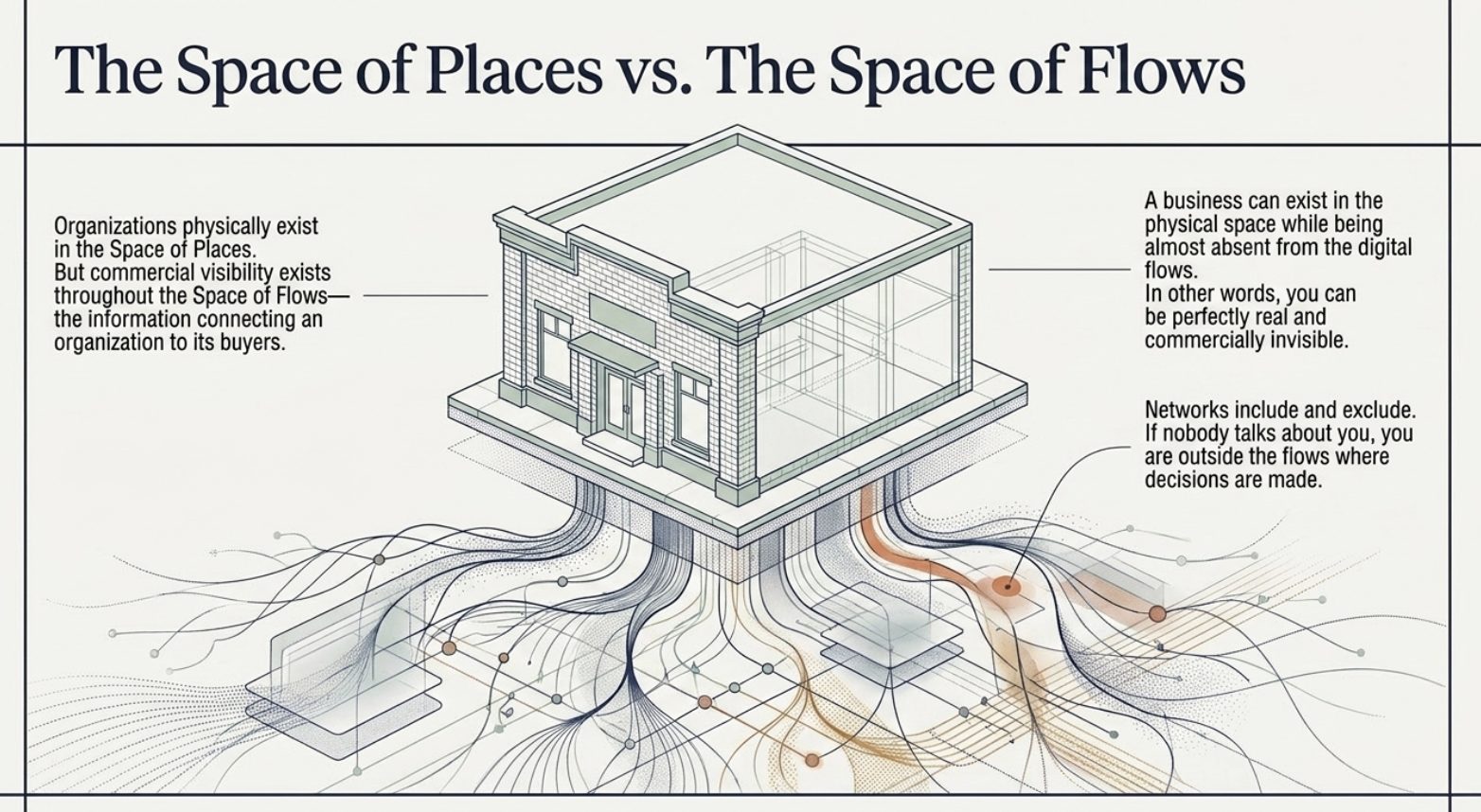
Manuel Castells, the sociologist best known for his work on the network society, provides a useful way of thinking about this.
Castells distinguishes between the space of places and the space of flows.
Forget the academic terminology for a moment and make it practical.
A hairdresser in Stoke is a place.
An engineering company in Bolton is a place.
A boxing club in Newcastle is a place.
A hotel in Staffordshire is a place.
These organisations physically exist. They have buildings, employees, customers and services. A digitally native brand might not have the same physical presence, but it still exists as an identifiable commercial entity.
Then there are the flows.
The information that causes someone to select the hairdresser might travel through Instagram, Google Maps, customer reviews, TikTok, a local Facebook group, a recommendation from a friend and eventually an AI-generated answer.
The information that causes a procurement manager to consider the engineering company might travel through an industry event, a trade publication, LinkedIn, a white paper, Google, conversations with other engineers and an AI research tool.
Commercial visibility therefore does not sit neatly on the company website.
It exists throughout the flows connecting the organisation to the people who might buy from it.
This seems obvious once you say it, but it has enormous implications.
A business can exist in the space of places while being almost absent from the space of flows.
In other words, you can be perfectly real and commercially invisible.
Networks possess the power to include and exclude. Sometimes that exclusion happens because of algorithms. Sometimes because nobody talks about you. Sometimes because you have never published anything useful. Sometimes because you have no relationships with the people and organisations that matter in your category.
Whatever the cause, the outcome is similar.
You are outside the informational flows through which decisions increasingly get made.
Meaningful visibility requires two things
This is why I think the useful model for GEO is much simpler than much of the current industry discussion.
You need network penetration and meaning formation.
Network penetration asks where your brand is present.
Meaning formation asks what your presence actually communicates.
And confusing those two things explains a large amount of the crap currently being produced in the name of AI optimisation.
Take the fashionable idea of publishing 500 AI-generated articles.
Technically, you have increased your presence on the internet. You have added 500 more pieces of information connected to your domain.
But have you increased visibility?
Perhaps.
Have you created useful meaning?
Maybe not.
If nobody reads the articles, nobody references them, nobody finds them, no system considers them important and they merely repeat the same generic information published by 500 competing companies, you have certainly produced more content.
Whether you have achieved anything commercially useful is another question.
Network penetration without meaning can be noise.
Meaning without network penetration can be invisible.
You need both.
Networks are not just platforms
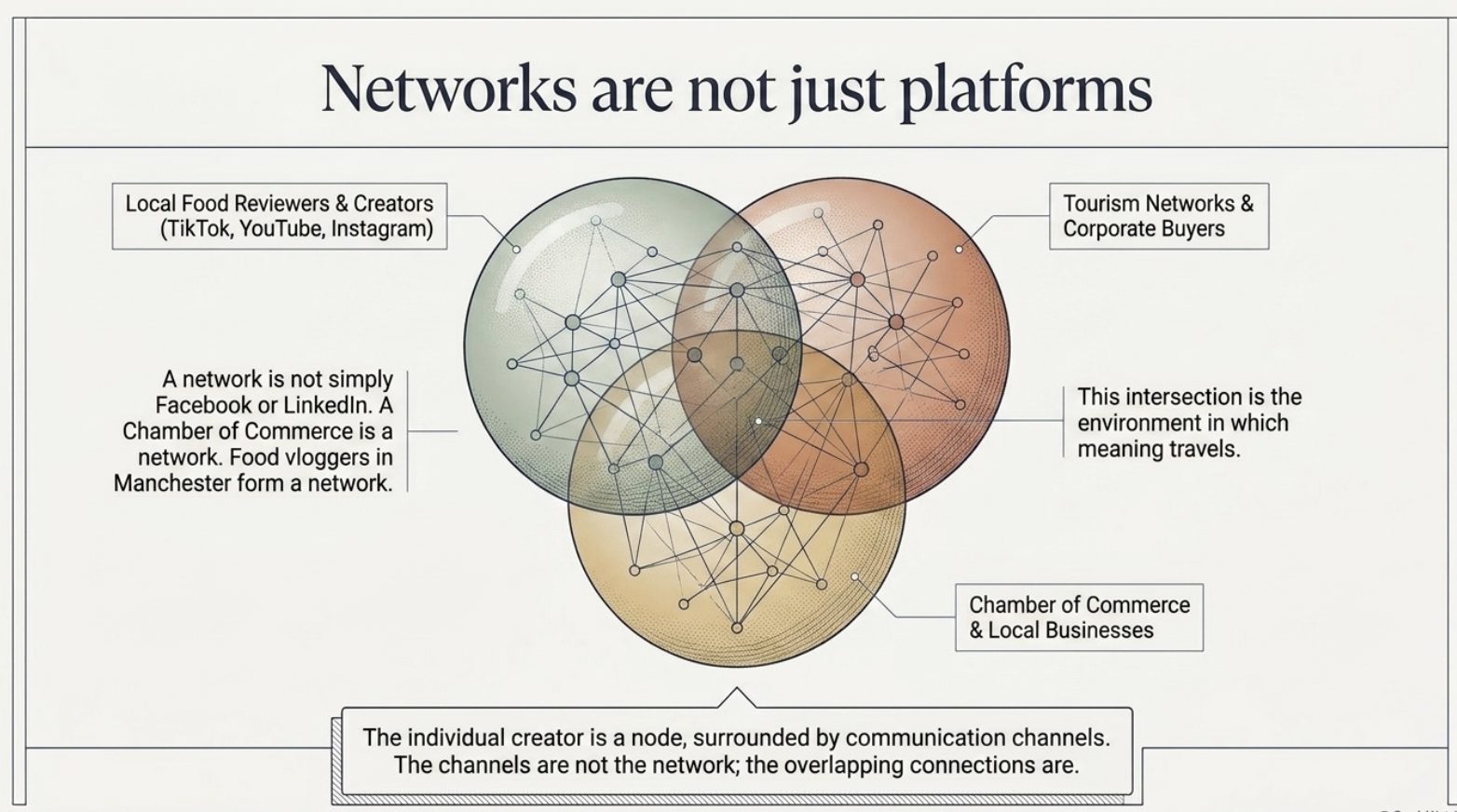
This also requires a more mature understanding of what a network actually is.
A network is not simply Facebook, LinkedIn or TikTok.
A Chamber of Commerce is a network.
Food bloggers in Manchester form a network.
Wedding photographers form a network.
Wedding publishers form another.
Wedding vloggers form another.
Those networks overlap with each other.
The individual food vlogger is a node. That person might operate a website, TikTok account, YouTube channel, Instagram profile, newsletter and merchandise store. Those are communications channels surrounding the node. They are not necessarily the network itself.
Imagine you operate a wedding venue. Relevant networks might include planners, photographers, local businesses, couples, reviewers, magazines, vloggers, venues and industry awards.
Imagine you sell an AI visibility platform. You might need to penetrate networks of SEO agencies, SEO practitioners, PR agencies, PR practitioners, AI researchers, technology publishers and marketing professionals.
Imagine you run a restaurant in Manchester. You might care about local food reviewers, local businesses, tourism networks, corporate dining buyers, review platforms and food creators.
These networks overlap, intersect and transmit information between each other.
That is the environment in which meaning travels.
And AI visibility data can begin to give you clues about which of those networks appear influential for particular category entry points.
Then comes meaning formation
Once you understand where you need to be present, the harder question begins.
What do you want people to associate with you?
What do you want to become famous for?
That is positioning.
A newly opened hairdresser can put a sandwich board outside and capture footfall. Congratulations, the business has joined the physical network of shops in the local area.
But perhaps the hairdresser wants to become known specifically for colour transformations.
Now there is something to communicate.
She creates a good website. She photographs before-and-after transformations. She records videos demonstrating her knowledge. She publishes those videos through TikTok, Facebook, Instagram and YouTube. Customers leave reviews. Perhaps she enters industry competitions. Perhaps she attends events. Perhaps another hairdresser references her work. Perhaps a podcast invites her on to discuss colouring techniques.
Slowly, evidence accumulates.
The important point is not TikTok.
It is not YouTube.
It is not the website.
It is the accumulation of distributed meaning.
Across multiple encounters, one association begins to emerge.
This person knows colour.
That same process applies at every scale.
A SaaS company needs to determine what it wants to represent in the mind of the buyer. An engineering company might want to be associated with reliability and difficult technical problem-solving. A wedding venue might want to own romance, exclusivity or a particular style of experience.
The tactics will be completely different.
The underlying job is identical.
Meaning needs to be formed, demonstrated and distributed.
Show your work
Sometimes this is much simpler than marketers want it to be.
My dogs, Ronnie and Reggie, go to a dog groomer who clearly loves what she does and treats them incredibly well. She posts photographs of dogs after their grooming appointments. The dogs look happy. The work looks good. Customers talk positively about the experience.
There is no mystical GEO trick involved.
She is showing her work.
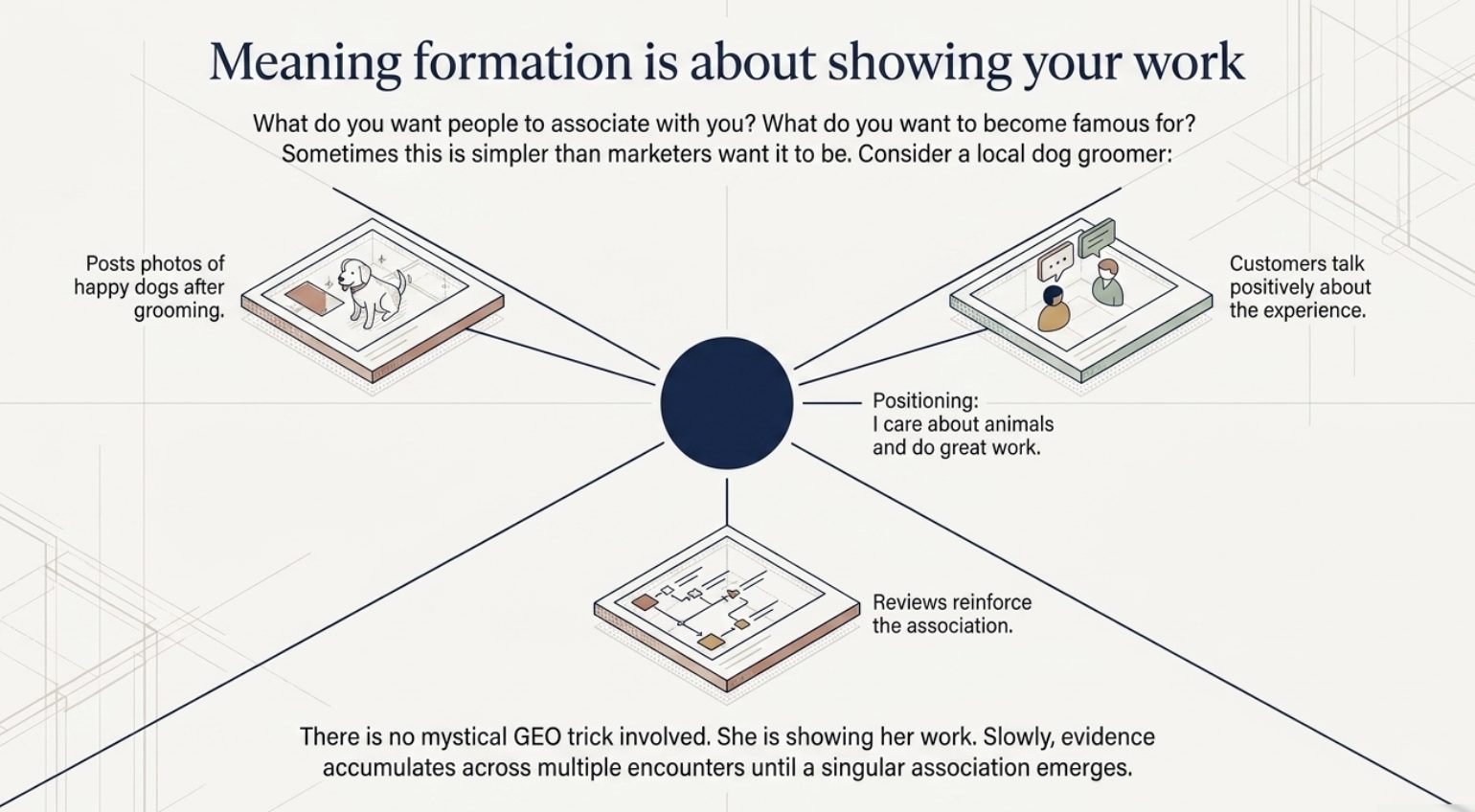
Every photograph communicates evidence.
Every happy customer adds another piece.
Every review reinforces the association.
She is distributing a very simple meaning: I care about these animals, and I am good at what I do.
For a local business, that might be enough.
A larger company will usually need more.
An engineering business might publish technical insight, create industry reports, run events, produce video, appear in trade media, speak at conferences, build case studies and develop relationships with important industry organisations.
Not because some GEO checklist told it that white papers are a ranking factor.
Because those activities help create evidence and distribute the intended meaning throughout the networks that matter.
And that distinction is absolutely fundamental.
The objective is not content production.
The objective is meaningful visibility.
So what is the role of SEO?
This is the point where people inevitably assume the argument is that SEO no longer matters.
Of course it matters.
Organic search still drives enormous amounts of commercial value. Ranking well still matters. Technical accessibility matters. Links matter. Landing pages matter. Bottom-of-the-funnel content matters. We do these things ourselves because they work.
But they are no longer sufficient as a complete conceptual model for GEO.
SEO is one part of the network.
Google remains an enormously important network and optimising your presence within it can be commercially valuable for a very long time yet.
But generative engine optimisation asks a broader question.
How does your brand become understood across multiple connected information environments?
That means GEO inevitably becomes cross-functional.
SEO has a role.
PR has a role.
Content marketing has a role.
Social has a role.
Creators can have a role.
Events can have a role.
Customer experience and reviews have a role.
Which levers matter most will depend on the business.
That is precisely why the current obsession with universal GEO tactics is so unhelpful.
There is no standard answer.
There is diagnosis.
Then strategy.
Then tactics.
SEO practitioners should actually be excited about this because diagnosis is something the good ones have always done well.
They can investigate category entry points. They can interrogate AI visibility data. They can examine citations and sources. They can identify where competitors are more visible. They can map the information environments around a category. They can help companies understand where important meaning is being formed and where the brand is absent.
That is much more interesting than being the department responsible for another 40 comparison pages.
But it also requires accepting that GEO cannot belong exclusively to SEO.
The art of increasing AI visibility
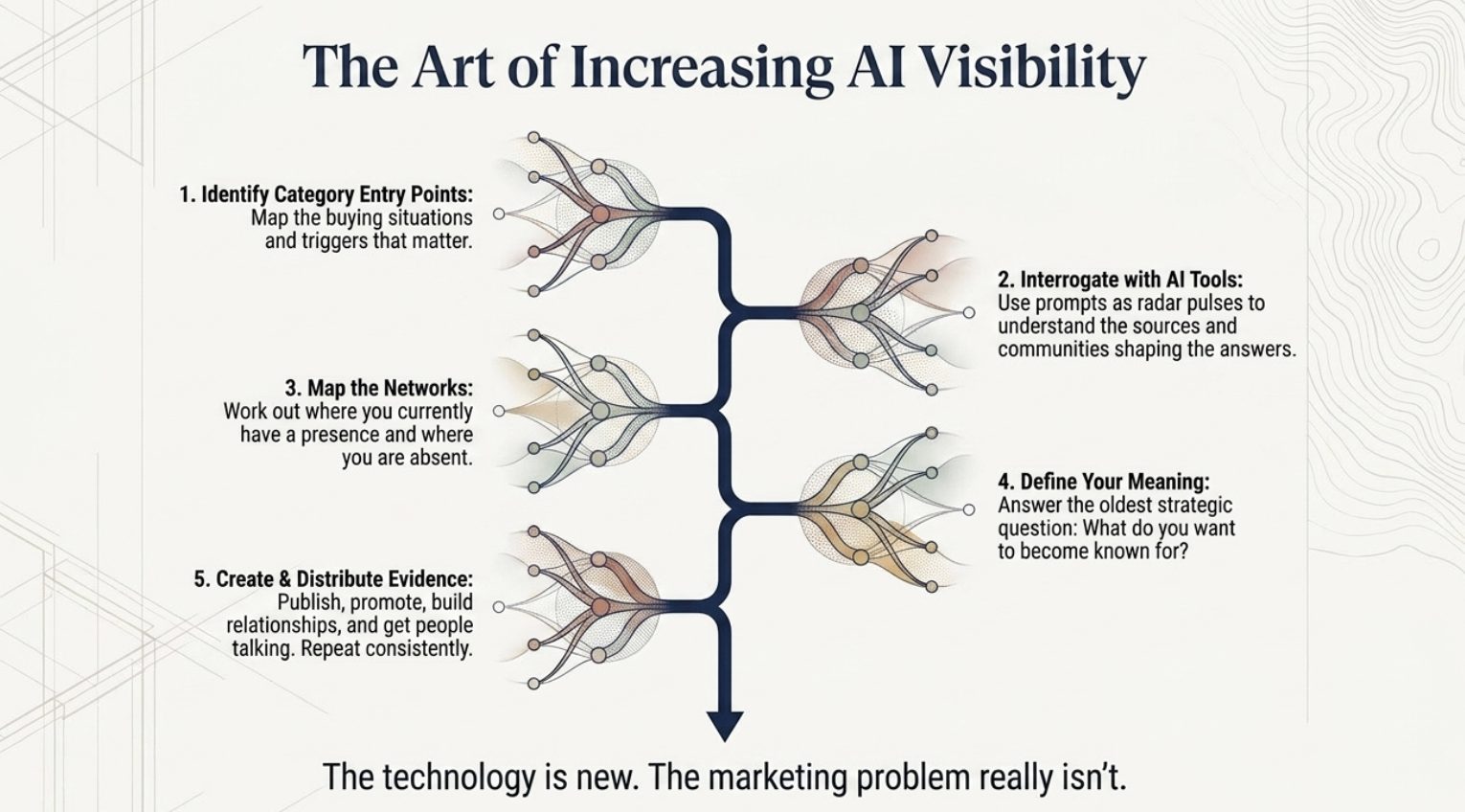
So the art of increasing AI visibility is not really about increasing some abstract visibility score.
It is about making conscious decisions about where the brand needs to exist and what it needs to mean when it gets there.
First identify the category entry points that matter.
Use AI visibility tools to interrogate those buying situations and understand the information being surfaced.
Look at the sources, people, publishers, platforms and communities shaping the answers.
Then identify the networks underneath them.
Work out where you currently have presence and where you are absent.
Then return to the oldest strategic question in marketing.
What do you want to become known for?
After that comes the hard bit.
Create evidence.
Publish it.
Promote it.
Get other people to experience it.
Get other people to talk about it.
Build relationships with the networks that matter.
Repeat the meaning consistently enough that both humans and machines increasingly encounter the same understanding of your brand.
That is meaningful visibility.
The SEO industry wants GEO to be another optimisation problem because optimisation is familiar. Give us a query, a page, a ranking factor and a dashboard and we know what to do.
The emerging environment is not that tidy.
You cannot optimise your way around the fact that nobody knows who you are.
You cannot schema-markup your way into having a reputation.
And you cannot generate 500 articles and assume you have created a brand.
You need to penetrate the networks that shape your market and form a meaning worth distributing within them.
The technology is new.
The marketing problem really isn’t.
Andrew Holland
Originally published on LinkedIn on 10 August 2026.