
Every new marketing discipline eventually gets mugged by the people who dominated the previous one.
Generative engine optimisation has barely staggered into existence, and the SEO industry is already rifling through its pockets.
Apparently, GEO is just SEO. Publish some content. Acquire links. Add schema. Put “AI visibility” on the agency credentials deck. Increase the retainer by 30%.
Nothing to see here.
Except there is.
SEO was predominantly about competing for position within an ordered list. First was better than second. Second was better than seventh. And anything beyond the first page was where content went to die.
Generative engines operate through a different interface.
A user describes what they need and the engine constructs an answer. It may compare products, mention businesses, summarise sources or recommend a specific option. Google itself describes AI Overviews as generated snapshots that provide key information alongside links for further exploration.
The consumer is no longer simply selecting a result from a list.
The machine is increasingly helping to decide which destinations deserve consideration.
It is less like scanning the departures board at Euston and more like stepping into Willy Wonka’s great glass elevator. You describe where you want to go and the mechanism selects a destination.
That changes the marketing problem.
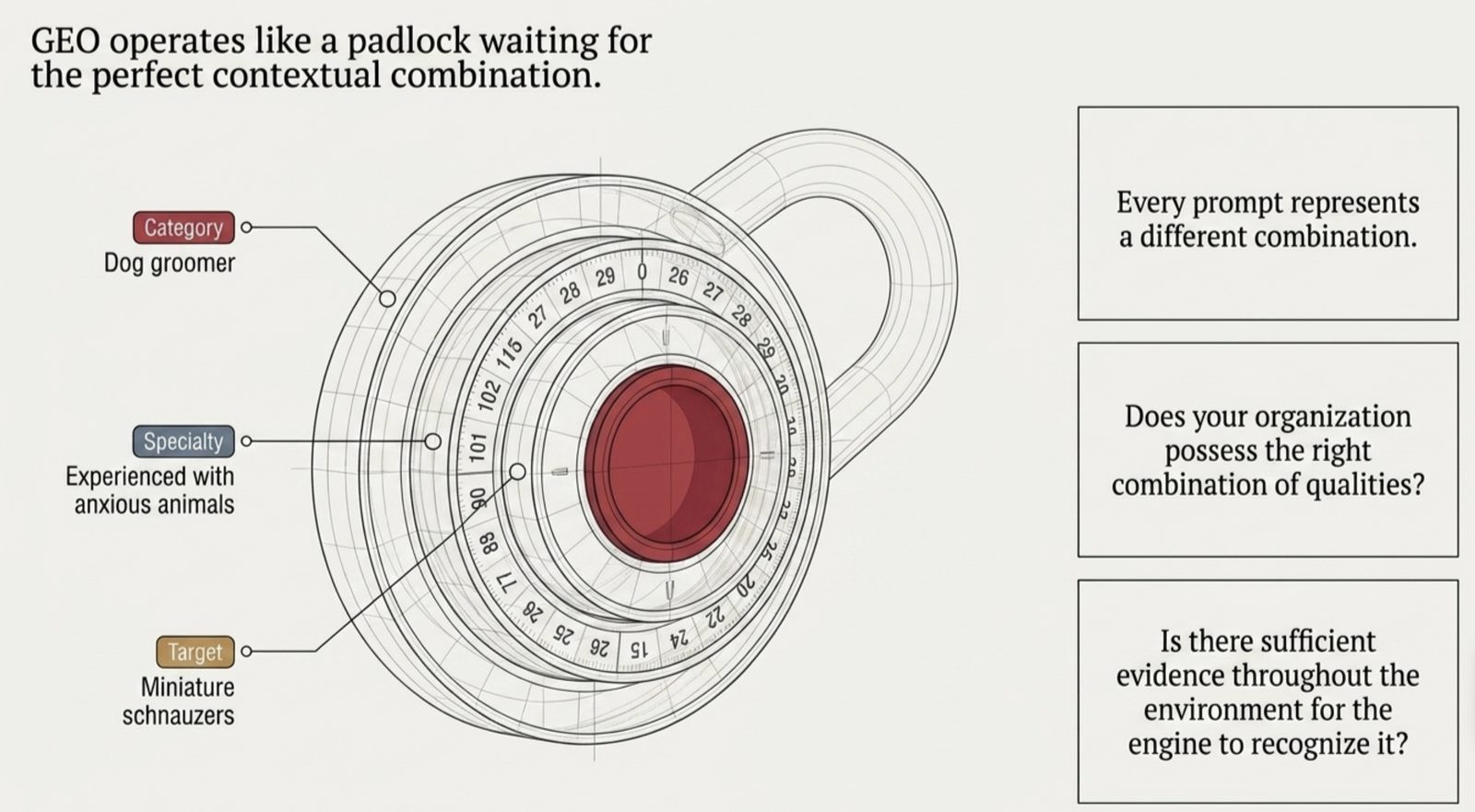
A useful way to understand GEO is as a padlock. Every prompt represents a different combination.
The best moisturiser for sensitive teenage skin.
A dog groomer experienced with anxious miniature schnauzers.
An independent bakery making elaborate dairy-free birthday cakes nearby.
An accountant who understands early-stage software businesses.
Does your organisation possess the right combination of qualities for the request?
More importantly, is there sufficient evidence throughout the information environment for an AI system to recognise that combination?
That second question is where most GEO advice becomes hopelessly inadequate.
Because publishing more pages about yourself is not enough.
You need hubs and authorities.
And in this article I’ll explain what they are and how they work.
Quality is not self-distributing
There are remarkable businesses everywhere.
There is a bakery producing cakes that would make a Bake Off finalist quietly reassess their career choices.
There is a hairdresser delivering transformations from a two-chair salon behind a petrol station.
There is a dog groomer working from a converted garage who understands frightened animals better than businesses with 40 locations and a private-equity growth plan.
These organisations can be excellent and remain almost completely unknown.
Marketers enjoy the comforting belief that the best product eventually wins. It is a lovely story, usually told retrospectively by the winner.
But quality does not distribute itself.
Businesses grow for all sorts of reasons that have little to do with superior marketing.
Demand suddenly increases. Regulation changes. A previously illegal category becomes legal. A legal activity is restricted, creating demand elsewhere. A competitor collapses. Investment becomes available. A pandemic changes behaviour. A platform decides to feature one supplier rather than another.
Then the executives arrive at the conference three years later and explain that growth came from their customer obsession and proprietary four-stage innovation flywheel.
Nonsense… most big brands became big because of external conditions which fuelled growth.
Growth is messy.
A strong product provides something worth distributing. It does not guarantee distribution.
And that distribution is central to GEO. A business cannot become associated with a quality, category or customer need if the wider market rarely encounters it.
You can be the best-kept secret in your industry.
Unfortunately, the commercial value of a secret is usually zero.
The three stages of GEO growth
There are three broad stages through which a business can grow its visibility in generative engines.
The first is publishing about itself.
A company must document what it does. It must explain its products, processes, qualities, expertise and relevance.
For some businesses, visual evidence does much of the initial work.
A baker should show the cakes.
A hairdresser should show the haircut before and after.
A landscape designer should show the garden before it was touched and after it stopped resembling an abandoned municipal roundabout.
But visuals alone are rarely enough.
Words explain what an image cannot. They identify ingredients, methods, materials, locations, audiences, constraints, benefits and differences.
Even video increasingly becomes words. It is captioned, transcribed, summarised and quoted.
Being explicit matters.
Do not merely show the cake. Explain that it is dairy-free, made locally, designed for 30 guests and available for collection in Bristol.
Do not merely show the dog. Explain that your process is designed for anxious rescue animals that struggle in noisy salons.
The first stage is making your qualities legible.
The second stage is getting other people to talk about those qualities.
Journalists mention you. Reviewers assess you. Customers discuss you. Experts refer to you. Publishers include you in comparisons. Podcasters interview you. Communities recommend you.
This external discussion reinforces, alters or occasionally destroys the positioning you attempted to create yourself.
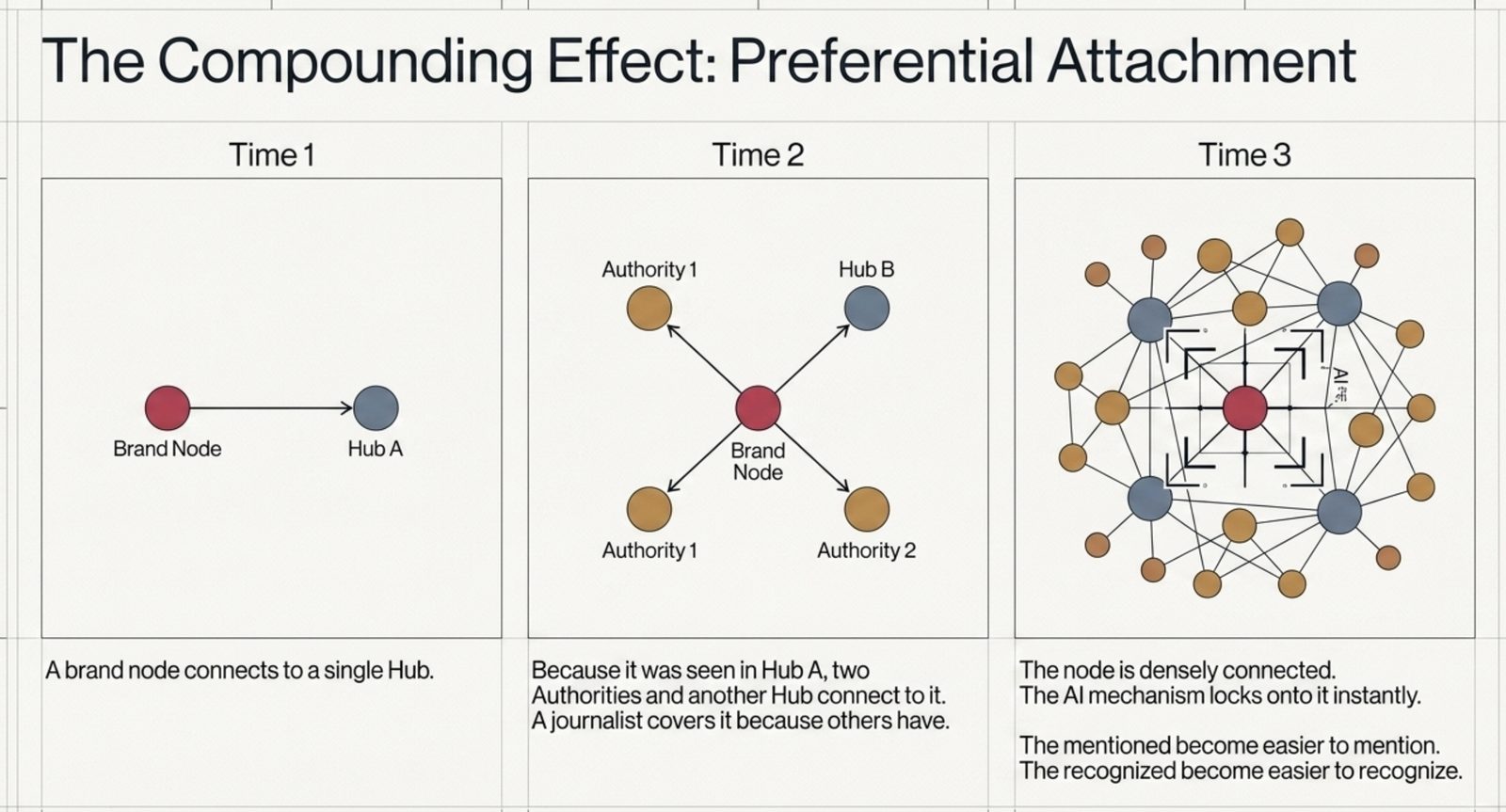
The third stage is preferential attachment.
In network science, preferential attachment describes the tendency of already well-connected nodes to acquire more connections. It produces the familiar rich-get-richer dynamic in which visibility makes additional visibility easier.
Brands experience a similar compounding effect.
A journalist includes a company because other journalists have already covered it.
A customer recognises it because they have encountered it before.
A creator reviews it because the product already possesses some profile.
The brand becomes easier to remember, mention and recommend.
But it is the second stage. The external network of exposure and validation that marketers keep dumbing down to “do PR” or “get links”.
That is not a strategy. It is a shopping list of tactics.
To understand how external recognition actually works, we need to talk about hubs and authorities.
What the hell are hubs and authorities?
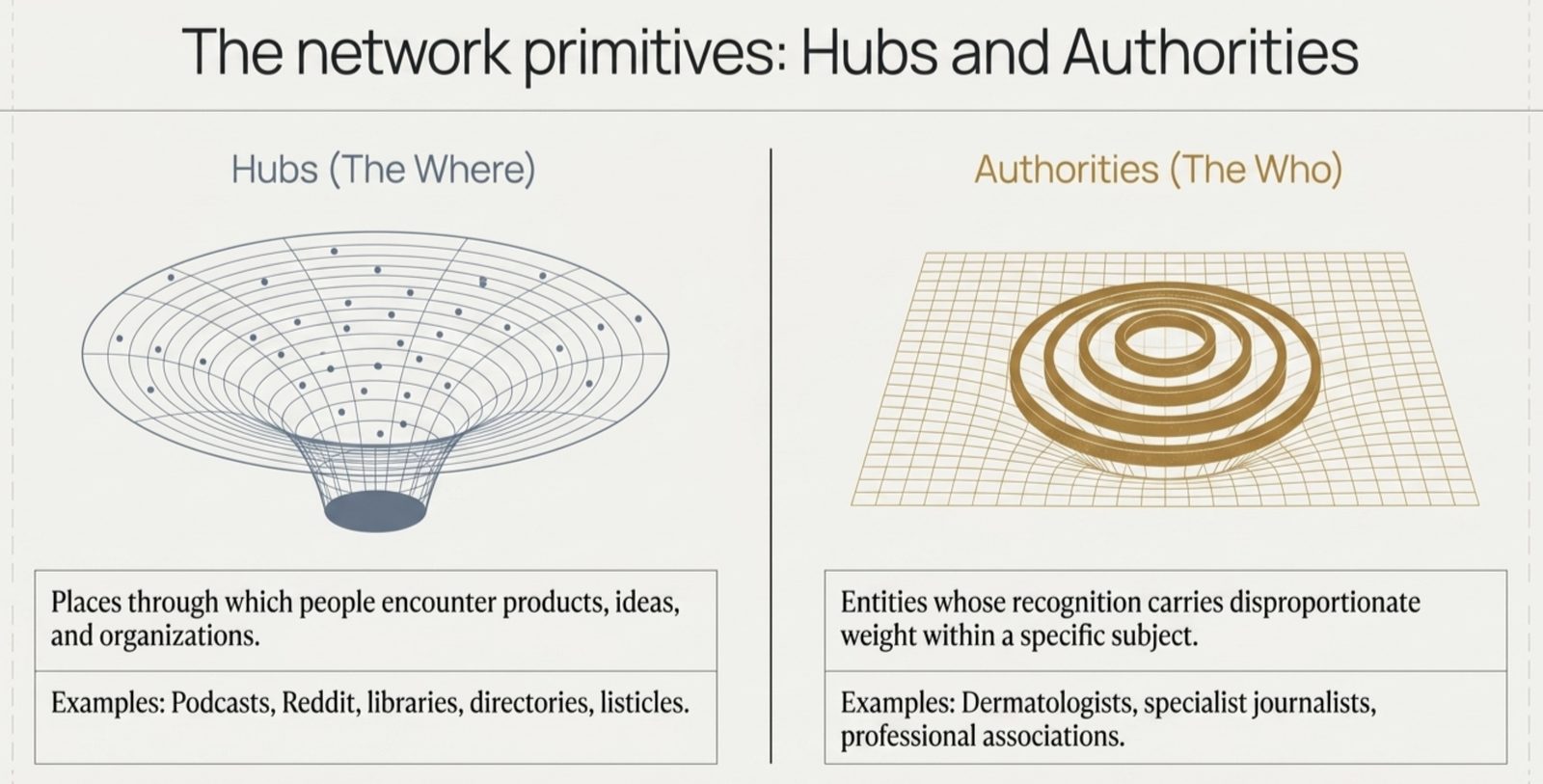
The concepts were developed by computer scientist Jon Kleinberg while studying the structure of the early web.
Kleinberg observed that valuable web pages tended to perform two different roles.
Some pages were useful because they pointed people towards a collection of strong sources. These were hubs.
Others were useful because good hubs repeatedly pointed towards them. These were authorities.
The relationship was mutually reinforcing.
A good hub linked to credible authorities. A credible authority was recognised by good hubs.
The original model concerned hyperlinks and information retrieval. We should not turn it into another piece of GEO mythology.
I am not claiming that ChatGPT, Gemini or every other generative system literally applies Kleinberg’s HITS algorithm before recommending a face cream.
Nobody outside these organisations knows the complete and constantly changing combination of training data, retrieval, ranking, citations, user context and proprietary systems involved in every answer.
The SEO industry already has enough people pretending to understand black boxes.
Instead, hubs and authorities should be used as a strategic model for growth.
A hub is a place through which people encounter other people, products, organisations and ideas.
A newspaper is a hub.
A podcast is a hub.
A YouTube channel is a hub.
Reddit is a hub, as is an individual subreddit.
Libraries, conferences, directories, marketplaces, newsletters, comparison sites, listicles and television programmes can all operate as hubs.
An authority is a person or entity whose recognition carries disproportionate weight within a specific subject.
A dermatologist can be an authority on skincare.
A specialist journalist can be an authority on personal finance.
A professional association can be an authority within its industry.
An influencer may be an authority, although having three million followers and the intellectual depth of a puddle does not automatically qualify them.
The distinction is simple.
Hubs answer: Where will people encounter you?
Authorities answer: Whose recognition will make you more credible?
Hubs create the first encounter
To see this concept unfolded, let’s look at the strange early story of Harry Potter.
The first hardback printing of Harry Potter and the Philosopher’s Stone consisted of only 500 copies, with 300 reportedly distributed to libraries.
The book did not arrive as an inevitable global phenomenon. It entered the world as a small print run from a relatively unknown author.
Libraries were crucial discovery environments.
They contained hundreds or thousands of books. Readers entered looking for something to borrow. Librarians helped organise the collection, noticed patterns in demand and made recommendations.
The library was the hub.
The librarian could act as an authority within it.
Readers then carried the story into homes, schools and conversations. More people encountered it. More people asked for it. More copies were ordered. The network expanded.
That does not mean school librarians single-handedly created the Harry Potter empire.
The books still needed qualities that people loved. A hub cannot sustain demand indefinitely for something nobody wants. But quality alone would have achieved nothing while the manuscript remained in a drawer.
The hub created encounters through which the quality could become visible.
The same mechanism appears in a completely different cultural sewer: Love Island.
Molly-Mae Hague entered the programme with an existing but relatively limited following. During the 2019 series, her Instagram audience grew to more than two million, with later reporting placing the increase from around 160,000 to almost three million during the programme.
Love Island was the hub.
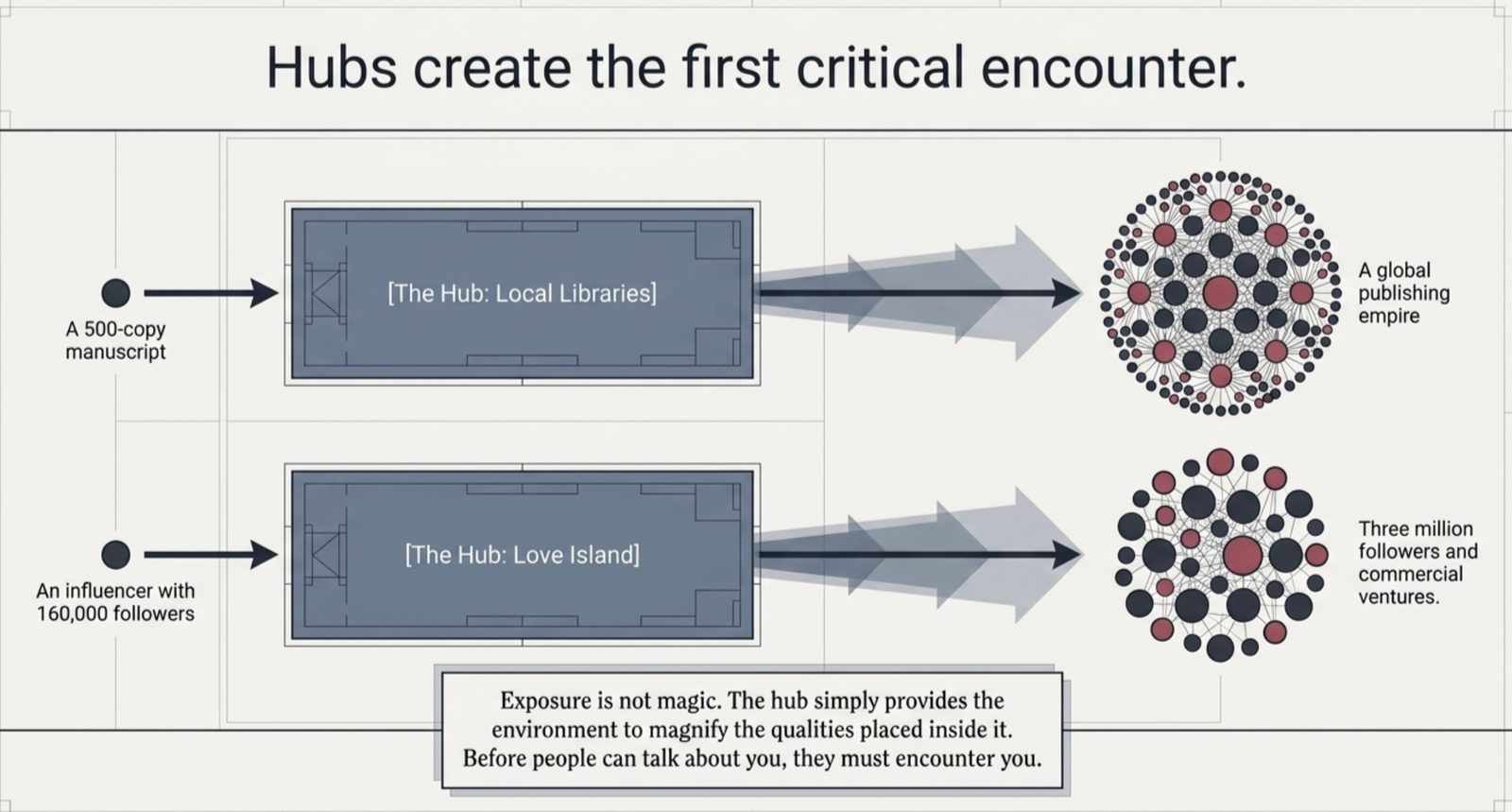
It exposed Hague and Tommy Fury repeatedly, over an extended period, to a huge audience. The programme was then surrounded by other hubs: newspapers, social platforms, fashion publications, entertainment programmes and online communities.
One hub fed another.
But not every contestant achieved the same outcome.
Exposure is not magic. The hub magnifies the people and qualities placed inside it. Some attract continued interest. Others evaporate before the reunion episode.
Hague converted that exposure into brand partnerships, media projects and her own commercial ventures. The hub made her encountered. What she did with that encounter helped make her authoritative within fashion, lifestyle and influencer culture.
That is the first principle of GEO growth.
Before people can talk about you, they must encounter you.
Before generative systems can repeatedly encounter external associations with your brand, those associations must exist somewhere.
Hubs provide the environment in which they are created and distributed.
A hub is not a backlink
This is where conventional SEO thinking does its usual reductive trick.
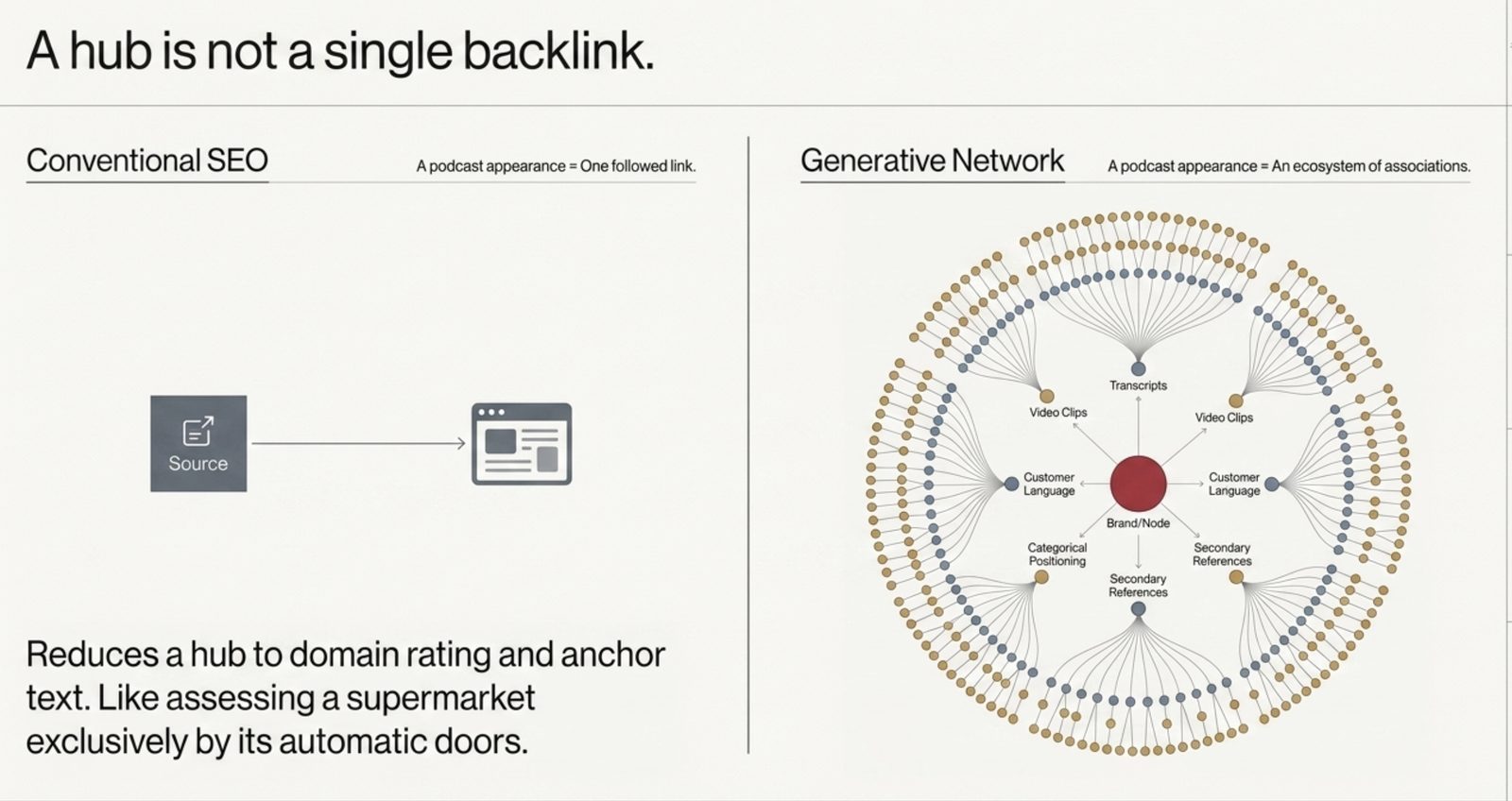
It looks at a podcast, publication or directory and sees a backlink.
Is the link followed? What is the domain rating? Can we influence the anchor text? Does the page receive organic traffic?
These are valid tactical considerations.
But reducing a hub to its link is like assessing a supermarket exclusively by the quality of its automatic doors.
A podcast appearance may create a backlink.
It can also create an hour of explicit language connecting a person with a subject. It creates a transcript, quotations, video clips, social posts, searches, discussions and secondary references.
A listicle may create a backlink.
More importantly, it places a product inside a defined evaluation:
Best moisturiser for dry skin.
Best accounting software for sole traders.
Best hotel for families.
Best laptop under £1,000.
The article does not merely link to the product. It associates that product with a specific buying situation.
And that association is the strategic prize.
A directory does something similar. It places the business inside a category, location or professional group.
A Reddit discussion can expose customer language, objections and comparisons.
A YouTube review can demonstrate the product while explicitly describing who it is suitable for and why.
The link is only one trace left behind by the encounter.
Hubs generate associations.
And generative engines run on a world of associations.
Authorities give the association weight
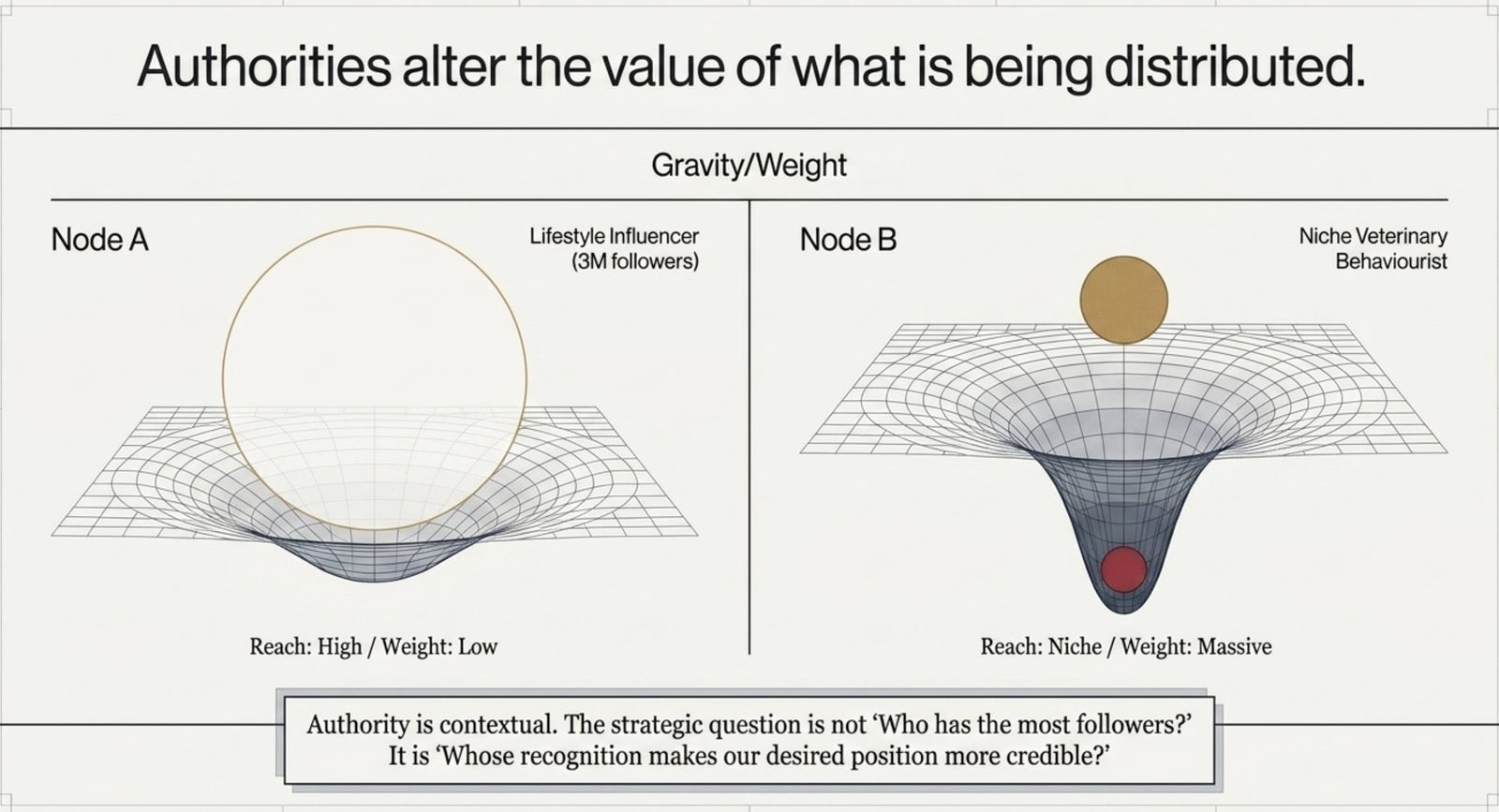
Hubs distribute attention, but authorities alter the value of what is being distributed.
Imagine two people recommending a specialist face cream.
The first is a lifestyle influencer who usually posts airport outfits and discount codes for teeth whitening.
The second is a dermatologist known for treating the condition the cream claims to address.
Both recommendations may create reach.
But they do not carry equal authority. Authority is contextual.
A niche veterinary behaviourist may have a smaller audience than a television celebrity but possess significantly more influence over buying decisions involving anxious dogs.
This is why influencer marketing should really be understood as authority marketing.
The strategic question is not: “Who has the most followers?”
It is: “Whose recognition would make our desired position more credible?”
Most influencer strategies fail this test because they begin with audience size, price and content format.
The marketer chooses a large personality, forces a product into their hand and hopes borrowed fame will somehow create relevant meaning.
It usually creates a forgettable Instagram Story and a large invoice.
The authority must connect to the combination you want to own.
If the product is designed for runners with knee problems, recognition from a respected physiotherapist or running coach matters.
If the restaurant specialises in regional Japanese cooking, recognition from people with knowledge of that cuisine matters.
Authority is not generic status.
It is credible association within a defined context. And yes, that also might mean mixing it up. You might want an influencer with a large audience to mention your brand, but equally you’ll want to be mentioned by an authority with niche expertise/ focus.
In GEO, the opposite of one thing is not necessarily bad. It can be good.
Hubs and authorities can be the same thing
Now, here’s where context is also important.
A publication may be a hub because it distributes information about other entities. It may also be an authority because readers trust its own judgement.
An influencer can be an authority while their podcast, newsletter or YouTube channel operates as a hub.
Yahoo provides an instructive historical example.
In June 2000, Yahoo selected Google as its default search-results provider. Google supplied its technology while Yahoo provided an enormous navigational gateway to the web.
Yahoo did not create Google’s product or single-handedly cause its eventual dominance. But it offered Google mass encounter and implicit validation.
Yahoo was a hub because millions of users passed through it.
It was also an authority because, as one of the defining internet brands of the era, its choice carried weight.
The combination was powerful.
A hub can turn an unknown entity into an authority. Once that authority becomes established, it can create hubs of its own.
That is where the loop begins.
The hub–authority loop
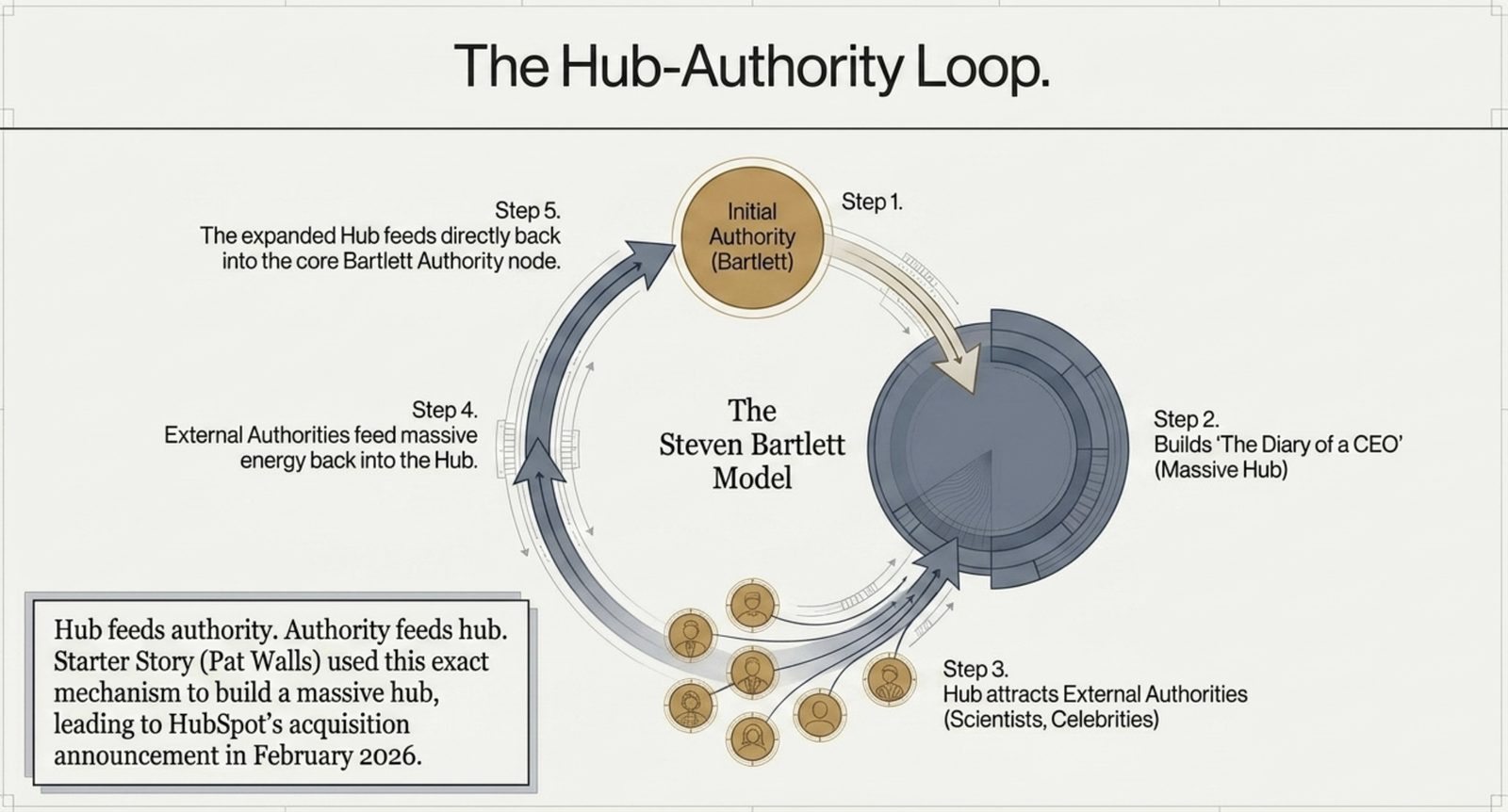
Steven Bartlett is another useful example.
Initial business success gave him a degree of authority as an entrepreneur. Books, television and public appearances increased his recognition.
He then built The Diary of a CEO.
The podcast became a hub through which audiences encountered entrepreneurs, scientists, celebrities and public figures. Those guests brought authority into the programme.
Their participation strengthened the hub. The larger and more credible the hub became, the more Bartlett’s authority increased as its host.
More authority attracted bigger guests.
Bigger guests strengthened the hub.
Hub fed authority. Authority fed hub.
Starter Story also demonstrates the same mechanism at an organisational level.
Pat Walls began publishing detailed stories about entrepreneurs and the businesses they built. Each founder gained exposure from the platform. Each additional case study made Starter Story a more useful destination for people interested in entrepreneurship.
The collection became a hub.
The strength of that hub increased Walls’s authority within the subject. That authority made it easier to attract more founders, readers and contributors.
In February 2026, HubSpot announced that it was acquiring Starter Story, describing it as a founder-storytelling brand reaching more than 100 million builders annually.
Walls did not wait to be repeatedly featured by an established business publication.
He created the publication.
He built the hub.
The hub built authority.
This is strategically important because most businesses assume visibility must be bestowed upon them by somebody else.
They pitch journalists.
They beg to appear on podcasts.
They send products to creators.
They chase inclusion in established directories.
All sensible activities.
But when access proves difficult, there is another option.
Build the hub yourself.
Stop waiting for permission
A hub does not have to begin with millions of users.
A specialist accountant serving restaurants could publish annual benchmarks on labour costs, margins, energy expenditure and ingredient inflation.
A manufacturer could create the industry’s most useful directory of materials, suppliers or technical standards.
By organising a market, you become more than another participant within it.
You become a destination.
You create reasons for experts to contribute, customers to visit and other publishers to cite the work.
Those contributors lend authority to the hub.
The hub, in turn, increases the authority of the organisation behind it.
The easiest hub to enter may be the one you build yourself.
Product GEO is future work
This matters enormously for products.
Current recommendations inside generative engines are not permanent commandments carved into a silicon tablet.
Products change. New evidence appears. New comparisons are published. Customer conversations shift. New authorities enter the category.
A product absent from today’s answers can become visible in tomorrow’s.
But only if the groundwork is undertaken now.
Suppose a brand is launching a genuinely distinctive cream, food product, tool or household appliance.
The lazy response is to publish a product page and wait.
The more intelligent response is to prepare the product for external encounter.
Document the ingredients.
Explain the use cases.
Make the differences explicit.
Conduct credible testing.
Provide samples to relevant reviewers.
Identify the journalists, creators and specialists who cover the category.
Secure detailed customer feedback.
Enter appropriate marketplaces and directories.
Invest in product PR.
And think about listicles as hubs.
Getting added to an existing “best products” article can be difficult. The article may be old, commercially locked down or built around affiliate arrangements.
That does not mean the market is permanently closed.
New lists will be researched. Existing pages will be updated. New publications and creators will emerge.
The strategic question is not merely: “How do we get a link from this article?”
It is: “What must be true for credible publishers to include us in the next round of comparisons?”
Which product qualities must be demonstrated?
Which authorities should test it?
Which category should it belong to?
Which customer need should it be associated with?
What evidence would make the inclusion rational rather than charitable?
Much of GEO is future work.
The information environment you create now shapes the combinations for which your product may become eligible later.
The four components of a GEO strategy
A proper GEO plan therefore needs four components.
The first is what you say about yourself.
This includes product pages, service descriptions, demonstrations, case studies, founder expertise, FAQs, videos and supporting evidence.
Make the positioning explicit.
The second is which hubs feature you.
Which publishers, podcasts, communities, directories, marketplaces, listicles, events and platforms distribute attention within your market?
Which ones can you earn access to?
Which could you build?
The third is which authorities mention you.
Which experts, journalists, practitioners, institutions, creators and established brands can credibly reinforce the associations you want to own?
Not who is famous.
Who is relevant.
The fourth is what customers say about you.
Customers form a distributed network of smaller authorities.
A company can describe itself as reliable. Fifty detailed customer reviews describing its reliability provide corroboration.
A dog groomer can claim expertise with nervous animals. Reviews explaining exactly how staff handled anxious dogs turn the claim into public evidence.
This is why reviews, community discussions and customer-created content matter beyond reputation management.
They provide independent language connecting the business to qualities, problems and outcomes.
These four components overlap.
A podcast may be PR, social media, content and influencer marketing simultaneously.
A customer review can affect sales, reputation, search visibility and generative answers.
A journalist can also run a newsletter, host a podcast and maintain a large social following.
The channels are collapsing into one another because consumers no longer experience them as neat departmental boxes.
This makes fashionable labels such as “social SEO” largely pointless.
You are not inventing a new discipline every time two tactics touch.
Ask better questions.
Does this activity make our qualities explicit?
Does it place us inside a relevant hub?
Does it earn recognition from a credible authority?
Does it generate customer corroboration?
That is the strategy.
The channel label can wait.
AI growth is networked growth
Generative engine optimisation is not simply a new method for ranking a page.
It is the process of becoming a credible answer across a growing number of customer needs.
The padlock combination must fit. You need the right product qualities. You need to explain them clearly. You need external sources to repeat and validate them.
Hubs create the encounters.
Authorities give those encounters weight.
Customers provide corroboration.
And when the system begins to compound, preferential attachment takes over. The mentioned become easier to mention. The recognised become easier to recognise. The encountered become easier to encounter again.
None of this eliminates the need for SEO, PR, social media, influencer marketing or good content.
It explains what those activities are supposed to achieve.
Stop treating every external appearance as a backlink.
Stop assuming your website can declare itself authoritative.
And stop pretending quality will magically distribute itself because the product team worked terribly hard.
Quality gives you the right to compete.
Hubs make you visible.
Authorities make you believable.
That is how the network grows.
Andrew Holland
Originally published on LinkedIn on 4 August 2026.