
The SEO industry is in a complete mess.
Don’t believe me? Go to the artist formerly known as Twitter, and inspect the advice being pumped into the market by SEO influencers.
You will find lists.
Lists of things not to do. Lists of ranking factors, content signals, prompt patterns, query fan-outs and algorithm updates.
And beneath this colossal tactical compost heap sits one especially vague instruction from Google: create helpful content.
Fine.
But helpful for who? Helpful in pursuit of what? And how does any of this help the business paying the SEO invoice?
Google’s guidance makes perfect sense from Google’s point of view. It wants original, non-commodity, people-first content rather than another 2,000-word reassembly of whatever already ranks. It now explicitly tells publishers not to produce endless pages targeting every conceivable query variation and warns that commodity content adds little unique value.
That is sensible platform guidance.
It is not a search strategy.
A strategy requires an objective, choices about where to compete and a coherent explanation of how the activity creates value. “Create helpful content” provides none of these. It describes the internet Google would prefer you to build for it.
The company funding the work still needs to know where the revenue comes from, and in this article I break down exactly how to win search in today’s era.
GEO won while SEO argued about the name
The SEO industry spent much of the past 2 years conducting a wonderfully pointless culture war against generative engine optimisation.
GEO was apparently not real. Or it was only SEO. Or it was a rebrand invented by grifters. Or it consisted entirely of hacks for manipulating large language models. Or anyone using the term was a professional idiot who had failed to appreciate that search engines had always generated answers.
There was an endless supply of objections and a spectacular shortage of strategic direction.
Meanwhile, the market adopted GEO. You are seeing more jobs with the title, more people talk about it, and yes, while names like AEO and AI SEO are also used, people are under no doubt that it’s different.

Business leaders began using AI systems to research suppliers, compare products, understand markets and make decisions. Inevitably, they started asking their marketing teams a simple question: what is our plan for AI search?
Google’s AI Mode has now passed one billion monthly users, with its query volume more than doubling each quarter since launch. AI Overviews has reached more than 2.5 billion monthly users. Whatever one thinks of the acronym GEO, the behaviour it describes is emphatically not going away.
The SEO industry was the logical first destination for this new demand. When companies have a visibility problem in search, they call an SEO agency.
But SEOs failed to establish their value clearly. Instead of explaining where traditional optimisation ended and generative optimisation began, many retreated into semantic pedantry.
The market does not care.
GEO won, not because it is a flawless term, but because buyers needed a name for a new problem and adopted one while the SEO industry was still composing angry threads explaining why the problem did not exist.
The question is no longer whether GEO is real.
The question is what remains of SEO.
Start with the only clicks that matter
For years, I have judged every piece of SEO advice with two questions.
What will this build?
And why does it matter?
That immediately forces us towards the concept the industry should have centred all along: the relevant click.
SEO was never supposed to generate traffic in the abstract. It was supposed to improve a business’s visibility for searches that mattered, leading to clicks that advanced an objective.
That objective might be a sale.
It might be a qualified lead, an app user, an email subscriber or a new reader for a publisher.
But the word relevant does an enormous amount of work. A thousand visits from people who will never buy, subscribe, return, remember the brand or recommend it are not necessarily an asset. They are simply a larger number in Analytics.
Once you focus on relevance, historic SEO separates into two very different disciplines.
The first is performance SEO: generating rankings for commercially valuable searches with the intention of producing leads or revenue.
The second is content SEO: generating rankings to produce readership.
Both could be legitimate. But they were never the same proposition.
Unfortunately, the industry bundled them together, lost sight of the difference and eventually made content production the default expression of SEO.
That is where the mess began.
When words turned into money
There was a time when readership SEO was a wonderful business model.
Publishers created content, attracted visitors and monetised those eyeballs through advertising or affiliate links. Bloggers did the same. You could write an article, rank it, direct the reader towards a product and receive a cheque for the introduction.
I still remember the thrill of receiving my first affiliate payment. It felt as though I had discovered alchemy. Words had gone into the internet, and money had come back out.
For publishers, almost any additional reader could have value because the business sold attention itself. If you made money from display advertising, another visitor was another monetisable impression.
For normal businesses, the model was different. Content had to contribute to a commercial outcome.
And originally, it often did.
When I first entered SEO, we did not create content because every company was apparently obliged to become a media organisation. We created strategic assets designed to earn links.
Brian Dean‘s skyscraper technique captured the logic beautifully. Find something that has already attracted links, build a substantially better version and promote it directly to the people most likely to reference it. The original framework was explicitly a link-building system, not a command to publish enormous articles until everyone lost the will to live.
We created power pages.
We produced data assets, comprehensive guides and resources worth referencing. We promoted them. They earned external links. We then used internal links to transfer authority towards the commercial pages that generated revenue.
Glen Allsopp‘s snowball link-building approach followed similar economic logic. Create assets such as statistics pages that can attract links, become more visible because they have links and then attract still more links because journalists, writers and researchers keep discovering them.
The content had a job.
It was an asset designed to strengthen the wider site and improve commercially important rankings.
That model still works.
The problem arrived when the SEO industry removed the strategy and retained only the output.
How SEO became an article subscription
Content stopped being a means and became the product.
The skyscraper technique deteriorated from “build the best linkable asset and promote it” into “make the article longer”.
An 800-word page became 1,500 words. Then 2,500. Then 5,000. Soon every search result contained a small Russian novel answering a question that required three paragraphs.
Agencies evolved with the model. A typical SEO retainer became two or four articles a month, a technical check, some internal links and outsourced backlinks.
The SEO agency had quietly become an expensive content-production company.
There was nothing inherently wrong with improving a website. A strong resource centre can demonstrate expertise and make a good impression on visitors. Businesses should explain their products, their sector, their methods and their thinking.
But any rational client eventually asks the awkward question.
What is the return?
I used to charge around £1,000 for a serious linkable page because the page was expected to earn links, and links had strategic and monetary value. But readership content also became expensive. A decent writer might need a full day to produce a strong 2,000-word article. Bigger resources needed design, original research, graphics and twenty or thirty hours of work.
You could spend £24,000 a year on an SEO retainer and receive a neat pile of articles that attracted 5,000 annual visitors.
That is not automatically good marketing.
It might be. The visitors might be exceptionally valuable. But if most of them are nowhere near the target market, the maths becomes appalling.
Imagine an engineering company in Bolton spending thousands of pounds creating broad educational content because a keyword tool says people search for it.
The articles rank. Traffic arrives. But the traffic is students, overseas researchers, hobbyists and miscellaneous internet wanderers visiting the site.
The monthly report goes green.
The sales pipeline does not move.
That is not successful SEO. It is the industrial manufacture of irrelevant clicks.
The HubSpot problem
HubSpot became the grandest expression of the readership model.
It built an enormous library covering almost every conceivable topic of interest to a marketer—and several topics of no conceivable interest to one. The famous article explaining the emoji became shorthand for the strategy: acquire vast quantities of search traffic, even when the connection between the query and the product was tenuous.
HubSpot succeeded for many reasons. It entered early, built extraordinary distribution, created genuinely useful resources and became one of the defining brands of inbound marketing.
But most businesses are not HubSpot.
They cannot reproduce its timing, scale, domain authority, sales infrastructure or content operation. Nor should they assume that every person visiting a generic article will remember which software company happened to publish it.
One exposure is not brand building.
We do not preserve every brand encounter permanently in memory. Brands fade. Advertising and repeated communication work partly because they refresh those memory structures.
And HubSpot itself has never survived on free organic traffic alone. Its 2024 filing showed sales and marketing expenditure equivalent to 46% of revenue. That hardly suggests a company able to publish an article once and enjoy costless customers for eternity.
Traffic from Google is not an owned asset.
It is a gift from Google.
Enjoy it. Measure it. Convert it when it arrives.
But do not build your entire marketing strategy on the assumption that the gift must continue. Because Google isn’t at that party any longer; they’ve moved on.
What remains of SEO
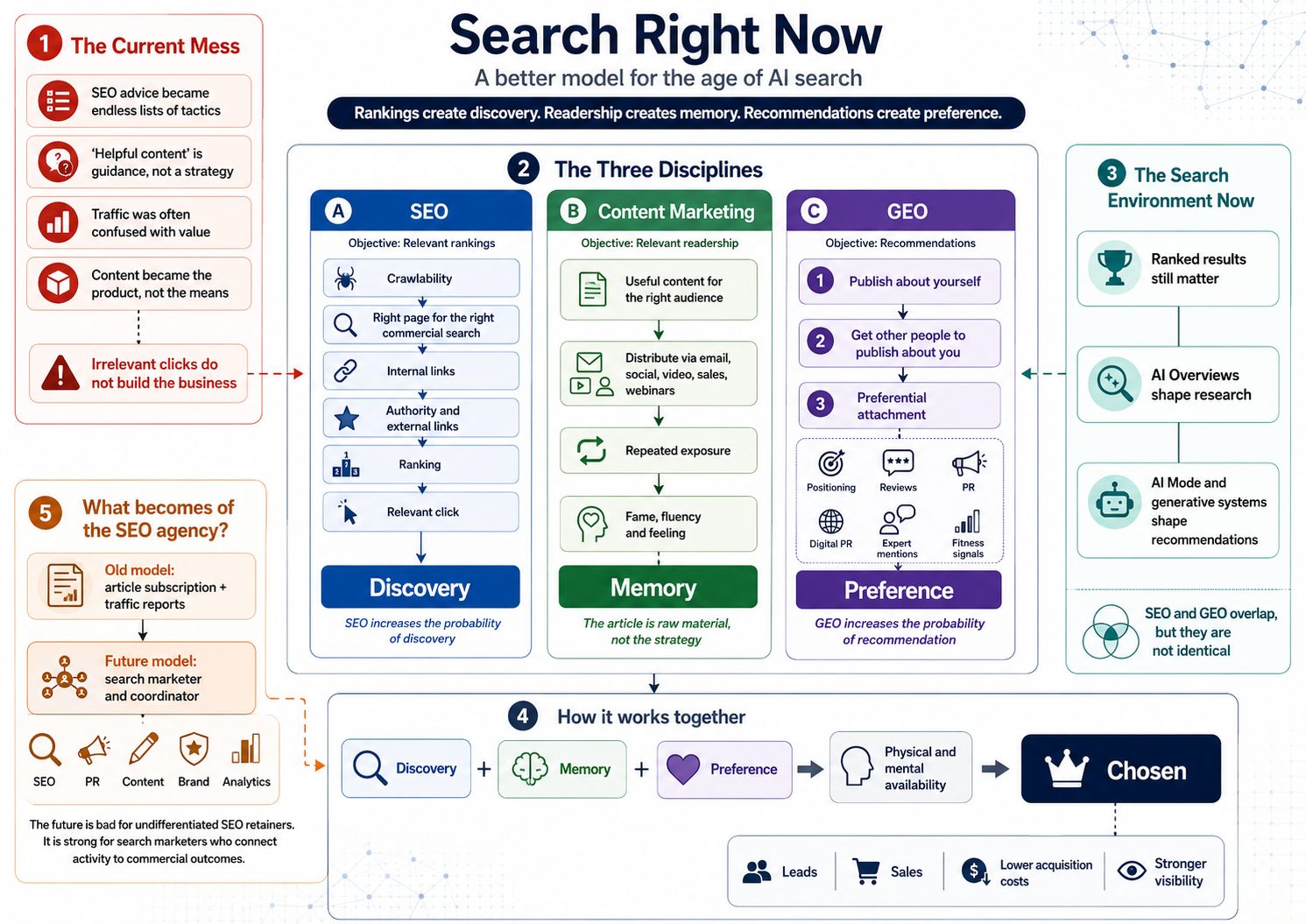
Once informational readership is decoupled from SEO, the discipline becomes much easier to understand.
SEO equals relevant rankings.
That is not the whole of modern search marketing. It is the part SEO can still own clearly.
The objective is to improve rankings for searches that are commercially relevant to the organisation.
That means identifying high-intent terms, building or improving the correct money pages, aligning titles and headings, clarifying the on-page content, strengthening internal linking, maintaining technical accessibility and earning external links and brand mentions.
It is less glamorous than predicting the next algorithm update from the flight pattern of a passing pigeon.
But it is commercially coherent.
The tactical tweaks that once produced enormous movement are less powerful in competitive categories. Much of modern SEO is now basic but demanding work executed consistently:
Get the site crawled.
Get the right page aligned with the right commercial search.
Build a logical internal structure.
Acquire authority.
Improve the ranking.
Generate the relevant click.
That still has immense value. Businesses spend billions buying high-intent clicks through paid search because those clicks produce leads and sales. Organic visibility for the same kind of demand remains commercially important.
The mistake was not believing in rankings.
The mistake was pretending every ranking and every click was equally valuable.
Readership belongs to content marketing
Businesses should continue creating content.
But they should stop automatically calling it SEO.
A double-glazing company should explain how to choose windows, how installation works, what can go wrong, why its products differ and why customers should trust the people fitting them.
A restaurant should talk about its new chef, its suppliers, a tasting event, a new cocktail, an award or why it sources its steaks locally.
An engineering company should publish technical insight that its buyers and sales prospects genuinely value.
Ahrefs should continue creating content about search because people trying to improve their search marketing are a logical audience for an SEO platform. The line from reader to potential customer is credible.
But the goal is not to locate every keyword with visible volume and fill the website with something vaguely adjacent to it.
The goal is to create material that helps the brand become more familiar, more credible and easier to remember among the people it needs to influence.
That is content marketing.
And the distribution mechanism has changed.
Publish the article, certainly. But also send it through email. Give it to the sales team. Turn it into a video. Cut the video into shorter social assets. Use it in a webinar. Build a presentation from it. Put paid distribution behind the best material.
The article is not the strategy. It is raw material.
Relevant readership builds fame, fluency and feeling. It creates small nudges that accumulate over time. It makes the brand more mentally available when someone eventually enters the market.
But it must be produced economically. Content is usually a weak effect, not a magic spell. You do more of it because digital production and distribution can be relatively inexpensive—not because every article will become a magnificent evergreen traffic asset.
Traffic might arrive from Google.
Treat that as a bonus.
GEO is the recommendation business
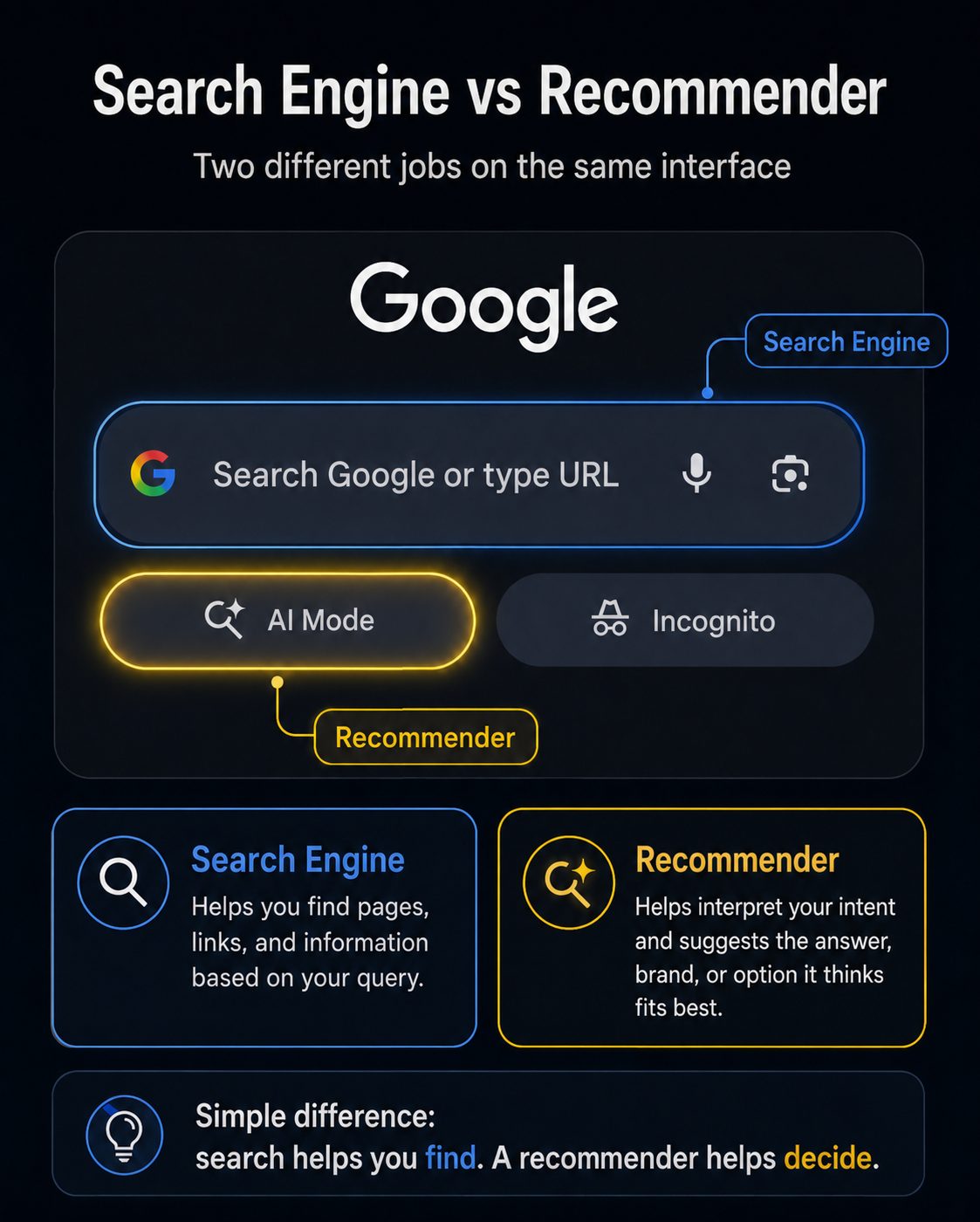
If SEO is about relevant rankings and content marketing is about relevant readership, what exactly is GEO?
The answer is much simpler than the industry makes it sound.
GEO is the coordinated work required to increase the probability that a generative system recommends your brand for a relevant need.
There are three stages.
1. Publish about yourself
Your website must encode what the brand is, whom it serves, what it does well and why it is different.
That is positioning.
Not a vague mission statement about empowering humanity through innovative excellence. Actual positioning: the customers, needs, occasions and attributes for which you want the brand to be considered.
A business can occupy several useful positions. But those positions need to appear clearly and consistently across its website, product pages, proof points and content.
2. Get other people to publish about you
A restaurant can claim it has the best steaks in Manchester. That is advertising.
When customers review the steaks, critics write about them, local publications feature the restaurant and food creators visit it, the claim becomes externally supported.
The internet is a network of distributed judgements. AI systems absorb that network and infer what an organisation is likely to be a good fit for.
Network science calls these external attributes fitness signals: evidence across the network that the brand is particularly suitable for a specific task, audience or requirement.
This is where PR, reviews, digital PR, links, expert references and credible third-party mentions become central.
3. Create preferential attachment
First, you publish about yourself.
Then other people publish about you.
Eventually, the association becomes self-reinforcing. Writers mention you because other writers mention you. Customers consider you because the category already associates you with the need. AI systems recommend you because the surrounding evidence repeatedly connects your brand with the prompt.
That is known as preferential attachment.
And that is where acquisition economics become especially attractive. You become selected without paying directly for every click.
Rankings still matter to recommendations
None of this means SEO disappears overnight.
Google says the established foundations of SEO remain relevant to AI Overviews and AI Mode. A page must still be indexed and eligible to appear in conventional search before Google can show it as a supporting link in its AI features. Google also says there are no magical additional technical requirements for AI visibility.
That does not mean ranking first guarantees an AI recommendation.
It clearly does not.
Generative systems use different models, query fan-outs, supporting sources and contextual signals. Their outputs vary according to the user, the prompt and the information available.
But higher relevant rankings can increase the probability that your pages are discovered, processed, cited or used as part of the evidence environment.
So the relationship is best expressed like this:
SEO increases the probability of discovery.
GEO increases the probability of recommendation.
They overlap. They are not identical.
The uncomfortable tension between SEO and GEO
This is where things become strategically interesting.
The copy most likely to rank is not always the copy that positions the brand best.
Imagine a software company trying to rank for “sales call SaaS software”. An SEO might want that phrase reflected prominently in the title, heading and body copy.
A good brand copywriter might reasonably object that no human being wants to buy something described like a keyword export.
The SEO wording may improve search alignment while making the company sound generic. Stronger positioning may improve differentiation and conversion while weakening alignment with a particular term.
That is a trade-off.
It cannot be solved by declaring either SEO or brand supreme. It needs to be tested and owned deliberately.
This is also why SEOs do not automatically control GEO.
A strong GEO programme may require:
a brand strategist to establish positioning;
an excellent copywriter to encode it;
a content team to develop useful owned material;
a PR team to create external validation;
an SEO specialist to manage rankings and technical visibility;
an analyst to monitor recommendation patterns;
and someone capable of coordinating the whole bloody thing.
The SEO may become that coordinator.
But owning the report does not mean performing every discipline inside it.
What becomes of the SEO agency?
SEO agencies remain viable while ranked search results and keyword-led behaviour continue to produce commercial demand.
But the old proposition is narrowing.
If Google eventually makes AI Mode the default interface and conventional ranked results become secondary, SEO will be absorbed into a wider model. That does not mean every SEO loses their job on Monday morning. It means the skill must find a new commercial home.
The opportunity is to evolve from SEO provider into search marketer.
Someone still needs to manage technical accessibility, agentic search readiness, prompt research, AI visibility, organic performance, and reporting. Someone needs to understand how rankings interact with recommendation systems. Someone needs to coordinate with PR, content, brand and analytics.
That coordinating role may be the best future for the SEO agency.
In-house teams will handle part of the work, particularly in larger organisations. They may employ a search specialist, a content marketer, a PR lead and external copywriters.
But agencies remain valuable because they see across companies, categories and problems. In-house teams see one organisation. Agencies can see patterns across twenty.
The future agency will probably retain a central strength and surround it with supporting capabilities.
A PR agency may add SEO, content and social expertise.
A content agency may add PR and search.
An SEO agency may add brand, digital PR and AI-visibility capabilities.
The answer is not for every agency to become a shapeless integrated blob that claims to do everything from TikTok to corporate strategy.
The answer is to maintain a clear centre of excellence while assembling the capabilities required to produce the client’s desired outcome.
That outcome is not another dashboard.
No chief executive wakes up desperate to increase the number of citations detected across 500 synthetic prompts.
They care about revenue.
They care about demand, leads, lower acquisition costs, greater visibility and a stronger likelihood of being chosen.
The better model
The SEO industry does not need another list of activities.
It needs a clearer model of value.
Here it is:
Rankings create discovery.
Readership creates memory.
Recommendations create preference.
SEO owns relevant rankings. Content marketing owns relevant readership. GEO coordinates the signals that make relevant recommendations more likely.
Together, they create physical and mental availability across the modern search journey.
Google has already launched dedicated Search Console reporting for visibility within its generative AI features. The platform now measures impressions in AI Overviews and AI Mode separately for selected sites. That is not evidence that every new AI metric matters, but it is evidence that generative visibility has become a defined part of search rather than a hypothetical sideshow.
The future is not bad for SEO.
It is bad for undifferentiated SEO retainers based on producing articles nobody needs, chasing traffic nobody values and reporting metrics nobody understands.
The future is excellent for search marketers who can connect activity to commercial outcomes.
SEO was never really about content.
It was about being chosen.
The machine doing the choosing has changed.
Andrew Holland
Originally published on LinkedIn on 24 July 2026.