
Spend five minutes in the SEO industry, and you will quickly discover that content has become a kind of secular religion.
Open X and you will find agency owners bragging about spinning up thousands of AI-generated pages. Scroll LinkedIn, and there is another dreary sermon on “topical authority”, “content velocity”, or getting cited by ChatGPT as though an LLM is the marketing equivalent of being touched by the hand of God.
And that, in a single miserable nutshell, is the problem.
The SEO industry has spent the last decade obsessing over content as an output metric. More pages. More clusters. More keywords. More topical coverage. More dashboards. More noise.
And almost no one stops to ask the only question that actually matters.
What is the content supposed to do?
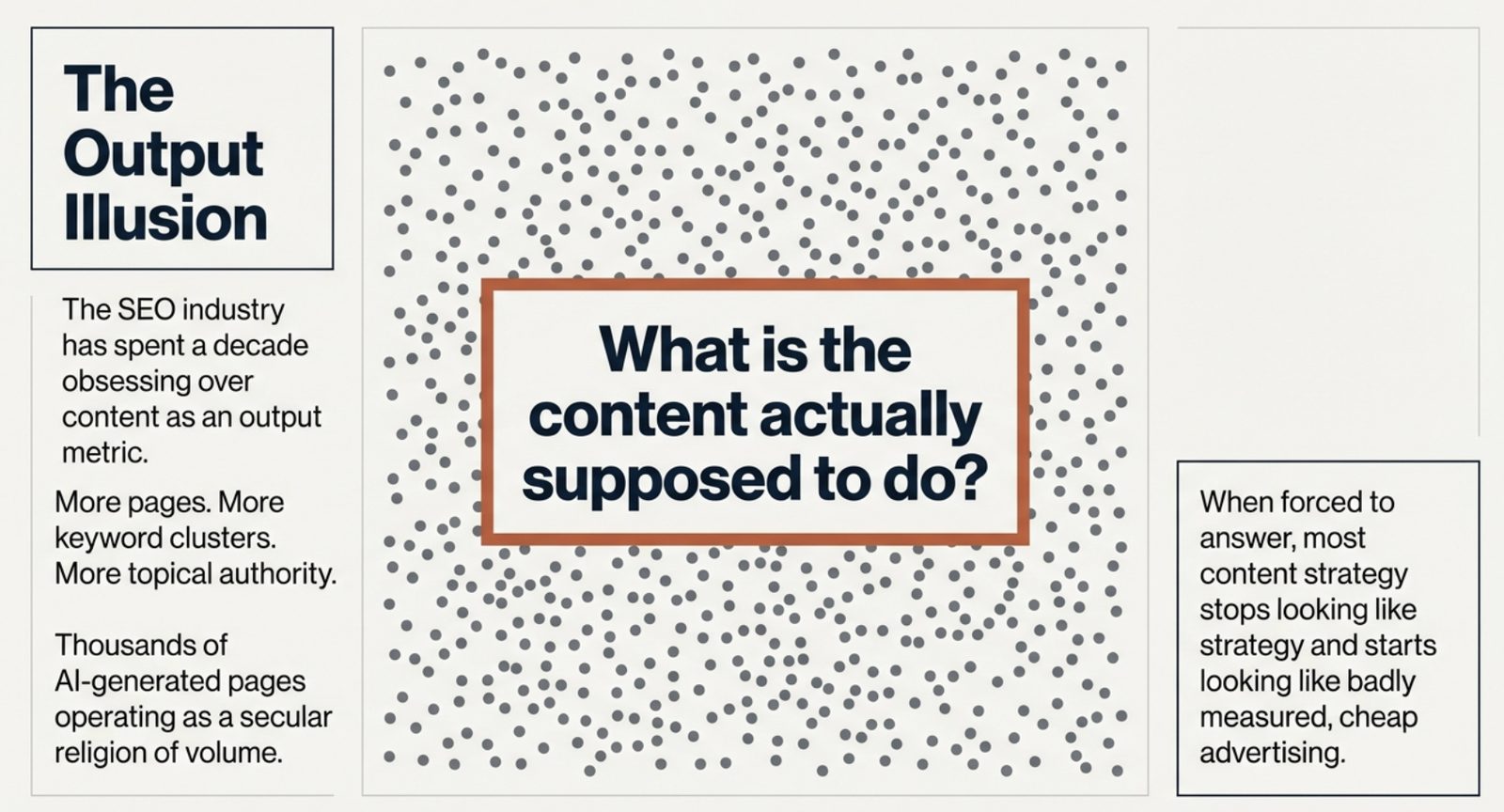
Because once you ask that properly — once you sit with it and force an honest answer — an awful lot of what passes for content strategy stops looking like strategy and starts looking like cheap, badly measured advertising.
Which is exactly what most SEO content has always been.
And that matters more now than ever, because the old model is being dismantled from the outside.
AI is cutting its legs off. The interaction layer that gave SEO content its commercial value is disappearing. Which means the industry needs a fundamentally different way of thinking about content.
The future of content is not more content. It is a shift from pull to push. From endlessly producing pages to drag people out of search engines, toward building and distributing branded assets that create memory, visibility and fame in the market.
That is the shift. Let us work through why it is necessary and what it actually means in practice.
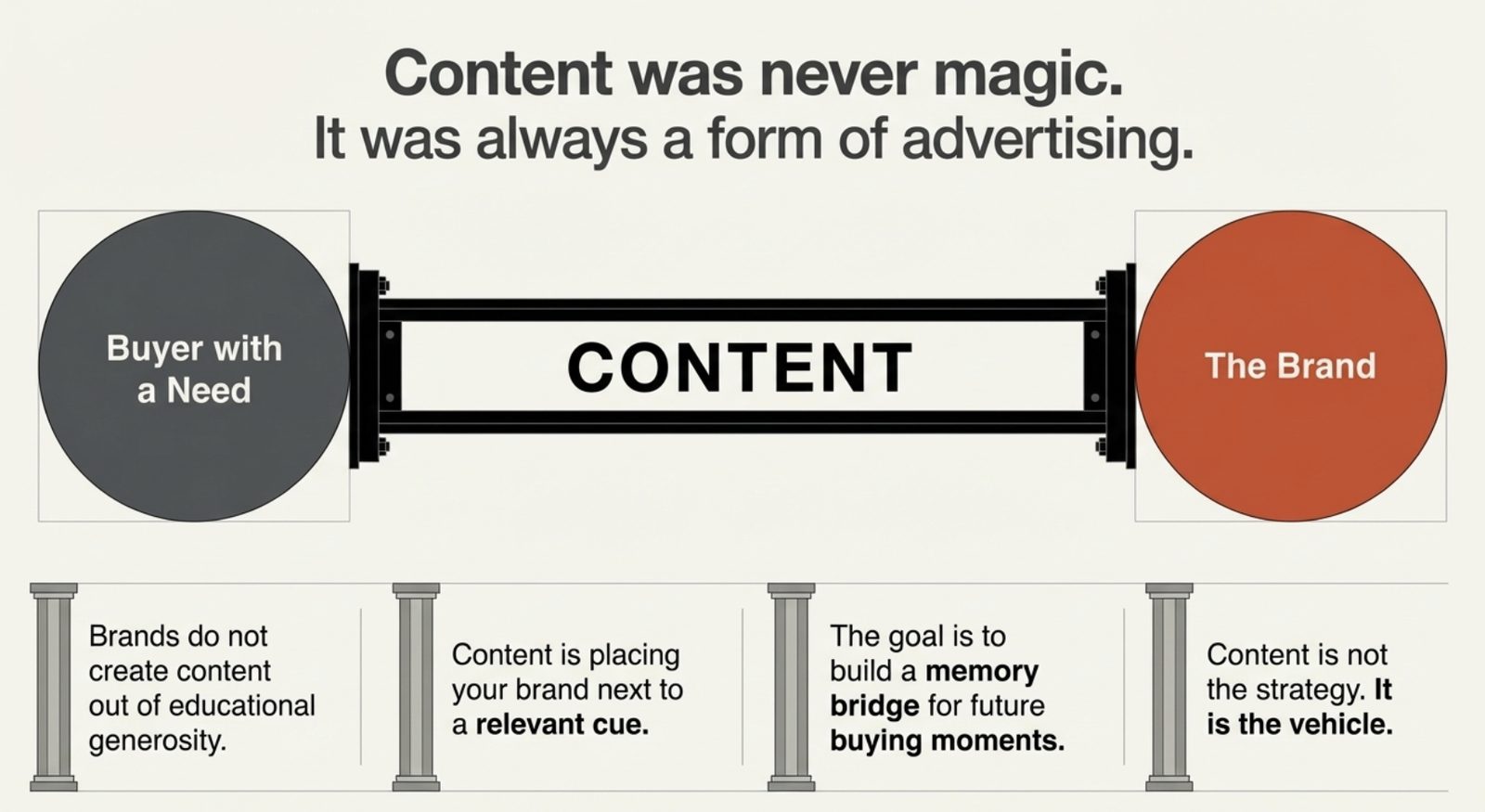
Content was never magic. It was a form of advertising.
Let’s start with the obvious point that the industry keeps trying to avoid.
Why do brands create content?
Not because they want to enrich humanity. Not because they woke up bursting with educational generosity. And certainly not because every business should “become a publisher”.
Brands create content because they want attention. Specifically, they want someone with a relevant need to encounter what they have made, notice the brand behind it, and build some kind of connection between the problem they have and the company that helped explain it.
If I sell beauty products and I publish useful material about acne, skin routines, or hydration, I am not merely “doing content”. I am placing my brand next to a relevant cue in the hope that, later on, when someone thinks about that problem, my brand comes to mind.
That is advertising.
The content may look educational. It may feel softer than a banner ad or a television spot. But in strategic terms it is trying to do the same thing that advertising has always done: build a bridge between a buyer and a brand.
The SEO world forgot this. It started treating content as a growth mechanism in its own right rather than interrogating whether that content was actually building useful memory structures in the market. And it did so at scale, for years, because nobody was asking the right questions.
Content was never the strategy. Content was the vehicle.
The industry was built on a very different internet
Part of the confusion is historical, and it is important to understand it before dismissing the entire content mythology out of hand.
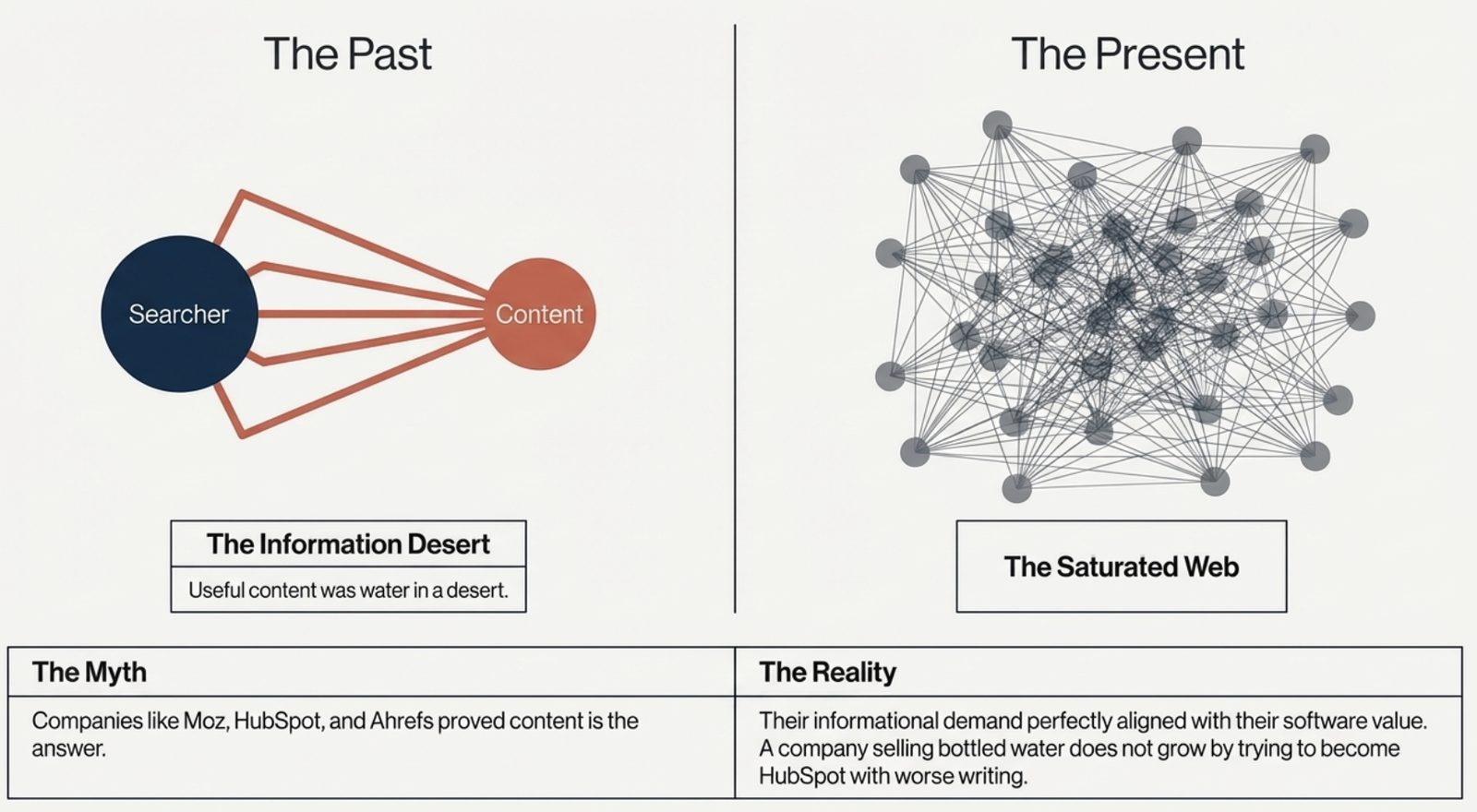
A lot of the mythology around content was forged in an earlier version of the internet. Back then there was less content, far less competition, and dramatically more unmet demand for information.
If you published something useful on a relevant topic, you had a reasonable chance of being discovered, shared and remembered. The internet was a relative desert, and useful content was water.
That world made content look absurdly effective.
It also created a generation of famous examples that the industry still wheels out as proof whenever someone raises a sceptical eyebrow. Moz. HubSpot. Ahrefs. SEMrush. Neil Patel. Backlinko. All held up as living proof that content is the answer.
But that is not what those examples prove.
What they prove is that content works very well when the topic people want to learn about is tightly linked to the product you sell. If you sell SEO software and publish mountains of content about SEO, your content is not some side project. It is an extension of the category itself. The audience’s informational need and the product’s value proposition are perfectly aligned.
A company selling soap, bottled water, or regional accounting services does not grow by trying to become HubSpot with worse writing. Yet that is precisely what thousands of businesses were persuaded to do. Endless articles. Endless keyword clusters. Endless pillar pages. Endless mediocrity dressed up as strategy.
What worked for a very specific type of brand in a very specific market condition was turned into a universal doctrine. That was always bollocks.
To understand content, you have to understand how human memory actually works
This is the section most SEO content discussions never reach, because it is far easier to talk about rankings and traffic than to talk about the way human beings actually make purchasing decisions.
Here is the inconvenient truth: buyers do not spend their time constructing careful, rational evaluation frameworks every time they need to buy something. They do not pull up a spreadsheet and dispassionately score alternatives. They reach for what is already mentally available — brands that come to mind easily when a relevant need surfaces.
This is the concept of mental availability, developed most rigorously by Professor Byron Sharp at the Ehrenberg-Bass Institute. Brands grow primarily by being easier to think of. Not necessarily better. Not necessarily cheaper. Easier to retrieve when a buying moment arrives.
And this brings us to how memory actually works, which is the thing the SEO industry has almost completely ignored.
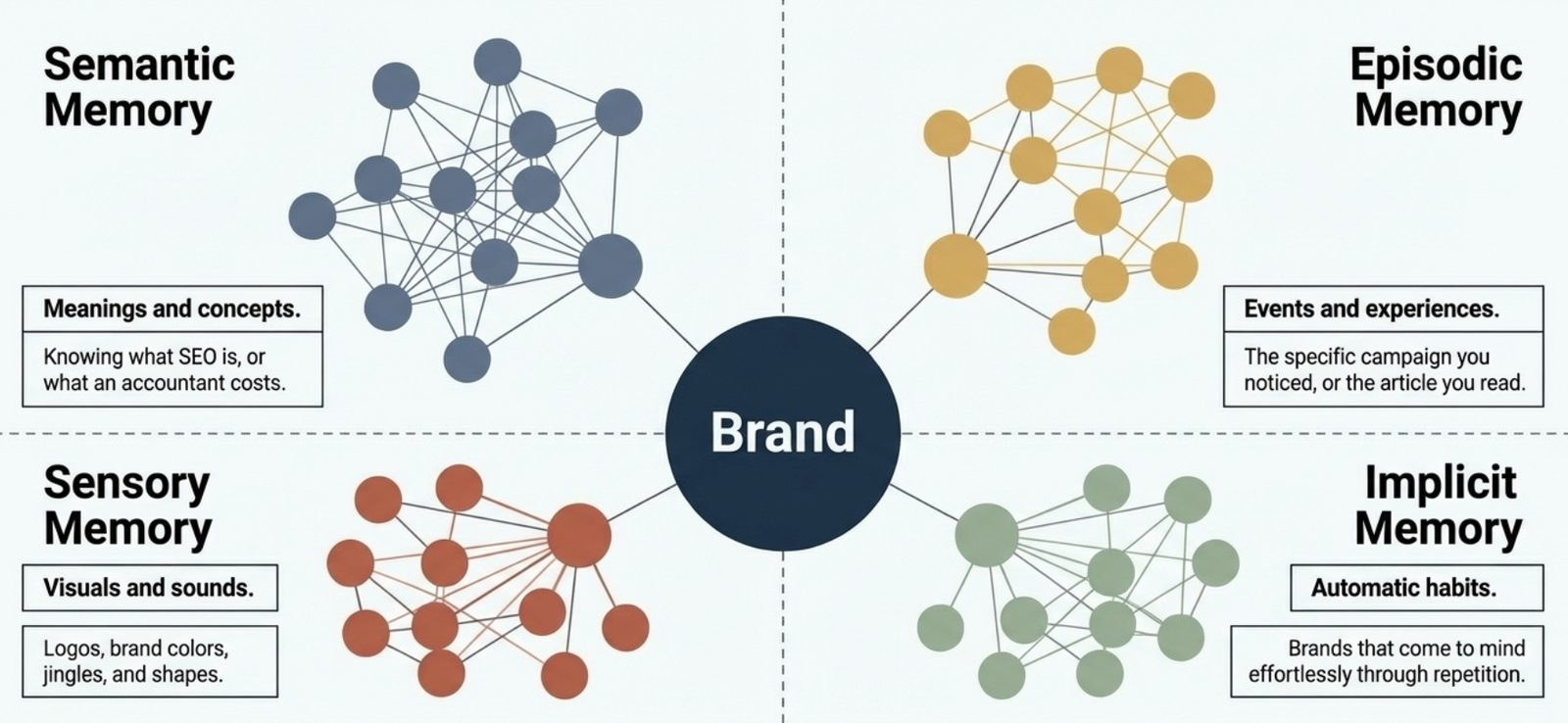
Human memory is not a filing cabinet. It is not a neat, organised library where information sits in labelled drawers waiting to be retrieved. Memory is a network. We store ideas, experiences, sensations, concepts and associations as interconnected nodes.
A brand is one node. A product category is another. A problem, a context, a need, a colour, a phrase, a face, a sound — all of these become nodes.
The four dimensions of memory matter here.
Semantic memory holds meanings and concepts: knowing what SEO is, what a plumbing fitting does, what an accountant costs.
Episodic memory holds events and experiences: that campaign you noticed during a major sports event, the article you read when your lease was about to expire.
Sensory memory is rooted in the senses — colours, shapes, sounds, tones, visual textures — which is where logos, jingles, brand characters and visual identity live.
And implicit memory is the automatic, habitual layer: brands that come to mind without effort because they have been woven into routine through repetition.
Brands draw on all of these.
The critical mechanism is this: when two things are repeatedly encountered together, the connection between them strengthens.
A brand and a need state become linked in memory. A brand and a category cue become linked.
A brand and a specific outcome become linked.
The more often those things appear together — the more often they are co-presented — the stronger the link between them grows.
This process is called associative memory, and it is fundamental to understanding why branding works. And yes, it’s very similar to how AI works
It is also fundamental to understanding why most content fails.
Because memory is also cue-driven. Buyers do not sit quietly and search their memory for the best available option. A need surfaces in a moment — you run out of coffee, your website goes down, your lease expires — and that cue triggers a retrieval process.
Relevant brands and options are activated automatically, based on which memory structures are strongest. The brands that come to mind fastest, most easily and most confidently are the ones most likely to be chosen.
What this means for content is stark. A piece of content only has genuine brand-building value if it creates or refreshes a link between your brand and something a buyer will later use as a retrieval cue. A category need. A specific problem. An outcome they want. A feeling. A context.
If the content creates a momentary impression but leaves no lasting association, it has not done brand work. It may have generated a pageview. It may have satisfied a query. But it has not made the brand more mentally available in any meaningful sense.
That is the test content should be measured against. Not traffic. Not rankings. Not sessions. Does this activity make our brand more likely to come to mind when a relevant buyer encounters a relevant cue?
Most content, subjected to that test, fails it comprehensively.
The old model was pull, and pull has always had limits
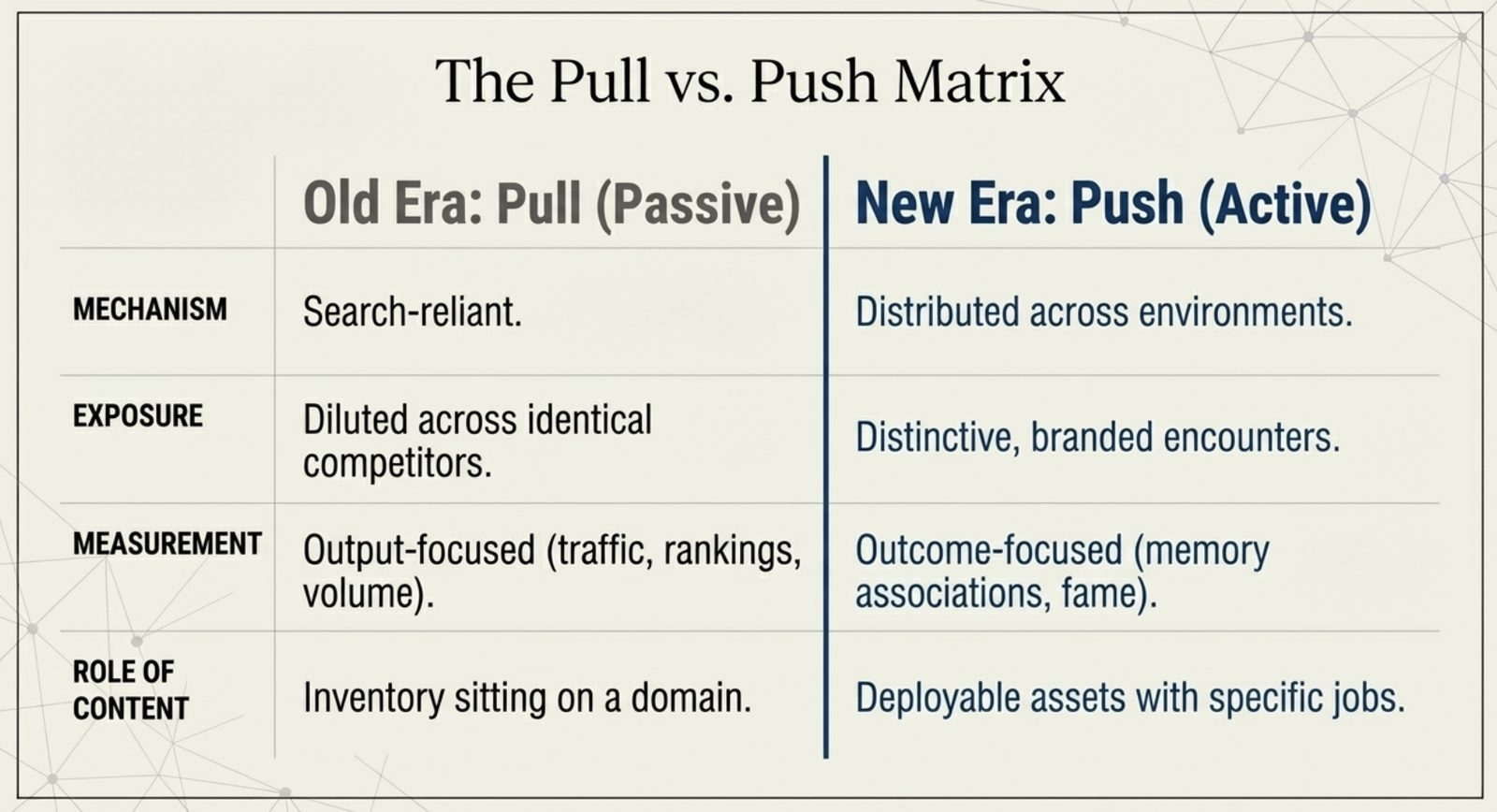
The clearest way to understand SEO content is to call it what it really was: pull content.
Pull content is content designed to drag people away from a search environment and onto your site. Someone has an informational need. They search. Your page appears. They click. They encounter your brand.
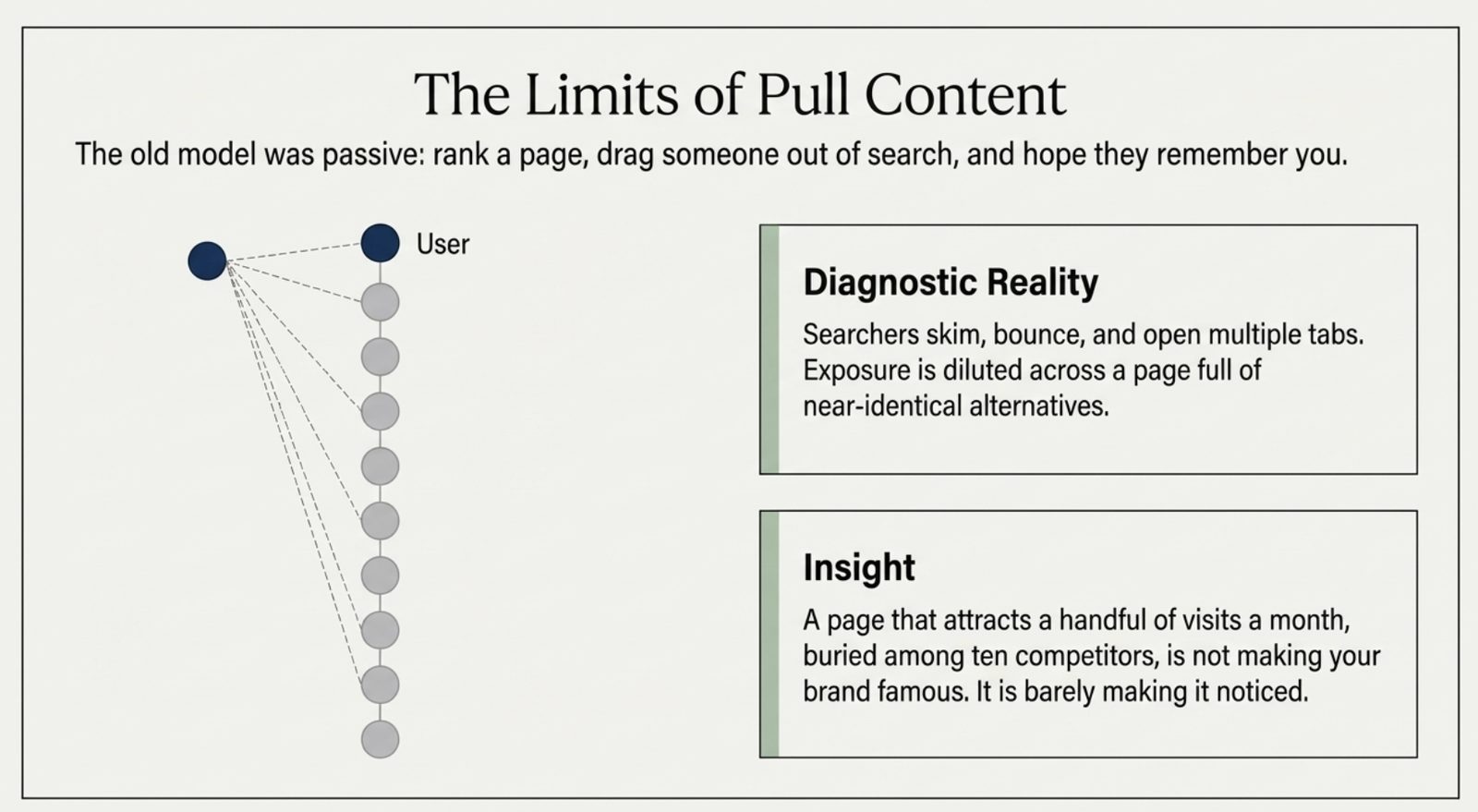
That was the classic model. Its strategic value came from two possibilities. First, the page might help the buyer enough to build trust or credibility. Second, and more importantly, it might build a memory link between the subject they cared about and your brand.
When that happened, the content had done something genuinely useful. It had not just ranked. It had advertised.
But the SEO industry romanticised the whole thing absurdly. It acted as though any click was a strategic triumph, any ranking was an asset, and any page indexed was a step toward market dominance.
In reality, most searchers skim. They bounce. They open multiple tabs. They compare several results. They hit the back button and try something else. The memory effect of most content encounters was always far weaker than the industry liked to imply.
Consider a search results page for “best project management software”. A dozen brands appear, all producing content on the same subject, all saying roughly the same things, all hoping the user associates the topic with them. The user clicks three results in sequence. Which brand builds the strongest memory association? The first one? The highest-ranked one? The one with the most distinctive design? The last one they visited before stopping?
Nobody in SEO seriously wanted to examine that question because there was no money in it.
It was easier to sell more content than to interrogate whether any of it was building retrievable brand associations at a meaningful scale.
The answer, in most cases, is that the memory work was modest at best. Exposure is not equal.
Distinctive branded exposure matters. Repeated exposure matters. But exposure diluted across a search results page full of near-identical alternatives is often achieving very little.
This is where the whole “just create more content” school starts to look so flimsy.
Most content never reached enough people, frequently enough, or distinctively enough to build strong memory structures. A page that attracts a handful of visits a month is not making your brand famous. It is barely making your brand noticed.
The three stories SEOs built to justify the content treadmill
To justify the production machine, agencies leaned on three models.
The first was content as advertising: publish pages, get found, expose people to the business, build awareness over time.
The second was content for links: create genuinely valuable resources — original research, data studies, tools, power pages — that other sites reference and cite, building authority and backlink equity.
The third was content for topical authority: publish enough semantically related material and Google will recognise you as an authoritative source, lifting all your commercial pages in the process.
The second remains credible. Always has. Original, genuinely useful, linkable resources can build real authority and brand fame. Done well, this is legitimate strategy.
The first was always hit-and-miss. It depended entirely on whether the content was distinctive enough, branded enough, and encountered frequently enough to do any real memory work. Most of it was not.
The third became a racket.
“Topical authority” was agency catnip because it decoupled content production from any meaningful business outcome. You no longer needed a strong case for each individual piece.
You just needed a topical map, a cluster diagram, an internal linking structure, and a vague hand-wave toward semantic relevance. Brands were encouraged to build sprawling content libraries on the promise that sheer volume would somehow translate into commercial strength.
Most of it did not.
What you got instead were enormous content estates where eighty percent of the traffic went to twenty percent of the pages, and the rest accumulated digital dust — occasionally visited by one lonely person who would never buy a single thing.
A page that reaches one person once is not building memory at scale. It is not creating strong brand associations. It is not making your brand more mentally available for anyone. It is noise dressed as strategy.
AI has now finished off what was already a weakening model
Enter AI.
ChatGPT, Google AI Overviews, Perplexity, AI Mode — these systems have done something very revealing: they have stripped out the interaction layer that made pull content feel so commercially valuable.
If a user gets the answer without meaningfully visiting your site — if the machine absorbs your article, synthesises the response, and serves it directly — then your content no longer functions as an ad. The user gets the information. Your brand gets almost nothing.
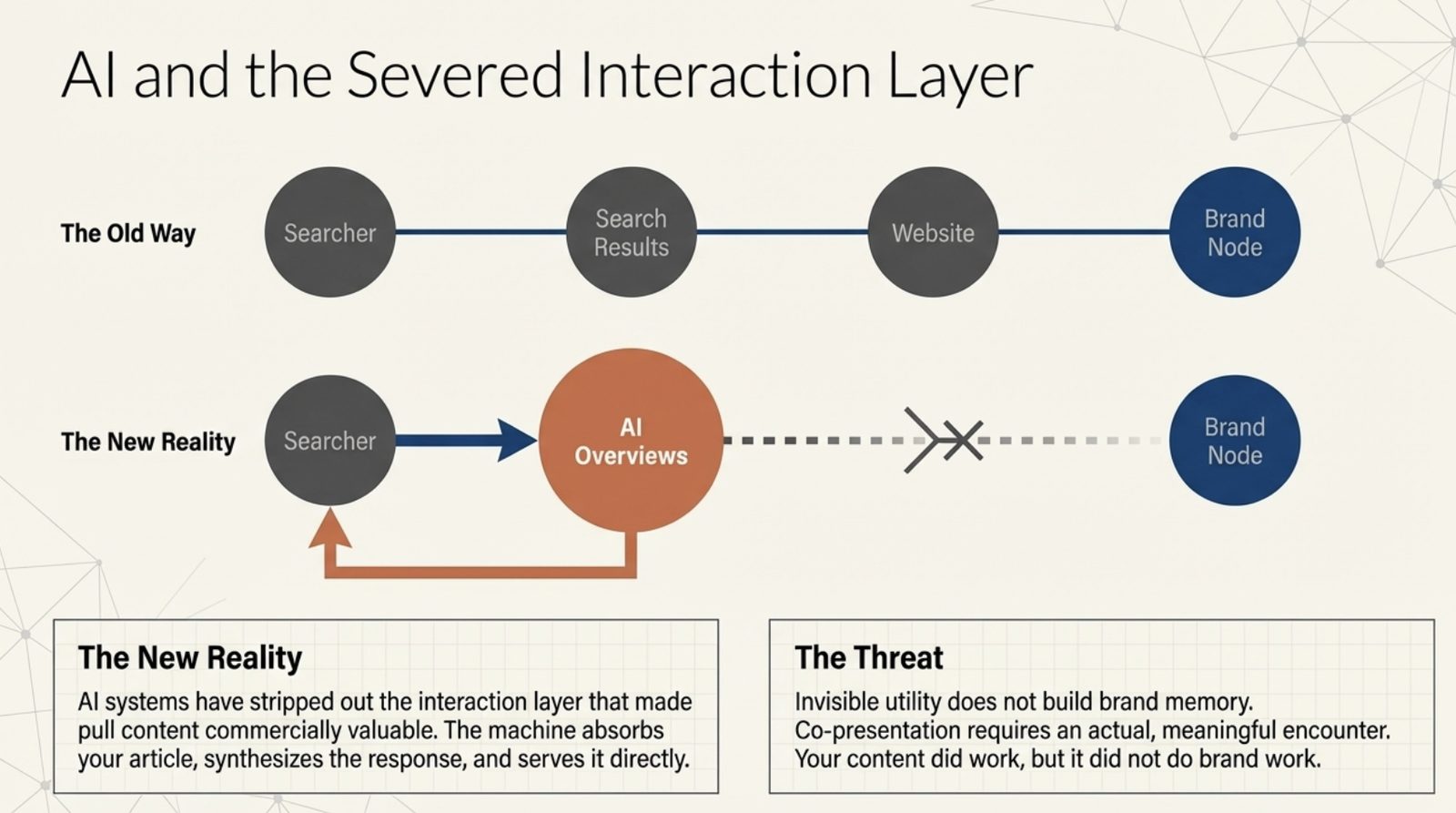
From a branding and memory perspective, being invisibly useful is not the same as being seen.
Co-presentation requires an actual encounter. If the buyer never meaningfully encounters the brand, the memory link is never refreshed or created. The content has done work, but it has not done your work.
That is why the current obsession with “being cited by AI” deserves scepticism. A citation is not the same as meaningful brand exposure. It might confer marginal authority. It might occasionally nudge a user toward clicking through. But from an associative memory standpoint, an invisible reference inside a synthesised AI response is nowhere near as valuable as genuine branded encounter.
Now, there is a more sophisticated version of the AI argument worth making, and it is one the industry has not properly confronted yet.
The real question is not whether AI cites you. The real question is whether AI recommends you.
There is a difference. A citation means your content was used as a source. A recommendation means that when someone asks an AI which brand they should consider, your name comes up.
That is a fundamentally different outcome, and it depends on a fundamentally different set of inputs.
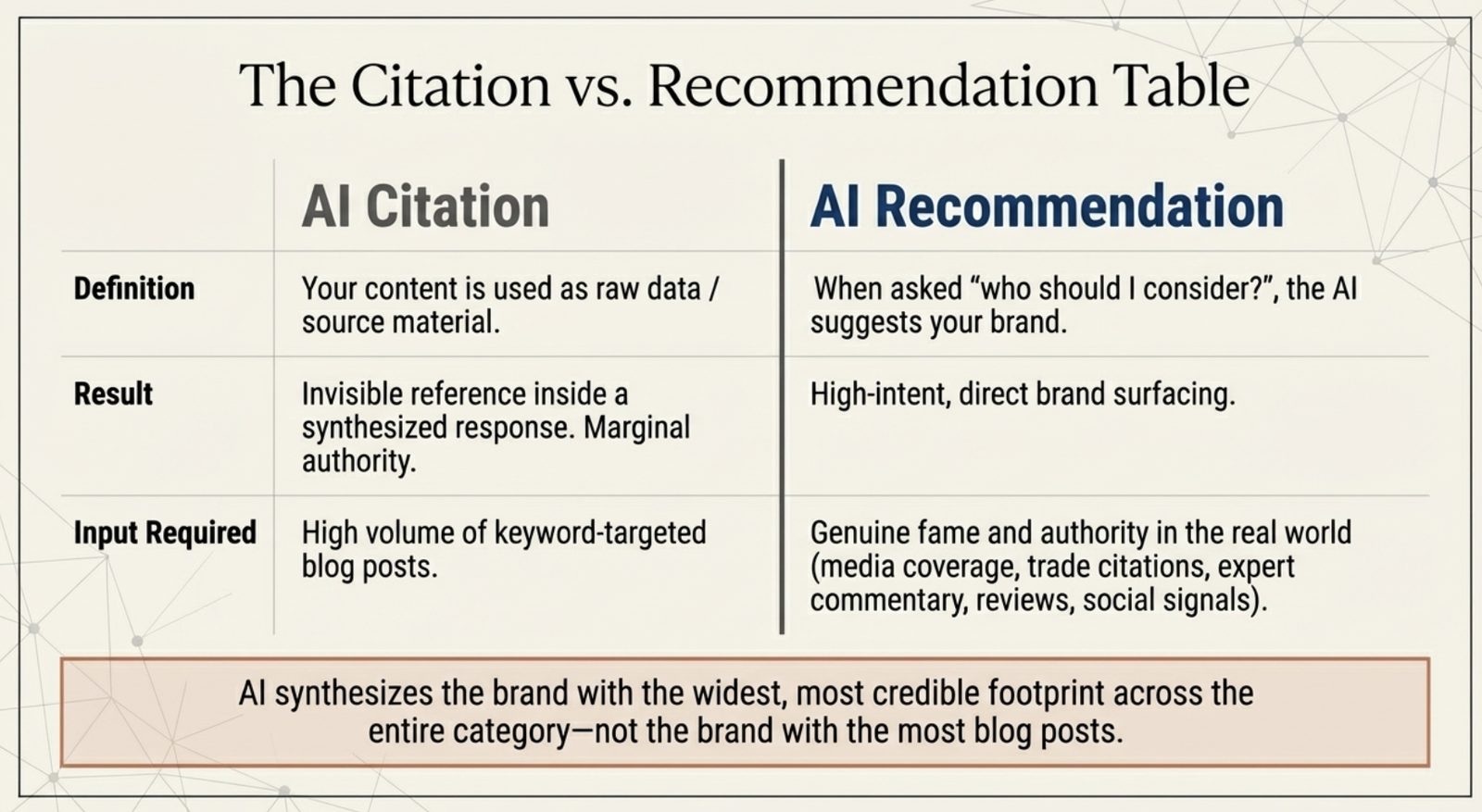
AI systems build their understanding of brand authority and category relevance from the entire information ecosystem: media coverage, academic and trade citations, expert commentary, third-party mentions, review platforms, user-generated content, social signals and yes, links.
They do not simply rank the brand with the most blog posts. They synthesise the brand with the widest, most credible footprint across the category.
Which means the brands best positioned for AI recommendation are the ones that have been building genuine fame and authority in the real world — not just on their own domain.
This is not new. It is just the SEO industry finally being forced to do what proper marketing has always required: be actually famous, not just searchable.
The new model is push
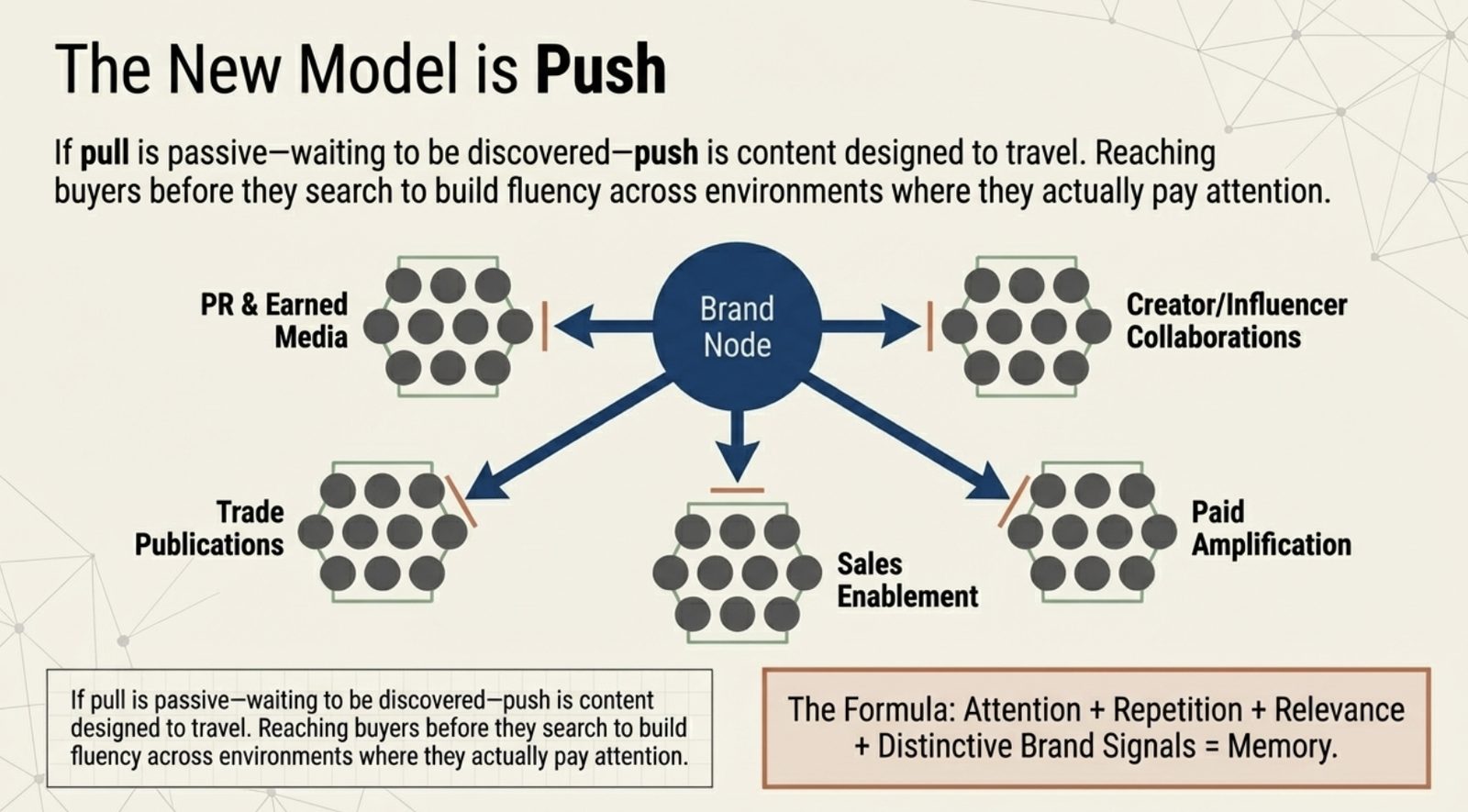
If pull is passive — content that sits and waits to be discovered — push is the opposite.
Push content is content designed to travel. To be distributed. To be amplified. To reach buyers before they even search. To build fame, feeling and fluency across the environments where your audience actually pays attention.
This is the future of content.
And it requires a completely different way of thinking about what you create and why you create it.
Push content can take many forms.
PR and earned media. Trade and industry publications. Creator and influencer collaborations. Email and newsletters. Paid amplification of strong organic assets.
Social distribution. Original research built to earn citations and links. Tools and guides that become reference points in a category. Sales enablement assets that make commercial conversations more effective.
What connects all of these is intent.
Push content is not published and forgotten. It is built with a specific job in mind and then actively deployed to do that job.
This is also where creator and influencer strategy fits, and it fits far more cleanly than most SEO practitioners have been willing to admit.
The right creator is not just a distribution channel. They are an attention broker and a co-presenter of your brand.
When the right voice introduces your research, product or point of view to the right audience, they build memory associations faster and more strongly than a lonely blog post ever could — precisely because their audience is paying active attention, and attention is what memory requires.
The mechanism is identical to the one that has always driven brand building: attention plus repetition plus relevance plus distinctive brand signals equals memory. Push content, done properly, delivers all four.
Stop asking how much. Start asking what for.
This is where most organisations need a hard reset — not a strategic refresh, but a genuine change in how content decisions are made.
The question is not: how much content did we produce this month?
The question is: what did we build, what was it designed to do, and where does it lead?
Every content asset should be able to answer three things before it is commissioned.
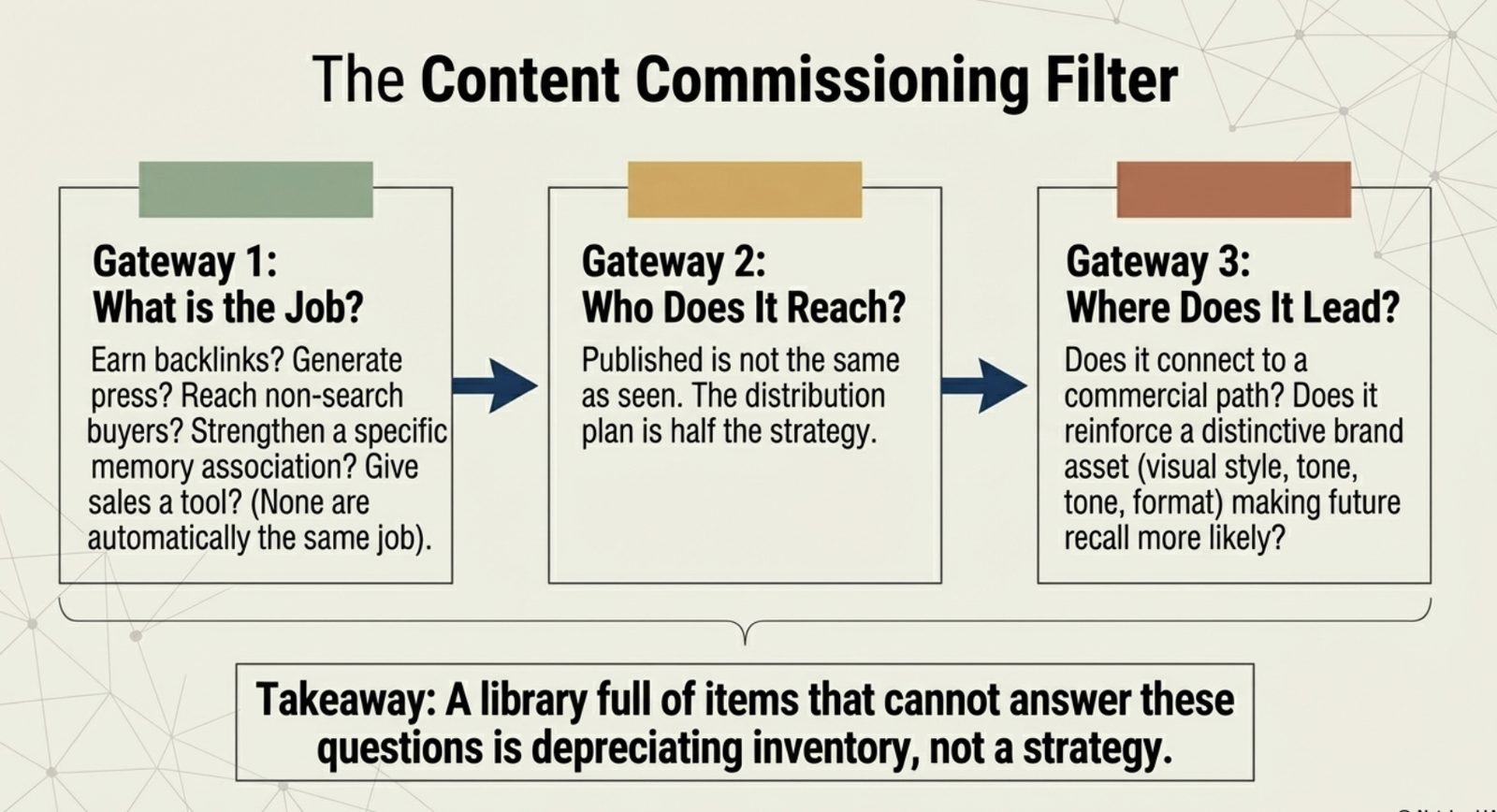
First: what is the job?
Is this asset designed to earn backlinks and strengthen search authority? Is it built to generate press coverage and brand mentions?
Is it meant to reach buyers who will never find you through organic search? Is it designed to strengthen a specific memory association — to link your brand to a particular need state, category cue or outcome?
Is it built to be amplified through creators, trade partners or paid channels? Is it meant to give your sales team something worth sending?
Every one of these is a legitimate job. None of them is automatically the same job.
Second: who does it reach, and how?
Content that reaches no one does no work, no matter how good it is. Published is not the same as seen. The distribution plan is not an afterthought. It is half the strategy.
Third: where does it lead?
What happens after someone encounters this asset? Does it connect them to a commercial path?
Does it reinforce a distinctive brand asset — a visual identity, a character, a recurring format, a phrase — that makes future recall more likely?
Does it make the brand easier to buy, or just easier to find? These are different things.
A content library full of assets that cannot answer these three questions is not a strategy. It is inventory. And inventory, unlike assets, tends to depreciate.
What you should actually be building
Given all of this, what does a good content strategy look like in 2026?
It looks like fewer things, built better, with a plan for how each one reaches the market and what it is supposed to do when it gets there.
Original research and proprietary data that the market actually wants to cite — this builds links, earns media, and feeds the AI systems that are synthesising authority across your category.
If a trade journalist, an industry blogger, or an AI system is looking for a source on a topic relevant to your brand, you want to be the source they reach for. That is brand fame with structural benefit.
Distinctive brand assets pushed through channels with genuine reach — creator partnerships, trade media, PR, newsletters, sponsored amplification.
These build the associative memory that drives cue-driven recall. A well-placed piece of research, a strong point of view shared through a respected industry voice, a recurring content format that becomes recognisable over time — these are the things that make a brand easier to think of when a buying moment arrives.
Sales and distribution-facing assets that shorten commercial conversations — content your team can actually use, rather than content that sits on a blog accumulating dust.
And through all of it, consistent and distinctive brand expression. Colours, language, visual style, recurring formats, tone of voice.
These are the sensory and implicit memory cues that allow a brand to be recognised before it is consciously remembered. They are not decoration. They are infrastructure.
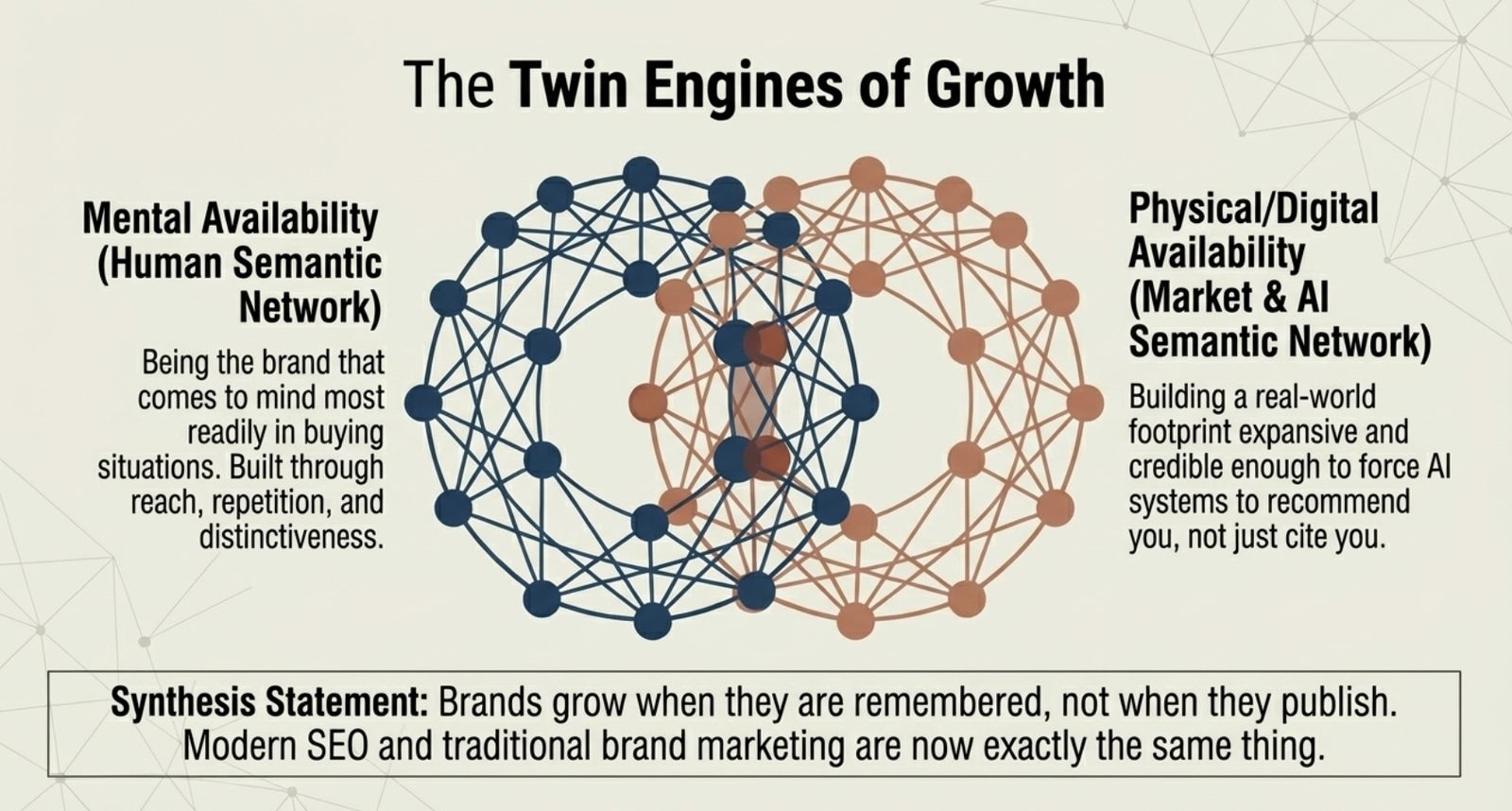
Brands grow when they are remembered. Not when they publish.
Let’s be very direct about what this all adds up to.
Brands grow by being easier to buy and easier to think of. Byron Sharp’s work at Ehrenberg-Bass made this clear two decades ago.
Physical availability — being present in the channels where buying happens — and mental availability — being the brand that comes to mind most readily in buying situations are the twin engines of growth.
Mental availability is not built by being theoretically discoverable on page one of a search results page. It is built through reach, repetition and distinctiveness.
You need to reach enough people in your category, frequently enough, with branded exposure that is recognisable and memorable.
Content strategy that ignores those requirements is not strategy. It is production.
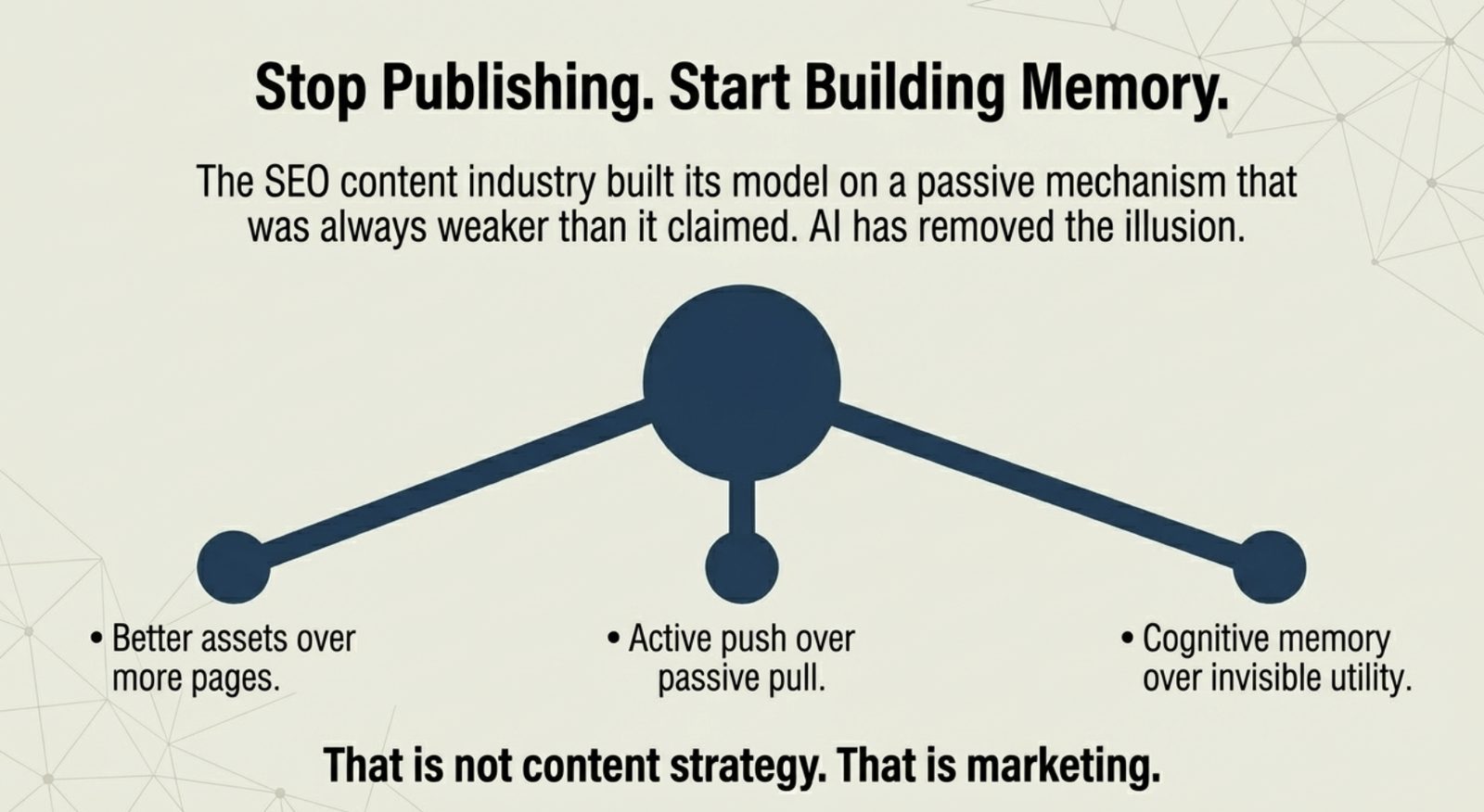
The SEO content industry built its entire commercial model on a pull mechanism that was always weaker than it claimed. AI has now removed much of what made that mechanism plausible. Which leaves the industry at a crossroads it has been avoiding for years.
More content is not the answer. It was never really the answer.
Better assets. Deliberate distribution. Active push into the market. A relentless focus on whether content is building the memory structures that make brands easier to think of at buying moments. And increasingly, whether it is building the kind of real-world brand presence that causes AI systems to recommend you, not just cite you.
That is not content strategy.
That is marketing.
And it is well past time the SEO industry learned the difference.
Andrew Holland
Originally published on LinkedIn on 8 April 2026.