
A few weeks ago, Nikita Bier posted one of those lines that looks like throwaway tech bravado until you stop and actually think about what it means.
His prediction was simple: within 90 days, the channels we still think of as relatively safe from spam and automation – iMessage, phone calls, Gmail – will be so flooded they become functionally unusable.
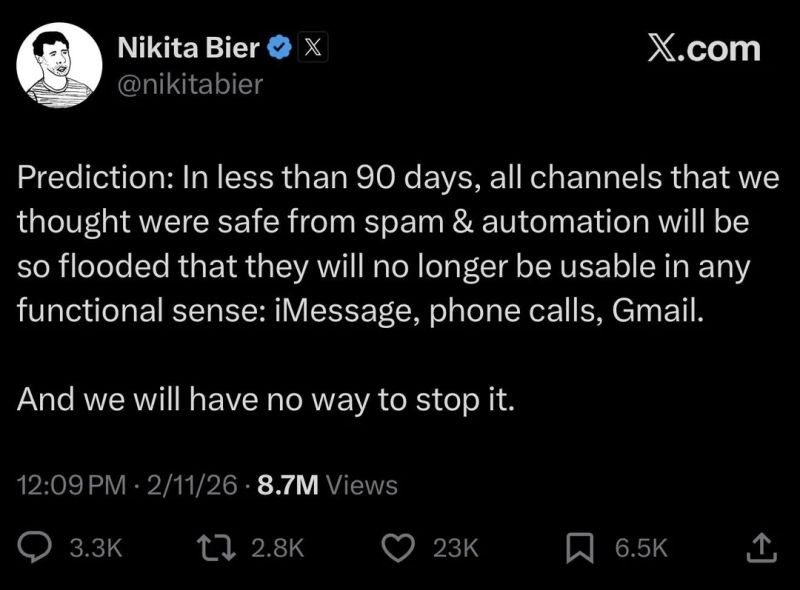
That is not a fringe interpretation of his post. That is the post.
And he’s probably right.
Not because he is uniquely brilliant. Not because product people at X have suddenly become prophets.
But because this is the logical conclusion of a marketing and technology culture that has spent fifteen years worshipping scale, automation, efficiency, and “content at volume” as though these were self-evident virtues rather than a slow-motion act of vandalism against communication itself.
The Internet Is Not Getting Bigger. It Is Getting Worse.
That is the first point worth making. The internet is not getting bigger in any meaningful human sense. It feels bigger because there is more stuff in it. More posts. More pages. More videos. More messages. More synthetic noise. But from the perspective that actually matters – the perspective of a human being trying to find something useful, trustworthy, or worth caring about – the internet is getting smaller, more congested, more hostile, and much harder to move around in.
That is what saturation looks like.
For years, digital marketing sold us the opposite story. We were told the internet democratised reach. We were told distribution had been unbundled from capital. We were told anyone could build an audience, any brand could become a publisher, and any publisher could become a platform. For a while, this looked true. Platforms multiplied, costs fell, and the volume of content exploded.
But there was always a basic flaw in the triumphalist bullshit: human attention did not scale with digital supply. It never has. It never will.
Gartner has been blunt about where this is heading, predicting that traditional search volume will fall by 25% this year as users shift towards AI chatbots and virtual agents instead. In other words, even discovery itself is being rerouted away from the old open web and into mediated answer engines.
Last night for the first time I saw Google place me in an AI Mode default.
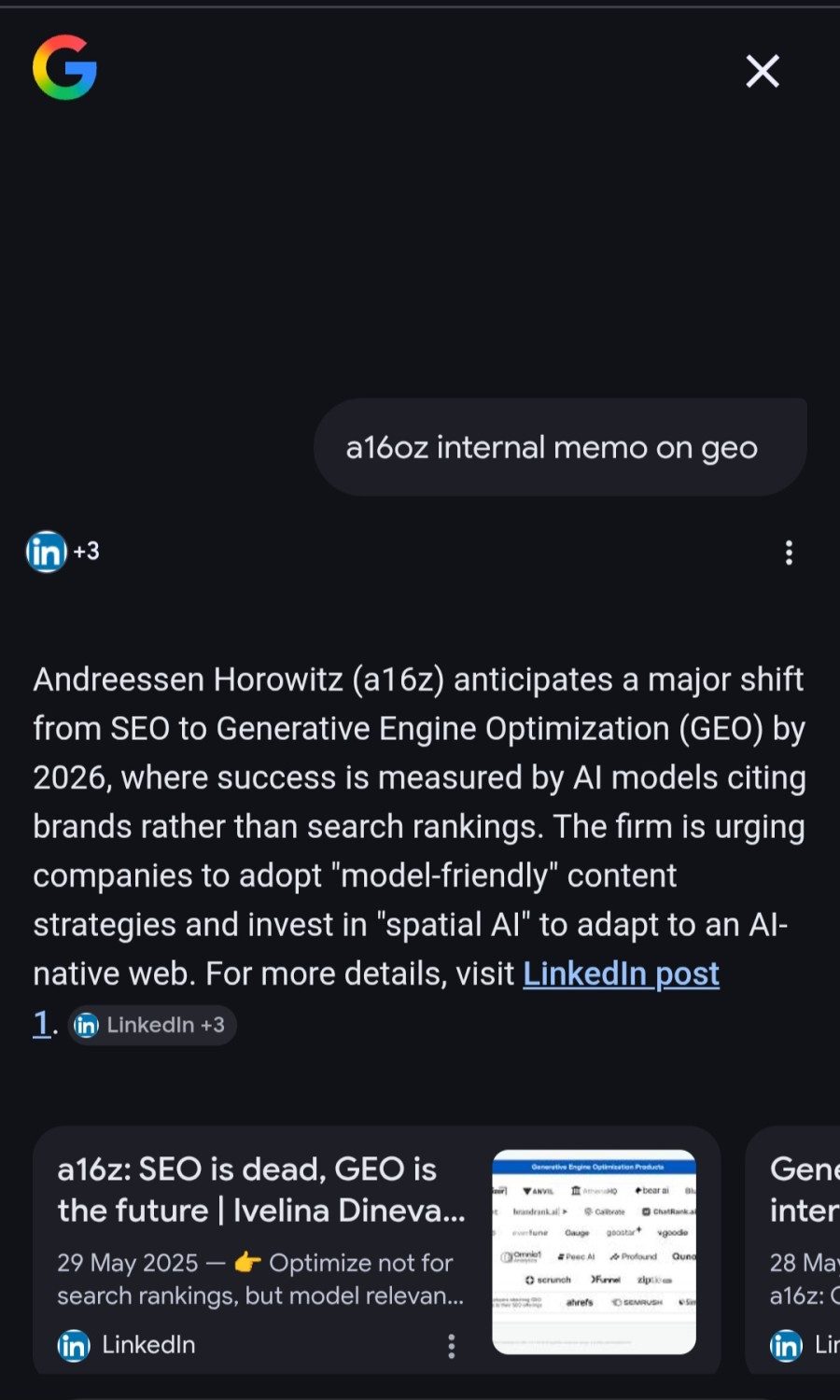
I went looking for an article, and an AI overview fired up in response, with a massive “learn more” CTA. And of course I’m going to click it because I wanted to learn more.
That took me to AI Mode and not the article.
That matters enormously. Because once discovery changes, marketing changes with it.
And this was probably the most aggressive I’ve seen Google in pushing its AI mode.
You can feel AI mode becoming the default setting now… it’s close.
Getting people to your site is going to get harder than ever.
AI Agents Did Not Just Arrive. They Are Already Acting.
The cheap-content fantasy was always built on a hidden assumption: that if you made enough stuff, some of it would eventually be seen. AI has now taken that assumption and kicked it in the teeth.
The cost of production has collapsed. OpenAI’s ChatGPT 5.4 can access the web and perform tasks independently – using a browser to click, type, scroll, and complete tasks on a user’s behalf. Anthropic, meanwhile, has been promoting “computer use” as a way for Claude to interact autonomously with desktop environments and complete multi-step tasks without human oversight.
These are not hypotheticals. The big labs are building software whose explicit purpose is to act online the way a person acts online.
Now stop pretending this is only about productivity.
If an agent can fill in forms, navigate sites, compare offers, place orders, handle inbox triage, and complete repetitive browser tasks, then of course it can also flood every communication channel ever built by marketers for marketers. Of course, it can do outbound at a scale no SDR team could ever manage. Of course, it can test subject lines, rotate domains, generate variants, mimic tone, personalise messages, and keep going while you sleep.
We are not heading towards a world of more communication. We are heading towards a world of more attempted communication and less actual connection.
There is a big difference.
The Bot Takeover Is Not Coming. It Already Happened.
The bot problem is already far beyond the stage where only paranoid people mention it. Thales/Imperva’s 2025 Bad Bot Report says automated traffic surpassed human activity in 2024, accounting for 51% of all web traffic. More alarmingly, malicious bots alone made up 37% of all internet traffic – up from 32% the year before – with the report explicitly linking that rise to the accessibility and scalability created by AI and large language models.
So when people talk about a future in which bots dominate digital space, they are late. That future has already started.
And you can see the symptoms everywhere.
Facebook feels like a landfill of repeated prompts, old memes, synthetic images and ads.
X is a rolling trench war between bots, grifters, auto-reply slop and the occasional actual thought.
LinkedIn is now packed with AI-polished self-importance from people who could not write a decent paragraph before ChatGPT and cannot write one now, despite having industrial help.
The reason these feeds feel worse is not simply that AI content exists.
It is that supply has become effectively infinite while curation remains limited and platform economics still reward volume, recency and engagement over substance.
So the feeds choke.
Then the platforms do what platforms always do when users create too much inventory: they throttle distribution. Reach gets squeezed. Organic fades. Paid products appear. You are invited to “boost” the very access that used to be the point of the platform.
Marketers then react with astonishment, as though the machine they spent years feeding has suddenly turned nasty for no reason at all.
This is not a bug. It is the business model.
Where Intent Still Survives
There is one partial exception, and it is instructive.
YouTube still feels more navigable than most social platforms, not because it is free of rubbish, it absolutely is not. But because it retains stronger intent signals.
Search matters. Subscription matters. The click matters. Session depth matters. You enter through choice more often than pure feed passivity. That is one reason publishers and creators remain so powerful there.
The Reuters Institute has noted that personalities and creators increasingly compete with, and often eclipse, traditional news brands for attention across social and video networks. That is what people do when the open environment becomes unmanageable: they appoint human filters.
And that is no coincidence. When the environment becomes too noisy to navigate alone, people stop relying on platforms to surface what matters. They outsource the decision to someone they trust. A creator. A curator. A voice with a track record. The platform becomes the pipe; the person becomes the signal.
That instinct, to seek human filters over algorithmic ones, is about to become the dominant behaviour across every channel.
And that brings us to the real issue.
The Bottleneck Is Not Supply. It Is Human Attention.
The problem is not content abundance. The problem is the human bottleneck.
AI can generate fifty pages of web copy before lunch. Fine. Who is going to read it? Who is going to verify it? Who is going to care enough to change behaviour because of it?
This is the bit the techno-optimists always skip over, usually because they are too busy congratulating themselves on output.
Production is no longer scarce. Judgement is scarce. Trust is scarce. Attention is scarce. Human time is painfully, stubbornly scarce.
And scarcity is where value lives.
Once you understand that, the strategic implications become obvious.
Being found is now the whole game.
Not “having content.”
Not “showing up consistently.”
Not “winning the algorithm.”
Being found by the right people, in the right context, with the right meaning attached to your name.
That is why search changes matter.
That is why aggregator power matters.
That is why creators matter.
That is why recommendation, memory, reputation, and mental shortcuts matter.
In a world of overwhelming supply, we stop consuming the world directly. We consume filters.
And the best commercial filter ever invented is brand.
Brand Is Not the Fluffy Stuff. It Is Cognitive Infrastructure.
This is the bit where modern marketers usually embarrass themselves. Because many of them still think brand is the fluffy stuff: logos, colours, “storytelling”, emotional wallpaper and other assorted nonsense.
Brand, properly understood, is not decorative. It is cognitive infrastructure. It is the mechanism by which a buyer decides what to notice, what to ignore, what to trust, what to pay for, and what to remember later when they finally need something. In a saturated environment, brand is not optional uplift. It is compression. It is shorthand. It is how meaning travels when attention is scarce.
Strong brands do not just win at the point of purchase. They shortcut the entire decision process.
A buyer who already knows your name, associates it with something specific, and has a memory of positive experience does not need to be found in the feed. They come looking.
That is the compounding advantage brand builds over time – and it is an advantage no AI content farm can replicate at scale, because it is built on something AI cannot manufacture: a sustained, coherent, distinctive presence over time.
Why Sutherland’s Powerful Messages Framework Changes Everything
In Alchemy, Rory Sutherland states the principle directly. All powerful messages, he writes, must contain an element of absurdity, illogicality, costliness, disproportion, inefficiency, scarcity, difficulty, or extravagance. Because rational behaviour and talk, for all their strengths, convey no meaning.
Read that again. Rational behaviour conveys no meaning. Not less meaning. Not reduced meaning. No meaning.
The logic is counterintuitive enough that most people immediately try to argue around it. But it holds, and it holds because of how signalling actually works in the real world.
The eight properties in Sutherland’s list are not arbitrary. Each one describes a quality that rational optimisation cannot produce — and therefore cannot fake.
Absurdity signals conviction. Illogicality signals genuine belief.
Costliness signals confidence in your own future.
Disproportion signals that something matters more than the ledger says it should.
Inefficiency signals that the goal is meaning, not throughput.
Scarcity signals selectivity: you chose this person, not everyone.
Difficulty signals that the sender actually did the work.
Extravagance signals that there is more where that came from.
The examples are everywhere once you look for them. A Rolex does not tell time better than a Casio. That is the point.
A handwritten note takes twenty minutes; an email takes twenty seconds. The disproportion is the message.
The peacock’s tail is metabolically ruinous. That is precisely why it works as a signal of genetic fitness. Only a genuinely fit peacock can afford to carry it. The waste is the proof.
A brand that burns boats takes a genuinely irreversible position, commits to a distinctive point of view that cannot be walked back without cost, and is signalling something that a thousand cautious, optimised, cost-per-click campaigns never can.
Now run Sutherland’s eight properties against AI-generated content and the result is not ambiguous.
AI content is not absurd — it is the averaged centre of all available training data.
It is not illogical — it is probabilistically optimised.
It is not costly — it costs fractions of a cent per word.
It is not disproportionate — it scales perfectly with input.
It is not inefficient — efficiency is the entire product.
It is not scarce — it is infinitely reproducible.
It involves no difficulty — the machine does not struggle.
And it is not extravagant — the marginal cost of one more piece of content is effectively zero.
Zero out of eight. A perfect score on Sutherland’s framework for meaninglessness. And this is not a flaw in the technology. It is a description of what the technology is.
AI content is the most rational possible communication: statistically optimised, frictionlessly produced, infinitely scalable. Which is precisely why, by Sutherland’s logic, it communicates nothing.
A powerful message requires a sender who has something to lose. AI has nothing to lose.
It has no reputation at stake, no financial exposure, no creative conviction, no professional risk. The absence of those constraints is exactly what makes it so productive — and exactly what makes its output so empty as a signal.
The algorithms already know this, even if the marketers using them do not.
Instagram’s ranking does not just measure engagement volume. It weights saves and shares more heavily than likes, because saves and shares require active intent — they cost the user something.
LinkedIn’s algorithm gives disproportionate reach to posts with high comment-to-impression ratios, because comments require effort, and effort implies genuine resonance.
YouTube’s recommendation engine prioritises watch time and return visits, because sustained attention is hard to fake and algorithmically expensive to manufacture at scale.
Every major platform, in other words, has already embedded a version of Sutherland’s framework into its ranking logic.
They are all trying to detect costly signals in a sea of free ones. The platforms have figured out what the content industry has not: that the ratio of effort to output is itself the signal.
Which means that if you are flooding those platforms with AI-generated content optimised for volume, you are not just wasting money. You are actively training the algorithm to ignore you.
What Marketers Should Do About It
First, stop fantasising about universal reach.
In an AI-saturated market, broad undifferentiated shouting is a tax on the stupid. You need a clearly defined audience, a clear problem, and a distinctive reason to exist. Positioning becomes more important, not less, because only relevance gives you a chance of surviving the flood.
Second, stop confusing output with impact. The fact that AI lets you make a hundred things does not mean the market wants one thing, let alone a hundred. Most firms are about to drown in their own synthetic productivity because they mistake “we made it” for “someone wanted it.”
Third, increase the power of your signals. That might mean better creative work. It might mean live events, physical experiences, proper research, original points of view, distinctive assets, genuine expertise, earned media, partnerships, or communications that carry enough wit, courage or expense to survive contact with the modern feed.
But whatever it is, it cannot be generic.
Generic is dead. Generic is what the machine makes by default.
Fourth, invest in distinctiveness before you need it. Brand is not a rescue vehicle. It does not work quickly. The brands that will survive the AI content flood are the ones that spent the last five years building recognisable assets, consistent positioning, and genuine meaning in specific markets. The ones that spent those years chasing volume are going to find themselves invisible inside a very crowded room.
The Brutal Irony
For fifteen years, the industry worshipped automation, scale and frictionless communication. AI has now delivered the lot. It has made content cheaper, outreach easier, and digital execution faster than any CMO from 2014 could have dreamed. And the result is not a communications utopia. It is a clogged, mistrusted, bot-infested mess in which every channel becomes less useful as more actors pile in.
When everyone can communicate, communication itself loses value.
That is why brand is the only way out. Not because brand is fashionable. Not because “brand building” sounds noble. But because in a world of infinite messages, buyers need a reason to notice you before they need a reason to buy you.
And that reason is almost never more content.
It is recognition.
It is trust.
It is memory.
It is distinctiveness.
It is the costly, durable signal that survives when the rest of the internet turns to shit.
Andrew Holland
Originally published on LinkedIn on 13 March 2026.