I’m getting annoyed at how few businesses and brands understand the power of organic search.
It generates billions in revenue globally and is one of the best ways for brands to dramatically increase their revenue.
So, let’s dig into how SEO does this.
Marketing Has a Problem
Marketing is under fire globally.
Spending is down, and brands are examining marketing performance closely.
For this reason, the SEO industry has declined over the past year.
The post-COVID growth bubble for SEO agencies has genuinely burst. And while we don’t have the data, we all feel the decline and see the redundancies in our feeds.
It shouldn’t be like this.
SEO should be a key part of brand conversations.
But for that to happen, we need to understand why.
Stop Worrying About Traffic Loss
Among the core issues of SEO right now is AI.
AI overviews in Google, and the rise of AI-powered search engines have people spooked.
They shouldn’t.
Not only does this present an opportunity for brands, but it also shows how SEO as an industry has been getting things wrong for years.
Content as a strategy in search has been oversold and, indeed, overplayed for as long as it gets.
The industry has wasted billions on content that (while driving traffic) has not impacted revenue.
And we’ve become comfortable with throwing around vague concepts to support this growth.
Concepts such as ‘topical maps’, ‘topical authority’, ‘brand awareness’, ‘lead magnets’, ’email list growth’, and a few more have all been used to justify producing content at an industrial scale.
The mantra of ‘traffic + conversion = revenue, has been missold as an industry.
But here’s the truth.
We never needed to sell SEO through this angle.
Because organic search is driving billions in revenue each year.
We’ve just ignored what was under our noses the whole time.
The Funnel is a Broken Concept: Here’s a Better Version
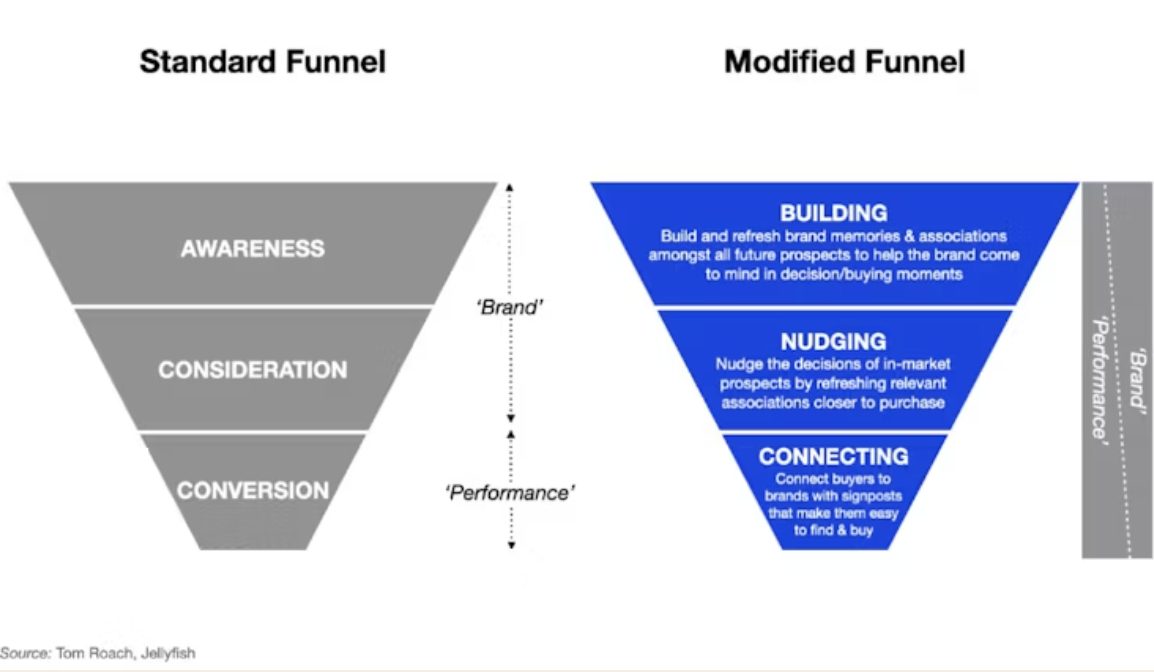
Possibly, the best article on the funnel proposes that the traditional funnel is broken.
This new funnel, created by Tom Roach is based on marketing science around brand growth.
To break it down, think of the funnel as 3 new parts:
Building brand memories and associations.
Nudging purchase decisions of in the market prospects.
Connecting brands to consumers (make them easy to find and buy).
SEO is clearly in the latter; we connect brands to consumers and make them easy to find and buy from.
The problem the SEO industry has caused itself is believing that our role is to deliver results for all of the funnel. SEOs have created content at scale to try and build brand memories and associations.
It’s not that content is bad; it’s just that most of it was targeted at the wrong audience: those who are not in the market to buy.
Information about a topic is only helpful for sales if it is for those in the market to buy.
However, to better explain this, we need to refresh our knowledge of the 95/5 rule in marketing.
The 95/5 Rule in Marketing (and how it changes SEO)
.
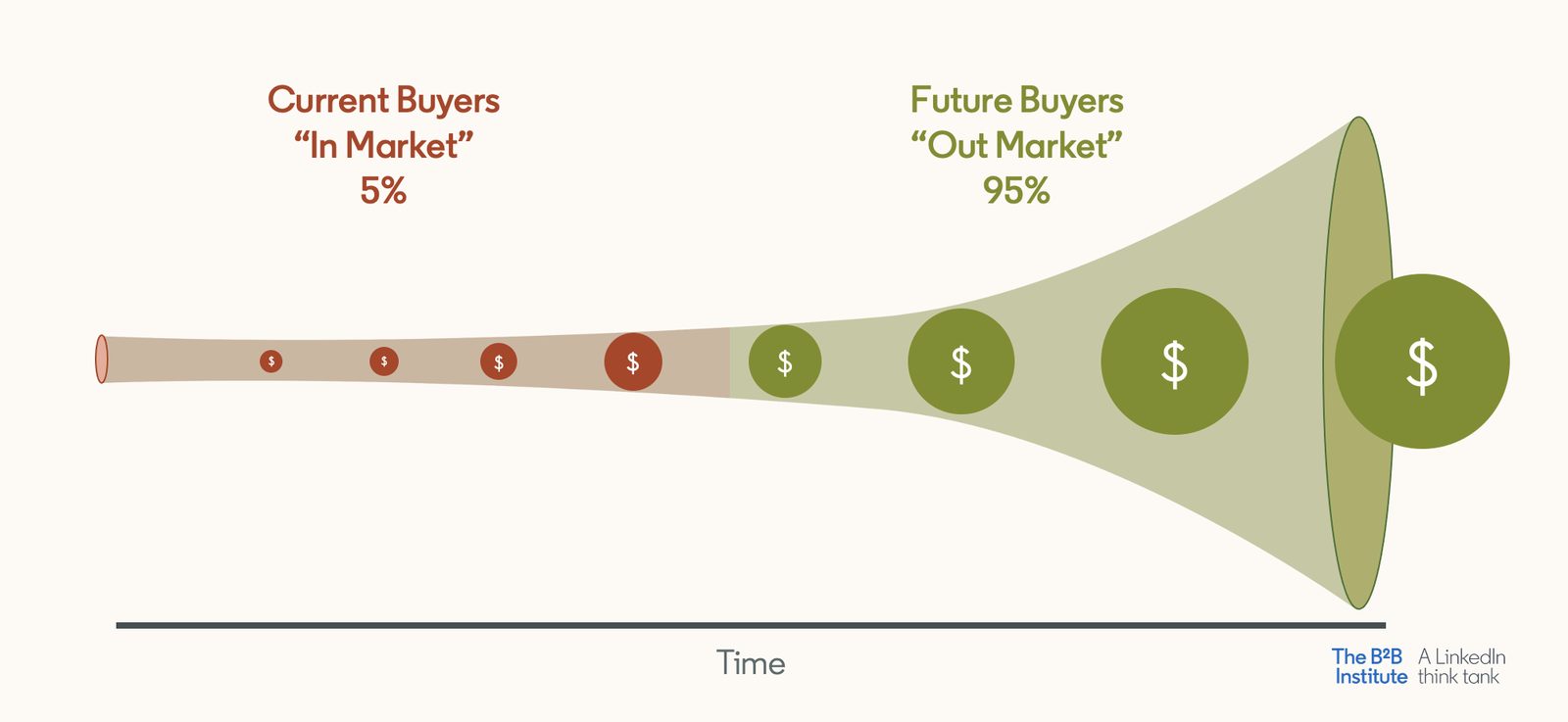
The 95/ 5 rule states that most of your future buyers are not in the market to buy right now.
SEO has traditionally attempted to reach these ‘out of the market’ buyers through content.
For years, this argument has been used by SEOs, Growth Hackers and Content Marketers.
But it’s a lie.
There is a vast problem that marketers seem to ignore, and it’s called the forgetting curve.
So, what is it?
Feel free to research this, but in its simple terms, we do not remember information that we do not use. This is a practical aspect of our brain’s working memory.
You think your content is doing wonders, but it’s forgotten quickly unless used repeatedly.
And content around a topic is of little use unless it is taregted at those in the market to buy what you sell.
People search, read your content, take the information they need and move on with their lives.
To clarify this point, here’s a quote from Ehrenberg-Bass Institute marketing professorByron Sharp‘s book “Marketing Theory, Evidence and Practice.”
Our marketing and brand is ignored and forgotten by most people most days.”
Of course, SEOs who rely on content (and I was once one of them) will say that content discovered through search can build email lists.
And yes, it can.
However, building a list of people who might never be in the market to buy what you sell is an expensive, inefficient and ineffective marketing tactic.
And we don’t need to. SEO works fine when we do what it is built for.
Reaching the 5% of buyers who are in the market to buy.
But how exactly do we do this?
SEO = Physical Availability and Distribution
The 4 P’s of marketing are Product, Price, Place and Promotion.
Product, price, and promotion get all the noise from marketers. However, ‘place’ is arguably the most ignored topic.
Look at most marketing budgets; you’ll see that they are primarily spent on paid search traffic, which is the ‘place’ of the 4’ps.
And yet, we know that paid search data is often the most incorrect.
Take this image from a search I made the other day.
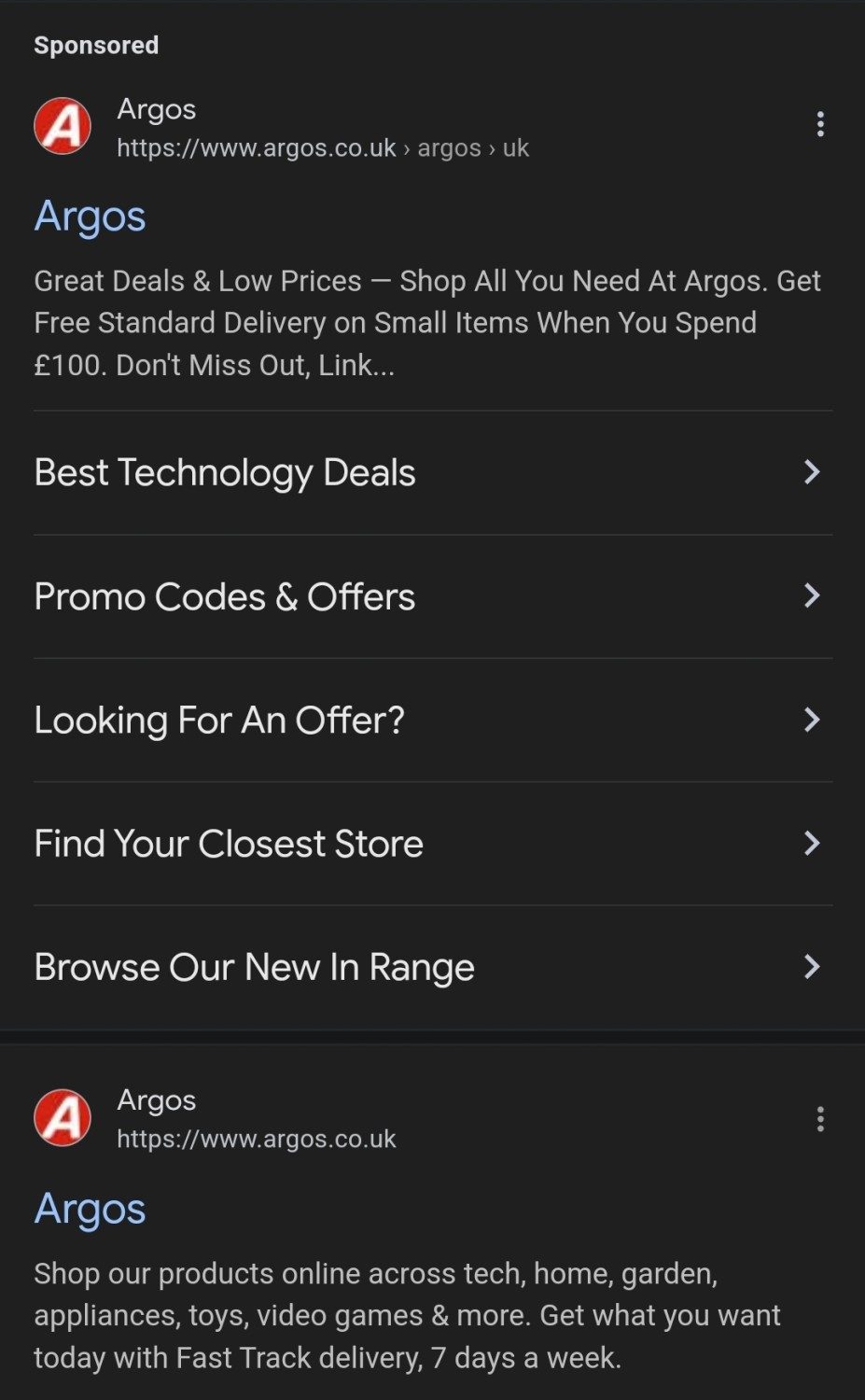
Argos were bidding on their brand name (which I clicked instead of the organic listing below).
I’ve heard every reason possible to justify this, but generally, most fall flat.
I searched for Argos to click on Argos.
They paid for what would have been free access to their brand, and regardless of the justification, I doubt it would stand up to any serious scrutiny.
This odd reliance on paid search attribution blinds brands to the simple truth.
The vast majority of people click on the organic search results.
There is, of course, a good reason for this.
We’ve become used to Google providing the best businesses to meet our needs because their organic search systems are designed to do this.
The reality is that most search clicks go to the organic search results.
And this also puts SEO in the ‘place’ element of marketing.
SEO is the ‘place’ in the 4Ps, just like paid search. However, we have a more extensive distribution than paid search at a fraction of the cost.
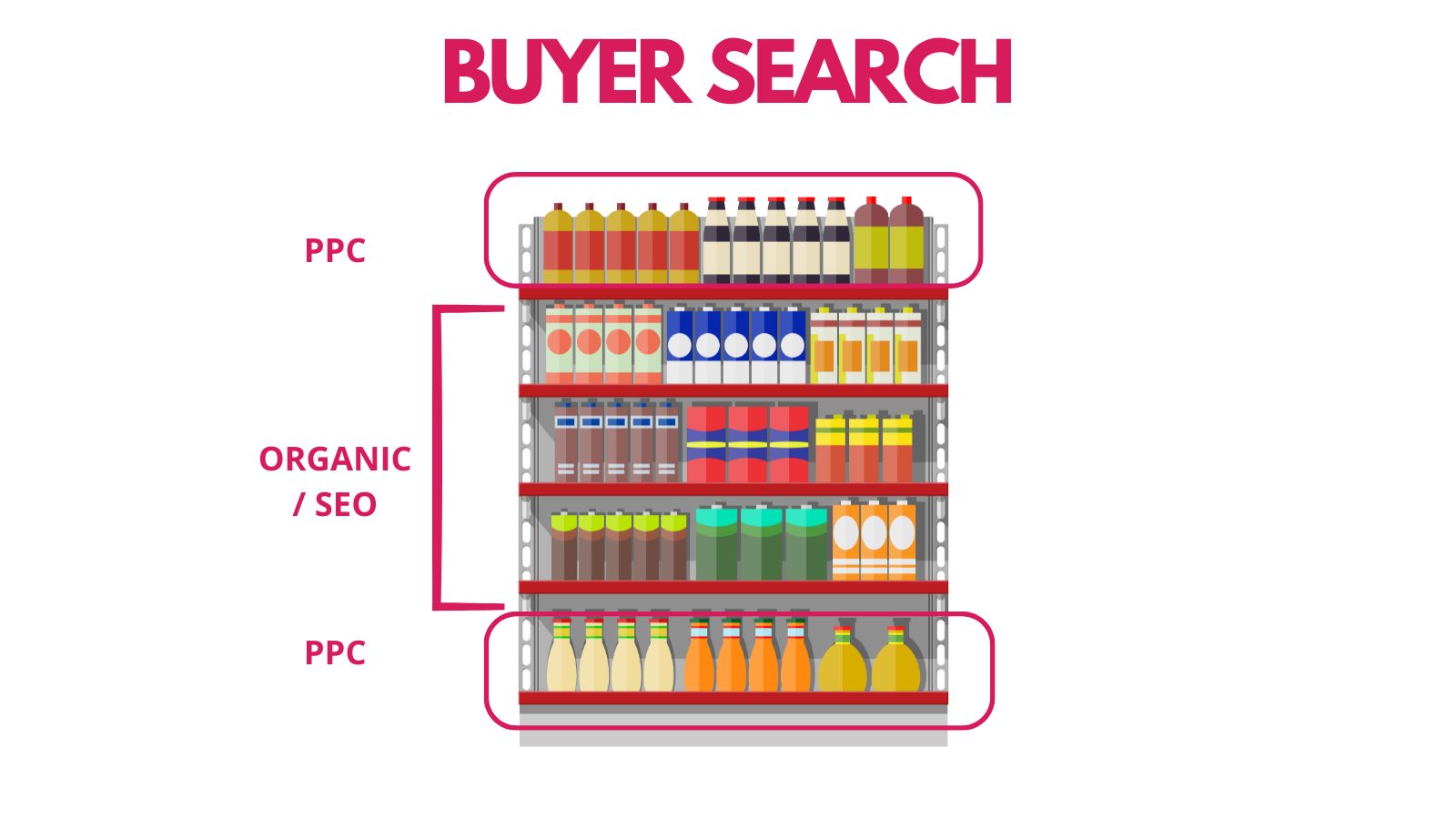
SEO is a distribution channel, and that’s fine because most brands are discovered on digital and physical shelves.
For this reason, organic search remains a key area of potential growth for brands. However, it is being ignored because paid search attribution is deeply flawed and biased toward its own ends.
Paid search will always look like it is driving the most results, because it targets those who were likely to buy from you anyway.
Or it nudges people to purchase at the very last minute.
However, spending most of your budget to seek high ROAS makes little sense when you can reach vastly more prospects through organic search.
We Search With Keywords When We Don’t Have a Chosen Brand
One of the core aspects of SEO is that it distributes your brand to people with no brand in mind when they enter the market to buy.
People use keywords or search queries to do this.
Take this search I’m making now for a new TV:
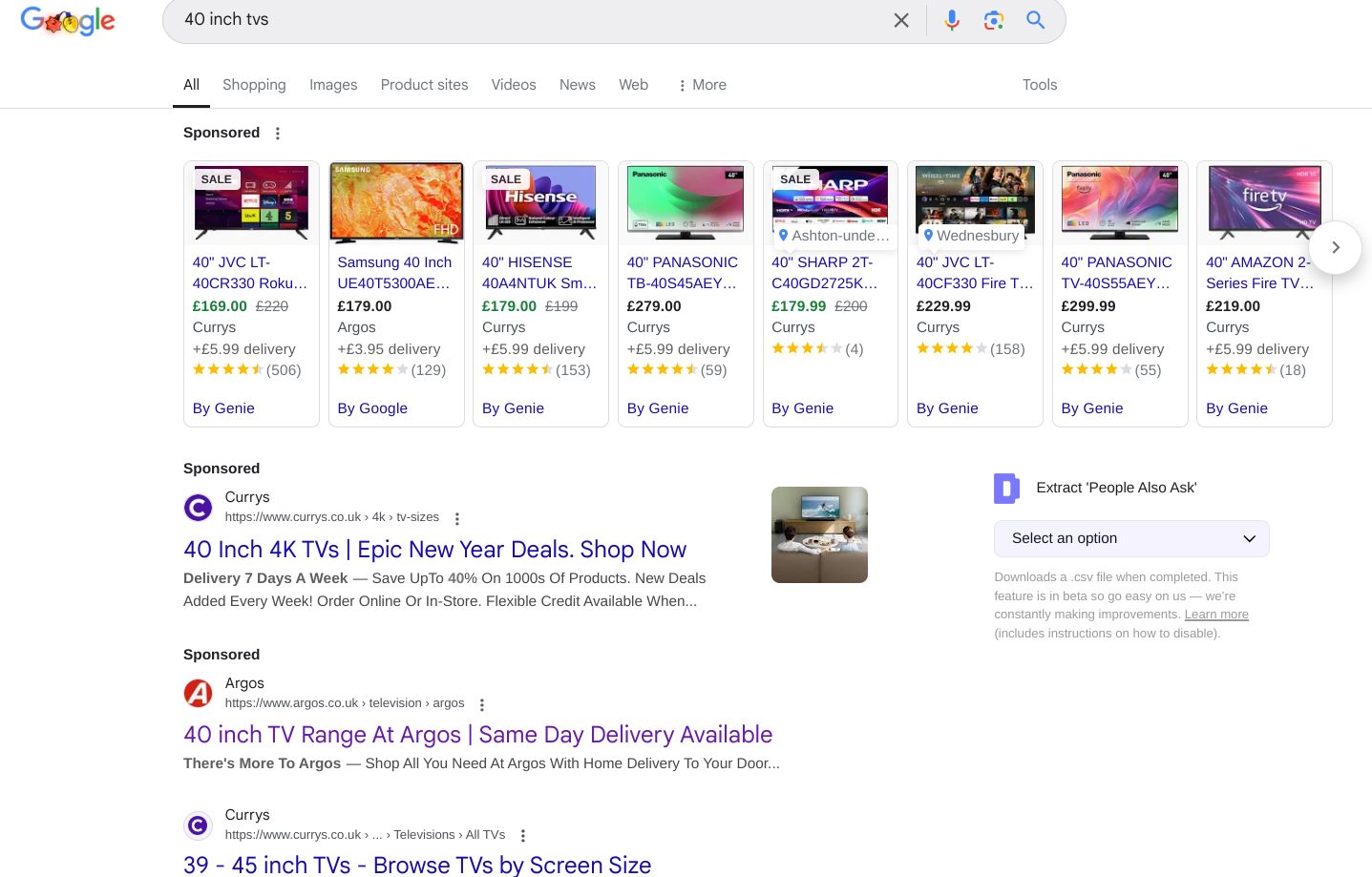
I do not have a brand, make or model in mind and am using size to find options that suit me.
With search users clicking on various results, attribution is a nightmare, so we must keep things simple.
To quote other legends of marketing, Les Binet and Sarah Carter in their fantastic book ‘How Not to Plan’:
The more widely and easily available your are, the more you’ll sell.
SEO/ organic search makes your products or services more widely and easily available.
And, to be frank, you all know this.
Just look at your purchase decisions and where you click.
This isn’t rocket science, folks.
So, what should you do?
SEO + Digital PR = Revenue
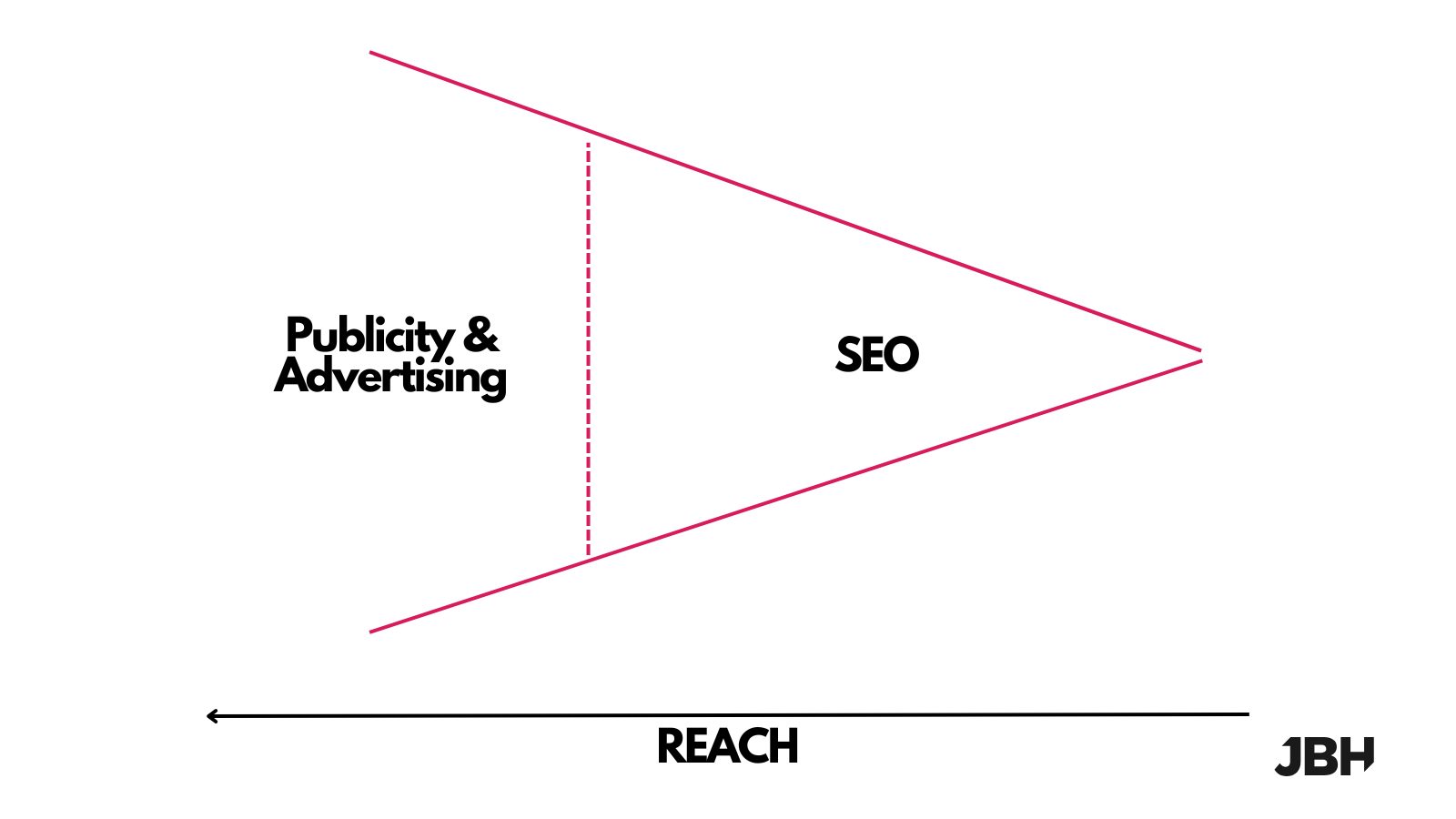
SEO does not exist in a silo.
Organic search is an ecosphere where your SEO department should connect the dots.
Old SEO was on-site, content and backlinks.
New SEO is on-site, content, and publicity (digital PR).
Digital PR not only builds backlinks, it tells people you exist, and it also builds brand mentions.
In addition, you will be included in the training data for LLMs, enabling you to future-proof your brand while supporting organic growth rankings.
And this is key for many brands.
Moving to a Distribution and Connection Based SEO Model
Like it or not, a huge amount of prospects do not have a set brand in mind to purchase from.
And as we’ve seen, they use search engines to discover, compare and find businesses that can solve their problems.
You must think of SEO as a ‘slotting fee’ that you pay to access the vast numbers of customers who walk the digital aisles of search engines.
Many won’t buy from you today, but they might someday.
It’s logical, and SEO generally costs peanuts compared to most marketing channels.
The problem in the past was that SEOs generally sought a traffic-focused model through content, which did not lead to purchases.
By moving from an information-based approach to a service/ product distribution approach, you’ll see faster SEO results that have a meaningful and measurable business impact.
By linking with digital PR to build your brand presence, mentions, and links, you’ll see even quicker results and advertise your business to people in and out of the market.
SEO works best at the bottom of the funnel.
SEO connect brands with prospects.
SEO drives billions in revenue for brands.
In 2025, it’s time you thought seriously about leveraging organic search.
And if you need help with this, feel free to message me.
Andrew Holland
Originally published on LinkedIn on 30 December 2024.