
There is a particular kind of SEO consultant who has spent the past 18 months telling everyone that nothing has really changed.
AI search? Just SEO. Generative engine optimisation? Just SEO. Google changing the interface of search itself? Still SEO. ChatGPT, Gemini, Claude, Perplexity and whatever else arrives next Tuesday? Apparently, yes, still just SEO.
How convenient.
Because if everything is still just SEO, the invoice can stay exactly where it is. A few technical fixes. A bit of schema. Some internal links. A pile of blog content. A few guest post links bought from the same sad spreadsheet everyone else uses. Then package the whole lot as “topical authority” and sell it on a 12-month retainer.
Lovely work if you can get it.
But it is not the truth.
The truth is much more uncomfortable. Search is changing. Social distribution is changing. LinkedIn, the once-reliable B2B visibility machine, is drowning in AI-written beige and strangling reach because marketers did what marketers always do. They found a channel that worked, gamed it into oblivion, and then complained when the platform shut the door.
Meanwhile, Google has no choice but to evolve. If people start using AI tools to make decisions, compare suppliers, ask for recommendations and reduce the friction of buying, Google has to respond or watch its core advertising machine weaken. This is not a small interface tweak. It is a discovery shift.
And that means content marketing has to change too.
Not because content is dead. That is the usual lazy funeral speech from people who need a conference slot. Content is not dead. Lazy content is dead. Keyword-first content is dying. Topical-authority sludge is dying. The idea that you can become an authority by publishing 100 mediocre posts around a subject and waiting for the Google gods to bless you is, finally, getting the kicking it deserves.
The future of content marketing is not more content.
It is fame.
The Goal Is Brand Visibility
Let’s simplify the whole mess.
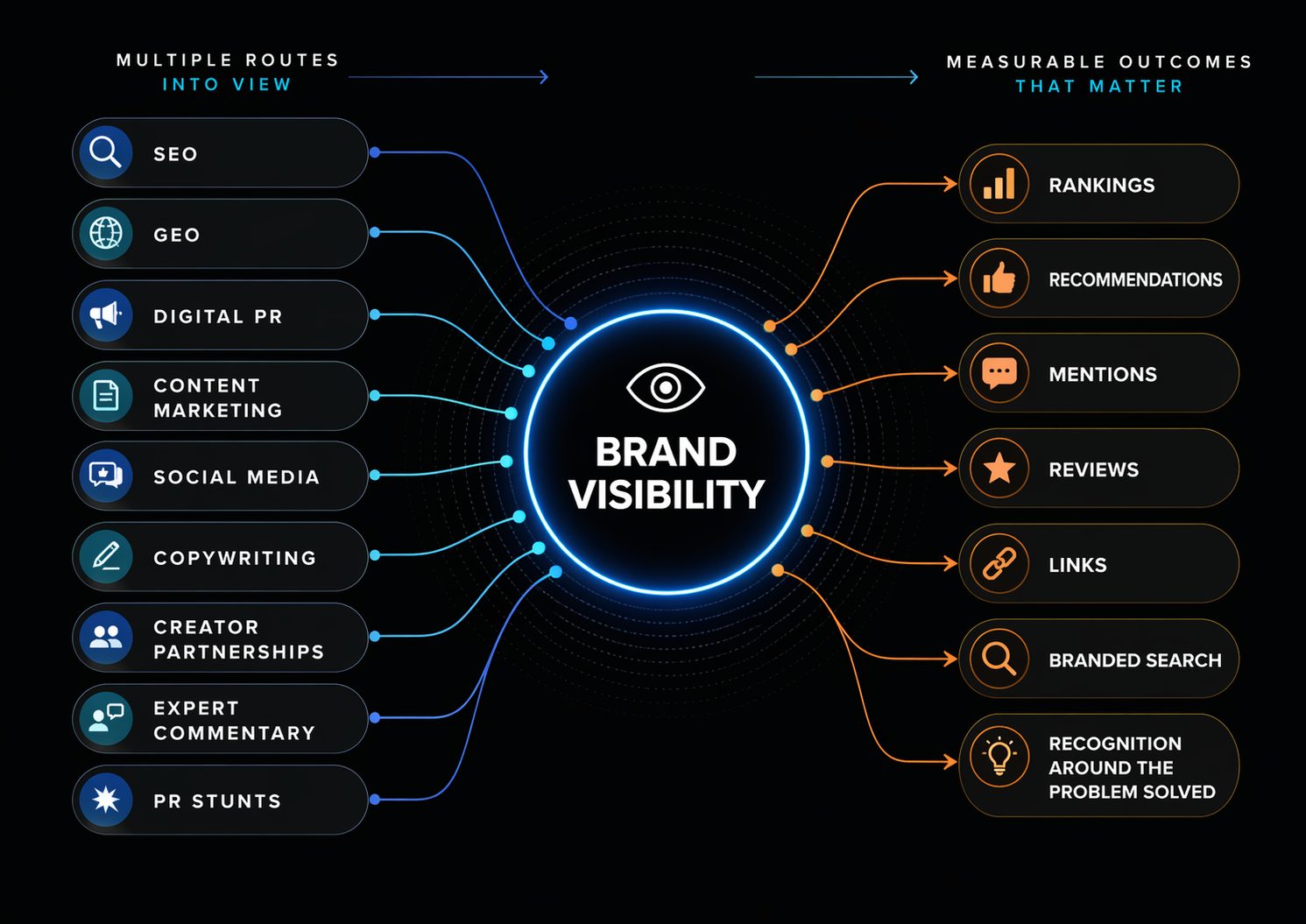
SEO, GEO, digital PR, link building, content marketing, social media, copywriting, creator partnerships, expert commentary and PR stunts are not separate kingdoms. They are different routes to the same destination.
That destination is brand visibility.
Are you being found when buyers search? Are you being recommended when buyers ask AI tools for help? Are journalists citing you? Are creators mentioning you? Are customers reviewing you? Are other sites linking to you without being bribed? Are people searching for your brand by name? Are buyers seeing your content before they know they need you? Are humans and machines associating your brand with the problem you solve?
That is the game.
SEO asks: are we ranking for buyer-intent search terms that matter?
GEO asks: are we being recommended for buyer-intent prompts and decision situations?
Digital PR asks: are we being used as a source of information by the media and earning quality mentions and links as a result?
Content marketing asks: are we putting the brand in front of relevant people and helping them understand what we solve?
Copywriting asks: are we positioned clearly enough for both humans and machines to understand who we help, what we do and why we are better?
These are not disconnected activities. They are all visibility work.
The mistake is measuring them as if they sit in different silos. Traffic over here. Links over there. Rankings in one report. PR coverage in another. LinkedIn impressions in some grim little social dashboard nobody believes.
Wrong.
The question is simpler: is the brand becoming more visible around the problems it solves?
Fame Is Not Fluffy
Fame makes marketers nervous because it sounds soft. It sounds like something for perfume brands, footballers and people who take themselves too seriously on podcasts.
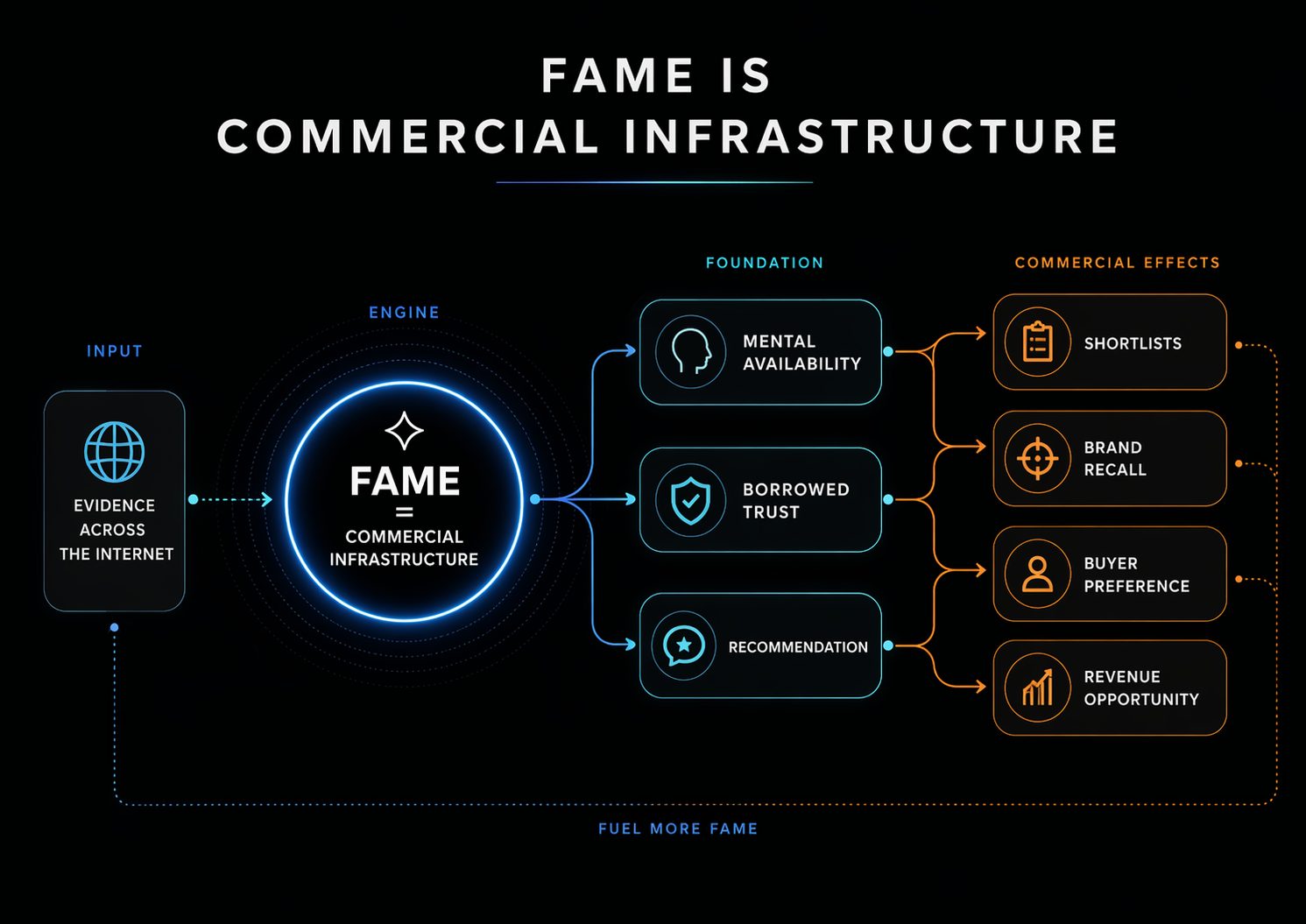
But fame is not soft. Fame is commercial infrastructure.
Byron Sharp and the Ehrenberg-Bass Institute have spent years making the case that brands grow through mental and physical availability. You need to be easy to think of and easy to buy. That is not poetry. That is how markets work.
But Sharp also makes an important point that many marketers conveniently ignore: advertising is a weak force. It does not usually grab a stranger by the collar and convert them on the spot. It reminds. It reinforces. It keeps the brand available in memory.
Recommendation is different. Recommendation carries borrowed trust.
And that is why AI changes the texture of discovery. Search used to present options. AI increasingly gives answers, summaries and recommendations. It does not just say, “Here are ten blue links, go and sort your own life out.” It synthesises what it can find and gives the user a view.
So the question becomes: how does your brand become recommendable?
Not by pumping out more “ultimate guides”. Not by pretending your blog is The Economist. Not by stuffing another 800 words onto a service page because some tool told you the competitors have a higher word count.
You become recommendable by creating enough evidence across the internet that humans and machines can understand what you are famous for.
That evidence includes your website. But it also includes reviews, mentions, links, media coverage, expert commentary, creator references, community discussions, comparison pages, customer stories, original research, tools, events and the wider trail of proof around your brand.
In the AI era, content is not just the thing you publish. Content is the evidence trail that teaches humans and machines what you are famous for.
Start With the Who
Content marketing in the AI era does not start with keywords. It starts with market orientation.
Who do you serve better than the alternatives?
That sounds basic because it is. Unfortunately, basic marketing is where most marketers go to die. They would rather talk about prompt engineering than identify the customer. They would rather create a “GEO content cluster” than admit they do not really know who the brand is for.
Start with the who.
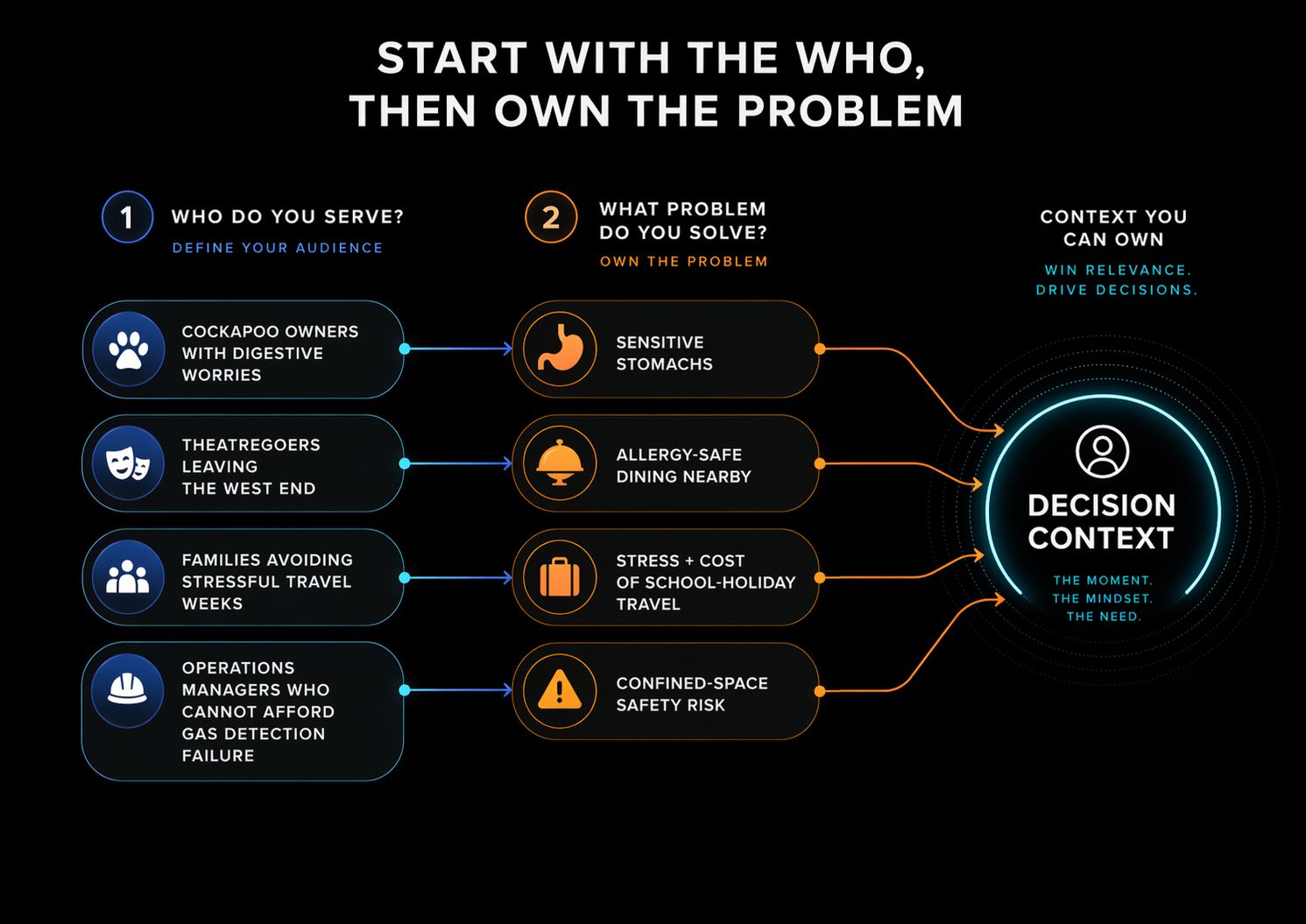
A dog food brand might serve owners of dogs with sensitive stomachs. More specifically, it might serve cockapoo owners worried about digestion. A restaurant might serve hungry people leaving a West End theatre. A holiday company might serve families trying to avoid the most expensive and stressful travel weeks of the year. A safety equipment company might serve operations managers who cannot afford a gas detection failure on site.
The who can be broad. The who can be narrow. But it has to be real.
And yes, broad reach still matters. This is not an argument for tiny targeting and performance-marketing myopia. You still need to reach more people than are currently in-market. You still need mass exposure. But broad reach does not mean vague messaging.
The rule is simple: reach broadly, speak specifically.
AI makes this more important, not less. A person does not always ask, “best dog food”. They ask about their situation. “What should I feed a cockapoo with a sensitive stomach?” “Which restaurants near the theatre are good for allergies?” “What gas detection equipment do I need for a confined space?”
That is not a keyword. It is a decision context.
If you do not understand the who, you cannot own the context.
Define the Problem You Want to Be Known For
Once you know who you serve, define the problem you solve.
This is where most content strategies collapse into mush. Businesses do not want to choose. They want to be known for everything. They want to be innovative, trusted, friendly, expert, affordable, premium, sustainable, customer-centric and, God help us, “solutions-led”.
That is not positioning. That is LinkedIn profile wank.
You need to decide what problem you want to be associated with.
If you sell jacket potatoes, the problem is hunger. But the content does not have to say “we solve hunger” like a dead-eyed brand guideline. Spudman and SpudBros helped turn the humble jacket potato into algorithmic theatre through personality, excess, repetition and visual fluency.
The Guardian has reported on TikTok helping revive the baked potato, including SpudBros building a large following with distinctive toppings and social content, while Spudman has also become a major viral figure around the format.
That is not “content” in the old SEO sense. Nobody was sitting at home searching for “topical authority baked potato content cluster”. They were entertained. They saw the product. They remembered the seller. They felt something.
If you sell family holidays, the problem might be cost, timing, stress, safety, boredom, food, airport misery or finding somewhere that works for children and adults. So create content around those problems. The best and worst weeks to travel as a family. The destinations where families overpay. The hidden costs of all-inclusive resorts. The mistakes parents make when booking during school holidays.
If you sell dog food for sensitive stomachs, talk about what owners should avoid feeding dogs with digestive issues. Commission expert commentary. Get vets involved. Create guides, data, checklists and explanations that media outlets, creators and owners can use.
The job is not to create topic coverage.
The job is to create problem ownership.
Fix the Home Base First
Before we get carried away with fame, fix the website.
Your own site still matters. It is the home base. It is where your positioning is made explicit. It is where buyers convert. It is where AI systems and search engines can find your clearest claims, proof and structure.
But you need to understand the difference between SEO and GEO.
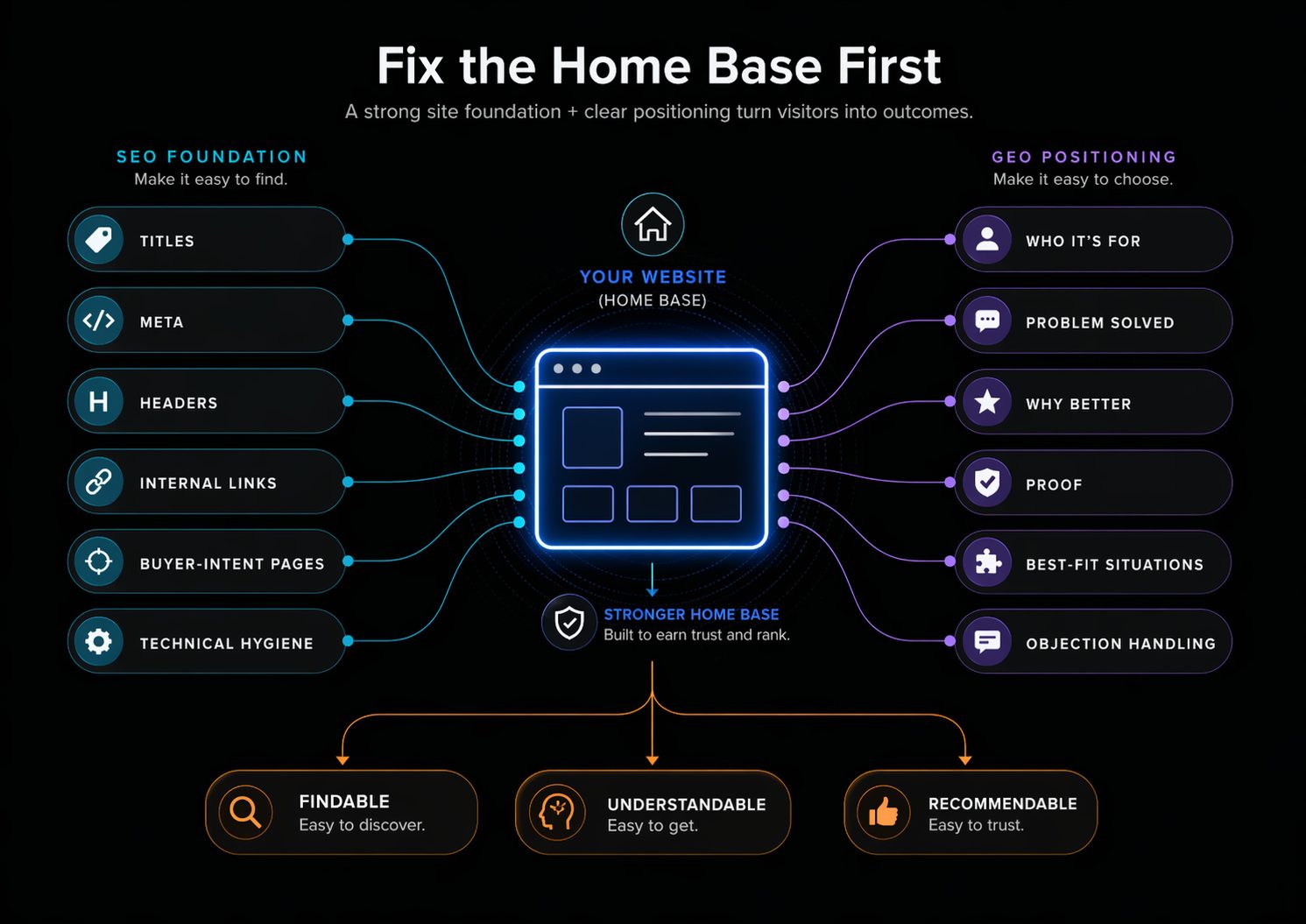
SEO asks: does this page answer the query?
GEO asks: is this brand the best answer to the buyer’s situation?
For SEO, you still need the basics. Page titles. Meta descriptions. Heading structure. Internal links. Buyer-intent keywords. Crawlability. Useful category, product and service pages. Clear copy. Technical hygiene.
Do not let anyone tell you that has disappeared. It has not. But it is now the floor, not the ceiling.
For GEO, you need sharper positioning. Who is this for? What problem does it solve? What makes it better than the alternatives? What proof exists? What situation does it fit? What objections does it overcome? What language would a buyer use when explaining their messy reality to an AI system?
That means pages should be built around decision contexts, not just keywords.
Here is a useful rule: add to an existing page when the qualifier is an attribute. Create a new page when the qualifier creates a different user task, proof need or conversion path.
“Private dining available” might be an attribute on a restaurant page. “Private business dinners in London” probably deserves its own page.
“Gluten-free options” might be an attribute. “Allergy-safe dining for families” might be a separate decision context.
“Free returns” is an attribute. “Best football boots for artificial grass and wide feet” is a different buying situation.
This is where SEO, GEO and positioning merge. You are no longer just answering keywords. You are mapping the real situations in which people choose.
Create Content With Marketing Value at the Point of Publish
The old content model allowed marketers to publish and pray.
Publish the blog. Wait six months. Hope it ranks. Tell the client “authority is building”. Add some graphs with upward arrows. Avoid the awkward question about revenue.
That model is finished.
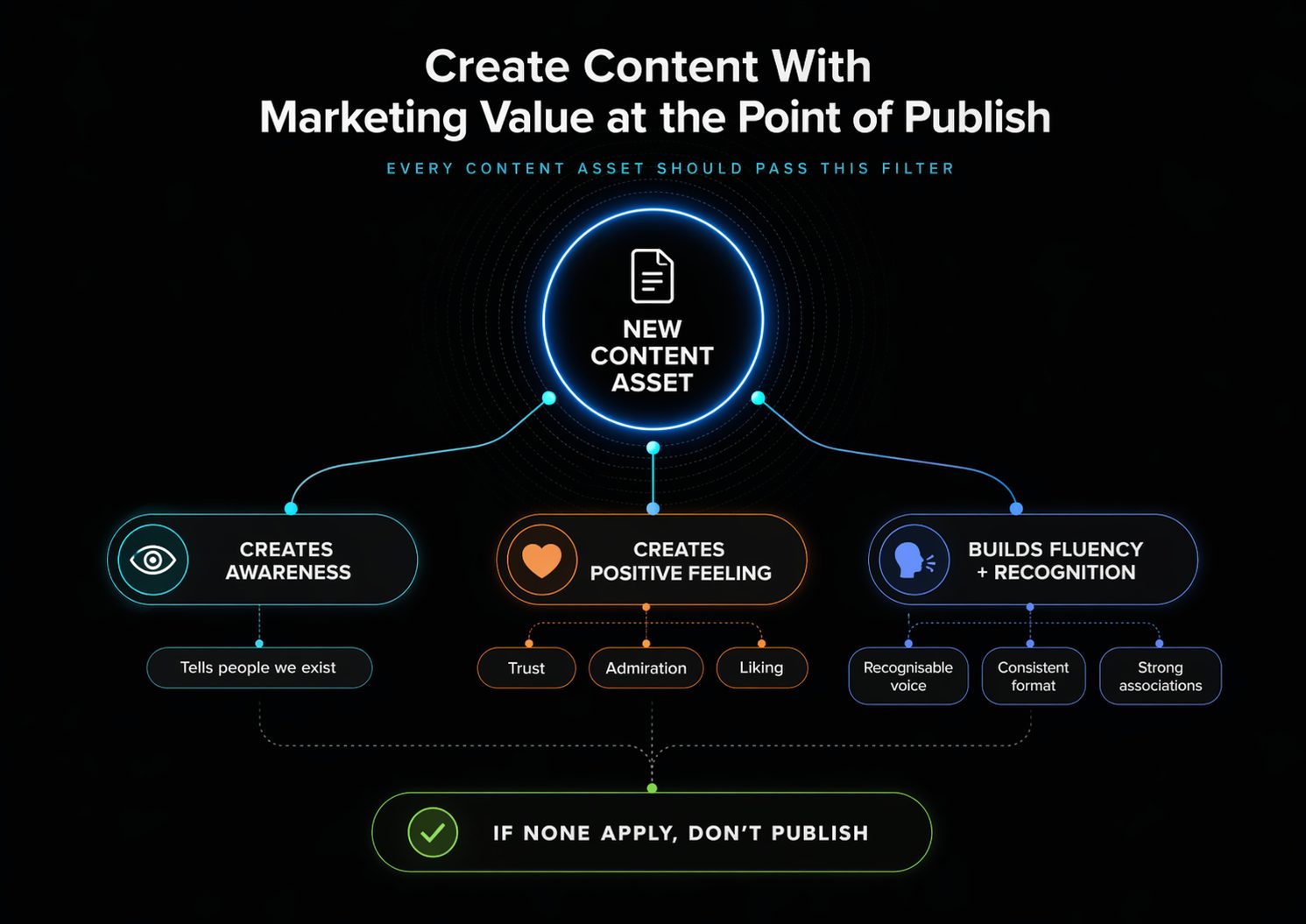
Every piece of content you publish now should have marketing value at the point of publish.
Not eventually. Not theoretically. Not because a tool says it fills a semantic gap. Immediately.
A piece of content should do at least one of three things.
First, it should create awareness. It should tell the right people that you exist, what problem you solve and who you solve it for.
Second, it should create positive feeling. It should make people like, trust, admire, respect, laugh at or feel safer with the brand.
Third, it should create fluency and recognition. It should make the brand easier to recognise next time through consistent voice, format, visual style, claims, assets and associations.
If a piece of content does none of these things, why the hell are you publishing it?
Traffic as the target was always stupid. Traffic as a signal still matters. If people are seeing, clicking, sharing, saving, referencing and acting on your content, that tells you something. But traffic is not the strategy. Visibility is the strategy.
Build Assets, Not Blog Posts
The word “content” is part of the problem. It is too vague. It makes a customer story, a research report, a TikTok, a sales deck, a founder rant, a product demo and a 600-word SEO blog sound like the same species.
They are not.
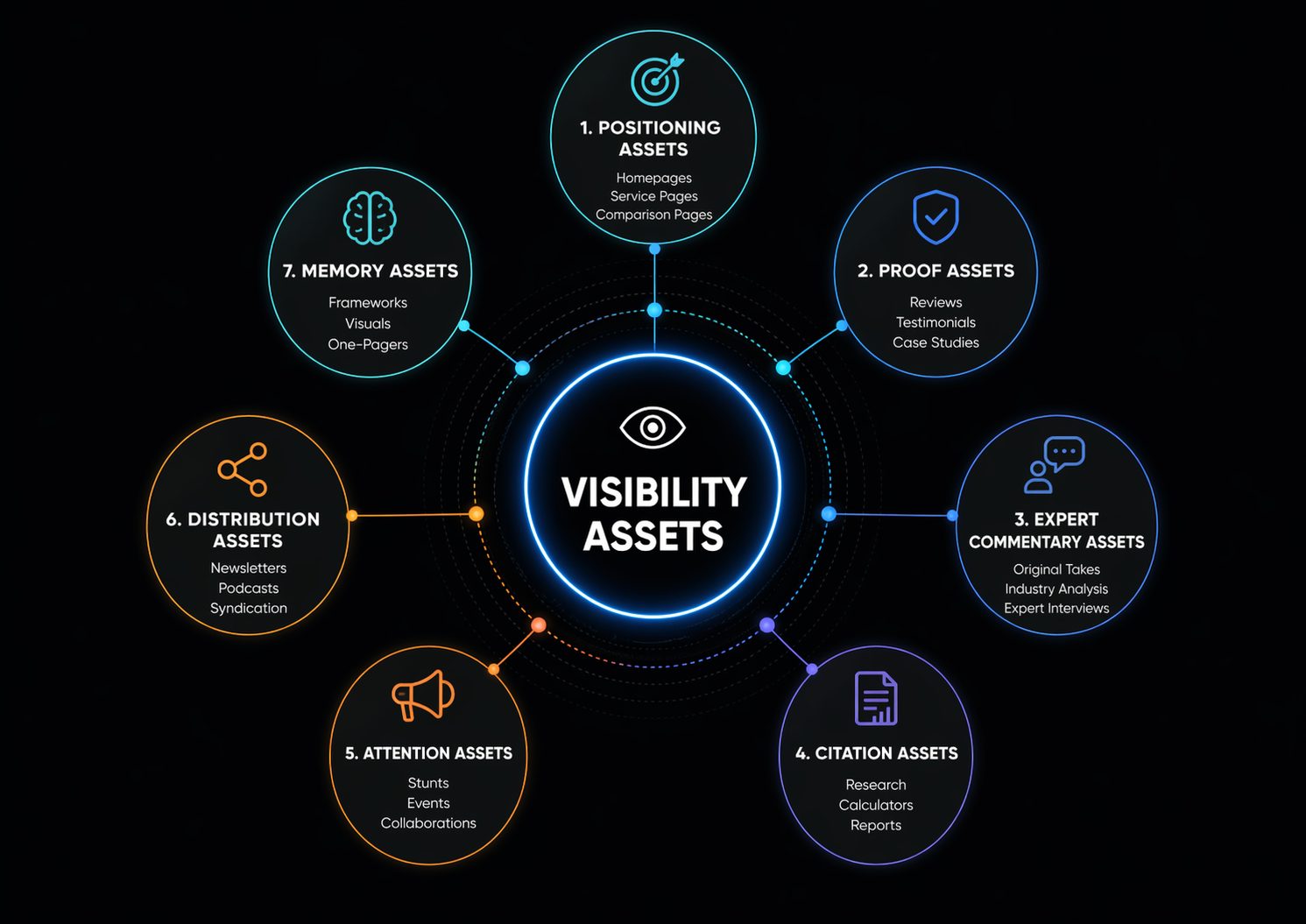
In the AI era, you need to build visibility assets.
There are seven types.
1. Positioning Assets
These explain who you help, what problem you solve, why you are better and why anyone should believe you.
Homepage copy. Service pages. Product pages. Category pages. Comparison pages. Use-case pages. Buyer guides. Proof pages. Case studies.
This is where clarity starts. If your website cannot explain what you are famous for, do not expect the market or the machines to do it for you.
2. Proof Assets
These make you easier to recommend.
Reviews. Testimonials. Customer stories. Certifications. Benchmarks. Before-and-after examples. Performance claims. Awards, when buyers actually care about them. Demonstrations. Data showing the product works.
AI systems do not need your vibes. Buyers do not need your vibes. They need proof.
3. Expert Commentary Assets
This is one of the cheapest and most underused visibility plays.
Expert commentary lets you enter conversations that are already happening. A journalist is writing about a regulation change. A trade magazine needs a quote on a market shift. A podcast wants someone to explain what a new law means for buyers. A LinkedIn creator is discussing a problem your business solves.
Get in there.
Not with bland corporate mush. With something useful, specific and quotable.
Expert commentary does three jobs. It tells people you exist. It associates your brand with a problem. And it creates third-party mentions that humans and AI systems can later find.
Not every company can build a giant stunt. Most can say something useful before lunch.
4. Citation Assets
These are assets other people want to reference.
Original research. Surveys. Annual reports. Industry rankings. Maps. Calculators. Failure databases. Cost calculators. Safety checklists. Trend reports. Benchmarks.
This is where digital PR and content marketing become the same thing. You are not publishing for the sake of publishing. You are creating something journalists, creators, analysts, customers and AI systems can use as evidence.
A gas detection company, for example, does not need 50 blog posts about “what is gas detection?” It might need the best annual report on confined-space safety failures. A calculator for compliance risk. A guide to the hidden costs of poor detection. Expert commentary when regulation changes. Product demonstrations showing what happens when detection fails.
That is content with commercial gravity.
5. Attention Assets
These are built to travel.
Stunts. Events. Experiments. Demonstrations. Collaborations. Challenges. Visual spectacles. Founder-led stories. Product seeding. Strong opinions.
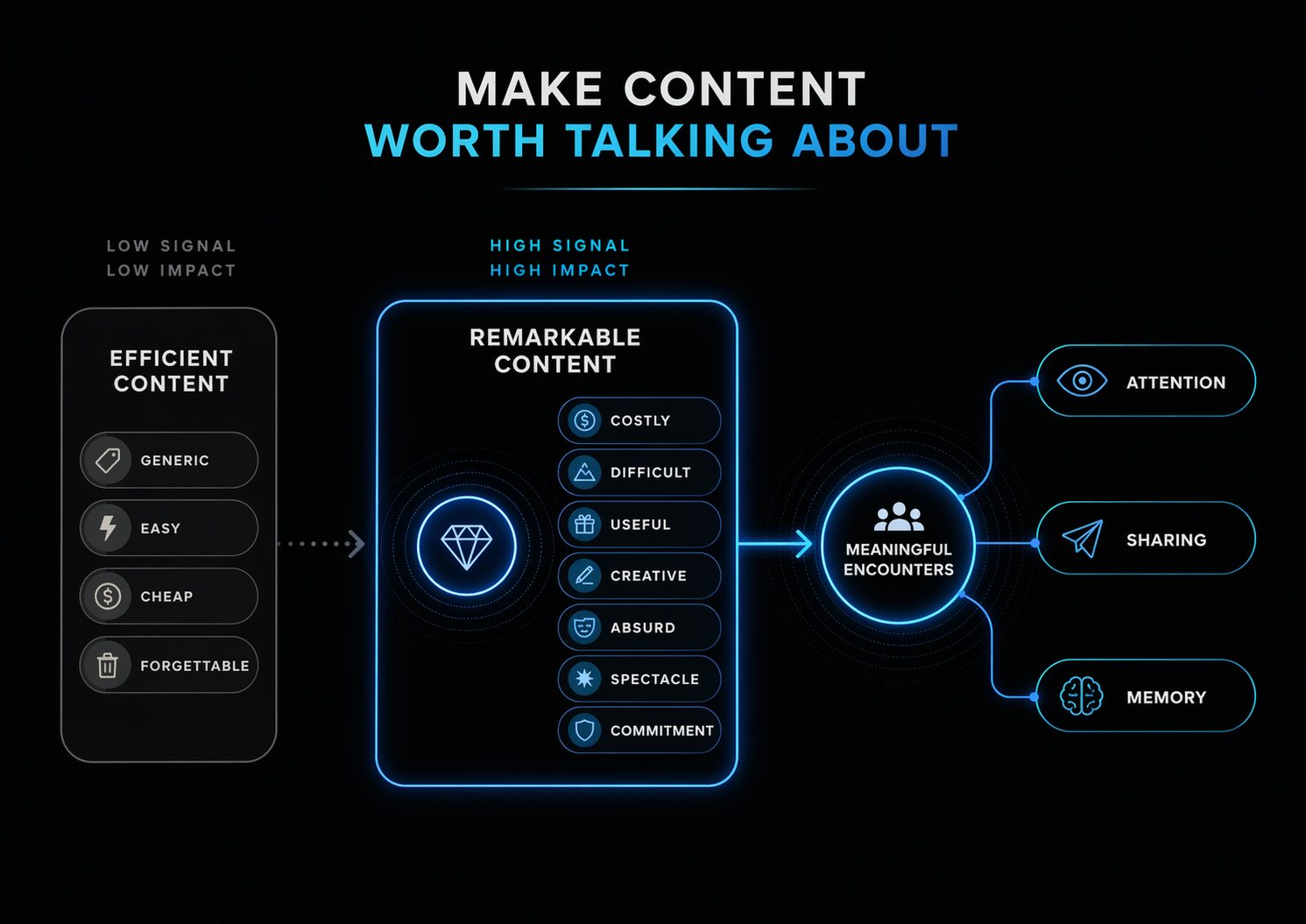
This is where Rory Sutherland’s point from Alchemy matters. Powerful messages often contain some element of absurdity, illogicality, costliness, disproportion, inefficiency, scarcity, difficulty or extravagance. Meaning is created when there is visible effort, risk or cost.
That is why a wedding invitation means more than an email. The inefficiency is the signal.
It is also why MrBeast became MrBeast. Difficulty, extravagance, costliness and absurdity became the format. It is why food content travels when it becomes theatre: sizzling smash burgers, excessive toppings, giant portions, neon interiors and calorie-loaded spectacle.
The point is not that every B2B brand should start behaving like a YouTuber with a warehouse and a moral injury.
The point is that efficient content is now everywhere. AI made efficient content basically free. So the content that stands out increasingly has to show cost, difficulty, taste, usefulness, creativity or commitment.
6. Distribution Assets
Most content strategies end at publication. That is amateur hour.
Distribution needs its own assets.
PR pitches. Journalist briefing notes. Creator packs. Sales decks. Partner content. Guest articles. Podcast talking points. Conference talks. Newsletter editions. Paid social cutdowns. Founder posts. Internal enablement materials.
The content does not travel because it exists. It travels because somebody pushes it, packages it, repeats it, adapts it and gives other people a reason to carry it.
7. Memory Assets
These build recognition over time.
Named frameworks. Recurring formats. Signature reports. Branded tools. Repeated phrases. Visual codes. Distinctive tone of voice. Consistent claims. Recognisable structures.
One viral post is nice. A recognisable property is better.
Distinctive assets matter because fame is not just exposure. It is exposure that links back to you. If people remember the idea but forget the brand, congratulations, you have done charity work for the category.
Make Content Worth Talking About
There is a reason stunts, events and collaborations keep appearing in famous marketing stories. They create an excuse for attention.
BrewDog’s early growth was fuelled by provocative PR, including tanks in London and other high-noise stunts. Whether you admire the brand or find it exhausting, the lesson is obvious: they understood that fame often requires something disproportionate enough to be discussed.
KFC’s recent Stranger Things collaboration reimagined the brand as “Hawkins Fried Chicken” for the show’s final season, turning a product tie-in into a culturally legible attention asset rather than a lazy logo swap.
The point is not “do a stunt”. That is the idiot’s reading.
The point is to create meaningful encounters. A launch event. A useful book. A proprietary tool. A report journalists need. A product demonstration. A collaboration with someone who already has attention. A training day. A challenge. A public experiment. A physical object. A conference. A guide so useful your sales team actually wants to send it to prospects.
At JBH, writing a book on digital PR and putting it directly into the hands of business owners is not “blogging”. It is a visibility asset. A proprietary tool that helps clients understand fame is not “content”. It is a proof asset, a sales asset and a memory asset.
This is the mental shift.
Stop asking, “What can we publish?”
Ask, “What can we create that gives people a reason to notice, trust, cite, share, remember or recommend us?”
Get Other People to Say It For You
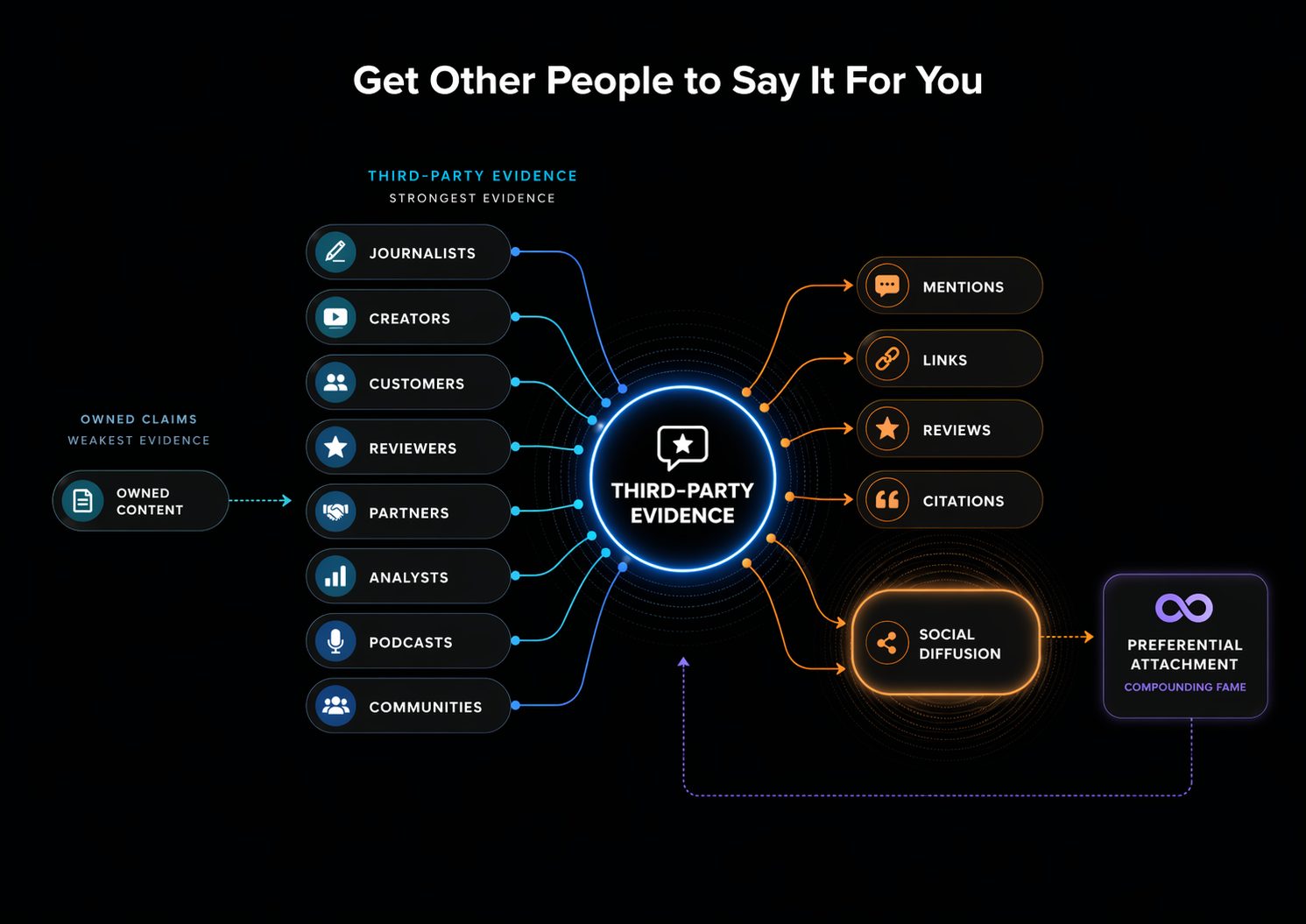
Owned content matters. But owned content is the weakest form of evidence because everyone knows you made it.
Of course, your website says you are brilliant. It is your website. It would be weird if it said you were average and often late.
The stronger evidence comes from elsewhere.
Journalists. Creators. Customers. Reviewers. Partners. Analysts. Communities. Podcast hosts. Newsletter writers. Event organisers. Industry bodies.
This is where the old SEO obsession with links accidentally pointed at something true but then ruined it by turning it into a transaction.
Links matter. Mentions matter. Reviews matter. Citations matter. Not because they are little technical tokens to manipulate a ranking system, but because they are public evidence that the brand exists beyond its own mouth.
You want people linking to you voluntarily. You want journalists using your data. You want creators referencing your product. You want customers reviewing you. You want partners naming you. You want your brand appearing naturally in the places buyers and AI systems go to understand the market.
This is social diffusion.
And once social diffusion starts working, preferential attachment kicks in. The mentioned become more mentioned. The linked become more linked. The recommended become more recommended. Fame compounds.
But fame still needs fuel. Stop feeding it, and it fades.
Measure Visibility, Not Vanity
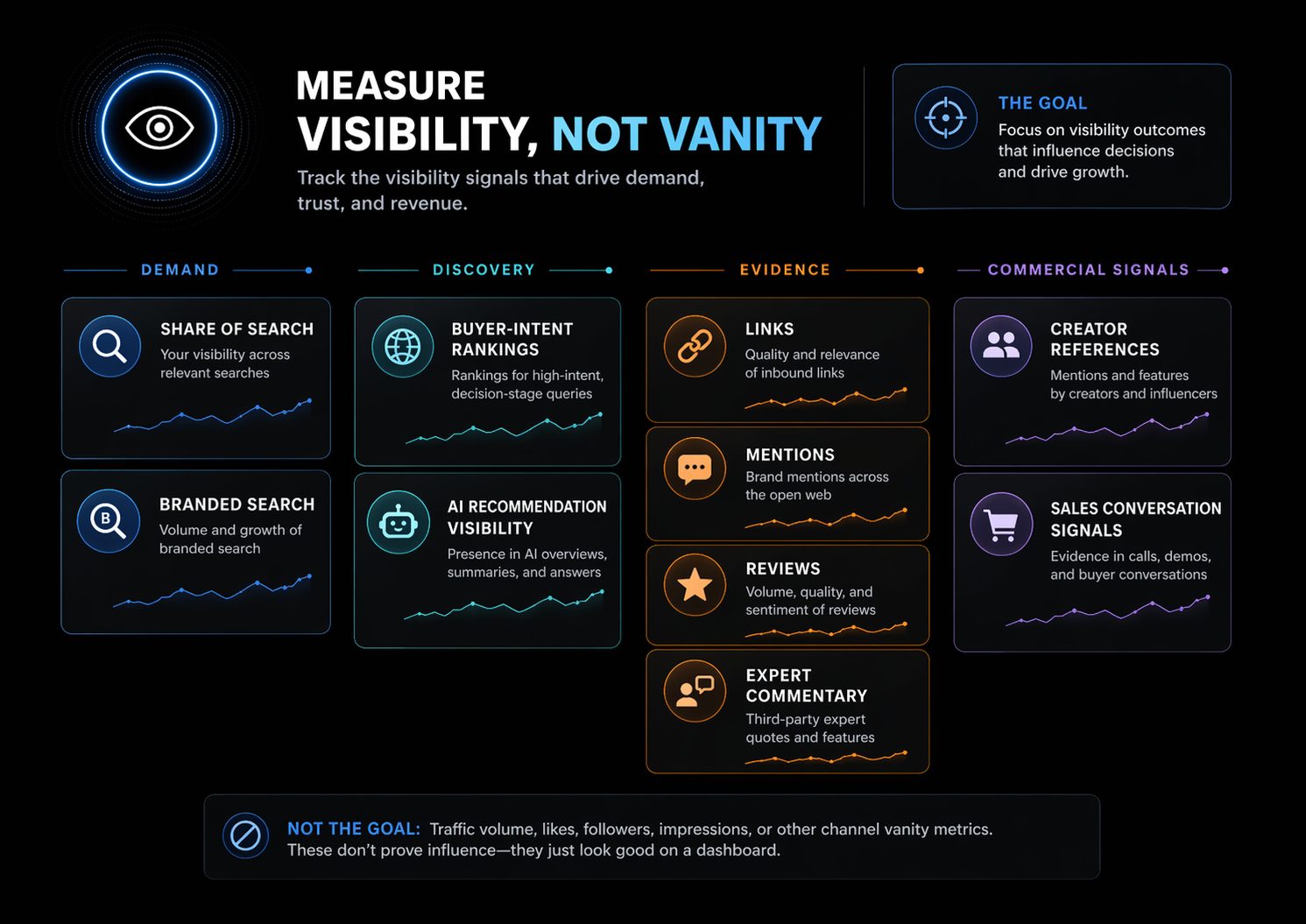
The dashboard needs to change.
You still track rankings. You still track traffic. You still track conversions. But do not confuse channel metrics for the goal.
Measure visibility.
Track share of search. Are more people searching for you relative to competitors?
Track branded search. Are more people looking for you by name?
Track buyer-intent rankings. Are you visible where active buyers still search?
Track AI recommendation visibility. When buyers ask realistic prompts, are you appearing? Are you being recommended? Which competitors appear instead?
Track links. Not just volume. Quality, relevance and whether they are earned voluntarily.
Track mentions. Where is the brand being talked about? By whom? In what context?
Track reviews. Volume, velocity, quality and themes.
Track expert commentary. How often are you quoted? In which publications? Around which topics?
Track creator and partner references. Who is carrying your message into audiences you do not own?
Track content impressions and engagement, but with discipline. Did the content create awareness, positive feeling or recognition? Did it lead to meaningful encounters with the business?
Track sales conversations. Are prospects arriving better informed? Are they using your language? Are they mentioning your reports, tools, events or commentary?
This is not a perfect measurement system. Nothing in marketing is. Anyone who tells you otherwise is either junior, lying or works in attribution software.
But it is better than pretending a traffic graph tells the whole story.
The Future Is a Brand Visibility Programme With SEO Inside It
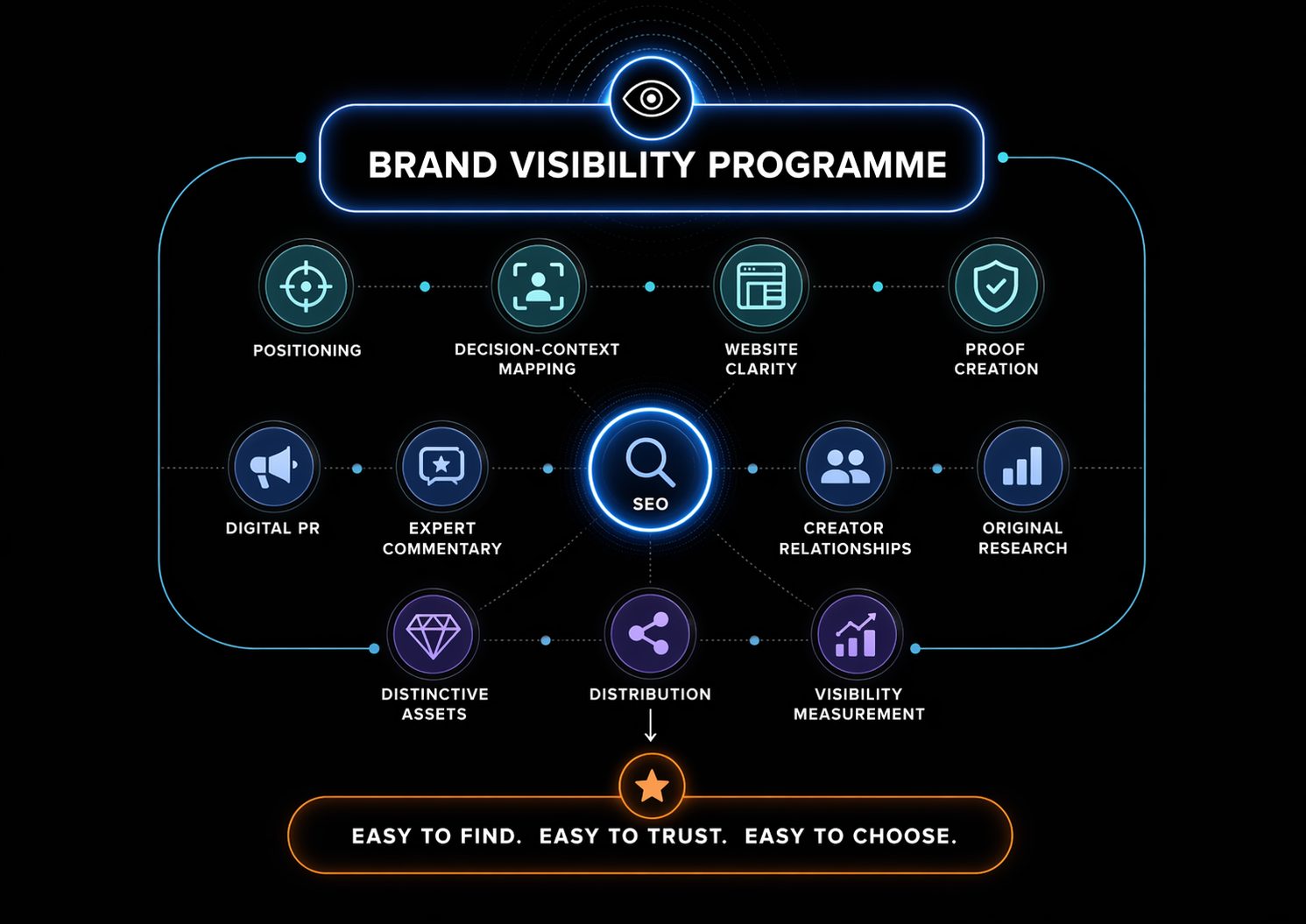
The 12-month SEO retainer is not dead everywhere. But the lazy version deserves to die.
The future is not “SEO with AI sprinkled on top”. It is a brand visibility programme with SEO inside it.
SEO becomes part of the infrastructure. Important, yes. Necessary, often. But not the whole answer.
The higher-value work is bigger: positioning, decision-context mapping, website clarity, proof creation, expert commentary, digital PR, creator relationships, original research, product seeding, events, distinctive assets, distribution and measurement of visibility across the market.
That is harder to sell than “we will publish eight blogs a month”.
Good.
It should be harder. The easy version created most of the mess.
AI has not changed the fundamentals of marketing. It has exposed the people who never understood them. You are still trying to reach buyers, create memory, build trust, show proof, trigger preference and make the brand easy to choose.
The interface has changed. The job has not.
Stop calling it SEO.
Build fame. It’s what I call Fame Engineering.
Andrew Holland