
What is coming for SEO this year is the search equivalent of dropping a lamb into a pool of piranhas.
There will be blood. There will be panic. There will be a lot of very serious people on LinkedIn who spent last year telling everyone that nothing was changing, suddenly explaining that they have been global AI search experts all along.
The SEO versus GEO civil war will look like friendly fire compared with what comes next.
But this is not another “SEO is dead” article.
Search is not dead. Being found is not dead.
In fact, the opposite is true.
Being found is about to become harder, more fragmented and therefore more valuable. The companies and consultants that can help brands become visible, trusted and chosen in the places where buyers make decisions will make a lot of money.
The companies selling vague retainers, content volume, citation dashboards and acronymic bollocks will have a much harder time.
This article is about how to stay valuable when that happens.
It’s for SEO consultants, agencies, freelancers, in-house teams and the clients who hire them. It will explain why the old SEO model is breaking, why the future is really about brand visibility, and how to rethink your business, customers, offer and value before the market does it for you.
Because that is the central point.
The reset is not SEO versus GEO.
It is rankings versus visibility.
And visibility wins.
The Old SEO Model Is Breaking Because Rankings Were Rented Visibility
The problem is not SEO. The problem is what SEO became.
Clients came to SEO agencies and consultants because they wanted growth. They wanted more leads, more sales, more revenue, more demand, more people finding them when they were already looking for a solution. That was the job. It still is.
But somewhere along the way, much of the industry shifted the conversation.
The client asked for revenue. The industry gave them a glossary and called it authority.
SEO became blog posts, hub-and-spoke models, topical authority, internal links, page titles, schema, outsourced links, audits and monthly reports. Some of that work was useful. Some of it still is. If you sell golf clubs, having supporting content around golf clubs, fitting, materials, swing types and buying considerations is perfectly sensible. It can help users. It can support commercial pages. It can create internal linking opportunities.
The problem is not that content never worked.
The problem is that content became the product.
And once content became the product, too much SEO stopped being judged by commercial impact and started being judged by activity.
How many articles did we publish? How many keywords moved? How much traffic did we gain? How many internal links did we add? How many citations did the shiny new tool report back to us?
That worked for a while because Google rewarded enough of it and because the value was often hard to verify. The agency could create the content, wait six months, and then claim victory if rankings improved. If nothing happened, there was always something else to blame: weak authority, technical debt, algorithm volatility, insufficient links, lack of patience, not enough budget, not enough content.
It was a beautiful machine.
Not because every blog post worked, but because nobody could prove quickly enough that most of them didn’t.
The deeper issue is that brands mistook rankings and traffic for visibility. For years, companies rented visibility from Google and thought they had built something durable. They ranked for enough keywords, bought enough clicks, published enough articles and watched enough upward-sloping traffic charts to convince themselves they were strong.
They were not strong. They were dependent.
If your brand only exists when Google ranks your page, you do not have brand visibility. You have an algorithmic tenancy agreement.
And now the landlord is changing the building.
AI search does not mean people stop needing answers. It means the answer layer moves.
A user no longer needs to search “best furniture ideas for a narrow bedroom” and click three articles. They can upload a photo and ask an AI tool what would fit in the space. The need is still there. The buyer is still there. The decision is still being shaped.
The click may not be.
That is the problem. Not that all content dies. Not that search disappears. Not that SEO becomes worthless.
The real issue is that weak informational content, generic advice, glossaries, definitions and thin inspiration pieces become far easier for AI systems to intercept.
So the question changes.
It is no longer only: can we rank?
It is: are we visible and trusted before the buyer chooses?
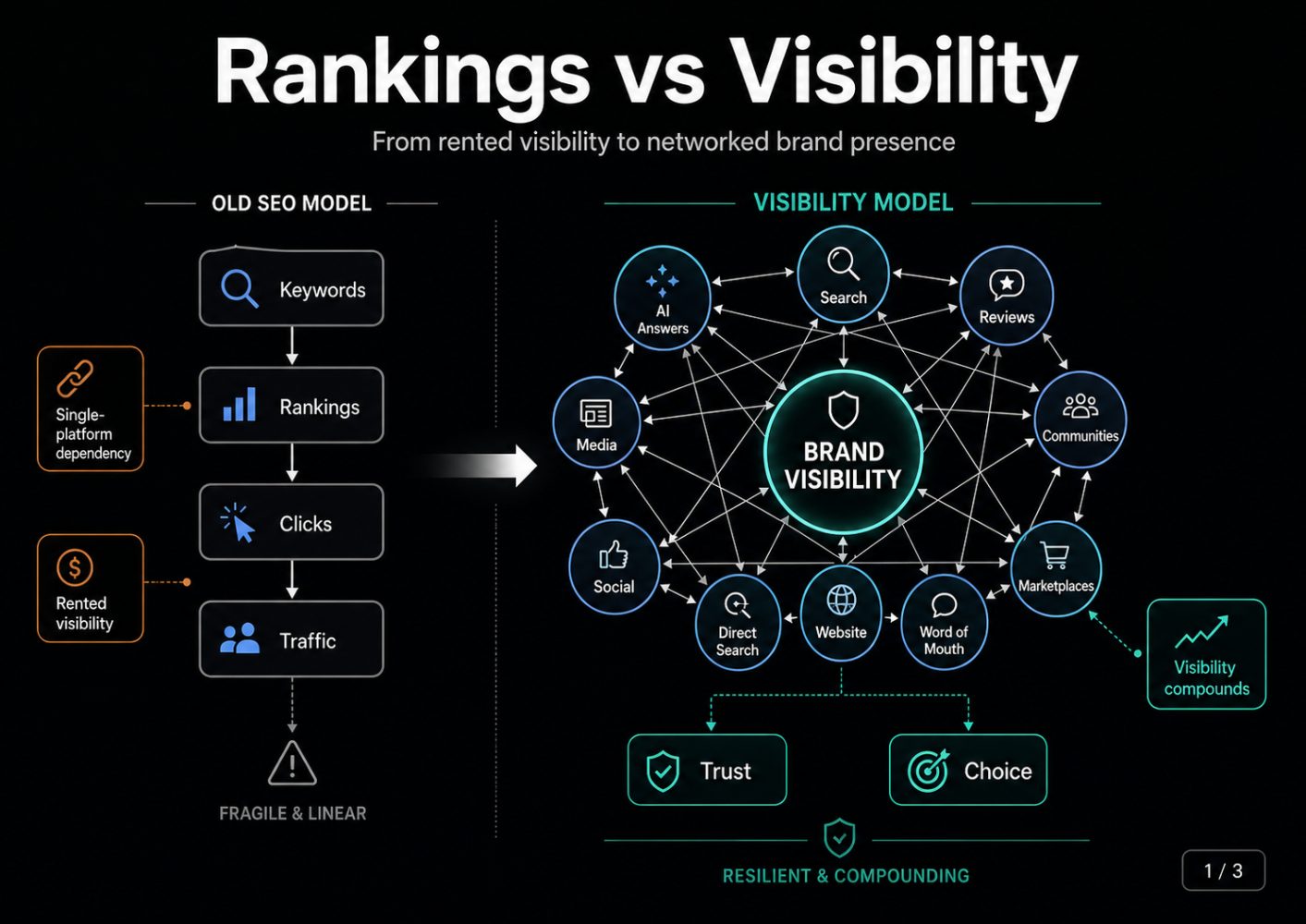
Brand visibility means the right buyers repeatedly encounter, recognise and trust your brand in the places where they discover, compare, shortlist and choose. That includes search, AI answers, reviews, communities, media, marketplaces, social, events, direct search and word of mouth.
SEO used to be able to make pages visible.
The future belongs to people who can make brands visible.
Those are not the same thing.
The Three Stupid Reactions Coming From The Industry
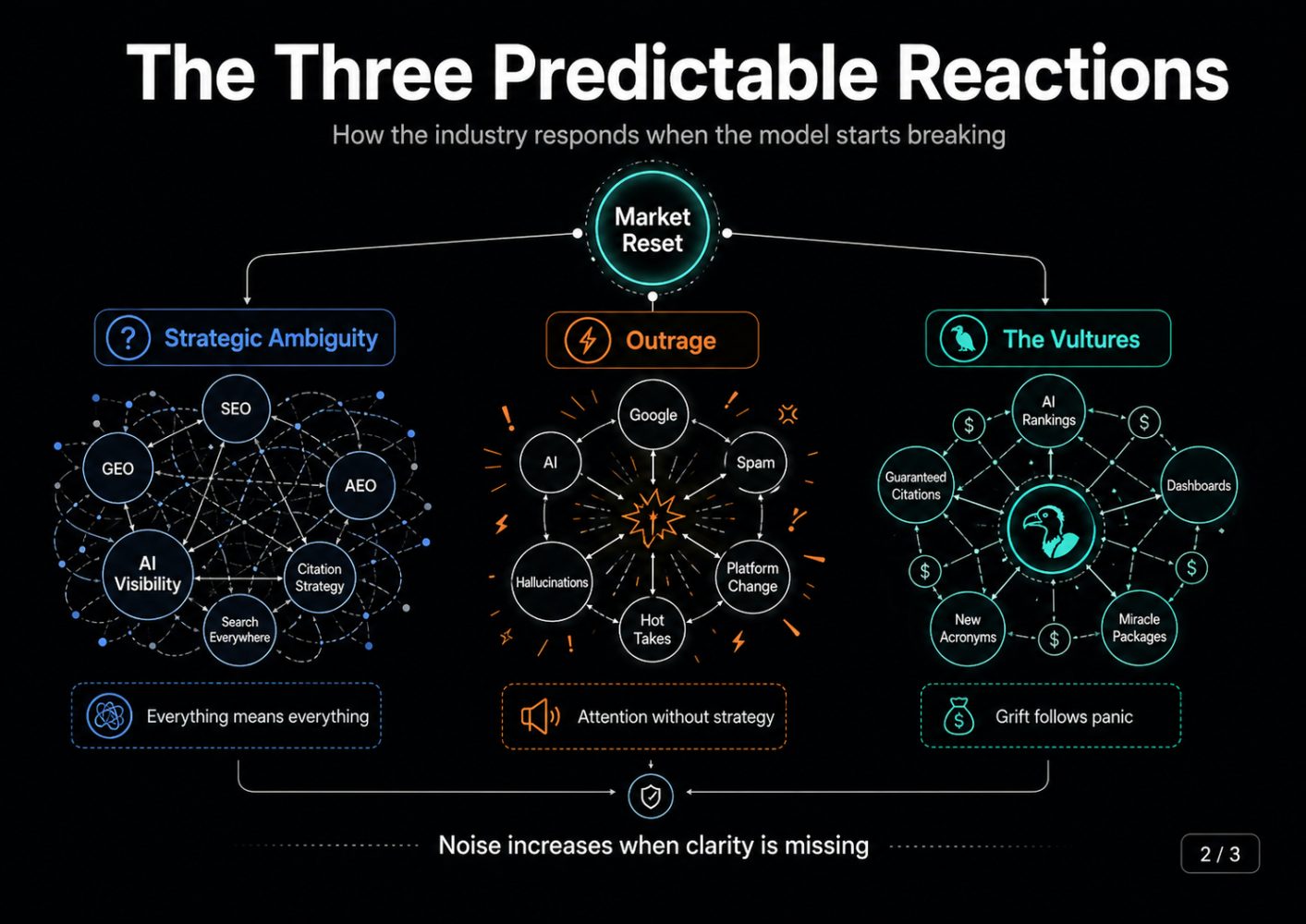
Before we get to what to do, we need to deal with what not to do. Because the SEO industry is already moving into three predictable defensive behaviours.
None of them will help.
Strategic Ambiguity
The first reaction is strategic ambiguity.
Strategic ambiguity is the deliberate use of language that lets everyone hear what they want to hear. Politicians use it. Consultants use it. SEO influencers are turning it into a business model.
When people do not really know what is happening, they widen the language. SEO becomes GEO. GEO becomes AEO. Then it becomes AI visibility, answer optimisation, entity optimisation, citation strategy, search everywhere optimisation and whatever other phrase is required to fill next week’s webinar.
The problem is not always the terms themselves. Some of the work beneath them may be useful. The problem is that the language is often used to avoid accountability.
Everything becomes SEO.
Content is SEO. PR is SEO. Links are SEO. Schema is SEO. Brand is SEO. Reddit is SEO. YouTube is SEO. Citations are SEO. At that point, SEO means everything and therefore nothing.
This is a survival tactic. If you define the work broadly enough, you can sell to everyone. If you describe the outcome vaguely enough, nobody can hold you to it.
That will not survive the reset.
The market will demand clearer answers.
What problem do you solve? For whom? Why does it matter? What changes commercially if you solve it? What do you do better than the alternatives? What do you not do?
Strategic ambiguity is what happens when a consultant knows just enough to sound intelligent, but not enough to be held accountable.
And accountability is exactly what comes next.
Outrage Porn
The second reaction is outrage.
There is outrage at Google. Outrage at AI. Outrage at ChatGPT. Outrage at spam. Outrage at black hats. Outrage at AI hallucinations. Outrage at anyone who says anything that threatens the old model.
Some of that anger will be justified. Google does not exist to protect SEO consultants. AI companies do not exist to preserve agency retainers. Platforms do what platforms have always done: serve their users, their economics and their shareholders.
That may be bad for publishers. It may be bad for brands. It may be bad for agencies that built their model on traffic that can now be intercepted.
But anger is not a strategy.
One of the weakest arguments you will hear is that AI gets things wrong. Of course it does. So do humans. So did half the content the SEO industry optimised for the last decade. The internet is full of human-made slop, affiliate sludge, copied summaries, fake expertise and 2,000-word articles written by someone who skimmed the top three ranking pages and had a deadline.
AI did not invent bad content.
It just made the problem more obvious.
Outrage will get attention. It will get comments. It will get shares from people who want a villain. But it will not help a client work out where their buyers are forming preferences or how their brand becomes visible there.
Outrage is strategy for people who have run out of strategy.
The Vultures
The third reaction is grift.
Every panic creates a market for miracle sellers. The SEO reset will be a banquet.
You will see people selling guaranteed AI rankings, ChatGPT visibility packages, citation hacks, GEO retainers, AI search domination and all the usual get-rich-or-lie-trying nonsense.
Some of these people will be stupid. Some will be cynical. Some will be very good at selling to desperate companies that over-indexed on organic search, paid search or both.
The tool companies will play their part too. If a funded startup builds a dashboard for AI citations, it needs the market to believe AI citations are the future. So it publishes reports, sponsors webinars, funds conferences, pays influencers, invents metrics and pushes the narrative that whatever it measures is now the thing that matters.
That does not mean all tools are useless. Some will be helpful. Some will show patterns worth understanding. Some will support better decisions.
But be careful.
The tool does not measure citations because citations matter. Citations matter because the tool needs something to measure.
A citation is not a customer. A mention is not demand. A dashboard is not strategy.
Do not confuse measurement theatre with commercial value.
We have seen this film before. The title was “Domain Authority”, and the sequel was shit.
Stop Selling SEO Activity And Start Selling Outcomes
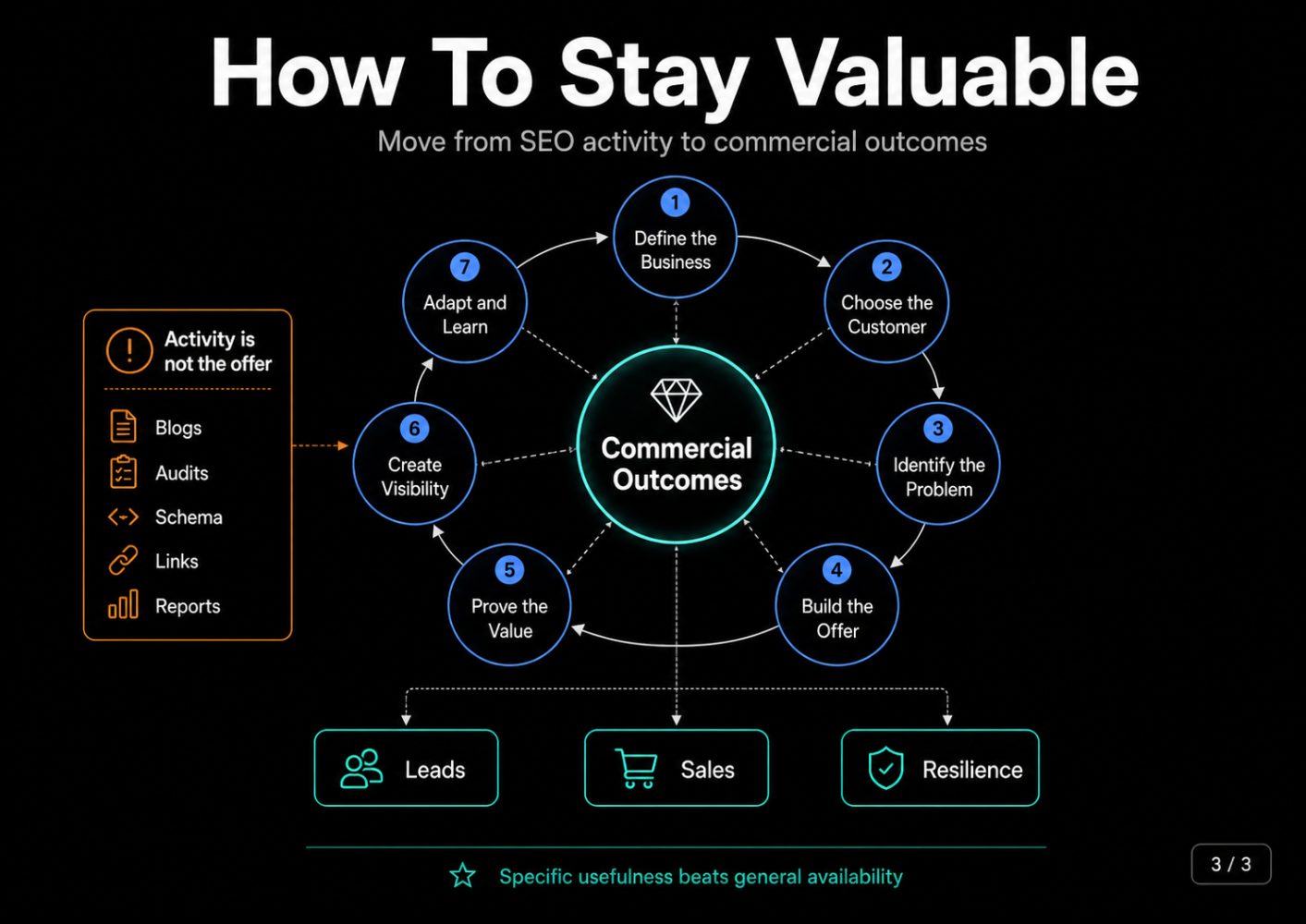
Now to the useful part.
The market will not stop buying help with search. It will stop buying vague SEO activity.
And yes, you need to understand this.
Clients do not really want SEO. They do not want GEO. They do not want PR. They do not want content. They do not want links. They do not want dashboards. Those are inputs, channels, tools or tactics.
Clients want outcomes.
They want more sales. More leads. Less wasted spend. More useful visibility. More confidence that buyers will find them. More resilience when Google changes. More evidence that what they are paying for is connected to commercial value.
That is where the reset starts.
If your offer is “we do SEO”, you are in a very crowded and increasingly commoditised place. You are standing next to agencies, freelancers, software platforms, AI tools, in-house teams and every newly minted GEO expert with a ring light.
You need to be clearer than that.
Not artificially clever. Just clearer.
If you are good at technical search, say that. If you are good at helping retailers work out why their products are not being found, say that. If you are good at helping B2B companies become visible, say that. If you are good at separating meaningful traffic loss from vanity traffic collapse, say that.
The reset rewards people who can describe the problem they solve in language a buyer recognises.
That means moving away from activity.
Five blog posts a month is activity.
A technical audit is activity.
Citation tracking is activity.
Schema implementation is activity.
Link-building is activity.
All of these things might be useful, but none of them is the reason a serious client hires you. They hire you because something commercially important is not happening and they believe you can help make it happen.
Their products are not being found.
Their paid search bill is too high.
Their organic traffic has collapsed and they do not know what matters.
Their brand is absent from the places buyers research.
Their site is full of content that costs money and creates no value.
Their competitors are being discovered before they are.
Their company is technically visible to Google but commercially invisible to the market.
That is the language of outcomes.
That is where the money will move.
Decide What Business You Are Really In
The first real strategic decision is deceptively simple.
What business are you in?
Most SEO consultants answer this badly because they answer with services.
“We do SEO, content and digital PR.”
That is not a business definition. That is an inventory list.
A useful business definition explains the customer problem you are especially well placed to solve. It should suit you better than it suits your competitors. It should reflect your strengths, your assets, your proof, your experience and the kind of work you can actually deliver better than the alternatives.
There is no universal answer.
A good definition for one consultant may be a disastrous definition for another. “AI search visibility” might make sense for a company with proprietary data, enterprise clients and genuine modelling capability. It is ridiculous for someone who reads three LinkedIn posts, bought a dashboard and now thinks they are leading a new discipline.
“Technical search engineering for e-commerce” might be too narrow for a content strategist, but perfect for someone who understands product feeds, faceted navigation, crawl waste, indexation and development teams.
“PR-led visibility” might be a strong business definition for someone with media relationships and a track record of building authority through third-party coverage. It is nonsense for an SEO agency that wants to rebadge link-building as brand.
The point is not to choose the fashionable lane. The point is to choose the lane where you have advantage.
Ask yourself what problems you understand better than most. Traffic loss? Product discoverability? B2B buyer journeys? Technical indexation? Local visibility? Content waste? Paid search dependency? Category authority?
Then ask what work you have repeatedly delivered well. Not what you wish you were known for. Not what looks hot this year. What have you actually done that created value, retained clients, produced referrals or made you unusually useful?
Look at your assets. Technical knowledge. Sector experience. Proprietary data. Relationships with journalists. Category expertise. Templates. Tools. Case studies. Research capability. A strong point of view. Access to a particular type of customer.
Then look at competitors. What are they all saying? Where are they weak? What are they overclaiming? What can they not prove? What are they selling because it is easy, not because it is valuable?
And then comes the part most people avoid.
What work should you stop doing?
Strategy is choice. Choice means sacrifice. If you keep selling everything because someone might buy it, you are not positioned. You are available.
And available is not valuable.
The SEO reset will punish general availability. It will reward specific usefulness.
Choose The Customers You Are Actually Going To Serve
Most SEO strategies start in the wrong place.
They start with keywords.
That was always dubious. Now it is dangerous.
Keywords are evidence of demand. They are not the definition of the market. If you start with keywords, you chase volume. If you start with customers, you chase value.
You need to choose which customers you are going to serve. That means making decisions about geography, segment, business model, urgency and fit.
Start with geography. Are you focused on the UK? The US? Europe? Australia? A specific region? Global enterprise? Local businesses? English-speaking markets? Regulated industries? Geography changes pricing, competition, media channels, buyer behaviour, legal constraints and sales cycles.
Then choose the segment.
SMEs or enterprise? Ecommerce or lead generation? B2B or B2C? Startups or mature brands? High-tech or low-tech? Companies with internal marketing teams or founder-led businesses? Brands with technical complexity or brands with awareness problems? Companies hit by traffic loss or companies quietly over-dependent on paid search?
These choices matter because a good customer is not simply someone with budget.
A good customer is someone who values what you can uniquely provide.
A bad-fit client buys your time, questions your value, compares you to cheap alternatives and demands miracles. A good-fit client understands the problem, values your method, gives you access, accepts trade-offs and can measure the outcome.
A good customer is not someone with a website and a pulse.
A good customer is someone whose problem fits your advantage better than it fits your competitor’s pitch.
The reset will create new attractive customers. Some companies that were previously comfortable will suddenly become urgent because their traffic is falling, paid search costs are rising or AI search is intercepting the content layer they depended on. Some clients you may have ignored before will become valuable because their visibility problem is now painful enough to pay for.
But you still have to choose.
If you are an organic revenue recovery consultant, a startup with no historic traffic is not your customer.
If you are a search infrastructure specialist, a founder who wants “a few blogs for SEO” is not your customer.
If you are a B2B visibility strategist, a retailer with broken feeds and 40,000 badly indexed products may not be your customer.
Say no faster.
That is not arrogance. It is strategy.
“Anyone with a website” is not a market. It is a cry for help.
Build Offers Around The Problem, Not The Deliverable
This is where many agencies will either survive or collapse.
An offer is not a list of deliverables.
An offer is a way of solving a customer problem.
Old SEO offers were often built around deliverables because deliverables are easy to package and invoice. Five blogs per month. Ten links. One technical audit. A keyword map. A content calendar. Schema implementation. A monthly report.
Again, some of these things may be useful. But they are not the offer. They are ingredients.
A better offer starts with the problem the customer already feels.
A company hit by traffic loss does not need a generic SEO retainer. It needs to know what happened, what revenue is at risk, which lost traffic mattered, which traffic was worthless, what can be recovered and where visibility needs to be rebuilt.
That is a very different offer.
A retailer whose products are not being found does not need “SEO content”. It needs to understand whether the issue sits in product feeds, category pages, crawlability, internal search, structured data, marketplace presence, product copy, reviews or paid dependency.
A B2B company that is absent from buyer shortlists does not need another article about “what is workflow automation?” It needs to know where buyers form opinions, which competitors appear there, what proof is missing, what media or communities matter, and whether its own website actually says anything useful.
A business sitting on 800 old blog posts does not need a content calendar. It may need half of them deleted, 50 consolidated, 20 turned into useful assets and the rest quietly buried with the agency invoices that created them.
This is the difference between selling activity and selling judgment.
Activity says: here is what we will do each month.
Judgment says: here is what matters, here is what does not, here is what to fix first, and here is why.
In the AI era, activity is cheap. Judgment is expensive.
That does not mean you stop delivering things. Of course there will be audits, content, technical fixes, PR, links, feeds, reports and implementation plans. But they should sit beneath a defined commercial problem.
The more specific the problem, the stronger the offer.
Traffic has collapsed and leadership needs clarity.
Products are invisible in the places buyers shop.
Paid search is carrying too much of the business.
The brand is missing from the places buyers compare suppliers.
The site has too much content and too little value.
Technical problems are stopping important pages being discovered.
Those are problems a client can recognise.
“Monthly SEO” is not.
Work Out Your Real Value
Once you have chosen the business, the customer and the problem, the next question is brutal.
Why should anyone believe you?
Not like you. Not follow you. Not applaud your posts.
Believe you.
Why should a customer trust you to solve this problem better than the alternatives?
Your value might come from technical depth. You can solve complex infrastructure problems that generalists cannot. It might come from sector knowledge. You understand a category, its buyers, its language and its decision process. It might come from commercial clarity. You can connect search work to revenue, pipeline, margin or reduced dependency.
It might come from relationships. You know the media, communities, events or networks that shape visibility in a category. It might come from data. You have benchmarks, patterns, analysis or diagnostic ability others do not. It might come from speed. You can identify the important issue quickly and stop clients wasting months on nonsense.
And increasingly, it will come from judgment.
Judgment is knowing which traffic loss matters and which does not. Judgment is knowing when not to create content. Judgment is knowing when the issue is technical, when it is brand, when it is PR, when it is conversion, and when the client simply has a weak proposition that no amount of optimisation can polish.
That last one is important.
A lot of SEO people have spent years trying to optimise around weak brands, weak products, weak offers and weak websites. The reset makes that harder. If the brand is not trusted, not known, not distinctive and not useful, visibility becomes harder to manufacture with tactical tricks.
Your proof must support your value.
Case studies. Before-and-after examples. Technical fixes and their impact. Content reduction results. Product discoverability improvements. Reduced paid search dependency. Branded search growth. Lead quality improvements. Client quotes. Category reports. Teardowns. Diagnostic frameworks. Commercial analysis.
Do not just claim expertise. Show how you think.
This matters because your competition is not only another consultant.
Your competition is a funded tool company trying to turn its dashboard into the definition of the market. It is an influencer selling a paid community. It is an internal team with AI tools. It is a PR agency claiming it can solve search visibility. It is a cheap freelancer. It is the client doing nothing. It is the client believing AI can handle the whole thing now.
You will not out-shout all of them.
You can out-position them.
But only if your value is clearer, more credible and more connected to a customer problem than theirs.
The question is not “what do we sell?”
The question is “what must the customer believe before they choose us?”
Then build your proof around that belief.
Make Yourself Visible To The Customers You Chose
Here is the slightly embarrassing bit for many SEO consultants.
You now have to do for yourself what you have been telling clients to do for years.
You have to become visible.
Not generally visible. Not visible to other SEOs. Not visible to a crowd of people who enjoy arguing about Google updates but will never buy anything from you.
Visible to the customers you chose, for the problem you solve.
That requires repetition, directness and a lot less passive posting.
If LinkedIn reach is down, fine. If Twitter is not what it was, fine. If search is changing, fine. Welcome to marketing. You do not get to complain that the channels are harder while advising clients to become more visible in harder channels.
Start by talking repeatedly about the problem you want to own.
If you help ecommerce brands with product discoverability, talk about product feeds, category pages, marketplace visibility, AI-assisted shopping, technical barriers, product data, internal search and revenue leakage. Show examples. Explain mistakes. Create diagnostics. Talk to ecommerce leaders. Publish small studies. Build material that a retailer would actually find useful.
If you help B2B companies with buyer visibility, talk about shortlists, review sites, analyst content, LinkedIn influence, sales conversations, category entry points, comparison pages, competitor presence and the places where buying committees build confidence.
Do not keep changing the subject because you are bored.
Your audience has not even noticed yet.
Most consultants get tired of their own positioning long before the market has absorbed it. That is why they remain vague. They mistake their own boredom for market saturation.
Create something useful. A report, a teardown, a checklist, a guide, a diagnostic, a small study, a benchmark, a point of view with evidence behind it. Not a lead magnet full of obvious filler. Something useful enough that the right person would forward it to a colleague.
Then distribute it directly.
Send it to ideal prospects. Ask for conversations. Offer a specific observation. Speak where your customers gather. Attend events. Run small roundtables. Build relationships. Ask better questions. Stop waiting for the algorithm to bless you.
This is old-school selling.
Good.
Old-school selling works.
And be clear about what you do not do.
We do not sell blog packages.
We do not guarantee AI citations.
We do not chase vanity traffic.
We do not optimise content that should not exist.
We do not report traffic as if it were revenue.
We do not work with every sector.
This will repel some people.
Excellent.
That is the point.
Telling people what you do not do is often the fastest way to make them believe what you do.
Experiment, Learn And Modify
The search landscape is going to keep changing. Google will change formats. AI Mode may expand. ChatGPT will release new features. Claude will change. Perplexity will push harder. Shopping results will evolve. Review surfaces may become more important. Communities may matter more. Some AI visibility metrics will prove useful. Others will be exposed as horseshit.
So you need to keep learning.
But learning is not the same as changing your entire identity every five minutes.
You need stable strategy and adaptive tactics.
The stable part is the business you are in, the customer you serve, the problem you solve and the value you provide.
The adaptive part is how you deliver it as the market shifts.
Review what buyers are asking. Watch where discovery is moving. Look at which traffic still converts. Identify which traffic is declining but never mattered. Pay attention to which competitors are becoming more visible and why. Test which offers create conversations. Drop services that are hard to prove. Improve proof where buyers hesitate. Adjust your delivery as the evidence changes.
But do not pivot every time someone posts a scary screenshot from a Google test.
That is not agility. That is professional attention deficit disorder.
The people who survive will not be the ones who pretend they predicted every change. They will be the ones who can learn faster without losing strategic shape.
That is a harder skill than posting “SEO is evolving” every six weeks.
But it is also much more useful.
What Clients Should Do Now
Clients need to stop asking only one question.
“How do we get more SEO traffic?”
It is too narrow. It encourages the wrong behaviour. It sends agencies back into the old machine of keywords, content volume and ranking reports.
The better question is:
“Are we visible where buyers from and make decisions?”
That question changes the brief.
It forces you to look beyond Google traffic. It forces you to examine PR, reviews, product pages, website copy, distinctive assets, events, research, communities, partnerships, direct demand, sales feedback and brand awareness.
It forces you to ask whether people know you before they search. Whether they trust you when they compare. Whether you appear in the places they ask for advice. Whether your product pages persuade. Whether your reviews support you. Whether your brand is mentioned by other credible sources. Whether your content actually helps or simply exists because an agency once sold you “topical authority”.
It also forces you to face what you have over-indexed on.
Some brands have relied too heavily on organic traffic. Others have relied too heavily on paid search. Many have underinvested in brand, PR, distinctive assets, events, studies, product pages, expert commentary and direct relationships.
If you spent five years polishing blog posts while underinvesting in being known, the reset will feel unfair.
It is not unfair.
It is compound interest in reverse.
Strong brands will not be immune to search change. But they will be more resilient because buyers already know them, trust them, search for them by name and encounter them in more than one place.
That is what visibility does.
The Final Lesson
The SEO reset is coming.
Not because search no longer matters, but because being found now matters too much to be left to vague retainers, glossary factories, citation dashboards and strategically ambiguous consultants.
The old model was comfortable. Rank pages. Produce content. Report traffic. Blame Google when things got weird.
The new model is harder.
Understand the customer. Choose the market. Define the problem. Build visibility. Prove value. Adapt constantly. Be specific. Be useful. Be commercially accountable.
That is not an algorithm trick.
That is marketing.
Funny how the fundamentals always come back to bite the people who ignored them.
The tactic will change.
The job will not.
Make the brand visible. Make it trusted. Make it chosen.
Rankings are rented. Visibility compounds.
Start there.
Andrew Holland