AI search is not making links less important. It is making the right kind of links, mentions and external visibility more important than they have been for years.
Not because links are magic. Not because some third-party tool says a domain is a 62. And certainly not because a guest post on a dead blog about “10 reasons to hire a dentist in Birmingham” is suddenly going to become a strategic asset.
Links matter because the web is a network.
Brands grow inside networks. Authority is inferred from networks. Search engines and AI systems need evidence from networks. And links, citations, mentions, conversations and creator references are the visible connections that show where a brand sits inside that network.
That is why link building is about to become the most valuable skill in search.
Not the old spreadsheet version. The real version. The hard version.
The version that makes a brand meaningfully visible, where humans and machines can encounter it.
In this article, I explain why, as well as giving you some link-building tips for the future.
We Turned Links Into Spreadsheet Litter
Links were not always the grubby little commodity they became.
In the early web, a link was a recommendation.
One person found something useful, interesting, funny, authoritative or strange and pointed to it. That was the whole deal. A link was a doorway. It said: go here, this is worth your time.
That is why links became so powerful in search. PageRank was built on a simple but profound idea: important pages tend to be linked to by other important pages. It was a model of popularity, trust and citation.
Then SEO arrived with its usual gift for ruining anything useful.
Links became DA, DR, anchor text, dofollow, nofollow, guest post packages, insertion fees, monthly KPIs and procurement spreadsheets. The industry stopped asking whether a link meant anything and started asking whether it counted.
That was the mistake.
Because once links became units, they became detached from visibility.
You could buy a link on a website nobody read, in an article nobody saw, surrounded by other articles nobody believed, and still call it link building. You could point to a report and say: “We built 12 links this month.”
No you didn’t. You bought 12 pieces of digital litter.
The problem was never links. The problem was that the industry turned links from signs of market activity into fake tokens of SEO activity.
AI search is going to expose that distinction very quickly.
A Link Is Not Just a Link. It Is a Connection in a Network
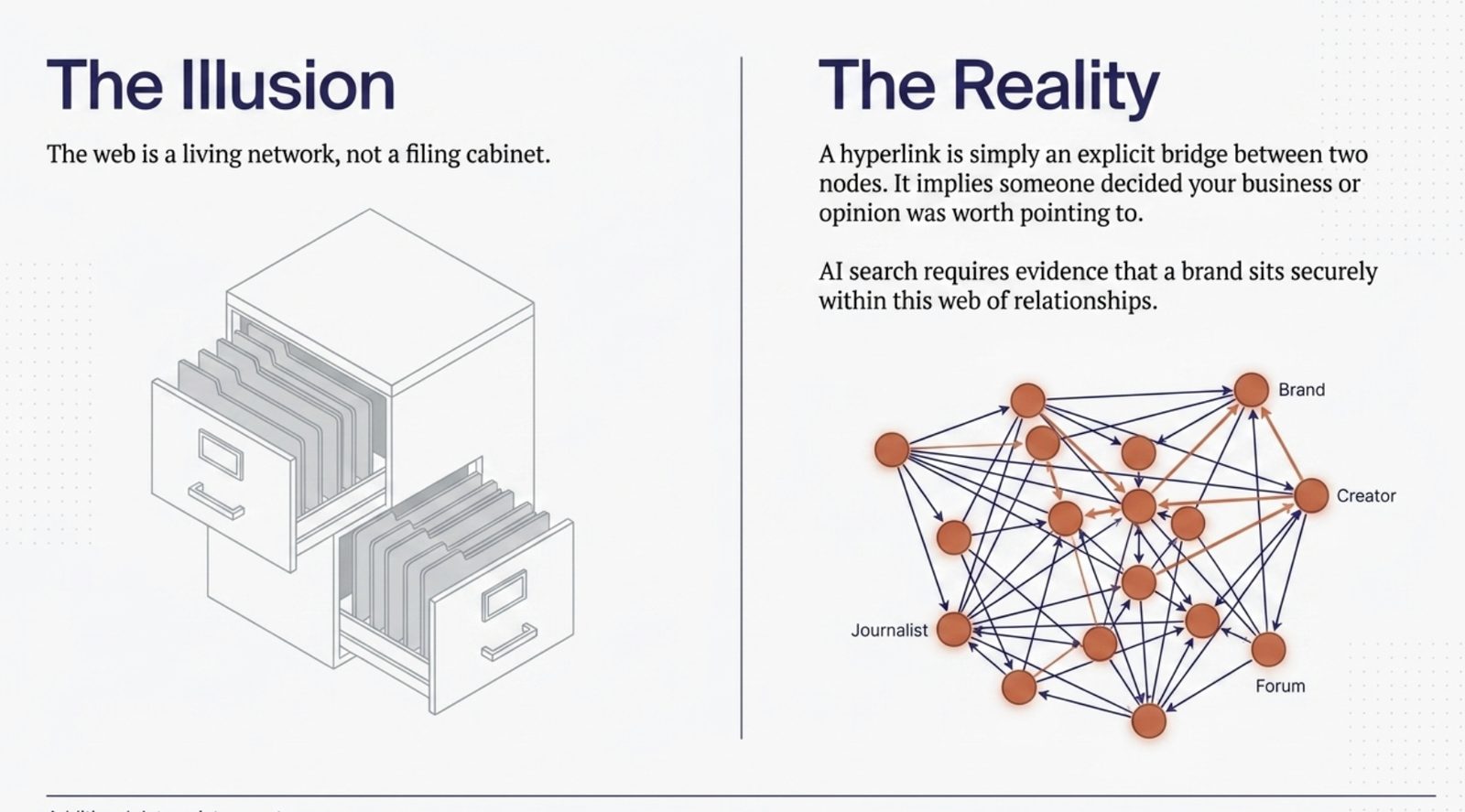
To understand why links work, you have to stop thinking of the web as a pile of pages.
It is not a filing cabinet. It is a network.
There are nodes: brands, people, publishers, creators, journalists, communities, forums, directories, newsletters, social profiles, podcasts, events, trade bodies, review sites and websites.
And there are connections between those nodes: hyperlinks, citations, unlinked mentions, quotes, reviews, list inclusions, podcast references, video transcripts, social posts, forum discussions, recommendations, comparisons and directory listings.
That is the real web.
A hyperlink is one of the clearest connections because it is explicit. Someone has physically created a bridge from one place to another. That action has meaning. It tells a human, a crawler or a model: this thing is related to that thing. Go there. Look at it. Use it. Trust it enough to reference it.
That is why naturally earned links remain so powerful. They require action. They cost a tiny bit of effort. They imply that someone, somewhere, decided your business, data, opinion, product or page was worth pointing to.
But the old SEO obsession with the blue clickable bit is now too narrow.
Natural language processing has changed how authority is understood.
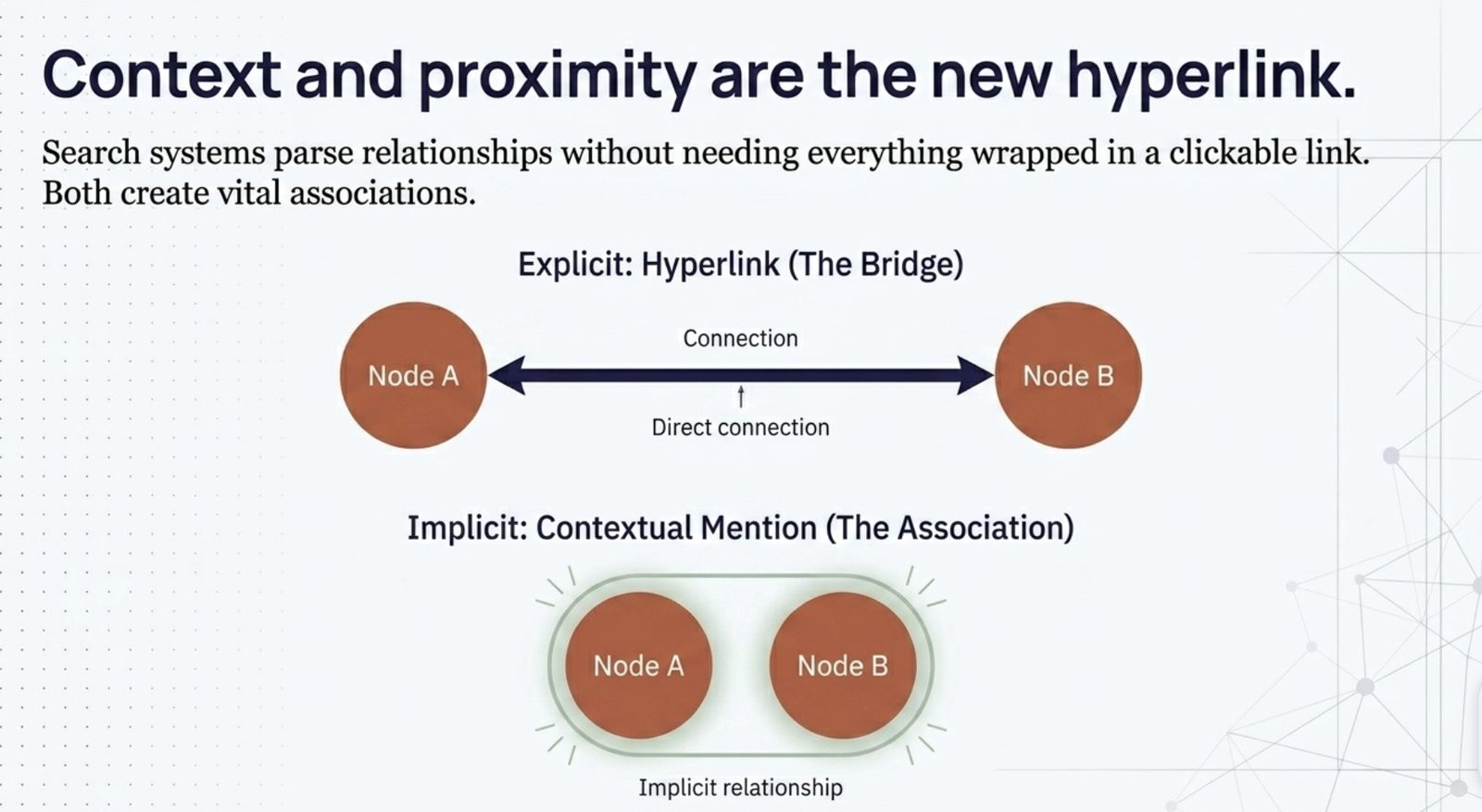
Search systems have been parsing text, entities, sources, topics and relationships for a long time. They do not need every brand reference to be wrapped in a hyperlink to understand that your company is being discussed in relation to a topic, category, location, problem or competitor set.
That means a linked mention matters. But so does an unlinked mention, when it appears in the right context.
A brand mentioned in a trade publication. A founder quoted in a relevant article. A product discussed in a Reddit thread. A company named in a podcast transcript. A consultancy included in a local business directory. A creator talking about a tool on YouTube. A newsletter referencing your research. A resource page listing you beside credible alternatives.
These are all connections.
Some create doorways. Some create associations. The best do both.
The hyperlink still matters. But the text around the hyperlink, the source carrying the mention, the category context and the visibility of the encounter now matter just as much.
Authority Is Built Through Repeated, Meaningful Association
This is where most SEO people get links wrong.
They think authority is a score.
It is not.
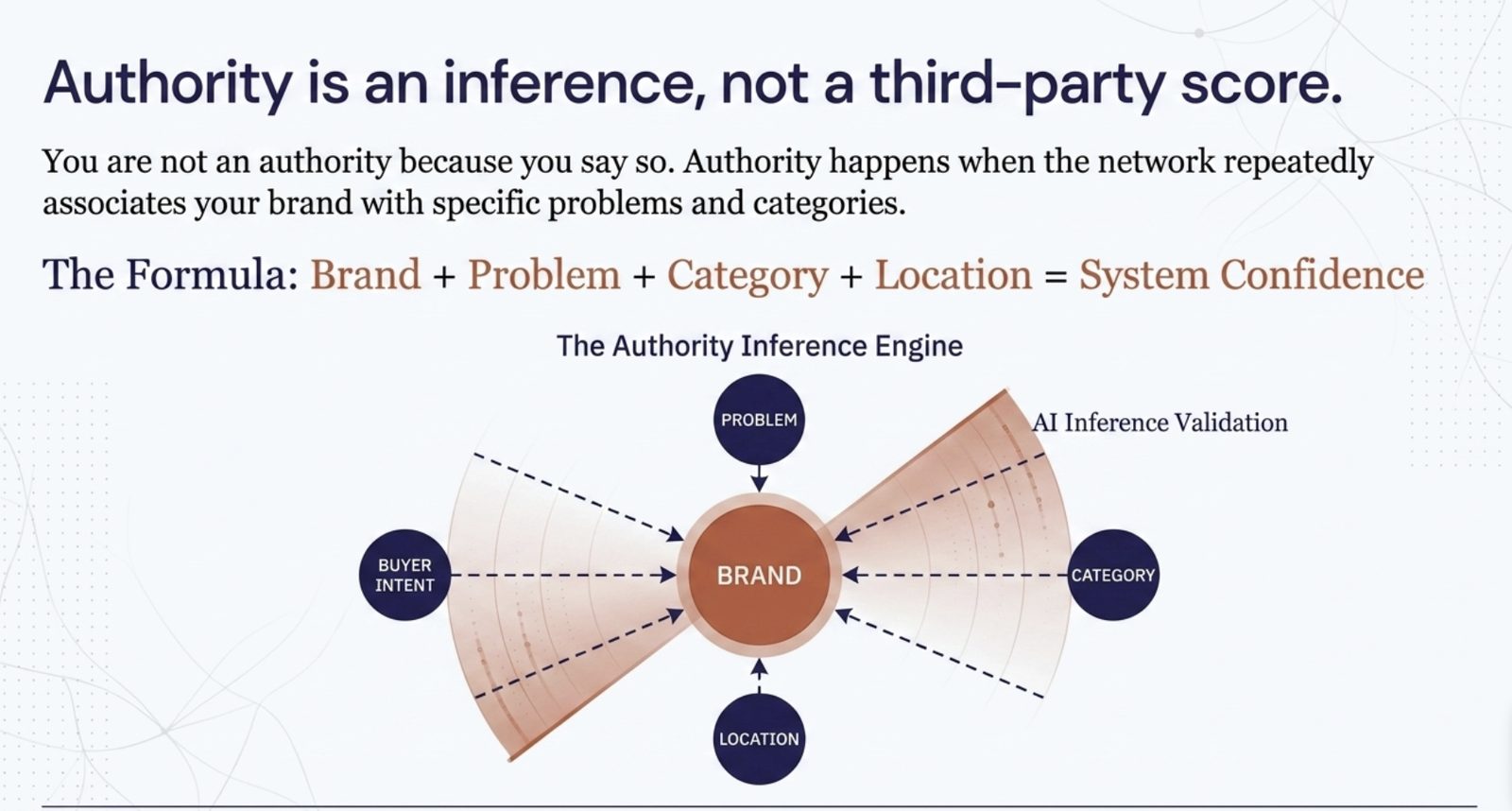
Authority is an inference.
It is what a system, a buyer or a market starts to believe when the same brand keeps appearing in the right places, around the right topics, from the right sources, often enough to become credible.
You do not become authoritative because your website says you are an authority. Every website says that. Every SaaS company is “revolutionary”. Every agency is “award-winning”. Every consultant has a “proven framework”. Every founder is “on a mission”. It is mostly bollocks.
You become authoritative when the network around you starts confirming the same thing.
Other people mention you. Other sources cite you. Other publishers list you. Other creators discuss you. Other buyers search for you. Other communities ask about you. Other websites link to you. Other pages associate your brand with the problem you claim to solve.
That is the authority model that matters in an AI era.
It is not just PageRank in the old sense. And it is not just content volume in the new SEO nonsense sense. It is repeated, meaningful, contextual association across the network.
Brand plus problem.
Brand plus category.
Brand plus location.
Brand plus buyer intent.
That is how systems build confidence. That is how humans build confidence too.
You hear about a company once and ignore it. You see it again in a newsletter. Then in a trade publication. Then in a creator’s video. Then in a “best tools” list. Then someone mentions it in a forum. Then you search for it by name.
That is not a funnel. It is diffusion.
And links are one of the most visible residues of that diffusion.
Links Are a Proxy for Brand Growth
A good link is rarely just a ranking input. It is residue from market behaviour.
When people link to a brand, something has usually happened. Someone discovered it. Used it. Respected it. Quoted it. Argued with it. Needed it as a source. Wanted their audience to see it. Wanted to support a claim. Wanted to make a recommendation.
That is why links are so interesting. They are not only technical signals. They are behavioural traces.
The same is true of branded search. When more people search for your brand, the market is moving. When more people mention your brand, the market is moving. When more people link to your brand, the market is moving.
The link is not the whole signal. The activity that produced the link is the signal.
That is why a link from a site with a real audience is so different from a link from a dead guest-post farm. One came from visibility. The other came from procurement.
And this is why the economics of link building went wrong.
Real visibility is hard to create. It requires an audience, an angle, a relationship, a reason, a story, a source or a useful thing worth citing. It takes time. It takes thought. It often takes money.
A synthetic guest post is easier. Cheaper. More scalable. Easier to report.
So the industry chose the easy thing.
It always does.
But AI search pushes us back toward the hard thing because AI systems need evidence that looks more like real-world visibility and less like synthetic SEO theatre.
A link nobody sees, from a source nobody trusts, in content nobody reads, is not evidence of authority. It is evidence of desperation.
Barabási and the Brutal Economics of Visibility
In my Brighton SEO talk last week, I introduced Albert-László Barabási’s work on networks, as it gives us a much better way to understand links than most SEO conference talks.
Barabasi’s team mapped the internet in 1998 and it here it is:
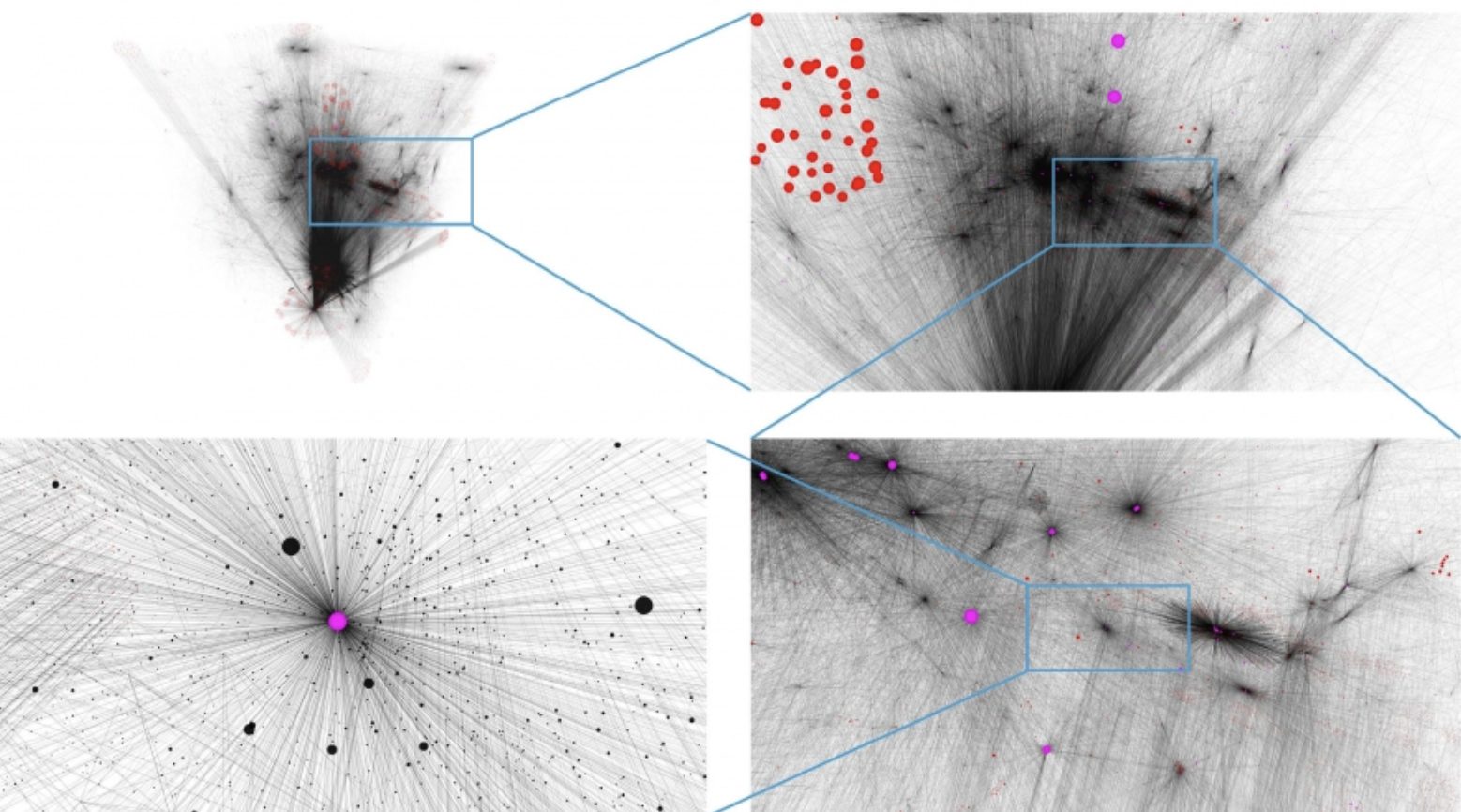
Barabasi discovered that in networks, connections compound. Nodes with more links are more likely to receive more links. The visible become more visible. The connected become more connected. The rich get richer.
This is called preferential attachment.
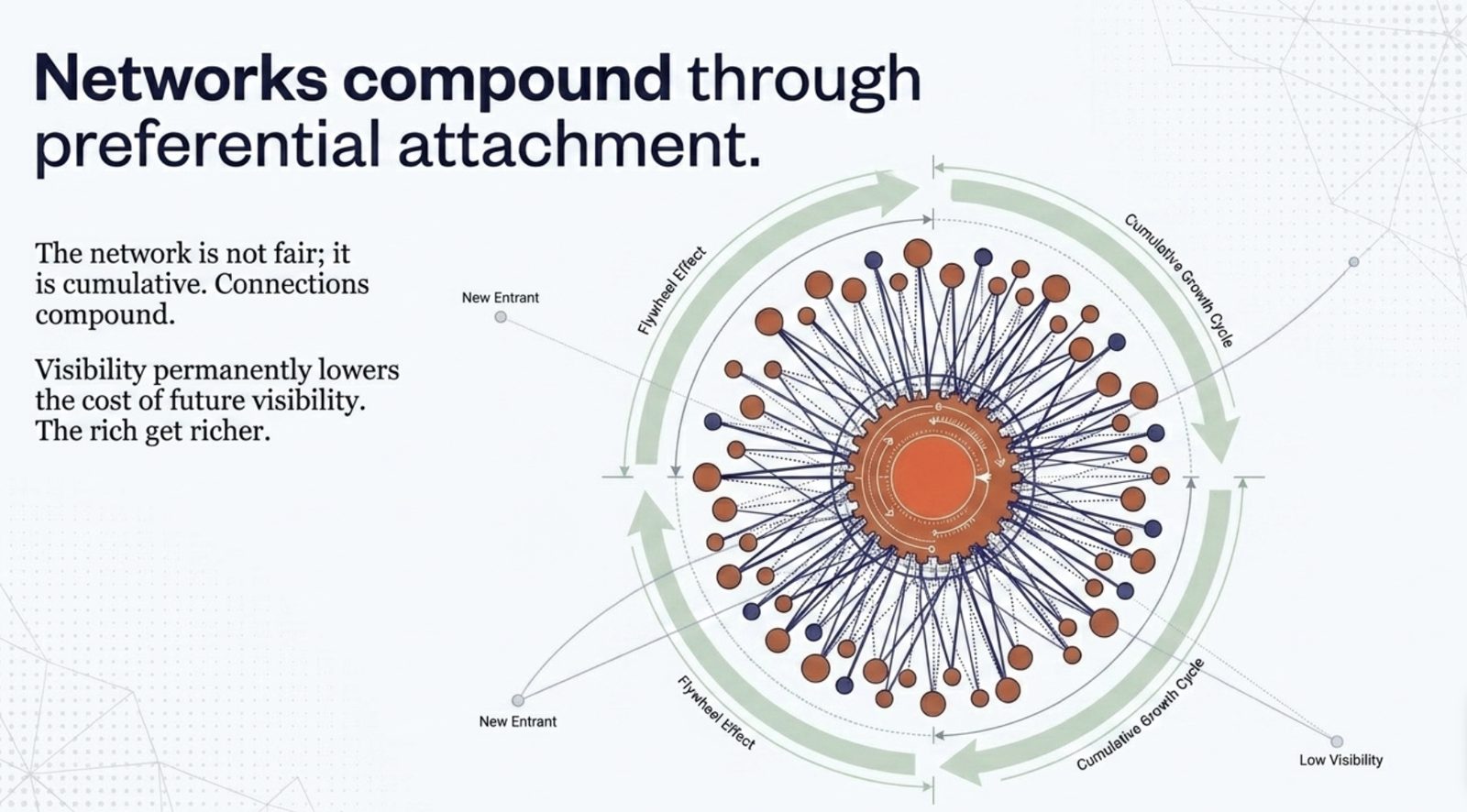
It explains why famous scientists get cited more. Why major publishers attract more references. Why creators with large audiences get more opportunities. Why big brands appear in more listicles. Why dominant products are easier to recommend. Why the same names show up again and again when people discuss a category.
The network is not fair. It is cumulative.
That is the brutal economic reality of visibility.
If you are already known, every new mention is easier. Journalists recognise your name. Creators know your product. Customers search for you directly. AI systems encounter you in more places. Publishers include you in lists because you are already part of the category. Other websites link to you because other websites already have.
Visibility lowers the cost of future visibility.
That is the compounding magic everyone wants.
But new brands have the opposite problem. They have no connections. No mentions. No citations. No creator references. No branded search. No directory footprint. No reviews. No reason for anyone, human or machine, to believe they matter.
Nobody links to you because nobody knows you. Nobody knows you because nobody links to you.
That is the cold-start problem.
And this is where link building becomes economically important. It is the work of creating the first connections before the network has any reason to give them to you naturally.
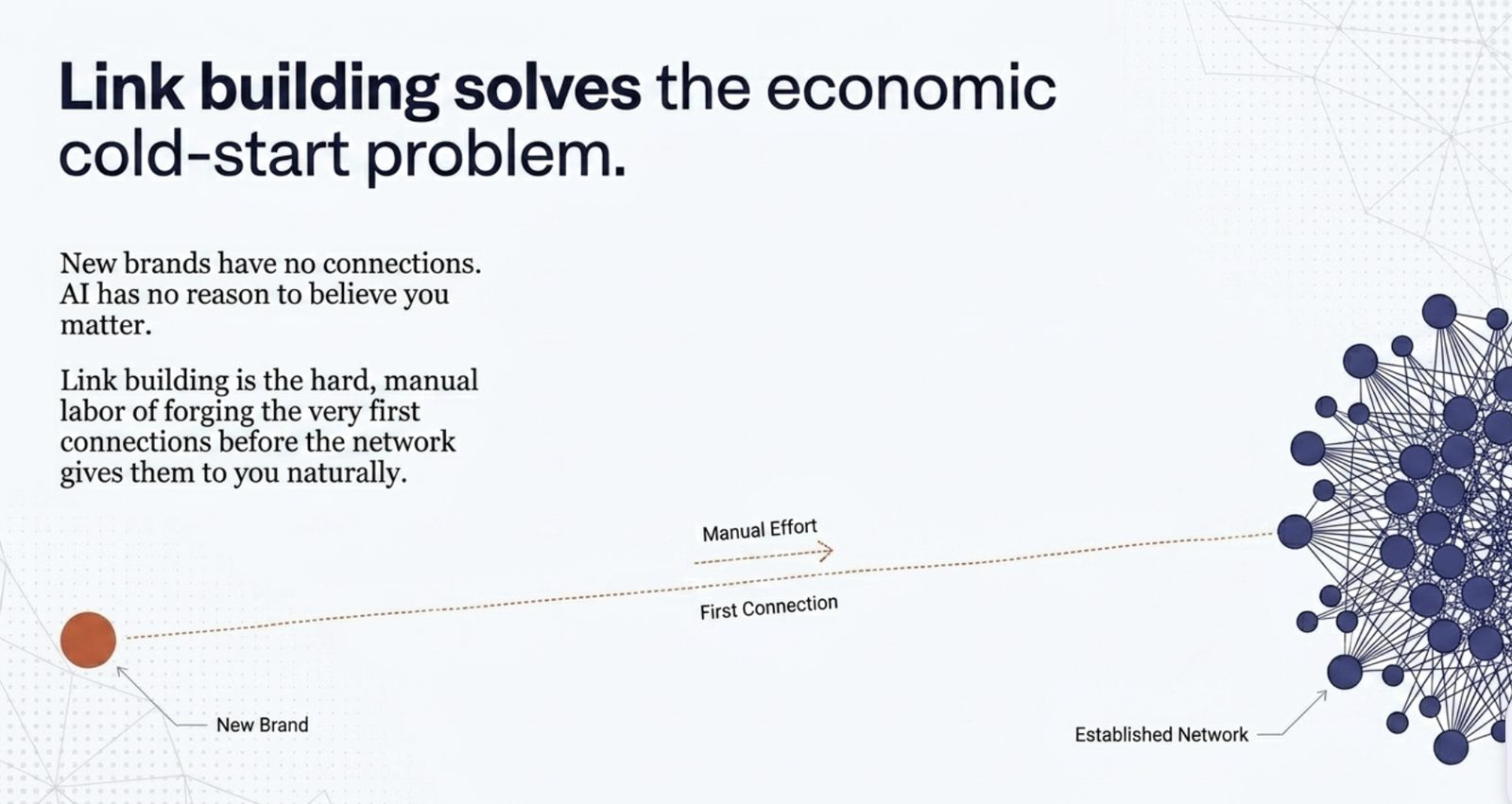
You build the first nodes manually. One at a time. Painfully. Repeatedly.
That is not glamorous. It is not a hack. It is not a secret. It is work.
But it is how visibility begins.
Social Diffusion Is the Game
Search people love to pretend search exists in a box.
It does not.
People discover things through other people.
They hear about brands in conversations, videos, newsletters, podcasts, private communities, events, social posts, Slack groups, Reddit threads, WhatsApp messages, reviews and recommendations. Then some of them search. Some click. Some mention. Some link. Some share. Some buy.
That is social diffusion.
And AI search does not remove it. AI search feeds on it.
If a creator talks about your product in a YouTube video, that can become a transcript. If a newsletter discusses your research, that can become a cited source. If a forum thread compares your service to competitors, that can become part of the language around your brand. If an influencer writes a review on their own site, that can create both a link and a narrative. If a podcast mentions your framework, that can associate your name with a specific problem. And if a journalist writes about your brand or mentions you.
This is why creators and influencers may become the future of the guest posting industry.
Not because every influencer is useful. Many are professional attention landlords with ring lights and an allergy to substance. But the good ones have something most guest-post sites lost a long time ago.
An audience.
That audience is the point.
A creator with a trusted niche following can introduce your brand into a real conversation.
Their website, newsletter, video, podcast or social profile can create mentions that travel. Their audience can search, discuss, share, compare and link. The mention can become a doorway. The doorway can become a signal. The signal can become another node in the network.
That is very different from buying a guest post on a blog built solely to sell guest posts.
The old guest post industry sold placement. The new visibility industry will sell encounter.
And encounter is much more valuable.
The Helpful Content Update Changed the Economics
There is another awkward part of this story.
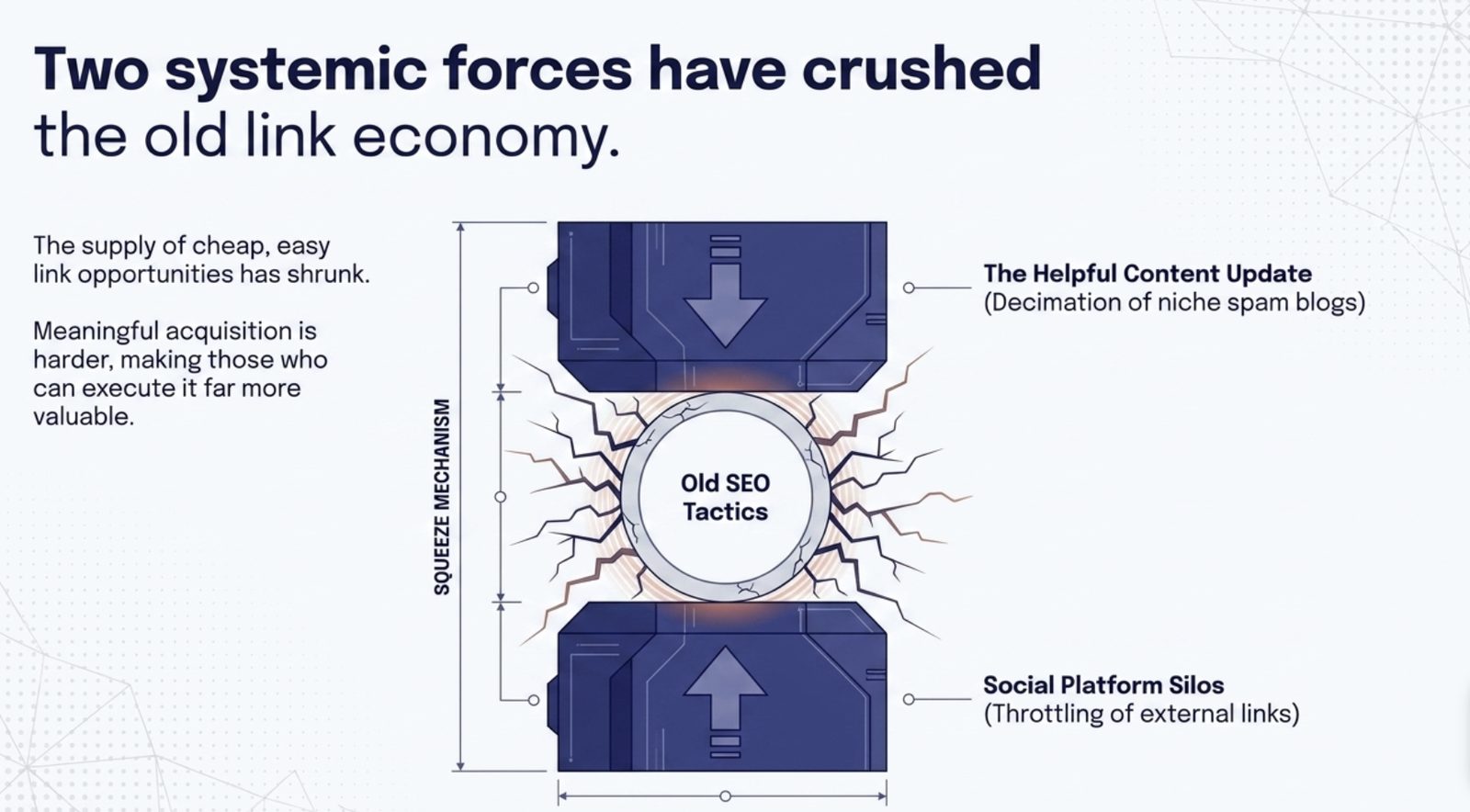
The supply of easy link opportunities has shrunk.
Google’s Helpful Content Update and the wider assault on low-quality content did not just hurt spammy SEO blogs. It also damaged many genuine independent sites that had built real audiences from search. Small publishers, hobby bloggers, niche reviewers, local operators and industry writers saw traffic collapse.
Some of those sites deserved it. Many did not.
But the effect is obvious. The old ecosystem of independent blogs, small publishers and niche sites that once provided traffic, feedback, community and link opportunities is weaker than it used to be.
That changes the economics of link building.
There are fewer decent independent blogs with reliable search traffic. There are fewer easy places to pitch. There are fewer webmasters casually linking out because they are building a useful resource for their audience. There are fewer communities where a good article naturally travels from blog to blog.
At the same time, social platforms have strangled outbound links. LinkedIn does not want people leaving LinkedIn. X does not want people leaving X. Facebook has treated external reach like a contagious disease for years. Platforms want native content because native content keeps attention inside the platform.
So the old link path is harder.
You cannot simply publish a great asset, get a few people to share it, and expect the web to carry it for you. That world is not gone completely, but it is weaker, more fragmented and more expensive.
Which means link acquisition gets harder.
And when something gets harder, the people who can still do it get more valuable.
Old-School Link Building Comes Back, But Different
This is the funny bit.
A lot of what will work in AI search looks suspiciously like link building from 2015.
Expert roundups. Original research. Data studies. Resource guides. Useful tools. Founder commentary. Industry rankings. Local PR. Trade publication pitching. Podcast appearances. Digital PR. Statistics pages. Contrarian essays. Named frameworks. Partnerships. Directories. Associations. Events. Creator outreach.
The tactics are not new. The context is.
Back then, many of these tactics existed to earn hyperlinks that improved rankings. Now they exist to create meaningful visibility across a network that both humans and AI systems can encounter.
That distinction matters.
An expert roundup published on your blog and shared once on LinkedIn is probably not enough anymore.
Organic reach is strangled. External links do not travel as easily. But the idea behind the roundup still works: associate your brand with credible people, create a reason for participation, generate social proof, and produce a piece of content that can travel through the participants’ networks.
The execution just has to change.
It might need a native LinkedIn version. A Substack edition. A YouTube discussion. A podcast episode. Short clips. Creator involvement. A data angle. Paid distribution. Journalist pitching. Inclusion in newsletters. A reason for someone outside your own team to care.
The asset is not the article. The asset is the set of encounters it creates.
That is the future of link building.
Foundational Links Make You Real
Let’s make this practical.
Imagine you have just launched an AI consultancy in Stoke-on-Trent. Call it AI Growth Systems Limited.
You have a website, a logo, a couple of service pages and, with luck, a founder who has not yet described himself as a “visionary”.
Now what?
The first job is foundation.
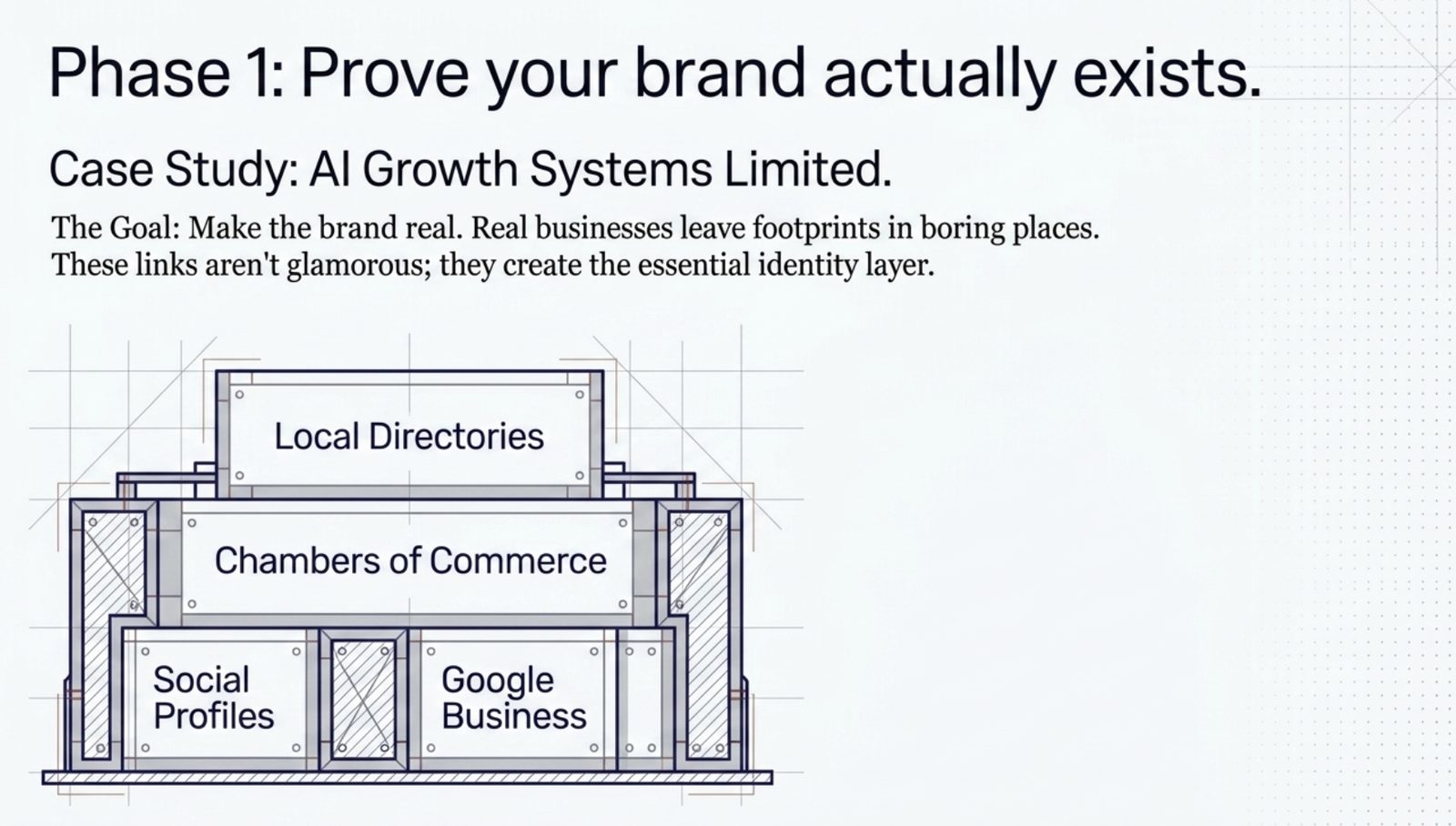
Claim the social profiles. Set up the Google Business Profile. Build the basic business listings. Join the Chamber of Commerce. Get listed in local business directories. Create founder profiles. Join relevant associations. Appear on legitimate industry directories. Make sure the name, category, location and basic business facts are consistent across the web.
This will not make you famous.
It will make you real.
And that matters. Real businesses leave footprints. They appear in boring places. They have profiles, listings, memberships, addresses, directors, reviews, social handles and local references. Foundational links are not powerful because they are glamorous. They are powerful because they create the first identity layer.
The first question for any new brand is not “how do we dominate AI search?”
Calm down.
The first question is: “does the network have enough evidence that we exist?”
Then You Build Meaningful Nodes
Once the foundation exists, the real work begins.
You need to build meaningful nodes in the network.
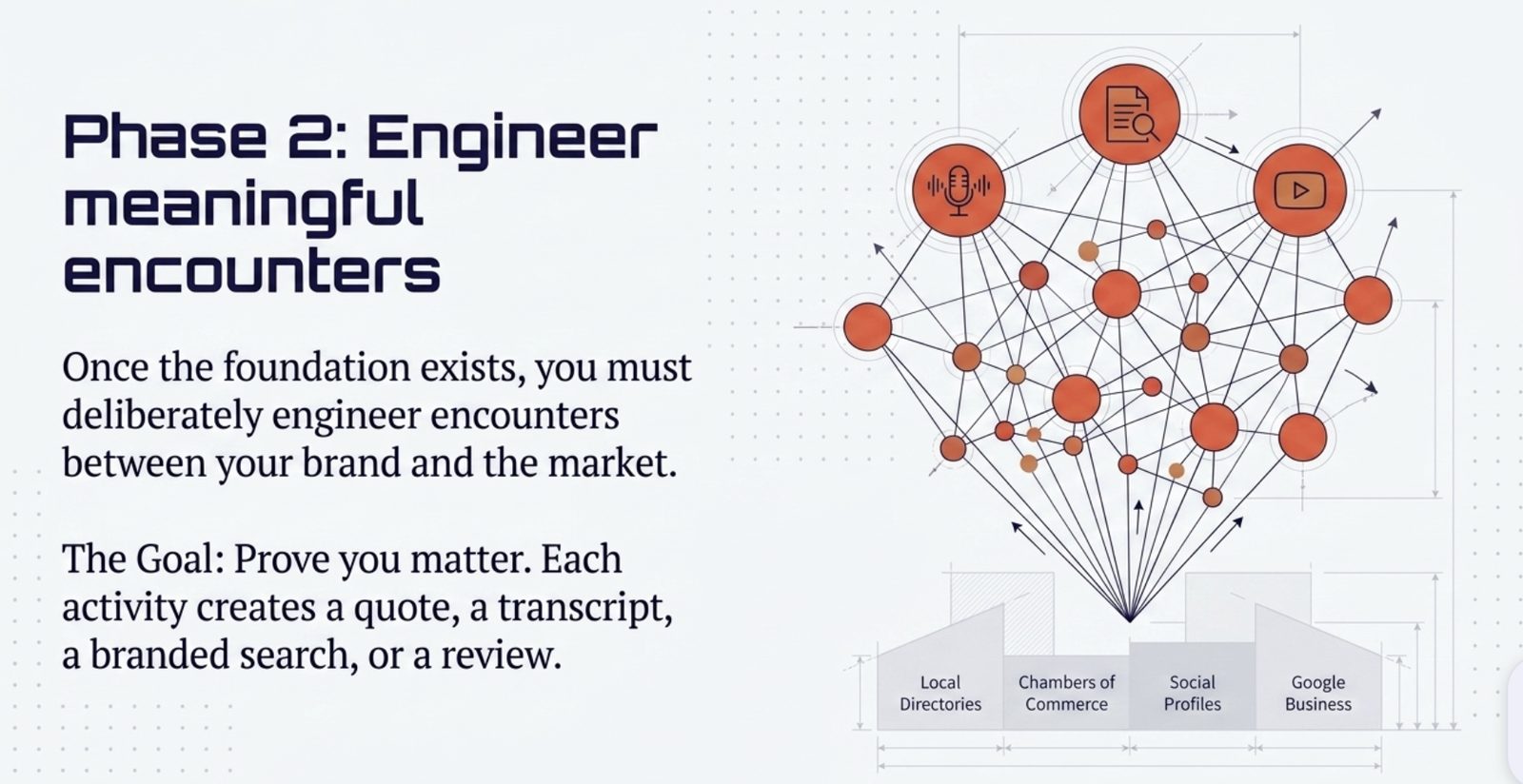
For our imaginary new business, that might mean pitching the local business press on how Stoke SMEs are using AI. It might mean publishing a small study on AI adoption in Midlands manufacturing. It might mean offering expert commentary to journalists covering automation. It might mean appearing on niche podcasts. It might mean sponsoring or speaking at a local business event. It might mean creating a practical guide for manufacturers trying to automate admin. It might mean partnering with an accountant, recruiter or software provider already trusted by local SMEs.
Each activity creates possible connections.
A quote. A link. A mention. A video. A transcript. A newsletter feature. A directory listing. A local citation. A social post. A branded search. A conversation. A review. A referral.
This is how you build visibility one node at a time.
It is slow at first. Horribly slow. That is the bit nobody wants to hear.
But the early phase of link building has always been slow because nobody gives a toss about you yet. You have to earn the right to be mentioned. Or pay to be present in the right places. Or create something sufficiently useful that people have a reason to cite it.
Sometimes you need PR. Sometimes you need digital PR. Sometimes you need creator partnerships. Sometimes you need advertorials. Sometimes you need to sponsor something. Sometimes you need to produce research. Sometimes you need to answer questions in communities. Sometimes you need to build the damn directory listing yourself.
There is no single tactic. There is only the repeated act of creating meaningful visibility.
The New Link Builders Will Be Mention Builders
This is why link creators and mention creators are going to become incredibly powerful.
Their job will not be to place links. Their job will be to make brands visible in the parts of the network that matter.
That might be a journalist’s article. A creator’s video. A newsletter. A podcast. A local business feature. A trade association page. A buyer’s guide. A best-of list. A Reddit discussion. A forum answer. A comparison page. A review site. A conference agenda. A research report. A partner website. A university resource. A niche directory.
Some of those will produce hyperlinks. Some will produce mentions. Some will produce both. Some will produce attention first and links later.
That is fine.
Because the objective is not merely to acquire a link. The objective is to create a meaningful encounter between your brand and the market.
This is also why PR becomes much closer to SEO again. Proper PR has always understood something SEO forgot: being talked about by the right people in the right places changes commercial reality.
Search is now catching up with that truth.
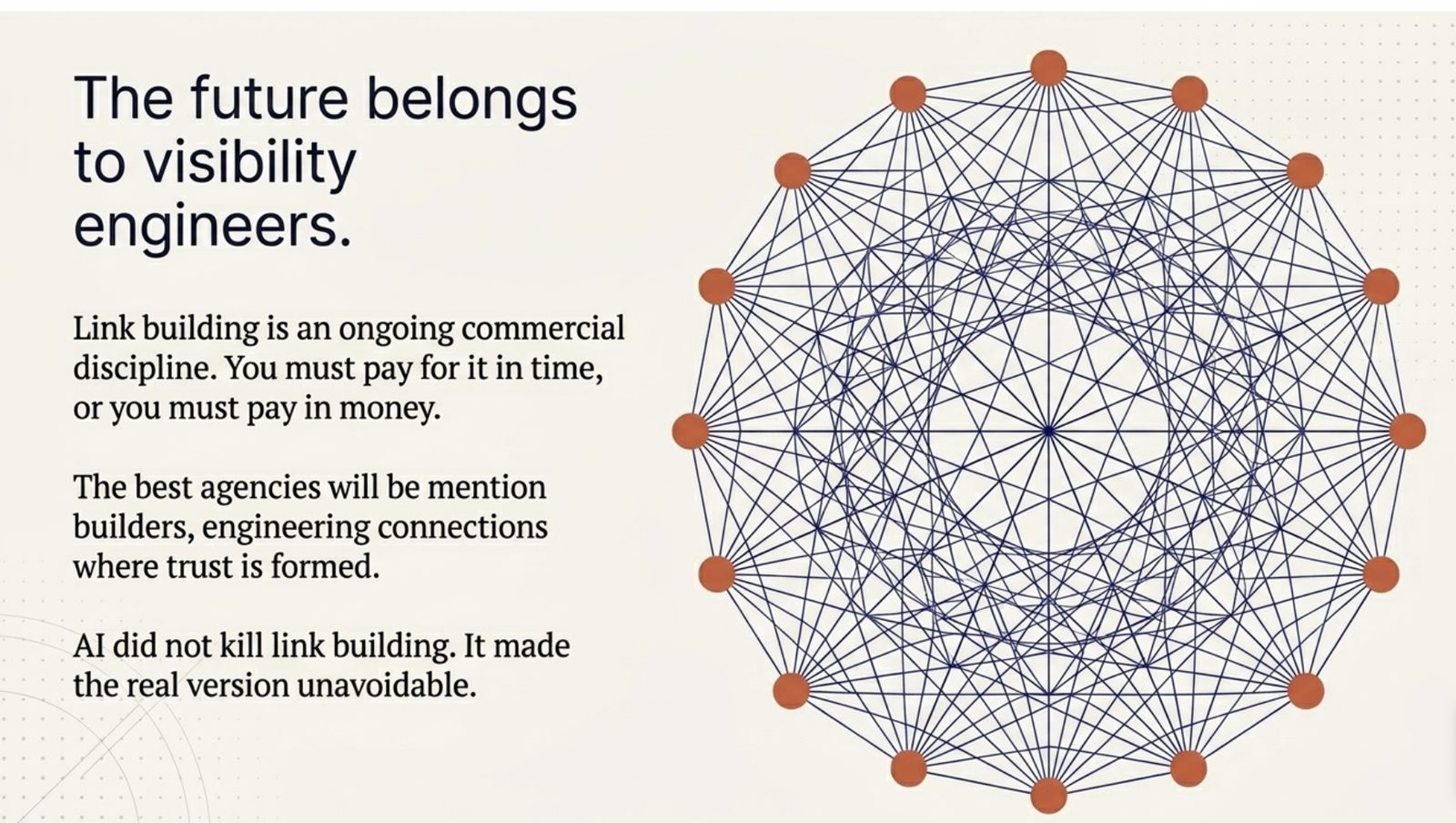
The best agencies of the future will not be “content agencies” endlessly publishing articles on your own site. They will be visibility agencies. Link engineering. Mention engineering. Digital PR. Creator outreach. Network building. Whatever label you want to stick on it.
The job is the same.
Make the brand visible where trust is formed.
It’s why we built the F.A.M.E. Engine at JBH. To view the media landscape on how trust is formed.
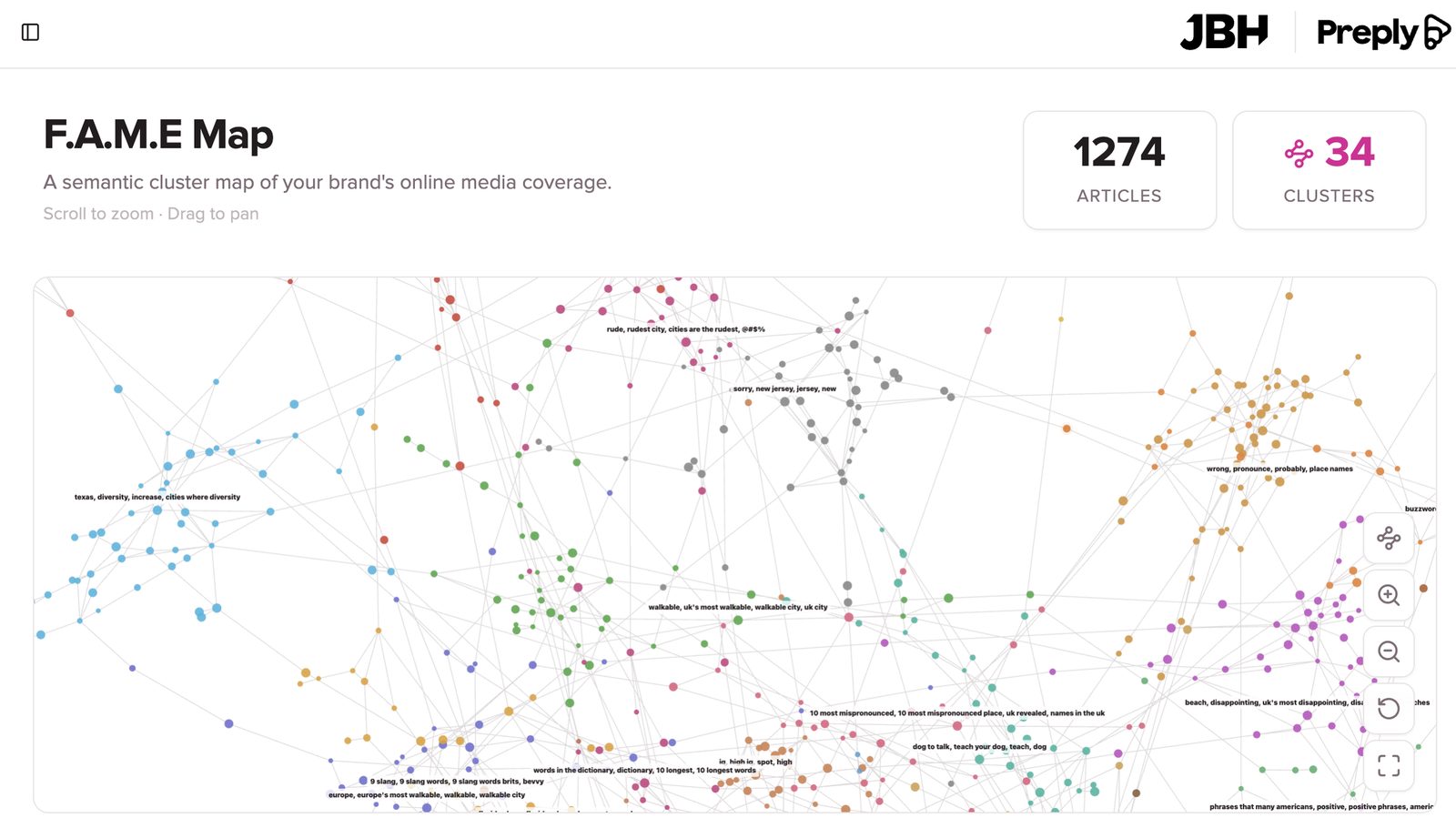
We can analyse up to 20 years of media data to identify the narratives shaping search and human understanding of your brand.
And that truly matters, because we can see how fame grows within networks. We can see which brands are stronger and being talked about in the right context.
It also helps us better understand AI search by reverse-engineering prompts.
Prompt Analysis Is Useful, But Not the Strategy
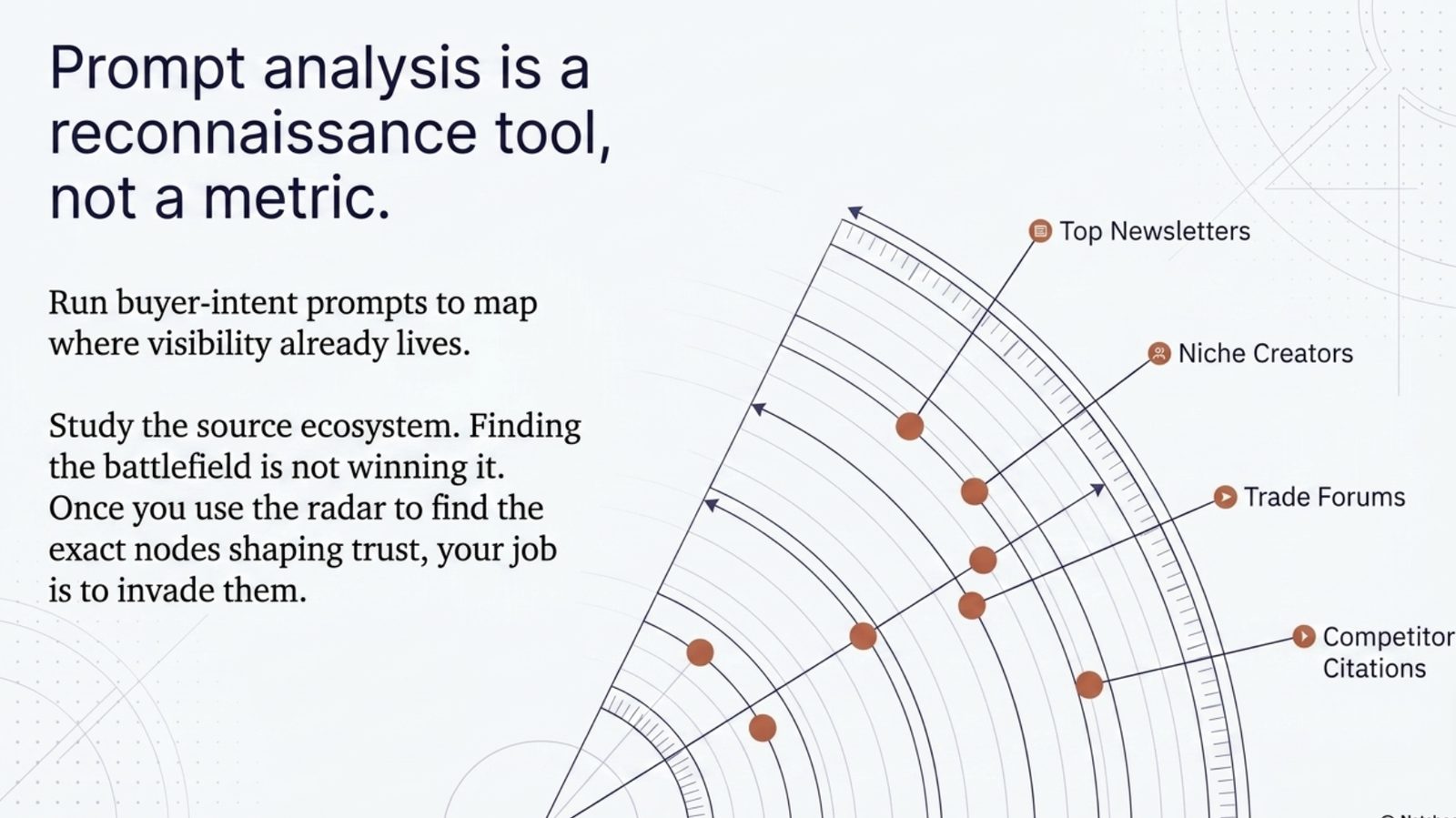
Prompt analysis has a huge place in the future of AI search.
Not as another magical metric. Not as a new dashboard to frighten clients. As reconnaissance.
Run buyer-intent prompts. Ask for the best AI consultants for SMEs. Ask for firms helping manufacturers automate operations. Ask for recommended tools in your niche. Ask for the best agencies in your region. Ask for comparisons, alternatives and buying advice.
Then study the sources.
Which publications appear? Which directories? Which creators? Which listicles? Which forums? Which competitors? Which newsletters? Which review sites? Which trade bodies? Which brands keep being mentioned?
That tells you where visibility already lives.
Your job is to become present there.
This is a much more useful way to think about AI search than obsessing over a made-up score. Prompt analysis shows you the source ecosystem. It reveals the network that AI systems are drawing from, or are likely to draw from, when forming answers.
But finding the battlefield is not the same as winning it.
You still need to get mentioned. You still need to get cited. You still need to create something worth including. You still need to build relationships. You still need to keep going.
You Have to Keep Doing It
This is the part that will annoy people.
Link building is not a campaign. Not really. It is an ongoing commercial discipline.
Brands do not become visible once. They stay visible through repeated encounters. They keep appearing. They keep being cited. They keep being discussed. They keep giving the market new reasons to reference them.
That does not mean every business needs a huge budget. It does mean every business needs some kind of sustained effort.
If you have money, you can buy speed. PR agencies, digital PR campaigns, creator partnerships, sponsorships, research projects, advertorials, events, content production, outreach teams.
If you do not have money, you pay in time. You answer questions. Pitch journalists. Build relationships. Publish useful data. Join communities. Speak at small events. Get listed. Collaborate. Offer commentary. Create resources. Ask for inclusion where it makes sense.
But you do have to pay.
With money, time, effort, creativity or all four.
Visibility has a cost. That is why it has value.
Meaningful Visibility Is the Future of Search
The search industry wants a new trick because tricks are easier to sell than fundamentals.
But the future of search is not going to be won by another metric. It will be won by brands that are meaningfully visible across the sources, people, platforms and communities that shape trust.
Links are part of that. Mentions are part of that. Creators are part of that. PR is part of that. Directories are part of that. Social diffusion is part of that. Original research is part of that. Local visibility is part of that. Podcasts, newsletters, forums, reviews, events and partnerships are all part of that.
This is not link building as the SEO industry cheapened it.
It is link building as it should always have been understood: the deliberate engineering of connections in a network.
And that is why link builders are about to become expensive.
Because the future of AI search will not belong to the brands with the most blog posts. It will belong to the brands with the strongest evidence around them.
The brands that are cited. Mentioned. Listed. Discussed. Reviewed. Compared. Recommended. Quoted. Shared. Searched for. Linked to.
AI did not kill link building.
It made the real version unavoidable.
Andrew Holland