
And why “it’s just SEO” is one of the stupidest arguments in marketing right now
I shouldn’t need to write this article, I thought we were moving past this…but once again, here we are.
Every week, another SEO consultant pops up with the same little question designed to milk likes: “What does a GEO expert actually do?”
The tone is always the same. Triumphant. As though they’ve caught the rest of the industry in some grand act of fraud.
Their logic goes like this: if GEO involves content, PR, mentions, links, pages, copy and websites, then it cannot possibly be its own thing. Because SEO has “always done that”.
This is a lovely example of how to sound confident while being completely wrong.
There is a fair criticism buried in there somewhere. A lot of GEO talk is flimsy. Some of it is absolute rubbish.
Plenty of people have slapped “AI SEO” or “GEO specialist” onto their LinkedIn headline after changing precisely nothing about what they do. Too many screenshot case studies. Too many vanity claims. Too many people acting as though one mention in ChatGPT means they’ve cracked the code.
Fine. All fair.
But the sceptics then make an even dumber mistake.
They confuse tasks with outcomes.
Because content can help rankings, they call it SEO.
Because PR can generate links, they call it SEO.
Because better copy can improve discoverability, they call it SEO.
By that logic, your homepage is SEO. Your founder bio is SEO. Your product naming is SEO. Your reviews are SEO. Your press office is SEO.
At which point the term means absolutely fuck all.
And that is the first thing you need to understand if you want to stop thinking about GEO like an amateur.
Disciplines are defined by outcomes, not overlapping tasks
Here is the easiest analogy for the search crowd.
CRO often involves the exact same page that SEO works on. Same templates. Same copy. Same structure. Same UX. Same buttons. Same forms.
Yet nobody sensible says CRO is “just SEO”.
Why?
Because the outcome is different.
SEO is trying to improve discoverability in search. CRO is trying to improve conversion once someone arrives. Same page. Different objective. Different lens. Different measurement. Different commercial responsibility.
GEO works exactly the same way.
If you want your rankings improved for commercially valuable search terms, you hire an SEO. If you want the probability increased that your brand is recommended by AI in a buying situation, you hire someone focused on GEO.
That does not mean the tactics never overlap. Of course they do. Real marketing is cross-functional. But overlap is not equivalence. The page may be the same. The job is not.
And that matters because once the objective changes, everything changes with it: the research, the diagnosis, the priorities, the reporting, the budget and the work.
That is why GEO needs a name.
Because if it does not have a name, it does not get owned. And if it does not get owned, nobody does the bloody work.
GEO is about recommendation, not retrieval
This is the second bit that the “it’s just SEO” brigade keeps missing.
SEO, at its cleanest, is about retrieval. Can your page be found? Can it rank? Can it satisfy the query?
GEO is about recommendations.
Can the model understand what your brand is?
Can it classify who you are for?
Can it compare you to alternatives?
Can it compress your value proposition into a sensible answer?
Can it see enough corroboration across the web to feel confident mentioning you?
And are you making this easy for an LLM.
That is not the same optimisation problem.
And no, “if you rank, you’ll probably be recommended” is not a serious argument. It is a lazy one.
Sometimes rankings will clearly help. Fine. Nobody sensible is denying that. But it is also obvious that ranking is not the whole story. You can rank and still not get recommended. You can have technically sound pages and still be invisible when a buyer asks for the best option for a specific use case, geography, industry, budget or trade-off.
That is because large language models are not just blue-link machines with better manners. There is retrieval involved, yes. There is grounding involved, yes. But there is also parametric knowledge, hidden prompts, fan-out queries, abstraction and weighting that you cannot see.
That means you can’t rely on rankings alone to understand recommendations.
RAG is part of GEO, but it’s not the only thing. Some people believe that large language models already have their ‘minds’made up about what brands they’re going to recommend. And RAG is just a secondary confirmation process.
We simply don’t know how these machines work; even people building them don’t.
So when SEO consultants puff their chests out to say they have all the answers, it’s code for saying they haven’t even bothered to investigate the field at all.
“There isn’t enough traffic there yet” is just as stupid
This is another weak argument.
The claim goes: maybe AI matters eventually, but there is not enough traffic or budget in it yet to justify separate attention.
Again: nonsense.
First, this was never about traffic. Paid search teams do not judge success by traffic. They judge it by conversions, revenue and commercial outcomes. GEO should be viewed the same way.
The question is not “how many visits did AI send?” The question is “how much buyer-intent influence, qualified demand, branded search lift and recommendation exposure is this creating?”
Second, this is not equally urgent for every business. A florist in Stoke does not need to burn the annual budget on GEO tomorrow morning. A B2B engineering firm selling specialist equipment into a market full of buyers already using AI to research suppliers probably does need to take it very seriously now.
The same goes for software firms, specialist consultants, SaaS brands, industrial suppliers and complex service providers whose buyers are already using AI to research, compare and shortlist.
Third, this is an interface change.
Uber did not invent transport. Deliveroo did not invent takeaway. They changed the interface through which demand was expressed and captured.
That is what AI is doing to search and discovery. The old journey was keyword, results page, click, comparison. The new journey is increasingly prompt, refinement, summary, shortlist.
That changes the job.
Because now the question is not just “can we rank?” It is “do we show up when a buyer asks for help?”
And if you cannot answer that, then you are not managing visibility. You are just defending an old map.
The Deliveroo and Just Eat example is a neat way to look at this. Takeaways lost traffic to their websites when Deliveroo and Just Eat took off.
Taxi firms lost visitors to their sites when Uber thrived.
But people still ordered food and jumped into taxis. What changed was the interface the user went to first.
So what does a GEO expert actually do?
Now we get to the part that matters.
A real GEO expert is not defined by a secret bag of magical tasks. They are defined by a commercial responsibility:
They improve the conditions under which a brand gets recommended by AI in buying situations.
That breaks down into several very obvious jobs.
Step one: prompt research
This is where the SEO industry gives itself away, because the minute you say “prompt research”, half of them start pretending it is just keyword research with longer phrases.
It isn’t.
Keywords were compressed human behaviour for navigating search engines. Prompts are richer, messier, more situational and often completely invisible. Some are typed. Some are spoken. Some are seven words. Some are a paragraph. Some get decomposed by the system into other hidden sub-queries.
You will never get the full prompt universe.
But that does not make prompt research impossible. It makes it more strategic.
A GEO expert starts with the customer, not the tool.
What situations are buyers in? What problem are they trying to solve? What trade-offs matter? What details would they include? Industry? Geography? Team size? Risk level? Budget? Use case? Urgency?
This is not a spreadsheet export. It is buying-situation analysis.
And that is why proper marketing theory is actually useful here. The Ehrenberg-Bass Institute and LinkedIn’s B2B Institute, in their Easy to Find report, explicitly point marketers to AI-assisted search and ask marketers to consider what happens when answers are summarised by AI rather than delivered through blue links.
In other words, serious marketing science is already telling people to pay attention to this interface shift.
So yes, prompt research is a real job. And no, you do not do it by lazily converting keywords into questions and hoping for the best.
You need to build a set of pseudo-prompts. These are prompts that buyers might use. They won’t be the actual ones, but they contain representative elements of what buyers could be using as real prompts.
My advice is to start small and try to build a list of twenty.
Step two: recommendation research
Once you have a set of pseudo-prompts, somebody has to go and see what actually happens.
Who gets recommended?
How often?
Under what kinds of prompt constraints?
What changes when the prompt becomes broader, narrower, more price-sensitive, more location-specific or more technical?
This is recommendation research, and it is absolutely central to GEO.
Because broad prompts often reward famous brands. Tighter prompts often reward fit. That tells you something very important. Sometimes your problem is not discoverability. It is classification. Sometimes it is not fame. It is vagueness. Sometimes it is not content volume. It is poor proof.
This is not the same as checking rankings and calling it analysis. It often requires repeat testing, pattern spotting, custom workflows, specialist tools and actual thought.
Which should be enough on its own to kill the stupid “it’s just SEO” argument.
Step three: diagnose recommendation gaps
This is where GEO becomes useful.
A proper GEO expert is not looking for ranking gaps. Not just traffic gaps. Recommendation gaps.
Is the positioning ambiguous?
Is the audience fit unclear?
Are the use cases too vague?
Is the comparative framing missing?
Is the proof thin?
Is the geography absent?
Is the brand weakly associated with the kinds of buying situations people actually ask AI about?
Those are recommendation problems.
And very often, what they reveal is not bad SEO. It is bad positioning.
That is why GEO keeps crashing into brand strategy. Recommendation environments punish vague brands. If your site never clearly says who you are for, what you solve, where you operate, when you are the right choice and what evidence backs that up, why on earth would a model infer it for you?
Models, like markets, are not mind readers.
Step four: define the inputs required for recommendation
Once the gaps are clear, the GEO expert has to define what the brand needs to state explicitly so a model can sensibly include it.
That might mean category language. Audience qualifiers. Geography. Use-case pages. Comparison pages. Proof blocks. Trade-off language. Suitability statements. Review signals. Third-party corroboration.
This is the bit people lazily collapse into “just content”.
But it is not content for content’s sake. It is the deliberate construction of recommendation-enabling inputs.
That is a different mindset.
A hotel that wants to be recommended for weddings is not solving a title-tag problem. It is solving an association problem. It needs clearer wedding language, proof, reviews, imagery, testimonials, social evidence, external mentions and category relevance. That may involve SEO. Fine. But the outcome being optimised is recommendation, not ranking.
Step five: build recommendation-ready assets
This is where the work becomes properly cross-functional.
Yes, it might involve SEO.
Yes, it might involve PR.
Yes, it might involve copywriting.
Yes, it might involve product marketing, social content, reviews, directories and company profiles.
Real marketing is cross-functional. Only idiots find that surprising.
The point is not whether those functions are involved. The point is whether anyone is orchestrating them around the outcome of recommendation.
A GEO expert helps build recommendation-ready assets: pages that clearly state who the offer is for, what it solves, when it is suitable, how it compares, what proof supports it, and how the same signals are repeated elsewhere across the web.
Recommendation confidence rarely comes from one page alone. It comes from repeated, coherent signals.
Step six: reduce ambiguity across the wider web
This is the bit many SEOs still underestimate.
Recommendation confidence is not built purely on your website. It is shaped by reviews, company bios, author profiles, media mentions, directories, social descriptions, Reddit threads, YouTube reviews, partner pages and all the other messy bits of the web that help machines build a picture of what your brand is and when it should be included.
That means a GEO expert has to reduce ambiguity beyond the site itself.
What does the wider web say you are?
Does that match what you want to be recommended for?
Are the same associations showing up consistently?
Are you repeatedly co-occurring with the subjects, problems and categories you want to own?
That is real work. Serious work. And it is one of the reasons GEO is better understood as part of a bigger discipline: brand visibility.
Step seven: measure properly, not with citation porn
Finally, measurement.
This is where too much GEO discourse becomes embarrassing.
One citation is not success.
One flattering answer is not success.
One screenshot is not success.
Citations are clues. Useful clues, yes. They can show what information environments appear to be shaping an answer. They can reveal whether product pages, reviews, PR, Reddit, YouTube or third-party coverage are getting pulled into the consideration set.
But they are not the commercial outcome.
The job is to measure whether recommendation probability is improving across a sensible set of prompts, whether branded demand is lifting, whether meaningful visits and qualified leads are increasing, whether more buyers report AI-assisted discovery, and whether the brand is becoming easier to encounter in the buying situations that matter.
That is serious work. It needs time, budget, frameworks and ownership.
Which is exactly why it needs a name.
The real threat to SEO is its own arrogance
The funny part is SEO should have been perfectly placed to lead this change.
Search people understand discovery. They understand intent. They understand information structures. They understand how people move through digital environments.
But too many of them have reacted like frightened landlords. Instead of asking, “What new outcome is emerging here?” they have started shouting, “No, no, no, this still belongs to us.”
That instinct will kill careers.
Because the winners will not be the people who insisted that everything was SEO. The winners will be the people who realised visibility had become broader, messier and more strategic than rankings alone.
Want help with GEO? Here’s what we actually do
This is exactly the work we do with brands.
We help businesses build a proper GEO strategy, run recommendation analysis, carry out GEO audits, diagnose recommendation gaps, and determine what needs to change across the site and the wider web to improve recommendation probability.
We also do the deeper diagnostic work that most agencies still cannot do properly. And we’ve built the tools to help us.
OptiGen helps us analyse GEO opportunities and recommendation readiness at the page level in ways humans simply cannot do at scale. It lets us look at pages through a recommendation lens, not just an SEO one, and spot what is missing, vague, poorly framed or commercially weak.
The F.A.M.E. Engine goes further. It maps brand co-occurrences, citation patterns and the wider media signals shaping AI recommendations.
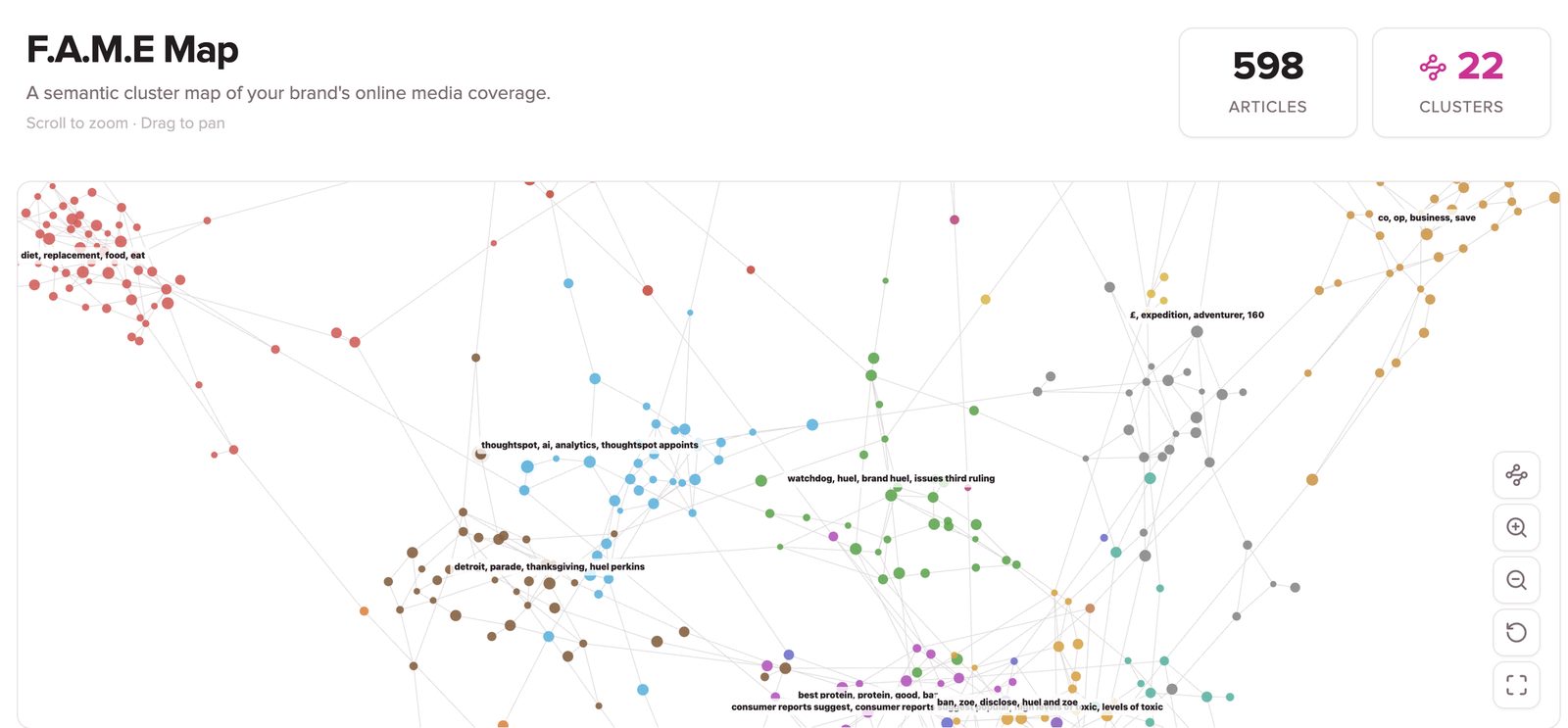
It helps us see what your brand is repeatedly associated with, where those associations are strong, where they are weak, and how the wider web is teaching machines to understand your business.
That matters because recommendations are often built on repeated co-occurrence and corroboration, not one neat ranking report.
And it allows us to analyse those co-occurrences in detail:
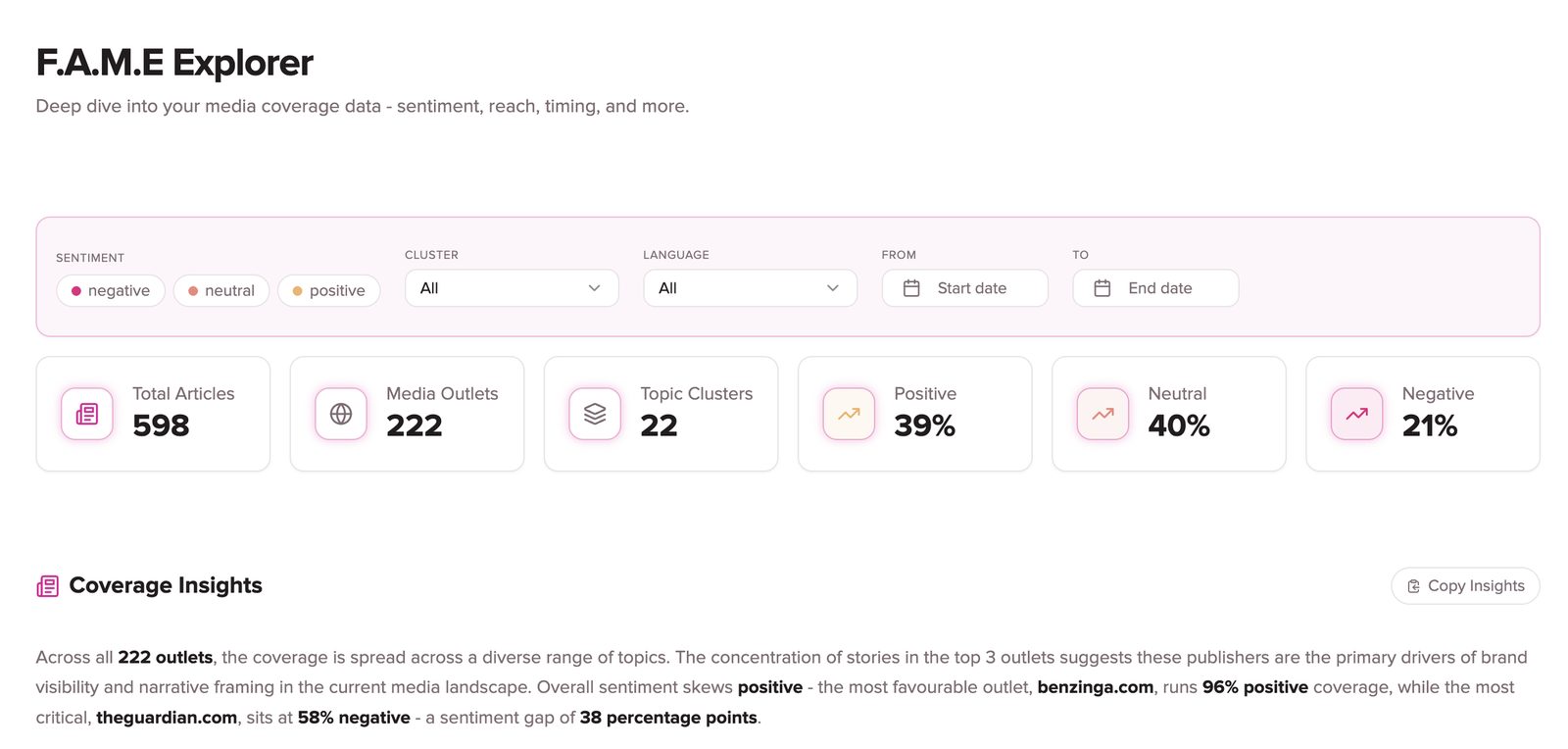
The F.A.M.E. Engine allows us to go granular into how a brand’s visibility is being shaped.
And we can see which publications are driving the brands fame.
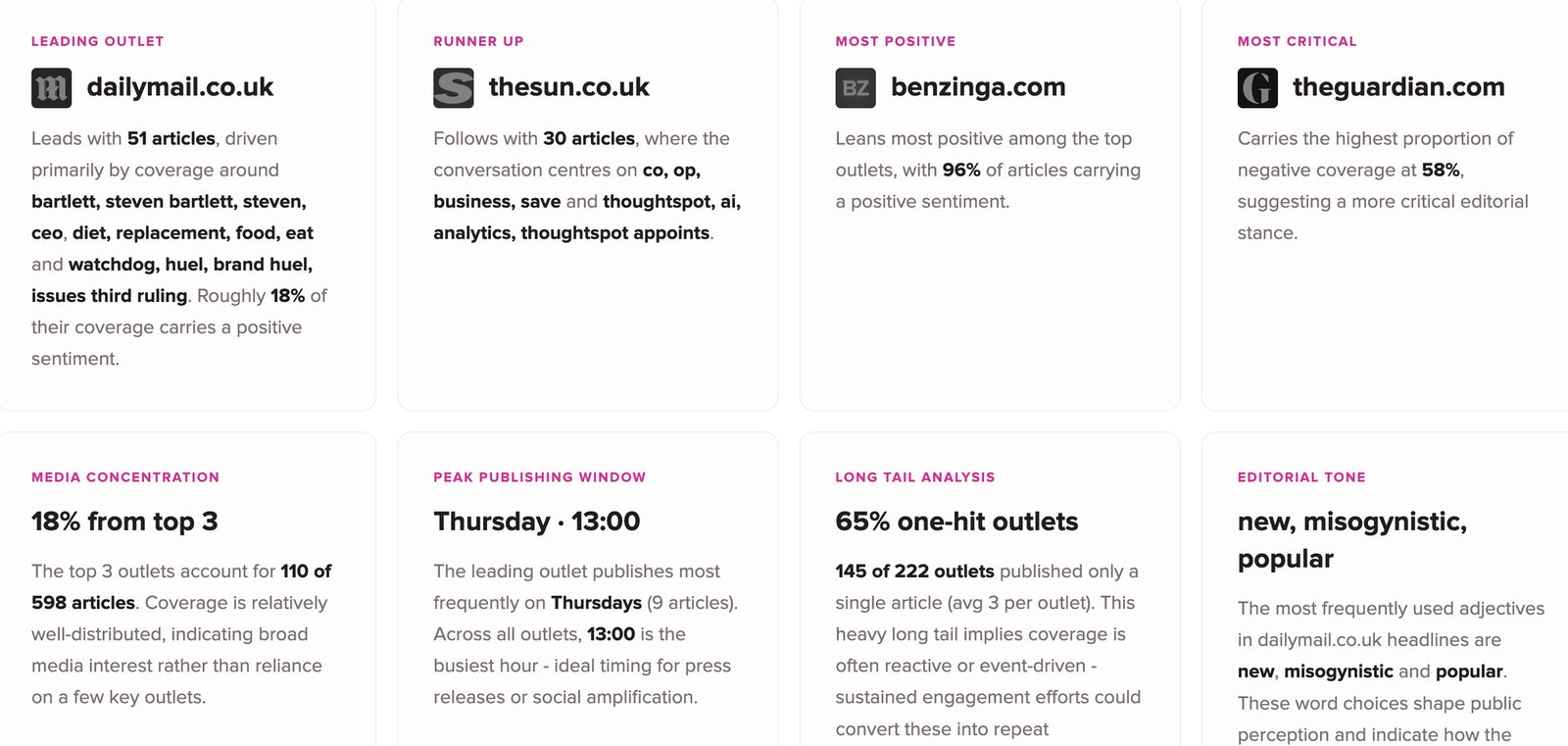
So if you want strategy, analysis, auditing, citation mapping, co-occurrence mapping, and a proper plan to improve your visibility in AI-driven buying journeys, get in touch.
Because this is no longer a vanity-screenshot game.
It is a visibility problem, a positioning problem and, increasingly, a revenue problem.
But one thing is certain, it’s not just SEO.
Andrew Holland